






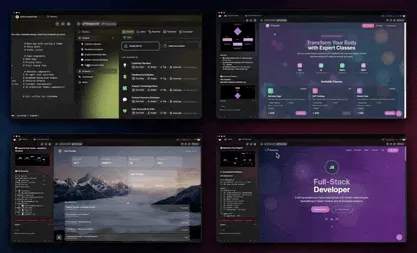
In 2026, the story everyone tells about AI is a creation explosion. More apps. More code. More software shipped by more people than ever before. App-store submissions are at record highs, and a large share of new code is now AI-generated.
But supply volume is not behavior. We asked a different question: once someone is inside an AI app builder, what do they actually do?
So we looked at 30 days of first-party usage on Taskade Genesis. In a single month, builders ran 295,284 AI generations and made or cloned 14,870 apps, agents, and automations. And the answer to how they build surprised us. It inverts the headline. People are not mostly creating software with AI. They are mostly cloning and adapting it.
TL;DR: The "AI creation explosion" is a myth. Inside one AI app builder over 30 days, people cloned working software 8,042 times but published just 60 new apps. They clone and adapt roughly 100x more than they create (~134:1). Fewer than 1.1% re-use their own work. Building with AI is selection, not syntax. Clone a working app free →
How Do People Actually Build Software With AI in 2026?
People build software with AI mostly by cloning a proven structure and adapting it, not by writing from a blank prompt. In 30 days of first-party Taskade Genesis data, builders cloned existing apps 8,042 times but published only 60 new ones to share, a roughly 134:1 remix ratio. Building with AI is selection, not syntax: the common act is adaptation, not creation from scratch.
By the numbers: 30 days inside one AI app builder
| Signal (30-day window) | Count |
|---|---|
| AI generations | 295,284 |
| Apps cloned and adapted | 8,042 |
| Automations built | 3,740 |
| AI agents created | 3,028 |
| Unique builders cloning | 4,599 |
| New apps published from scratch | 60 |
| Clone-to-publish ratio | ~134 : 1 |
That is the scale. The shape is the story: of every structural build action, the overwhelming majority is cloning something that already works, not authoring something new.
⛏️ The Creation Explosion Is a Myth
The supply numbers are real, but they measure the wrong thing. Every public dataset about AI building captures one of three things, and all three frame the era as an explosion of making:
| What the data measures | Example sources (attributed, unaffiliated) | What it actually captures |
|---|---|---|
| Market / revenue | Gartner spend forecasts; analyst valuations | Money flowing into the category |
| Adoption / sentiment | JetBrains (85% of developers use AI tools regularly, 2025); developer surveys | What developers say they do |
| Supply volume | Sensor Tower (App Store new-app submissions up sharply year-over-year, 2026); GitHub Octoverse | How many things get submitted |
None of them answer the behavioral question: of the things people start, how many are new, and how many are adaptations? A surge in submissions tells you how many projects started, not how many got used, and not how they came to be. The "fast-built, fast-abandoned" worry assumes everyone is originating new software and then walking away.
The behavioral data tells a calmer, stranger story. People are not flooding the world with original apps. They are finding something that already works and making it theirs.
That last bar, 60, is not a rounding error. It is the entire month of net-new apps published to share, next to 8,042 clones of apps that already exist. Creation is the sliver. Adaptation is the mountain.
🔁 What People Actually Do: The Remix Economy
In 30 days of real usage on Taskade Genesis, 4,599 people cloned an existing app and 49 people published a new one. By events, that is 8,042 clones to 60 publishes, a ~134:1 remix ratio. By unique people, ~94:1. Building with AI overwhelmingly means starting from a proven structure, not a blank page.
| The remix economy at a glance | Clone (adapt existing) | Publish (create new) | Ratio |
|---|---|---|---|
| Events (30 days) | 8,042 | 60 | ~134 : 1 |
| Unique people | 4,599 | 49 | ~94 : 1 |
| Self-re-use | — | — | < 1.1% |
Three things make this more than a stunt number:
The <1.1% self-re-use floor: people remix others', not their own
Only 49 people published anything in this window. So at most 49 of the 4,599 cloners could possibly be cloning their own published app, under 1.1%. The other 98.9%+ are cloning structures someone else built. This is a cross-user remix economy, not creators duplicating their own files.
Leverage: ~164 clones per publisher
Divide 8,042 clones by 49 publishers and you get ~164. Each person who publishes a working system seeds, on average, 164 downstream adaptations. A tiny number of authors create the structures that everyone else bends to their own use. Proven systems propagate; blank pages do not.
Creation is abundant: it is just private
This is the nuance that defeats the obvious objection ("of course people clone, that's what no-code is"). People do create constantly. In the same 30 days, builders made 3,740 automations, 3,028 AI agents, and ran 295,284 AI generations. The making is real and constant; it just happens inside an app you already cloned. What is rare is contributing a brand-new structure back to the commons.
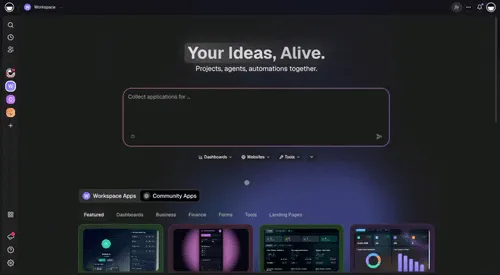
🧭 Selection, Not Syntax: The New Shape of Building
When the model writes the code, the scarce skill stops being syntax and becomes selection, choosing a proven structure and knowing how to adapt it. A ~134:1 remix ratio is what that shift looks like in live behavioral data. For decades the bottleneck in software was writing it. AI removed that bottleneck, not by making everyone a better coder, but by making the syntax itself free. So the value moved one step up the chain, to the part the model cannot do for you: knowing what to build, and recognizing the structure that already fits.
This is not a new dream. In 1987, Apple shipped HyperCard, Bill Atkinson's "stacks of cards" that let ordinary people assemble software without writing a real program. It was famously billed as "programming for the rest of us." Atkinson described the feeling he was chasing: people amazed and pleased at the newfound power they got from a program, when they say, "Wow, I can do this!" The remix economy is that promise, finally kept at scale. The "Wow, I can do this" moment now happens when someone clones a working dashboard, points it at their own business, and watches it run. They did not write syntax. They made a selection.
   THE OLD BOTTLENECK              THE NEW BOTTLENECK
   (when humans wrote code)        (when the model writes it)
   ─────────────────────────      ─────────────────────────
   Can you write the syntax?  -->  Which proven structure fits?
   Can you debug it?          -->  How do I adapt it to my case?
   Can you host and ship it?  -->  What do I need it to do?
   ─────────────────────────      ─────────────────────────
   Gatekeeper: engineers           Gatekeeper: operators who
                                   know what a working system is
📊 What People Build When They Remix
When you look at what gets cloned and run, the pattern holds: people build operational business systems, not toys. Among the top-traffic paid Taskade Genesis apps, the single largest category is dashboards and analytics at 28.2%, far ahead of calculators (12.9%), booking tools (10.0%), and education apps (7.7%).
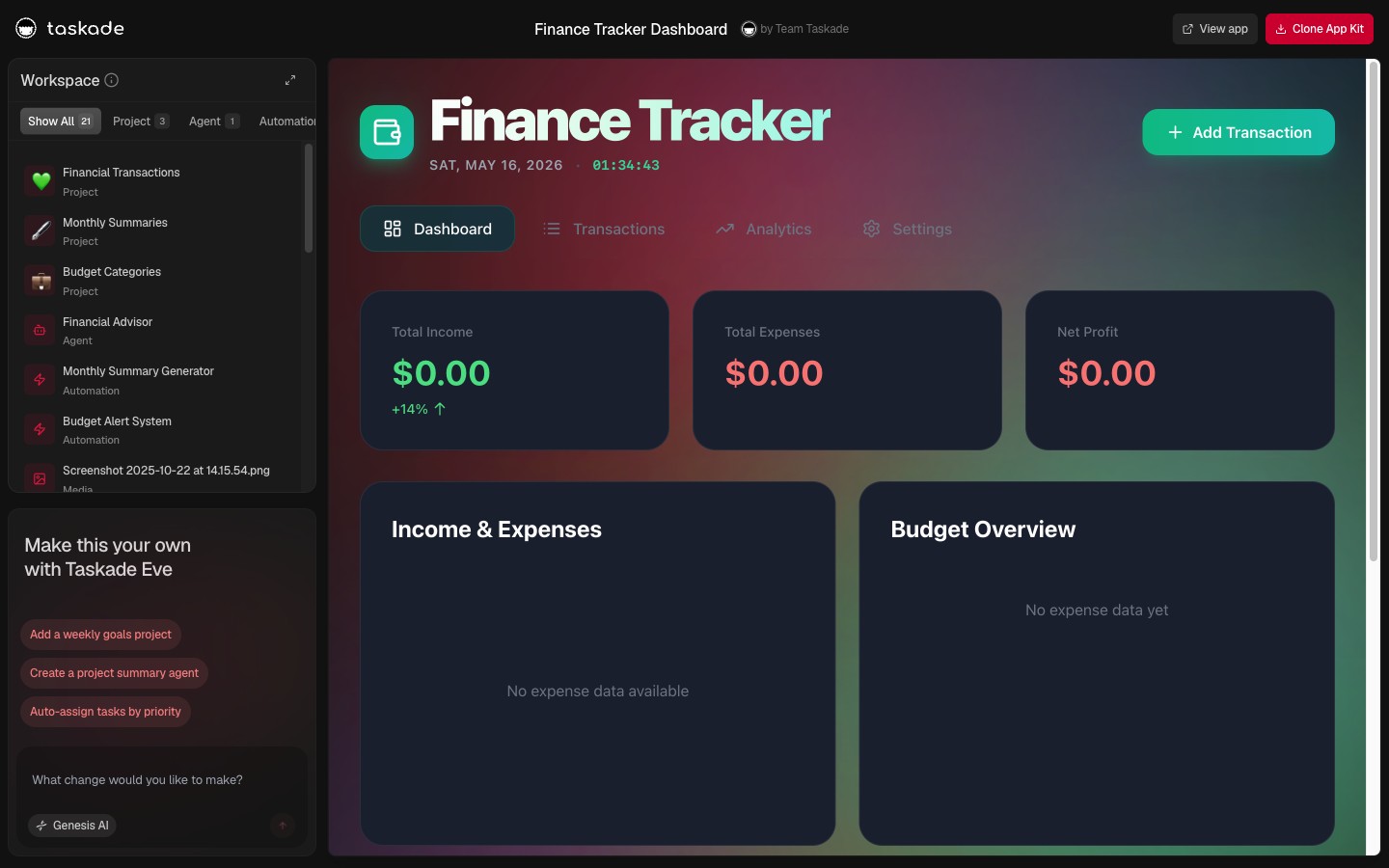
These are not single-screen demos. The 471 apps in the study hold 2,778 connected projects and 1,078 AI agents, nearly 3,900 working parts, averaging 5.9 projects and 2.3 agents per app: multi-part systems a business runs on. We go category by category in the companion piece, What People Actually Build With AI →.
👤 Who Is Building (and Why Most Aren't Developers)
Most of the people doing this are not engineers. Industry figures put roughly 63% of people exploring vibe-coding tools in the non-developer category. The market context agrees: Gartner has forecast that developers outside formal IT will make up 80% of the low-code user base by 2026 (up from 60% in 2021), and that the low-code market will reach about $44.5B by 2026. Retool found that 35% of teams have already replaced at least one SaaS tool with a custom build (a late-2025 survey of 817 respondents).
When code is free, the builder population stops being defined by who can write syntax. It becomes defined by who knows what a working business system is, which is exactly the population that has been running businesses on spreadsheets for years. The remix economy is how non-technical operators do that without hiring a developer.
🔬 How Our Data Compares (Behavior vs. Everything Else)
Several platforms have published first-party data on AI building. Ours is the only one that measures behavior inside the builder rather than market size, demographics, or raw project counts. That is the information gap this study fills:
| Source | What it reports | What it measures |
|---|---|---|
| Taskade Genesis (this study) | 134:1 clone-to-publish; 28.2% dashboards | Behavior — what people do inside a builder |
| Hostinger Horizons (Mar 2026, 1M users) | 49% websites / 10% ecommerce / 5% SaaS tools | Project category — what gets published |
| Lovable, The Build Economy (Jun 2026, self-reported) | 50M+ projects; 80% non-technical | Project counts + demographics |
| Cursor, Developer Habits (2026, telemetry) | Lines of code per developer | How professional developers type |
| Retool (Feb 2026, n=817) | 35% replaced a SaaS tool | Survey intent |
Everyone else counts supply, sentiment, or who shows up. The clone-versus-publish ratio is the missing behavioral layer, and it is the layer that explains why the "explosion" narrative feels off.
🚀 Why Remixing Wins (and What the Explosion Narrative Misses)
A proven structure adapted beats a novel structure built from nothing. With ~164 clones per publisher and dashboards leading every category, the data shows people don't want a blank canvas. They want a working system they can bend to their case. Selection compounds; origination doesn't scale.
The "explosion" framing measures the wrong end of the pipe. Counting submissions is like counting blank documents: it tells you how many things started, not how many work. A clone of a system that already runs is far more likely to keep running than a one-shot generation from a cold prompt. People aren't shipping junk and abandoning it. They're starting from something that already works.
For anyone building AI tools, the lesson is direct: ship proven templates, not blank canvases. The leverage is a great shared library of things that work, not a smarter model per user.
🛠️ What Taskade Genesis Actually Does (and Why Remixing Is Built In)
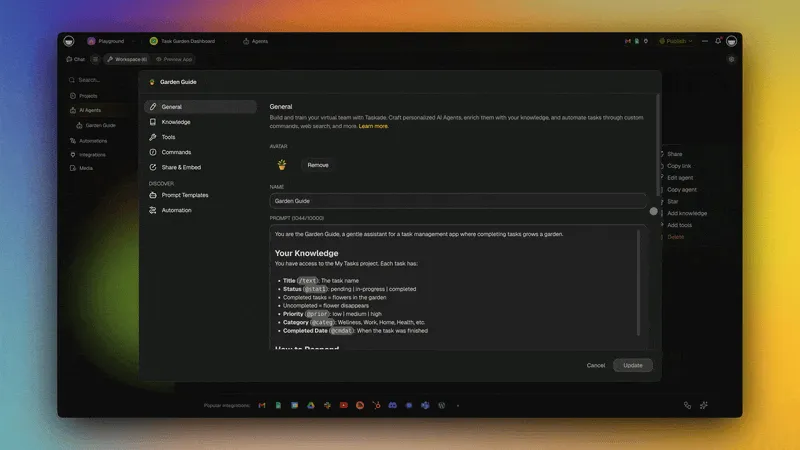
The remix economy is not a limitation to design around. It is Taskade Genesis working exactly as intended. You describe what you need in plain English and get back a working system, not a prototype you still have to host. Your connected projects become its memory, AI agents become its brain, and automations become its hands that run on their own, on a schedule or a trigger, even while you sleep, a workspace that gets smarter the more you use it.
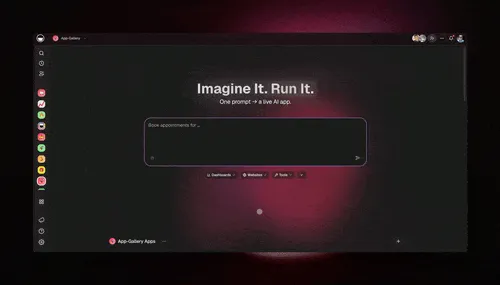
You see the same data in multiple views: list, board, calendar, table, mind map, Gantt, and org chart. Agents carry built-in tools and pick from 15+ frontier models automatically, so you never choose a model or write a line of code. Apps connect to 100+ services in both directions, hand work to teammate agents, and go live the moment they are built. Give clients their own login and your own web address, lock a page behind a password, or list it in the Community Gallery for anyone to clone.
| Capability | What you can do | Plan |
|---|---|---|
| Prompt → living app | Describe an idea, get a working app — data, AI, automations, and a shareable interface — live in minutes, no hosting | Free to start |
| Workspace DNA | Your projects (memory) teach your agents (intelligence) that run your automations (execution) — a system that compounds | Free+ |
| Multiple project views | See the same data as a list, board, calendar, table, mind map, Gantt, or org chart — one click to switch | Free+ |
| AI agents + built-in tools | Agents search the web, read files, call APIs, run slash commands, and remember context — real work, not just chat | Pro+ |
| 15+ models, auto-routed | Never pick a model; each task goes to the right frontier model and keeps running if a provider goes down | Free+ |
| 100+ integrations | Connect Slack, Gmail, Sheets, Notion, Stripe and more — triggers pull events in, actions push results out | Pro+ |
| Multi-agent teams | Hand work between specialized agents that collaborate on a job instead of one agent doing everything | Pro+ |
| Custom domain + client sign-in | Publish on your own web address and give each client a login that shows only their data — no auth code | Business+ |
| Community Gallery | Clone any public app to start fast, or publish yours as public, secret, or private | Free+ |

That whole loop is the Workspace DNA: Projects (Memory) feed Agents (Intelligence), Agents trigger Automations (Execution), and Execution creates more Memory.
Start from a proven app in the Community Gallery, or describe your own and build it free →.
🔬 The Honest Limits of This Data
This is one platform's 30-day behavioral snapshot, not an industry census. Three caveats matter:
- Single platform, single window. The clone and publish counts come from one 30-day window of Taskade Genesis usage. Magnitudes this large (134:1) are robust to normal week-to-week noise, but the exact ratio will move.
- The category breakdown is scoped. It covers the 471 top-traffic paid Taskade Genesis apps, not every app ever built and not the whole AI-building market. That population skews toward serious operators, which is the point. But we are not claiming it represents all AI apps.
- What we don't report. We deliberately withhold revenue, individual app names, and trend lines. What this data uniquely shows is behavior, what people do inside a builder, not what they say in a survey.
The remix economy is one platform's honest read of its own data. But the shape of it, cloning beats authoring, dashboards beat demos, selection beats syntax, lines up with everything else in the category once you stop counting submissions and start counting behavior.
📚 Sources & Methodology
Taskade Genesis first-party data. Clone and publish figures are event telemetry from a single 30-day window: 8,042 clone events from 4,599 unique users versus 60 publish events from 49 users. The self-re-use floor is derived from the 49-publisher ceiling. Build totals (3,740 automations, 3,028 agents, 295,284 AI generations) and the category census (471 top-traffic paid published apps, categorized by their projects and agents) are from the same window. This is behavioral usage data, not a survey, and not a claim about all AI apps. Revenue, individual app names, and trend lines are withheld.
Third-party figures are attributed to their publishers and cited by name only (we do not pass links to commercial or low-quality sources): Hostinger Horizons (Mar 2026, one million users); Lovable, The Build Economy (Jun 2026, self-reported); Cursor Developer Habits Report (2026, telemetry); Retool build-vs-buy survey (Feb 2026, n=817); Gartner low-code forecasts (2022); JetBrains State of Developer Ecosystem (2025); Sensor Tower App Store submission data (2026); Anthropic Economic Index (2026).
Methodology last reviewed June 12, 2026.
🔗 Related Reading
- What People Actually Build With AI →, the category census in full
- The State of Vibe Coding 2026, the market and adoption numbers
- What Is Vibe Coding?, the canonical explainer
- Vibe Coding for Non-Developers, who this is really for
- The Best Free AI App Builders, the tool roundup
- Will Vibe Coding Kill SaaS?, the disruption debate
- The Vibe-Coded Business, running a company on AI-built apps
- Build it yourself: Taskade Genesis · AI Apps · AI Agents · Automations · Community Gallery
💬 Frequently Asked Questions
Do people actually build real software with AI, or just demos?
They build real operational systems. In first-party usage data from Taskade Genesis, the top-traffic paid apps average 5.9 connected projects and 2.3 AI agents each, and 28.2% are dashboards and analytics tools. These are systems a business runs on, not throwaway demos.
What is the remix economy in AI app building?
The remix economy is the observed pattern that people build software with AI mostly by cloning a proven structure and adapting it, not by originating from a blank prompt. In a 30-day window on Taskade Genesis, builders cloned existing apps 8,042 times versus publishing 60 new ones, roughly 134:1 by events.
How often do people clone versus build from scratch with AI?
About 100 times more often. Across 30 days, Taskade Genesis logged 8,042 clone events from 4,599 users against 60 publish events from 49 users, a remix ratio of roughly 134:1 by events and 94:1 by unique users.
Does cloning mean people copy their own work?
No. Fewer than 1.1% of the 4,599 cloners have ever published an app, so almost all cloning is cross-user remixing. People start from other builders' proven systems, not their own old files. Each unique publisher seeds roughly 164 downstream clones.
What does "selection, not syntax" mean?
When an AI model writes the code, syntax stops being the scarce skill. The scarce skill becomes selection, choosing a proven structure and knowing how to adapt it to your situation. A 134:1 remix ratio is what that shift looks like in live behavioral data.
Who is actually building with AI app builders?
Mostly non-developers. Industry figures put roughly 63% of people exploring vibe-coding tools in the non-developer category, and Gartner projects developers outside formal IT will make up 80% of low-code users by 2026.
How is this data different from other AI build reports?
Most reports measure market size, survey sentiment, or project counts, how many projects, who builds, and what gets published. This is behavioral data: what people actually do inside a builder. The clone-versus-publish ratio is a behavioral measure not reported elsewhere.
What is Taskade Genesis?
Taskade Genesis is an AI app builder that turns a prompt into a living workspace app with connected projects, AI agents, and automations. It runs on 15+ frontier models, includes built-in agent tools and 100+ integrations, and starts free.
▲ ■ ● The AI era is not a creation explosion. It is a remix economy. People clone what works, adapt it to their world, and run it. Memory feeds Intelligence, Intelligence triggers Execution, Execution creates Memory. Don't start from a blank page, clone a working system and make it yours →.