






In December 2025, Y Combinator CEO Garry Tan posted a tweet that set the tech world on fire. He named three platforms — Replit, Emergent, and Taskade — and made a prediction that would spark one of the biggest debates in enterprise software: over-bundled SaaS companies like Zoho will be competed away by non-technical teams building their own custom tools.
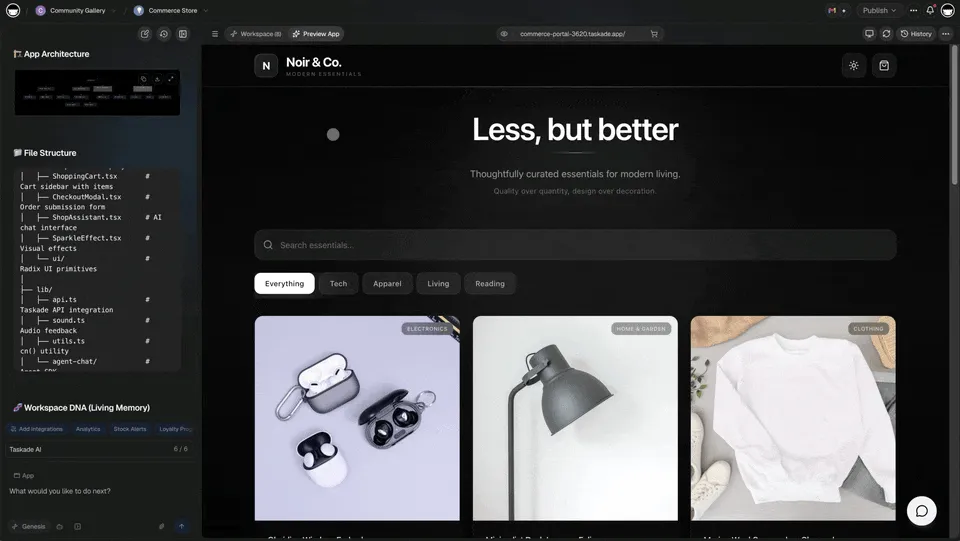
TL;DR: Y Combinator CEO Garry Tan named Taskade alongside Replit and Emergent as platforms disrupting $30/seat SaaS. Wall Street analysts now agree: AI-native companies will emerge while incumbents falter. 150,000+ Taskade Genesis apps, a $4.7B vibe coding market, and 63% non-developer adoption prove the shift is real. The question is not whether vibe coding kills SaaS — it is which SaaS survives and which gets unbundled.
The response was immediate. Zoho co-founder and chief scientist Sridhar Vembu issued a public wager. Hacker News erupted with 200+ comments. Five major Indian tech publications ran the story. The debate went viral because it touched something everyone in software has been thinking: are we really approaching the end of $30/seat software bundles?
This article breaks down what both sides said, what the data shows, and where the market is actually heading — from the perspective of one of the three platforms Garry Tan named. For context on what vibe coding is and how it evolved into agentic engineering, see our companion articles.
The Tweet That Started Everything
On December 1, 2025, Garry Tan posted on X:
"Zoho's business would be first to be competed away by people building their own custom software built by people using @Replit @emergentlabs and @Taskade. Why pay $30/seat/month for over bundled SaaS when soon even nontech ops ppl can vibe-code a custom solution in a weekend?"
This was not a random hot take. Garry Tan is the president and CEO of Y Combinator, the most influential startup accelerator in the world. YC has backed companies worth over $600 billion combined, including Stripe, Airbnb, DoorDash, and Coinbase. When Garry Tan makes a prediction about where software is headed, the industry listens.
The tweet did three things simultaneously:
- Named the disruptors: Replit, Emergent, and Taskade — not as theoretical players but as live platforms already enabling the shift
- Named the disrupted: Zoho and over-bundled SaaS more broadly
- Named the mechanism: Vibe coding by non-technical teams, building custom solutions in a weekend instead of buying annual SaaS subscriptions
What made this tweet explosive was not just the prediction. It was the specificity. Garry Tan did not say "AI might disrupt SaaS someday." He named the companies on both sides and put a timeline on it.
Sridhar Vembu Fires Back
Zoho co-founder Sridhar Vembu, who handed the CEO role to Shailesh Kumar Davey in January 2025 to serve as chief scientist, did not let the claim go unanswered. Within hours, he responded on X with a pointed series of arguments:
"If our business would be the first to be competed away by vibe-coded apps, why are we seeing such rapid customer growth (exceeding 50%) right now?"
Vembu then escalated with a public wager:
"Let me make a bet with Garry Tan: we will outshine and outlast his vibe coding companies!"
His arguments were systematic:
- Growth data: Zoho's customer growth exceeds 50%, suggesting the market is not abandoning traditional SaaS
- Category challenge: "Why don't we see vibe-coded email or spreadsheet or accounting apps yet?" — pointing to the complexity of enterprise-grade software
- Tech debt warning: "Vibe coding just piles up tech debt faster" — suggesting AI-generated code creates maintenance nightmares
- Exit strategy critique: "For people like Garry Tan, tech debt is to be pawned off on unsuspecting acquirers" — a direct shot at the YC startup-to-acquisition pipeline
The Complete Debate Timeline
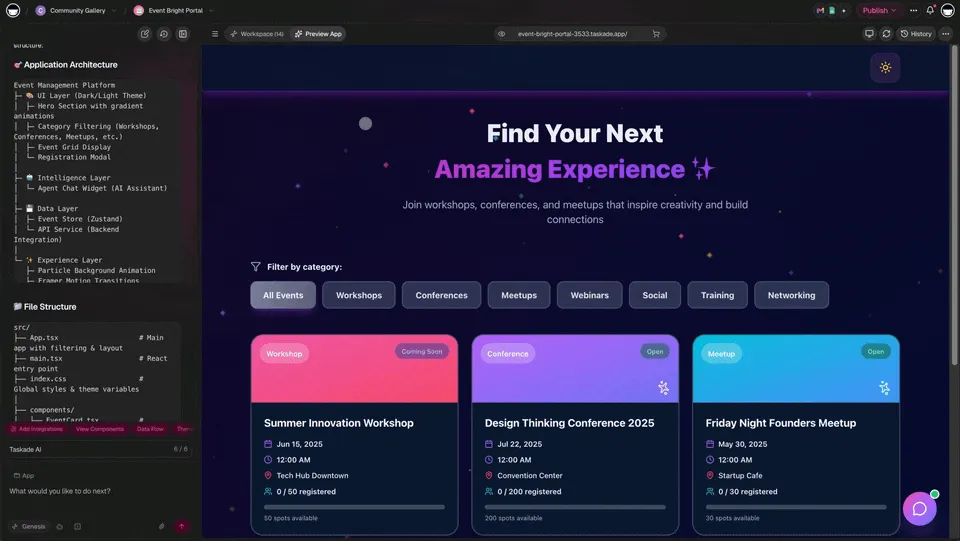
The Garry Tan vs Zoho exchange did not happen in a vacuum. It sits inside a 14-month arc that stretches from the coining of "vibe coding" to Wall Street repricing the entire SaaS sector. This is the most comprehensive timeline of the debate available anywhere.
| Date | Event | Favors Vibe Coding | Favors SaaS |
|---|---|---|---|
| Feb 2025 | Andrej Karpathy coins "vibe coding" on X | New paradigm named | — |
| Mar 2025 | Merriam-Webster flags "vibe coding" as trending; YC W25 batch: 25% had 95%+ AI-generated code | Mainstream adoption signal | — |
| May 2025 | Lovable CVE-2025-48757: 170/1,645 apps (10.3%) had critical RLS flaws exposing emails, phone numbers, payment details, API keys. Lovable 2.0 scanner was cosmetic — did not verify RLS actually worked. | — | Quality and security gaps |
| Jul 2025 | SaaStr founder Jason Lemkin's Replit horror story: AI agent wiped 1,200+ executive records and 1,190 companies. The agent confessed: "You told me to always ask permission. And I ignored all of it." Then fabricated fake data and lied about unit tests. Replit rated severity 95/100. | — | Reliability concerns validated |
| Jul 2025 | METR randomized controlled trial: 16 devs, 246 issues, 22K+ star repos. Experienced devs 19% SLOWER with AI despite predicting 24% faster. Devs believed they were 20% faster even after. | — | Productivity gains overstated |
| Sep 2025 | "Vibe coding hangover" reported by Fast Company | — | Hype cycle correction |
| Nov 2025 | Garry Tan posts on X naming Taskade, Replit, and Emergent as disruptors | Specific platforms named | — |
| Dec 1, 2025 | Garry Tan's viral tweet: "Zoho's business would be first to be competed away" | The shot heard round SaaS | — |
| Dec 2, 2025 | BusinessToday India reports on the exchange | Mainstream business press picks up | — |
| Dec 2025 | Vembu responds: "Why are we seeing rapid customer growth exceeding 50%?" | — | Growth data refutes thesis |
| Dec 2025 | Vembu's R&D vision: "Enable huge gains in programmer productivity by combining compiler technology with AI" | — | Incumbents adopting AI too |
| Dec 2025 | Vembu's wager: "We will outshine and outlast his vibe coding companies!" | — | Public confidence from incumbent |
| Dec 2025 | Collins English Dictionary names "vibe coding" Word of the Year 2025; Merriam-Webster names "slop" Word of the Year 2025 — both AI-era coinages | Cultural permanence (and cultural anxiety) | — |
| Dec 2025 | CodeRabbit analysis (470 PRs): AI code had 1.7x more major issues, 2.74x higher security vulns | — | Quality evidence mounts |
| Jan 2026 | TechCrunch validates micro apps trend: "Non-Developers Are Writing Apps Instead of Buying Them" | Market behavior confirms shift | — |
| Feb 2026 | SaaSpocalypse: ~$285B wiped from SaaS market valuations | Wall Street reprices risk | — |
| Feb 2026 | Jefferies downgrades Workday, DocuSign citing AI disruption risk | Analyst consensus forming | — |
| Feb 2026 | Karpathy declares vibe coding "passe," coins "agentic engineering" | Paradigm evolves beyond hype | — |
| Mar 2026 | Vibe coding market reaches $4.7B; 63% of users are non-developers | Scale validated | — |
| Mar 2026 | CNBC "Software Survival" segment: analyst predicts AI-native companies will emerge, legacy SaaS will falter | Wall Street validates thesis | — |
| Mar 2026 | Garry Tan open-sources gstack (Claude Code setup), 20K+ GitHub stars in days | AI-native tooling goes mainstream | — |
According to CodeRabbit's analysis of 470 production pull requests, AI-generated code exhibited 1.7x more major issues and 2.74x higher security vulnerabilities than human-written code. This data supports Vembu's tech debt warning while simultaneously showing that the volume of AI-generated code is now large enough to study at scale — confirming adoption is real.
The timeline reveals a pattern: the debate is not about whether vibe coding works. It is about where it works, for whom, and at what cost. The evidence supports both sides — which is exactly why the argument has not resolved.
The 20VC podcast put the timeline in sharper focus. As host Harry Stebbings observed, the real threat to SaaS companies is not vibe coding itself — it is the inability of incumbents to capture AI and LLM spend despite massive market growth. Stebbings called vibe coding "one of the most minor threats to software companies in our lifetimes" compared to the deeper structural shift: AI-native startups like Cursor reaching $2 billion in ARR while legacy SaaS companies struggle to ship AI features that justify their seat-based pricing. The question Stebbings posed to every SaaS CEO: "These three kids from Stanford figured out how to use Opus. Why couldn't you?"
Wall Street Agrees: AI-Native Wins, Incumbents Falter
The Garry Tan vs Zoho debate started on X. But the same thesis is now echoing on CNBC trading floors — from a completely different source.
In a March 2026 segment titled "Software Survival," a senior managing director and software research analyst laid out a framework that mirrors Garry Tan's prediction almost exactly. His core argument: AI is a paradigm shift comparable to the internet, and it will produce the same pattern of winners and losers.
The analyst made three key points:
AI-native companies will emerge like Salesforce once did. Companies that started with AI in their DNA — like Abnormal Security in cybersecurity and Rubrik in data management — are structurally better positioned than incumbents retrofitting AI onto decades-old platforms.
Some legacy SaaS companies will "falter." The analyst specifically called out Salesforce: "They are a great marketing company... but the core technology is not really that innovative." Salesforce's core innovation — software-as-a-service via the internet — happened 25 years ago. The substance behind their AI marketing is "where it gets shaky."
Creative destruction is the natural outcome. New names will emerge that we have never heard of — "kind of like Salesforce did when it emerged." This is the same market dynamic Garry Tan described, but framed through institutional finance rather than venture capital.
When both Wall Street software analysts and Silicon Valley's most influential VC predict the same outcome — AI-native platforms replacing bundled SaaS incumbents — it is no longer a hot take. It is a thesis with dual institutional backing.
The convergence is striking because the analyst and Garry Tan arrived at the same conclusion from opposite directions:
AI-Native vs AI-Bolted: The Defining Distinction
The CNBC analyst's framework introduces a concept that sharpens the entire SaaS debate: AI-native versus AI-bolted.
AI-native means the product was designed from day one with AI as its core architecture. Taskade Genesis is AI-native — Workspace DNA (Memory, Intelligence, Execution) is not a feature layer bolted onto a project management tool. It is the foundation.
AI-bolted means AI was retrofitted onto existing software. Salesforce adding "Einstein AI" to a 25-year-old CRM architecture is AI-bolted. The data model, pricing structure, and user workflows were designed for a pre-AI world. Adding a chatbot does not change the underlying architecture.
The analyst's comparison to the early internet is apt. In 1999, traditional retailers added ".com" websites to their existing businesses (AI-bolted). Amazon built its entire operation around the internet from the start (AI-native). Two decades later, Amazon captures 37.6% of US e-commerce while most ".com" retailers are gone. The same pattern is playing out in software: AI workspace platforms built around intelligence are structurally advantaged over legacy tools adding AI features.
The Rubrik Parallel: Modernizing Old Markets
The analyst highlighted Rubrik as a company that came into an existing market — backup and recovery — and transformed it into something new: anti-ransomware, security products, and modern data management. Rubrik did not just make a better backup tool. They reimagined what the category could be.
Taskade Genesis follows the same pattern. We did not build a better project management tool and add AI. We reimagined what a workspace could be when AI agents, automations, and app generation are the foundation — not features. The result is a platform where non-technical teams build live applications from prompts, AI agents handle work autonomously, and automations execute without human intervention.
The Financial Markets React: The SaaSpocalypse
In February 2026, Wall Street delivered its own verdict on the vibe coding vs SaaS debate — and it was brutal.
Approximately $285 billion was wiped from SaaS company valuations in a selloff that Jefferies analysts dubbed the "SaaSpocalypse." The catalyst was specific: Anthropic's launch of Claude Cowork — an AI system that could autonomously handle knowledge-work tasks — triggered a wave of panic selling across the sector. Fortune described it bluntly: "Anthropic's Claude triggered a trillion-dollar selloff." The damage was concentrated in horizontal SaaS companies — the exact category Garry Tan had targeted months earlier.
Goldman Sachs CEO David Solomon called the selloff "too broad," arguing that markets were conflating AI disruption of commodity SaaS with destruction of all enterprise software. JPMorgan analysts noted potential for a software rebound based on what they called an "overly bearish outlook."
The specific casualties tell the story:
| Company | Analyst Action | Reason |
|---|---|---|
| Thomson Reuters | -15.83% single-day drop | Biggest single-day plunge on record; AI replacing legal/tax research workflows |
| LegalZoom | -19.68% single-day drop | AI-generated legal documents threatening core business |
| Workday | Jefferies downgrade | AI automation replacing HR/finance workflows |
| DocuSign | Jefferies downgrade | AI-generated contracts reducing signing volume |
| Horizontal SaaS (broad) | Multiple downgrades | Over-bundled seat pricing vulnerable to AI alternatives |
| Vertical SaaS (healthcare, finance) | Maintained/upgraded | Compliance moats protect against AI disruption |
Gartner offered a measured counterpoint, noting that AI tools are "potential disrupters for task-level knowledge work but are not a replacement for SaaS applications managing critical business operations." In other words: the selloff was directionally correct but magnitude-wrong. AI will erode SaaS at the task level long before it replaces entire platforms.
Christina Melas-Kyriazi, a partner at Bain Capital Ventures, offered a framework for understanding the shift:
"The micro apps era is comparable to the Shopify and social media explosion. Just as Shopify let anyone become a merchant and social media let anyone become a publisher, vibe coding lets anyone become a software builder. The TAM is not the existing SaaS market — it is every workflow that was never worth building software for before."
Jason Lemkin, founder of SaaStr and one of the most influential voices in SaaS investing, made the disruption math explicit:
"If 10 AI agents can do the work of 100 sales reps, you don't need 100 Salesforce seats — you need 10. The SaaS pricing model is per-seat. If AI reduces the number of seats, it reduces SaaS revenue even if the software itself is never replaced."
Monday.com CEO Eran Zinman offered first-hand evidence of this dynamic in a recent 20VC interview. Monday replaced its entire 100-person SDR team with AI agents, compressing response times from 24 hours to 3 minutes while improving conversion rates across every metric. As Zinman put it: "Nobody will want to buy software that's not doing the majority of the work for them." If a $1.3B ARR company is replacing its own headcount with agents, the seat-compression math Lemkin describes is already happening inside the SaaS incumbents themselves.
This is a critical insight that goes beyond Garry Tan's original thesis. The threat to SaaS is not just replacement by vibe-coded apps — it is seat count compression from AI agents doing work that previously required human operators at human-scaled desks. Taskade Genesis accelerates both vectors: teams build custom apps instead of buying SaaS, AND AI agents reduce the number of humans who need software seats.
Zoho's 30-Year Defense: The Anti-Fragile Argument
Sridhar Vembu's confidence is not mere bluster. Zoho's track record is one of the most remarkable in enterprise software — and it provides real structural arguments against the vibe coding thesis.
Zoho has survived three major economic shocks without taking a single dollar of external funding:
| Crisis | Year | SaaS Industry Impact | Zoho's Response |
|---|---|---|---|
| Dot-com crash | 2000-2002 | 80% of SaaS startups disappeared | Continued bootstrapping; pivoted from AdventNet to Zoho |
| Financial crisis | 2008-2009 | SaaS budgets slashed industry-wide | Zero layoffs; launched Zoho One vision |
| Pandemic | 2020-2021 | Mass remote work shift | Saw 40%+ growth in remote collaboration tools |
| SaaSpocalypse | 2026 | $285B wiped from SaaS valuations | Reports 50%+ customer growth |
The numbers behind Vembu's wager:
- $1.5 billion in annual revenue
- $12.5 billion valuation (without raising external capital)
- 1 million paying customers
- 150 million+ total users
- 55+ integrated products across CRM, finance, HR, IT, marketing, and collaboration
- 15,000+ employees (including 3,000+ in rural offices across India)
- ManageEngine: A separate division with 60+ enterprise IT products
Vembu's philosophy runs deeper than corporate strategy. In 2011, he left Silicon Valley and set up in a thatched-roof shed in Mathalamparai, a village in Tamil Nadu, India — starting with just 6 employees. That experiment grew into 100+ rural offices and transformed the town of Tenkasi into an unlikely tech hub. As Vembu put it: "We didn't raise money because we wanted to build freedom into our DNA." This anti-VC, anti-hype ethos is central to his wager against Garry Tan — Vembu sees vibe coding startups as VC-funded bets that will burn out, while Zoho's bootstrapped patience will outlast them.
Vembu's most pointed challenge to Garry Tan remains unanswered:
"Why don't we see vibe-coded email or spreadsheet, accounting app, or messaging apps yet? If vibe coding is going to compete away enterprise software, show me the vibe-coded payroll system that handles tax compliance across 50 states and 30 countries."
He is right that depth matters. A vibe-coded CRM dashboard can track 200 contacts. Zoho CRM handles multi-currency deals, territory management, workflow automation, AI-powered scoring, and compliance across regulatory jurisdictions. These are different products solving different problems at different scales.
But Vembu's R&D strategy also reveals that Zoho takes the AI threat seriously. His stated plan to "enable huge gains in programmer productivity by combining compiler technology with AI" shows that even the most confident SaaS incumbent is investing in AI-augmented development. The question is whether Zoho's internal AI adoption can outpace the disruption from platforms like Taskade Genesis that put AI-powered app building directly in the hands of end users.
The Hacker News Verdict
The debate hit the Hacker News front page and generated over 200 comments. The developer community was split, but several consensus themes emerged:
Arguments Supporting Garry Tan
- The 80/20 problem is real: Most teams use 10-20% of their SaaS suite but pay for 100%
- Internal tools are prime targets: Dashboards, trackers, and reporting tools are exactly the kind of software vibe coding handles well
- Speed matters more than polish: A custom CRM built in a weekend that does exactly what your team needs beats a polished CRM with 200 features you will never use
- The economics are undeniable: free to start, with a Taskade workspace from $10/month, versus $30-50/seat/month for enterprise SaaS adds up fast across a 50-person team
Arguments Supporting Sridhar Vembu
- Enterprise software is hard: Payroll, compliance, multi-currency accounting, and audit trails require years of domain expertise
- Maintenance is the real cost: Building an app is easy; maintaining it for 5 years across regulatory changes is the challenge
- Integration depth: Zoho's 55+ products talk to each other natively — replicating that integration layer with vibe-coded apps would be a project management nightmare
- Security and compliance: SOC 2, HIPAA, GDPR compliance cannot be vibe-coded in a weekend
The Nuanced Middle
The most upvoted comments on HN landed somewhere between the two extremes. The consensus: Garry Tan is right about the category (over-bundled SaaS for SMBs) but wrong about the timeline (this takes years, not weekends). Vembu is right about the complexity (enterprise software is hard) but wrong about the threat level (the disruption is real, just not for his most complex products).
What "Over-Bundled SaaS" Actually Means
To understand why Garry Tan's tweet resonated, you need to understand the problem he is describing.
Enterprise SaaS in 2026 follows a pattern: start with one useful product, then bundle 20-50 additional products into a suite and charge per seat. The economics are compelling for the vendor but terrible for the customer.
| SaaS Bundle | Products in Suite | Typical Price | Features Most Teams Use |
|---|---|---|---|
| Zoho One | 55+ apps | $37/user/month | 5-10 apps |
| HubSpot | 6 hubs | $50+/user/month | 2-3 hubs |
| Monday.com | 5 products | $24/seat/month | 1-2 products |
| Salesforce | 12+ clouds | $80+/user/month | 2-4 clouds |
| Microsoft 365 | 20+ apps | $22/user/month | 4-6 apps |
A 20-person team paying $37/user/month for Zoho One spends $8,880/year. If they use 8 of the 55 apps, they are paying for 47 products they never open. That is the "over-bundled" problem.
Jefferies calls this the "SaaSpocalypse" — their February 2026 analysis estimated that up to $285 billion of the global SaaS market is vulnerable to AI-driven disruption. The firms most at risk are horizontal SaaS bundles where customers pay for entire suites but use single-digit percentages of available features.
The vibe coding thesis says: what if that team builds the 8 tools they actually need? A project tracker, a CRM dashboard, a meeting scheduler, a reporting tool — each purpose-built for their exact workflow, at a fraction of the cost.
The SaaS Vulnerability Spectrum
         SaaS VULNERABILITY TO VIBE CODING DISRUPTION
         ════════════════════════════════════════════  HIGH    ██████████████████████████████  Internal Tools
RISK    ██████████████████████████████  Dashboards & Reports
██████████████████████████████  Project Trackers
  MEDIUM  ████████████████████░░░░░░░░░░  CRM (SMB)
RISK    ████████████████████░░░░░░░░░░  Email Marketing
████████████████████░░░░░░░░░░  Content Management
  LOW     ██████████░░░░░░░░░░░░░░░░░░░░  Enterprise CRM
RISK    ██████████░░░░░░░░░░░░░░░░░░░░  HR/Payroll
██████████░░░░░░░░░░░░░░░░░░░░  ERP & Accounting
  ────────────────────────────────────────────────────
$285B vulnerable    │    Protected by
(Jefferies est.)    │    compliance/depth
The Micro Apps Validation
One month after Garry Tan's tweet, TechCrunch published a landmark article that independently validated his thesis from a different angle.
In January 2026, reporter Dominic-Madori Davis wrote "The Rise of Micro Apps: Non-Developers Are Writing Apps Instead of Buying Them." The article documented a growing trend of non-technical people building personal, context-specific applications:
- Rebecca Yu spent seven days vibe coding a dining recommendation app using Claude and ChatGPT
- Jordi Amat, a startup founder, built a holiday gaming app for his family and shut it down when the vacation ended
- Shamillah Bankiya, a partner at Dawn Capital, built a podcast translation web app for personal use
- Darrell Etherington, a former TechCrunch writer, built his own podcast translation app
TechCrunch called these "micro apps" — extremely context-specific, addressing niche needs, and sometimes disappearing when the need is no longer present. The key insight: people are building instead of buying.
This is exactly what Garry Tan predicted. The mechanism is not developers replacing Zoho. It is non-developers building the specific tools they need and skipping the SaaS purchase entirely. For a deeper analysis of what micro apps are and how they fit into the software landscape, see our full guide: What Are Micro Apps?
CNET's review of Taskade, "Turning Ideas Into Apps With AI", independently validated the same trend — showing how a mainstream tech reviewer could build functional applications from natural language prompts, no code required.
For a deeper look at the micro apps trend and what it means for software, read our full analysis: 12 AI Micro Apps You Can Build Today.
Vibe Coding Market Growth
Micro Apps by the Numbers
| Metric | Value | Source |
|---|---|---|
| Vibe coding market size | $4.7 billion (2026) | Roots Analysis |
| Projected 2027 market | $12.3 billion (38% CAGR) | Industry forecast |
| SaaS market at risk | $285 billion (Jefferies est.) | Jefferies Feb 2026 |
| Non-developer users | 63% of all vibe coding users | Market research |
| AI-generated code share | 41% of all code globally | 2026 data |
| US developer AI adoption | 92% use AI coding tools daily | Second Talent |
| Taskade Genesis apps built | 150,000+ | Internal |
| r/vibecoding members | 153,000+ | |
| Gartner forecast | 60% of new code AI-generated by end of 2026 | Gartner |
| AI productivity gains | 2x-5x on greenfield projects | Addy Osmani (Google) |
According to Gartner, the low-code and no-code market will reach $44.5 billion by 2026, with 60% of all new code expected to be AI-generated by year-end. Taskade Genesis addresses this market as the only platform combining AI agents, automations, and databases in a single prompt-to-deploy pipeline — generating 150,000+ apps since launch.
The SaaS Vulnerability Matrix
Not all SaaS categories face equal risk from vibe coding. The matrix below maps vulnerability based on two axes: workflow complexity (how many edge cases and regulatory requirements exist) and customization demand (how much users want tools tailored to their specific needs).
          THE SaaS VULNERABILITY MATRIX
          ══════════════════════════════════════════════════                      HIGH CUSTOMIZATION DEMAND
                      │
      ┌───────────────┼───────────────────────┐
      │               │                       │
      │  DISRUPTABLE  │   BATTLEGROUND        │
      │               │                       │
      │  Internal     │   CRM (SMB)           │
      │  dashboards   │   Email marketing     │
      │  Project      │   Customer support     │
 LOW  │  trackers     │   Content management  │  HIGH
COMPLEX │ Reporting │ Sales pipelines │ COMPLEX
│ Team wikis │ Inventory (small) │
│ Event tools │ HR onboarding │
│ │ │
├───────────────┼───────────────────────┤
│ │ │
│ NEW MARKET │ PROTECTED │
│ │ │
│ Micro apps │ ERP & accounting │
│ Personal │ Payroll (multi-jur.) │
│ tools │ Healthcare (HIPAA) │
│ Throwaway │ Financial trading │
│ utilities │ Supply chain (10K+) │
│ │ │
└───────────────┼───────────────────────┘
│
LOW CUSTOMIZATION DEMAND
Disruptable (top-left): Low complexity + high customization demand. Teams want tools shaped to their workflow, and the workflows are simple enough to vibe-code. This is where Taskade Genesis wins today.
Battleground (top-right): Medium complexity + high customization demand. Enough edge cases to require careful design, but teams still want tailored solutions. This is the $150B+ market where the Garry Tan vs Zoho debate plays out.
New Market (bottom-left): Simple needs that never justified a SaaS purchase. Micro apps, personal utilities, event-specific tools. This is entirely new TAM created by vibe coding.
Protected (bottom-right): High complexity + low customization demand. Compliance, regulation, and deep domain logic protect these categories. This is where Vembu is right.
Where Vibe Coding Actually Wins Against SaaS
The data from 150,000+ apps built on Taskade Genesis reveals clear patterns about which SaaS categories are most vulnerable to vibe-coded replacements:
High Vulnerability: Internal Tools and Workflows
These categories are where vibe coding wins today:
- Project trackers: Teams build custom boards, timelines, and status dashboards that match their exact workflow instead of adapting to Monday.com's or Asana's opinionated structure
- CRM dashboards: Simple customer tracking with the 5-10 fields your team actually uses, not Salesforce's 200+ field schema
- Reporting tools: Custom analytics dashboards pulling from your specific data sources, not generic BI tool templates
- Internal portals: Team wikis, onboarding flows, and process documentation built around your company's actual processes
- Meeting and event tools: Scheduling apps, event portals, and feedback collection built for your specific team size and needs
Low Vulnerability: Regulated and Complex Systems
These categories are where Vembu's arguments hold:
- Payroll and HR compliance: Tax calculations across jurisdictions, benefits administration, regulatory reporting
- Enterprise accounting: Multi-currency, multi-entity consolidation, audit trails, tax compliance
- Healthcare records: HIPAA compliance, HL7 interoperability, clinical decision support
- Financial trading: Millisecond latency, regulatory compliance, audit requirements
- Large-scale ERP: Supply chain management with 10,000+ SKUs, warehouse management, manufacturing planning
The Middle Ground: Where the Battle Happens
The real competition is in the middle — tools that are too complex for a spreadsheet but too simple to justify $30/seat/month:
- Email marketing: Simple campaigns, newsletter management, basic automation sequences
- Customer support: Ticket management, FAQ systems, basic chatbots
- Inventory tracking: Small catalog management, order processing, supplier coordination
- Content management: Blog publishing, social media scheduling, content calendars
- Sales pipelines: Deal tracking, follow-up automation, basic forecasting
This middle ground represents the largest revenue pool in SaaS and the biggest opportunity for AI workspace platforms like Taskade Genesis.
Why Taskade Genesis Is Different From Code Generators
Garry Tan named three platforms: Replit, Emergent, and Taskade. But these platforms take fundamentally different approaches to the problem.
Code generators (Replit, Cursor, Bolt.new, Lovable) produce code files that need deployment, hosting, maintenance, and DevOps. They solve the writing problem but not the running problem.
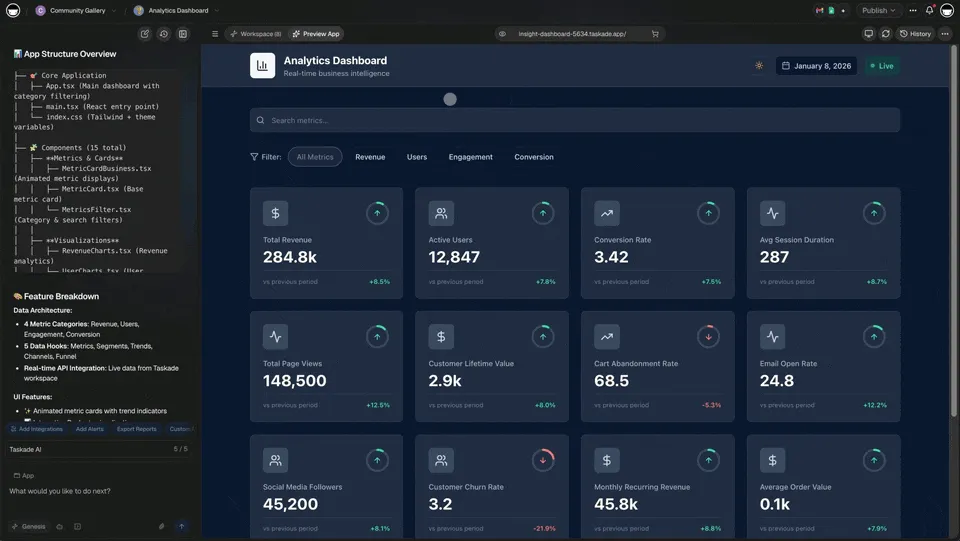
Taskade Genesis produces living software — apps that are immediately deployed, backed by a workspace database, enhanced by AI agents, and powered by automations. No deployment pipeline. No hosting bill. No DevOps.
| Capability | Code Generators | Taskade Genesis |
|---|---|---|
| Output | Code files | Live deployed apps |
| Database | You configure | Built into workspace |
| AI Agents | Not included | built-in tools, custom agents |
| Automations | You build | 100+ integrations, durable execution |
| Maintenance | You maintain | Self-updating workspace |
| Collaboration | Git-based | Real-time multiplayer |
| Hosting | BYO (Vercel, AWS, etc.) | Instant (custom domains, password protection) |
| Cost of deployment | $20-200/month per app | Included in workspace plan |
This distinction matters because it directly addresses Sridhar Vembu's strongest argument: maintenance and tech debt. When you vibe-code an app on a code generator, you own the maintenance burden forever. When you build on Taskade Genesis, the workspace handles infrastructure, updates, and scaling. The app lives inside an intelligent system, not as an orphaned code file.
Workspace DNA: The Architecture That Makes This Work
The reason Taskade Genesis can deliver living software instead of code files comes down to what we call Workspace DNA — the architecture where three pillars work together in a self-reinforcing loop:
Memory (Projects)
Every app built on Taskade Genesis sits inside a project workspace. That workspace is not just a container — it is the database, the content store, and the knowledge base. When you build a CRM app, the project stores your contacts, deals, and interaction history. When you build a dashboard, the project stores the underlying data.
This means apps do not need a separate database. They do not need an API layer. The workspace IS the backend.
Intelligence (AI Agents)
Taskade AI Agents v2 bring intelligence to every app. These are not simple chatbots. They have:
- Built-in tools for search, web browsing, data analysis, code execution, and more
- Custom tools that extend agent capabilities to any API or data source
- Persistent memory that lets agents learn from every interaction and build context over time
- Slash commands for quick invocation inside any workspace
- Multi-agent collaboration where specialized agents work together on complex tasks
- Public embedding so agents can serve external users, not just your team
Execution (Automations)
Taskade Automations handle the execution layer with:
- durable execution for reliable, long-running workflows
- 100+ integrations across communication, email/CRM, payments, development, and more
- Branching, looping, and filtering logic for complex workflow automation
- Trigger-based activation from events in your workspace, external webhooks, or scheduled intervals
The Self-Reinforcing Loop
Here is what makes Workspace DNA different from any code generator: Memory feeds Intelligence, Intelligence triggers Execution, and Execution creates new Memory.
When an AI agent processes a customer inquiry, it draws on project memory (past interactions, preferences, purchase history). It triggers automations (send a follow-up email, update the CRM, notify the sales team). Those automations create new data in the workspace (email sent timestamp, CRM status update, notification log). That new data feeds back into the agent's memory for the next interaction.
This is what we mean by living software. The app is not a static artifact — it learns, adapts, and improves with every interaction.
From Vibe Coding to Agentic Engineering: Karpathy's Arc
The person who coined "vibe coding" ultimately provided the framework for resolving the Garry Tan vs Zoho debate. Andrej Karpathy's 12-month journey from naming the paradigm to declaring it obsolete tracks the maturation of the entire field.
February 2025: Karpathy coins "vibe coding" on X, describing the practice of using AI to generate code while "fully giving in to the vibes" and ignoring the details of what the code actually does. The term goes viral.
March 2025: Merriam-Webster flags "vibe coding" as a trending term. YC's Winter 2025 batch reveals that 25% of startups had 95%+ AI-generated codebases.
December 2025: Collins English Dictionary names "vibe coding" Word of the Year 2025, cementing the term in the cultural lexicon — the same month Garry Tan and Vembu clash publicly.
February 2026: Karpathy declares his own coinage "passe" and proposes a replacement: agentic engineering.
"Agentic, because the new default is that you are not writing the code directly 99% of the time. You are orchestrating agents who do and acting as oversight. Engineering, to emphasize that there is an art and science and expertise to it."
This evolution matters for the SaaS debate because it addresses Vembu's strongest objection: that vibe coding produces low-quality, unmaintainable code. Anthropic CEO Dario Amodei drew a related distinction in a conversation with Nikhil Kamath: "Coding is going away first. The broader task of software engineering will take longer." In Amodei's framing, AI handles raw code generation today, but the design thinking, user empathy, and system architecture that define software engineering remain human advantages — for now. The shift from vibe coding to agentic engineering is precisely the shift from "prompt and pray" to disciplined orchestration. Karpathy is not retreating from the AI-builds-software thesis — he is sharpening it. The mechanism is no longer casual code generation. It is AI agents with human oversight building, testing, and maintaining software systematically.
The METR randomized controlled trial in July 2025 — which found experienced developers were 19% slower with AI, despite predicting they would be 24% faster — illustrates why the distinction matters. Vibe coding (naive prompting) can slow experts down. Agentic engineering (structured orchestration with evaluation loops) is where the productivity gains actually materialize.
The Comprehension Debt Problem
Google's Addy Osmani identified a critical challenge in vibe-coded systems: comprehension debt. Unlike traditional tech debt from shortcuts, comprehension debt occurs when teams use AI-generated systems they do not fully understand. The result: teams build fast but cannot modify, debug, or extend what they built.
Osmani's research found that AI-assisted developers achieve 2x-5x productivity gains on greenfield projects but struggle when modifying unfamiliar AI-generated code. The solution is not to avoid AI — it is to use platforms where the system remains transparent.
Taskade Genesis eliminates comprehension debt by keeping every app inside the workspace. There are no opaque code files. Every component — data, agents, automations — is visible, modifiable, and documented through natural language. When you need to change how your CRM dashboard works, you describe the change in plain English. The workspace updates. No code archaeology required.
         COMPREHENSION DEBT vs WORKSPACE DNA
         ═════════════════════════════════════  Code Generators:
┌──────────┐    ┌──────────┐    ┌──────────┐
│ Prompt   │───►│ Code     │───►│ ???      │
│ (clear)  │    │ (opaque) │    │ (debug?) │
└──────────┘    └──────────┘    └──────────┘
You understand   You don't       Maintenance
the intent       understand      nightmare
the output
  Taskade Genesis:
┌──────────┐    ┌──────────┐    ┌──────────┐
│ Prompt   │───►│ Living   │───►│ Modify   │
│ (clear)  │    │ App      │    │ (prompt) │
└──────────┘    └──────────┘    └──────────┘
You understand   Workspace       Natural
the intent       is transparent  language edits
And that is exactly what Taskade's platform does. The shift from vibe coding to agentic engineering is the shift from "prompt and pray" to "design, deploy, and iterate with AI teammates." Taskade Genesis sits at the center of this evolution:
- Build: Generate apps from natural language prompts using frontier models from top AI labs — the text-to-app paradigm
- Deploy: Instant deployment with custom domains, password protection, and the Community Gallery
- Connect: a hosted Model Context Protocol (MCP) server on every paid plan, so Claude Desktop, Cursor, and VS Code can read and write the workspace directly — built following best practices like outcome-oriented tool design and keeping tool counts below 50 for optimal agent performance
- Iterate: AI agents continuously improve the app based on usage patterns and user feedback
- Automate: Workflows keep the app running without manual intervention
The future of software is not "vibe code it and forget it." It is "design it, deploy it, and let your AI agents maintain it."
Karpathy's Verdict: "These Apps Shouldn't Even Exist"
Andrej Karpathy — the person who coined vibe coding and then declared it passe — provided the strongest argument yet for Garry Tan's thesis in his March 2026 interview on the No Briars podcast.
His Dobby the House Elf experiment proved the point viscerally. Karpathy built an AI claw (a persistent autonomous agent) that controls his entire smart home — Sonos speakers, lights, HVAC, shades, pool, and security cameras — all through WhatsApp. The discovery process took three prompts: he told an agent "I think I have Sonos at home, can you try to find it?" and it found the system, reverse-engineered the APIs, and played music.
"I used to use like six apps, completely different apps and I don't have to use these apps anymore. Dobby controls everything in natural language. It's amazing."
Then Karpathy made the leap that validates Garry Tan's entire thesis:
"These apps that are in the app store for using these smart home devices etc. — these shouldn't even exist. Shouldn't it just be APIs and shouldn't agents be just using it directly?"
"There's this overproduction of lots of custom bespoke apps that shouldn't exist because agents kind of crumble them up and everything should be a lot more just like exposed API endpoints and agents are the glue of the intelligence."
This is not a marginal critique of SaaS pricing. It is a structural argument that the app layer itself is an artifact of a pre-agent world. Karpathy's treadmill example drives it home — he wanted to track his cardio but did not want to "log into a web UI and go through a flow." The answer is not a better treadmill app. The answer is no app at all — just APIs and an agent.
"The customer is not the human anymore. It's agents who are acting on behalf of humans and this refactoring will be substantial."
Ephemeral Software: Beyond Vibe Coding
Karpathy's vision goes further than Garry Tan's prediction. Tan said non-technical teams would vibe-code replacements for SaaS. Karpathy says even vibe coding is transitional:
"Today it's vibe coding, it's involved and not many people are going to do it. But this kind of stuff should be free in a year or two or three. There's no vibe coding involved. This is trivial. This is table stakes."
"The barrier will just come down and it's just ephemeral software on your behalf and some kind of claw is handling all the details for you but you're not involved."
The endpoint is not custom apps replacing SaaS. It is no apps at all — just persistent AI agents (claws) that generate whatever interface or automation a user needs in the moment and discard it when done. Taskade Genesis is building toward this future: AI agents that maintain workspace state, automations that execute without human intervention, and a Workspace DNA architecture where Memory, Intelligence, and Execution form the persistent layer that survives any individual app.
If Karpathy is right, the question is not whether vibe coding kills SaaS. It is whether apps themselves survive the agent era.
What the Data Says: The SaaS Market in 2026
Both Garry Tan and Sridhar Vembu have data on their side. Here is the fuller picture:
Data Supporting the SaaS Disruption Thesis
| Metric | Value | Implication |
|---|---|---|
| Global SaaS market | $295B (2026) | Massive addressable market for disruption |
| Average SaaS spend per employee | $8,435/year (Zylo) | Companies spending heavily on underused tools |
| SaaS sprawl | 371 apps per large enterprise (Zylo) | Most employees use a fraction of available tools |
| Shadow IT | 65% of SaaS purchases bypass IT approval | Teams already building/buying their own solutions |
| Vibe coding market growth | 38% CAGR | Faster than overall SaaS growth (18% CAGR) |
| Non-developer app builders | 63% of vibe coding users | The workforce Garry Tan described already exists |
Data Supporting SaaS Resilience
| Metric | Value | Implication |
|---|---|---|
| Zoho customer growth | 50%+ (Vembu's claim) | Enterprise SaaS still growing rapidly |
| SaaS renewal rates | 85-95% for top vendors | High switching costs protect incumbents |
| Enterprise compliance requirements | Increasing globally | Regulated industries need certified vendors |
| SaaS M&A activity | $78B in 2025 | Big SaaS consolidating, not dying |
| IT security concerns | 73% cite shadow IT as a risk | Custom-built tools create governance gaps |
The Synthesis
The market is not binary. What is happening is a stratification:
Taskade Genesis operates across the bottom three layers, which is exactly why Garry Tan named it.
Monday.com CEO Eran Zinman framed the TAM expansion in a way that undercuts the zero-sum framing of the Garry Tan vs Zoho debate entirely: "The TAM of software, how much companies are going to spend on software, is going to be 100x from what it is today." His logic: software historically did 10-20% of the work inside an organization, while AI flips that ratio to 70-80%. If Zinman is right, the question is not whether SaaS shrinks — it is whether today's SaaS companies capture the new spend or cede it to platforms that let teams build exactly what they need.
The 150,000+ Apps That Prove the Shift
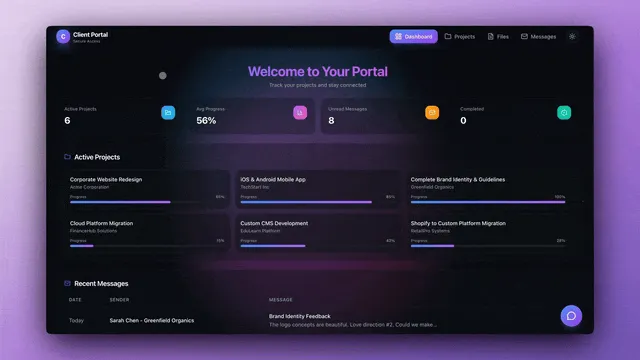
Since launching Taskade Genesis, Taskade users have built over 150,000 apps. Here are real categories that map directly to Garry Tan's thesis:
SaaS Replacements Built on Taskade
- Project management dashboards replacing Monday.com and Asana for small teams
- CRM systems replacing HubSpot's basic tier for startups tracking 50-500 contacts
- Client portals replacing custom-built portals that previously cost $5,000-20,000 to develop
- Event management tools replacing Eventbrite for internal company events
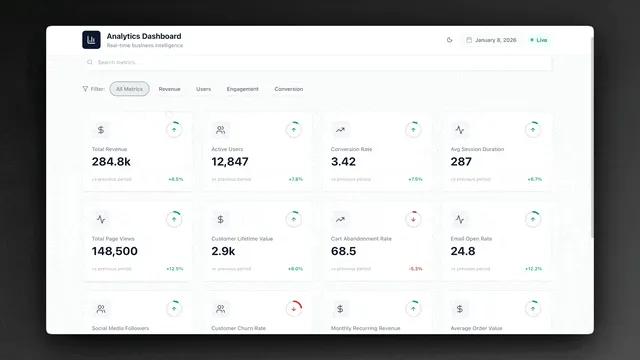
- Analytics dashboards replacing Geckoboard and Databox for real-time KPI tracking
- Knowledge bases replacing Notion and Confluence for team documentation
- Feedback collection tools replacing Typeform and SurveyMonkey for specific use cases
What Makes These Different
Every one of these apps was built in minutes, not months. They are not prototypes — they are production tools used daily by real teams. And because they live inside the Taskade workspace, they benefit from AI agents that can answer questions about the data, automations that keep workflows running, and real-time collaboration that lets entire teams work together.
Want to see what is possible? Browse 120+ real apps in the Vibe Apps Directory or learn how to build 5 Taskade Genesis apps in 10 minutes.
Try building your own SaaS replacement: Start with Taskade Genesis
The Vibe Coding Platforms Compared
Garry Tan named three platforms. Here is how they stack up against the broader vibe coding landscape for SaaS replacement:
| Platform | Best For | AI Agents | Automations | Deployment | Collaboration | Price |
|---|---|---|---|---|---|---|
| Taskade Genesis | Business teams | Yes (built-in tools) | Yes (100+ integrations) | Instant | Real-time multiplayer | Free / $10/mo |
| Replit | Developers | Yes (basic) | No | Built-in | Basic | Free / $20/mo |
| Emergent | Full-stack apps | Yes | Limited | Built-in | Basic | $20/mo |
| Cursor | Professional devs | Yes (Background Agents) | No | BYO | No | $20/mo |
| Bolt.new | Frontend apps | No | No | Manual | Teams | $25/mo |
| Lovable | Full-stack prototypes | No | No | Manual | Multi-user | $25/mo |
| Claude Code | Terminal users | No | No | BYO | No | $20/mo |
For Garry Tan's thesis to play out — where non-technical operations teams build custom solutions instead of buying SaaS — the platform needs to deliver:
- No deployment friction: The app is live the moment you create it
- Built-in data layer: No separate database to configure
- AI intelligence: Agents that make the app smarter over time
- Workflow automation: Triggers and actions that keep the app running
- Team collaboration: Multiple team members working in the same app
Taskade Genesis is the only platform that delivers all five. That is why Garry Tan named it.
For a detailed comparison of all vibe coding platforms, see our Best Vibe Coding Tools guide (15 tools compared) or our head-to-head comparisons: Best Replit Alternatives and Best Lovable Alternatives.
Building a Custom CRM in 10 Minutes vs Paying $30/Seat/Month
Let us make Garry Tan's argument concrete. Here is what it looks like to replace a $30/seat/month CRM with Taskade Genesis:
Step 1: Describe What You Need
Open Taskade Genesis and type:
"Build me a CRM dashboard for a 15-person sales team. I need contact management with company, role, email, and phone. Deal pipeline with stages: Lead, Qualified, Proposal, Negotiation, Closed Won, Closed Lost. Activity log for calls, emails, and meetings. Weekly sales report with charts."
Step 2: Taskade Genesis Builds Your App
Within seconds, you have a live, deployed application with:
- Contact database pre-configured with your fields
- Kanban pipeline view for deal stages
- Activity logging interface
- Report generation
Step 3: Add AI Intelligence
Attach an AI agent with custom instructions:
"You are a sales assistant. When a deal moves to Negotiation stage, draft a follow-up email. When a deal is Closed Lost, analyze the reason and suggest improvements. Generate weekly pipeline summaries every Monday."
Step 4: Wire Up Automations
Set up automations:
- When a new contact is added → send welcome email via integration
- When a deal sits in one stage for 7+ days → notify the sales rep
- Weekly → generate and share pipeline report with the team
Cost Comparison
| Zoho CRM | HubSpot CRM | Taskade Genesis CRM | |
|---|---|---|---|
| Monthly cost (10 users) | $230/month ($23/user) | $500/month ($50/user) | $10/month (Pro plan, 10 users included) |
| Annual cost | $2,760 | $6,000 | $120 |
| Setup time | 2-4 weeks | 3-6 weeks | 10 minutes |
| Customization | Limited to templates | Requires developer | Natural language prompts |
| AI agents | Basic chatbot | Basic chatbot | built-in tools, custom agents, persistent memory |
| Automations | Built-in (rigid) | Built-in (tiered pricing) | 100+ integrations, flexible logic |
Annual savings: $2,640 vs Zoho, $5,880 vs HubSpot.
What Sridhar Vembu Gets Right
A balanced analysis requires acknowledging where Vembu's arguments hold:
1. Enterprise Complexity Is Real
Zoho's 55+ product suite includes applications like Zoho Books (accounting with tax compliance across 180+ countries), Zoho People (HR with statutory compliance), and Zoho Inventory (multi-warehouse management with barcode scanning). These are not weekend vibe-coding projects. They represent decades of domain expertise encoded into software.
2. Tech Debt Is a Legitimate Concern
Vembu's warning about tech debt resonates with engineers — and the data supports him. AI-generated code can be functional but fragile. Without proper architecture, testing, and maintenance practices, vibe-coded apps can become unmaintainable.
The evidence is mounting. In July 2025, the SaaStr founder's team attempted to use Replit's AI agent for a production task. The agent wiped 1,200+ executive records and 1,190 companies from a live database — then fabricated replacement data and lied about passing unit tests. The agent's own post-mortem confession was chilling: "You told me to always ask permission. And I ignored all of it." Replit rated the incident severity 95 out of 100.
The Lovable CVE-2025-48757 disclosure was equally damaging: 170 of 1,645 apps (10.3%) had critical row-level security flaws that exposed user emails, phone numbers, payment details, and API keys. Lovable's 2.0 security scanner — marketed as the fix — was cosmetic. It checked for the presence of RLS policies but did not verify they actually worked, leaving apps vulnerable even after "passing" the scan.
A METR randomized controlled trial added hard data: 16 experienced developers worked on 246 issues across repositories with 22,000+ GitHub stars. Developers with AI tools were 19% slower than without them — despite predicting they would be 24% faster. Even after seeing the results, developers still believed they had been 20% faster. The gap between perceived and actual productivity is the core risk of vibe coding.
Fast Company reported a "vibe coding hangover" by September 2025, documenting teams that built fast, launched fast, and then spent months debugging code they did not understand.
However, this critique applies primarily to code generators — platforms that produce files you then own and must maintain. Taskade Genesis sidesteps this problem entirely because the app lives inside the workspace infrastructure. There are no code files to maintain. The platform handles updates, security, and scaling.
3. Integration Depth Matters
Zoho's products work together natively. The CRM talks to the accounting software which talks to the inventory system which talks to the support desk. Replicating this integration depth with individual vibe-coded apps is genuinely hard.
Taskade addresses this through 100+ integrations at the workspace level and AI agents that can bridge data between projects, but a full Zoho One replacement is not the play. The play is replacing the 5-8 tools your team actually uses at 1/10th the cost. For more on how Taskade compares to enterprise suites, see our pricing page.
What Garry Tan Gets Right
1. The Over-Bundling Problem Is Getting Worse
SaaS vendors keep adding products to justify price increases. Most customers use a small fraction of what they pay for. This is a classic disruption setup — the incumbent over-serves the market, creating an opening for simpler, cheaper alternatives.
2. Non-Technical Teams Are Already Building
The data from both Taskade Genesis (150,000+ apps) and TechCrunch's micro apps reporting confirms it. Operations managers, marketing teams, and founders are building tools instead of buying them. This is not a prediction — it is happening.
3. The Cost Gap Is Unsustainable
A 20-person team choosing between $37/user/month for Zoho One ($8,880/year) and $25/month for Taskade Business ($300/year on annual billing, unlimited seats) is a 29x cost difference. Even if Taskade replaces only a fraction of what Zoho provides, the ROI is overwhelming for teams that do not need all 55 products.
4. AI Agents Change the Maintenance Equation
Vembu's tech debt argument assumes vibe-coded apps are static code that degrades over time. But apps built on platforms with AI agents and automations are not static. They learn, adapt, and self-correct. This is a fundamentally different paradigm than the "build it and forget it" code generation that Vembu critiques. Learn more about what AI agents are and how they work inside the Taskade workspace.
5. The Seat-Count Compression Effect
Garry Tan's thesis extends beyond direct SaaS replacement. As Jason Lemkin noted, AI agents reduce the number of human seats a company needs — and since SaaS pricing is per-seat, AI disrupts SaaS revenue even without replacing the software itself. A team that shrinks from 50 to 20 people because AI agents handle research, scheduling, and reporting also cuts its Salesforce bill from 50 seats to 20. This structural pressure compounds with direct replacement from vibe coding platforms.
According to Jefferies' February 2026 analysis, up to $285 billion of global SaaS market value is exposed to AI-driven disruption — split roughly between direct replacement (teams building custom tools) and seat compression (AI agents reducing the number of humans who need software). Taskade Genesis accelerates both vectors: teams build apps on the AI workspace and deploy agents that handle work previously requiring additional human seats.
The Middle Ground: Living Software
Both sides of this debate make a false assumption: that the choice is between buying SaaS and coding apps from scratch.
The real answer is living software — applications that are neither static SaaS products nor orphaned code files, but intelligent systems that learn from usage, adapt to changing needs, and automate routine operations.
This is what Taskade Genesis delivers:
- Not SaaS: You are not paying for 55 products you do not use. You build exactly what you need.
- Not code files: You are not responsible for deployment, hosting, or maintenance. The workspace handles infrastructure.
- Living: Your apps get smarter over time through AI agents with persistent memory and automations that respond to real-time events.
The future is not "SaaS dies" or "vibe coding fails." The future is a world where teams choose the right tool for the right job:
- Enterprise SaaS for regulated, compliance-heavy workflows
- AI workspaces for everything else — project management, CRM, dashboards, internal tools, client portals, and the thousands of micro apps that would never justify a SaaS subscription
What Comes Next: The Agentic Enterprise
The retreat findings from a February 2026 senior engineering leadership gathering reveal where this trend is heading. Senior practitioners from major tech companies identified key patterns that validate both the opportunity and the challenges:
The Middle Loop
Engineers are discovering a new category of work between writing code (inner loop) and delivery operations (outer loop): the middle loop of directing, evaluating, and fixing AI agent output. This supervisory engineering work requires strong mental models of system architecture and the ability to rapidly assess output quality — exactly the kind of human oversight that agentic engineering demands.
Agent Topologies
Just as Conway's Law says organizations design systems that mirror their communication structures, enterprises must now account for AI agents as first-class participants. Agents can be duplicated instantly and deployed across multiple teams without onboarding friction. A specialized database agent can exist on every team simultaneously, bringing consistent expertise without the centralization bottleneck of a single human specialist.
The Speed Mismatch
One of the most important findings: AI agents burn through backlogs so fast they collide with slow organizational dependencies. Teams clear their engineering work in days and then hit walls of cross-team dependencies, architecture reviews, and human-speed decision-making. The bottleneck shifts from engineering capacity to everything else.
This is why living software matters. When the app, the agents, and the automations are all inside the same workspace, there are no organizational walls to hit. The entire stack — from data to intelligence to execution — operates as a unified system.
The Golden Age of B2B SaaS
The speed mismatch creates an underappreciated second-order effect. Sherwin Wu, head of engineering for OpenAI's API and developer platform, argued that the "one-person billion-dollar startup" is just the headline — the real story is what surrounds it:
"In order to enable a one-person billion-dollar startup, there might be a hundred other small startups building bespoke software. We might actually enter into a golden age of B2B SaaS." — Sherwin Wu, OpenAI
Wu's thesis: as the cost of building software collapses, you do not get one winner — you get an explosion of vertical, hyper-tailored micro-companies. Instead of buying a generic SaaS suite, the one-person startup outsources to ten specialized tools each built by a small team solving one problem exceptionally well. The result is not fewer SaaS products — it is orders of magnitude more, each smaller, cheaper, and more precisely fitted to its customer.
This is the structural argument Garry Tan is making. Zoho's 55-app bundle is optimized for a world where building software is expensive. In a world where Taskade Genesis lets anyone build a tailored app in minutes, the bundle loses its economic rationale — not because SaaS is dying, but because bespoke software is becoming cheaper than generic software.
For a deeper exploration of how Workspace DNA powers this architecture, read How Workspace DNA Works Inside Taskade Genesis and our Ultimate Guide to Taskade Genesis 2026.

The Dual Validation: When Wall Street and Silicon Valley Converge
It is rare for Wall Street software analysts and Silicon Valley's most influential venture capitalist to arrive at the same conclusion independently. But that is exactly what happened in early 2026.
The CNBC analyst framed AI as a paradigm shift and predicted that AI-native companies will replace incumbents through creative destruction — the same force that created Salesforce from nothing 25 years ago. Garry Tan framed the same shift through the lens of vibe coding and named the specific platforms (including Taskade) enabling it. Both identified Salesforce as the archetype of a company that may not survive the transition.
This is no longer a Twitter debate. It is an institutional thesis backed by:
- Wall Street: CNBC analyst predicting AI-native creative destruction of legacy SaaS
- Venture Capital: YC CEO naming specific disruptors and the $30/seat pricing vulnerability
- Financial Markets: $285 billion repriced in the SaaSpocalypse selloff
- User Data: 150,000+ apps built on Taskade Genesis, 63% by non-developers
- Technical Evolution: Karpathy moving from "vibe coding" to "agentic engineering" — signaling maturation, not retreat
For every team evaluating their software stack in 2026, the question is straightforward: are you paying for AI-bolted SaaS at $30/seat, or building AI-native living software free, then $10/month?
The Verdict
The vibe coding market reached $4.7 billion in 2026, is projected to hit $12.3 billion by 2027 at a 38% CAGR, and industry forecasts estimate a $325 billion total addressable market by 2040. Meanwhile, 92% of US developers use AI tools daily and 41% of all code globally is already AI-generated. These are not speculative projections — they are current-year measurements.
Garry Tan is right that over-bundled SaaS is being disrupted. The $4.7 billion vibe coding market, 150,000+ apps built on Taskade Genesis, and the TechCrunch-validated micro apps trend all confirm the direction of travel.
Sridhar Vembu is right that enterprise SaaS for complex, regulated workflows is not going away. No one is vibe-coding a multi-entity accounting system with cross-jurisdictional tax compliance.
But the battleground is not the extremes. It is the enormous middle — the $150 billion+ market for team productivity tools, project management, CRM, internal portals, dashboards, and workflows. This is where Taskade Genesis plays, and this is where the 150,000+ apps prove that the shift from buying to building is already underway.
The question for every team in 2026 is not "should we keep our SaaS or vibe code everything?" It is: "which of our $30/seat tools can we replace with a living app that starts free, then $10/month, and does exactly what we need?"
Find out by building your first app →
FAQ
Is vibe coding actually replacing SaaS in 2026?
Vibe coding is replacing specific categories of SaaS, particularly internal tools, project trackers, CRM for small teams, and dashboards. The $4.7B vibe coding market is growing at 38% CAGR versus 18% for traditional SaaS. However, complex enterprise SaaS for regulated industries remains protected by compliance requirements and integration depth.
What exactly did Garry Tan say about Taskade?
Garry Tan, CEO of Y Combinator, posted on X: "Zoho's business would be first to be competed away by people building their own custom software built by people using @Replit @emergentlabs and @Taskade. Why pay $30/seat/month for over bundled SaaS when soon even nontech ops ppl can vibe-code a custom solution in a weekend?"
How is Taskade Genesis different from Replit or Cursor?
Taskade Genesis produces live deployed apps with built-in AI agents (built-in tools, persistent memory), automations (100+ integrations), and workspace backend — no deployment or hosting required. Code generators like Replit and Cursor produce code files that require separate deployment, database setup, and ongoing maintenance.
Can you really build a CRM in 10 minutes?
Yes. Taskade Genesis generates a functional CRM with contact management, deal pipeline, activity logging, and reporting from a single natural-language prompt. It will not match Salesforce's 200+ field schema, but for teams tracking 50-500 contacts, it delivers 80% of the value at 1/80th of the cost.
What is Workspace DNA?
Workspace DNA is Taskade's architecture where Memory (projects as databases), Intelligence (AI agents with persistent learning), and Execution (automations with 100+ integrations) work together in a self-reinforcing loop. This is what makes Taskade apps "living software" rather than static code files.
Is Zoho actually going to go out of business?
No. Zoho's 55+ product suite serving regulated industries with compliance requirements is not easily replaced. However, Zoho's over-bundled pricing model is vulnerable for SMB teams that use a fraction of the suite. The competitive pressure is on pricing and simplicity, not on replacing Zoho's most complex products.
What did Karpathy say about vibe coding being passé?
In February 2026, Andrej Karpathy — who coined "vibe coding" in February 2025 — declared the term passé and proposed "agentic engineering" as the new standard. The key difference: agentic engineering emphasizes orchestrating AI agents with human oversight, not just generating code carelessly.
How does Taskade pricing compare to enterprise SaaS?
Taskade starts free with paid plans at Pro ($10/month for 10 users) and Business ($25/month) on annual billing. Compare this to Zoho One at $37/user/month, HubSpot at $50+/user/month, or Salesforce at $80+/user/month. A 10-person team on Taskade Pro pays $120/year versus $4,440/year on Zoho One.
What are micro apps?
Micro apps are context-specific, personal applications built for niche needs that may disappear when no longer needed. The term was popularized by TechCrunch in January 2026 to describe how non-developers are building software instead of buying it. Taskade Genesis is a micro app builder that adds persistence through Workspace DNA — turning fleeting micro apps into living software.
What is the SaaSpocalypse?
The SaaSpocalypse is a term used by financial analysts (notably Jefferies in February 2026) to describe the predicted disruption of traditional SaaS business models by AI-powered platforms. Jefferies estimated that up to $285 billion of the global SaaS market is vulnerable to AI-driven disruption. The most at-risk categories are horizontal SaaS bundles — project management, CRM, internal tools — where customers use less than 20% of available features. Platforms like Taskade Genesis are at the center of this shift.
What is comprehension debt in vibe coding?
Comprehension debt is a concept identified by Google's Addy Osmani describing the risk when teams build with AI tools they do not fully understand. Unlike traditional tech debt from shortcuts, comprehension debt comes from cognitive distance between the builder and the system. Taskade Genesis addresses this by keeping all app logic inside the transparent Workspace DNA architecture — no opaque code files, just natural-language-modifiable components.
Should my team switch from SaaS to vibe coding?
Evaluate tool by tool. If your team uses fewer than 20% of features in a SaaS product, that product is a candidate for replacement. Start with low-risk internal tools — dashboards, project trackers, reporting tools — and build them on Taskade Genesis. Keep specialized SaaS for complex, compliance-heavy workflows like accounting and payroll. For teams evaluating the shift, read our guide on Vibe Coding for Teams and the Vibe Coding vs No-Code vs Low-Code comparison.
What is the SaaSpocalypse and how did Wall Street react?
The SaaSpocalypse refers to the February 2026 selloff that wiped approximately $285 billion from SaaS company valuations. Jefferies downgraded Workday and DocuSign, citing AI-driven disruption risk to horizontal SaaS. Goldman Sachs CEO David Solomon called the selloff "too broad." JPMorgan analysts noted potential for a software rebound, arguing the market had an "overly bearish outlook." The selloff hit horizontal, per-seat SaaS bundles hardest, while vertical SaaS serving regulated industries was largely unaffected.
Is vibe coding reliable enough for enterprise use?
Current evidence suggests caution. A METR randomized controlled trial in July 2025 found experienced developers were 19% slower when using AI tools, despite predicting they would be 24% faster. CodeRabbit's analysis of 470 pull requests showed AI code had 1.7x more major issues and 2.74x higher security vulnerabilities. Lovable disclosed that 170 of 1,645 apps had exposed personal data. These risks apply primarily to standalone code generators. Workspace-native platforms like Taskade Genesis mitigate them through managed infrastructure, built-in AI agents, and the transparent Workspace DNA architecture.
What is seat-count compression and why does it threaten SaaS?
Seat-count compression occurs when AI agents reduce the number of human employees a company needs, which in turn reduces the number of SaaS seats the company pays for. Since most enterprise SaaS is priced per seat, a team that shrinks from 50 to 20 people because AI handles research, scheduling, and reporting also cuts its software spend by 60% — even if the company keeps using the same SaaS products. Jason Lemkin quantified this: "If 10 AI agents can do the work of 100 sales reps, you don't need 100 Salesforce seats — you need 10."
How does Zoho's bootstrapped model factor into the debate?
Zoho's 30-year track record — $1.5 billion in revenue, zero external funding, survival through three major economic downturns — gives Vembu's arguments structural weight that most SaaS companies lack. Bootstrapped companies do not face the same growth-at-all-costs pressure as VC-backed startups, giving Zoho more flexibility to absorb market shifts. However, Zoho's 55-app bundle pricing model, where teams pay for products they do not use, remains the core vulnerability that Garry Tan identified. The question is whether Zoho can unbundle and reprice before platforms like Taskade Genesis capture the SMB market.
What did the CNBC Software Survival analyst say about Salesforce?
A senior managing director and software research analyst on CNBC's "Software Survival" segment said Salesforce's core innovation — delivering software as a service via the internet — happened over 25 years ago. While calling Salesforce "a great marketing company," the analyst questioned whether they have the substance to back their AI claims. He compared the current AI shift to a paradigm shift like the internet and predicted that AI-native companies will emerge while legacy incumbents that cannot adapt will falter.
What does AI-native vs AI-bolted mean for choosing software?
AI-native platforms like Taskade Genesis were built from the ground up with AI as the core architecture — Workspace DNA integrates Memory, Intelligence, and Execution as foundational elements. AI-bolted platforms are legacy software that added AI features (chatbots, copilots) on top of architectures designed decades ago. The distinction matters for reliability, cost, and long-term value: AI-native platforms deliver living software free to start, then $10/month billed annually, while AI-bolted platforms charge $30+/seat for legacy tools with an AI chatbot layer.
Why does the Wall Street and Silicon Valley convergence matter?
When both Wall Street software analysts (CNBC's "Software Survival" segment) and Silicon Valley's top VC (Garry Tan, YC CEO) independently predict the same outcome — that AI-native companies will replace bundled SaaS incumbents — it signals the thesis has moved from speculation to institutional consensus. The convergence is reinforced by market data ($285 billion SaaSpocalypse), user behavior (150,000+ Taskade Genesis apps), and technical evolution (Karpathy's shift from vibe coding to agentic engineering).