






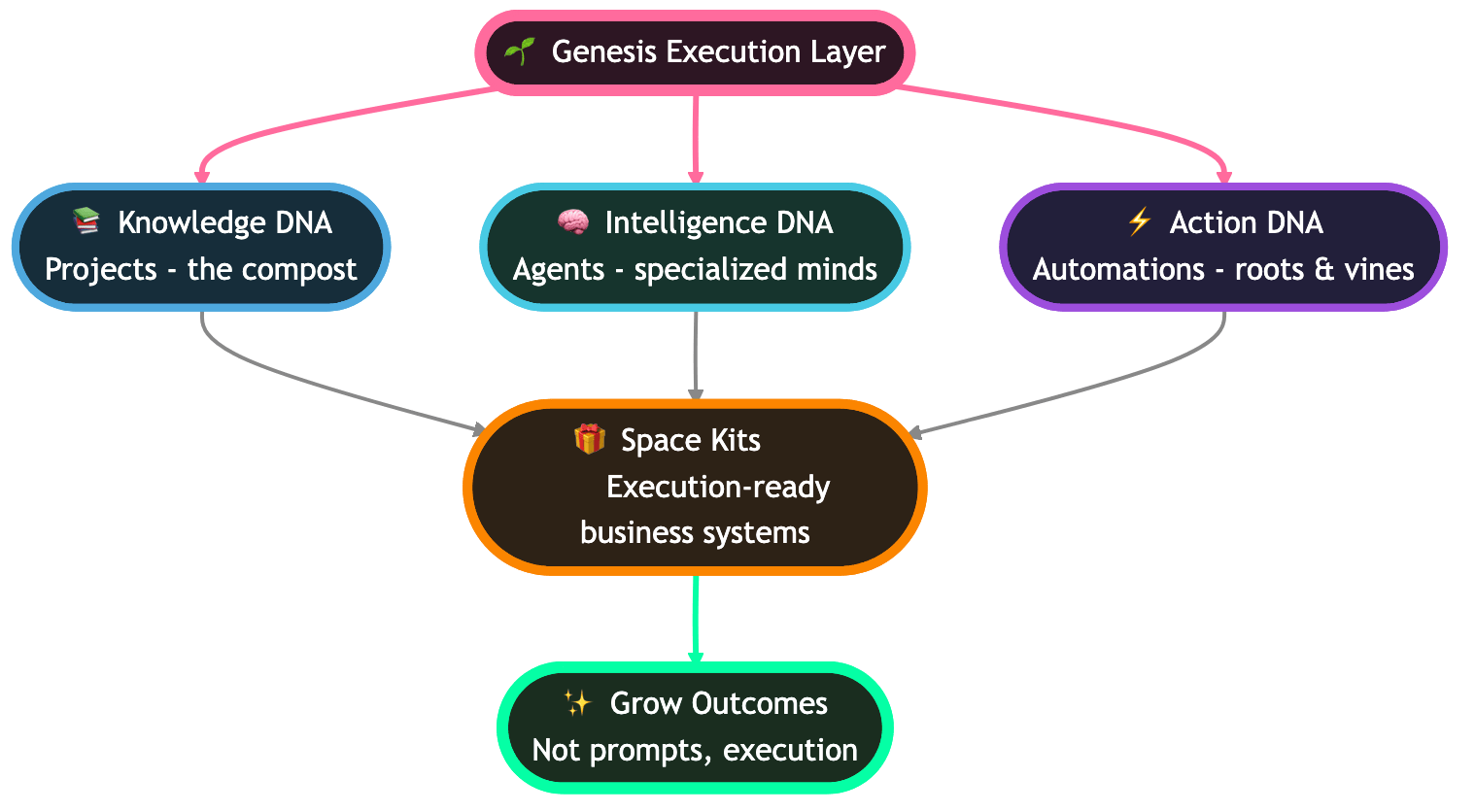
TL;DR: The AI stack has three layers: foundation models, chat interfaces, and the execution layer. The first two have commoditized. The third is where the next decade of value gets built. Chatbots are demos. Execution is production. This is the thesis behind Taskade Genesis.
The Tell
Here's the tell that the chatbot era is over: every frontier lab just shipped the same product.
Open Claude. Open ChatGPT. Open Gemini. Open Copilot. Open Meta AI.
You see the same thing. A text box at the bottom. A streaming response at the top. A thin sidebar of past conversations. A model picker. A file upload button. Some variation of "tools" or "extensions" tucked into a menu.
The UX is identical because the primitive is identical: a conversation with a stranger who forgets you every time you log off.
When five competing companies with tens of billions of dollars in budget converge on the same UI, it means the UI has commoditized. It means the interface is no longer where value is captured. It means the interesting competition is happening somewhere else.
It is. Let me show you where.
The Three-Layer Stack
Think of the AI stack the way the internet stack got organized in the 1990s — not as a monolith, but as a set of tiers where value accrues differently at each level.
                ┌──────────────────────────────────────┐
   Layer 3      │         EXECUTION LAYER              │
   (emerging)   │   Memory + Agents + Automation       │
                │   [Taskade Genesis, Lindy, ...]      │
                ├──────────────────────────────────────┤
   Layer 2      │         CHAT INTERFACE               │
   (commodity)  │   ChatGPT, Claude, Gemini, Meta      │
                │   Copilot, Perplexity, ...           │
                ├──────────────────────────────────────┤
   Layer 1      │       FOUNDATION MODELS              │
   (commodity)  │   Claude, GPT, Gemini, Llama,        │
                │   Mistral, DeepSeek, ...             │
                └──────────────────────────────────────┘
Layer 1 — Foundation Models. Training runs. Billions of dollars of compute. Produces raw intelligence. Economics look like telecoms or semiconductors: massive capex, thin differentiated margins, converging capabilities.
Layer 2 — Chat Interface. The conversational wrapper that makes a model accessible. Every major lab ships one. Economics look like search engines in 2005: user acquisition wars, subsidized access, feature parity within six months of any new capability.
Layer 3 — Execution Layer. The system that turns intelligence into shipped work. Economics look like AWS in 2012 or Slack in 2017: durable differentiation through integration density, workflow lock-in, and data gravity. This is where the next decade of defensible value gets built.
Every layer in computing history has had a primitive
The pattern isn't new — every era of computing has commoditized the layer below it, and the winning product at each layer names its own atomic primitive. Here's the lineage:
| Era | Commoditized Below | Winning Layer | Atomic Primitive |
|---|---|---|---|
| 1970s | Hardware (IBM clones) | Operating System (Unix, DOS) | File |
| 1980s | OS kernel | Desktop UI (Mac) | Icon |
| 1990s | Desktop | Networked content (Web) | Page |
| 2000s | Servers | Hosting stacks (cPanel/LAMP) | Account |
| 2010s | Infrastructure | Cloud workspaces (Notion) | Block |
| 2020s | Knowledge (Obsidian) | AI workspaces (Taskade Genesis) | Task |
Each primitive is the answer to "what is the atom, and what can you do with it?" For the execution layer, the answer is the task — because tasks are the only primitive in fifty years of computing history that both humans and AI agents can act on natively. For the full story, see fifty years of computing primitives.
How We Know Layer 1 Has Commoditized
Three signals, any one of which would be suggestive. All three together are conclusive.
Capability convergence. Run any benchmark — MMLU, HumanEval, SWE-bench, GPQA — and the top five labs cluster inside a few percentage points. For the overwhelming majority of commercial tasks, the models are substitutable. A five-point gap on GPQA does not change whether your legal team can use the model to summarize a contract.
Price collapse. Per-token prices have fallen roughly 10x every 18 months for the same capability tier. Intelligence that cost $60 per million tokens in 2023 costs under $1 today. When input prices collapse that fast, the input is not the differentiator. The input is the substrate.
Routing is the new moat. The winning products route between models based on task, cost, and latency. They do not bet on one model. Taskade Genesis runs across frontier models, selecting per task. Cursor does the same. So does every serious agent platform. If the product's architecture treats models as interchangeable, the market has already decided they are.
Models are the substrate. The router is the product. This is the commodity pattern.
How We Know Layer 2 Is Commoditizing Next
Chat interfaces are three to eighteen months behind foundation models on the same curve. The signals are already visible.
UI convergence. Every major chat product looks the same because the conversational primitive has nowhere to go. There are only so many ways to arrange a text box, a stream, and a history panel.
Feature parity in months. When Claude shipped Projects, ChatGPT shipped Projects within four months. When ChatGPT shipped Canvas, Claude shipped Artifacts (actually first) and Gemini shipped Canvas. Features diffuse across the category at SaaS speeds, not defensible-moat speeds.
Commoditization by bundling. Microsoft bundles Copilot into Office. Google bundles Gemini into Workspace. Apple bundles Intelligence into the OS. When incumbents bundle a category as a feature, that category is no longer a standalone business — it's table stakes.
User behavior migration. Power users now split their attention across three or four chatbots. When a user treats your product as one tab among many, you haven't lost — yet — but the ceiling on your category is already set.
The same pattern that commoditized search-engine-as-UX in the late 2000s (leading to content platforms, not search engines, capturing the value) is now commoditizing chat-as-UX. The value moves up.
What the Execution Layer Actually Is
The execution layer is not a new kind of chatbot. It is a different category of product.
A chatbot's output is a message. An execution-layer product's output is a shipped outcome: a deployed app, a closed ticket, an approved contract, a sent campaign, a merged PR, a scheduled meeting, a rebalanced portfolio.
To produce outcomes, the execution layer needs three primitives no chat interface has:
1. Persistent Memory
Chat interfaces treat each session as sovereign. Context decays at the session boundary. An execution-layer product cannot work that way — the unit of work is the project, which lives for days, weeks, or months.
This is what Projects do in Taskade Genesis. Every project is a persistent memory store that survives restarts, onboards new collaborators, and accumulates context over time. The MEMORY.md and .tdx memory system formalize this — not as a feature, but as the substrate the entire product sits on.
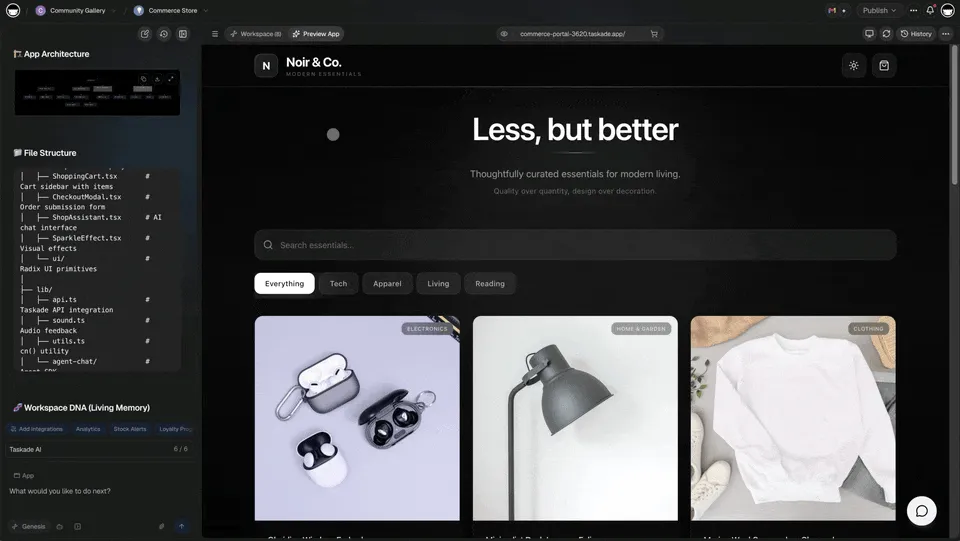
Memory is where context lives. No memory, no execution.
2. Reasoning Agents
Chat interfaces wait for input. Agents pursue goals. The distinction matters because real work involves decomposition, delegation, and multi-step planning — none of which fit in a request-response loop.
An agent in Taskade Genesis is not a chat session. It is a persistent entity with:
- An assigned role and skillset
- Access to specific memory
- Permission to use specific tools
- The ability to delegate sub-tasks to other agents
- A feedback channel back to the human orchestrator
This is the agentic planner/executor architecture: the planning agent and the execution agent, separated by design, coordinating by contract. The bicameral-mind pattern. One side proposes, the other disposes. The human stays in the loop.
3. Autonomous Execution
The final primitive is the one chatbots cannot have: the ability to act in the real world without a human present to hit send.
Automations in Taskade Genesis run on triggers — time, events, incoming data, upstream decisions. They send emails. They update databases. They deploy code. They file tickets. They rebalance schedules. They do this while the user is asleep, on a plane, or in another meeting.
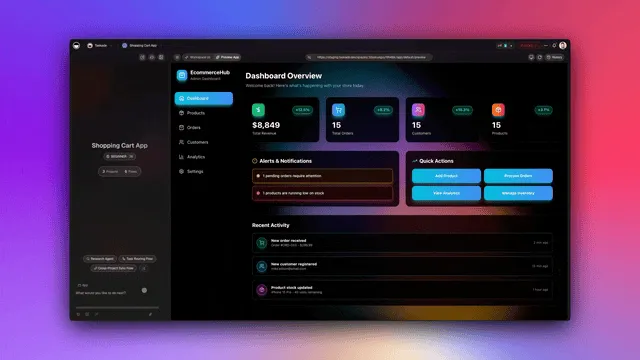
Execution is what turns a planning tool into a production system.
Three primitives. One workspace. This is what a chat interface structurally cannot be.
The Workspace-Incumbent Scoreboard
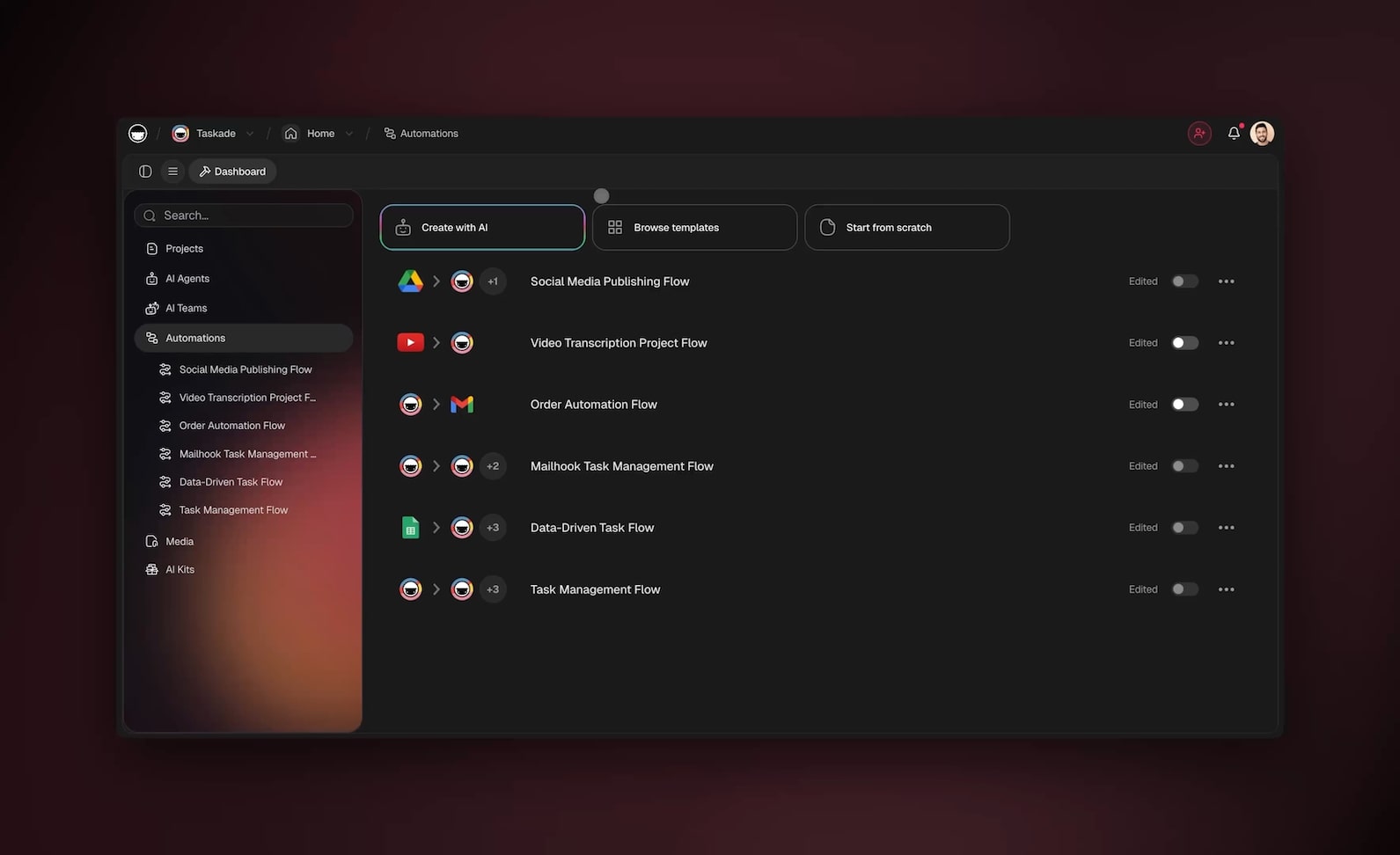
The question "is X an execution-layer product?" only has one honest test: does X ship all three primitives — persistent memory, reasoning agents, autonomous execution — inside one runtime, not bolted across three separate SKUs? Here is how the workspace incumbents score as of April 2026.
| Product | Memory (persistent, project-scoped) | Intelligence (multi-agent, multi-model) | Execution (durable automations w/ integrations) | App-gen from prompt | Execution-layer complete? |
|---|---|---|---|---|---|
| Notion AI + Custom Agents | Yes | Partial — agent scoped to workspace data | No native durable engine; integrations read-only | No | No — missing execution + app-gen |
| Airtable (Omni + Superagent) | Yes (record-scoped) | Yes (Field Agents) | Yes (Automations) | Limited (Interface Designer) | Close — but relational-first, no document/chat runtime |
| ClickUp Brain / Autopilot | Yes | Yes (Brain Autopilot agents) | Yes (Automations) | No | Close — missing app-gen |
| Monday AI (Vibe + Sidekick) | Yes (board-scoped) | Yes (Sidekick + specialty agents) | Yes | Yes (Vibe mini-apps) | Close — board-scoped, not document/project-graph |
| Asana AI Studio | Yes (project-scoped) | Yes (Studio agents) | Yes (workflows) | No | Close — missing app-gen |
| ChatGPT Projects + Tasks + Operator | Session + user memory (Feb 2026) | Single-agent | Operator (browser) — no durable workflow engine | No | No — no multi-user workspace |
| Claude Projects + Artifacts + Memory | Project memory (Mar 2026) | Single-agent | No | No (Artifacts are code snippets) | No — no execution layer |
| Gemini Enterprise | Workspace data | Agent-builder | Partial | No | No — productivity layer, not app platform |
| Microsoft Copilot Studio | Graph-tied | Yes | Yes | No | No — IT-owned, not user-owned |
| Lindy | Per-agent | Yes | Yes (agents + voice) | No | No — no workspace or app surface |
| Taskade Genesis | Yes (project + cross-project) | Yes — frontier models, multi-agent | Yes — sequential automation engine, 100+ integrations | Yes — prompt constructs Projects + Agents + Automations + live React app | Yes — all four primitives, one runtime |
The cells where incumbents say "close" are not cosmetic. "Close" here means you can get two or three primitives in one SKU and have to wire the fourth yourself, through a second vendor, or do without. The difference between "close" and "complete" is the difference between a system you configure and a system that runs itself.
Analysts Write the Execution Layer. Taskade Genesis Ships It.
Pull any April 2026 strategy paper on "agentic SaaS" or "the AI execution layer" — Deloitte's 2026 TMT predictions, Salesforce's TDX 2026 deck, a dozen consultancy blogs — and the shape is identical: a diagram of four coordinated layers, a prediction that 50% of enterprise transformation spend routes into AI automation, and a call-to-action that resolves to "talk to our enterprise team." No live product. No URL you can open in a browser. No solo founder can touch it tonight.
┌────────────────────────────────────────────────────────────────┐
│                  THE EXECUTION LAYER, AS:                      │
├──────────────────────────────┬─────────────────────────────────┤
│  A Deloitte/Salesforce deck  │  A Taskade workspace            │
├──────────────────────────────┼─────────────────────────────────┤
│  Four abstract layers        │  Four runtime primitives        │
│  "Planning / Decision /      │  Projects / Agents /            │
│   Execution / Orchestration" │   Automations / App             │
│                              │                                 │
│  Ships in:  FY27 roadmap     │  Ships in:  taskade.com/create  │
│  Price:     "Contact us"     │  Price:     Free, $10/mo        │
│  Proof:     Gartner citation │  Proof:     150,000 apps built  │
│  Owner:     Enterprise CIO   │  Owner:     Anyone with a URL   │
│  Time to   │                 │                                 │
│  first     │  weeks of SOW   │  60 seconds from prompt to app  │
│  running   │                 │                                 │
│  system:   │                 │                                 │
└──────────────────────────────┴─────────────────────────────────┘
Every white-paper on this topic describes what the execution layer is. Very few describe where it is. This post is both — but the second half (where) is the one that ships today. Try it →
The Genesis Equation
Inside Taskade we use a shorthand to describe the architecture. It reads as a formula:
$$
\text{Taskade Genesis} = \text{P} \times \text{A} \mod \Omega
$$
- P — Projects (Memory)
- A — Agents (Intelligence)
- Ω — Organizational context (Execution, boundaries, integrations)
The multiplication matters. Projects without Agents is Notion. Agents without Projects is ChatGPT. Projects times Agents without Ω is a toy. The mod operation — the binding to real organizational context, calendars, inboxes, repos, CRMs — is what makes the output useful to a company rather than impressive in a demo.
A product missing any factor is not an execution-layer product. It is a component that belongs inside one. The full unpacking of this equation lives in The Genesis Equation.
Why This Is Where the Value Goes
Every generation of the stack has rewarded the same pattern: value migrates to the layer above commoditization.
| Era | Commoditized Layer | Value-Capture Layer |
|---|---|---|
| 1970s–80s | Hardware (IBM PC clones) | Operating systems (Microsoft, Apple) |
| 1990s | Operating systems (Linux, commodity OEMs) | Browsers / search (Netscape, Google) |
| 2000s | Servers (EC2) | Platforms (AWS, Salesforce) |
| 2010s | Mobile OS (Android commoditizes) | Apps (WhatsApp, Instagram, TikTok) |
| 2020s | Foundation models, chat UX | Execution layer |
The pattern is not a coincidence. When a layer commoditizes, downstream products can build on it without paying for differentiation at that layer. The surplus flows upward into the next tier, where differentiation is still possible.
Foundation models are commoditizing. Chat interfaces are commoditizing. The next tier up — persistent, agentic, executable workspaces — is where the surplus is flowing.
This is not a prediction. This is already happening. It's visible in:
- Enterprise spending migrating from per-seat chatbot licenses to per-workflow agent platforms
- Consumer products retaining users by adding memory and agents, not by adding new chat features
- Foundation labs themselves launching execution-layer products (Agents, Operators, etc.) because they can read the same curve we can
Four Independent Voices Reach the Same Conclusion
The execution-layer thesis is not a single-company framing — it is what happens when you triangulate across four of the most watched voices in AI right now. Each reached the same endpoint from a different starting position, and none of them were coordinating.
| Voice | Field | The claim that converges on the execution layer |
|---|---|---|
| Peter Steinberger (OpenClaw / OpenAI) | Agent frameworks | "Chatbots give up. Agents improvise." The primitive that wins is the one that can compose tools at runtime, not the one that answers from training data. |
| Andrej Karpathy | AI research / education | Software 3.0: natural language is the programming interface; humans orchestrate agents that do the implementation. Chat is the IDE, execution is the runtime. |
| Amole Avasari (Anthropic growth) | Commercial scaling | $1B → $19B in 14 months. The growth flywheel is not chat DAU — it is agentic work completion, and Anthropic is already automating its own growth experiments. Claude is growing itself. |
| Emad Mostaque (Stability / Intelligent Internet) | Public intellectual / open-source | In 800 days, human cognitive labor is economically negative. Value accrues to systems that connect memory + tools + execution, not to systems that answer questions. |
Four very different people. Four very different axes. One shared endpoint: whoever owns the execution layer owns the next decade. The chatbot convergence is the signal. The execution-layer buildout is the bet. The same conviction shows up in how Jensen Huang runs NVIDIA — strategy measured by what the company ships, not by what it forecasts.
"When five competing companies with tens of billions in budget converge on the same UI, the UI has commoditized. The interesting competition is happening somewhere else."
That somewhere else is where Taskade Genesis, Agents v2, and the Automations layer all live — in the Workspace DNA loop where Memory feeds Intelligence and Intelligence triggers Execution. Every mermaid diagram in this post, every table, every external voice points back to the same architectural choice. The only open question is which execution-layer platform captures your team first.
Why Vertical Agents Lose
There is a class of competing products positioning themselves as "Cursor for lawyers," "Cursor for accountants," "Cursor for HR," and so on. Each is a vertical wrapper around an agent, aimed at one role.
Vertical agents will generate interesting revenue. They will not define the category.
Two reasons:
Real work crosses verticals. A product launch is engineering plus design plus marketing plus finance plus legal. An agent that only knows legal cannot coordinate the launch. It can produce a contract. It cannot ship a product.
The integration tax returns. The whole premise of the execution layer is that it eliminates the cognitive overhead of stitching fifteen SaaS tools together. Vertical agents recreate the problem one layer up — the user ends up stitching fifteen agent products together. This is the situation that killed the 2010s productivity-SaaS boom. Repeating it with agents is not innovation; it is regression.
The winning architecture is horizontal. One workspace. Many agents. Vertical expertise adopted via context, templates, and memory — not via separate products.
This is why Taskade Genesis is horizontal. This is why we built the community template library rather than vertical SKUs. This is the bet.
What This Looks Like in Practice
I've been looking at product data across Genesis users for six months. The pattern is unambiguous.
Users who land on Taskade Genesis and only use the chat feature — treating it as another ChatGPT — churn at rates indistinguishable from any chatbot. They never activate.
Users who discover the full loop — create a project, deploy an agent, configure an automation — retain at over 90%. Not for a week. Not for a month. For the full duration of our oldest cohort data.
The gap between these two user populations is the execution-layer thesis in one chart. Chat alone is a commodity experience. The three-primitive loop is a product people stay with.
The uncomfortable truth is that 92% of new Genesis users never complete the loop. They treat the product as a chatbot because chatbots are the pattern their brains have been trained on. Our hardest product problem — the one we spend more engineering hours on than any other — is teaching users that the workspace is the product, not the chat box.
This is not a Taskade Genesis problem. This is an industry problem. The entire execution-layer category has to teach a new interaction pattern to users who were handed a chatbox in 2022 and told "this is AI."
It isn't. That was the demo. The execution layer is the product.
The Honest Counterargument
I'll steelman the other side because you should see it.
"Chatbots will absorb the execution layer." The argument: OpenAI will ship memory, agents, and automations inside ChatGPT, and the execution layer becomes a feature rather than a category. This is a real risk. The counter-argument is that execution-layer products win on integration density, workflow data, and organizational context — things a general-purpose chatbot cannot easily accumulate. Slack didn't lose to email. Figma didn't lose to Google Docs. Specialized execution environments tend to survive general-purpose challengers when the specialized workflow is deep enough.
"Foundation labs will own the execution layer themselves." Possible for single-player use cases. Harder for multi-player organizational workflows where the lab doesn't have the trust, the integrations, or the permission model. The labs are very good at training. Shipping Slack integrations and SOC 2 Type II is not what their org chart is optimized for.
"The browser is the execution layer." Anthropic's Claude in Chrome and similar products make the case that the existing web is the workspace, and the agent is the layer. Real argument. Probably correct for one class of tasks — the ones that already live in SaaS UIs. Probably incorrect for the tasks that require new structured artifacts the web doesn't natively support (projects, memory graphs, multi-agent coordination). Both layers likely coexist.
These arguments are real. The execution-layer thesis is not a slam dunk. But the alternative — believing that chatbots are the endgame — requires believing that the pattern of value migration that has held for five decades of computing will stop now, for reasons yet unexplained. I don't buy it.
What to Do With This
If you are building in AI in 2026, the question is which layer you are building at and whether that layer still has defensible surplus.
- If you are building a foundation model, you are in a capex war with four companies that have more capital than you. Unless you have a structural cost advantage (DeepSeek's efficiency work, for example) this is a hard game.
- If you are building a chat interface, you are competing with free products bundled into operating systems. This is a distribution game, and you need a distribution channel.
- If you are building at the execution layer, you are in an open market where no incumbent has the shape to win. But you have to ship all three primitives — memory, agents, execution — not just one. Fragments lose. Bill Atkinson's HyperCard shipped authoring and execution in 1987 but never the network — a fragment, and the web ate it.
In The Nvidia Way, Tae Kim documents how NVIDIA CEO Jensen Huang spent roughly two decades on GPU computing and CUDA, refusing to retreat even when the financials punished it, so the company owned the AI moment when it arrived. His instruction was blunt: "We need to consider this work our highest priority." That is the execution-layer bet in one line — commit to the durable layer early and let the surplus migrate to you.
If you are using AI in 2026, the question is whether your workflow is leaving surplus on the table by living in a chatbox. The same discipline applies to builders: pick the layer where value will accrue, then swarm it. As we argue in why execution beats fundraising, the durable advantage comes from what you ship, not from the layer you announce.
Most workflows are. Taskade Genesis is the answer to that.
Closing
The chatbot was the demo. It was the right demo for 2022 because the models had just become good enough to be conversational and the interface had to be legible to a first-time user.
The demo is over. The product is the execution layer. And the primitive of the execution layer is the task — a verb-shaped, stateful, composable atom that both humans and agents can act on. Every platform that wins a decade wins by naming an atom: files (Unix, 1973), icons (Mac, 1984), pages (Web, 1991), blocks (Notion, 2018). 2026 is the task. Read fifty years of computing primitives →
What Engelbart showed in 1968, what Rosenblatt started in 1957, what the transformer made possible in 2017 — all of it pointed to this layer. Not a smarter chat. A system that ships.
Build at the layer where the value lives.
Deeper Reading
- Fifty Years of Computing Primitives: File → Icon → Page → Task — The five-decade lineage of atomic units. The execution layer wins because it claims the right atom.
- Doug Engelbart's 1968 Demo Was Taskade — The human-augmentation track that led here
- From Bronx Science to Taskade Genesis — The machine-intelligence track that led here
- The 27-Year Accident — Why a single substitution is often the lever
- Software That Runs Itself — The canonical execution-layer thesis
- The Genesis Equation: P × A mod Ω — The architecture, compressed
- Memory Reanimation Protocol — Why persistent memory is load-bearing
- History of cPanel & WHM (1996 → 2026) — The visual-panel pattern the execution layer inherits
- How Do LLMs Actually Work? — The Layer 1 substrate this thesis sits on
- Chatbots Are Demos. Agents Are Execution. — The short version of this argument
John Xie is the founder and CEO of Taskade. He has spent the last eight years building at the execution layer — starting before the category had a name, before most of the industry agreed it was a category, and before the models were good enough to make it obvious. He still thinks chatbots are a beautiful demo.
Build with Taskade Genesis: Create an AI App | Deploy AI Agents | Automate Workflows | Explore the Community
Frequently Asked Questions
What is the execution layer in AI?
The execution layer is the tier of the AI stack that actually gets work done on behalf of the user — not just responding to a prompt, but planning tasks, delegating to agents, triggering automations, updating shared state, and coordinating with humans and other systems over time. It sits above foundation models (the raw intelligence) and chat interfaces (the conversational access layer), and is characterized by three primitives: persistent memory, reasoning agents, and autonomous execution. Taskade Genesis is an execution-layer product.
Why is the chatbot era ending?
The chatbot era is ending because chat interfaces are becoming commoditized. Every major company — OpenAI, Anthropic, Google, Meta, Microsoft — ships essentially the same chat UX on top of their model. The user experience of typing a message and waiting for a reply is structurally identical across providers. When an interface pattern commoditizes, value migrates upward into the layer that provides differentiation. That next layer is the execution layer, where the product is measured by what gets shipped, not by how clever the responses are.
What's the difference between a chatbot and an AI agent?
A chatbot answers the question in front of it and then forgets. An AI agent maintains context across sessions, takes multi-step actions, uses tools, coordinates with other agents, and delivers outcomes. A chatbot is reactive; an agent is proactive. A chatbot's unit of output is a message; an agent's unit of output is a completed task or shipped artifact. Chat is a UI pattern. Agents are a system architecture.
Why do AI agents need workspaces?
AI agents need persistent, structured, multi-user environments to be useful teammates rather than one-shot tools. A workspace provides three things a raw chat cannot: persistent memory (so the agent doesn't forget between sessions), shared state (so multiple humans and agents can coordinate), and observable artifacts (so work produced is visible and editable). Without a workspace, an agent is a smart stranger you re-explain your project to every morning. Inside a workspace, an agent is a teammate.
What are the three layers of the AI stack?
Layer 1 is foundation models — raw intelligence produced by training runs at companies like Anthropic, OpenAI, Google, and Meta. Layer 2 is chat interfaces — the conversational UX that wraps a model and makes it accessible to end users. Layer 3 is the execution layer — the system that turns intelligence and conversation into shipped work, via persistent memory, agents, and automations. Layers 1 and 2 have largely commoditized. Layer 3 is where the next decade of value gets built.
Will foundation models become commoditized?
They largely already have for mainstream use cases. Claude, GPT, Gemini, and open-weight Llama-class models are now close enough in capability that product choice is driven by price, latency, and integration rather than capability gap. Niche frontier use cases (advanced math, cutting-edge coding) still show meaningful gaps, but for 90% of commercial tasks the models are substitutable. This commoditization is exactly what enables the execution layer to thrive — products no longer have to choose one model; they route to the best one for each task.
Is Taskade Genesis competing with ChatGPT?
No. ChatGPT is a chat interface, which is a different tier of the stack. Taskade Genesis is an execution-layer product, which sits above the chat interface. Users frequently use both — they use ChatGPT for conversational queries and use Taskade Genesis for work that needs to persist, coordinate, and ship. The closer competitive comparison is with products like Notion, Asana, Monday.com, and Airtable, all of which are now retrofitting agent capabilities onto workspaces originally designed for static content.
What is Workspace DNA?
Workspace DNA is the three-primitive architecture that defines an execution-layer product: Memory (persistent projects and documents that retain context across time and sessions), Intelligence (AI agents that reason, plan, and delegate using frontier models), and Execution (automations and integrations that execute actions in the real world without human supervision). A product missing any one of these is not an execution-layer product — it's a fragment. Taskade Genesis ships all three in a single unified workspace.
Why are vertical AI agents a dead end?
Vertical AI agents — 'Cursor for lawyers,' 'Cursor for accountants,' 'Cursor for X' — are a dead end for two reasons. First, real work crosses verticals: a marketing launch involves engineering, design, finance, and legal, and an agent trapped inside one vertical can't coordinate across them. Second, vertical agents recreate the integration tax the execution layer was supposed to eliminate — users end up stitching together eight vertical agents instead of eight SaaS tools. The winning architecture is horizontal: a general-purpose workspace with agents that adopt vertical expertise via context, not via separate products.
What does it mean to play at the execution layer?
Playing at the execution layer means building a product where success is measured by outcomes shipped, not messages exchanged. It means treating the foundation model as a replaceable component, the chat interface as one input surface among many, and the real product as the system that converts intent into persistent, coordinated, executable work. It means the unit of value is a shipped project, not a clever answer. This is the shift happening across the industry in 2026, and it's the thesis behind every decision we've made in Taskade Genesis.