
In April 2026, Jon Cheney got on a podcast and said this: "I just woke up and said, I wonder if I could vibe-code a piece of software, start today, and have my first customer by the next day." He started on a Thursday. He had his first customer the following Tuesday. The customer was $15,000. He had spent $400.
That is the cleanest one-paragraph case study published anywhere in 2026 for what AI-first operators have been hinting at for two years: the cost of testing a new business has collapsed by three orders of magnitude, and the people who internalize that first run away with it.
This post is a primary-source deep dive on Jon Cheney and the General AI Proficiency Institute (Gen-AIPI), the day-by-day build, the cold-DM motion that closed customer #1, the IQ-quiz pivot to fractional Chief AI Officer retainers, the internal AI team he runs without employees, and what his playbook tells operators choosing between Replit, Bolt, Lovable, and Taskade Genesis. For the parallel platform-side story, how the original low-code business-app pioneer is rebuilding for the agent era, see the complete history of Airtable.
TL;DR: Jon Cheney started Gen-AIPI on Feb 27 2025 with $400 cash and zero coding ability. By Tuesday he had a $15,000 customer. Six weeks later, $180,000. Year one closed at $2.5M revenue, $1M+ net profit, zero employees for the first six months. April 2026 run-rate targets $7–8M ARR. The product was a quiz; the moat was the workspace below it, assessment data, training plans, follow-up automations, CRM, internal Jarvis. That stack maps cleanly onto Workspace DNA. Build your first vibe-coded business in Taskade Genesis →
This is the companion case study to the Bring-Your-Own-Agent operator playbook and the one-person companies thesis. Read all three to see the same pattern from three angles.
The Three-Day Build (Feb 27: March 4, 2025)
Cheney didn't sit down to start a company. He sat down to test whether vibe-coding actually worked. Five days later he had a $15,000 customer.
Here is the sequence, reconstructed from the primary-source interview:
       The 5-day build that started a $2.5M business
       ─────────────────────────────────────────────────────────────  WED Feb 26 │ ▓ Saw Replit on LinkedIn / dragged $105K dev-shop PDF in
             │
  THU Feb 27 │ ████████████ Vibe-code Gen-AIPI ── 12 hrs
  FRI Feb 28 │ ████████████                         12 hrs
  SAT Mar 01 │ ████████████                         11 hrs ── 35 hrs total
             │
  SUN Mar 02 │ ★ 3 a.m. — site LIVE
             │   (rest day)
             │
  MON Mar 03 │ ░░░ 150 leads · $0 sales · broken Stripe
             │ ░░░ Fix in 5 min · pivot to direct B2B · 6 LinkedIn DMs sent
             │
  TUE Mar 04 │ ★ One reply → call → $15,000 close
             │
             │  Day 5. Cash-flow positive. ~$400 spent.
       ─────────────────────────────────────────────────────────────
| Day | Action | Outcome |
|---|---|---|
| Wed Feb 26 | Saw a LinkedIn post: "VC watched a founder build software in 10 minutes with Replit." Dragged a $105K Ukrainian-dev-shop PDF into Replit | Working prototype in ~20 minutes. Frame broken. |
| Thu Feb 27 | Decided to vibe-code an "AI IQ test" funnel — assess business AI readiness, sell courses + certification | Project named "Gen-AIPI" |
| Thu–Sat | ~35 hrs of vibe-coding, 10–12 hrs/day, three days straight | Site complete |
| Sun 3 a.m. | Launched | Live |
| Sun | Rest day | — |
| Mon | Checked metrics: 150 emails captured, $0 sales | Discovered Stripe misconfig → fixed in 5 minutes |
| Mon evening | Pivoted from B2C funnel to direct B2B outreach. Sent six LinkedIn DMs to existing weak-tie network of business owners | One reply: "this is interesting, can you jump on a call?" |
| Tue | Took the call. Buyer asked the price. Cheney said $15K. Buyer said "Done." | First customer. Cash-flow positive day five. |
Total spend: ~$400 across domain, email, Stripe setup, and Replit credits. Total return: a $15,000 contract on day five, then $180,000 in the next six weeks.
"100,000 [dollars] to 30 bucks… that change was so different. It broke my frame."
, Jon Cheney, Vision With Execution / Greg Eisenberg interview, April 2026.
The Frame-Break ($105K Becomes $400)
Cheney is unusual in that he had already raised about $13M over seven to eight years for a previous startup before starting Gen-AIPI. He knew exactly what software costs the old way, because he had paid for it. That's why the $400 number lands so hard.
   THE OLD WORLD                          THE NEW WORLD (Cheney's actual line items)
   ──────────────────                     ─────────────────────────────────────────
   Dev shop quote       $105,000          Domain                          ~$15
   18 months / 4 devs                     Email + workspace               ~$10
   CEO + sales + mktg salaries            Stripe                          ~$0 (until txn)
   Travel-app idea (different concept)    Replit credits                  ~$300
                                          Misc tooling                    ~$75
                                          ────────────────────────────────────
   ──────────────────                     ─────────────────────────────────────────
   ~$3.2M expected total                  $400 total
   ~18 months expected                    3 days expected
The line nobody wants to print: the prior business raised $13M and exited well, and Cheney has now generated nearly the same personal economics in 12 months on $400, without anyone telling him to keep working.
"I've actually almost made as much money in this business in one year than I did in seven or eight years raising 13 million bucks."
, Jon Cheney, April 2026.
The Cold-DM Motion That Closed Customer #1
The IQ-quiz funnel didn't work because of a Stripe configuration bug, and probably because the funnel was wrong, not just the wiring. Cheney didn't iterate the funnel. He pivoted the entire business model from product-led to outbound-led on Monday afternoon.
The pitch (paraphrased from the primary-source interview, anonymized template):
Hey [name],I've got this new thing — I can measure all your employees on AI
readiness, see how good they are with the tools, then build a plan
so your team doesn't miss the boat. You guys are probably trying to
get on board with all this. Worth a 15-min call?
— Jon
Six messages. One reply. One Tuesday call. One $15,000 close.
"There's no vibe coding, no vibe marketing shortcut here. You just got to reach out to people and talk to them."
, Jon Cheney, April 2026.
The strongest signal in the whole story: Cheney's edge wasn't the prototype, it was being able to ship the prototype fast enough that he could pivot the business model in 36 hours. That's the part most operators skip.
The IQ-Quiz Pivot to Fractional CAIO
About four months in, an existing customer asked: "Do you have a model where you stick around?" Cheney invented the fractional Chief AI Officer service on the call.
Three packages, priced on hours then later on systems:
| Tier | Monthly | Hours / month | Customer profile |
|---|---|---|---|
| Standard CAIO | $10,000 | 12–15 | $10–20M revenue, no CTO |
| Pro CAIO | $15,000 | 25–35 | $20–30M revenue, growing AI surface area |
| Enterprise CAIO | $25,000 | 50–60 | $30M+ revenue, multiple departments |
The product offer crystallized into three pillars:
- Strategy, figure out how AI affects your industry, your competitors, your moat
- Transformation, install systems (CRM, dashboards, OpenClaw "Jarvis," automation pipelines)
- Training, train every role from CEO to executive assistant to use AI to think differently
Six or seven calls later, half closed. One signed at the $25K tier on the first call. By month 4, Cheney was a recurring-revenue business.
The Customer Profile (Who Buys)
Cheney's tightest filter is also the most counterintuitive: $10–30M revenue, no CTO, blue-collar industries.
            Cheney's customer pattern (low-tech / high-urgency wins)   HIGH ┤  Painting ($15M) ●                   ● Tony Robbins
URGENCY │  Pool ($22M) ●                       ● Dean Graziosi
        │  Masonry ($18M) ●
        │
        │     ┌────────────────────────────────────────┐
        │     │  SWEET SPOT — CEO is the buyer,        │
        │     │  no CTO, $10–30M revenue, FOMO frame   │
        │     └────────────────────────────────────────┘
        │
        │                                   ● Generic $5M biz
    LOW │                                              ● Big SaaS ($50M+)
        └─────────────────────────────────────────────────────────
          LOW           TECH SOPHISTICATION              HIGH
The CEO is always the buyer. The frame is FOMO: if I miss the boat, it's my fault.
"Almost every customer I sell to is a CEO at a $10-30M business with no CTO. They have $2M problems and they can write me a $15K monthly check tomorrow."
, Jon Cheney, April 2026.
The Internal AI Team Cheney Runs (Without Employees)
For the first six months, Cheney's "team" was an arrangement of agents and tools. No headcount. Here is the topology:
When you've shipped your vibe-coded surface, the workspace where it actually runs, with sharing, auth, and automations underneath, matters more than the prompt that generated it.
Five tools to do the work that would have needed five hires:
| Cheney's stack | Replaces | Comment |
|---|---|---|
| ChatGPT | Project manager / research lead | "Project manager" — Cheney's own term |
| Grok | Cross-model fact-checker | Used to catch ChatGPT hallucinations |
| Replit | Developer / shipper | The platform that started it all |
| OpenClaw / Claude Code (in Slack) | Internal "Jarvis" assistant | One Slack channel per client; logs everything to CRM |
| Custom CRM + dashboards | Salesforce + HubSpot + ops | All vibe-coded internally |
The Joe Rogan / Replit CEO Distribution Accident
Around month six, Replit CEO Amjad Masad went on Joe Rogan. Mid-conversation, he name-dropped Cheney as the canonical example of a non-technical founder building a real business on Replit. Tony Robbins and Dean Graziosi reached out shortly after.
Two compounding effects from that single mention:
- Free Replit credits. Cheney has not paid for Replit usage since. ("They're like, cool. So my costs were almost zero.")
- Inbound from celebrity-coach businesses, exactly the customer profile that monetizes recurring CAIO retainers.
The general principle: distribution finds builders who ship and talk publicly. Cheney was build-in-public on LinkedIn from day one ("I don't have any customers yet. This is what I'm building"). That's a multiplier most solo founders skip.
The "Don't Become a Dev Shop" Rule
Cheney's strongest single piece of advice for operators copying his playbook is also the most counterintuitive, especially for technically-inclined readers who would naturally want to sell the build.
Sell systems and training, not custom builds.
"If you sell a bunch of coding, you've sold yourself a job that someone has to maintain forever."
, Jon Cheney, April 2026.
His best customers vibe-code their own internal tools after his team trains them. Recurring revenue comes from installing and managing the customer's system, not from being the customer's dev shop.
This is the rule that separates the operators who scale to seven figures alone from the ones who plateau at $20–40K/mo as glorified contractors.
| You sell… | Recurring? | Defensible? | Margin |
|---|---|---|---|
| Custom builds | No (one-time) | No (anyone can copy) | Tight (you're paid hourly) |
| Training | Sometimes (depends) | Partial (your taste) | Better, but still hours-bounded |
| Systems + ongoing management | Yes | Yes (trust + integration) | Best — scales with workspace size, not headcount |
▲ ■ ● Where Taskade Genesis Fits the Cheney Playbook
Cheney's stack is exactly the architecture Taskade Genesis ships in a single workspace. Five tools collapse to one. Here is the side-by-side:
Memory + Intelligence + Execution, in one canvas, instead of five.
┌──────────────────────────────────────────────────────────────────────┐
│  CHENEY'S 5-PLATFORM STACK (early 2026)                              │
├──────────────────────────────────────────────────────────────────────┤
│  Replit          → app + CRM + dashboards (3 services in 1 platform) │
│  Slack + Jarvis  → 1 channel per client, OpenClaw context resets     │
│  ChatGPT + Grok  → research + project mgmt, no shared memory         │
│  Manus           → cold-outreach research, isolated runs             │
│  Stripe + email  → payments + transactional, separate integrations   │
├──────────────────────────────────────────────────────────────────────┤
│  TASKADE GENESIS — SAME CAPABILITY, ONE WORKSPACE                    │
├──────────────────────────────────────────────────────────────────────┤
│  ▲ MEMORY        Projects = CRM, dashboards, client docs, samples    │
│  ■ INTELLIGENCE  Agents v2 = persistent voice, custom tools, memory  │
│  ● EXECUTION     Automations = Stripe, Slack, email, Salesforce, …   │
│                                                                      │
│  One URL. One bill. One audit trail. One workspace that compounds.   │
└──────────────────────────────────────────────────────────────────────┘
Important parallel, Airtable's Howie Liu played the same hand from the platform side. Liu spent 18 months refounding a 14-year-old company to ship Omni (June 2025), Superagent (January 2026, Airtable's first standalone product in 13 years), and Hyperagent.com (early 2026, agents with their own cloud compute). Every operator-side Cheney pattern in this post has a platform-side Liu pattern. Read the full history of Airtable for the playbook from the other side of the table.
The failure mode Liu names: and Cheney quietly avoided
Liu has been the loudest voice in 2026 warning that vibe-coding business apps from scratch hits three failure modes: unreliable bug-prone code, data-and-security gaps, and context collapse, the agent eventually can't manage the app it built once the surface area exceeds its working memory. His Omni architecture dodges this by having the agent compose existing Airtable primitives instead of generating every layer from raw code.
Cheney avoided the same failure mode by accident. His prototype was a quiz funnel with a CRM behind it, small enough surface area for one agent loop to keep coherent, narrow enough domain for the bugs to be tractable, and crucially he ran the services layer himself instead of asking an agent to maintain a 50-table production app. Most operators reading this post will not be that disciplined, which is why the workspace-style platforms (Taskade Genesis, Omni) outlast the pure-codegen builders for any business that needs to last past the demo.
"Pure vibe-coding from scratch hits known failure modes, unreliable code, data and security issues, and context collapse where the agent can't manage all the code as the app grows."
, Howie Liu, paraphrased from Lenny's Podcast (Aug 2025)
The single lesson, in one line: the agent should manipulate primitives, not regenerate them. That is what Cheney did across Replit + ChatGPT + Grok + Slack/OpenClaw without naming it; that is what Taskade Genesis ships by default in one workspace.
The same frame applies to dashboards. Anthropic's April 2026 Live Artifacts launch shipped a beautiful single-laptop file format. Genesis ships the file format plus the storefront plus the runtime plus the team layer, primitives the workspace already had.
| Cheney's capability | Taskade Genesis surface | Why this matters for the next 100 Cheneys |
|---|---|---|
| Quiz / assessment app | Genesis App (custom domain, password protect, OIDC/SSO via GenesisAuth) | Same prompt-to-deploy flow, but the app is part of the workspace — not a separate URL you maintain |
| Slack channel per client | Agents v2 with persistent memory + custom tools | The agent remembers the client across sessions. Cheney's Jarvis loses context every Slack restart. |
| Custom CRM | Projects-as-databases — multiple views (Table, Board, Calendar, etc.) | No INSERT INTO clients SQL. Just a Project. |
| Client dashboards plugged into APIs | Genesis App + 100+ integrations (Stripe, Salesforce, Shopify, Notion, Slack, GitHub, etc.) | Bidirectional. Triggers pull data in; actions push data out. Cheney built each connection by hand. |
| AI-driven follow-up tasks | Automations with reliable durable execution | Guaranteed delivery. No silent failures. Cheney's manual prompts run once and forget. |
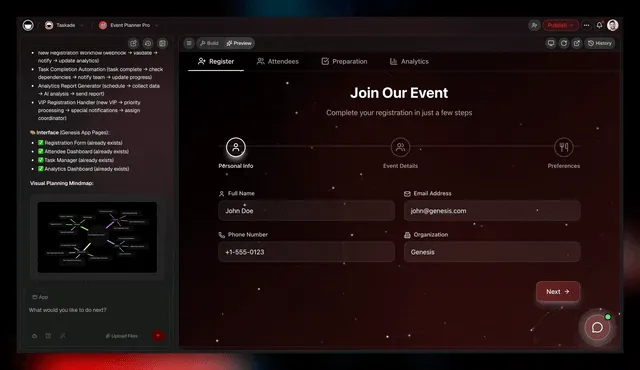
The strongest signal here is what Cheney is doing with his time. He is not building features. He is selling, training, and traveling (he flew to Paris with his daughter for five days mid-interview). The workspace runs while he's gone. That's the test of a real one-person company.
The 30-Day Playbook to Copy Cheney
If you want to test this for yourself in May 2026, here is the calendar:
Ascii
WEEK 1 — BUILD (Mon - Sun)
Mon  Tue  Wed  Thu  Fri  Sat  Sun
[  vibe-code prototype in Taskade Genesis  ]
~10-12 hrs/day, $30 domain, $50 in creditsWEEK 2 — VALIDATE (Mon - Sun)
Mon  Tue  Wed  Thu  Fri  Sat  Sun
[ DM 10 ][ DM 10 ][ DM 10 ]   [calls][calls]
target: 1 reply per day, 1 call per 5 messages
WEEK 3 — CLOSE (Mon - Sun)
Mon  Tue  Wed  Thu  Fri  Sat  Sun
[ first paid pilot @ $5-15K, 1-month engagement ]
deliver value manually first; document everything in Taskade Genesis
WEEK 4 — RECUR (Mon - Sun)
Mon  Tue  Wed  Thu  Fri  Sat  Sun
[ ask: "do you have a stick-around model?" ]
upgrade paid pilot to $5-15K/mo retainer
Total cash outlay through day 30: under $200. Total time investment: ~120–160 hours. At Cheney's hit rate, expected outcome is one $5–15K monthly retainer signed by day 30.
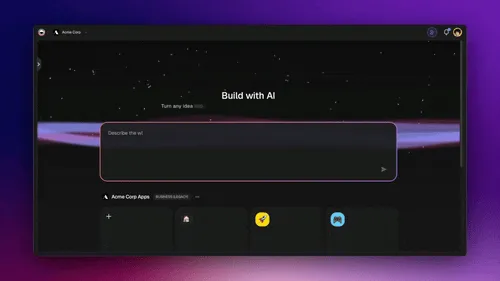
The discipline most copycats break: don't build features in week 4. Sell. Train. Document. The workspace gets better while you sleep. But only if there's a customer paying you to make it better.
What Cheney's Story Validates About 2026
Three things that were not obvious in 2024 but are now visibly true:
| Old assumption | Cheney's evidence | Implication |
|---|---|---|
| You need a co-founder | Solo for first 6 months, $1M revenue | Solo is the default; team is the optimization |
| You need a CTO | Self-described non-coder | Vibe-coding is the new CTO until ~$3M ARR |
| You need to raise capital | $400 cash, no funding | Capital is for speed, not survival |
| SaaS multiples are gospel | 6–7× services-led, $15M valuation | Service-led + SaaS layer beats pure SaaS at this scale |
| You should "build first" | Manual-first, automate after demand | The Wizard-of-Oz pattern (see Dan Martell's 6-step) wins |
| Marketing is paid | LinkedIn build-in-public + Joe Rogan accident | Distribution finds builders who ship and talk publicly |
The category Cheney accidentally founded, fractional Chief AI Officer for the messy middle ($10–30M businesses without a CTO), is the largest underserved B2B segment in 2026. Every painting company, every pool builder, every masonry firm in the US is one CEO call away from a $15K/mo retainer. The TAM here, at Cheney's pricing, is measured in tens of thousands of businesses.
The next 100 Cheneys ship faster because they don't have to glue 5 tools together. They get the workspace.
Frequently Asked Questions
Who is Jon Cheney and what is Gen-AIPI?
Jon Cheney is a non-technical operator who founded the General AI Proficiency Institute (Gen-AIPI) on February 27, 2025 after vibe-coding a software prototype on Replit in three days. He invested approximately $400 in domain, email, Stripe setup, and AI credits, closed a $15,000 enterprise customer the following Tuesday, and reached $180,000 in revenue in the first six weeks. Year one closed at $2.5M revenue and over $1M in net profit with no employees for the first six months. He had previously raised about $13M for an unrelated startup that he sold before starting Gen-AIPI.
How did Jon Cheney's first $15,000 customer come in only five days after launch?
Cheney pivoted away from his original AI IQ test funnel, 150 leads, zero conversions because of a Stripe misconfiguration he caught and fixed in five minutes, and started cold-messaging local business owners on LinkedIn. After six messages, one CEO of a few-hundred-employee company asked for a call, asked the price, and bought a $15,000 employee-AI-readiness assessment plus training package on the call. The pitch was a FOMO frame: "I can measure your team's AI readiness and build a plan so you don't miss the boat." That single Tuesday call set the entire trajectory.
What is the Gen-AIPI fractional Chief AI Officer model?
About four months after launch, an existing customer asked Cheney for an ongoing engagement instead of a one-time training. Cheney invented the fractional Chief AI Officer service on the call, $10,000 to $25,000 per month for 12 to 60 hours of work covering strategy, transformation, and training. Pricing later shifted from hourly to system-installation. Most customers are $10M to $30M revenue businesses without a CTO. Vertical mix: painting, pool construction, masonry, plus higher-profile clients including Tony Robbins and Dean Graziosi.
What is the tool stack Jon Cheney used to build his app and run his business?
The original prototype was vibe-coded on Replit in three days, about 35 hours total, for roughly $400 including domain, email, Stripe, and credits. His operations stack uses ChatGPT and Grok as research and project-management teammates, OpenClaw or Claude Code as an internal "Jarvis" Slack bot with one channel per client, a custom-built CRM and dashboard he vibe-coded internally, and Manus for cold-outreach research. The Replit CEO went on Joe Rogan and credited Cheney's build, which generated organic distribution and Tony Robbins as an inbound client.
Why did Jon Cheney choose vibe-coding over hiring a dev shop?
Cheney had received a $105,000 quote from a Ukrainian dev shop for an unrelated travel social-network idea and had hung up the call when he saw a LinkedIn post about Replit. He dragged the proposal PDF into Replit and the platform built a working prototype in roughly 20 minutes. He estimated that the same product his prior company would have taken 18 months and $3.2M in salaries to build cost him three days and $400 with vibe-coding. That frame-break became the genesis insight for Gen-AIPI: "Software is now you can build software in 10 minutes that you then use to complete a task and then throw away."
What does Cheney's case study tell operators choosing between Replit, Bolt, Lovable, and Taskade Genesis?
Cheney's product was a quiz funnel, but the business value lives in his services layer, the assessment, training, and recurring fractional Chief AI Officer contracts. That is the gap Taskade Genesis is built to close. Taskade Genesis ships a workspace below the app: Memory holds client data as Projects, Intelligence runs assessments and follow-ups via Agents v2, and Execution wires Slack, CRM, email, and calendar through Automations without leaving the canvas. Replit, Bolt, and Lovable ship code; Taskade Genesis ships a runtime where the agent and the data are already in the same room as the human. For non-technical operators copying Cheney's playbook, this is the difference between maintaining seven platforms and running one.
What was Cheney's revenue trajectory and current employee count?
Day five, first customer at $15,000. Six weeks, $180,000. Six months, approximately $1M revenue and still solo. Year one (February 2025 to February 2026), $2.5M revenue and over $1M net profit. April 2026 run-rate, $7M to $8M ARR target by end of 2026, with five full-time employees on benefits and salaries plus Cheney himself. The team is projected to be roughly 15 employees by end of 2026. Net profit margin tracks above 50%.
What does it cost to copy Cheney's playbook in 2026?
Domain plus email setup costs about $30. Stripe and payments are free until the first transaction. Vibe-coding tool credits on Replit, Bolt, Lovable, or Taskade Genesis run $25 to $50 per month on the entry tier. Cold-outreach tooling adds about $50 per month. Total month-one cash outlay lands under $200. The non-cash cost is the 35 to 40 hours to build the first prototype and the willingness to cold-message ten business owners before the first call. Cheney's frame: "I needed $30 to find out if my idea would work, instead of $100,000."
Why does Cheney recommend not becoming a dev shop?
Cheney's strongest piece of advice for operators copying his playbook is to sell systems and training, not custom builds. "If you sell a bunch of coding, you've sold yourself a job that someone has to maintain forever." His best customers vibe-code their own internal tools after his team trains them. Recurring revenue comes from installing and managing the customer's system, not from being the customer's dev shop. This is why workspace-style platforms like Taskade Genesis beat code-generators for service-led operators, the customer keeps building inside the workspace after the engagement ends.
How does Cheney's playbook validate Taskade Genesis's positioning?
Cheney's product was a quiz; his moat was the workspace below it, assessment data, training plans, follow-up automations, CRM, internal Jarvis assistant. That layered architecture is exactly Workspace DNA: Memory feeds Intelligence, Intelligence triggers Execution, Execution creates Memory. Taskade Genesis ships this loop by default in a single workspace. Cheney built it himself across Replit, ChatGPT, Grok, OpenClaw, and a custom CRM. Taskade Genesis collapses that stack into one workspace at $6 to $25 per month per seat, which is the natural distribution channel for the next 100 Cheneys.
Related Reading
The three companion deep-dives that complete this thesis:
- Bring Your Own Agent: The $1M-Per-Employee Era, the operator-pricing layer above the Cheney case study
- One-Person Companies: The Future of Work, the broader category Cheney is part of (with Dan Martell's Wizard-of-Oz playbook)
- How to Win With AI in 2026, the workflow-first operator's playbook (10 plays, 1 workspace)
- Best AI App Builders 2026, the tier list Cheney's tools sit inside
- Forty People Week, output-per-employee benchmarks at the leading edge
- Workspace DNA Architecture, the technical reference for the loop Cheney built by hand
- The Remix Economy, the first-party data behind why operators clone proven systems instead of building from scratch
- What People Actually Build With AI, the category census: dashboards, CRMs, and trackers, not toys
Build your own Cheney-style workspace in Taskade Genesis →