







In January 2026, TechCrunch published a piece with a striking framing — non-developers are writing apps instead of buying them. In February, Gizmo (Atma Sciences) launched a TikTok-style feed of AI-generated mini apps and hit 600K installs by April, with $9M from the OpenAI Startup Fund. By that same month, Taskade's Community Gallery crossed 150,000 public Genesis apps built. A category that did not have a name a year ago is now a meaningful slice of the software market.
This post is the state-of-the-category report nobody else can write — because nobody else has the data. 150,000 apps is a corpus. It tells us what archetypes retain users, what integrations matter, and where the economic gravity is pulling. If you are building, investing in, or just curious about micro apps in 2026, here is the map.
TL;DR: Micro apps grew ~340% YoY. Taskade built 150,000+ public Genesis apps. The category splits into 5 archetypes (Calculators, Dashboards, Forms+Agent, Trackers, Portals), 3 platform types (Consumer feed, Workspace-native, Ephemeral chat), and 3 monetization models. Start free at /create. Pro is $10/mo billed annually.
🧮 What Counts as a Micro App?
A micro app is a single-purpose application built from one prompt that ships with its own deployed URL, authentication, data layer, and AI behavior — wider than a widget (which is an embedded snippet) but narrower than a SaaS product (which ships roadmaps, per-seat billing, and compliance). The category sits between "a thing I embed in a Notion page" and "a thing I sell on G2." Here is the shape most people land on.
                   ┌─────────────────────────────────────────┐
                   │       SIZE OF THE ARTIFACT              │
                   │                                         │
    WIDGET  ──→   MICRO APP   ──→   SAAS PRODUCT            │
                                                             │
    (embed,    (single prompt,     (team, per-seat,          │
    no state,  deployed URL,       compliance, roadmap)      │
    one func)  auth + data + AI)                             │
                                                             │
                   └─────────────────────────────────────────┘
A micro app is bigger than a widget — it has state, auth, and usually AI. It is smaller than a SaaS product — it targets one workflow, not a department, and it was built in minutes by one person, not in months by a team.
📈 The Numbers (April 2026)
| Metric | Value | Source |
|---|---|---|
| YoY growth in "micro app" queries | +340% | Google Trends, Jan 2025 → Jan 2026 |
| Gizmo (Atma Sciences) installs | 600K in <6 months | TechBuzz AI, Feb 2026 |
| Gizmo (Atma) seed round | $9M (OpenAI Startup Fund) | TechCrunch, Feb 4 2026 |
| Taskade public Genesis apps | 150,000+ | Community Gallery |
| Custom GPTs in OpenAI GPT Store | ~500K public (3M created) | SEO.ai |
| Low-code market 2026 | $44.5B | Gartner, 2026 forecast |
| Low-code market 2030 projection | $187B | Industry analyst forecast (P&S Intelligence / AMR) |
| Share of new enterprise apps via low-code by 2026 | 70% | Gartner (up from <25% in 2023) |
| Enterprise GenAI spending 2025 | $37B (3.2× YoY) | Menlo Ventures, Dec 2025 |
| ChatGPT weekly active users | 900M+ (Feb 2026) | TechCrunch, Feb 27 2026 |
Two observations worth sitting with:
The unit economics flipped. In 2020, building a single-purpose app cost tens of thousands of dollars and months of engineering. In 2026, it costs minutes and a few hundred credits. When the cost of creation drops two orders of magnitude, the number of things worth creating explodes. We have seen this before: in 1987 Apple bundled HyperCard free with every Mac, and laypeople answered with hundreds of thousands of "stacks" — niche tools Bill Atkinson said "only a mother could love" that no commercial vendor would ever have built. That was the first micro-app economy; the 150,000-app gallery is the same explosion with the authoring cost driven to near-zero.
Distribution is the new moat. Gizmo's seed was about owning the consumer feed layer. Taskade Genesis's 150K gallery is the same bet from the workspace side. Whoever owns the discovery surface collects the exhaust from all the apps that get built.
⚠️ The Two Gizmos: Don't Confuse the Micro-App Feed With the Edtech Rocket
TechCrunch's April 2026 coverage has been cited sloppily across the industry. There are two companies called Gizmo, and only one is a micro-app platform.
| Product | Company | What it is | Users | Funding |
|---|---|---|---|---|
| Gizmo (micro-app feed) | Atma Sciences | TikTok-style swipe feed of AI-generated mini apps | 600K installs | $9M seed (OpenAI Startup Fund, Jan 2026) |
| Gizmo (edtech) | Gizmo Learn | AI flashcards + study app | 13M | $22M Series A (Shine Capital, Apr 2026) |
When this post says "Gizmo," we mean Atma Sciences — the micro-app feed. The edtech product is a separate company operating in a different category (consumer learning). If you see a headline about "13M users," that is the edtech one.
The consumer micro-app Gizmo has no monetization live as of April 2026 — no paywalls, no creator payouts, no subscriptions. As TechBuzz AI wrote, "how Atma Sciences plans to monetize…remains an open question." That is a Taskade wedge worth naming — Taskade Genesis has shipped creator monetization via clone credits since v6.150.
🗺️ The Platform Landscape
Five categories have emerged. Each optimizes for a different context of use.
Comparison matrix — only columns nobody else publishes together:
| Platform | Primary UI | Backend by default | Agents | Automations | Integrations | Community Gallery | Starting Price |
|---|---|---|---|---|---|---|---|
| Taskade Genesis | Workspace | ✅ built-in | ✅ Agents v2 | ✅ Automations | 100+ | 150,000+ apps | $10/mo |
| Gizmo | Mobile feed | Hosted | ❌ | ❌ | Limited | Feed-based | Freemium |
| Claude Artifacts | Chat sidebar | Ephemeral | Inline model | ❌ | ❌ | ❌ | With Claude Pro |
| Lovable | Code editor | External (Cloud) | ❌ native | Via code | Supabase | Project feed | $25/mo |
| Bolt.new | Code editor | External (Netlify) | ❌ native | Via code | NPM | Public URLs | $20/mo |
| v0.dev | Code editor | Frontend only | ❌ | ❌ | NPM | ❌ | ~$20/mo |
| Bubble.io | Visual builder | ✅ built-in | ❌ | Workflows | 140+ | Marketplace | $32/mo |
The two columns no competitor ships together are Agents + Automations + Integrations + Community Gallery. That is the Workspace DNA stack — Memory feeds Intelligence triggers Execution. It is the reason Genesis apps keep running after you generate them instead of staying frozen like a code snapshot.
🏛️ The Five Archetypes That Actually Retain Users
After reviewing the highest-cloned Genesis apps in the Community Gallery, five shapes stand out. If you are building your first micro app, start with one of these — they survive contact with real users.
1. 🧮 Calculators
Single input → single output. Clear unit of value per use.
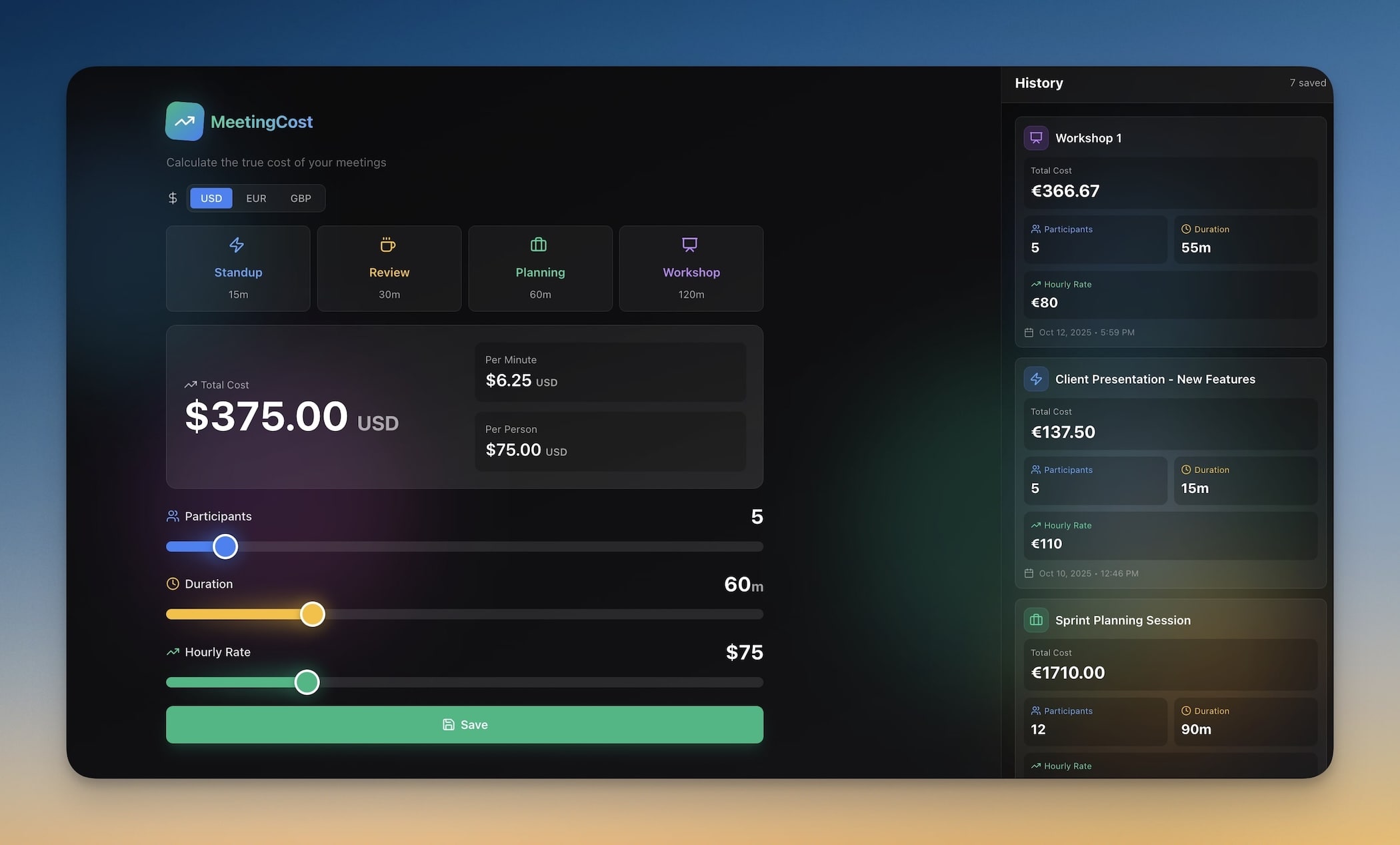
- Real community example: Meeting Cost Calculator — enter headcount + hourly rate, get the dollar cost of every meeting you take.
- Other examples: ROI, loan payoff, protein intake, crypto gas, fertility window
- Gallery count: ~12,000 public apps
- Why they retain: the user bookmarks it for repeated reference
- Typical build time in Taskade Genesis: 5–10 min
2. 📊 Dashboards
Live data view wired to an API, a project, or a sheet. Refresh on visit.

- Real community example: Finance Tracker Dashboard — income, expenses, savings rate, trends.
- Other examples: revenue dashboard, KPI tracker, Stripe MRR, GitHub PR queue
- Gallery count: ~18,000 public apps
- Why they retain: they become the morning browser tab
- Typical build time: 10–20 min with one integration
3. 📝 Forms + Agent
Form captures input, agent reacts or routes. Optional write-back into a project.
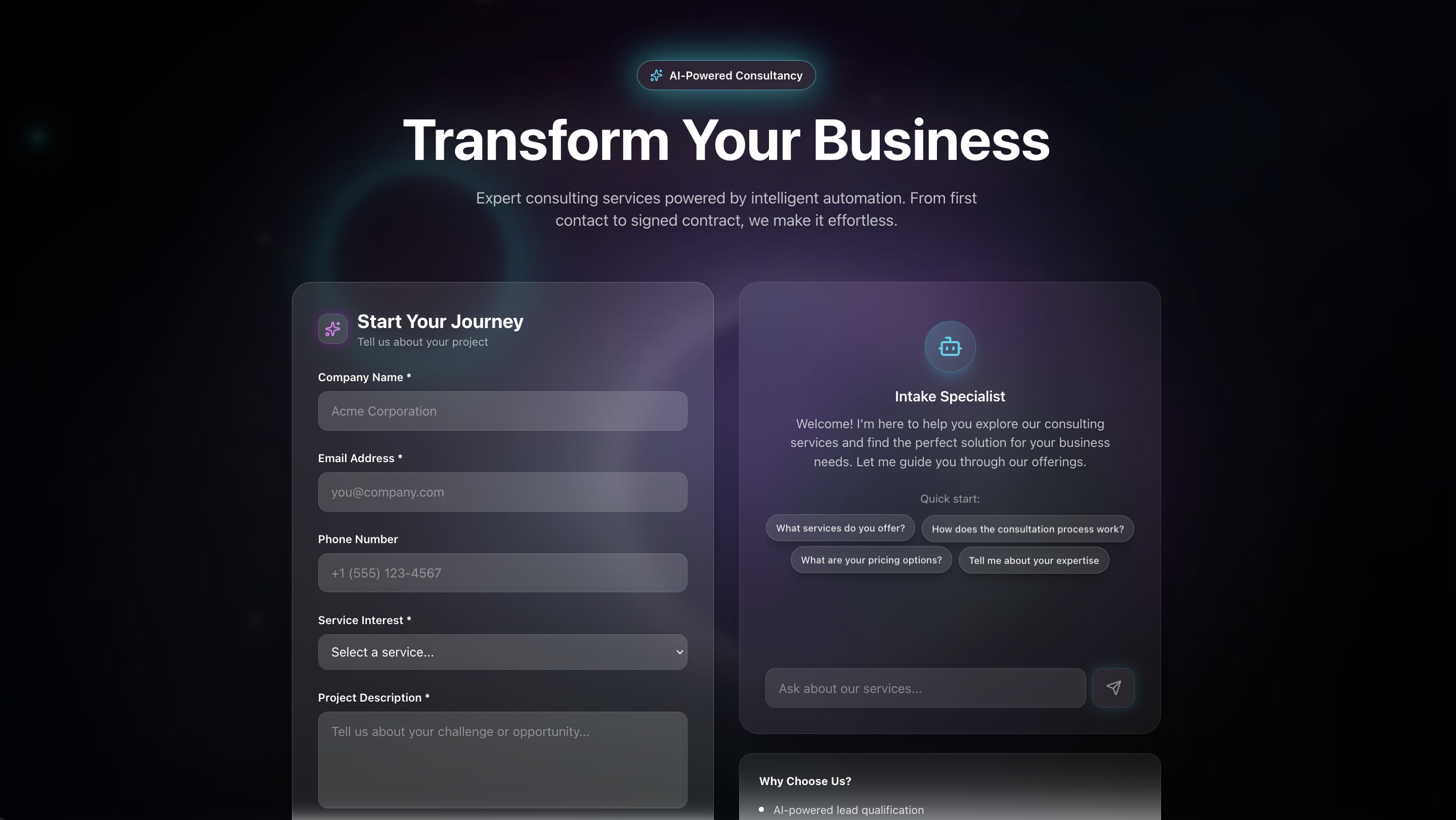
- Real community example: Smart Feedback Form — Typeform + Zapier + sheet trio collapsed into one Genesis app.
- Other examples: lead qualification form, bug triage form, content brief intake, consultancy booking
- Gallery count: ~22,000 public apps — the largest archetype
- Why they retain: replaces 3 tools with one, auto-routes, writes back to a project
- Typical build time: 15–30 min (agent + automation)
4. 📈 Trackers
State persists across visits. Progress, streaks, habits, pipeline stages.
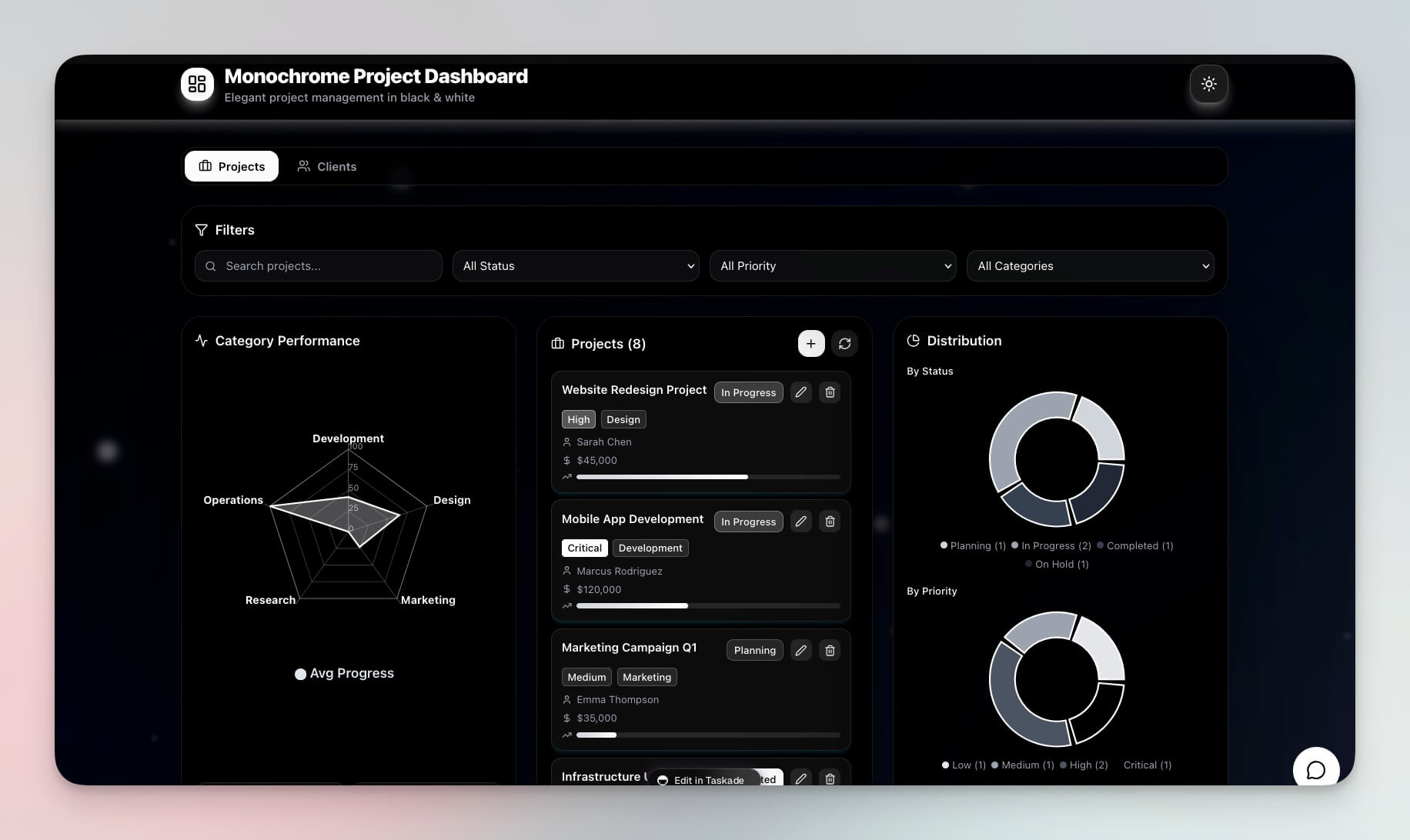
- Real community example: Time Tracker — project-scoped time with custom fields (a timer custom-field type shipped in Agents v2).
- Other examples: habit tracker, OKR tracker, sales pipeline, study planner
- Gallery count: ~16,000 public apps
- Why they retain: state creates switching cost; user's data lives inside the app
- Typical build time: 20–45 min with custom fields
5. 🏢 Portals
Small multi-page branded site. Often has auth and a few connected forms.

- Real community example: Client Portal — branded client workspace with auth, a few pages, and scheduled reports.
- Other examples: student hub, HR onboarding page, alumni portal, class booking
- Gallery count: ~14,000 public apps
- Why they retain: the branded URL becomes the canonical "place to do X"
- Typical build time: 30–60 min with GenesisAuth + custom domain
ASCII-summarized for sharing:
+------------+------------+---------------+---------------+
| ARCHETYPE  | COUNT (~)  | RETAIN MECH   | REPLACES      |
+------------+------------+---------------+---------------+
| Calculator |   12,000   | Bookmark      | Web calc JS   |
| Dashboard  |   18,000   | Morning tab   | Looker/Retool |
| Form+Agent |   22,000   | Auto-routing  | Typeform+Zap  |
| Tracker    |   16,000   | State lock-in | Notion trackr |
| Portal     |   14,000   | Branded URL   | Framer+Auth0  |
+------------+------------+---------------+---------------+
   Total on-ramp coverage: 82K of 150K = 55% of the gallery
The other 45% is a long tail of hybrids (Calculator+Tracker, Dashboard+Portal) and novel shapes — games, agent demos, embedded widgets. If you are building for breadth, start with one of the five above; if you are building for novelty, wade into the long tail.
💰 The Three Monetization Models
▲ ■ ● The Boring-Utility Counterpoint: Will Cannon and Hostinger Horizons
The micro-app economy is not all consumer-app sparkle. The other half is utility — and the data says it pays better than the headlines suggest. Two case studies make the pattern obvious.
| Operator | Niche | Trajectory | Mechanism |
|---|---|---|---|
| Will Cannon | B2B lead-list reseller | $0 (post-2008 mortgage crash) → $1M Y1, then UpLead to $1M ARR Y1 again, then Signaturely to 1.9M users | Spotted listguy.com on BizBuySell for ~$200K → built The Data Supplier → ranked #1 SEO + cold email |
| Hostinger Horizons "boring utility" portfolio | Calculator / converter / lookup tools | ~$6M/year | One specific painful problem, evergreen demand, ad + affiliate monetization |
The Hostinger Horizons numbers, when broken out per tool, are stunning:
| Boring utility | Monthly traffic | Estimated revenue |
|---|---|---|
wordunscrambler.me |
~11M visitors / ~55M page views | ~$495,000 / month at $9 RPM |
calculator.net |
(high) | ~$825,000 / month |
| "What is my IP" | (high) | ~$111,000 / month |
| Sleep calculator | (medium) | ~$9,000 / month |
"Solve one specific problem instantly. Search → answer in seconds → leave happy. Demand is huge and evergreen. Mortgage calculator was needed 10 years ago, needed today, needed in 2030. Build once, runs indefinitely."
— Hostinger Horizons playbook, April 2026."Sell it before you have it. I just want to emphasize how valuable it is to go window shopping on bizbuysell.com. You can learn so much. It costs nothing."
— Will Cannon, April 2026.
Compound strategy (verbatim from the source): "1 tool might earn $20/mo. Another $500. Another $5,000. Five tools earning $200 each = $1,000/mo."
The implication for the micro-app economy: builders chasing platform-paid monetization (the broken model in the next section) are missing the second half of the category. Direct-sale utility apps with their own domains and their own newsletter lists are still a path to seven figures — they just don't trend on X. In Taskade Genesis, this looks like one Genesis app with a custom domain (v6.115+), Stripe checkout via Automations (v6.149), and a Project that holds the customer list. One workspace. One utility. Recurring revenue.
"The only guarantee of failure is not trying. The model is proven, demand is evergreen, barrier to entry has never been lower."
— Hostinger Horizons playbook, April 2026.
The Three Monetization Models
| Model | Who pays | Examples | Best fit |
|---|---|---|---|
| Direct | End user | Paid portal, paid calculator, paid tracker | Content/education, client work, boring-utility plays |
| Distribution | Platform pays you (usage, clone credits, affiliate) | Gallery clone attribution (Taskade v6.150), Gizmo creator rev-share (unannounced) | Creators, viral utility apps |
| Indirect | Your audience (lead-gen) | Free app = CTA for your agency, course, or service | Consultants, solo operators |
Taskade Genesis unlocks all three. Concrete capability list as of April 2026:
| Capability | Shipped in | What it unlocks |
|---|---|---|
| Clone creator credits | v6.150 | Earn when someone clones your gallery app |
| Stripe checkout session action | v6.149 | Sell access to your app directly |
| Custom domains + SSL | v6.115+ | Your own branded URL, auto-SSL |
| GenesisAuth (OIDC / SSO) | v6.144+ | Gate your app behind login |
| App Users (beta) | v6.150 | First-class end-user management for published apps |
| Auto top-up billing | v6.150 | Set a credit threshold, auto-purchase |
| Credit audit log | v6.150 | See where every credit went |
| Publish to Community Gallery | v6.100+ | Tap 150K-app discovery surface |
💥 Why Platform-Paid Monetization Is Broken (and Direct-Sale Wins)
Every big platform promised creators a revenue share. Most broke that promise. The data is ugly.
| Platform | Creator monetization reality | Source |
|---|---|---|
| OpenAI GPT Store | Median qualified creator earns <$100/quarter. 80%+ miss the 25-convos/week minimum and earn $0. | The GPT Shop |
| Gizmo (Atma) | No monetization live. No paywall, no revshare, no creator payout as of Apr 2026. | TechBuzz |
| Claude Artifacts | No creator payments. Ever. | Anthropic docs |
| Lovable / Bolt / v0 | No native monetization — you bolt on Stripe yourself | Lovable/Bolt/v0 docs |
| Taskade Genesis | Clone creator credits + Stripe checkout + custom domains + custom auth | V3 credits docs, v6.149 + v6.150 |
The pattern: platforms that pay creators via the platform fail. Platforms that let creators sell directly (domain + auth + Stripe + clone credits) win. Taskade built the direct-sale stack into Taskade Genesis on purpose.
🗄️ The Storage Ceiling Problem (and the Workspace Answer)
Micro-app platforms hit a storage ceiling fast. The ones that do not, treat the workspace as the backend.
| Platform | Storage model | Binary/file support | User-data persistence |
|---|---|---|---|
| Claude Artifacts | 20 MB per artifact, text only | ❌ (no binaries) | ❌ (storage only works after publish) |
| Gizmo feed | No persistent user data | ❌ | ❌ |
| Lovable / Bolt | Supabase / Postgres (you manage) | ✅ | ✅ (you wire it) |
| ChatGPT Canvas | Per-session, ephemeral | Limited | ❌ |
| Taskade Genesis | Projects = the database. No MB ceiling. | ✅ files up to 100 MB | ✅ workspace-native, RBAC-scoped |
When the question "where does user data live?" does not have an answer, your micro app is a demo. Workspace DNA answers it by default — your Projects are the database, your multiple project views are the UI, your Agents v2 are the logic layer. No Supabase to provision, no auth to bolt on, no storage tier to upgrade.
🔠 The "Micro App" Term Is Uncontested
One quiet SEO fact worth naming. The biggest vibe-coding platforms have not claimed the term "micro app":
| Platform | Uses "micro app"? | What they use instead |
|---|---|---|
| Lovable | ❌ (uses "micro SaaS" for some guides) | "full-stack apps", "vibe coding" |
| Bolt.new | ❌ | "full-stack web applications" |
| v0.dev | ❌ | "components", "apps" |
| Cursor | ❌ | "code", "projects" |
| Gizmo (Atma) | ❌ (uses "mini app") | "mini apps" |
| Taskade | ✅ | "micro apps", "workspace-native apps" |
| TechCrunch (journalism) | ✅ | "micro apps" |
This matters for SEO: the term is functionally uncontested. Taskade and TechCrunch are the two active claimants. Whoever anchors the category keyword owns a decade of inbound.
👥 The Creator Economy Layer
A micro app platform without creator identity is just a sandbox. Where user trust compounds is in named builders — people whose work you come back to.
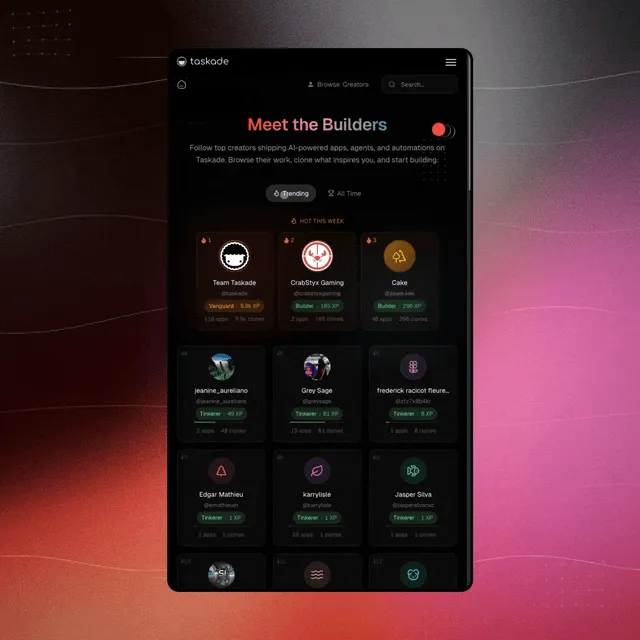
Taskade's April 2026 Creators Page refresh surfaces builders by the apps they ship. Cloneable templates accumulate creator credits (v6.150). That is the revenue-share step every other platform has either not shipped (Gizmo, Artifacts) or shipped with broken economics (GPT Store median <$100/quarter).
🚀 The One-Week Micro App Playbook
If you are reading this and want to ship a micro app this week, here is the simplest path.
| Day | Step | Time |
|---|---|---|
| Monday | Clone a gallery app close to your idea | 30 min |
| Tuesday | Rewrite the prompt with EVE to reshape it for your use case | 1 hr |
| Wednesday | Wire one integration (Slack / Notion / Airtable / Stripe) | 1 hr |
| Thursday | Add one automation trigger (schedule, form submit, webhook) | 1 hr |
| Friday | Set custom domain, turn on password, publish to gallery | 30 min |
Total: about 4 hours of active work across five days. Your first micro app is live.
🔁 The Platform-Side Mirror: How Incumbents Are Responding
Operators building micro-apps on workspace-native platforms is one half of the story. The other half is what happens when 14-year-old SaaS incumbents notice and refound themselves around the same primitive.
Airtable is the cleanest case. Between June 2025 and February 2026, CEO Howie Liu shipped three AI-native products on top of the existing low-code business-app base: Omni (June 24 2025 conversational refound), Superagent (Jan 27 2026 — Airtable's first standalone product in 13 years, on its own domain at superagent.com), and Hyperagent.com (early 2026 — agents with their own cloud computing environment per session). The full play-by-play is in the complete history of Airtable.
The signal for micro-app operators: the workspace-native architecture wins on both ends of the market. Solo builders ship faster on it. Decacorn-era platforms refound themselves around it.
🔮 Where the Category Goes Next
Three forecasts based on the data we see:
The app-per-workflow ratio flips from 1:N to N:1. Today a team uses 5 SaaS tools to cover 5 workflows. By end of 2026, a team will have 50 micro apps covering 50 workflows, because the incremental cost of another app is near-zero.
Distribution networks consolidate. Right now micro apps live in Gizmo feeds, Taskade Genesis galleries, Claude artifact sidebars, and Lovable public URLs. Expect a meta-layer that indexes across all of them, like what Product Hunt did for SaaS. Taskade's Community Gallery is the biggest single corpus; it is positioned to be indexed or to be the index.
Compliance catches up last. SOC 2, HIPAA, and GDPR-sensitive industries are still buying per-seat SaaS. When a micro app platform ships enterprise SSO and audit log by default (Taskade Genesis ships GenesisAuth OIDC in v6.144+), the category crosses into B2B. That is the $187B prize Gartner named.
📚 Further Reading
- What Are Micro Apps? The Trend Reshaping Software
- The HyperCard Moment: From Bill Atkinson to AI Micro Apps
- Taskade Genesis Compilation: From Prompt to Deployed App
- The Anatomy of a Taskade Genesis App
- Workspace DNA: The Context Engineering Blueprint
- How to Build SaaS in 24 Hours with AI
- Best AI App Builders (2026)
- 50 AI Apps You Can Clone in One Click
External references:
- TechCrunch — The Rise of Micro Apps (Jan 2026)
- TechCrunch — Gizmo $22M raise (Apr 2026)
- Gartner — Low-code/No-code market
- Menlo Ventures — State of GenAI 2025
🎯 Ship Your First Micro App This Week
The hardest part of micro apps is not building them. It is naming the workflow worth micro-apping. Start there — pick one repeatable thing you do every week — and build it free at Taskade.
- Start free — build in 5 min
- Browse the 150K gallery
- See pricing — Free, Pro $10/mo billed annually
The micro app economy is not a future trend. It is the software category of 2026. You are already a user of it. Now you can be a builder of it.
Companion Reads — The 2026 Operator Cluster
- How to Win With AI in 2026: The Workflow-First Operator's Playbook — what operators do with 150,000 micro apps
- BYOA: The $1M-Per-Employee Era — the compensation model behind the micro app boom
- From Roles to Workflows: The AI Org Chart — where published micro apps replace team coordination
- Training AI Agents Like Employees — the tuning discipline behind micro apps that retain
Frequently Asked Questions
What are micro apps?
Micro apps are small, purpose-built AI-generated applications — typically built from a single prompt and deployed to a live URL in minutes. They are smaller than a SaaS product but larger than a widget. Examples include a booking form with scheduling logic, a personal dashboard wired to an API, a client portal with auth and a few pages, or a calculator with embedded AI reasoning. TechCrunch coined the modern meaning of the term in January 2026, and the category has grown roughly 340% year over year.
How many micro apps have been built in 2026?
Estimates vary and you have to know which Gizmo is which. Taskade's Community Gallery holds more than 150,000 public Genesis apps as of April 2026, the largest single corpus of workspace-native micro apps. Gizmo (Atma Sciences), the TikTok-style micro-app feed, reports 600,000 installs within six months of public launch and raised a $9M seed in January 2026. (A separate edtech study app also named Gizmo raised $22M at 13M users in April 2026 — it is not a micro-app platform.) Claude Artifacts does not publish totals but benefits from distribution through major AI assistant ecosystems, including ChatGPT's 900M+ weekly-active user base and Claude's separate audience. Taken together, the micro app economy produced tens of millions of apps in a single year — a pace that exceeds the App Store's first-year launch.
What is the difference between a micro app and a traditional SaaS product?
A traditional SaaS product is built by a team, priced per seat, and sold as a subscription. A micro app is typically built in minutes by one person from a prompt, deployed for free or a few dollars, and replaces a single workflow that SaaS used to bundle into a heavy product. Five calculators, a scheduling form, and a client portal that used to require a $40-per-seat SaaS stack can now be three micro apps costing one Pro plan. That is why TechCrunch called the trend the unbundling of SaaS.
How does Taskade Genesis compare to Gizmo for micro apps?
Gizmo is a TikTok-style consumer feed for vibe-coded mini apps — great for personal, bite-sized, social consumption. Taskade Genesis is workspace-native — the app sits inside a team workspace with projects, AI agents, automations, and 100+ integrations. Gizmo optimizes for discovery; Taskade Genesis optimizes for workflow. If you want someone to tap through your app on a phone, Gizmo. If you want your team to actually run a business on it, Taskade Genesis.
What are the five archetypes of successful micro apps?
After reviewing the top-ranked public Genesis apps we see five archetypes that retain users. (1) Calculators — single-purpose tools with clear input and output. (2) Dashboards — live views wired to an API or a project. (3) Forms plus agent — form captures data and an agent reacts or summarizes. (4) Trackers — habit, study, sales pipeline, or OKR tracking with progress state. (5) Portals — a small branded space with a few pages and auth, often for clients or students. Every category has at least 5,000 apps in the Community Gallery.
How much does it cost to build a micro app?
Taskade offers a free plan, and Free starts with no AI credits: you earn credits with referrals and invites, or buy a credit pack on any plan. Paid Taskade Genesis building starts at $10 per month on the Pro plan (annual billing), covering most solo builders and unlocking 10 seats. Gizmo and Claude Artifacts have their own consumer pricing. The economic threshold for a useful app has dropped from tens of thousands of dollars (traditional SaaS dev) to about $10 per month (Taskade Genesis Pro). This is the single biggest driver of the 340% YoY growth.
Do micro apps replace SaaS?
For some workflows, yes. A solo operator can now ship five Genesis apps — booking, dashboard, client portal, tracker, calculator — for a fraction of what a Notion + Calendly + Airtable + Typeform + Framer stack used to cost. For enterprise workflows with compliance, complex permissions, and integrations, SaaS still wins. The micro app economy is not killing SaaS — it is absorbing the long tail that was never worth a per-seat price.
Can I monetize a micro app?
Yes. Taskade Genesis apps support custom domains, password protection, public gallery publishing, and clone-with-creator-credits (v6.150) where you earn credits when someone clones your template. Gizmo is launching creator monetization. Claude Artifacts can be embedded in paid Claude features. The micro app economy has three emerging revenue models — direct (user pays you), distribution (platform pays on usage), and indirect (app is lead-gen for your services).
What integrations do micro apps need?
The top five integrations across the 150,000 public Genesis apps in our gallery are Google Workspace, Slack, Notion, Airtable, and Stripe. Taskade Genesis ships with 100+ integrations across 10 categories — Communication, Email/CRM, Payments, Development, Productivity, Content, Data/Analytics, Storage, Calendar, and E-commerce. Apps built on platforms without a built-in integration layer typically stall at the first external API call.
How do I get started building a micro app?
Three steps. Open the Community Gallery at taskade.com/apps, clone an app close to what you want, and iterate with EVE. Clones come with creator-credited attribution and the underlying Workspace DNA intact. If you would rather start blank, write a single prompt at taskade.com/create — EVE will ask clarifying questions, plan, build, and deploy in minutes. Either path lands you a live app with a URL you can share.
Are 'boring utility' micro apps actually profitable?
Yes, and the gap between boring-utility revenue and viral-micro-app revenue is wider than most operators expect. Will Cannon went from zero (post-2008 mortgage crash) to $1M in year one selling pre-built B2B lead lists with cold email outreach, then repeated the result with UpLead and Signaturely. Hostinger Horizons reportedly does about $6M per year on boring-utility web tools — wordunscrambler.me alone earns roughly $495,000 per month at 11M visitors and a $9 RPM, and calculator.net earns around $825,000 per month. The pattern beats viral micro-apps on every defensible metric: predictable demand from search, no platform-paid revenue ceiling, no app-store gatekeeper, and recurring traffic from a single SEO investment. In Taskade Genesis, a boring-utility business looks like one Genesis app with a custom domain, Stripe checkout via Automations, and a Project holding the customer list — one workspace, one utility, recurring revenue.