

Taskade Genesis is a no-code, model-neutral alternative to OpenAI AgentKit: you describe an app in plain language and it ships deployed, with AI agents, automations, and 100+ bidirectional integrations already wired in. AgentKit is a developer toolkit for orchestrating agents on OpenAI's own models, priced on API usage, where you still write code, build the front end, and host the runtime yourself.
See the alternative working: clone in 60 seconds
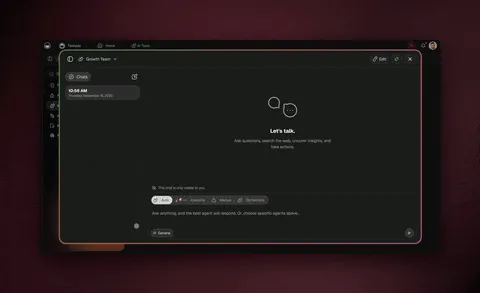
No signup, no credit card.
| Capability | OpenAI AgentKit | Taskade Genesis |
|---|---|---|
| Pricing (starting) | Usage-based API tokens + tool fees | $0 Free · $10/mo Pro billed annually (10 seats) |
| Cloneable live demo | ❌ | ✅ |
| Built-in AI agents | Agents you code, orchestrate, and host | ✅ built-in tools |
| Automation engine | Connector Registry + code you write | ✅ Durable runtime, 100+ integrations |
| Workspace DNA loop | ❌ | ✅ ▲ Memory · ■ Intelligence · ● Execution |
TL;DR: Taskade Genesis is a no-code, model-neutral workspace: describe an app and it ships deployed with AI agents, automations, and 100+ integrations. OpenAI AgentKit is a developer toolkit on OpenAI models, priced on API usage. Agent Builder winds down November 30, 2026. Taskade is Free Forever. Pro is $10/mo billed annually. Try Taskade Genesis free →
Overall winner: ✅ Taskade Genesis for any team whose goal is a deployed app with agents and automations on flat, predictable pricing. OpenAI AgentKit is the stronger choice for an engineering team that wants low-level, code-first control on the OpenAI model layer.
What is Taskade Genesis?
Taskade Genesis is the AI app builder inside the Taskade workspace. You describe what you want in plain language, and it returns a deployed, working application with AI agents, real-time data, automation workflows, and team collaboration already connected. It is built on Workspace DNA: Memory (your Projects), Intelligence (your AI Agents), and Execution (your Automations), a self-reinforcing loop where what your team does becomes the substrate the agents reason over.
A single prompt can produce a customer support portal, an operations dashboard, a CRM, a knowledge base, an intake form, or an internal tool, all with built-in AI agents, automations, custom domains on Business and above, and a public Community Gallery of apps anyone can clone. There is no code to write, no deploy step, and no infrastructure to maintain. It is for everyone: founders, marketers, ops, product managers, and engineers who want to skip the plumbing.
What is OpenAI AgentKit?
OpenAI AgentKit (openai.com) launched on October 6, 2025 at OpenAI DevDay as a toolkit for building, deploying, and testing AI agents on OpenAI's models. It bundles four building blocks:
- Agent Builder is a visual, drag-and-drop canvas for composing multi-step and multi-agent workflows, with preview runs and versioning.
- ChatKit is an embeddable chat component that handles streaming, threading, and in-chat experiences inside your own app.
- The Agents SDK is an open-source Python and Node framework that gives developers programmatic control over agent logic, tools, guardrails, handoffs, sessions, and tracing.
- The Connector Registry manages access to data sources, MCP servers, and built-in tools like web search, file search, and code interpreter through the Responses API.
AgentKit also shipped Evals for grading agent runs. It is genuinely capable developer tooling, and for a team already building on OpenAI it removes a lot of orchestration glue.
One important 2026 change to know before you commit: on June 3, 2026, OpenAI announced it is deprecating the visual Agent Builder, the Evals platform, and reusable Prompts. Evals becomes read-only on October 31, 2026, and Agent Builder shuts down on November 30, 2026. OpenAI's recommended path is the code-first Agents SDK or ChatGPT Workspace Agents, while ChatKit remains available. So the no-code visual piece of AgentKit is being retired, and the durable path forward is the developer SDK, a different shape from a no-code platform for whole teams.
Key Differences
No-code app vs developer toolkit
Taskade Genesis produces a finished, deployed application from a prompt. OpenAI AgentKit produces agent logic that a developer assembles into their own product. With Taskade Genesis, a product manager or operator can ship a working portal without touching code. With AgentKit, shipping something real means writing Agents SDK code, building the surrounding UI beyond the ChatKit chat window, and standing up the runtime.
Model-neutral vs OpenAI-native
Taskade Genesis provides access to 15+ frontier models from OpenAI, Anthropic, and open-weight providers. AgentKit is centered on OpenAI's own models and the Responses API. The open-source Agents SDK can call other providers through compatible endpoints, but the built-in tools, the Connector Registry, and Agent Builder are OpenAI-native, and the toolkit requires an OpenAI API account. If you want to avoid single-vendor lock-in, model neutrality is a structural advantage.
Deployed application vs agent logic you host
With Taskade Genesis, the application is the artifact and the workspace is the runtime. You get a live URL, email sign-in through GenesisAuth on any plan, and custom domains on Business and above, without any deploy pipeline. With AgentKit, the artifact is the agent, so hosting, monitoring, and the user-facing app remain your responsibility. For an engineering team that already owns those surfaces, that is fine. For an operator or PM team, each one is a cost that has to come from somewhere.
Flat pricing vs usage-metered
Taskade Genesis is a flat subscription. Free Forever to start, then Pro at $10 per month billed annually with 50,000 AI credits included. AgentKit has no separate subscription, but it bills on OpenAI API usage: per-token model charges plus tool fees, such as roughly $0.03 per Code Interpreter session and about $0.10 per gigabyte per day for File Search storage. Metered pricing scales with usage and is harder to forecast, especially once agents run at volume.
Team workspace vs API primitive
Taskade is workspace-native: real-time multiplayer editing, comments, chat, and role-based access. AgentKit is an API-layer primitive with no built-in collaboration surface. Agents built with it live in your codebase and your product, not in a shared workspace where non-engineers can contribute.
Choose OpenAI AgentKit If
Honest comparison beats a hatchet job. There are real cases where AgentKit is the better tool:
- You want full programmatic control. The open-source Agents SDK gives engineers precise command over agent loops, guardrails, handoffs, sessions, and tracing. If your team wants to own the logic in code and integrate it deep inside an existing application, that low-level control is genuinely valuable.
- You are all-in on OpenAI's models. AgentKit offers the earliest and most native access to OpenAI's frontier models and built-in tools like web search, file search, code interpreter, and computer use through the Responses API. If your stack is already OpenAI-centric, that first-party integration is hard to beat.
- You are embedding agents into your own product. ChatKit gives you a clean embeddable chat UI, and the Connector Registry centralizes enterprise access to data sources and MCP servers across the OpenAI and ChatGPT ecosystem. For a developer slotting an agent into an existing app, that fit is tight.
Taskade's edge is everywhere else: no-code app generation, model neutrality, agents and automations as part of the product, flat predictable pricing, and a workspace-native collaboration surface for the whole team.
Why Teams Choose Taskade
Taskade Genesis turns a prompt into a deployed app with AI agents, 100+ bidirectional integrations, and durable automations already connected, on a flat subscription whose monthly AI credit allowance is included. OpenAI AgentKit is powerful developer tooling, but it is code-first, priced on API usage, and centered on one vendor's models, and its no-code visual builder is being retired in November 2026. Taskade stays no-code and model-neutral, so a whole team can build and run apps without engineers or DevOps. The table below shows where each fits.
| After you decide to build | OpenAI AgentKit | Taskade Genesis |
|---|---|---|
| The artifact | Agent logic in your codebase | A deployed application |
| Who can build it | Developers on the OpenAI stack | Anyone on the team, no code |
| Models | OpenAI models via Responses API | 15+ frontier models, model-neutral |
| Automations | Code you write and host | 100+ bidirectional integrations, built in |
| Pricing | Usage-based API tokens + tool fees | Flat subscription, monthly AI credits included |
| Operations | You host and monitor it | Managed, zero DevOps |
Pricing and total cost of ownership
| Plan | Taskade Genesis | OpenAI AgentKit |
|---|---|---|
| Free | Free Forever, one-time 1,000+5,000 credit grant, 3 Genesis apps | Agent Builder free to design in; API usage billed separately |
| Entry | Pro $10 / month billed annually, unlimited apps, 10 seats | No subscription; pay per token + tool fees as agents run |
| Mid | Business $25 / month billed annually, custom domains (email sign-in is on every plan) | Same usage-based model; costs scale with volume |
| High end | Max $100 / month billed annually, maximum AI capacity | Same usage-based model; enterprise API terms available |
| Enterprise | Enterprise $250 / month billed annually, custom SLA | Custom OpenAI enterprise agreement |
The headline math: Taskade Pro is $10 per month billed annually for 10 seats with 50,000 AI credits included and no per-token billing layered on top. AgentKit has no subscription, but every model call and tool call is metered on OpenAI API usage, so a busy agent in production accrues cost continuously and is harder to budget. For a team that wants a fixed monthly number and a finished app, the flat subscription is the simpler total cost of ownership. For an engineering team that wants raw model access and will manage its own spend, the metered model can be efficient at small scale.
Frequently asked questions
How does Taskade Genesis compare to OpenAI AgentKit in 2026?
OpenAI AgentKit is a developer toolkit for building agents that run on OpenAI models, bundling a visual Agent Builder, the open-source Agents SDK, ChatKit, and a Connector Registry, all priced on OpenAI API usage. The output is agent logic you embed and host yourself. Taskade Genesis takes a plain-language prompt and returns a deployed application with AI agents, automations, and 100+ bidirectional integrations, on a flat subscription. AgentKit is code-first tooling for engineers on the OpenAI stack; Taskade Genesis is no-code and model-neutral for whole teams.
What is OpenAI AgentKit and what does it include?
AgentKit launched on October 6, 2025 at OpenAI DevDay. It includes Agent Builder (a visual workflow canvas), ChatKit (an embeddable chat component), the Agents SDK (an open-source Python and Node framework), and the Connector Registry (access management for data sources, MCP servers, and built-in tools like web search, file search, and code interpreter). It also shipped Evals for grading agent runs.
How much does OpenAI AgentKit cost in 2026?
AgentKit has no separate subscription. Designing in Agent Builder is free, and you pay standard OpenAI API usage when agents run: per-token model charges plus tool fees, such as roughly $0.03 per Code Interpreter session and about $0.10 per gigabyte per day for File Search storage. Because it is metered per token and per tool call, real-world spend scales with usage. Taskade Genesis is a flat subscription: Free Forever to start, Pro at $10 per month billed annually.
Is OpenAI's Agent Builder being discontinued?
Yes, the visual Agent Builder is being wound down. OpenAI announced on June 3, 2026 that it is deprecating Agent Builder, the Evals platform, and reusable Prompts. Evals becomes read-only on October 31, 2026, and Agent Builder shuts down on November 30, 2026. OpenAI's recommended path is the code-first Agents SDK or ChatGPT Workspace Agents, and ChatKit remains available. Taskade Genesis stays a no-code product where a prompt produces a deployed app.
Does OpenAI AgentKit only work with OpenAI models?
AgentKit is built around OpenAI's models and the Responses API, and it requires an OpenAI API account. The open-source Agents SDK can call other providers through compatible endpoints, but the built-in tools, the Connector Registry, and Agent Builder are OpenAI-native. Taskade Genesis is model-neutral, routing across 15+ frontier models from OpenAI, Anthropic, and open-weight providers.
Does Taskade Genesis require code to build agents?
No. Taskade Genesis is no-code. You describe the app or agent in plain language and it produces a deployed application with agents, automations, and integrations connected. AI Agents v2 are configured through the interface with a large built-in toolset, custom tools, persistent memory, and public embedding. OpenAI AgentKit is developer tooling: shipping a real product means writing Agents SDK code and hosting the runtime.
Does OpenAI AgentKit deploy a finished app for you?
No. AgentKit gives you agent logic and an embeddable chat UI, but you still build the surrounding application, connect your data, and host the runtime. Taskade Genesis ships a live application immediately at a shareable URL, with email sign-in through GenesisAuth on every plan, custom domains on Business and above, and no deploy step to manage.
Which AI models does Taskade Genesis use compared to OpenAI AgentKit?
Taskade Genesis provides access to 15+ frontier models from OpenAI, Anthropic, and open-weight providers. OpenAI AgentKit is centered on OpenAI's own models through the Responses API. If you want first-party OpenAI access, AgentKit is the most native path; if you want flexibility without lock-in, Taskade Genesis is model-neutral.
Does Taskade Genesis include workflow automations and integrations?
Yes. Taskade includes durable automations across 100+ bidirectional integrations with Slack, Gmail, Stripe, HubSpot, Salesforce, Notion, Shopify, Google Sheets, and GitHub. Triggers pull external events in, and actions push data out. AgentKit's Connector Registry manages access to data and tools, but turning that into a running trigger-and-action workflow is code you write and host.
What does OpenAI AgentKit do better than Taskade Genesis?
Three things: full programmatic control through the open-source Agents SDK, the earliest and most native access to OpenAI's frontier models and built-in tools, and clean ecosystem fit for teams already building on OpenAI and ChatGPT. Taskade Genesis is the better fit when the goal is a deployed app a whole team can build and run without code.
Can I use OpenAI AgentKit and Taskade Genesis together?
Yes. Many engineering teams use the Agents SDK to build a specialized agent inside their core product, then use Taskade Genesis to ship the surrounding surfaces: internal tools, dashboards, customer portals, and agentic workflows that need agents, automations, and integrations to run in front of users without an ops team.
Ship the app, not just the agent
OpenAI AgentKit gives engineers a toolkit for orchestrating agents on OpenAI's models. Taskade Genesis gives everyone, engineers and non-engineers alike, a workshop where the app comes out finished, hosted, and ready for users. Start building with Taskade Genesis → and describe the app you want.
Explore Taskade Genesis
- Multi-agent orchestrator: Clone a live agent team without code
- AI App Builder: Complete apps from one prompt
- AI Agent Platform: Digital teammates with tools and memory
- Workflow Automation: 100+ bidirectional integrations
- Workspace DNA explainer: Memory, Intelligence, and Execution
- Community Gallery: Clone apps shipped by other builders
- Pricing: Flat, predictable plans
Related reading
- Taskade vs Simular: Sai operates desktop software, Taskade Genesis ships a cloud app