







Manus AI burst onto the scene in March 2025 with a viral demo that showed an AI agent booking flights, writing code, and filling out spreadsheets — all inside a virtual computer, without any human hand-holding. The hype was immediate. The waitlist hit six figures in 48 hours. And the question on every team lead's mind was simple: is this the agent that finally replaces half my SaaS stack?
Eighteen months later, the answer is more nuanced than the hype suggests. The waitlist is gone, the pricing is published, and the company went through a Meta acquisition, a Chinese order to unwind it, and an investor buyback that made it independent again on September 1, 2026. In this review, we break down what Manus AI actually does, where it falls short, and which alternatives deliver more value for teams shipping in 2026.
TL;DR: Manus AI is a general-purpose agent that runs tasks on a cloud computer or in your own browser. It went from a viral demo (March 2025) to a Meta acquisition (December 2025), a Chinese unwind order (April 2026), and independence under Tencent-led investors (September 2026). It is strong for solo research and browser work. For teams that want agents, automations, and people in one shared workspace, Taskade Genesis fits better. Try it free →
What Is Manus AI?
Manus AI is a general-purpose AI agent built by Butterfly Effect, an AI startup founded in Beijing in 2022 and headquartered in Singapore since mid-2025. Before Manus, the company was best known for Monica, a browser-based AI assistant. The platform's core idea is simple but ambitious: give an AI agent a full virtual computer — browser, terminal, file system — and let it complete multi-step tasks autonomously. In 2026 that computer can be a sandbox in Manus's cloud, an always-on Cloud Computer add-on, your own desktop through the My Computer app, or your own Chrome or Edge browser through Browser Operator. Manus says it is LLM-agnostic and picks the model for each use case.
Unlike chatbots that wait for your next prompt, Manus operates in a continuous loop. You describe a goal, and the agent plans, executes, and iterates until the task is done or it runs out of credits.
The Butterfly Effect: March 2025
The Manus story begins with a single demo video posted to social media on March 6, 2025. In the clip, the agent:
- Searched the web for apartment listings matching specific criteria
- Opened a spreadsheet and populated it with structured data
- Navigated airline booking sites and compared prices
- Generated a travel itinerary document with embedded links
The demo racked up millions of views in 48 hours. Waitlist registrations exceeded 100,000 within a week. Chinese tech media dubbed it "the ChatGPT killer," and Western outlets followed with breathless coverage comparing it to Devin, the autonomous coding agent that had gone viral a year earlier.
The reality, as early testers quickly discovered, was more complicated.
Virtual Computer Architecture
Manus runs each task inside a sandboxed virtual machine. Here is what that stack looks like:
+----------------------------------------------------------+
|                    MANUS AGENT LAYER                     |
|  +----------------------------------------------------+  |
|  |  Planning Module         Execution Module          |  |
|  |  - Goal decomposition    - Step-by-step actions    |  |
|  |  - Task graph            - Error recovery          |  |
|  |  - Priority queue        - Progress tracking       |  |
|  +----------------------------------------------------+  |
|                                                          |
|  +----------------------------------------------------+  |
|  |  VIRTUAL COMPUTER (Sandboxed VM per session)       |  |
|  |  +----------+  +----------+  +------------------+ |  |
|  |  | Browser  |  | Terminal |  | File System      | |  |
|  |  | (Chrome) |  | (bash)   |  | (isolated /tmp)  | |  |
|  |  +----------+  +----------+  +------------------+ |  |
|  +----------------------------------------------------+  |
|                                                          |
|  +----------------------------------------------------+  |
|  |  LLM BACKBONE                                      |  |
|  |  - LLM-agnostic: Manus picks the model per task    |  |
|  |  - Tiers: Manus 1.6 Lite / 1.6 / 1.6 Max          |  |
|  |  - Vision: screenshots parsed for navigation       |  |
|  +----------------------------------------------------+  |
+----------------------------------------------------------+
By default each task gets its own sandbox. Three features carry context between tasks: Projects apply a master instruction and a knowledge base of files to every new task, the Cloud Browser keeps you signed in to sites for 7 days on Free or 21 days on paid plans, and the Cloud Computer add-on keeps a machine running. What Manus's docs do not describe is tasks writing what they learned back into shared memory, which we revisit in the weaknesses section.
Manus AI vs ChatGPT
The comparison people make most often is Manus vs ChatGPT. It is an understandable but misleading comparison.
| Dimension | ChatGPT | Manus AI |
|---|---|---|
| Interaction model | Conversational chat | Autonomous agent loop |
| Environment | Chat window only | Virtual computer (browser + terminal + files) |
| Task completion | User guides each step | Agent plans and executes end-to-end |
| Web access | Search, plus a cloud browser in ChatGPT Work (paid plans) | Cloud browser or your own browser |
| Code execution | Code Interpreter sandbox | Full terminal + file system |
| Persistence | Chat history, Projects, memory | Task history, Projects, remembered logins |
| Team features | ChatGPT Business workspace | Team plan, Collab, shared Projects |
| Pricing | Free tier; Plus $20/month | Free daily credits; Pro from $20/month |
ChatGPT is a conversation partner that can also run long tasks in ChatGPT Work. Manus is a task executor first: it writes a plan, and since July 2026 Plan Mode lets you edit that plan before it runs. Whether that autonomous loop works reliably is the central question of this review.
From Invite-Only Hype to Open Access
Manus launched invite-only, and the scarcity worked: the waitlist reportedly exceeded 500,000 users, and a secondary market for invite codes sprang up within weeks. Then, in May 2025, shortly after closing a Benchmark-led $75 million round at a reported $500 million valuation, the company removed the waitlist entirely. Anyone can now sign up and receive 300 free daily credits plus a one-time signup bonus.
Open access solved the evaluation problem, but the demo-sharing culture that scarcity created still amplifies perceived capability beyond actual reliability. Users tend to share their most impressive results, while failures — broken task loops, hallucinated browser clicks, incomplete deliverables — get less visibility.
From Viral Demo to Blocked Meta Acquisition (2025-2026)
The bigger story since launch has been corporate, not technical. Here is the verified timeline:
| Date | Event |
|---|---|
| Mar 6, 2025 | Viral demo; invite-only launch; waitlist reportedly passes 500,000 |
| Apr 2025 | Benchmark leads a ~$75M round at a reported ~$500M valuation |
| May 2025 | Waitlist removed; open signup with free daily credits |
| Mid 2025 | Butterfly Effect moves its headquarters from China to Singapore |
| Nov 2025 | Browser Operator lets Manus work in your own Chrome or Edge browser |
| Dec 29, 2025 | Meta acquires Manus; terms undisclosed, press reports above $2 billion |
| Apr 27, 2026 | China's National Development and Reform Commission orders the deal unwound: "prohibit foreign investment in the Manus project" |
| Jun 11, 2026 | Meta cuts off Manus's access to its data |
| Jul 2026 | Branch, Auto-Publish, native .pptx slides, and Plan Mode ship |
| Aug 11, 2026 | "A Note to Our Users": Manus returns to independent operation; some users lose data created on or after Dec 29, 2025 |
| Aug 12, 2026 | Caixin reports Tencent, ZhenFund, and HSG bought Manus back from Meta for $2 billion; Tencent becomes the largest shareholder |
| Sep 1, 2026 | "Manus Resumes Independent Operations"; the founders stay in charge |
| Sep 17-18, 2026 | Reports say Manus seeks ~$500M at a ~$4 billion valuation; the round has not closed |
For teams evaluating Manus, the ownership question is now settled, but the transition had a cost. Manus deleted some users' data created on or after December 29, 2025, between August 23 and 25, and opened a restore portal on August 25. Manus says this was not a security incident. The lesson applies to any agent vendor: keep the record of your work somewhere you control.
Manus AI Features: What Can It Actually Do?
Autonomous Web Research
Manus's strongest use case is open-ended web research. You give it a research question, and the agent:
- Opens a browser session
- Searches Google, Bing, or specified sites
- Reads and extracts content from multiple pages
- Synthesizes findings into a structured document
- Saves the output as a downloadable file
For example, "Research the top 10 AI agent platforms launched in 2025, compare their pricing, and create a spreadsheet" is a task Manus can handle with moderate success. The output quality depends heavily on the websites it encounters and whether they block automated browsing.
Code Writing and Execution
Manus can write Python, JavaScript, and shell scripts, then execute them in its terminal environment. This is useful for:
- Data processing (CSV/JSON transformations)
- Web scraping (BeautifulSoup, Playwright)
- Simple API integrations (REST calls, webhook pings)
- Chart generation (matplotlib, plotly)
The limitation is that nothing persists. Every script runs in a disposable VM. There is no package manager state, no installed libraries carried between sessions, and no version control.
File Management and Document Creation
The agent can create, edit, and organize files within its sandboxed file system. Supported outputs include:
- Markdown documents
- CSV and Excel spreadsheets
- PDF reports (via code generation)
- HTML pages
Browser Automation
Manus has three browser modes:
- Cloud Browser runs on Manus servers. You sign in to a site once, and Manus keeps the session. Sites often show CAPTCHAs to data-center traffic, so Manus asks you to "Take Over".
- Browser Operator is a Chrome and Edge extension that works in your own signed-in browser, from your own IP address, with permission per task.
- Preferred Browser (May 2026) lets one Chrome run tasks that you start from any device.
This is a real Manus strength. For how browser agents work and fail, see browser agents explained and the history of Browserbase.
Task Planning and Decomposition
When given a complex goal, Manus generates a task plan. Since July 22, 2026, Plan Mode lets you edit that plan before Manus runs it, and Branch (July 9) starts a parallel session from any message. Wide Research splits large research jobs across many sub-agents that run in parallel.
What Manus Added in 2026
| Date (2026) | Feature | What it does |
|---|---|---|
| Feb 16 | Telegram Agents | Run Manus from Telegram |
| Mar 16 | My Computer | Desktop app that works on your own machine |
| Apr 30 | Cloud Computer | Always-on Ubuntu machine, a paid add-on |
| May 12 | Preferred Browser | One Chrome runs tasks started from any device |
| Jul 9 | Branch | Parallel session from any message |
| Jul 13 | Auto-Publish | Publish Web Builder sites to web, iOS, and Android |
| Jul 14 | Native .pptx slides (beta) | Editable PowerPoint output |
| Jul 22 | Plan Mode | Edit the plan before Manus runs it |
| Jul 24, Aug 3 | Supabase and ElevenLabs connectors | More MCP connectors |
Manus AI Pricing
| Plan | Price per month | Credits | Notes |
|---|---|---|---|
| Manus Free | $0 | 300 refresh credits a day | 1 concurrent task, 2 scheduled tasks, chat and Manus 1.6 Lite |
| Manus Pro | $20 | 4,000 a month + 300 a day | 20 concurrent tasks, Manus 1.6 Max, 1.6, and Lite |
| Manus Pro (larger tiers) | From $40 and from $200 (sliders) | From 8,000 and from 40,000 a month | Every Pro tier works out to 200 credits per $1 |
| Manus Team | $20 per seat | 4,000 per seat, shared pool | SSO is an add-on under 30 seats |
| Cloud Computer add-on | $10 / $30 / $50 | — | Always-on Ubuntu machine |
| Taskade Free | $0 | 1,000 when you verify your account + 10,000 after your first build | 1 AI agent, 3 Taskade Genesis apps, up to 2 members |
| Taskade Pro | $10 billed annually ($20 monthly) | Included | Up to 10 users |
Manus annual billing saves 17%. Credit use per task still varies with task length and retries, so forecasting a monthly bill takes some trial runs. Prices checked on manus.im/pricing on September 22, 2026.
Manus AI Strengths
1. Genuinely Autonomous Execution
Manus does not need hand-holding. For well-defined tasks — "find the cheapest flight from SFO to JFK on March 15" — the agent can plan, execute, and deliver without further input. This is a real step beyond chatbot-style AI.
2. Virtual Computer Gives Real Tool Access
The sandboxed VM approach means Manus can use real web browsers, real terminals, and real file systems. This is more capable than plugin-based approaches that simulate tool access.
3. Strong Research and Data Gathering
For open-ended research tasks that require visiting multiple websites, extracting data, and synthesizing findings, Manus performs above average compared to other agent platforms.
4. Visual Verification via Screenshots
Manus takes screenshots during browser navigation and uses vision models to verify that actions completed correctly. This reduces (but does not eliminate) the problem of agents clicking the wrong button.
5. Transparent Task Planning
Plan Mode shows the plan before execution and lets you edit it, so you can correct the agent before it goes down a wrong path.
6. Security Paperwork Is in Place
Manus's Trust Center lists SOC 2 Type II, ISO 27001, and ISO 27701, data storage in the US and Singapore, and contracts that bar model providers from training on customer data. For a procurement review, that is a real head start.
Manus AI Weaknesses
1. Memory Is Setup, Not a Shared Record
Manus Projects give every new task the same master instruction and knowledge files, which is useful. But a task inherits that setup when it starts, and the docs do not describe tasks writing what they learned back into shared memory. The result of each task stays in that task. For teams that need agents with persistent, shared context, the record of the work has to live somewhere else.
2. Team Features Stop at the Task
The Team plan ($20 per seat per month) adds a shared credit pool and admin controls, Collab lets several people prompt one task together, and shared Projects hold common instructions. But in a shared Project each member sees only the tasks they created. Taskade takes the opposite default: projects, agents, and automations are shared across the workspace, with role-based access from Owner to Viewer.
3. Ownership Whiplash
In nine months Manus was acquired by Meta, ordered unwound by China's NDRC, cut off from Meta data, bought back by Tencent, ZhenFund, and HSG, and relaunched as independent on September 1, 2026. It is now raising again, and reports mention a restructure for a possible Hong Kong listing. Independence is good news for users, but the August data deletion showed that a vendor's corporate events can reach your files.
4. Automation Starts From a Task
Manus now connects to many tools through MCP connectors (Gmail, Google Drive, Notion, Slack, GitHub, Stripe, HubSpot, and more), custom MCP servers, Zapier, and an API. Work starts from a chat, a schedule, an email to Mail Manus, Slack, or an API call. What Manus does not offer is a library of app-event triggers that run automations and write results into a shared database. That is the core of Taskade automations, which connect 100+ integrations in both directions.
5. Credit Use Is Hard to Forecast
Credits are consumed per task, and the same kind of task can cost very different amounts depending on how many steps and retries the agent needs. Budgeting takes trial runs.
6. Browser Agents Carry Browser Risks
Any agent that reads web pages can be steered by text hidden in them. Aurascape's SilentBridge report (February 24, 2026) showed that hidden instructions on pages, search results, or documents could take over a Manus task with no user action, rated CVSS 9.8. Manus fixed it in November 2025. Give any browser agent limited logins, no payment credentials, and a review step before anything irreversible.
10 Real Use Cases for Manus AI
Where Manus works (and where it does not):
| # | Use Case | Manus Fit | Notes |
|---|---|---|---|
| 1 | Competitive research | Strong | Multi-site data gathering is its sweet spot |
| 2 | Lead list building | Moderate | Works when target sites allow scraping |
| 3 | Price comparison | Moderate | Breaks on sites with anti-bot measures |
| 4 | Travel planning | Moderate | Demo-worthy but unreliable for booking |
| 5 | Data entry automation | Moderate | Connectors and Browser Operator help; odd forms still break |
| 6 | Code prototyping | Moderate | Disposable VM means no iteration |
| 7 | Report generation | Strong | Synthesizing web data into docs |
| 8 | Form filling | Weak | Fragile across different form frameworks |
| 9 | Team workflow automation | Weak | Members see only their own tasks in a shared Project |
| 10 | Customer support triage | Weak | Slack and Mail Manus can start tasks, but there is no shared ticket record |
The pattern is clear: Manus works best for solo, research-heavy, and browser-heavy tasks. It is weaker where a team needs one shared record that agents, automations, and people keep updating.
What Users Actually Report
Early testers on Reddit and Hacker News converge on a few recurring observations:
- Research tasks usually work on public sites. The agent gathers data from most public websites, but struggles with JavaScript-heavy single-page apps, sites behind Cloudflare bot protection, and pages that require scrolling to load content.
- Complex multi-step tasks fail frequently. Tasks with more than 5 dependent steps have a high failure rate. The agent loses track of its position in the plan, repeats steps, or gets stuck in loops.
- Output formatting is inconsistent. Sometimes you get a clean spreadsheet; sometimes you get a malformed CSV with merged cells. The quality depends on which code path the agent's LLM generates.
- Credit consumption is hard to predict. Users report widely varying credit costs for similar tasks, depending on how many steps and retries the agent needs.
These reports align with the fundamental challenge of autonomous agents in 2026: LLMs are powerful but unreliable at multi-step planning. The virtual computer architecture gives Manus impressive tool access, but it does not solve the reliability problem at the core of autonomous execution.
7 Best Manus AI Alternatives in 2026
1. Taskade Genesis — Best for Teams That Need Multi-Agent Orchestration
Taskade Genesis is the AI-native workspace where you build, deploy, and run multi-agent systems from a single prompt — with shared memory, automations, and a full workspace backing every agent.
Where Manus gives you a strong agent that works task by task, Taskade Genesis gives you a team of specialist agents with shared project memory, custom tools, and reliable automation workflows that persist across sessions. This is the fundamental difference: Manus is built around the task; Taskade Genesis is built around the shared workspace.
Why Taskade Genesis wins for teams:
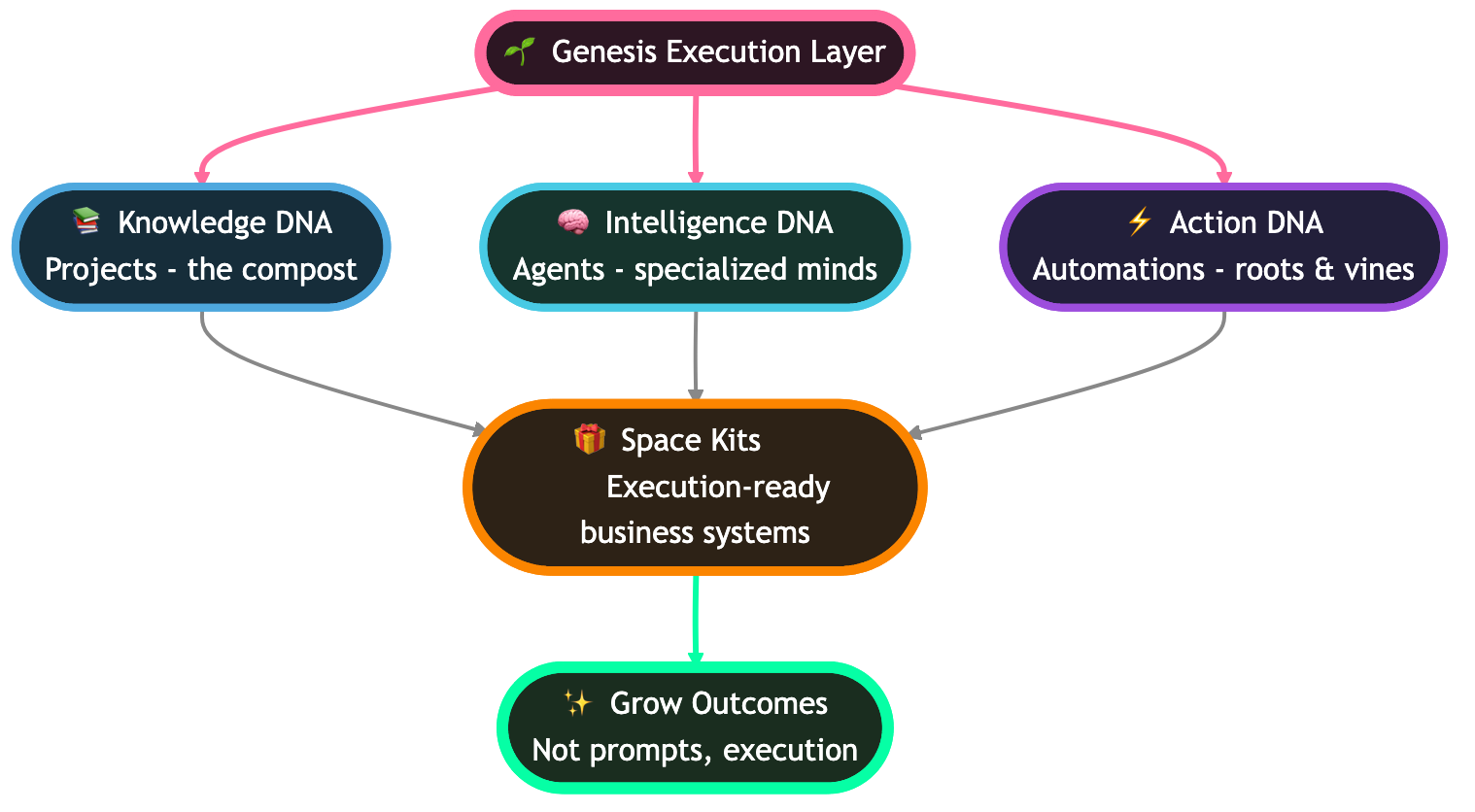
Taskade's Workspace DNA architecture — Memory + Intelligence + Execution — creates a self-reinforcing loop that Manus cannot replicate. Your projects and data (Memory) feed your AI agents (Intelligence), which trigger automations (Execution), which create more data. Every agent interaction enriches the workspace; every automation reinforces context.
Here is how that plays out in practice:
- Multi-agent orchestration: Deploy specialized agents for research, writing, coding, and analysis — all sharing the same project context. More than 500,000 agents have been deployed on Taskade, each with custom tools and persistent memory.
- Built-in tools: Agents search the web, read pages, run code, and analyze files. They do not click through websites; for a step that needs a real browser, an automation can call a browser-agent service through the HTTP Request or MCP Client action.
- 100+ integrations: Connect Slack, Gmail, Google Sheets, GitHub, Salesforce, Shopify, HubSpot, and many more, with triggers that pull events in and actions that push data out.
- 15+ frontier models: Choose from models by OpenAI, Anthropic, and open-weight providers, per agent. Manus picks the model for you.
- Multiple project views: Visualize and manage agent output in List, Board, Calendar, Table, Mind Map, Gantt, and Org Chart views.
- Role-based access: From Owner to Viewer, across every project and agent.
- Free plan: 1,000 credits when you verify your account and 10,000 more after your first build, with 1 AI agent, 3 apps, and up to 2 members.
- 150,000+ Genesis apps built and a Community Gallery with 130,000+ shared apps prove this is not vaporware — it is production infrastructure.
+----------------------------------------------------------+
|              TASKADE MULTI-AGENT WORKSPACE               |
|  +----------------------------------------------------+  |
|  |  WORKSPACE DNA (Persistent)                        |  |
|  |  Memory  <-->  Intelligence  <-->  Execution       |  |
|  |  (Projects)    (AI Agents)        (Automations)    |  |
|  +----------------------------------------------------+  |
|                                                          |
|  +------------+  +------------+  +------------------+    |
|  | Research   |  | Writing    |  | Analysis         |    |
|  | Agent      |  | Agent      |  | Agent            |    |
|  | - Web tool |  | - Doc tool |  | - Data tool      |    |
|  | - Memory   |  | - Memory   |  | - Memory         |    |
|  +-----+------+  +-----+------+  +--------+---------+    |
|        |               |                  |              |
|  +----------------------------------------------------+  |
|  |  SHARED PROJECT MEMORY (Persistent across sessions)|  |
|  |  Vectors + KV + Full-text + File OCR               |  |
|  +----------------------------------------------------+  |
|                                                          |
|  +----------------------------------------------------+  |
|  |  100+ INTEGRATIONS                                 |  |
|  |  Slack | Gmail | Sheets | GitHub | Salesforce ...  |  |
|  +----------------------------------------------------+  |
+----------------------------------------------------------+
Pricing (billed annually): Free / Pro $10/month for up to 10 users / Business $25/month / Max $100/month / Enterprise $250/month.
2. Claude Agent SDK — Best for Developers Building Custom Agent Loops
The Claude Agent SDK from Anthropic provides Python and TypeScript libraries for building agentic applications on top of Claude models. It gives developers fine-grained control over tool use, memory management, and multi-step reasoning.
The SDK is particularly strong for use cases where you need to define custom tool schemas, implement complex retry logic, or build agents that interact with proprietary APIs. Anthropic's Claude models consistently rank among the best for multi-step reasoning and instruction following, which translates to more reliable autonomous loops compared to alternatives.
However, the Claude Agent SDK is a developer tool, not a product. There is no dashboard, no drag-and-drop builder, and no way for non-technical team members to create or manage agents. You also need to provision your own infrastructure (servers, databases, monitoring) and manage API billing separately.
- Strengths: Best-in-class reasoning (Claude models), extensive tool use API, streaming support, computer use capability
- Weaknesses: Code-only (no UI for non-developers), no built-in workspace, requires infrastructure management
- Pricing: Pay-per-token via Anthropic API
- Best for: Engineering teams building custom autonomous agents with specific tool requirements
3. ChatGPT Work — Best for Long Browser Tasks Inside ChatGPT
ChatGPT Work launched on July 9, 2026 for long, multi-step tasks, with a cloud browser that can sign in to websites. It replaced ChatGPT agent, which OpenAI removed in July 2026; ChatGPT agent had itself absorbed Operator in July 2025. The Atlas browser stopped working on August 9, 2026.
For people already paying for ChatGPT, this is the closest match to Manus without a new app. The trade-off is the same as Manus: work lives in your ChatGPT account, not in a shared project your whole team and your automations can build on.
- Strengths: Familiar interface, cloud browser, huge user base
- Weaknesses: Paid plans only (not Free or Go), no shared team record, no event-driven automations
- Pricing: Included with paid ChatGPT plans, from Plus at $20/month
- Best for: Individuals already in the OpenAI ecosystem
4. Devin — Best for Autonomous Software Engineering
Devin by Cognition AI is purpose-built for software engineering. It gets its own development environment with IDE, browser, and terminal and can write, test, debug, and deploy code autonomously. Cognition cut Devin's entry price from $500 to $20 per month with Devin 2.0 in April 2025 and acquired the Windsurf editor in July 2025. Today Devin runs in Devin Desktop, a CLI, and cloud agents.
- Strengths: Deep engineering focus, can handle multi-file refactors, creates PRs, runs test suites
- Weaknesses: Usage-based compute pricing adds up on long tasks, engineering-only (not a general-purpose agent), requires codebase access
- Pricing: Free; Pro $20/month; Max $200/month; Team $80/month plus $40 per full developer seat
- Best for: Engineering teams that want an AI pair programmer on complex codebases
5. AutoGPT — Best for Open-Source Agent Experimentation
AutoGPT is the open-source project that kicked off the autonomous agent wave in April 2023. It chains LLM calls in a goal-directed loop with memory and tool access. The project was the first mainstream demonstration that LLMs could be given tools and goals and left to iterate autonomously — an idea that directly inspired Manus and dozens of other agent startups.
In 2026, AutoGPT has matured into a more structured platform with a builder UI and a marketplace for sharing agent configurations. However, production reliability remains a challenge. Autonomous loops still get stuck, token costs compound unpredictably, and error handling requires manual intervention. For experimentation and prototyping, AutoGPT is unmatched. For production deployment, most teams graduate to managed platforms.
- Strengths: Fully open-source (MIT), large community (160K+ GitHub stars), highly customizable
- Weaknesses: Unstable in production, high token consumption, requires significant prompt engineering
- Pricing: Free (self-hosted), cloud version varies
- Best for: Developers and researchers experimenting with autonomous agent architectures
6. CrewAI — Best for Multi-Agent Python Frameworks
CrewAI provides a Python framework for orchestrating teams of AI agents with defined roles, goals, and backstories. Each agent can use different tools and collaborate through a structured delegation system.
- Strengths: Multi-agent by design, role-based agent definitions, good documentation, active development
- Weaknesses: Python-only, no UI for non-developers, requires LLM API keys and infrastructure
- Pricing: Open-source framework (free), Enterprise platform pricing varies
- Best for: Python developers building multi-agent applications with role specialization
7. OpenAI Responses API and Agents SDK — Best for Developers on OpenAI Models
This slot used to cover the OpenAI Assistants API, which shut down on August 26, 2026. OpenAI's replacement is the Responses API with the Conversations API, plus the open-source Agents SDK for Python and TypeScript. Built-in tools include web search, file search, code interpreter, and remote MCP servers.
- Strengths: Managed tools, strong models, open-source SDK
- Weaknesses: Locked to OpenAI models, code only, per-token costs add up
- Pricing: Pay per token
- Best for: Developers building production agents on OpenAI models
Mega Comparison Matrix: Manus AI vs All 7 Alternatives
| Feature | Manus AI | Taskade Genesis | Claude SDK | ChatGPT Work | Devin | AutoGPT | CrewAI | OpenAI Responses API |
|---|---|---|---|---|---|---|---|---|
| Multi-agent | Parallel sub-agents (Wide Research) | Yes, shared workspace | Manual | No | No | Limited | Yes | Via Agents SDK |
| Persistent memory | Project instructions + files | Shared projects | Manual | Chat memory | Session | Manual | Manual | Conversations |
| Team collaboration | Team plan, Collab | Yes (real-time) | No | Business plan | Team plan | No | No | No |
| Access control | Team admin | Owner to Viewer | No | Workspace roles | Admin | No | No | API keys |
| Integrations | MCP connectors, Zapier, API | 100+ | API only | Apps | GitHub | API only | API only | Remote MCP |
| Free tier | 300 credits/day | Yes | No | No | Yes | Yes (self-host) | Yes (OSS) | No |
| Clicks through websites | Yes (cloud or your browser) | No (search + read pages) | Computer use | Yes (cloud browser) | Yes | Plugin | Tools | Via tools |
| Code execution | Yes (sandbox) | Yes (agents) | Yes | Yes | Yes (IDE) | Yes | Yes | Code interpreter |
| No-code access | Yes | Yes | No | Yes | No | No | No | No |
| Entry price | Free / $20/month | Free / $10/month billed annually | Pay-per-token | $20/month (Plus) | Free / $20/month | Free (self-host) | Free (OSS) | Pay-per-token |
| Models available | Picked by Manus | 15+ | Claude family | GPT family | Multiple | Any (via API) | Any (via API) | GPT family |
| Project views | None | Multiple | None | None | None | None | None | None |
| Security certifications | SOC 2 Type II, ISO 27001 | SOC 2 Type II in progress | SOC 2 | SOC 2 | SOC 2 | N/A (self-host) | N/A (self-host) | SOC 2 |
Should You Use Manus AI in 2026?
The honest answer depends on three variables: your team size, your task type, and your tolerance for unpredictability.
Use Manus if:
- You are a solo researcher or analyst
- Your tasks are one-shot and web-heavy (competitive research, price comparison, data gathering)
- You are comfortable with credits-based pricing that varies per task
- You do not need to share agent outputs with a team
Skip Manus if:
- You need team collaboration or shared agent workspaces
- You need one shared record that every agent and teammate builds on
- You need automations triggered by events in your other apps
- You need a flat plan price rather than per-task credits
- You need agents that learn from past interactions
- You need automation workflows connected to your agent output
For most teams in 2026, the calculus is simple. Manus is excellent at running a task. Teams also need the place where the results of many tasks live, get reviewed, and trigger the next step.
Architecture: Manus vs Taskade Genesis
Understanding the fundamental architecture difference helps explain why Manus and Taskade serve different users.
Manus: Solo Agent, Disposable Environment
+------------------------------------------+
|         MANUS SESSION (Ephemeral)        |
|                                          |
|  User  --->  [Agent]  --->  [VM]         |
|               |   ^          |           |
|               v   |          v           |
|          [Plan] [Act]   [Browser]        |
|                         [Terminal]       |
|                         [Files]          |
|                                          |
|  Session ends  --->  VM destroyed        |
|  No memory carried  --->  Start fresh    |
+------------------------------------------+
Taskade Genesis: Multi-Agent, Persistent Workspace
The key difference: in Manus, the agent's world is born and dies with each session. In Taskade, the workspace is permanent, the memory accumulates, and agents get smarter over time because they share context with the team.
Decision Flowchart: Which Agent Platform Should You Choose?
Free Tier Generosity: Who Actually Lets You Start for Free?
Manus moved to open signup in May 2025 and now includes 300 free daily credits, roughly one task per day, with no rollover. ChatGPT Work requires a paid ChatGPT plan, and Devin's free plan has a light quota. AutoGPT and CrewAI are free because they are open-source (but you pay for hosting and API keys). Taskade's free plan includes an AI agent, a shared workspace, and credits, with no infrastructure to run.
Multi-Agent Workflow: How Taskade Specialist Agents Collaborate
In Manus, this workflow is impossible. There is no way to hand off between agents, no shared memory, and no automation trigger. Each step would require a separate, isolated session with manual copy-pasting between them.
Deeper Architecture: The Virtual Computer Stack Visualized
Manus's core architectural bet is the virtual computer — a sandboxed VM containing a browser, terminal, file system, and code runtime, orchestrated by an LLM planner. This approach is conceptually clean but operationally fragile. The diagram below maps the full stack as it exists in the shipping product.
Now compare the Taskade Genesis multi-agent stack — where the workspace itself is the runtime, agents are first-class citizens with persistent memory, and execution is durable rather than ephemeral.
The difference is not cosmetic. Manus collapses all intelligence into one generalist operating in an ephemeral shell. Taskade Genesis splits the work across specialist agents that share a durable workspace — the same Workspace DNA loop described in the Living App Movement.
Single Generalist vs Team of Specialists
Watch what happens when the same task — "research 5 competitors, build a comparison, distribute to stakeholders" — lands on each architecture.
Two architectures, two outcomes. Manus hands you a file. Taskade hands you a repeatable, memoried, team-visible workflow.
Reliability Data: Where the Hype Meets the Ground
Community reports from the first 12 months of Manus access (Reddit r/singularity, r/LocalLLaMA, Hacker News, Product Hunt reviews) converge on a reliability profile that degrades sharply with task length. The chart below approximates reported success rates by task step count.
This chart is a model, not measured Manus data: if each step succeeds 90% of the time, a task of n steps succeeds 0.9 to the power of n. Real agents often do worse, because one early mistake makes the next step more likely to fail. Short tasks work. Long tasks break. Every autonomous agent hits this wall, and more tools do not fix it on their own. (The AI agent stack breaks down where production agents earn or lose reliability.)
The common failure modes in community reports are hallucinated clicks, timeouts, anti-bot blocks, wrong tool choice, and planning loops. The first three come from working through web pages instead of APIs. Manus reduces them with connectors, Browser Operator, and a "Take Over" handoff for CAPTCHAs. Taskade avoids the click layer: its 100+ integrations are API connections.
And pricing transparency (or lack thereof):
Entry prices converged around $20/month in 2025-2026. Claude Agent SDK and the OpenAI Responses API bill per token, and AutoGPT and CrewAI are free open source plus hosting and API costs. Taskade Pro is $10/month billed annually and covers up to 10 users, while Manus Pro covers one.
The Autonomy vs Reliability Tradeoff
Every agent platform sits on a tradeoff curve. More autonomy means the agent makes more decisions without you. More reliability means more of those decisions are correct. Manus is high-autonomy, medium-reliability — which sounds exciting until you need to ship.
The AI agents taxonomy covers this tradeoff in depth and places Manus in the "solo browser-native autonomous" quadrant alongside OpenAI's browser agent.
Manus or Alternative? A Decision Flowchart
The 8-Alternative Landscape Map
Plot the 8 platforms across two axes: DIY framework vs managed platform, and solo vs multi-agent.
Among these eight, Taskade Genesis is the only managed, multi-agent workspace. It is the hardest quadrant to build, because it needs persistent memory, real-time collaboration, role-based access, an integration layer, and a workspace backend working together.
Workspace DNA: The Self-Reinforcing Loop
Memory feeds Intelligence. Intelligence triggers Execution. Execution writes back to Memory. Every loop iteration makes the workspace smarter. Manus has no such loop — the VM dies, the context evaporates, the next task starts cold.
Memory Types: Ephemeral vs Persistent
Task Routing: When to Use What
Capability Matrix: 8 Platforms, 10 Dimensions
+-------------------+-------+--------------+--------+---------+-------+---------+--------+----------+
| Capability        | Manus |   Taskade    | Claude | ChatGPT | Devin | AutoGPT | CrewAI | OpenAI   |
+-------------------+-------+--------------+--------+---------+-------+---------+--------+----------+
| Multi-agent       | Wide  |     Yes      | Manual |   No    |  No   | Limited |  Yes   | AgentSDK |
| Shared memory     | Proj  |     Yes      | Manual | Chat    | Sess  | Manual  | Manual | Convos   |
| Team collab/roles | Team  | Owner-Viewer |   No   | Busnss  | Team  |   No    |   No   |    No    |
| Integrations      |  MCP  |     100+     |   API  |  Apps   |  Git  |   API   |   API  |   MCP    |
| Free tier         | Daily |   Credits    |   No   |   No    | Light | OSS     |  OSS   |    No    |
| No-code UI        |  Yes  |     Yes      |   No   |   Yes   |  No   |   No    |   No   |    No    |
| Models available  | Auto  |     15+      | Claude | GPT fam | Multi |  Any    |  Any   | GPT fam  |
| Project views     | None  |   Multiple   |  None  |  None   | None  |  None   |  None  |   None   |
| Clicks websites   |  Yes  |      No      | CompU  |   Yes   |  Yes  | Plugin  | Tools  |  Tools   |
| Security certs    | SOC2  |  In progress |  SOC2  |  SOC2   | SOC2  |  N/A    |  N/A   |   SOC2   |
+-------------------+-------+--------------+--------+---------+-------+---------+--------+----------+
Failure Mode Reference Card
+----------------------+----------+-------------------------+-------------------------+
| Failure mode         | Root cause              | Manus mitigation        | Taskade approach        |
+----------------------+-------------------------+-------------------------+-------------------------+
| Hallucinated click   | Vision misreads page    | Screenshot checks       | API actions, no clicks  |
| Browser timeout      | Heavy JS / slow network | Retry, Take Over        | Durable automation retry|
| Anti-bot block       | Cloudflare / CAPTCHA    | Your own browser        | OAuth API connections   |
| Wrong tool selected  | Weak tool routing       | Plan Mode review        | Specialist agents       |
| Plan loop (repeat)   | LLM planning drift      | Branch, edit the plan   | Shared project record   |
| Out of credits mid   | Variable task cost      | Credit tiers            | Plan-level credits      |
+----------------------+-------------------------+-------------------------+-------------------------+
Expanded Manus Architecture Stack
+--------------------------------------------------------------+
|                       MANUS AGENT LAYER                      |
|  +--------------------------------------------------------+  |
|  |  Planner  ->  Task Queue  ->  Executor  ->  Observer   |  |
|  |  (goal     (dependency      (tool call    (vision +    |  |
|  |  decomp)   graph)           dispatch)     text parse)  |  |
|  +--------------------------------------------------------+  |
|                                                              |
|  +--------------------------------------------------------+  |
|  |   TASK SANDBOX (fresh per task; Cloud Computer add-on) |  |
|  |   +---------+  +---------+  +----------+  +---------+  |  |
|  |   | Chrome  |  | Bash    |  | /tmp fs  |  | Python  |  |  |
|  |   | browser |  | shell   |  | scratch  |  | runtime |  |  |
|  |   +----+----+  +----+----+  +-----+----+  +----+----+  |  |
|  |        |            |             |            |        |  |
|  |        +---- Screenshot + DOM scrape ----------+        |  |
|  +--------------------------------------------------------+  |
|                                                              |
|  +--------------------------------------------------------+  |
|  |  LLM BACKBONE (LLM-agnostic, picked by Manus)          |  |
|  |  Tiers: 1.6 Lite / 1.6 / 1.6 Max, vision               |  |
|  +--------------------------------------------------------+  |
|                                                              |
|  Team plan   Collab   MCP connectors   Project files      |
+--------------------------------------------------------------+
Expanded Taskade Genesis Stack
+--------------------------------------------------------------+
|            TASKADE GENESIS MULTI-AGENT WORKSPACE             |
|  +--------------------------------------------------------+  |
|  |  RBAC (Owner > Viewer)   +   Real-time collab          |  |
|  +--------------------------------------------------------+  |
|                                                              |
|  +--------------------------------------------------------+  |
|  |  WORKSPACE DNA (durable, self-reinforcing loop)        |  |
|  |    Memory  <->  Intelligence  <->  Execution           |  |
|  |  (projects,     (15+ frontier      (automations,       |  |
|  |   views,         models,           100+ integrations,  |  |
|  |   vectors,       built-in tools,   Shopify, Slack,     |  |
|  |   OCR, KV)       custom tools      Gmail, GitHub ...)  |  |
|  +--------------------------------------------------------+  |
|                                                              |
|  +----------+  +----------+  +----------+  +------------+   |
|  | Research |  | Writing  |  | Editor   |  | Analysis   |   |
|  | Agent    |  | Agent    |  | Agent    |  | Agent      |   |
|  | persistent  persistent   persistent    persistent    |   |
|  | memory   |  | memory   |  | memory   |  | memory     |   |
|  +----+-----+  +----+-----+  +----+-----+  +-----+------+   |
|       |             |             |              |          |
|       +-------- shared Workspace DNA -------------+          |
|                                                              |
|  500,000+ agents deployed | 150,000+ Genesis apps shipped    |
|  130,000+ community apps  | Free tier: 11,000 credits         |
+--------------------------------------------------------------+
Why Taskade Genesis Is the #1 Manus Alternative
We mentioned Taskade Genesis briefly in the alternatives section. It deserves a deeper card because the architectural gap is that wide.
Specialist agents that share a workspace. Manus can fan out sub-agents for one research job. Taskade Genesis lets you deploy a Manager Agent that routes work to Research, Writing, Editor, and Analysis specialists — each with their own persistent memory, custom tool set, and model choice. Under the hood, that coordination runs on TSK-1, the Taskade System Kernel, which keeps agents, memory, and automations working as one system. A researcher agent might run on a Claude model, a coder agent on a GPT model, and a summarizer on an open-weight model. Manus picks the model for you.
15+ frontier models, picked per agent. Models from OpenAI, Anthropic, and open-weight providers differ in reasoning, tool use, and cost. Taskade lets you pick per agent.
Built-in tools plus custom agent tools. Web search, page reading, code, and file analysis are native. Custom tools let you wire an agent to an internal API with a schema. Taskade agents do not click through websites; that remains a Manus strength.
100+ integrations (v6.97). Slack, Gmail, Google Sheets, Notion, GitHub, Salesforce, HubSpot, Shopify, Stripe, Discord, Jira, Linear, and Airtable, with triggers that start automations and actions that write results back. See Zapier alternatives for the broader context.
Memory that accumulates. Manus Projects give each new task the same setup. In Taskade, agents and automations read and write the same projects, so each run can build on what the last one produced.
Multiple project views for tracking agent work. List, Board, Calendar, Table, Mind Map, Gantt, and Org Chart — pick the view that fits how your team thinks about agent output. Manus gives you a file download and walks away.
Role-based access for agent work. From Owner to Viewer, control who can deploy agents, edit prompts, and view outputs.
A free plan to start. 1,000 credits when you verify your account and 10,000 more after your first build. Start building today at /create. See best AI agent builders and the AI agents taxonomy for the full category landscape.
Social proof that is not vaporware. 500,000+ agents deployed across the platform. 150,000+ Genesis apps built and running. 130,000+ community apps in the Community Gallery — every one of which you can clone and fork. Manus's numbers are real too, reportedly about $400M in annual recurring revenue by June 2026 according to Caixin's source, but its product centers on the task rather than a shared, team-visible workspace.
Manus Pricing, Expanded
| Plan | Listed price | Credits | What you actually get |
|---|---|---|---|
| Manus Free | $0 | 300 a day | 1 concurrent task, chat and Manus 1.6 Lite |
| Manus Pro | $20 / from $40 / from $200 a month | 4,000 / from 8,000 / from 40,000 a month, plus 300 a day | 20 concurrent tasks, all Manus 1.6 models |
| Manus Team | $20 per seat a month ($200 per seat a year) | 4,000 per seat, shared pool | Admin controls; SSO add-on under 30 seats |
| Manus Cloud Computer | $10 / $30 / $50 a month | — | Always-on Ubuntu machine |
| Taskade Free | $0 | 1,000 when you verify your account + 10,000 after first build | 1 AI agent, 3 apps, up to 2 members |
| Taskade Pro | $10 a month billed annually | Included | Up to 10 users, role-based access |
| Taskade Business | $25 a month billed annually | Included | SSO, custom domains |
| Taskade Max | $100 a month billed annually | Included | Higher limits |
| Taskade Enterprise | $250 a month billed annually | Included | SCIM, bring your own key |
Hallucination Mitigation Playbook
| Symptom | Root cause | Manus response | Taskade Genesis response |
|---|---|---|---|
| Clicked wrong button | Vision misread DOM | Retry from screenshot | Native API call, no click required |
| Made up a URL | LLM hallucination | Retry or ask the user | Sources saved in the project |
| Invented a data field | LLM drift | Malformed CSV output | Schema-typed outputs via Custom Tools |
| Skipped a required step | Planning drift | Plan corruption | Manager Agent re-planning + memory check |
| Needed a login | Session handling | Remembered Cloud Browser session or your own browser | OAuth integration connections |
| Forgot prior context | Setup-only memory | Project instructions and files load into each task | Agents read and write shared projects |
Autonomy Levels Comparison
| Autonomy level | Definition | Example platforms |
|---|---|---|
| L0 — Chat | User drives every turn | ChatGPT, Claude chat |
| L1 — Tool use | LLM picks tools, user approves | OpenAI Responses API |
| L2 — Short autonomy | Agent runs 1-3 steps alone | Claude in Chrome, Perplexity Comet |
| L3 — Medium autonomy | Agent runs 3-8 steps alone | Manus AI, ChatGPT Work, CrewAI |
| L4 — Long autonomy | Agent runs 8+ steps, self-corrects | Devin, AutoGPT |
| L5 — Team autonomy | Multi-agent with shared memory | Taskade Genesis |
Manus sits at L3, with Wide Research reaching toward parallel work. Taskade Genesis is built for L5: specialist agents and automations that share one workspace memory.
Tool-Use Reliability Table
| Tool category | Manus reliability | Taskade reliability | Why |
|---|---|---|---|
| Web search | High | High | Both use real search APIs |
| DOM click | Medium | N/A | Taskade uses APIs, not clicks |
| Web form submit | Medium (Browser Operator) | Not supported | Taskade writes through APIs, not web forms |
| Code execution | Good | Good | Both run code; Manus has a full terminal |
| File generation | Good (docs, slides, sites) | Good | Taskade files land in shared projects |
| Slack post | Connector or browser | Native API | Taskade ships Slack as a first-class integration |
| Gmail send | Connector | Native API | Both use Gmail connections |
| Sheets write | Connector or browser | Native API | Taskade writes via the Google Sheets API |
Persistent Memory Comparison
| Memory feature | Manus | Taskade Genesis |
|---|---|---|
| Instructions applied to every new task | Yes (Project master instruction) | Yes (agent instructions and knowledge) |
| Shared knowledge files | Yes (Project knowledge base) | Yes (projects, files, linked sources) |
| Remembered website logins | Yes (Cloud Browser, 7 or 21 days) | No (integrations use OAuth instead) |
| Results written back to a shared record | Not described in the docs | Yes (automations write back into projects) |
| Teammates see each other's work | Per task through Collab | Yes, from Owner to Viewer |
| Agents read live, structured project data | Uploaded files | Yes |
Cost Per Successful Task
| Platform | Nominal price | What drives cost per successful task |
|---|---|---|
| Manus Pro | $20-$200+/month | Credits per task, plus retries on failed steps |
| ChatGPT Work | From $20/month (Plus) | Plan limits on long tasks |
| Devin | Free, then $20/month and up | Quota and model choice |
| Claude Agent SDK | Pay-per-token | Tokens, plus your own hosting |
| Taskade Pro | $10/month billed annually, up to 10 users | Plan credits shared across the team |
| AutoGPT (self-host) | Free + API | API tokens and hosting |
| CrewAI (self-host) | Free + API | API tokens and hosting |
No vendor publishes comparable success rates, so compare cost on your own tasks: run the same five tasks on each tool and divide the spend by the number that finished correctly.
Connecting the Dots: Sprint Sibling Reads
This review lives inside a broader sprint about the shape of the AI agent market in 2026. If you want the full picture, read alongside:
- The Living App Movement — why static SaaS is losing to AI-native, workspace-backed apps
- AI Agents Taxonomy — the canonical taxonomy that places Manus, OpenAI's browser agent, and Taskade Genesis
- Best AI Agent Builders in 2026 — 15 platforms compared head-to-head
- NemoClaw Review — the enterprise NVIDIA-forked contrast to Manus
- Gizmo Review — micro-app contrast to Manus's generalist ambition
- Best AI Workspace Tools — workspace-native AI rather than VM-in-a-box
- Community Gallery SEO — how 130K+ community apps drive organic growth
- Taskade Genesis vs ChatGPT Custom GPTs — the other big comparison in this sprint
- Best MCP Servers — the protocol both Manus and Taskade use for connectors
- Browser Agents Explained — how agents like Manus drive a browser, and where they fail
- History of Browserbase — the cloud browsers behind many agents
- Best OpenClaw Alternatives — open-source autonomous agents
- Best Claude Code Alternatives — AI coding agents and IDE tools
- What Is Agentic Engineering? — the discipline behind building reliable agents
Hub pages worth bookmarking: /agents, /create, /apps.
Related Reading
Explore more from this sprint and our deep-dive library:
- Best AI Agent Builders in 2026 — 15 platforms compared for building autonomous agents
- AI Agents Taxonomy: Types, Architectures, and Use Cases — understand the agent landscape
- 15 Best Zapier Alternatives in 2026 — automation platforms with AI agent support
- The Living App Movement — why static software is giving way to AI-native apps
- NemoClaw Review 2026 — NVIDIA's enterprise agent fork tested
- Best AI Dashboard Builders — build dashboards with AI in minutes
- AI Prompt Generators — tools for crafting better agent prompts
- Best AI Flowchart Makers — diagram your agent workflows
- Best Free AI App Builders — build apps without code or budget
- Best OpenClaw Alternatives — open-source agent frameworks compared
- Best Claude Code Alternatives — AI coding agents and IDE tools
- Community Gallery SEO — how community-built apps drive organic growth
- Best AI Translation Tools — AI-powered translation for global teams
- Best PDF to Notes AI — extract structured notes from PDFs
- Best YouTube to Notes AI — turn video content into actionable notes
- What Is Agentic AI? — the complete framework guide
- Taskade vs Manus — side-by-side comparison
Verdict: Manus Runs Tasks Well. Teams Need a Shared Workspace.
Manus AI proved that a general-purpose autonomous agent could capture millions of users, and in 2026 it grew up: Projects, Collab, Plan Mode, Branch, Wide Research, a website builder, SOC 2 Type II and ISO 27001, and independence after the Meta saga.
What Manus is built around is the task. You hand it a goal, it works, and the result lives in that task. For a solo researcher, analyst, or founder doing browser-heavy work, that is often exactly right.
Teams need one more layer: the place where the results of many tasks live, get reviewed, and trigger the next step. That is the Workspace DNA approach: Memory feeds Intelligence, Intelligence triggers Execution, and Execution creates Memory. Every agent contribution is stored, searchable, and available to the next agent or the next teammate.
If you want agents without running infrastructure, Taskade offers:
- A free plan: 1,000 credits when you verify your account and 10,000 more after your first build
- 100+ integrations, with triggers in and actions out
- 15+ frontier models from OpenAI, Anthropic, and open-weight providers
- Role-based access from Owner to Viewer
- 150,000+ Taskade Genesis apps built, and a Community Gallery to clone from
If you are a solo user who wants one-off web tasks on free daily credits, Manus is worth trying. If your team needs the work to add up, the math points to Taskade. ▲ ■ ●
Build your first multi-agent workspace free →
Frequently Asked Questions
What is Manus AI?
Manus AI is a general-purpose AI agent developed by Butterfly Effect, an AI startup founded in China and headquartered in Singapore since mid-2025. It operates inside a virtual computer environment and can autonomously browse the web, write and execute code, manage files, and complete multi-step tasks without continuous human guidance. The platform gained widespread attention after a viral demo in March 2025 showing the agent booking flights and building spreadsheets. In December 2025 Meta announced it was acquiring Manus for a reported $2 billion; Chinese regulators ordered the deal unwound in April 2026, and the situation remains unresolved as of mid-2026.
How much does Manus AI cost?
Manus AI uses a credits-based pricing model with open signup. The free plan includes 300 daily refresh credits (roughly one task per day) plus a one-time signup bonus. Pro tiers cost $20, $40, and $200 per month with roughly 4,000, 8,000, and 40,000 monthly credits, and a Team plan starts at $20 per seat per month. Unused monthly credits expire at the end of each billing period. By comparison, Taskade starts free with 11,000 credits and paid plans begin at $10 per month (Pro, billed annually).
Is Manus AI available without an invite?
Yes. Manus removed its invite-only waitlist in May 2025, shortly after a Benchmark-led $75 million funding round. Anyone can now sign up and receive free daily credits. For teams that need shared AI agents rather than solo sessions, Taskade Genesis offers open signup with a free tier and a full collaborative workspace.
Manus AI vs ChatGPT — what is the difference?
ChatGPT is a conversational assistant that responds to prompts in a chat interface. Manus AI is an autonomous agent that operates inside a virtual computer with a real browser, terminal, and file system. ChatGPT requires the user to guide each step of the conversation; Manus attempts to plan and execute entire tasks end-to-end autonomously. ChatGPT offers team workspaces; Manus is individual-only.
Can Manus AI work with a team?
Only in a limited way. Manus added a Team plan (from $20 per seat per month) with shared credit pools, SSO, and admin controls, but the product remains built around individual agent sessions. There is no shared workspace, no role-based access control across projects, and no real-time co-editing of agent outputs. Teams that need collaborative AI agents with shared memory and RBAC should evaluate Taskade instead.
What are the best Manus AI alternatives in 2026?
The top seven alternatives are: (1) Taskade Genesis for teams needing multi-agent orchestration with 100+ integrations and a free tier; (2) Claude Agent SDK for developers building custom agent loops; (3) ChatGPT Agent (which replaced Operator in 2025) for task automation in the OpenAI ecosystem; (4) Devin for autonomous software engineering; (5) AutoGPT for open-source agent experimentation; (6) CrewAI for multi-agent Python frameworks; (7) OpenAI Assistants API for production agent deployment.
Does Manus AI have a free tier?
Yes, since May 2025. The free plan includes 300 daily refresh credits (roughly one task per day) plus a one-time signup bonus. Daily credits reset every 24 hours and do not accumulate, so sustained work requires a paid credit tier. Taskade offers a free tier with 11,000 one-time credits, full workspace access, AI agents, and multi-agent automation.
Is Manus AI safe to use for sensitive data?
Manus AI has not published SOC 2, ISO 27001, or equivalent security certifications. The agent operates inside a virtual machine with full browser access, meaning it can navigate to any website and interact with login forms. Users should not input credentials, API keys, or sensitive business data until the company publishes formal security documentation. For enterprise-grade security, evaluate platforms with published compliance certifications and data handling policies.