
Definition: Memory consolidation is the process that turns a fresh, fragile memory into lasting knowledge. In the brain, the hippocampus captures the specifics of an experience fast, then replays it so the neocortex can fold it slowly into what you already know. The theory behind this two-speed design is called complementary learning systems, and it is one of the most borrowed ideas in AI agent memory research.
TL;DR: Your brain runs two memory systems. A fast one records what just happened, and a slow one builds general knowledge from replays of the fast one. Rats replay the routes they just ran while they sleep (Wilson and McNaughton, 1994). AI agents copy the split: the context window is the fast store, curated project memory is the slow one, and summarizing between them is consolidation. Build one free →
Think of a field reporter. All day they scribble everything into a pocket notebook: names, quotes, half-sentences, a phone number on the margin. None of it is organized, and all of it is precise. Later, back at the desk, they reread the notebook and rewrite what matters into the newsroom's shared reference file, where it sits next to everything the paper already knows. The notebook is fast and messy. The reference file is slow and structured. No newsroom runs on only one of them, and the brain does not either.
Why Memory Consolidation Matters in 2026
Memory consolidation matters because every serious AI agent now faces the problem the brain solved first: how to take in new experience quickly without scrambling what it already knows. The 1995 paper that framed the answer, McClelland, McNaughton and O'Reilly's complementary learning systems theory, observed that networks which learn by adjusting connections only discover structure when learning is gradual and interleaved. Learn one new thing too fast and the network overwrites old knowledge, a failure known as catastrophic interference. Their proposal was a division of labor: a hippocampal system that learns new items rapidly, and a neocortex that learns slowly as new memories are reinstated and interleaved with old ones.
In 2016, Kumaran, Hassabis and McClelland updated the theory and argued that intelligent agents in general, not only mammals, need both systems. They broadened the role of replay, noting that it lets the brain weight experiences by current goals rather than by how often they happened. They showed that the neocortex can learn fast when new information fits structure it already holds, and they pointed out the theory's relevance to the design of artificial agents.
That link is now a crowded research line. The December 2025 survey AI Meets Brain connects cognitive neuroscience memory research to LLM-driven agents, and it describes how the brain reorganizes experiences across hippocampal and neocortical systems into more structured, abstract forms, much as agents turn raw interaction logs into summaries. In January 2026, TiMem organized conversations into a temporal memory tree and consolidated them from raw turns into progressively more abstract summaries, without fine-tuning. It reported 75.30% accuracy on the LoCoMo benchmark while cutting recalled memory length by 52.20%.
Neuroscience kept moving too. A March 2025 Nature Neuroscience study by Jacob Bakermans, Tim Behrens and colleagues at Oxford and UCL argued that hippocampal memories are compositions of reusable building blocks, which lets an animal act well in a new environment without new learning, and it found evidence that replay builds and strengthens those compositional memories. In May 2026, a follow-up in people, He, Wang and colleagues, recorded from electrodes inside the brains of 28 epilepsy patients solving LEGO-like puzzles. Hippocampal ripples shifted prefrontal activity toward the inferred solution, and replay reorganized building blocks into candidate sequences. Replay is not only a nightly backup. It is also a planning tool.
How Memory Consolidation Works
Consolidation is a relay. One system captures, another system keeps, and replay carries the memory across the gap between them.
- The hippocampus captures the event fast. One exposure is enough. It stores the specifics, such as where you parked, who said what, and the order of events, as a pattern across a set of neurons.
- The trace is replayed offline. In 1994, Matthew Wilson and Bruce McNaughton recorded ensembles of hippocampal place cells in three rats. Cells that fired together while a rat ran a route fired together again during slow-wave sleep after the task, more than in the sleep before it. The experience was re-expressed in the same circuits.
- The neocortex changes a little on each replay. The 1995 theory holds that each reinstatement nudges neocortical connections slightly, and that remote memories rest on the sum of those small changes.
- Interleaving protects old knowledge. Replay mixes the new memory in with older ones instead of cramming it alone. That interleaving is what lets the slow system absorb something new without catastrophic interference.
- Structure emerges as a schema. Over many replays the neocortex keeps what the episodes have in common and loses much of what made each one unique. You forget which Tuesday you learned the rule, and you keep the rule.
- Replay is selective. Kumaran, Hassabis and McClelland describe replay as goal-weighted, so the brain does not replay every experience equally. The 2025 compositional replay work adds that replay can also build new memories from parts of old ones.
The same two-speed pipeline, drawn side by side for a brain and for an agent:
  BRAIN                                  AI AGENT IN A WORKSPACE
  ------------------------------------   ------------------------------------
  Experience                             Chat turn, tool result, new file
      |                                      |
      v                                      v
  Hippocampus: fast, specific            Context window: fast, specific
      |                                      |
      |  replay during sleep and rest        |  summarize, compact, write a note
      v                                      v
  Neocortex: slow, structured            Curated memory: projects and notes
      |                                      |
      v                                      v
  Schema: the rule you keep              Knowledge the agent reads next time
  ------------------------------------   ------------------------------------
  What changes: synapses                 What changes: text (weights stay fixed)
Synaptic Consolidation vs Systems Consolidation
Neuroscientists use "consolidation" for two processes on very different clocks. Synaptic consolidation stabilizes a change at individual synapses within minutes to hours of learning. Systems consolidation is the slow reorganization across brain regions, over days to years, as a memory comes to rest more on the neocortex than on the hippocampus.
| Question | Synaptic consolidation | Systems consolidation |
|---|---|---|
| Where it happens | At individual synapses | Across brain regions |
| Time scale | Minutes to hours | Days to years |
| What changes | The strength of a connection | Which regions a memory depends on |
| Sleep stage most linked to it | REM sleep, per Diekelmann and Born | Slow-wave sleep, per Diekelmann and Born |
| Closest agent analog | Saving one fact to memory right away | Periodic review that rewrites many notes into a structured record |
Sleep, Sharp-Wave Ripples, and the Causal Evidence
Sleep is where most systems consolidation happens. In their review The Memory Function of Sleep, Susanne Diekelmann and Jan Born describe slow-wave sleep, in which slow oscillations, sleep spindles, and hippocampal ripples coordinate the reactivation of recent memories and their redistribution to neocortical sites. They propose that REM sleep then supports synaptic consolidation in the cortex.
Correlation is not proof, so researchers tested whether replay is needed. In 2009, Gabrielle Girardeau, Michaël Zugaro and colleagues in Paris selectively suppressed sharp-wave ripples in rats during the rest periods after training on a spatial memory task. The rats performed worse. Removing the replay signal damaged the memory, which is the strongest kind of evidence that ripples take part in consolidation rather than only happening next to it.
Standard Model vs Multiple Trace Theory
The textbook picture, often called the standard model, holds that a memory eventually stops needing the hippocampus. In 1997, Lynn Nadel and Morris Moscovitch challenged that picture with multiple trace theory. Retrograde amnesia after hippocampal damage can reach back over much of a lifetime, they noted, so the hippocampus seems to stay involved in autobiographical episodic and spatial memories for as long as those memories exist. It helps transform and stabilize other kinds of memory stored elsewhere.
The debate has a direct lesson for agents. A summary is the semantic, rule-like version of an event. The source transcript is the episodic version. Multiple trace theory suggests you want both: a compact note for everyday use, plus a link back to the original when the details matter.
Reconsolidation: Recall Reopens a Memory
Consolidation is not a one-way door. In 2000, Karim Nader, Glenn Schafe and Joseph LeDoux showed in rats that a consolidated fear memory, once reactivated by recall, returned to a fragile state. Blocking protein synthesis in the amygdala shortly after that recall produced amnesia on later tests, whether the memory was 1 or 14 days old. The same treatment without recall left the memory intact. The authors noted that traditional consolidation theories did not predict this.
Agents meet the same effect in text. Each time an agent reads a note and rewrites it, the note can be corrected, and it can also drift. That is why readable memory matters: a person can open the note and see exactly what changed.
Engrams: Where a Single Memory Lives
The German biologist Richard Semon coined the word engram in 1904 for the physical trace a memory leaves in the brain. His idea, as Sheena Josselyn and Susumu Tonegawa summarize it in Science (2020), was that an experience activates a subset of cells that then undergo lasting chemical or physical change, and that reactivating those cells brings the memory back. Semon was largely ignored in his lifetime. Tools that image and manipulate single neurons revived the idea, and researchers now tag the cells active during learning, then silence or trigger them to test recall, as this explainer of engram experiments by neuroscientist Artem Kirsanov walks through. Josselyn and Tonegawa conclude that the evidence is beginning to define the engram as the basic unit of memory. Consolidation, in these terms, is what happens to an engram over time: under the standard model, it starts out leaning on the hippocampus and comes to depend more on the neocortex.
A Short History of Memory Consolidation
Memory consolidation research runs for more than a century, from a German memory lab in 1900 to intracranial recordings in 2026. The table lists the milestones that shaped both neuroscience and AI.
| Year | Milestone | Who | Why it matters |
|---|---|---|---|
| 1900 | Memory needs time to set after learning | Georg Elias Müller and Alfons Pilzecker | Introduced the idea of consolidation |
| 1957 | Loss of recent memory after bilateral hippocampal lesions | William Scoville and Brenda Milner | Their patient H.M. tied the forming of new memories to the hippocampus |
| 1994 | Place cells that fired together fire together again in later sleep | Matthew Wilson and Bruce McNaughton | First direct recording of replay |
| 1995 | Complementary learning systems theory | James McClelland, Bruce McNaughton, Randall O'Reilly | Explained why two stores beat one |
| 1997 | Multiple trace theory | Lynn Nadel and Morris Moscovitch | The hippocampus may stay involved for episodic detail |
| 2000 | Reconsolidation | Karim Nader, Glenn Schafe, Joseph LeDoux | Recall makes a stable memory fragile again |
| 2009 | Suppressing ripples impairs spatial memory | Gabrielle Girardeau, Michaël Zugaro and colleagues | Causal evidence that replay matters |
| 2015 | Deep Q-network trains on replayed experience | Volodymyr Mnih and colleagues at DeepMind | Replay enters mainstream AI |
| 2016 | Complementary learning systems updated | Dharshan Kumaran, Demis Hassabis, James McClelland | Extended the theory to intelligent agents in general |
| 2017 | Elastic weight consolidation | James Kirkpatrick and colleagues | Slowed learning on important weights to fight forgetting |
| 2020 | Engram review in Science | Sheena Josselyn and Susumu Tonegawa | The engram as the basic unit of memory |
| 2025 | Compositional replay | Jacob Bakermans, Tim Behrens and colleagues | Replay builds new memories from reusable parts |
| 2026 | Human ripples coordinate planning | He, Wang and colleagues | Replay supports planning in people, not only storage |
| 2026 | TiMem temporal memory tree | The TiMem research team | Hierarchical consolidation for conversational agents |
Memory Consolidation in AI: From Experience Replay to Agent Memory
AI borrowed consolidation twice. The first time was inside neural networks. The 2015 deep Q-network that learned to play Atari games from pixels used what its authors called "a biologically inspired mechanism termed experience replay": it stored past transitions and trained on random samples of them, which broke up correlations in the stream of experience. In 2017, elastic weight consolidation attacked catastrophic forgetting directly. It remembers old tasks by slowing learning on the weights that matter most for them. The fight against forgetting in trained weights is the subject of continual learning.
The second time is outside the network, in agent memory. Here nothing about the model changes. The agent writes notes, summaries, and records, and reads them back later. This is where the two-speed design maps cleanly, and it is the framing many 2025 and 2026 agent memory papers start from. The table lines up each brain store with its agent counterpart and the place it lives in Taskade.
| Role | Brain | AI agent | Where it lives in Taskade |
|---|---|---|---|
| Fast store of specifics | Hippocampus | The context window of the current chat or run | The live conversation with an agent or with Taskade EVE |
| Consolidation step | Replay during rest | Context compaction, summarizing, writing notes | An agent or Taskade EVE writes what matters back into a project |
| Slow store of structure | Neocortex | Curated long-term memory outside the model | Memory notes saved as editable projects in projects/memory |
| Running record of work | Episodic sequence | A task ledger | The TASKS.md project that tracks what is done and what remains |
| Reusable knowledge | Schema | Retrieved knowledge and RAG | Agent knowledge from your files, links, and projects |
| What actually changes | Synapses | Text in a memory store | Readable content you can open, edit, or delete |
The last row is the honest limit of the analogy. Biological replay rewrites synapses, so the brain itself changes. Agent consolidation rewrites text, and the model's weights stay exactly as they were. That is a strength as much as a limit: a memory stored as text can be read, corrected, and shared, which no synapse allows. It also carries a cost. Every summary drops detail, and a long context that is never consolidated degrades on its own, a problem covered in context rot. The results that did not pan out are collected in agent memory negative results.
Design Lessons From the Brain for Agent Memory
Each finding above suggests a concrete rule for anyone who designs agent memory. These are analogies, not proofs, but each one names a failure that teams hit in practice.
| Brain finding | Design lesson for agent memory |
|---|---|
| Two stores run at two speeds | Keep the live conversation separate from the curated record |
| Interleaving protects old knowledge | Merge each new note against the existing record instead of appending blindly |
| Replay is weighted by goals | Tell the agent what matters, so it consolidates decisions and skips small talk |
| Multiple trace theory keeps episodic detail | Keep a link from every summary back to its source |
| Reconsolidation reopens memories on recall | Make memory readable, so people can catch a rewrite that drifted |
| Engrams live in specific cells | Store each memory in a named, findable place |
Connection to Taskade
Taskade builds the slow store out of something you can see: your projects. Workspace DNA pairs Memory (projects and databases that hold the facts your team works from) with Intelligence (AI agents, Taskade EVE, and frontier models from top AI labs) and Execution (automations across 100+ bidirectional integrations). Execution writes its results back into Memory, which is the consolidation step made visible.
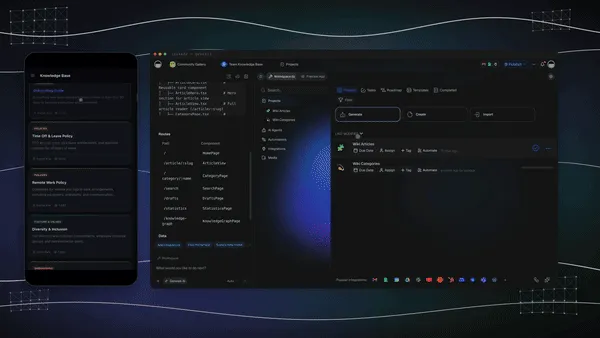
Taskade EVE, the agent that builds Taskade Genesis apps, saves notes as real Taskade projects in a projects/memory folder that you can open, edit, share, or delete. It keeps a TASKS.md ledger so each app workspace has one running record of what is done and what remains. AI agents keep context across chats with persistent memory and read the knowledge you train them on. None of this changes how the agents learn. It changes what they know, which is why the workspace gets sharper the more you use it.
The wiring map at /connect/dna draws the same loop from the outside in: integrations on the outer rim, projects and shared context in the middle ring, agents and Taskade EVE in the inner ring, and Memory, Intelligence, and Execution meeting at the core. Its brain terms are a metaphor, not a claim that Taskade models a brain. For the product side in detail, see Taskade EVE memory.
What You Would Build in Taskade
You already consolidate by hand. After a client call you skim your scribbled notes, copy two decisions into the account doc, and let the rest go. On a busy week the skim never happens, and the decisions stay buried in a transcript nobody reopens.
In Taskade you would describe an account memory hub. Call notes, emails, and meeting summaries land in an inbox project as they happen, which is your fast store. An agent reviews each new entry against the account's existing record and writes only what changed into a structured account project: new decisions, open commitments, contacts, and renewal dates. Each update links back to the inbox entry it came from, so the details stay one click away. An automation runs that review on a schedule, so consolidation never depends on a quiet afternoon. Your team opens the account project and reads the current state, and anyone can correct an entry directly, because the memory is a project, not a hidden model setting.
Describe yours and build it free →
Related Concepts
- Agent Memory Types: short-term, long-term, episodic, and semantic memory in agents
- Persistent Memory: what an agent keeps between sessions
- Context Compaction: the agent version of the consolidation step
- Context Rot: what happens to a long context that is never consolidated
- Continual Learning: the machine learning fight against catastrophic forgetting
- In-Context Learning: how a model uses what sits in its context window
- Connectome: the wiring map that replay runs across
- Hebbian Learning: the synaptic rule that cells which fire together wire together
- Hopfield Network: an early model of memory stored as patterns in a network
- Predictive Coding: the theory that the brain predicts its input
- The History of Agent Memory: how AI systems learned to remember users
- Types of AI Agent Memory: a practical guide to agent memory stores
Frequently Asked Questions About Memory Consolidation
What is memory consolidation in simple terms?
Memory consolidation is how a new, fragile memory becomes lasting knowledge. The hippocampus records an event quickly, then reactivates it so the neocortex can absorb it slowly and link it to what you already know. Over time the memory depends less on the hippocampus and more on the neocortex.
What is hippocampal replay?
Hippocampal replay is the reactivation of the neural patterns from a recent experience while the animal is offline. In the classic 1994 study, Wilson and McNaughton found that rat place cells which fired together during a spatial task fired together again during slow-wave sleep afterward, which is the replay that consolidation theories had predicted.
What is complementary learning systems theory?
Complementary learning systems theory holds that intelligent systems need two learning systems. McClelland, McNaughton and O'Reilly (1995) proposed a fast hippocampus for specifics and a slow neocortex for structure, linked by interleaved replay. Kumaran, Hassabis and McClelland (2016) updated it and applied it to artificial agents.
Why does the brain need two memory systems?
One network cannot learn fast and stay stable at the same time. A network that learns a new item quickly tends to overwrite older knowledge, which researchers call catastrophic interference. Keeping a fast store separate lets the slow store absorb new material gradually, interleaved with old material, so structure survives.
What is the difference between synaptic and systems consolidation?
Synaptic consolidation stabilizes changes at individual synapses within minutes to hours of learning. Systems consolidation reorganizes a memory across brain regions over days to years, so that it rests more on the neocortex than on the hippocampus.
Does sleep help memory consolidation?
Yes. During slow-wave sleep, slow oscillations, spindles, and hippocampal ripples coordinate the replay of recent memories and their transfer to the neocortex, as Diekelmann and Born (2010) review. When researchers suppressed ripples in rats after training, spatial memory got worse.
What is memory reconsolidation?
Reconsolidation is the finding that recalling a consolidated memory makes it fragile again, so it must be stabilized once more. Nader, Schafe and LeDoux (2000) showed that blocking protein synthesis right after recall erased a fear memory in rats, while the same treatment without recall did not.
What is an engram?
An engram is the physical trace of a single memory in the brain. Richard Semon coined the term in 1904. Modern experiments reviewed by Josselyn and Tonegawa (2020) tag the cells active during learning and show that reactivating them brings the memory back, which supports the engram as the basic unit of memory.
How does memory consolidation apply to AI agents?
Agents copy the two-speed design. The context window acts as the fast store, a curated long-term memory outside the model acts as the slow store, and summarizing or compacting a session into notes is the consolidation step. Papers such as TiMem (2026) build hierarchical consolidation on exactly this idea.
Does AI memory consolidation change the model itself?
Not in most agent systems. Biological replay rewrites synapses, but agent consolidation rewrites text in a memory store, and the model's weights stay the same. In Taskade, memory lives in editable projects, so it improves what agents know, and you can read and correct every note.
Where does Taskade store agent memory?
Taskade stores memory in your workspace, as projects you can open. Taskade EVE saves memory notes as real Taskade projects in a projects/memory folder and keeps a TASKS.md ledger of what is done and what remains. Agents also keep persistent memory across chats and read the knowledge you give them.