
Definition: A Hopfield network is a recurrent neural network that stores memories as the low points of an energy landscape and recalls a complete memory from a partial or noisy cue by sliding downhill to the nearest stored pattern. John Hopfield introduced it in 1982 as a model of content-addressable memory: memory you find by what it contains, not by where it is stored. Its modern continuous version is mathematically the same operation as attention in a transformer.
TL;DR: A Hopfield network recalls a whole memory from a fragment by rolling downhill on an energy landscape to the closest stored pattern. John Hopfield shared the 2024 Nobel Prize in Physics for it with Geoffrey Hinton, and in 2020 researchers proved that transformer attention is one update step of its modern form. For builders, that means a context window works like associative memory: what you put in it decides what the model can recall. Build an AI app free →
You hear three notes of a song at a party and the rest of it plays in your head, along with the concert where you last heard it. You did not search a list of every song you know. The fragment pulled the whole memory back by itself. A Hopfield network is the simplest machine that does the same thing, and it turns out to sit underneath the AI you use every day.
Why the Hopfield Network Matters in 2026
The Hopfield network matters because it is the bridge between how brains recall and how large language models read their context. On October 8, 2024, the Royal Swedish Academy of Sciences awarded the Nobel Prize in Physics to John Hopfield and Geoffrey Hinton "for foundational discoveries and inventions that enable machine learning with artificial neural networks". The Academy described Hopfield's network as one that works "stepwise to find the saved image that is most like the imperfect one" it receives.
The link to modern AI is exact, not a metaphor. In Hopfield Networks is All You Need (Ramsauer and colleagues at Johannes Kepler University Linz, published at ICLR 2021), the authors built a modern Hopfield network with continuous states and showed that its update rule "is equivalent to the attention mechanism used in transformers." The same network can store exponentially many patterns in the dimension of its space and usually retrieves a pattern in one update.
The idea is still producing research. At ICML 2025, Dmitry Krotov of IBM Research and colleagues presented Modern Methods in Associative Memory, a tutorial that connects Hopfield-style memory to both transformers and diffusion models. A 2025 paper revised in March 2026, Memorization to Generalization, goes further: it reads image diffusion models as dense associative memories and reports that once training data passes the critical storage capacity, "new local minima, which are different from the training data, emerge". In classical Hopfield terms those extra minima were a defect. In a generative model they are the first sign of new output.
Neuroscience keeps the other end of the bridge. Edmund Rolls argues in Frontiers in Systems Neuroscience that the hippocampal CA3 region "operates as a single attractor or autoassociation network", in which "completion of a whole memory can occur from any part". That is the behavior Hopfield wrote down in 1982, found in a real brain region.
How a Hopfield Network Works
Hopfield's own example in the 1982 PNAS paper is a citation. Store "H. A. Kramers & G. H. Wannier Phys. Rev. 60, 252 (1941)", and a good content-addressable memory returns the whole reference from "& Wannier, (1941)", or even from the misspelled "Vannier, (1941)".
- Neurons are switches. Each neuron is on or off, like the binary units of the perceptron. Every neuron connects to every other neuron, and the connections are symmetric: the weight from A to B equals the weight from B to A.
- Memories are written into the weights. The storage rule is Hebbian, the "cells that fire together wire together" idea from Hebbian learning. Each stored pattern adds its outer product to the weight matrix, so neurons that agree in a memory strengthen their link.
- Every state has an energy. The weights define a single number for any on/off configuration. Stored memories sit at the bottoms of valleys. Hopfield showed the model is isomorphic to an Ising model of magnetic spins, which is why a physics prize fits.
- Recall is downhill motion. Set the neurons to the cue, then let them update one at a time. Each update can only lower the energy or leave it unchanged, so the state keeps falling until no single flip helps. Where it stops is the answer.
- Capacity is limited. In simulations with 30 and 100 neurons, Hopfield found that "about 0.15 N states can be simultaneously remembered before error in recall is severe." Overload the network and memories blur into spurious mixtures. In 1985, Amit, Gutfreund, and Sompolinsky used spin-glass theory to show that a large network keeps associative memory only below about 0.14N patterns.
- Randomness makes it generative. The Boltzmann machine adds a temperature to the same energy model. In 1985, Ackley, Hinton, and Sejnowski published a learning algorithm for it in Cognitive Science. It does not stop at one valley. It wanders, and the time it spends in each state follows a probability distribution, the same stationary-distribution idea behind a Markov chain. The Royal Swedish Academy credited it with the ability to "create new examples of the type of pattern on which it was trained."
The energy landscape is easiest to picture as terrain:
 energy
   ^
   |  o   <- partial cue: "Vannier, (1941)"
   |   \
   |    \                   __
   |     \                _/  \_              __
   |      \             _/      \_          _/  \
   |       \           /          \        /
   |        \         /            \__  __/
   |         \       /                \/
   |          \_   _/              memory B
   |            \_/
   |         memory A = "H. A. Kramers & G. H. Wannier,
   |                     Phys. Rev. 60, 252 (1941)"
   +------------------------------------------------------> network state
   The cue starts high and rolls downhill. It stops at the bottom
   of the valley it started in: the stored memory it most resembles.
The modern version keeps the landscape and changes the math. Krotov and Hopfield (2016) showed that energy functions with higher-order interactions let a network store "many more patterns than the number of neurons in the network". Ramsauer's continuous version writes one update as new state = X · softmax(β · Xᵀ · state), where X holds the stored patterns. With β set to 1/√d, that is transformer attention: the stored patterns act as keys and values, the state is the query, and one attention pass is one step downhill. The paper names three kinds of minima: a global fixed point that averages all patterns, metastable states that average a subset, and fixed points that return a single pattern. The sharpness term β decides which one you get, much as temperature shapes entropy in a probability distribution.
Classical Hopfield vs Modern Hopfield vs Transformer Attention
| Question | Classical Hopfield (1982) | Modern Hopfield (2016 to 2021) | Transformer attention |
|---|---|---|---|
| What is stored | Binary patterns in the weight matrix | Continuous vectors kept as explicit patterns | Keys and values from the tokens in context |
| What the cue is | A partial or noisy pattern | A query vector | A query vector for each token |
| How recall runs | Neurons flip one at a time until the energy stops falling | One softmax-weighted update, rarely more | Exactly one softmax-weighted pass per layer |
| Capacity | About 0.15N patterns in Hopfield's simulations | More patterns than neurons, exponential in the dimension in Ramsauer's version | Bounded by the context window |
| What it returns | One stored pattern or a spurious mixture | A single pattern, a metastable average, or a global average | A weighted blend of values |
| Where you meet it | Physics, neuroscience, the Nobel lineage | Research layers for pooling and memory | Every modern large language model |
The three minima show up in real models. When Ramsauer's team analyzed pre-trained BERT, they found that heads "perform in the first layers preferably global averaging and in higher layers partial averaging via metastable states." Some heads look at everything, and some retrieve a small, specific group of tokens.
The builder lesson follows directly. If attention is associative recall over the context window, then the context is the memory store. A model can only retrieve what is in it. Crowd the context with near-duplicates and retrieval blurs into an average, which is one way to explain context rot. Keep the right, distinct material in context and the query lands in a clean valley.
Hopfield Network Timeline: From 1982 to Transformers
The Hopfield network idea took four decades to travel from a physics paper to the core of every language model. Each row below links to the source this article used.
| Year | Milestone | Who | Why it matters |
|---|---|---|---|
| 1982 | Neural networks and physical systems with emergent collective computational abilities | John Hopfield | Content-addressable memory as an energy landscape |
| 1985 | A learning algorithm for Boltzmann machines | Ackley, Hinton, Sejnowski | Temperature turns recall into sampling |
| 1985 | Storing infinite numbers of patterns in a spin-glass model | Amit, Gutfreund, Sompolinsky | Capacity limit near 0.14N for large networks |
| 2016 | Dense Associative Memory for Pattern Recognition | Krotov, Hopfield | Store more patterns than neurons |
| 2020 | Hopfield Networks is All You Need | Ramsauer et al., JKU Linz | Modern Hopfield update equals attention |
| 2024 | Nobel Prize in Physics | Hopfield, Hinton | Physics credits the roots of machine learning |
| 2025 | Modern Methods in Associative Memory | Krotov, Hoover, Ram, Pham | ICML tutorial links memory to transformers and diffusion |
| 2025 | Memorization to Generalization | Pham, Krotov, and colleagues | Spurious states read as the start of generation |
Connection to Taskade
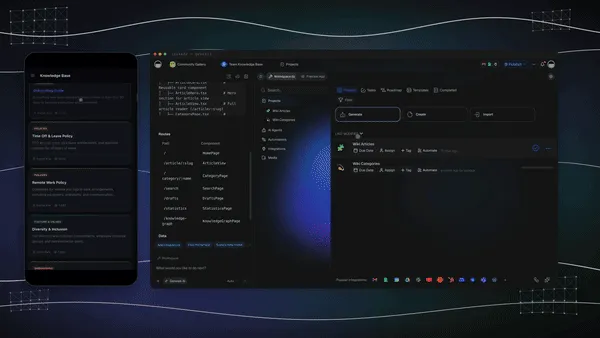
Taskade does not run a Hopfield network. What it shares with one is the idea that recall depends on what is stored and how cleanly it is kept. In Taskade, Workspace DNA is Memory + Intelligence + Execution. Memory is your projects and databases. Intelligence is AI agents and frontier models from top AI labs that read that memory. Execution is automations that act on the result and write it back.
Agent memory lives as readable workspace content, not hidden weights. Taskade EVE, the agent that builds Taskade Genesis apps, saves its notes as real Taskade projects in a projects/memory folder that you can open, edit, share, or delete. It keeps a running TASKS.md ledger there so it knows what is done and what remains. Custom AI agents keep persistent memory across chats, and you train them on files, links, projects, and media through agent knowledge. When an agent answers, it retrieves from that material into its context. The Hopfield lesson applies: distinct, current, well-named notes give the agent clean valleys to land in. The workspace gets sharper the more you use it because it holds more and better content, not because anything learns on its own.
What You Would Build in Taskade
You already do content-addressable recall by hand. Someone asks "what did we decide about the vendor renewal, back in spring?" and you dig through chats and docs with half a name and a rough date until the full decision surfaces.
In Taskade, you describe a team decision memory in one prompt. Every decision lands as a row in a project with the date, the owner, the options, and the reason. An agent trained on that project answers fragment questions like "the renewal call with the hosting vendor" by retrieving the full entry and linking the source row. An automation files each new meeting summary into the same project, so the store stays current without a weekly cleanup. Because every note is a readable project, you can correct a wrong entry once and every later answer uses the fix.
Describe yours and build it free →
Related Concepts
- Attention Mechanism: the transformer operation that equals one modern Hopfield update
- Transformer: the architecture that stacks those attention steps into a language model
- Perceptron: the binary neuron that Hopfield's units build on
- Hebbian Learning: the storage rule that writes memories into the weights
- Markov Chain: the random walk behind the Boltzmann machine's sampling
- Entropy: the quantity that temperature and β trade against sharp recall
- Persistent Memory: how AI systems keep information beyond a single context window
- Types of Memory in AI Agents: the builder's guide to short-term, long-term, and shared agent memory
Frequently Asked Questions About Hopfield Networks
What is a Hopfield network in simple terms?
A Hopfield network is a memory that recalls a whole pattern from a piece of it. It stores memories as valleys in an energy landscape. You give it a partial or noisy cue, and it slides downhill until it settles into the closest stored memory. John Hopfield published it in 1982.
How does a Hopfield network relate to transformer attention?
Ramsauer and colleagues proved in 2020, published at ICLR 2021, that the update rule of a modern continuous Hopfield network equals transformer attention when the sharpness β is 1/√d. The stored patterns act as keys and values, the state acts as the query, and one attention pass is one step of Hopfield recall.
Why did John Hopfield win the Nobel Prize in Physics?
He shared the 2024 prize with Geoffrey Hinton "for foundational discoveries and inventions that enable machine learning with artificial neural networks". His network uses the physics of atomic spin systems: stored patterns get low energy, and recall is the system settling into a low-energy state.
What is the difference between a Hopfield network and a Boltzmann machine?
A Hopfield network is deterministic. It descends to one valley and stops, which makes it a memory. A Boltzmann machine, introduced by Ackley, Hinton, and Sejnowski in 1985, adds temperature so the state keeps moving. The time it spends in each state follows a learned distribution, which lets it generate new examples.
How many memories can a Hopfield network store?
The classical version is small. Hopfield's 1982 simulations showed about 0.15N memories for N neurons before recall errors became severe. Modern Hopfield networks change the energy function and can store a number of patterns that grows exponentially with the dimension of the space.
Is the brain a Hopfield network?
Not literally, but one region comes close in theory. Edmund Rolls argues that hippocampal area CA3 works as an autoassociation network that completes a whole memory from part of it, which is the Hopfield behavior. The model is a simplification: real neurons fire in graded, sparse patterns, and the brain has many other memory systems.
What does a Hopfield network mean for AI agents and context windows?
If attention is associative recall, the context window is the memory store, so an agent can only retrieve what you put in it. Many near-duplicate notes blur retrieval into an average. Distinct, current, well-labeled material gives the model a clean target, which is why curated agent memory beats dumping everything into the prompt.
Are Hopfield networks still used today?
Yes, mostly through their descendants. Transformer attention is a modern Hopfield update, researchers use Hopfield layers for pooling and memory tasks, and a 2025 study reads diffusion models as dense associative memories. The ICML 2025 tutorial on associative memory covers these links in depth.