

A note on the blanks. We publish a price only when we can read it off the vendor's own page. Perplexity's plan pricing is not something we can read off reliably from our side, so rather than repeat a number we cannot verify, we point you at their pricing page. Every ChatGPT figure above is month-to-month, straight from OpenAI's plans page.
What TSK-1 Found
TSK-1 tests models, not search products. Perplexity is a research surface, not a model family. GPT-5.6 Luna sticks closest to your words in the TSK-1 dataset — from early through mid-August it rebuilt what the customer asked for word for word. See /tsk/gpt for the full evidence and the TSK-1 hub.
The Headline: Retrieval vs Generation
Perplexity finds and cites. ChatGPT writes and builds. They are not substitutes — they are two halves of one workflow.
- Perplexity is the AI search engine with native citations on every answer. Comet (now free to everyone), the Sonar models, the Model Council router, and the Computer sandbox make it the right tool when grounded, checkable sources matter.
- ChatGPT is the general-purpose assistant with the broadest consumer surface. DALL·E, Sora, voice mode, the Custom GPTs marketplace, and the Atlas browser make it the right tool when the job is to produce something new.
The 2026 best practice is Perplexity for the retrieval, ChatGPT for the generation, with Taskade Genesis as the workspace that turns both into a deployed app your team actually uses.
TL;DR: Perplexity is retrieval-with-citations (Sonar models, Deep Research, the Computer sandbox, and the Comet browser, free to everyone in 2026 with Comet Plus at $5/mo). ChatGPT is generate-and-build (Go $8/mo, Plus $20/mo, Pro at $100 and $200/mo, all month-to-month). Inside Taskade Genesis you ship the deployed app on top of either.
Two Different Product Bets
- Perplexity bet on citations as the primary product differentiator. Every answer carries sources. Comet, Computer, and Model Council compound the research-product strategy — and taking Comet free in 2026 turned the browser from a top-tier perk into the funnel.
- OpenAI bet on the broadest model and tool surface, then widened the price ladder underneath it. The Go tier at $8/mo opened a rung below Plus, and ads are being tested on Free and Go in the US.
Different bets. Both winning their segments.
Product Maps Side by Side
| Surface | Perplexity ships | ChatGPT (OpenAI) ships |
|---|---|---|
| Chat | Perplexity.ai (search-style) | ChatGPT (chat-style) |
| Citations | Native on every answer | Search + Browse mode (partial) |
| AI browser | Comet — free to everyone | Atlas |
| Browser add-on | Comet Plus, $5/mo | — |
| Image | via the higher tiers | ✅ DALL·E + Sora |
| Video | via the higher tiers | ✅ Sora |
| Voice | partial | ✅ Voice Mode |
| Models | Sonar + Model Council (OpenAI, Anthropic, Google) | OpenAI's own frontier models |
| Sandboxed agent | Perplexity Computer (Max tier) | Operator |
| Custom tools | ✗ | ✅ Custom GPTs marketplace |
| Deep research | ✅ Perplexity Deep Research | ✓ ChatGPT Search + Atlas |
| Enterprise | Perplexity Enterprise | ChatGPT Enterprise |
The overlap is real — both ship a browser, a sandboxed agent, and a paid ladder. The audiences are different: research professionals who must show their sources, versus a broad consumer base that wants one assistant for everything.
The Routing Matrix: Where to Send Each Task
This is the table to keep. Every row is a task, the tool you should send it to, and what that choice costs.
| Task | Send it to | Why | Cost consequence |
|---|---|---|---|
| A factual question you must be able to defend | Perplexity | citations are native on every answer | free tier covers light use; heavier use needs a paid Perplexity tier |
| Multi-step market or literature research | Perplexity Deep Research | multi-step web exploration with cited findings | a paid Perplexity tier |
| Research inside the browser, agentically | Comet | now free to everyone — the cheapest way to try citation-first research | free; Comet Plus adds a paid layer at $5/mo |
| Sandboxed multi-step agent tasks with source tracking | Perplexity Computer | controlled environment plus citation tracking | the higher-usage Max tier |
| Draft, rewrite, or summarize material you already have | ChatGPT | strongest general writing surface | Plus $20/mo month-to-month |
| Image or video generation | ChatGPT (DALL·E, Sora) | native in-product, no hand-off | Plus $20/mo; heavy use pushes you to Pro at $100 or $200/mo |
| Realtime voice | ChatGPT Voice Mode | native realtime audio | Plus $20/mo |
| A packaged, reusable assistant to share | ChatGPT Custom GPTs | builder plus marketplace distribution | Plus $20/mo |
| Casual assistant use at the lowest paid price | ChatGPT Go | the entry rung below Plus | $8/mo month-to-month; ads being tested on Free and Go in the US |
| Turning any of the above into software the team uses | Taskade Genesis | a deployed app with agents and automations, not a transcript | included in the workspace subscription |
| All of the above, for a whole team | route per task | neither tool does the other's job | one workspace bill instead of a consumer subscription per person per vendor |
Two budgeting notes people get wrong:
- ChatGPT has no annual discount. OpenAI publishes no annual billing on any tier, so the monthly price is the best price. Do not model a 20% annual saving that does not exist.
- ChatGPT Pro is two prices, not a range. $100/mo and $200/mo are separate published rungs, not the ends of a band. Pick the one that matches your usage rather than budgeting for a midpoint.
Pricing Snapshot
| Tier | Perplexity | ChatGPT |
|---|---|---|
| Free | ✅ Yes | ✅ Yes — ads being tested on Free and Go (US) |
| Entry paid | Pro tier — see their pricing page | Go $8/mo |
| Mid | — | Plus $20/mo |
| Power user | Max tier — see their pricing page | Pro — $100/mo and $200/mo (two distinct rungs) |
| Browser | Comet, free to everyone; Comet Plus $5/mo | Atlas, bundled |
| Annual billing | see their pricing page | 🔴 none published on any tier |
| Enterprise | Custom | Custom |
Every ChatGPT figure above is month-to-month. We deliberately leave Perplexity's plan prices blank rather than restate a number we cannot read off Perplexity's own page today — a comparison is only worth as much as its weakest figure.
Inside Taskade Genesis you route frontier models from top AI labs through one workspace picker, with the AI allowance included in the subscription (billed annually: Free $0, Pro $10, Business $25, Max $100, Enterprise $250 per month). That is one bill instead of a consumer subscription per person per vendor — and it means you are not betting the company on a single lab's roadmap.
When to Pick Each
In practice: Perplexity for the retrieval, ChatGPT for the generation, Taskade Genesis for the deployed app.
Choose Perplexity If
Three things Perplexity does better, stated plainly.
- Citations are the product, not a feature. Every answer links to its sources by default. If your work gets reviewed — legal, medical, financial, academic, journalism — that default is worth more than raw model quality.
- Comet is free. An AI browser with citation overlays and multi-tab research synthesis, at no cost, is the lowest-friction way to change how you research. This was a top-tier perk until 2026.
- Model Council routes for you. Rather than betting on one lab, Perplexity picks between frontier models per question. That is the same instinct behind multi-model routing generally, applied to search.
Choose ChatGPT if the job is to make something new — text, images, video, voice, or a shareable Custom GPT — and if you want the widest paid ladder, from Go at $8/mo up to Pro at $200/mo.
The Three-Stage Research-to-Ship Pipeline
The 2026 pattern that works for research-driven workflows.
┌─────────────────────────────────────────────────────────────┐
│  STAGE 1: Retrieve with citations                           │
│  → Perplexity Deep Research, or Comet in the browser        │
│  → Output: cited findings, source URLs, confidence ranges   │
├─────────────────────────────────────────────────────────────┤
│  STAGE 2: Generate and synthesise                           │
│  → A frontier writing model, your pick in the workspace     │
│  → Output: polished report or content                       │
├─────────────────────────────────────────────────────────────┤
│  STAGE 3: Ship as a deployed app                            │
│  → Taskade Genesis app from a single prompt                 │
│  → Output: live URL, custom domain, agents, automations,    │
│             100+ integrations, ready for the team to use    │
└─────────────────────────────────────────────────────────────┘
Inside Taskade Genesis the three stages connect via an automation HTTP request step for the retrieval input and the model picker for the synthesis model. The deployed app is the work product, not a chat transcript.
The Taskade Genesis Angle: From Research to Living Software
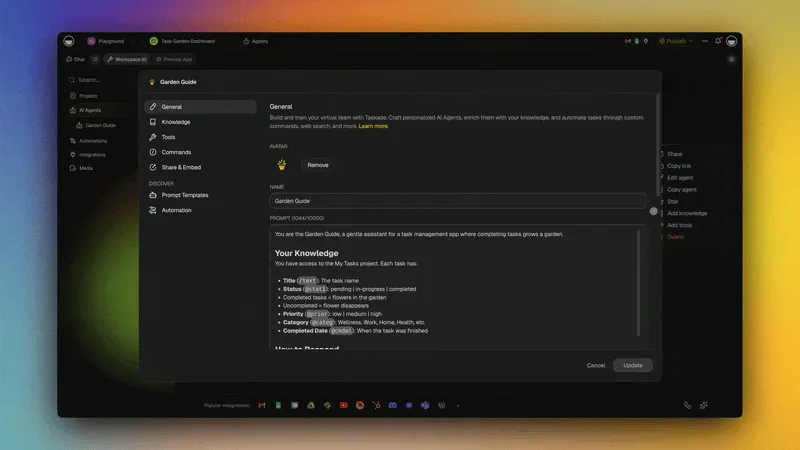
Taskade routes across frontier models from top AI labs inside one workspace, with the AI allowance included in the subscription rather than a separate consumer subscription per vendor. Five patterns that work right now.
✓ Pattern 1: Perplexity finds, Taskade ships. A market research automation calls the Perplexity Sonar API through an HTTP request step for cited findings. A separate writing agent in Taskade Genesis composes the report. The output ships as a deployed dashboard at a custom domain.
✓ Pattern 2: ChatGPT for the image, Perplexity for the fact-check. A content automation generates illustrations through the OpenAI models in the picker. A Perplexity step fact-checks the claims in the copy and attaches citation links before publish.
✓ Pattern 3: Daily research digest. A scheduled automation runs Perplexity Deep Research on three to five topics every morning. A frontier writing model drafts the digest. Taskade Genesis publishes it to a team dashboard before the standup.
✓ Pattern 4: Customer due-diligence agent. A sales agent calls Perplexity Sonar for cited company background on every new lead. A writing model composes the prep notes. The output is saved as Memory in the project so it persists into the next customer interaction.
✓ Pattern 5: Auto mode handles routing. Set Auto mode as the default on new agents. Taskade Genesis routes content steps automatically and adapts as new versions ship, while a scheduled automation pulls the cited research in over an HTTP request step.
See 10 Best Open-Source AI LLMs in 2026 for the open-source picks that complement both research and building.
Where Both Are Heading
Perplexity's bets
- Comet as a free, mass-market surface — the browser is now the top of the funnel, not a Max perk
- Comet Plus as the paid layer on top of a free browser
- Model Council routing between frontier models per question
- Perplexity Computer as the sandboxed agent for power users
- Sonar models as the citation-grounded answer layer
OpenAI's bets
- A wider price ladder — Go at $8/mo below Plus, Pro split into $100 and $200 rungs
- Advertising as a second revenue line, in testing on Free and Go in the US
- Sora video + voice + DALL·E for multimodal consumer breadth
- Atlas browser + Operator + AgentKit for the agentic surface
- Custom GPTs marketplace for the developer platform
Where Taskade Genesis fits
Perplexity solves "find the truth with sources." ChatGPT solves "make the new thing." Taskade Genesis solves "ship the product the work flows into." All three are needed. None replaces the others.
Workspace DNA (Memory + Intelligence + Execution) wraps them. Memory stores the cited findings. Intelligence routes the synthesis to the right model per step. Execution publishes the result as a deployed app with 100+ integrations that flow both ways — triggers pull events in, actions push data out.
Read the deep histories:
- Anthropic Claude History 2026. Claude family for the synthesis layer.
- What is OpenAI?. Complete OpenAI history.
Frequently Asked Questions
Is Perplexity better than ChatGPT?
They solve different problems. Perplexity is purpose-built as an AI search engine with native citations on every answer, the Comet browser, its own Sonar models, and a Model Council that routes a question to whichever frontier model suits it. ChatGPT is a general-purpose assistant with the broadest consumer surface: Custom GPTs, DALL-E images, Sora video, voice mode, and the Atlas browser. Perplexity wins on research you need to be able to verify. ChatGPT wins on broad chat, creative work, and ecosystem breadth. Most 2026 teams use both.
How do Perplexity and ChatGPT pricing compare?
ChatGPT publishes a free tier, Go at 8 dollars per month as the entry paid tier, Plus at 20 dollars per month, and Pro at two separate price points, 100 dollars and 200 dollars per month. Every one of those is month-to-month, because OpenAI publishes no annual billing on any tier. Perplexity offers a free tier, a paid Pro tier, and a higher-usage Max tier; check the Perplexity pricing page for the current figures, since we only publish prices we can read off a vendor's own page. One Perplexity price is public and worth knowing: Comet Plus is 5 dollars per month.
Is the Perplexity Comet browser free?
Yes. Comet, Perplexity's AI browser, is now free to everyone. It was previously restricted to the top-tier Max plan, and opening it up is one of the more significant product changes Perplexity made in 2026. Comet Plus, a paid add-on at 5 dollars per month, sits on top of the free browser. If you want to try the citation-first research workflow without committing to a subscription, Comet is the cheapest way in.
Does Perplexity use ChatGPT models?
Partly. Perplexity has historically routed across multiple frontier models, and its Model Council routes between frontier models from OpenAI, Anthropic, and Google alongside Perplexity's own Sonar models. Sonar is tuned specifically for citation-grounded answers. So Perplexity does use OpenAI models among others, but the search-and-cite layer built on top is Perplexity's own product and is the reason to use it.
Which is better for research, Perplexity or ChatGPT?
Perplexity is purpose-built for research you have to defend. Every answer carries links to sources, Deep Research runs multi-step web exploration with cited findings, and Comet folds that into your browsing. ChatGPT can browse the web and ships the Atlas browser, but citation handling is not the center of the product. For citation-grounded research, reach for Perplexity. For research that immediately turns into writing, drafts, images, or code, ChatGPT's broader surface wins. The strongest pattern pairs them: Perplexity cites the sources, a frontier writing model drafts the report, and Taskade Genesis ships the deployed dashboard.
Does ChatGPT offer annual billing?
No. OpenAI publishes no annual billing on any ChatGPT tier, so every ChatGPT price is a month-to-month rate. Any annual-equivalent figure you see quoted for ChatGPT is a third-party calculation, not an OpenAI price. This matters when you are comparing against tools that do discount for annual commitment, because it means ChatGPT's headline price is also its best price. OpenAI is also testing ads on the Free and Go tiers in the US.
What is the Perplexity Computer?
Perplexity Computer is a sandboxed AI computer available on the higher-usage Perplexity Max plan. It lets an agent perform multi-step tasks (browse, fill forms, run scripts, draft documents) inside a controlled environment with citation tracking, against a monthly credit allowance. It is Perplexity's answer to ChatGPT's Operator. Inside Taskade Genesis the equivalent role is played by AI Agents v2 with its built-in tool set plus the MCP Server connection to external clients.
Can I use Perplexity inside Taskade Genesis?
Side by side, not inside the model picker. Perplexity is a separate research surface: run the sourced research in Perplexity or the Comet browser, then paste or import the cited findings into a Taskade Genesis project, where they become durable workspace context every agent can read. For research that stays in the workspace, Taskade agents ship their own web search tool. Taskade itself routes across frontier models from top AI labs, so Perplexity slots in as the research-and-cite layer feeding a workspace that already has the writing and building models.
Is Perplexity safe to use for business research?
Perplexity sells an Enterprise tier aimed at regulated teams, and the citation grounding is itself a compliance advantage: every claim in an answer links back to a source a reviewer can inspect. Verify the current certification and data-residency list on Perplexity's own enterprise documentation, since those lists change. On the Taskade side, Enterprise plans wrap the research your team brings in with role-based access, audit logging, and SCIM user provisioning.
What does Taskade Genesis add beyond Perplexity and ChatGPT?
A deployed workspace. Perplexity finds the sources. ChatGPT drafts the content. Taskade Genesis ships the actual application. One prompt builds a live app that reads and writes live workspace data, with persistent AI agents, automations, custom domains, and 100+ integrations that flow both ways. The agents inside it route across frontier models from top AI labs, with the AI allowance included in the subscription. The end product is software your team uses, not a research thread or a chat transcript.
Final Word: Retrieve, Generate, Ship
Perplexity is for the retrieval you have to be able to defend. ChatGPT is for the generation that follows it. Taskade Genesis is for the deployed app at the end.
Three tools, one flow, each earning its keep at a different step — and one workspace subscription instead of a consumer plan per person per vendor.
▲ Memory feeds Intelligence. ■ Intelligence triggers Execution. ● Execution creates Memory. Three tools. One workspace. The right surface for every step.
This is the origin of living software. 🌱
Build a research-to-ship pipeline in one workspace →
Verify these numbers yourself
- Perplexity plans: perplexity.ai/pricing
- ChatGPT plans: openai.com/chatgpt/pricing
Related reading
- 10 Best Open-Source AI LLMs in 2026 — Full open-source ranking.
- What is OpenAI? — Complete OpenAI history.
- GPT vs Claude — OpenAI vs Anthropic head-to-head.
- Gemini vs Claude — Multimodal-native vs reasoning-native.
- Copilot vs Claude — IDE pair programmer vs frontier reasoner.
- Multi-Model AI Access — How Taskade Genesis routes work across frontier models from top AI labs.
- Tools for AI Agents — The built-in agent toolset.
- Taskade MCP Server — Use any MCP-compatible client.
- TSK-1 GPT profile — Full benchmark evidence for the GPT family.
- TSK-1 hub — The complete model benchmark dataset.