





In 2026, "AI agent" stopped meaning one thing.
It can mean a Python class you import from CrewAI. A chat thread you scope to a single PDF in Claude Projects. A drag-and-drop visual graph in Lindy. A function in Cursor that edits a file. These are all called "agents," and they share almost no infrastructure.
This essay names what's missing, and where the puck is going.
TL;DR: A workspace-native AI agent shares persistent memory with the workspace it lives in, co-edits projects with human teammates in real time, and triggers automations natively without an orchestration layer. Frameworks are not workspace-native. Chat tools are not workspace-native. Visual builders are not workspace-native. Taskade Genesis is the canonical implementation, clone any of 78 live agent apps and see the pattern firsthand.
How the "AI Agent" Category Fractured (2023–2026)
To understand workspace-native, you have to understand how "AI agent" became a contested word in the first place.
The five categories didn't arrive at once. They fractured out of the same source, chat completions, over three years.
| Date | Milestone | Which category it spawned |
|---|---|---|
| Mar 14, 2023 | OpenAI GPT-4 released | Reasoning step-change |
| Mar 30, 2023 | AutoGPT lands on GitHub — 30K stars in 13 days, 183K+ today | Framework (viral draft) |
| Jun 13, 2023 | OpenAI ships function-calling (GPT-4-0613) | Tool-use primitive |
| Oct 2, 2023 | Microsoft AutoGen open-sources (top GitHub trending Oct) | Framework (production-grade) |
| Late 2023 | CrewAI repo lands (company formally launches Jan 2024) | Framework (ergonomic) |
| Nov 21, 2023 | Anthropic Claude tool use beta (Claude 2.1) | Tool-use parity |
| Mar 2024 | LangGraph ships (stateful graph runtime) | Framework (stateful production) |
| May 30, 2024 | Anthropic tool use GA across Claude 3 family | Tool-use mainstream |
| Jun 27, 2024 | Dust raises $16M Series A (Sequoia) | Enterprise chat-context fundraise |
| Oct 22, 2024 | CrewAI raises $18M (Insight, boldstart, Andrew Ng, Dharmesh) | Multi-agent platform funding |
| Nov 4, 2024 | Cursor agent mode ships (replaces Composer) | IDE-Resident category formed |
| Nov 25, 2024 | Anthropic Model Context Protocol announced | Wire-format standardization |
| Jan 10, 2025 | Sam Altman: "in 2025 we may see the first AI agents 'join the workforce'" | Category framed at CEO level |
| Apr 7, 2025 | Tobi Lütke Shopify memo: "Reflexive AI usage is now a baseline expectation" | CEO mandate goes public |
| Aug 2025 | Gartner: AI Agents debut at Peak of Inflated Expectations | Buyer-side category awareness |
| Sep 18, 2025 | Notion 3.0 Agents — 1M+ Notion agents built by May 2026 | Workspace incumbents enter |
| Oct 2025 | LangGraph 1.0 GA · Cursor 2.0 + Composer model | Frameworks reach v1 |
| Dec 2025 | MCP donated to Linux Foundation · 10K+ public servers | Standardization endgame |
| Q4 2025 | Taskade Genesis launches workspace-native pattern | Workspace-Native (fifth) |
| Jan 16, 2026 | TechCrunch coins "micro apps" | Adjacent category named |
| Feb 24, 2026 | Notion Custom Agents (always-on, triggered, scheduled) | Workspace-native becomes table stakes |
| Apr 15, 2026 | Gizmo raises $22M from OpenAI Fund | Consumer micro-app validation |
| Apr 2026 | MCP: 97M monthly SDK downloads · 5,800+ community servers · 17,468 public servers (Nerq census Q1) | Bidirectional MCP mainstream |
| May 13, 2026 | Notion opens workspace as "hub for AI agents" (Claude Code · Cursor · Codex · Decagon) | Workspace-as-platform confirmed |
The shared root of all five categories is the LLM tool-use pattern. Where they fork is what surrounds the tool call:
Workspace-native is the fifth fork. It was the slowest to emerge because it required all four other categories to mature first, frameworks proved orchestration, chat-contexts proved memory-as-context, visual builders proved no-code composition, IDE-resident proved file integration. Workspace-native is the synthesis.
What Does "AI Agent" Even Mean in 2026?
There are four widely-shipped categories of AI agent in production today, plus a fifth, workspace-native, that this post defines as its own category. The four established categories share almost no infrastructure. A buyer who picks one without understanding which they need ends up with an agent that can't do what they thought they bought.
┌─────────────────────────────────────────────────────────────────────────┐
│  The four widely-shipped categories of "AI agent" in 2026               │
│  (a fifth — workspace-native — is added in the comparison below)        │
├─────────────────────────────────────────────────────────────────────────┤
│  Framework        →  Python class you compose (CrewAI · AutoGen)        │
│  Chat-Context     →  Read-only thread scoped to docs (Claude Projects)  │
│  Visual Builder   →  Drag-and-drop flow (Lindy · Dust · Relevance)      │
│  IDE-Resident     →  File-editing function (Cursor · Windsurf · Cline)  │
└─────────────────────────────────────────────────────────────────────────┘
Compare them on the seven capabilities buyers actually need, alongside workspace-native (Taskade Genesis), the fifth category this post argues should exist:
| Capability | Framework | Chat-Context | Visual Builder | IDE-Resident | Workspace-Native |
|---|---|---|---|---|---|
| Persistent memory | DIY | per-thread | per-agent | per-project file | ✅ Workspace DNA |
| Real-time co-editing | ❌ | ❌ | ❌ | partial | ✅ native |
| Wired to real Projects | ❌ | read-only | partial | files only | ✅ first-class |
| Native automation triggers | ❌ | ❌ | ✅ | ❌ | ✅ durable |
| Clonable as a team | partial | ❌ | ❌ | ❌ | ✅ /share/apps/* |
| Workspace-scoped RBAC | ❌ | partial | partial | ❌ | ✅ Owner to Viewer |
| MCP server for external clients | ❌ | client only | ❌ | client only | ✅ hosted server |
Five categories. Seven capabilities. The fifth category, workspace-native, is the only one that passes all seven. It is also the only one with no widely-agreed name. Until now.
The Missing Fifth Category: Workspace-Native
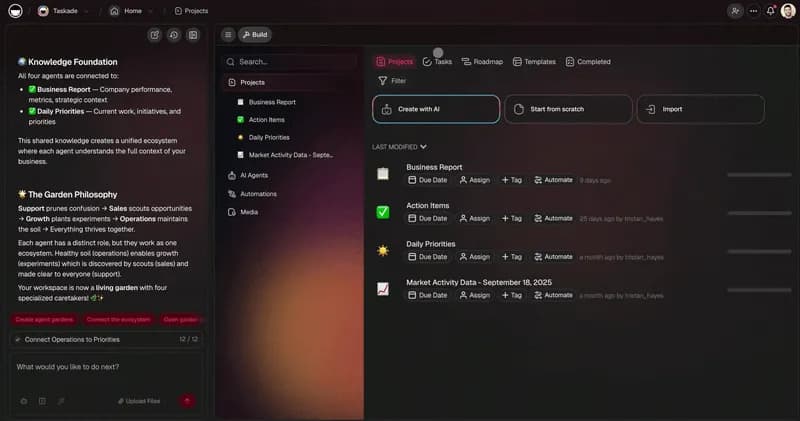
A workspace-native AI agent is an agent that lives where the work lives. Not a process you invoke. Not a chat you context-prime. Not a function you call. A first-class citizen of the workspace, with the same access humans have to the projects, the same persistent memory the team has across sessions, and the same ability to trigger automations as a normal output.
The conceptual shift is this:
That loop is Workspace DNA: Memory feeds Intelligence, Intelligence triggers Execution, Execution updates Memory. Every workspace-native agent participates in that loop by default. Frameworks let you build the loop manually over ten to fourteen days. Visual builders give you a piece of it. Chat tools give you none of it.
Workspace DNA is also why the agent's memory survives a session: every output it writes lands in a real Project the rest of the team (and other agents) can read. There's no separate vector store to wire, no Redis to provision, no Postgres schema to design. The Project itself is the memory.
See the live Workspace DNA loop in action →
The Seven-Test Criteria
Every workspace-native agent passes all seven of these. Score one and you have a chat tool. Score four and you have a visual builder. Score all seven and you have a workspace.
□ 1. Persistent memory shared with the workspace
□ 2. Real-time co-editing alongside humans
□ 3. Agents wired to real Projects (not chat threads)
□ 4. Native automation triggers
□ 5. The whole team is clonable as a unit
□ 6. RBAC and audit at workspace scope
□ 7. A hosted MCP server external clients connect into7 / 7 = workspace-native
< 7 = something else
1. Persistent Memory Shared With the Workspace
The agent's memory is the workspace's memory. Not a per-conversation buffer. Not a private vector store. The same database the team reads from. When an agent writes an output, that output becomes context for the next agent's invocation, the next human's review, the next session's start.
   First session              Day 30                 New teammate joins
   ─────────────              ──────                 ──────────────────
   Agent reads                Agent reads             Agent reads
   Project A                  Projects A...K          ALL projects
   ─────────                  ─────────────           ────────────
   Output → Project B         Outputs woven           Onboarded with
                              into Memory             full context
                                                      (no re-priming)
See agent memory in action with Workspace DNA →
2. Real-Time Co-Editing Alongside Humans
Two cursors on one document. One human. One agent. The classic Operational Transform problem solved decades ago for human-to-human editing, now solved for human-to-agent editing. The agent's edit appears in your editor the same way a teammate's edit would. You don't poll for the result; you watch it happen.
3. Agents Wired to Real Projects (Not Chat Threads)
Chat threads die. Projects persist. A workspace-native agent reads and writes Projects with custom fields, knowledge bases, and connected tools. The same Project the SDR agent updates is the one the human reviews on Monday morning.
4. Native Automation Triggers
When an agent produces an output, an automation fires, not via a webhook hack, but as a first-class event on the platform's workflow engine. Triggers can be agent decisions, project updates, scheduled times, external webhooks, or HTTP requests with bearer tokens. Taskade Genesis automations are durable: built-in retries, branching, looping, and filtering on a workflow engine that survives restarts.
5. The Whole Team Is Clonable as a Unit
You can clone a single agent anywhere. The workspace-native test is whether you can clone the team, every agent, every project they read, every automation they trigger, as one atomic unit. Genesis apps at /share/apps/* are running agent teams cloneable in one click.
6. RBAC and Audit at Workspace Scope
Permissions apply to humans and agents using the same model: Owner to Viewer. An agent inherits the role of the workspace member who deployed it. Audit logs track every agent action the same way they track every human action.
7. A Hosted MCP Server External Clients Connect Into
The Model Context Protocol standardized in late 2024 became the de facto wire format for AI tooling by 2026. The workspace-native test is whether the workspace itself is addressable over that wire, whether a developer sitting in Claude Desktop or Cursor can reach the same projects the team works in, without an export step:
The hosted MCP server at https://www.taskade.com/mcp lets Claude Desktop, Cursor, and VS Code connect into your workspace over OAuth2, on every paid plan. An external client authenticates once and then lists spaces, inspects a project, and writes files against live workspace data, which is what separates an addressable workspace from one you have to copy-paste out of.
The other half of the protocol is a platform acting as an MCP client, calling out to third-party servers on your behalf. Taskade does that from your automations: the MCP Client step registers a remote server, lists the tools it publishes, and calls the one you pick, on every plan including Free. The distinction that matters when you design the build is where the call sits. It lives in the automation, not inside the agent — the agent reads the project, decides what it needs, hands the step the work, and reads the answer back. For systems that publish no MCP server, 100+ native integrations with triggers that pull events in and actions that push data out, plus the built-in tools every agent carries, cover the same ground. Worth knowing which mechanism you are buying, because all of it gets described with the same three letters.
See what agent tools ship built in →
The Category, By the Numbers (Apr 2026)
The workspace-native bet is made against a category that has gone from research curiosity to multi-billion-dollar market in under three years. The numbers are public; the implications are not.
| Stat | Value | Source |
|---|---|---|
| AI agent market size, 2025 | $7.84B | MarketsandMarkets |
| AI agent market size, 2030 projection | $52.62B (CAGR 46.3%) | MarketsandMarkets |
| Active AI agents, 2025 → 2030 (IDC) | 28.6M → 2.216B (CAGR 139%) | IDC via BigGo |
| Tasks executed by agents, 2025 → 2030 (IDC) | 44B → 415T (CAGR 524%) | IDC |
| MCP monthly SDK downloads, Apr 2026 | 97M | DigitalApplied |
| Public MCP servers, Q1 2026 (Nerq census) | 17,468 | Zuplo State of MCP |
| Enterprise AI teams with MCP agent in production | 78% | MCP Manager |
| LangChain GitHub stars / PyPI downloads | 137,305 / 47M+ | Gitnux |
| AutoGPT GitHub stars (peak / current) | 150K in weeks / 183K+ today | Wikipedia |
| CrewAI agents executed per month | 10M+ | CrewAI public stats (Oct 2024 Series A press) |
| Notion agents built by May 2026 | 1M+ | Notion Releases |
| Gartner: agentic projects cancelled by end of 2027 | >40% | Gartner press |
The Gartner 40% cancellation forecast is the one that matters most. Most of those cancellations will be framework projects that never shipped a workspace, never gave a non-developer a UI, never produced a clone-able artifact. Workspace-native is the bet that the survivors look more like a workspace than a Python class.
What the CEOs Said
"We believe that, in 2025, we may see the first AI agents 'join the workforce' and materially change the output of companies."
, Sam Altman, CEO of OpenAI, "Reflections", Jan 10, 2025
"Reflexive AI usage is now a baseline expectation at Shopify. What would this area look like if autonomous AI agents were already part of the team?"
, Tobi Lütke, CEO of Shopify, internal memo posted publicly on X, Apr 7, 2025
"In my mind, this is really a lot more accurately described as the Decade of the Agent."
, Andrej Karpathy, formerly Tesla AI + OpenAI, Dwarkesh podcast, Oct 2025
Three different framings of the same bet: agents stop being a feature and become a co-worker. The question every platform now answers is: where do those co-workers live? Framework agents live in a Python process. Chat-context agents live in a thread. Visual-builder agents live in a flow. Workspace-native agents live where the team works.
A Live Workspace-Native Agent Team You Can Clone
Three apps. Three operational pillars. Each one is a working agent team you can clone into your free workspace in 60 seconds.
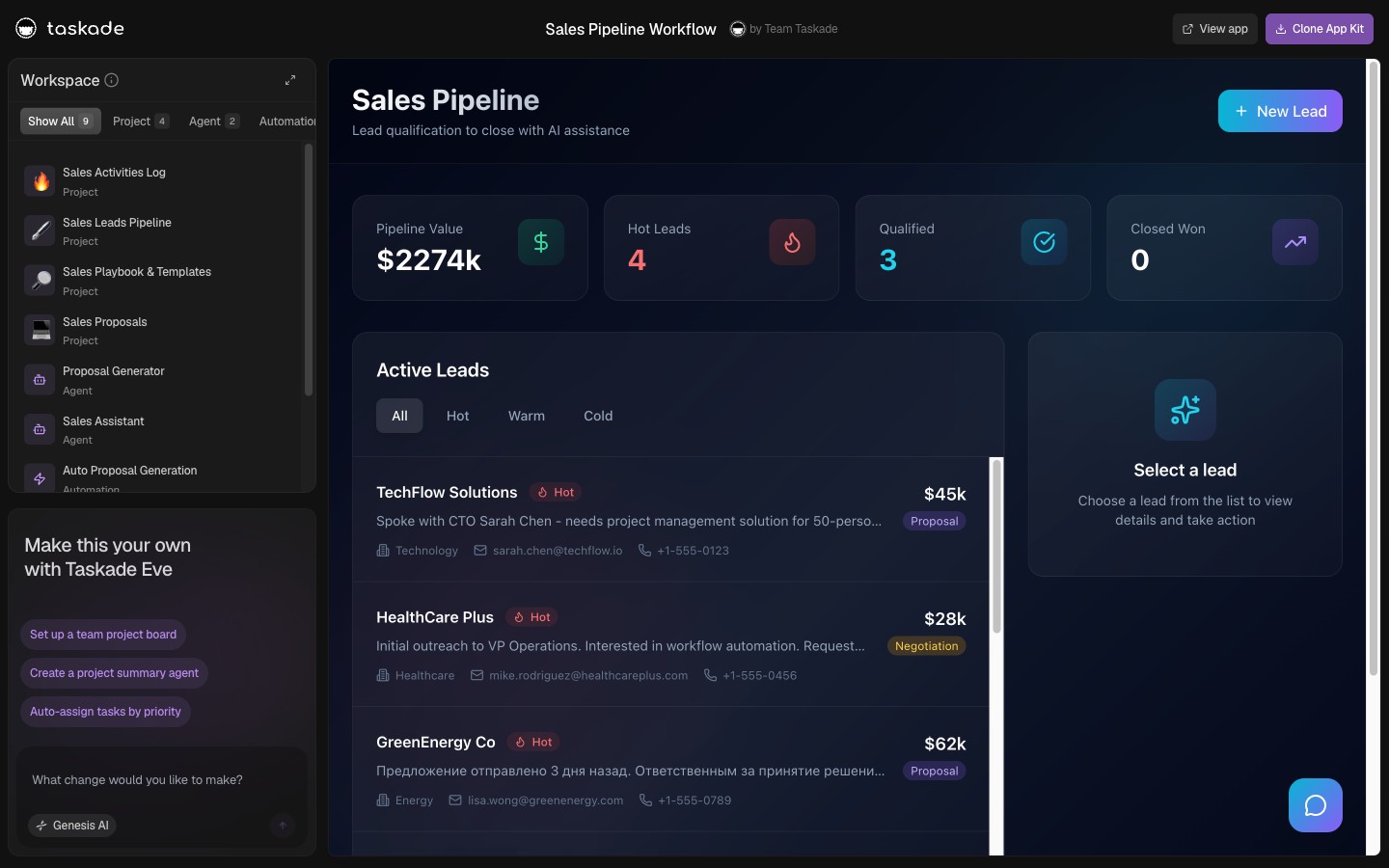
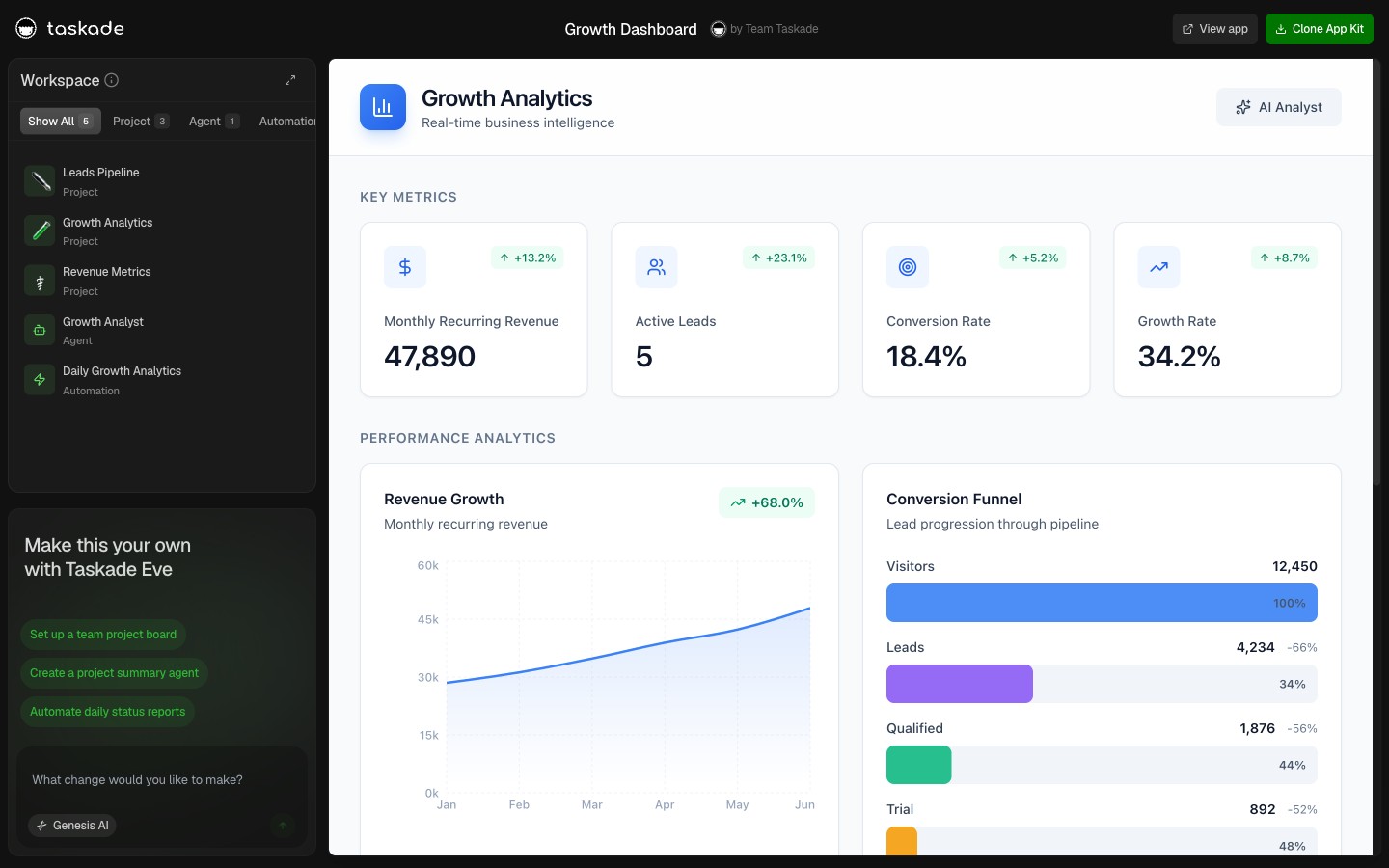
Sales Agent Studio, an SDR agent that watches your inbox, qualifies leads against criteria stored as Workspace Memory, books meetings via the calendar action, and writes back to the CRM Project the rest of the team reads. Six tools wired. One automation chain. Clone, change the criteria, ship.
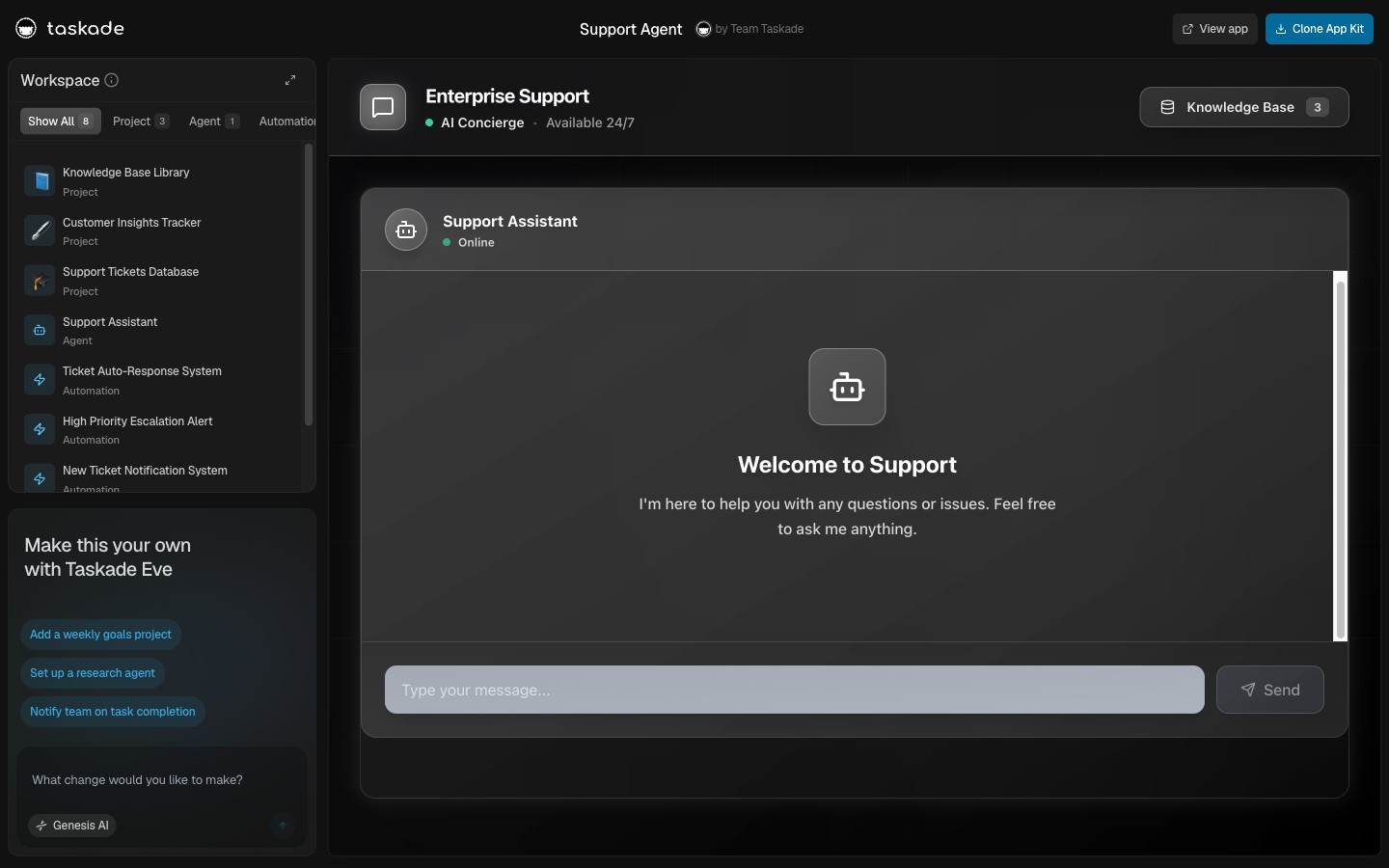
Support Agent, a triage agent that reads incoming tickets, classifies them against the playbook stored in your Knowledge Base Project, escalates the hard ones, drafts replies for the soft ones, and updates the Support Workflow Project the team manages. The team sees every reply before it sends, edits inline, and approves with one click.
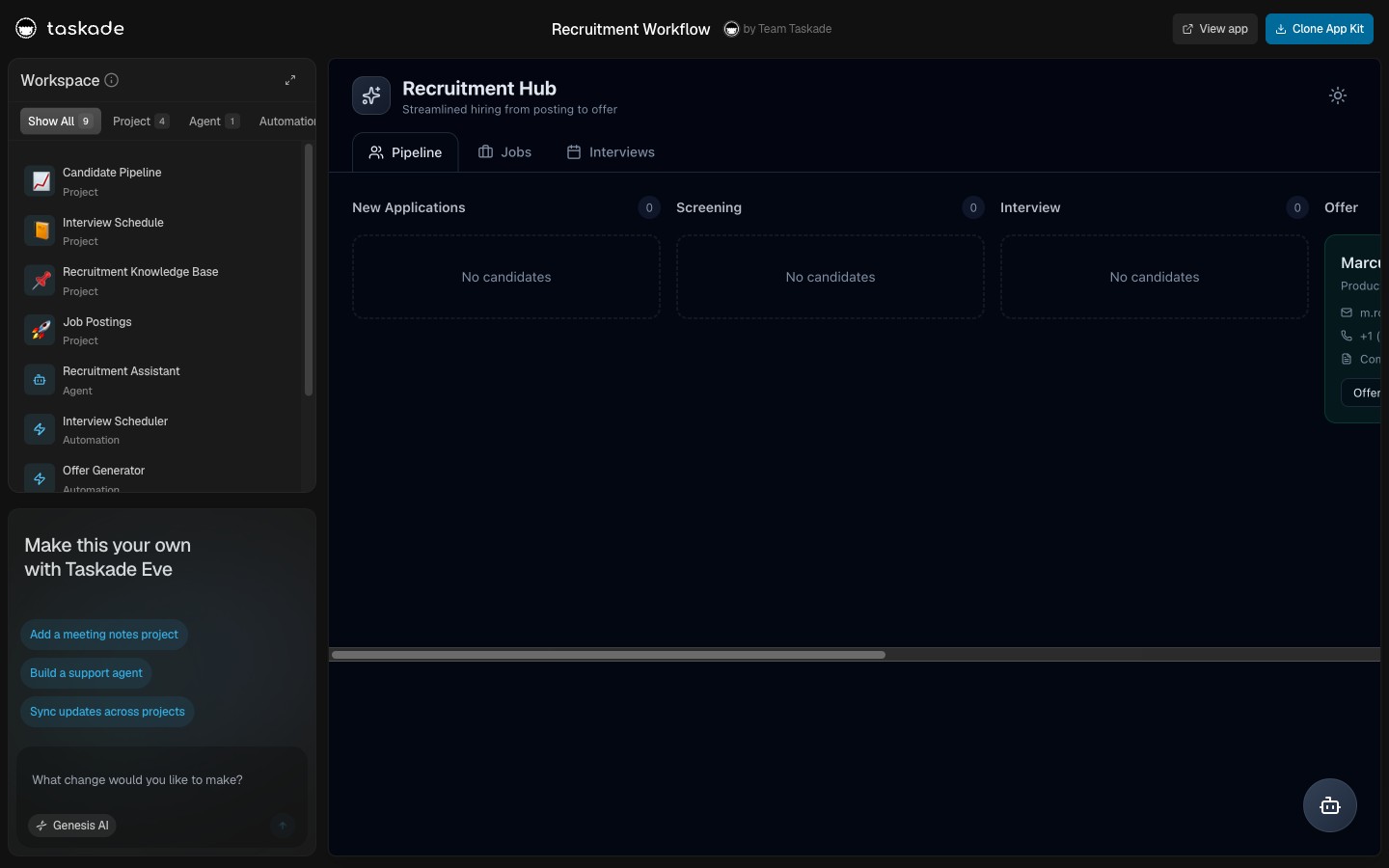
Recruitment Workflow, three agents collaborating on one pipeline. A sourcing agent finds candidates. A screening agent reads resumes against the role spec. A scheduling agent books interviews. All three read the same Candidates Project and write to it. The hiring manager sees the whole pipeline live.
Why Frameworks Fall Short
Frameworks like CrewAI, AutoGen, and LangGraph are excellent engineering primitives. They give a developer the smallest meaningful unit of an agent, a class, a graph node, a tool wrapper, and trust the developer to compose the rest. The rest is most of the work.
In production, "the rest" looks like this: provision a vector database. Wire it to your agents. Set up Redis for ephemeral memory. Stand up a backend service to host the agents. Build a frontend so non-engineers can interact. Add SSO. Add audit logging. Add a permission model. Add a way for agents on the same team to see each other's outputs. Add monitoring. Add retries. Pick a queue. Pick a database. Pick a hosting plan.
Ten to fourteen days for a competent team. Sometimes a quarter. And at the end you have a system that does what Genesis ships in thirty minutes.
| Platform | Time to first multi-agent team with shared memory + UI + RBAC |
|---|---|
| CrewAI (Python) | 10–14 days (host, memory, UI, RBAC all DIY) |
| AutoGen | 7–10 days |
| LangGraph | 10–14 days |
| Lindy | 2–4 hours per agent, no team coherence |
| Claude Projects | minutes — but no execution, no triggers |
| Cursor | per-project file, no multi-agent |
| Taskade Genesis | 30 minutes for a 3-agent team with shared memory + automations |
Frameworks win when you need bespoke orchestration outside a workspace, a research lab, a custom inference pipeline, a system with no human in the loop. Workspace-native wins everywhere else.
Why Chat-Contexts Fall Short
Claude Projects, ChatGPT Teams, and Gemini Gems are excellent reading machines. You scope them to a set of files; they answer questions about those files. That is genuinely useful, and genuinely not an agent.
A chat-context "agent" cannot trigger an automation. It cannot write to a different project. It cannot collaborate with another chat-context agent in real time. It cannot be cloned as a team. It cannot be embedded in another app with a custom tool wired in. It is, by design, a contextualized assistant. The category exists; it just isn't what the rest of the industry means by "agent" in 2026.
How Workspace DNA Powers Workspace-Native Agents
┌──────────────────────────────────────────────────────────────────┐
│  ▲ MEMORY              ■ INTELLIGENCE        ● EXECUTION         │
│  ──────────            ───────────────       ─────────────       │
│  Projects              AI Agents v2          Automations         │
│  Custom fields         15+ frontier models   100+ integrations   │
│  Knowledge base        34 built-in tools     Bidirectional       │
│  7 project views       Persistent memory     Reliable workflows  │
│  Workspace-scoped      Slash commands        Triggers + actions  │
│  RBAC at every layer   Hosted MCP server     Real-time collab    │
└──────────────────────────────────────────────────────────────────┘
The Workspace DNA loop is the connective tissue that makes the seven-test criteria possible. Without Memory, agents can't share context. Without Intelligence, projects don't reason. Without Execution, the loop doesn't close. Every workspace-native agent participates in all three layers, all the time.
The diagram is simple. The implementation took two years. The result is that an operator with no engineering team can ship in days what a Fortune 500 build would staff for eighteen months.
How to Start (The 30-Minute Workspace-Native Agent)
- Open a Taskade Project at taskade.com/create
- Type
/and pick New Agent from the slash menu - Wire two tools, start with Slack and Google Sheets
- Drop into the Project chat. The agent now sees the Project's data, the team's conversations, and the workspace's connected tools
- Trigger an automation when the agent posts a result, e.g., "if the agent classifies a ticket as urgent, post it to #escalations"
Thirty minutes. One agent. Full Workspace DNA. From here, every additional agent inherits the same memory, the same tools, and the same team.
Start with the AI Agent Generator →
When You Outgrow It (Honest Limits)
Workspace-native isn't the answer to every agent question. Compliance audits at FedRAMP scope, custom model fine-tuning on proprietary data, on-premise deployments with no cloud egress, multi-region geo-fencing for data sovereignty. These still need engineers and bespoke infrastructure.
What workspace-native takes off the table is the generic operational layer: customer ops, sales ops, content ops, support ops, recruiting ops, project ops. The work nobody wanted to wire by hand. The work that consumed seven roles in a Fortune 500 org chart. That work, in 2026, is workspace-native.
The 78-App Reference Library
Every app at taskade.com/@taskade is a workspace-native agent team you can clone in one click. Seventy-four App Kits plus four Showcase apps. Each one ships with its agents, its automations, its connected tools, and its memory. Each one passes all seven tests.
Read the companion brief on multi-agent platforms for the head-to-head comparison across CrewAI, AutoGen, LangGraph, Lindy, Dust, Relevance AI, and Taskade Genesis. Read the Replace-a-Team playbook for the role-by-role mapping of operational functions to cloneable agents.
The category is named. The criteria are testable. The implementation is shipping. The proof is one click away.
Frequently Asked Questions
What is a workspace-native AI agent?
A workspace-native AI agent shares persistent memory with the workspace, co-edits projects with humans in real time, and triggers automations natively. It is a first-class workspace citizen, not a separate process or chat thread.
How are workspace-native agents different from agent frameworks?
Frameworks (CrewAI, AutoGen, LangGraph) give you Python primitives. You build the rest. Workspace-native platforms ship with shared memory, real-time UI, RBAC, and a hosted MCP server external clients can connect into. Ten to fourteen days of framework work versus thirty minutes of workspace-native deployment.
What is Workspace DNA?
The Workspace DNA loop is Memory → Intelligence → Execution → Memory. Projects hold the memory. Agents reason over the memory. Automations execute on agent decisions. Execution writes back to memory. Every workspace-native agent participates in the loop by default.
Can workspace-native agents collaborate with each other?
Yes. Multi-agent teams share workspace memory, see each other's outputs in real time, and hand off via slash commands, at-mentions, or automation triggers. Taskade Genesis Agents v2 ship with built-in tools, and the hosted MCP server on every paid plan lets external clients connect into the workspace they share.
Which platforms qualify as workspace-native?
As of 2026, Taskade Genesis is the canonical implementation. Notion AI and ClickUp Brain are workspace-aware but chat-only. Claude Projects is chat-only. CrewAI, AutoGen, LangGraph are frameworks. Lindy, Dust, Relevance AI are visual builders.
Do workspace-native agents replace human teams?
No. They collapse the operational middle layer. Strategy, relationships, compliance attestations, hiring decisions, and customer escalations remain human work. The framing is "AI absorbs the org chart's middle layer," not "AI replaces humans."
What can I clone today to see this in action?
Try Sales Agent Studio, Support Agent, or Recruitment Workflow. Each clones into your free workspace in one click.
Is MCP support required?
A hosted MCP server is, and Taskade ships one on every paid plan: external clients like Claude Desktop and Cursor connect in at https://www.taskade.com/mcp and work with live workspace data. The reverse direction, a platform acting as an MCP client that calls out to third-party servers, runs from your automations: the MCP Client step registers a remote server, lists its tools, and calls the one you pick, on every plan including Free. That call lives in the automation, not inside the agent, so an agent hands it the work and reads the answer back. For services that publish no MCP server, 100+ native integrations and built-in agent tools cover the same ground.
How does this differ from no-code agent builders?
No-code builders (Lindy, Dust, Flowise) let you compose an agent visually. Workspace-native platforms give you the workspace around the agent, the memory, the team, the automations, the projects. The agent is the smallest unit, not the system.
What is the seven-test criteria?
Persistent memory shared with the workspace. Real-time co-editing with humans. Agents wired to real Projects. Native automation triggers. The whole team clonable as a unit. RBAC at workspace scope. A hosted MCP server external clients connect into. Seven of seven equals workspace-native.
▲ ■ ● Memory · Intelligence · Execution, the loop is the product. The product is the workspace. The workspace is alive.
Try Taskade Genesis free → · Browse the 78-app reference library → · Read the multi-agent platform comparison → · The 150,000+ micro-apps inside → · App builder vs workspace builder →