





In January 2026, TechCrunch ran a piece titled The Rise of Micro Apps: Non-Developers Are Writing Apps Instead of Buying Them. The piece coined the category but did not show the scale. In February, Gizmo raised $9M. In April, Gizmo raised $22M from the OpenAI Fund.
Meanwhile, on Taskade Genesis alone, non-developers had already built 150,000+ micro apps.
TL;DR: Micro apps are single-purpose, prompt-built mini applications that replace fragments of work previously done by hand or by SaaS. TechCrunch named the category in January 2026. Gizmo raised $22M building consumer micro apps. Taskade Genesis has 150,000+ workspace-native micro apps built since launch. Below: the 12 archetypes and live cloneable proof for each.
The Three Movements That Created Micro Apps
Micro apps didn't appear in January 2026. TechCrunch named them in January 2026. The three forces that created them were already running for years.
| Era | What broke | What replaced it |
|---|---|---|
| 2010s | Bundled all-in-one suites (Microsoft Office, Lotus, Oracle) | SaaS unbundling — point solutions for every job-to-be-done |
| 2020–2023 | Custom-app dev cost ($50K-200K minimum) | No-code platforms (Bubble, Webflow, Glide, Softr) |
| 2024–2026 | "Buy SaaS or build custom" binary | AI-generated micro apps from a prompt — Taskade, Bolt, Lovable, Gizmo |
The third movement closed the loop the first two opened. SaaS unbundling created demand for single-purpose tools. No-code proved non-developers wanted to build, not buy. AI-generated apps removed the last friction: the visual-builder learning curve. By 2026 a non-developer types a sentence and gets a working application.
The shared accelerant: frontier models got reliable enough to compile intent into structure. The 2023 generation was suggestive; the 2026 generation of frontier models from OpenAI, Anthropic, Google, and open-weight providers is deterministic for the structured-output paths micro-app generation requires. Generation reliability passed a threshold; the category emerged.
What TechCrunch Named in January 2026
A micro app is a single-purpose mini application built from a prompt by a non-developer, shipped as a live URL, and cloneable by anyone who finds it. TechCrunch defined the category in January 2026 and ran two follow-up pieces in February and April. By the time the April piece ran, Gizmo had a $22M check and 13M users, and Taskade had passed 150,000 apps built since the Genesis launch.
The macro shift: in the 2010s, you bought SaaS to do what custom software used to do. In 2026, you generate a micro app to do what SaaS used to do. The platform that wins is the one that makes generation, hosting, deployment, and cloning a single five-minute experience.
The Defining Properties
┌──────────────────────────────────────────────────────────────┐
│  What makes a micro app a micro app                          │
├──────────────────────────────────────────────────────────────┤
│  1.  Single-purpose            (does one thing well)         │
│  2.  Built from a prompt       (not a node-graph or code)    │
│  3.  Live URL, not source code (you ship a link, not a repo) │
│  4.  Cloneable by anyone       (the network effect)          │
│  5.  Workspace-native          (Taskade's specific addition) │
└──────────────────────────────────────────────────────────────┘
The fifth property is what separates Taskade's micro apps from Gizmo's, Bolt's, and Lovable's. A Taskade Genesis micro app comes wired into the workspace's Memory + Agents + Automations. A Bolt or Lovable app comes as deployable code. A Gizmo mini-app comes as a consumer feed. Different builders, different bets.
Micro Apps vs Regular Apps vs Templates
| Dimension | Micro App | Regular App | Template |
|---|---|---|---|
| Build time | minutes | months | minutes |
| Maintenance | platform handles | engineering team | none (static) |
| Live URL | ✅ | ✅ | ❌ |
| Has data + agents | ✅ | ✅ | ❌ |
| Cloneable | ✅ free | ❌ shrink-wrapped | ✅ but static |
| Built by | non-developers | engineers | anyone |
| Cost | $0-40/mo | $20K-200K+ build | $0-50 |
The most common mistake is treating a micro app as "a template with AI." It is not. A template is paper; a micro app is a working system. Clone a template, you get a starting point. Clone a Taskade Genesis micro app, you get a running Project with its agents, automations, and integrations intact.
The 12 Archetypes (With Cloneable Proof)
1. Generators
Single-input → polished output. Examples: Invoice Generator, Cover Letter Generator, Contract Draft.
2. Trackers
Watch a thing over time. Examples: Inventory Management, Fleet Management, Task Tracker.
3. Dashboards
Aggregate signals into one view. Examples: Growth Dashboard, Customer Health Dashboard, Finance Tracker.
4. Portals
A branded surface for an audience. Examples: Client Portal Nexus, Event Portal, Onboarding Portal.
5. Calculators
One input → one number. Examples: Meeting Cost Calculator, AI Cost Calculator, ROI Calculator.
6. Pipelines
Multi-stage workflows with handoffs. Examples: Sales Pipeline, Recruitment Workflow, Content Workflow.
7. Schedulers
Time-aware booking and confirmation. Examples: Meeting Scheduler, Class Booking Portal, Appointment Booking.
8. Forms
Capture structured input. Examples: Smart Feedback Form, Intake Form, Application Form.
9. Knowledge Bases
Searchable, AI-queryable docs. Examples: Team Knowledge Base, FAQ Center, Training Library.
10. Agents
Reasoning-first surfaces. Examples: Sales Agent Studio, Support Agent, Research Bot.
11. Workflows
Reusable multi-step processes. Examples: Content Workflow, Support Workflow Manager, Recruitment Workflow.
12. Publishers
Output across channels. Examples: Multi-Platform Publisher, RSS Feed Inbox, Social Scheduler.
The Companies Building Micro-App Platforms
| Platform | Who it is for | Build surface | Funding | Live apps |
|---|---|---|---|---|
| Taskade Genesis | Operators · small business · IC at large company | Workspace + agents + automations | (private) | 150,000+ |
| Gizmo | Consumer creators | Feed of mini-apps | $22M (OpenAI Fund) | tens of thousands |
| Bolt.new | Developers | Full-stack code generation | Series A | thousands |
| Lovable | Developers | Frontend code generation | Series A | thousands |
| v0 by Vercel | Developers | UI components | Vercel-funded | thousands |
Taskade's wedge is workspace-native, apps come wired to the rest of the work. Gizmo's wedge is the consumer feed, apps are entertainment-first. Bolt and Lovable and v0 ship code, not apps. Different bets, different winners.
How to Build Your First Micro App in 5 Minutes
- Go to taskade.com/create
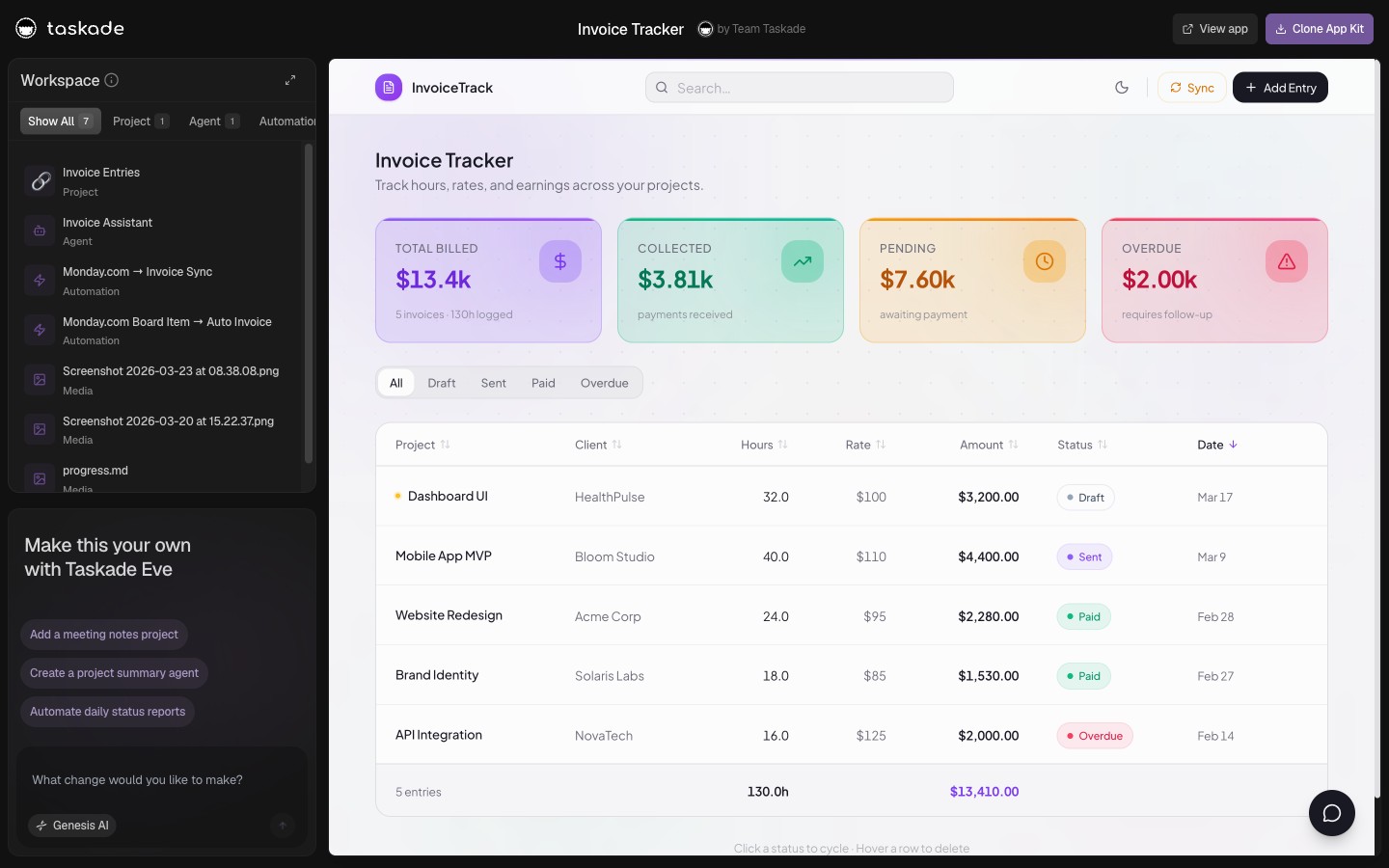
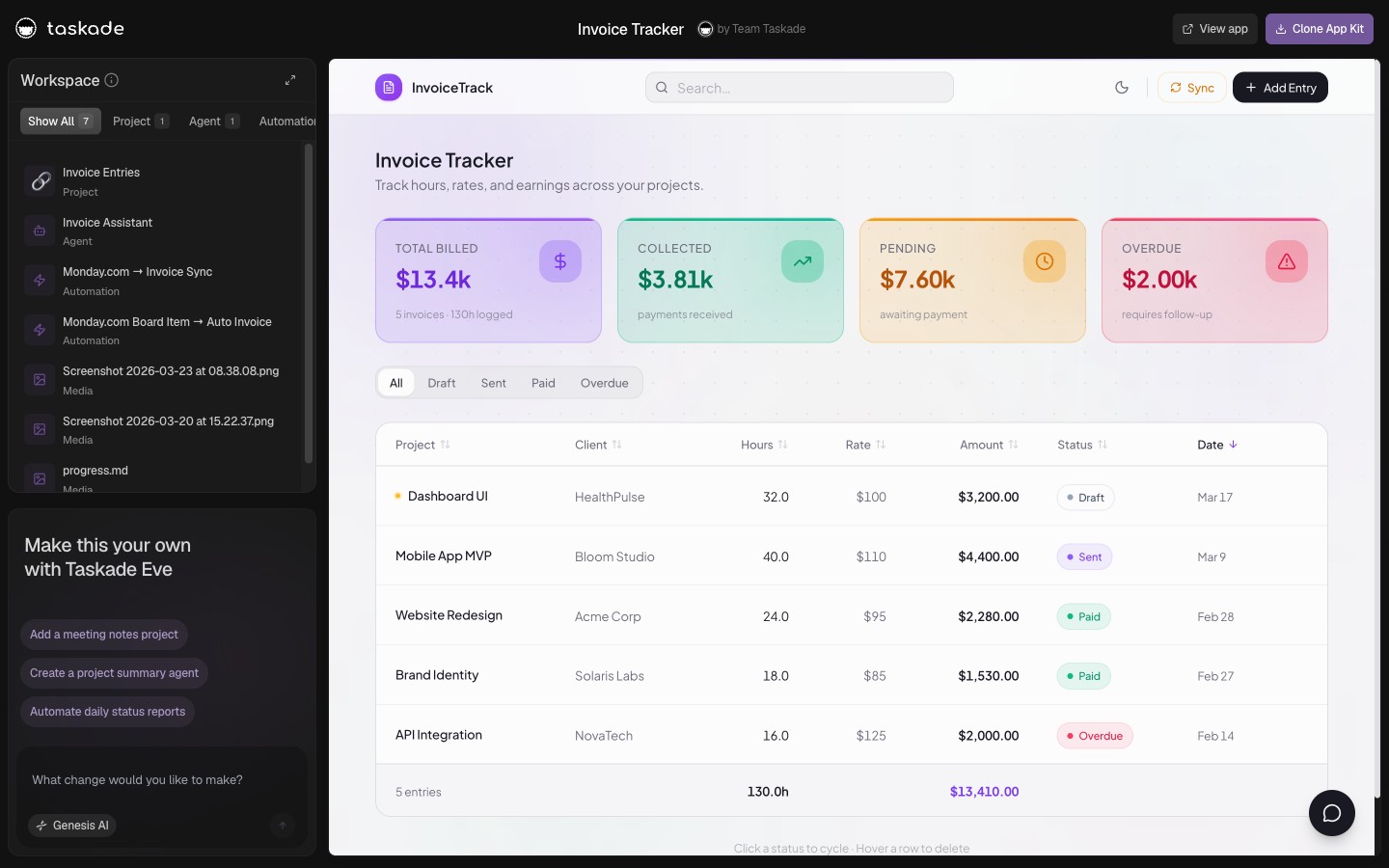
- Type the app you want: "Build a simple invoice tracker for a freelance consultant, fields for client, hours, rate, status, due date"
- Wait 60–90 seconds. Genesis generates the Project, the views, the agent, and the workflow.
- Open the published URL. It's live.
- Iterate by typing what to change: "Add a Stripe payment field. Add a reminder automation if status is overdue."
Five minutes. One micro app. Live URL. Cloneable. Read the full Workspace-Native AI Agents authority post for the seven-test criteria that make Genesis micro apps different.
The Business Case: 12 Micro Apps vs 12 SaaS Subs
   Equivalent SaaS Stack         Taskade Genesis Stack
   ─────────────────────         ─────────────────────
   $1,305+/mo                    $25/mo (Business, annual)
   12 separate apps              12 micro apps in 1 workspace
   12 logins                     1 login
   12 onboarding flows           1 onboarding
   Data silos                    Shared Workspace Memory
See the Replace-a-Team playbook for the role-by-role mapping. The cost math is the same in both posts because the bet is the same.
Monetization (You Can Sell What You Build)
Taskade Genesis ships with Stripe checkout actions wired into every app. Paid App Kits via Stripe were added in v6.168. Clone-creator credits (v6.150) attribute earnings to the original builder. Several creators in the Community Gallery now make recurring revenue from cloned apps.
This is the micro-app network effect: build once, ship once, earn forever as others clone.
What Comes Next
The category is open. TechCrunch named it. Gizmo proved consumer demand. Taskade proved operator demand. The next 12 months will see the third category emerge, enterprise micro apps, where the wedge is governance + audit + RBAC. Workspace-native platforms with proper role-based access (like Taskade Genesis) are positioned for it. Code generators are not.
Read the Workspace-Native AI Agents authority post for the criteria. Read the Multi-Agent Platforms comparison for the head-to-head.
Related Reading
- How to Build Micro Apps with AI: 10 Team Examples and Templates (2026)
- Best Calculator Builders 2026: 10 No-Code Tools Compared (We Tested Them All)
- Quantum Supremacy for App Builders: Why Taskade Genesis Builds in Parallel Branches (2026)
Frequently Asked Questions
What are micro apps?
Single-purpose, prompt-built mini applications that replace fragments of work previously done by SaaS or by hand. TechCrunch coined the term in January 2026.
How are they different from regular apps?
Regular apps try to be platforms. Micro apps do one thing well, ship as a URL, and clone freely.
Who is building them?
Non-developers. Solo operators, small business owners, individual contributors. Taskade has 150,000+ built; Gizmo has tens of thousands.
How are they different from templates?
Templates are static. Micro apps are running systems with their own data, agents, automations.
What companies are building micro-app platforms?
Gizmo (consumer), Taskade Genesis (workspace), Bolt.new / Lovable / v0 (code generation).
What can a micro app actually do?
Anything previously done by SaaS or by hand, invoices, CRMs, dashboards, schedulers, forms, agents, workflows.
How long does it take to build one?
Minutes for the first draft on Taskade Genesis. Five-minute path: describe → wait 60-90s → publish.
Are they secure for business use?
Yes on a workspace platform with proper governance, RBAC, GenesisAuth sign-in, custom domains, audit at workspace scope.
What are the 12 archetypes?
Generators, Trackers, Dashboards, Portals, Calculators, Pipelines, Schedulers, Forms, Knowledge Bases, Agents, Workflows, Publishers.
Can I monetize a micro app?
Yes. Taskade Genesis has Stripe checkout, paid App Kits via Stripe, and clone-creator credit attribution.
▲ ■ ● Memory · Intelligence · Execution, every micro app is a workspace; every workspace is alive.
Try Taskade Genesis free → · Browse 150,000+ micro apps → · Read the Workspace-Native authority post → · How Skool bet on a network effect →