






The real limit isn't how much we can think. It's how much we can hold.
Every day we juggle fragments. Tasks, emails, stray notes, half-remembered conversations. A brain made for focus is forced into endless context switching. That is why people have chased the idea of a second brain for decades. Not to replace thinking, but to carry the weight so we can fly higher.
But here is the uncomfortable truth: most second brains become second jobs.
TL;DR: A second brain that demands manual curation is ballast, not lift. Taskade Genesis automates PKM with 15+ frontier AI models, 34 agent tools, and 100+ integrations. 150,000+ apps built since launch prove it scales. Start at $10/month on Pro. Build your second brain free →
Why Do Most Second Brains Fail in 2026?
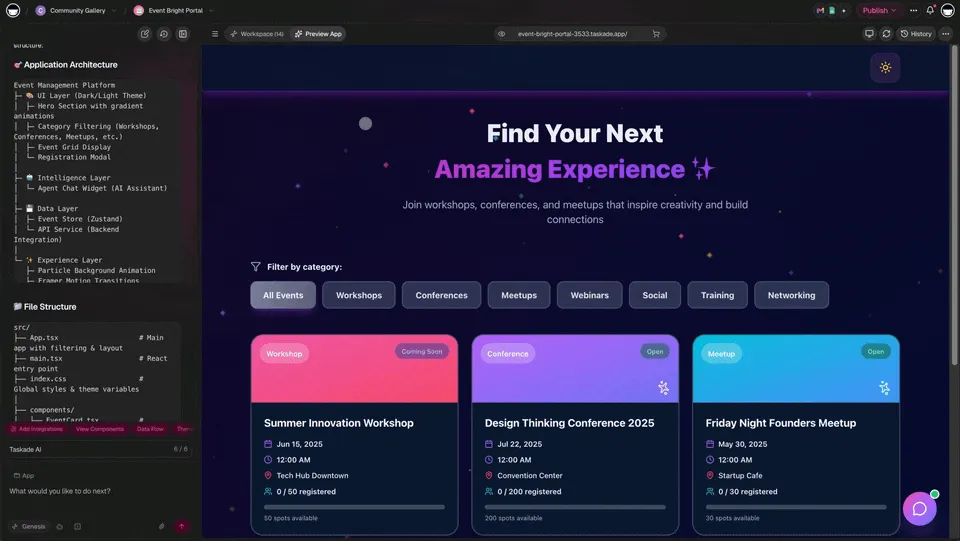
Most second brains fail because they are static storage systems that demand constant manual maintenance. Tools like Notion, Obsidian, and Roam promised freedom from forgetting but delivered a new chore: tagging, linking, refactoring, and pruning notes every week. Every hour spent on curation is an hour stolen from the work the system was supposed to enable. In 2026, the only second brains that survive are the ones that maintain themselves.
The problem is not storage. It is execution. Static notes remember but do not act. They store but do not learn. They organize but do not evolve.
The PKM Landscape: From Zettelkasten to Genesis
Personal knowledge management is older than the internet. Each era solved one problem and created the next.
Zettelkasten: Atomic Notes With Manual Links
Niklas Luhmann built 90,000 paper index cards that generated 70 books. The magic was atomicity (one idea per card) and linking (each card pointed to others). The curse was manual labor.
PARA: The Four-Folder Shortcut
Tiago Forte's PARA method (Projects, Areas, Resources, Archive) simplified PKM into four buckets. It is the default mental model in 2026 because it maps naturally to how work flows.
Roam and Obsidian: The Backlink Era
Roam Research popularized bidirectional backlinks. Obsidian made them local-first. Both still require you to manually add [[links]].
Taskade Genesis: The Autopilot Era
Genesis is the first PKM system where the linking, routing, and summarizing happen automatically via AI agents. Static methodologies become operational.
What Autopilot Really Means for a Second Brain
Autopilot does not mean doing nothing. In aviation, autopilot frees the pilot to navigate and decide. In knowledge work, autopilot means your second brain handles the background processes while you focus on thinking.
- Remembering every detail — not just storing, but understanding context
- Updating every system — keeping projects, notes, and dashboards in sync
- Connecting every dot — finding relationships you did not know existed
- Executing on insight — turning notes into actions automatically
This shift from maintenance to autonomy is the core application of agentic engineering.
The Genesis Shift: Workspace DNA for PKM
With Taskade Genesis, a second brain finally learns to fly itself. The architecture is called Workspace DNA and it has three layers.
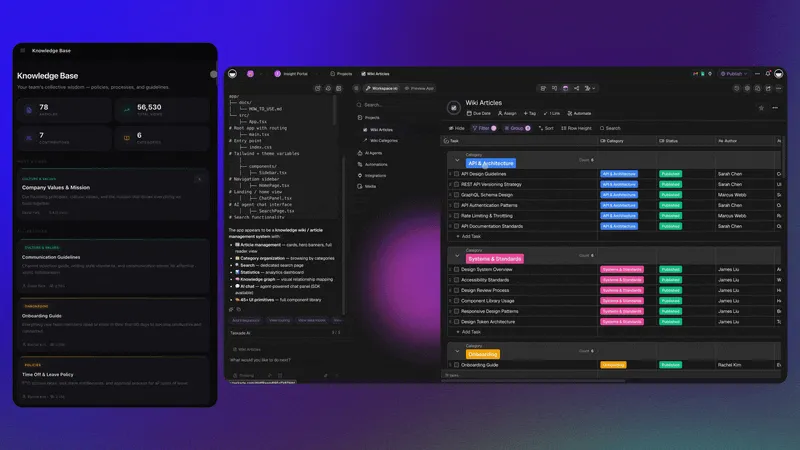
- Projects as Memory — structured databases with 7 views (List, Board, Calendar, Table, Mind Map, Gantt, Org Chart). Your notes, sources, and references live here. See how Workspace DNA works.
- Agents as Intelligence — custom AI agents trained on your workspace with 34 built-in tools and persistent memory.
- Automations as Execution — branching, looping, and filtering workflows connect memory and intelligence to the outside world. See automation triggers.
This is not "note-taking." It is navigation.
Mapping PARA Onto Taskade
| PARA Bucket | Taskade Structure | Agent Behavior |
|---|---|---|
| Projects | Active Taskade projects with Gantt + Board views | Status agent updates progress nightly |
| Areas | Folders grouped by life area (Health, Finance, Career) | Review agent surfaces stale items weekly |
| Resources | Knowledge project with Table view + custom tags | Ingest agent routes new content by topic |
| Archive | Read-only workspace with full-text search | Archivist agent prunes duplicates quarterly |
Build this structure in 5 minutes with one Genesis prompt: "Build me a PARA second brain with four projects, agents that route incoming content, and a weekly review automation."
Mapping Zettelkasten Onto Taskade
Zettelkasten requires atomic notes and manual linking. Taskade removes the friction.
| Zettelkasten Principle | Taskade Implementation |
|---|---|
| Atomic notes | One task per idea in a Knowledge project |
| Unique IDs | Auto-generated task IDs |
| Tags | Custom fields with multi-select |
| Links | Agents add @mentions to related tasks automatically |
| Fleeting notes | Inbox project with auto-routing agent |
| Literature notes | Media Q&A extracts highlights from PDFs |
| Permanent notes | Published Genesis app viewable by others |
The Compounding Effect of Intelligent Memory
When execution compounds, something magical happens.
Your Support Agent does not just answer FAQs. It grows more precise with every ticket by learning from resolved issues. Over time, it resolves 90% of tickets and escalates only the complex ones.
Your Research Agent does not just summarize articles. It notices which topics you return to, surfaces unread sources when related projects start, and forecasts what you will want to read next week.
Your Writing Agent does not just draft posts. It learns your voice, catches your tics, and suggests outlines shaped by posts that actually shipped.
Over time, your second brain becomes more capable, more nuanced, and more yours. That is autopilot: not automation for its own sake, but systems that accumulate experience.
Three Real Second Brain Patterns That Work
1. The Knowledge Hub That Never Sleeps
A product team wires documentation, research papers, and customer interviews into a Knowledge project. An agent trained on Workspace DNA answers questions instantly, surfaces relevant research, and connects insights across domains. RSS automations pull new papers, summarize them, and categorize by topic.
Result: The team stops searching. Information finds them.
2. The Sales Brain That Remembers Everything
A sales team builds a CRM powered by agents. Customer interactions and deal history live in a project. Agents analyze patterns, suggest next steps, and draft personalized outreach. Automations trigger follow-ups and sync data across Slack, Gmail, and HubSpot through 100+ integrations.
Result: Reps focus on relationships. The system handles the rest.
3. The Content Brain That Writes Itself
A content team trains an agent on their style guide and past articles. The agent generates drafts, suggests headlines, and maintains tone. Automations pull research from RSS feeds and route drafts through approval workflows.
Result: Output scales without losing voice.
How to Build Your Autopilot Second Brain in 30 Minutes
Step 1: Create Your Memory Foundation
Start with three Taskade projects: Inbox (capture), Knowledge (resources), Active (projects). Each project ships with 7 views out of the box.
Step 2: Train Your Intelligence Layer
Build an Ingest agent trained on your Knowledge project using custom agents. Give it one job: read new items in the Inbox and route them to the correct Knowledge topic with tags.
Step 3: Wire Your Execution Layer
Set up automations that trigger on email arrival, RSS update, and Slack message. Use automation triggers to chain them. Example: new email in a labeled folder, summarize, tag, and route to the Ingest agent.
Step 4: Publish a Dashboard
Use Genesis to generate a personal dashboard that shows today's priorities, new captures, and agent summaries. See the full playbook in the ultimate Genesis guide.
Step 5: Schedule the Weekly Review
Automate the review. An agent pulls every open project, ranks by urgency, and posts a Monday morning briefing. You spend 10 minutes deciding instead of 2 hours organizing.
Comparison: Second Brain Tools in 2026
| Feature | Taskade Genesis | Notion | Obsidian | Roam |
|---|---|---|---|---|
| AI agents (native) | Yes, unlimited | Notion AI (limited) | Plugin-based | No |
| Automations | 100+ integrations | Limited | Community | No |
| Mobile app | Full | Full | Limited | Limited |
| Offline mode | Partial | No | Yes | No |
| Collaborative | Yes | Yes | Sync (paid) | Yes |
| Price (10 seats) | $10/mo | $80/mo | $80/mo | $150/mo |
| Setup time | 30 minutes | 4+ hours | 8+ hours | 6+ hours |
| Learns over time | Yes (persistent memory) | No | No | No |
The Future of Work
The first generation of tools digitized notes. The second automated reminders. The third, Genesis, gives us a living system that learns, acts, and endures. Not storage. Not memory. Continuity.
A second brain that never tires, never forgets, never loses the thread.
Knowledge compounding happens when every interaction feeds back into the system. Your Support Agent learns from every ticket. Your Research Agent learns from every paper. Each cycle compounds previous learning, making your second brain smarter with every use.
On Autopilot
The future of work is not typing faster or organizing harder. It is building systems that fly themselves. A true second brain does not just remember for you. It moves with you. It acts with you. It keeps the stream alive while you dream.
- Projects remember everything, structured and searchable
- Agents think and reason, adapting to your patterns
- Automations keep everything moving, syncing, executing continuously
Together, they form a second brain that works on autopilot.
Build your second brain free →
Related Reading
- How Workspace DNA works
- Ultimate guide to Taskade Genesis
- What is vibe coding
- AI apps you can build
- Agent templates
- Automation templates
- Community gallery
- Integration catalog
- Pricing
- Custom agents guide
- Automation triggers guide
- Free Bolt alternative
- Template library
— John Xie, Co-founder and CEO, Taskade
This is the origin of living software.
Frequently Asked Questions
What is a second brain and why do most second brain systems fail?
A second brain is a personal knowledge management system that offloads information so your biological brain can focus on thinking, creating, and deciding. Most fail because they demand constant manual curation. Tagging, linking, and refactoring notes becomes a second job that steals time from the work the system was supposed to enable.
How is an AI-powered second brain different from Notion or Obsidian?
Notion and Obsidian are static storage layers. You do all the organizing, linking, and retrieval. Taskade Genesis adds an autonomous layer with AI agents that read, categorize, link, and act on your notes automatically. Your second brain stops being an archive and becomes an active teammate.
What is the PARA method and does Taskade support it?
PARA stands for Projects, Areas, Resources, Archive. It is Tiago Forte's canonical second brain framework. Taskade maps directly to PARA: Projects become Taskade projects with 7 views, Areas become folders, Resources live in a tagged knowledge project, and Archive is a read-only workspace. Agents can auto-route new content into the right PARA bucket.
How does Zettelkasten work in a Taskade workspace?
Zettelkasten relies on atomic notes linked by ideas, not hierarchy. In Taskade, each note becomes a task in a Knowledge project with custom fields for tags, connections, and source. An agent reads new notes, finds conceptual links to existing atomic notes, and creates the connections automatically. This eliminates the main friction of Zettelkasten: manual linking.
Can AI agents manage my knowledge base without manual input?
Yes. Taskade AI Agents v2 include 34 built-in tools, persistent memory, and custom slash commands. They can watch RSS feeds, summarize incoming content, route notes to the right project, tag them, and trigger automations. Once trained, an agent needs zero hand-holding.
How many AI models power Taskade second brains?
Taskade agents route across 15+ frontier models from OpenAI, Anthropic, and Google. The system picks the right model per task: reasoning models for analysis, fast models for tagging, long-context models for document understanding. All included on Pro at $10/month.
What integrations matter most for an autopilot second brain?
The highest-leverage integrations are Gmail, Slack, Google Drive, Notion, Readwise, RSS feeds, and webhooks. Taskade ships 100+ native integrations across 10 categories, so new content flows into your second brain automatically without copy-paste.
Can I build a second brain on the Taskade Free plan?
Yes. The Free plan includes unlimited projects, 3 members, and 3,000 AI credits per month, which is enough to start a personal PKM system. Upgrade to Pro at $10/month when you want unlimited agents, unlimited automations, and 10 user seats for household or small team use.
Does Taskade Genesis replace tools like Readwise or Obsidian?
For most users, yes. Genesis combines capture, storage, review, and action in one workspace. Obsidian loyalists can still use Taskade as the active layer while keeping Obsidian for the long-term vault. They connect via webhooks and Markdown sync.
How fast can I set up a second brain in Taskade?
A basic PARA-style second brain takes about 30 minutes. Describe what you want to Genesis in plain English and it builds the project structure, custom fields, and a starter agent automatically. 150,000+ apps built on Genesis since launch prove this speed of setup.