





Large language models (LLMs) from OpenAI, Anthropic, Google, and Meta have changed the way we think, work, and collaborate. But even the most advanced AIs occasionally spiral down the rabbit hole of inaccuracies and imaginative detours (like that one friend who saw a UFO once). This is where Retrieval-Augmented Generation (RAG) comes into play.
So, what exactly is RAG? How does it enhance AI-generated responses? Why is it considered a breakthrough in dealing with the limitations of LLMs? Let's find out.
But first, there is one more thing we need to talk about. 👇
TL;DR: Retrieval-Augmented Generation (RAG) is a two-step AI technique: a retriever fetches relevant documents from a knowledge base, then the LLM generates an answer grounded in that retrieved context. The result is more accurate, current, and source-backed responses with fewer hallucinations — no costly retraining required. Try Taskade free →
🚧 Limitations of Current AI Language Models

When researchers at OpenAI released GPT-3 (generative pre-trained transformer) in June 2020, it caused quite a stir. Not necessarily because it was a novel thing. But because it far surpassed its older, more obscure sibling from two years prior, GPT-2.
GPT-3 boasted 175 billion parameters compared to GPT-2's 1.5 billion. That and more diverse training data gave it a much better grasp of natural language, which translated to an ability to generate eerily human-like and contextually relevant text.
GPT-3 could do it all - draft legal documents, pen poetry, write code, or… generate recipe ideas. It was difficult not to get swept up in the excitement.
But as any other LLM - that also includes the most recent and far superior GPT-4 that’s rumored to have 1.76 trillion parameters - it had some flaws.
LLMs are only as good as their training data. This means that their capabilities are limited by the core “knowledge” acquired during the training process.
For instance, a model trained only up until 2019 wouldn't know about the COVID-19 pandemic or the latest swings in climate change debates. It would also not understand the newest laws and regulation affecting your business.
Of course, LLMs can fill in the blanks in a very convincing way. But unless you’re drafting a post-apocalyptic fantasy novel, the output of an LLM needs a reality check.
🔀 What Is Retrieval Augmented Generation (RAG)?
Retrieval-Augmented Generation (RAG) is an AI technique that combines the generative capabilities of language models with a retrieval system that fetches external data.
Let’s say you're drafting an analysis of the electric car market with the help of an AI-powered writing tool. It's 2024, but the LLM that runs under the hood of the app was last updated in early 2021. The AI will give you an excellent overview, but the output will not include recent trends, like a major breakthrough in battery tech last month.
With RAG, you can point the LLM to relevant documentation or news articles to fill in the gaps. Tools like Taskade's AI document converter make it easy to prepare content for ingestion. RAG will dynamically fetch and integrate the latest data directly into the AI's output.
The history of RAG goes back to a paper titled "Retrieval-Augmented Generation for Knowledge-Intensive NLP Tasks” published in 2020 by the research team at Facebook.
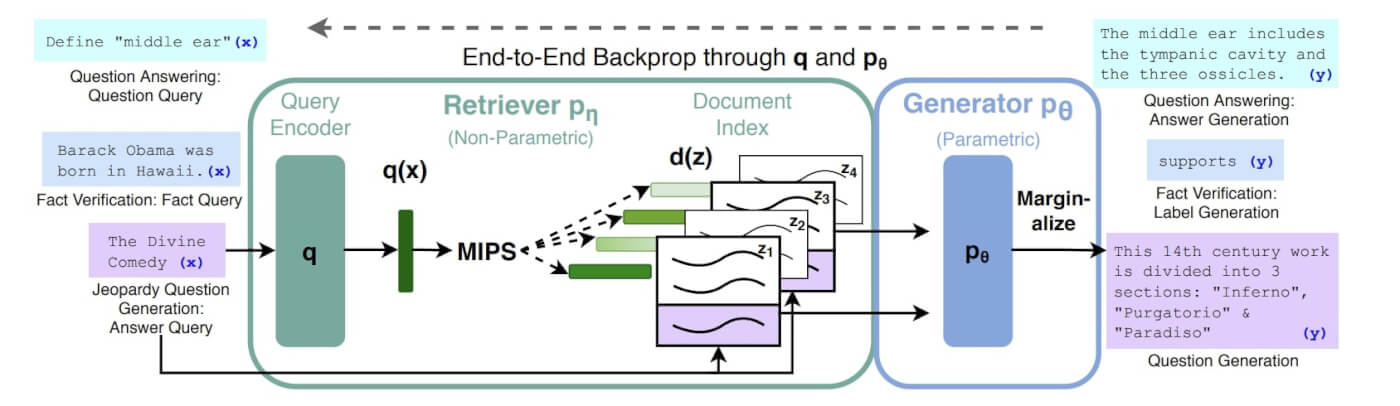
In a nutshell, Retrieval-Augmented Generation is a two-step method. First, the "retriever" sources information relevant to a task from a provided pool of data. Then, the "generator" (the LLM itself) takes this information and crafts a contextually-relevant response.
The full pipeline starts before any query arrives. Your documents are split into chunks, converted into embeddings, and stored in a vector database. At query time, the system retrieves the most similar chunks and hands them to the LLM as context:
That vector store is the engine behind retrieval — if you want the mechanics of embeddings and similarity search, see our deep dive on vector databases and vector search.
This approach has a number of serious advantages.
🧠 How the Brain Does Retrieval
RAG may sound like a recent invention, but the brain has been doing retrieval-augmented generation for millions of years.
In 1982, physicist John Hopfield built a mathematical model of how the brain stores and recalls information. In a Hopfield network, memories are encoded as stable patterns in the connections between neurons. When you feed in a partial or noisy input, the network doesn't scan through entries one by one. It settles into the nearest stored pattern - reconstructing the complete memory from a fragment.
Consider hearing a short snippet of your favorite song. Almost instantly, your brain recalls the lyrics, the melody, the last time you heard it. The search space of every sound you have ever heard is astronomically large. An exhaustive search would be impossible. Yet your brain solves this in milliseconds through associative retrieval - the input activates a pattern, and the network's dynamics pull it toward the closest stored memory.
Neuroscience has since confirmed this mechanism at the cellular level. Memories are stored as engrams - small, sparse ensembles of neurons that physically encode an experience. Recall happens through reactivation: a partial cue fires the same ensemble again, and the full memory reconstructs itself.
RAG works on the same principle:
- Partial input → Your query (like a song snippet)
- Pattern matching → The retriever finds semantically similar documents (like the brain settling into an energy minimum)
- Full reconstruction → The LLM generates a complete, grounded response (like the brain reconstructing a full memory from a fragment)
The key insight from both neuroscience and RAG is the same: you don't need to store everything in the model itself. You need a reliable way to retrieve the right context at the right time and let the generative system do the rest. The brain separates storage (engrams) from generation (neural processing). RAG separates storage (knowledge base) from generation (the LLM).
This is why RAG is not just an engineering trick. It is the computational implementation of how biological memory actually works.
🤖 The Benefits of RAG in AI
Training a language model isn't cheap.
The exact cost? Training a frontier language model from scratch can run into hundreds of millions of dollars. Fine-tuning an existing model on your own data is cheaper but still requires ML expertise and ongoing maintenance.
Let's make something clear. RAG does not replace the (costly) process of training a large language model. But it does open a world of interesting possibilities.
It's worth being precise about when to reach for each approach. RAG is the right tool when you want to give a model knowledge — facts, documents, and data it can cite. Fine-tuning is the right tool when you want to change a model's behavior — its tone, format, or how it follows instructions. The two are complementary, not competing, and many teams combine them. For a full breakdown of which to use when, see our guide on fine-tuning vs RAG vs prompting.
Imagine you're a new user navigating an app for the first time.
There you are, eyes wide, finger poised over the mouse - “where do I start?”, ”where is the settings menu?” And as you accidentally click something that makes the screen flicker, a slight panic sets in. "Did I break something?”
An AI assistant integrated into the app and fine-tuned with user documentation could give you a guided tour. It will fetch the right set of instructions, give you a nudge in the right direction, tell you what you're doing wrong, and suddenly, you're in the know.
RAG makes all that possible with off-the-shelf AI models.
But the access to domain-specific sources of knowledge is one thing.
RAG also reduces the risk of model hallucination, a common issue for all commercial and open-source LLMs. Since the generation process is supported by real-world data, it leaves less leeway for a “creative” approach and confabulation.
Finally, RAG allows for more dynamic and accurate answers.
Typically, when a language model doesn't understand a query or provides an inadequate response, you must rephrase the prompt over and over again. That's a lot of experimentation for a tool that's supposed to save you time and effort.
With RAG, you get faster and more precise results than with just the stock training data.
| Dimension | Traditional LLM | With RAG |
|---|---|---|
| Accuracy | Limited to training data; may fabricate details | Grounded in retrieved documents; verifiable claims |
| Currency | Frozen at training cutoff date | Access to real-time, up-to-date sources |
| Hallucination risk | High for niche or recent topics | Significantly reduced by source-backed generation |
| Domain knowledge | Generic, broad coverage only | Tailored to your documents, policies, and data |
| Cost efficiency | Requires full retraining to update knowledge | Update knowledge base without retraining the model |
The question of the day is, where can RAG make the biggest impact?
⚒️ RAG in Practice: Applications and Use Cases
While the commercial success of LLMs is still fairly recent, there are hundreds of exciting ways you can use RAG in your personal and business projects.
Smarter Project Management
Starting a new project is an adventure.
You're gearing up, doing the research, and assembling the right team for the job. You want it to be a hit, so you take cues from what's worked before. Maybe you're sifting through old tasks, trying to figure out who should do what and when.
Why not let AI do the heavy lifting?
An AI-powered project management app with RAG will dive into a sea of historical project data, pull out golden nuggets of past strategies, set realistic deadlines, allocate resources, assign team roles, and structure your project.
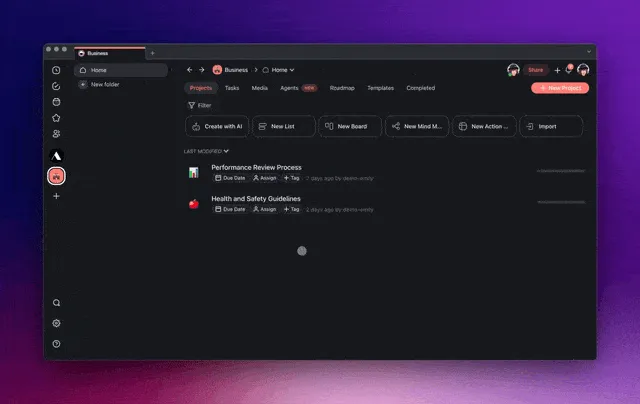
Taskade AI allows you to use your own documents or external resources
as "seeds" for the Workflow Generator.
Faster Content Creation
Large language models are excellent at generating content. With a few solid prompts, they can churn out comprehensive articles, reports, and other textual resources.
But there’s a catch: it's all pretty generic at first.
There’s a slim chance that the first output will sound like you or fit the unique vibe of your brand. It takes time to fine-tune the tone, cadence, and nuances.
You can speed up this process with RAG.
Need to write another social media post?
You can simply cherry-pick your past successful posts, feed them to the LLM, and set it to generate fresh content using the style your audience loves. No more endless adjustments - just sharp, engaging copy that sounds just like you, only quicker.
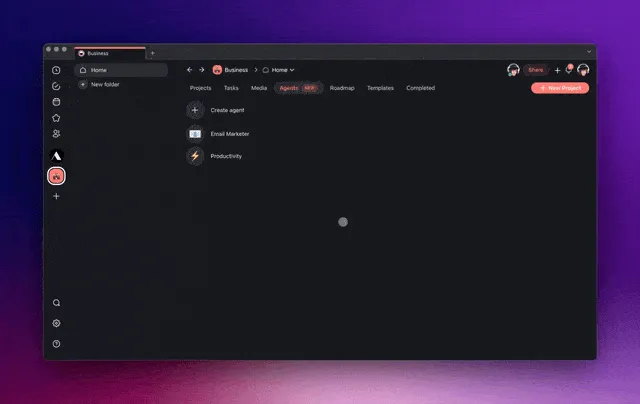
You can equip Taskade AI Agents with custom knowledge based on documents,
spreadsheets, or online resources including YouTube videos.
Personalized Learning
Now, let's consider a different scenario.
You’re a diligent student preparing for an exam. You have a ton of solid but unorganized notes. But you need to learn fast and can't afford to get lost in the paper shuffle.
You can spend a couple of nights slouched over coffee-stained pages trying to connect the dots. Or you can set up a smart AI study buddy to help you out. All you need to do is upload your notes, provide links to other credible resources, and ask away.
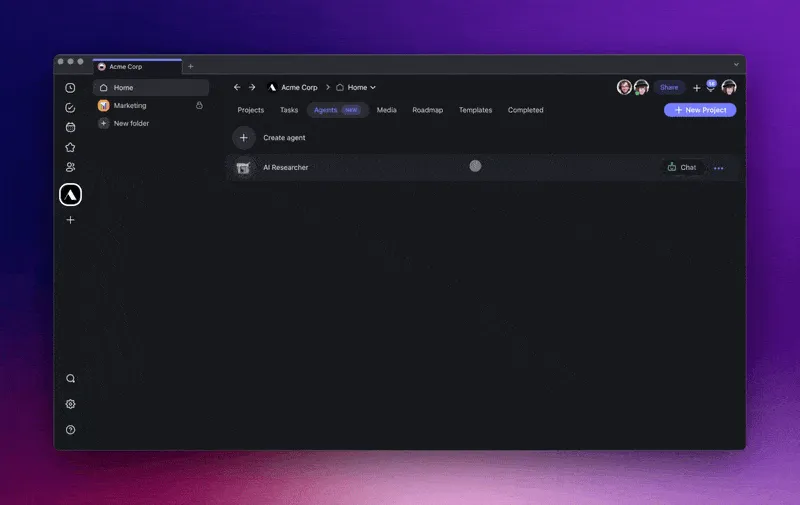
RAG allows Taskade AI Agents to master any topic in seconds.
🔮 The Future of Retrieval Augmented Generation
Tools based on frontier language models from OpenAI, Anthropic, and Google have already reshaped our work landscape. RAG pushes the boundaries even further by giving AI access to the latest, most relevant data for any task, project, or decision.
In 2026, retrieval is moving toward agentic RAG — where an AI agent decides what to look up, when, and how many times — combined with hybrid search that blends keyword and semantic vector search for sharper results. Retrieval is also one layer in the broader AI agent stack, working alongside agent memory that lets agents carry context across conversations.
Agentic RAG turns one-shot retrieval into a decision loop: the agent chooses whether to search, runs hybrid keyword + vector search, then re-queries until it has enough context to answer.
Before you go, let’s recap what we learned today:
⭕ More accurate responses: With RAG, off-the-shelf LLMs can deliver context-relevant and accurate answers without the need for retraining.
⭕ Real-time updates: RAG opens AI-powered tools to fresh data, which means that they can generate content based on the most current information.
⭕ Reduced hallucinations: By accessing up-to-date and accurate data, RAG minimizes the chances of AI producing irrelevant or incorrect information.
⭕ Specialized applications: Using external resources from various fields, from healthcare to finance, you can tailor AI’s responses to industry standards.
⭕ Affordability: RAG is an excellent solution for companies who can't or don’t want to spend big bucks on retraining large language models.
Tired of constantly reprompting AI and bottlenecking your projects? We have a solution.
Taskade AI is the most complete suite of productivity tools, now powered by frontier models from top AI labs with RAG support — one platform for all your projects, tasks, notes, and collaboration.
🧬 Beyond RAG: Living Knowledge with Genesis
RAG is powerful, but Taskade Genesis takes it further with dynamic knowledge: agents trained on live Taskade projects that update automatically as your workspace changes. No manual re-uploads. No stale documents.
Here's how Taskade Genesis goes beyond traditional RAG:
| Traditional RAG | Taskade Genesis |
|---|---|
| Upload static documents | Train on live workspace projects that auto-sync |
| Knowledge decays as docs get stale | Knowledge stays current: sync frequency by plan (daily → hourly → real-time) |
| Retrieves text, generates text | Retrieves context, reasons about it, triggers automations |
| No action-taking | Agents invoke 100+ integrations as custom tools (Shopify, Stripe, HubSpot, Slack, and more) |
| Session-based memory | Persistent memory across all conversations. Agents remember everything |
| Single knowledge source | 8 file types (PDF/CSV/DOCX/PPTX/XLSX/EPUB/MD/TXT) + YouTube transcripts + cloud storage + live projects |
The result: Instead of just retrieving information, Taskade Genesis creates living software: complete applications built on your knowledge that can think, execute, and evolve. Background agents (Pro+) keep processing even when you're offline. With vibe coding, describe your goal and Taskade Genesis builds AI agents, workflows, and automations trained on your data. Browse 150,000+ apps in the community gallery.
Sign up and supercharge your projects with Taskade AI! 🤖
🤖 Custom AI Agents: Create and deploy teams of AI agents, each with a unique personality and skills. Upload your documents and spreadsheets, or use external resources to amplify agents' knowledge. Set agents to automate your tasks in the background, or call them when needed with custom AI commands.
🪄 AI Generator: Need to outline a document? Maybe you want to kickstart a project but don't want to spend hours setting things up. Let Taskade AI do the heavy lifting and structure your work in seconds. Describe your work in natural language or upload seed documents and resources for more tailored results.
✏️ AI Assistant: Brainstorm, plan, outline, and write faster with smart suggestions powered by frontier AI models, right inside the project editor. Choose from a set of built-in /AI commands or tap into your custom agents for extra help.
📄 Media Q&A: Add your documents and spreadsheets to projects, and use Taskade AI to extract valuable insights. Start a Q&A session with AI and ask questions about document contents using a conversational interface.
And much more...

💬 People Also Ask
What is Retrieval Augmented Generation?
Retrieval Augmented Generation, or RAG, is an advanced AI technology that enhances the capabilities of Large Language Models (LLMs) by integrating real-time, external data. RAG ensures that AI responses are not only generated based on pre-learned data but are also dynamically updated with the latest information, making them more accurate and contextually relevant.
Who created the Retrieval Augmented Generation?
Retrieval Augmented Generation was conceptualized and developed by a team of researchers at Facebook AI Research (FAIR). The innovative approach was detailed in their 2020 paper titled "Retrieval-Augmented Generation for Knowledge-Intensive NLP Tasks," laying the groundwork for future advancements in AI and LLM technologies.
How does the RAG model work?
The RAG model works by combining the generative capabilities of LLMs with a retrieval mechanism. Essentially, when a query is inputted, RAG first retrieves relevant and up-to-date external data and then integrates this information to generate a more accurate and contextually relevant response. This two-step process involves continuously sourcing and updating its knowledge base from a wide array of external sources.
Is Retrieval Augmented Generation better than LLM?
Retrieval Augmented Generation is not necessarily better than traditional Large Language Models; rather, it's an enhancement. While LLMs are powerful on their own, they are limited by the data they were trained on. RAG addresses this limitation by ensuring that the AI's responses are continually updated with the latest information, making it a more dynamic, accurate, and reliable tool.
What are the benefits of Retrieval Augmented Generation?
The benefits of Retrieval Augmented Generation are manifold. It significantly increases the accuracy and relevance of AI responses by integrating the latest data. RAG reduces the frequency of AI hallucinations, improves the efficiency of information retrieval, and broadens the application of AI across various industries by providing more tailored and up-to-date solutions.
What are the limitations of Retrieval Augmented Generation?
Despite its numerous advantages, RAG has some limitations. It relies heavily on the availability and quality of external data sources, which if flawed or biased, can affect the accuracy of responses. The complexity of integrating RAG into existing systems can be high, and the process of continuously retrieving and processing large volumes of data requires robust computational power and can be resource-intensive.
Frequently Asked Questions
What is Retrieval-Augmented Generation (RAG) and how does it work?
RAG is a technique that improves AI accuracy by combining two steps: retrieval (searching a knowledge base for relevant information) and generation (using an LLM to produce a response grounded in that retrieved information). The process: 1) Your query is converted into an embedding (a numerical representation of meaning), 2) The system searches a vector database for documents semantically similar to your query, 3) The most relevant documents are fed to the LLM as context alongside your original question, 4) The LLM generates a response grounded in the retrieved documents rather than relying solely on its training data. This dramatically reduces hallucinations and keeps responses current.
Why is RAG important for AI accuracy?
RAG solves three fundamental LLM limitations: 1) Knowledge cutoff - LLMs only know what was in their training data; RAG provides access to current, updated information, 2) Hallucinations - without source documents, LLMs fabricate plausible-sounding answers; RAG grounds responses in verified data, 3) Domain specificity - general LLMs lack specialized knowledge about your company, products, or processes; RAG lets you inject your own data as context. The result: AI responses that are more accurate, verifiable, and relevant to your specific use case rather than generic internet knowledge.
How do AI agents use RAG in practice?
AI agents use RAG to access custom knowledge bases when answering questions or performing tasks. In practice: 1) You upload documents (PDFs, websites, notes) to a knowledge base, 2) The system indexes and embeds the content into a vector database, 3) When the agent receives a task, it automatically retrieves relevant information from the knowledge base before generating output. Taskade AI agents use RAG to access workspace content - they can reference your project documents, meeting notes, and team knowledge when researching, writing, or making decisions, producing output that's specific to your business context rather than generic AI responses.
How does the brain perform retrieval-augmented generation naturally?
The brain performs its own version of RAG through associative memory. Hopfield networks (1982) showed that memories are stored as stable patterns in neural connections. A partial cue triggers the network to settle into the nearest stored pattern, reconstructing the full memory without searching a database. Neuroscience confirms this through engrams - sparse neuron ensembles that encode experiences and reactivate on partial cues. Like RAG, the brain separates storage (engrams) from generation (neural processing), retrieving relevant context before reconstructing a complete response.
What is the difference between RAG and fine-tuning an AI model?
RAG and fine-tuning are complementary but different approaches: RAG gives a pre-trained model access to external knowledge at query time - the model itself doesn't change, but it receives relevant context with each request. This is dynamic (add new documents anytime) and doesn't require ML expertise. Fine-tuning modifies the model's weights by training on your specific dataset - the model permanently learns new patterns and behaviors. This is more expensive, requires ML expertise, and the model needs retraining when data changes. Most businesses benefit more from RAG because it's cheaper, faster to set up, keeps data separate from the model, and can be updated without retraining.