






In September 2026 a decade-long project finished: the first complete wiring diagram of a male fruit fly's central nervous system. Scientists now hold an almost cell-by-cell, synapse-by-synapse diagram of that entire system — brain and nerve cord, sensory input through to motor output, in one individual. A female map of the same scope arrived three months earlier.
It is not a mind readout. It is something more useful and more honest: a complete structural map of a working intelligence, and an unusually clear statement of what such a map can and cannot explain.
That second half is why this belongs on a blog about AI agents and automation. The people who finished the map also published, in plain language, the exact limit of what a map buys you. Anyone building agent systems should read that limit carefully.
TL;DR: The September 2026 male fruit fly connectome maps 166,700 neurons and roughly 125 million connections across a whole central nervous system. Its biggest finding is architectural: no central controller, just local sensory-action loops joined into behavior-centric modules. Its biggest caveat: wiring gives you paths, never strengths. Build a distributed agent workspace →
What Is a Connectome?
A connectome is a complete map of the connections between neurons in a nervous system — which neuron connects to which, through which synapse, in which direction, and how many times. The word was coined independently in 2005 by Olaf Sporns and by Patric Hagmann. A connectome is structural, not functional: it is the circuit schematic for a brain, not a recording of the brain running.
That distinction does all the work in this article, so it is worth fixing early with a picture rather than a definition.
Notice that it is a loop, not a pipeline. Action changes the world, the changed world changes the sensory input, and the input changes the next action. That closed circuit is the thing a partial brain map cannot show you and a whole-nervous-system map can.
The Forty-Year Road to a Finished Map
Connectomics has now produced several complete nervous systems. The table also keeps one partial map, the 2020 hemibrain, because it bridged the worm and the whole fly. The progression explains the significance better than any single number.
| Year | Subject | Neurons | Connections | The question it answered |
|---|---|---|---|---|
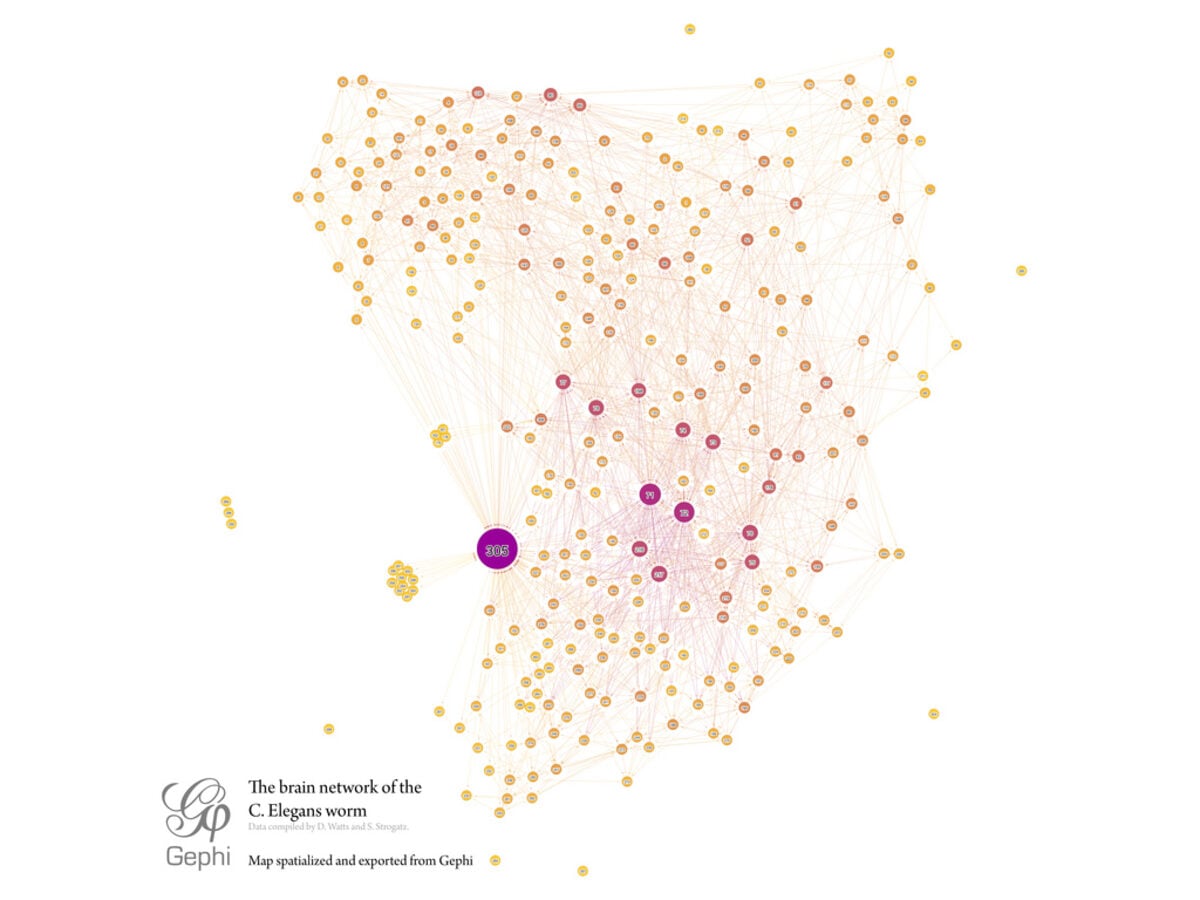
| 1986 | C. elegans roundworm | 302 | ~7,000 | Can we map every neuron at all? |
| 2020 | Fly "hemibrain" | ~25,000 | ~20 million | Can we map a complex brain region? |
| 2024 | Adult female fly brain | 139,255 | 54.5 million | Can we trace information across a whole brain? |
| Jun 2026 | Female brain + nerve cord | — | ~10⁸ | How is behavior actually controlled? |
| Sep 2026 | Male brain + nerve cord | 166,700 | ~125 million | How does a whole nervous system turn perception into behavior? |
Three of those rows carry a qualifier worth knowing, because they are commonly misreported.
The worm's 302 is the hermaphrodite count. White, Southgate, Thomson and Brenner published The structure of the nervous system of the nematode Caenorhabditis elegans in 1986, and it remains the founding document of the field. The male worm has a different nervous system, and its complete connectome only arrived in 2019 with Cook et al. in Nature. Even in a 302-neuron animal, sex differences took another 33 years to map.
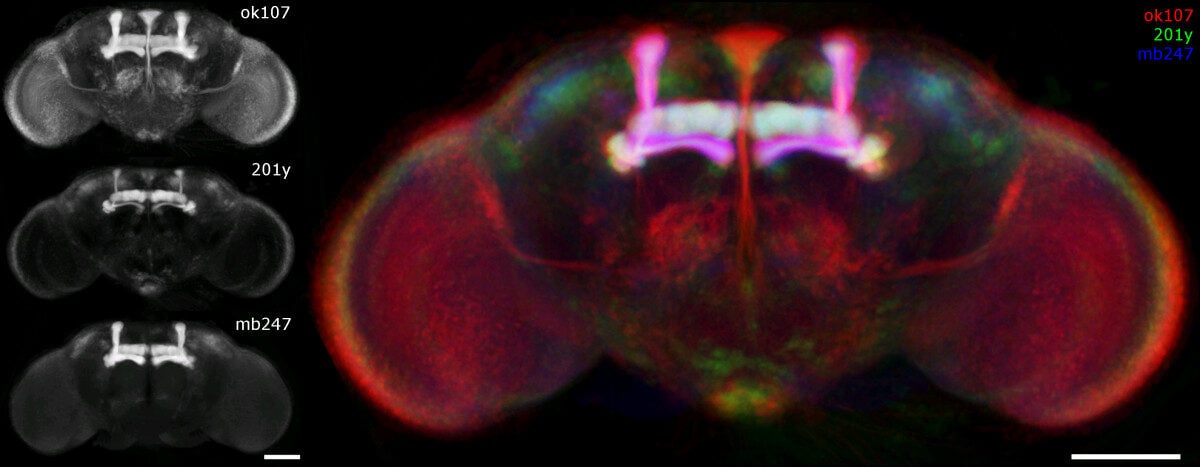
The 2020 "hemibrain" is half of the central brain, not half of a fly brain. Scheffer et al. in eLife describe about 25,000 neurons and about 20 million chemical synapses, covering most of the central brain and excluding the optic lobes. The whole fly brain, optic lobes included, holds over 100,000 neurons. Calling it "half a brain" overstates the coverage by a wide margin.
The 2026 female whole-CNS map came first. Three months before the male dataset, a large consortium published Distributed control circuits across a brain-and-cord connectome in Nature (8 June 2026), uniting a brain and a ventral nerve cord for the first time. The male dataset is not the first whole CNS — it is the first male one, which is exactly what makes a sex comparison possible.
Why "Largest" Needs a Qualifier
Google Research describes the male dataset as "the largest brain map by number of neurons to date." That qualifier is load-bearing, and dropping it produces a claim the source never made.
| Dataset | Scope | Cells | Synapses | Complete nervous system? |
|---|---|---|---|---|
| Fly male CNS (Sep 2026) | Whole adult CNS | 166,700 | ~125 million | Yes |
| MICrONS mouse cortex (Apr 2025) | 1 mm³ of visual cortex | >200,000 | ~500 million | No — a fragment |
| Fly female brain (Oct 2024) | Whole adult brain | 139,255 | 54.5 million | Brain only, no nerve cord |
| Larval zebrafish (preprint) | Brain + anterior cord | >180,000 somata | ~30 million | Vertebrate, still a preprint |
MICrONS is larger by synapse count and it is a genuinely remarkable dataset, pairing structure with functional recordings from roughly 75,000 neurons. But it is one cubic millimeter of a mouse. The fly is the only finished adult central nervous system on the list.
That difference decides which questions you can even ask:
PARTIAL CONNECTOME                  WHOLE CNS CONNECTOME ?                                  eyes
 |                                   |
[region A] vision
| |
[region B] brain
| |
? decisions / state
|
neck
|
nerve cord
|
motor neurons
|
legs
|
action
You see circuitry. You see loops.
"What happens here?" "How does seeing X
eventually make the
animal do Y?"
Completeness beats scale when the question is a loop. That is the generalizable lesson, and it applies well outside neuroscience. A bigger pile of partial data does not answer a question that requires following a circuit all the way around.
The Result That Surprised Everyone: There Is No Boss
Here is the finding that deserves more attention than the neuron count.
The intuitive model of a brain is a central controller: sensory data flows in, a decision-making core processes it, commands flow out. The completed maps do not look like that at all.
The June 2026 whole-CNS paper found that motor, endocrine and visceral effectors are primarily influenced by sensory neurons in the same body part, forming local feedback loops. Ascending and descending neurons then join those local loops into behavior-centric modules. Brain regions involved in learning and navigation supervise those modules rather than commanding them. The paper's own closing sentence calls the architecture "distributed, parallelized and embodied, reminiscent of distributed control architectures in engineered systems."
Two words in that finding carry the weight. Local: the strongest influence on an effector is a sensor on the same body part, not a command from headquarters. And supervise: a weaker verb than "control", and a more robust one, because a supervised module that fails degrades locally instead of taking the system down.
This connects directly to work the blog has covered before on systems thinking, where the central claim is that structure generates behavior, and to the practical question of whether to run one agent or a team of them.
What a Connectome Does Not Tell You
This is the section most coverage of the September announcement skipped, and it is the most valuable one.
CONNECTOME GIVES YOU              CONNECTOME DOES NOT GIVE YOU
====================              ============================neuron A --synapse--> neuron B    effective synaptic strength
|                               neuromodulatory state
+-- morphology                  hormonal state
+-- location                    short-term plasticity
+-- cell type                   long-term plasticity
+-- neurotransmitter clues      gene-expression state
+-- connection counts           learning history
body state
sensory environment
moment-to-moment activity
The clean way to say it is that a connectome is a netlist, not a running program:
connectome != running programconnectome ~= an extremely detailed hardware netlist
+ network topology
+ typed components
                  PLUS

        dynamics + state + plasticity
                    +
        body + environment + feedback

                    =
             behaving organism
This is not an outsider's objection. It is the field's own position, and it has a name. A 2024 Nature paper by Pospisil and colleagues, The fly connectome reveals a path to the effectome, states it exactly:
"The recently reported whole-brain fly connectome specifies the synaptic paths by which neurons can affect each other, but not how strongly they do affect each other in vivo."
Their proposed fix is not a better map. It is perturbation: pair the wiring diagram with stochastic optogenetic experiments and use the connectome as a Bayesian prior to recover causal strengths.
Structure gives you the paths. Only the experiment gives you the strengths. Hold on to that sentence — the rest of this article is about how widely it applies.
Male and Female: Small Rewiring, Different Behavior
Because a female whole-CNS map already existed, the male dataset enabled something new: a diff between two complete maps of the same species.
The published abstract is careful, and worth quoting rather than paraphrasing: "Sex-specific/dimorphic neurons are concentrated in higher brain centers, while the sensory and motor periphery is largely isomorphic." It closes: "Dimorphic neurons reroute information across sexes."
Read that architecturally and it is a striking claim. The input hardware and the output hardware are nearly identical. The differences sit in the integrative middle, and they work by changing routing rather than by changing sensors or muscles.
Anyone who has shipped software will recognize this failure mode immediately: a small change in a shared layer reroutes everything downstream. The sensors did not change. The actuators did not change. A handful of cells in the middle changed where the signal goes, and the behavior of the whole organism changed with it.
How AI Built the Map, and Why Humans Still Had to Check It
The reconstruction pipeline is a genuine machine-learning success story, and it also contains an honest lesson about where automation currently stops.
The core technique is flood-filling networks, introduced by Januszewski and colleagues in 2016 and validated in Nature Methods in 2018. A flood-filling network starts at a single pixel and identifies every other pixel that belongs to the same object — turning a stack of flat images into a traced 3D neuron. The later PATHFINDER system automates more of the assembly, and in April 2026 Google added synthetic neuron shapes to its training pipeline, reporting a 4.4% reduction in reconstruction error.
Now the honest part, in Google's own framing: mapping a fly brain still "requires years of human effort just to verify and annotate the neural shapes."
| Stage | Who does it | Current state |
|---|---|---|
| Imaging | Electron microscope | Automated, expensive |
| Segmentation and tracing | Flood-filling networks, PATHFINDER | Automated, improving |
| Synapse detection | Machine learning | Automated |
| Proofreading and annotation | Human experts | Years of effort — the bottleneck |
AI produced the candidate. Expert humans produced the truth. That is the number to quote whenever someone says AI produced a connectome. It is also the same shape as every reliable AI system currently shipping: a fast generator paired with a slower, independent checker.
What This Means for AI Agent Architecture
Treat what follows as an engineering analogy rather than a claim that language models work like flies. With that caveat stated plainly, three lessons transfer.
1. The interesting unit is the module, not the neuron
The naive picture of an agentic system is one large model at the center, calling tools. The biological picture that emerged from a complete map is different:
OLD INTUITION                    WHAT THE CONNECTOME SHOWS   BIG INTELLIGENCE                  higher cognition
|                            / memory / state
CENTRAL CONTROLLER                       |
|                              supervision
+------+------+                           |
v      v      v                  +--------+--------+
tool   tool   tool                 |        |        |
v        v        v
module   module   module
^ |      ^ |      ^ |
| v      | v      | v
local    local    local
loop     loop     loop
|        |        |
+-- selective ----+
coordination
A module with its own sensors, its own effectors and its own feedback loop does not need to be told what to do at every step. It needs to be selected, and it needs a channel to report upward. This is the practical argument for pairing AI agents with automations that own their own triggers, rather than funneling every decision through a single orchestrator.
2. Narrow channels force useful abstraction
The fly's brain talks to its nerve cord through the neck — a physically constrained channel carrying ascending and descending neurons, a small population next to the sensory and motor periphery they serve. Behavior still works.
Read as architecture, a narrow channel is a bandwidth constraint that forces summarization. A module does not ship its raw sensory stream upward; it ships a conclusion. A supervisor does not micro-manage a limb; it selects a behavior.
That is the opposite of the common agent-handoff pattern, where one agent passes its entire transcript to the next and the context window fills with material nobody will read. The related failure — quality degrading as context grows — is what we call context rot.
3. You cannot read behavior off structure
This is the effectome lesson, and it is the most important of the three because it contradicts how most teams actually evaluate agent systems.
A beautiful architecture diagram is a connectome of your system. It shows the paths. It tells you nothing about the strengths — which handoffs actually fire, which tool calls silently fail, which prompt change rerouted half your traffic. For that you need evaluations and perturbation, not a better diagram.
| Question | What structure answers | What only perturbation answers |
|---|---|---|
| Can agent A influence agent B? | Yes — the path exists | — |
| How strongly does it? | — | Measure it under load |
| What happens if A fails? | Which paths are severed | Whether the system degrades or collapses |
| Did my change help? | Which paths changed | Whether behavior improved |
The discipline this implies is the same one that makes RL environments and benchmarks worth building: you find out by running the system, not by reading it.
How the Distributed Pattern Shows Up in a Workspace
Taskade organizes work as Workspace DNA — Memory, Intelligence and Execution. Projects hold the memory, AI agents supply the intelligence, and automations do the executing. That maps onto the architecture the connectome revealed more closely than a single-controller design does.
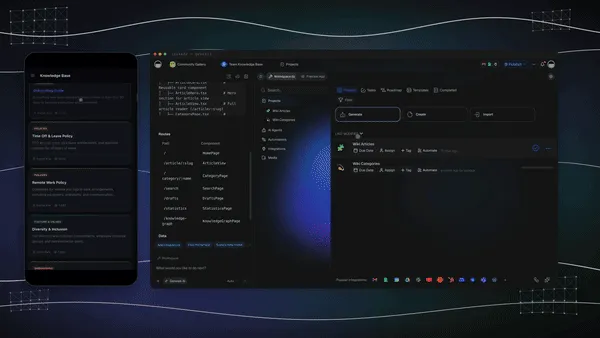
The parallel is worth stating precisely, including where it breaks down.
| Connectome concept | Workspace analogue | Honest status |
|---|---|---|
| Local sensory-action loops | Automations with their own triggers | Shipped |
| Behavior-centric modules | Agents with their own knowledge and tools | Shipped |
| Supervision, not command | Taskade EVE coordinating across agents | Shipped |
| Narrow ascending channel | Structured handoffs between agents | Partial — this is a design discipline, not an enforced limit |
| Perturbation for strengths | Testing an agent against real tasks | Your job, and there is no substitute |
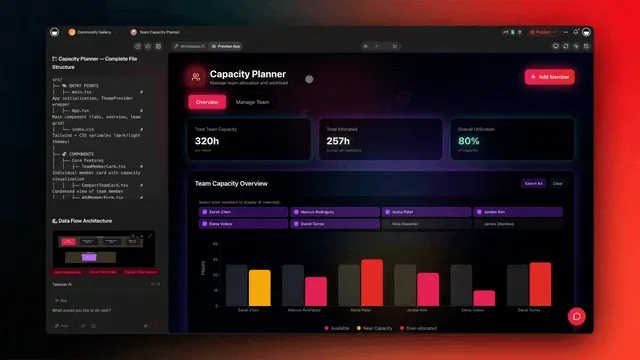
The last row is the one that matters most, and the connectome is the reason to take it seriously. A complete map of the most thoroughly documented nervous system in science still does not tell you how strongly one neuron affects another. Your architecture diagram will not tell you how well your agents work either. You find out by running them.
Taskade brings projects, agents and automations onto one substrate, which is what makes a supervised-module design practical rather than theoretical. You can start free — 2 workspace members, 3 Genesis apps and 1 agent — and paid plans begin at $10/month billed annually. Browse what other people have built in the app gallery, or start from the AI app builder.
Frequently Asked Questions
What is a connectome in simple terms?
A connectome is a complete map of every connection between neurons in a nervous system — the wiring diagram of a brain. It records which neuron connects to which, in what direction, and how many times, but it does not record activity. It is the schematic, not the video.
How many neurons are in the fly connectome?
The September 2026 male dataset holds 166,700 neurons across 11,710 neuron types, with roughly 125 million synaptic connections spanning the brain and the ventral nerve cord. The raw electron-microscopy detection reports finer-grained numbers — about 46 million presynaptic sites linked to 312 million postsynaptic densities — which is the same data counted at a different level, not a contradiction.
Is the human connectome finished?
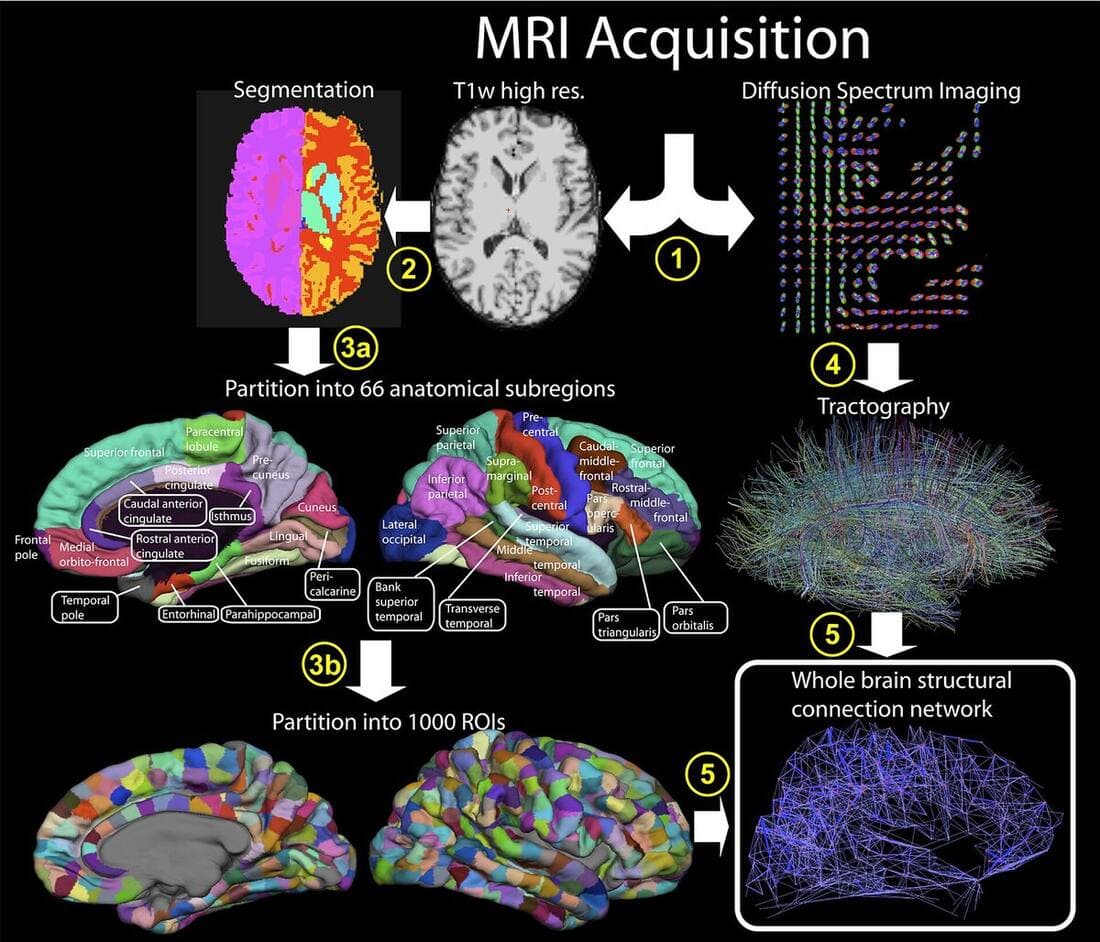
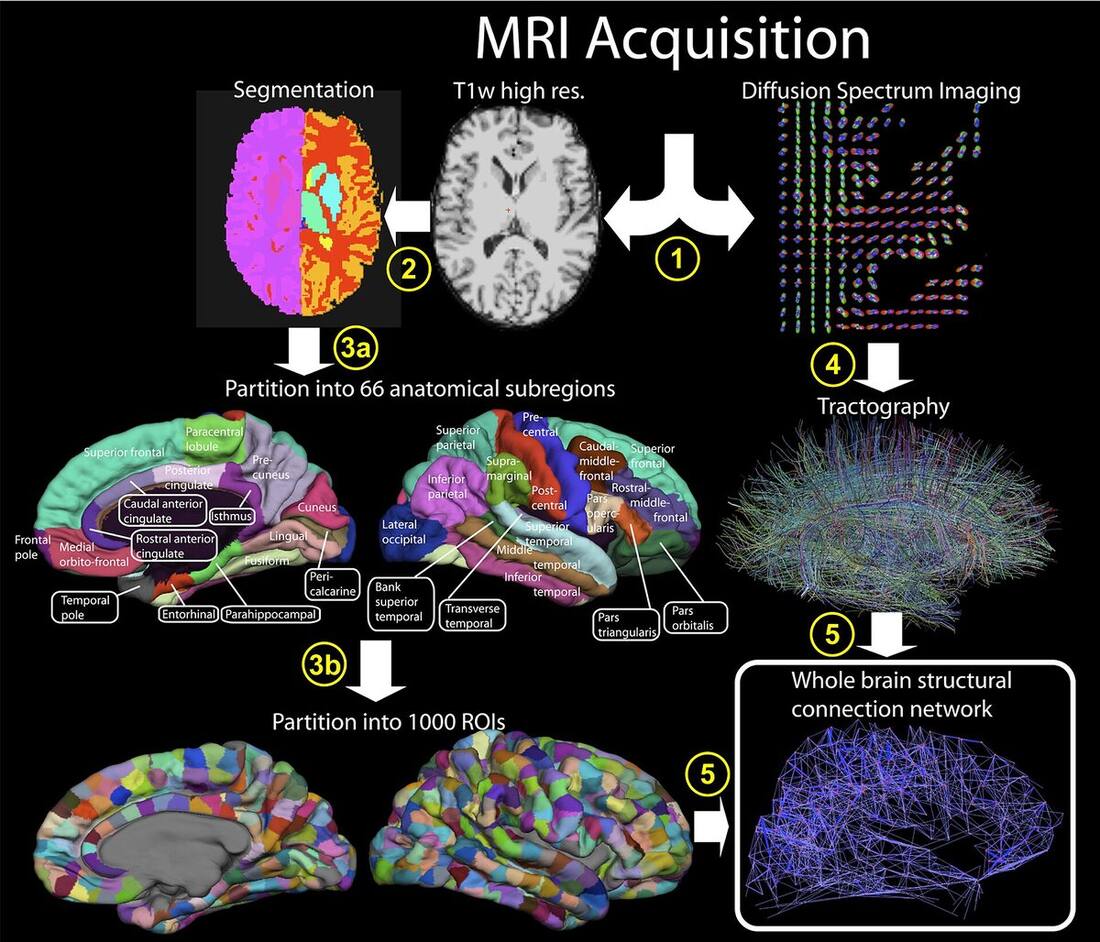
No. Only a coarse, region-level human connectome exists, produced with diffusion MRI rather than electron microscopy. A neuron-level human map is not currently feasible: estimates place the adult human brain near 86 billion neurons, roughly five orders of magnitude beyond a fly.
What is the difference between a connectome and a genome?
A genome is a sequence — the instructions an organism is built from. A connectome is a graph — the structure that resulted. The useful similarity is in what they enable: both are reference resources that thousands of later experiments can query without re-deriving them. Both are also silent about dynamics on their own.
Can you upload a brain from its connectome?
Not from the connectome alone. Simulations built from the fly connectome have produced real predictions — a 2024 whole-brain model correctly identified the neurons required to start feeding when modeled sugar neurons were activated — but every such model must supply parameters the connectome does not contain. Without effective synaptic strengths, neuromodulatory state and plasticity, the wiring is necessary and not sufficient.
Why is the fruit fly the model organism for this?
The fly is small enough to finish and complex enough to matter. Its nervous system produces navigation, learning, courtship and feeding, and it shares circuit motifs with larger brains. It has also been a genetics workhorse for over a century, so there is a deep body of prior work to check a map against.
What is the effectome?
The effectome is the causal counterpart to the connectome: not just which neurons can affect each other, but how strongly they do in a living animal. The 2024 Nature paper that named it proposes combining the wiring diagram with stochastic perturbation experiments, using the connectome as a prior to make the experiments tractable.
What does "distributed, parallelized and embodied" mean?
It is the phrase the June 2026 whole-CNS paper uses for the architecture it found. Distributed: no single controller. Parallelized: modules run at the same time rather than in sequence. Embodied: the loops run through the body and the environment, not only inside the brain. The authors compare it to distributed control architectures in engineering.
How is this relevant to building AI agents?
Three ways. It is empirical evidence that a working intelligence is organized as specialized modules with local feedback rather than one central controller. It shows that the channel between a supervisor and its modules is narrow, which argues for summaries over raw transcripts. And it demonstrates that a complete structural map still cannot predict behavior — so testing beats architecture diagrams.
Does a bigger map mean a better one?
No, and this is the sharpest lesson in the whole field. MICrONS has roughly four times the synapses of the fly dataset and cannot answer "how does seeing X make the animal do Y", because it covers one cubic millimeter of a mouse. Completeness beats scale when the question is a loop.
A complete connectome is the closest thing science has to a full schematic of a working mind. What it teaches is not that intelligence has been solved, but that intelligence looks like a running system — modules, local loops, supervision, feedback, a body, a world — rather than one big brain doing everything.
That is a useful thing to remember when you design your own systems. Structure is where you start. Behavior is what you measure.
▲ ■ ● Memory. Intelligence. Execution.
Further reading: Single agent vs multi-agent teams · The AI agent stack · Inter-agent communication patterns · Systems thinking explained · What is intelligence? · The history of agent memory · Why AI agents need an ontology · Workspace DNA architecture · Multi-agent systems · Emergent behavior · Persistent memory · Neural networks