







Single-agent systems handle well-defined, sequential tasks. Multi-agent teams unlock emergent capability — behavior no individual agent was designed to produce. Research from Stanford (Smallville), Altera (Project Sid), and ChatDev proves that multi-agent interaction creates qualitatively different outcomes for complex workflows.
TL;DR: Multi-agent AI teams outperform single agents on complex tasks requiring coordination, creativity, and parallel execution. Taskade lets you build multi-agent systems without code — built-in tools, persistent memory, 100+ integrations, and Taskade Genesis for complete agent-powered apps from a single prompt. 150,000+ apps built. Try it free →
This guide compares single-agent and multi-agent architectures with research evidence, practical examples, cost analysis, and a comparison of platforms for building agent teams.
💡 Before you start... New to the topic? Check these articles to get up to speed:
- What Are AI Agents? — The complete guide to autonomous AI
- What Are Multi-Agent Systems? — How agent teams collaborate
- What is Agentic AI? — Autonomous agents, frameworks, and the future
- Autonomous Task Management — AI agents that plan and execute
- What Is Agentic Engineering? — The emerging discipline of building agent-powered systems
- What is Vibe Coding? — Build apps by describing what you want
👤 What Is a Single-Agent AI System?
A single-agent AI system deploys one autonomous AI agent to handle all aspects of a task — planning, executing, and evaluating in a self-directed loop. Single agents excel at well-defined, sequential tasks where speed matters more than depth, and they are simpler to set up than multi-agent alternatives.
The main purpose of such a system is to perform tasks independently in self-directed loops. This is a step up from “traditional” prompt-based AI interactions where you continuously feed AI instructions.
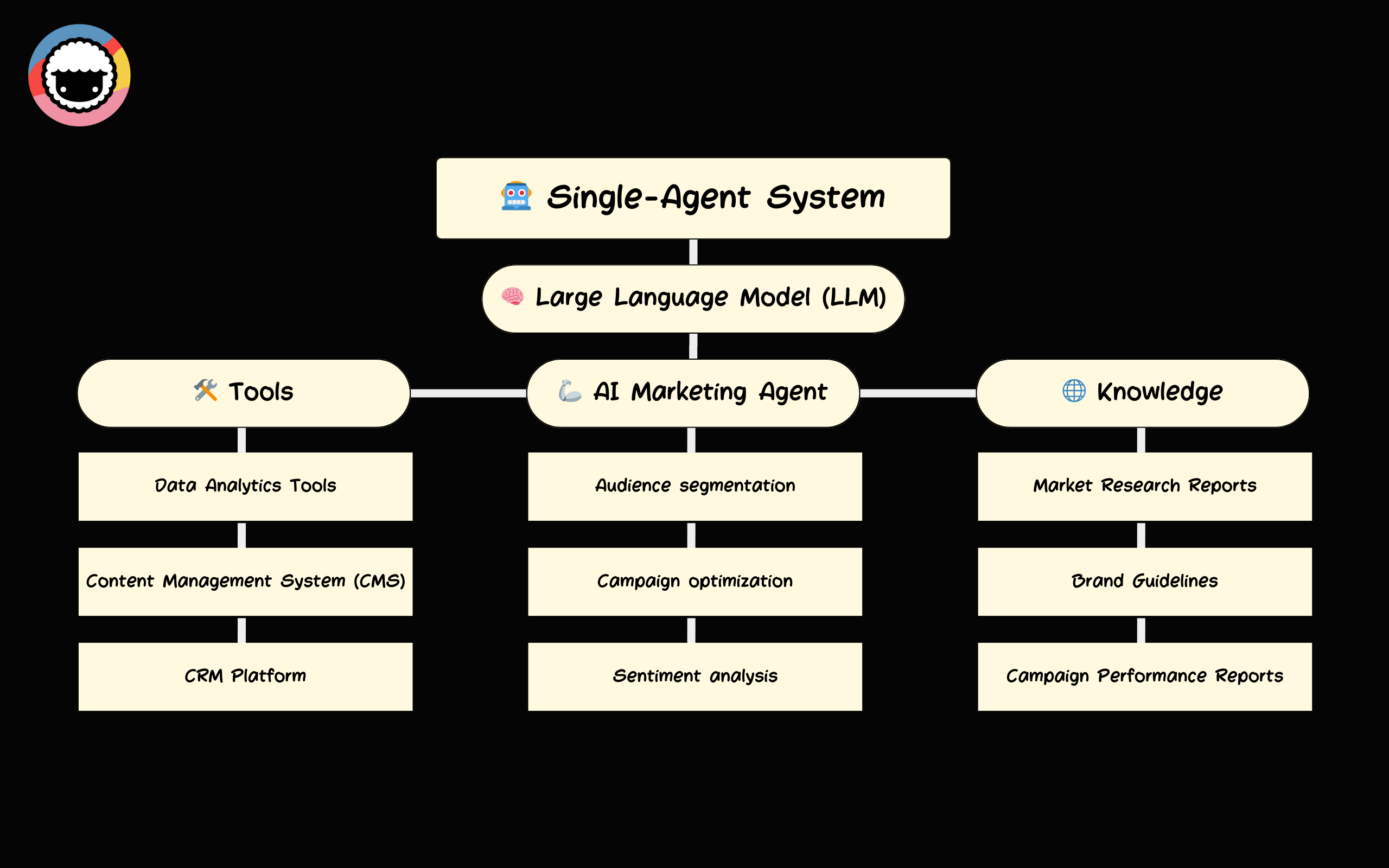
In a single-agent topology, one agent owns the entire loop. It reads the request, calls whatever tools it needs, and returns the result — a single context window doing planning, execution, and evaluation in one place.
Aside from partial autonomy, agentic systems are specialized and can provide more tailored responses than generalized chats with large language models (LLMs) like OpenAI GPT (frontier models), Gemini, or Bard. This makes them particularly useful for specific, complex tasks that require a deep understanding of niche topics.
This is the pattern the industry calls a coding harness or single-threaded agent: the human decomposes the work, hands one well-defined chunk to the agent, and reviews the result. Your judgment is the quality gate. It's the simplest agentic configuration — and for well-scoped tasks, it gets you remarkably far.
👥 What Is a Multi-Agent AI System?
A multi-agent AI system deploys multiple specialized agents that collaborate on complex workflows, each handling a specific subtask — like a department with specialized roles (researcher, analyst, writer, reviewer). In Taskade, agents coordinate through shared workspace projects, trigger each other through automations, and access shared knowledge bases.
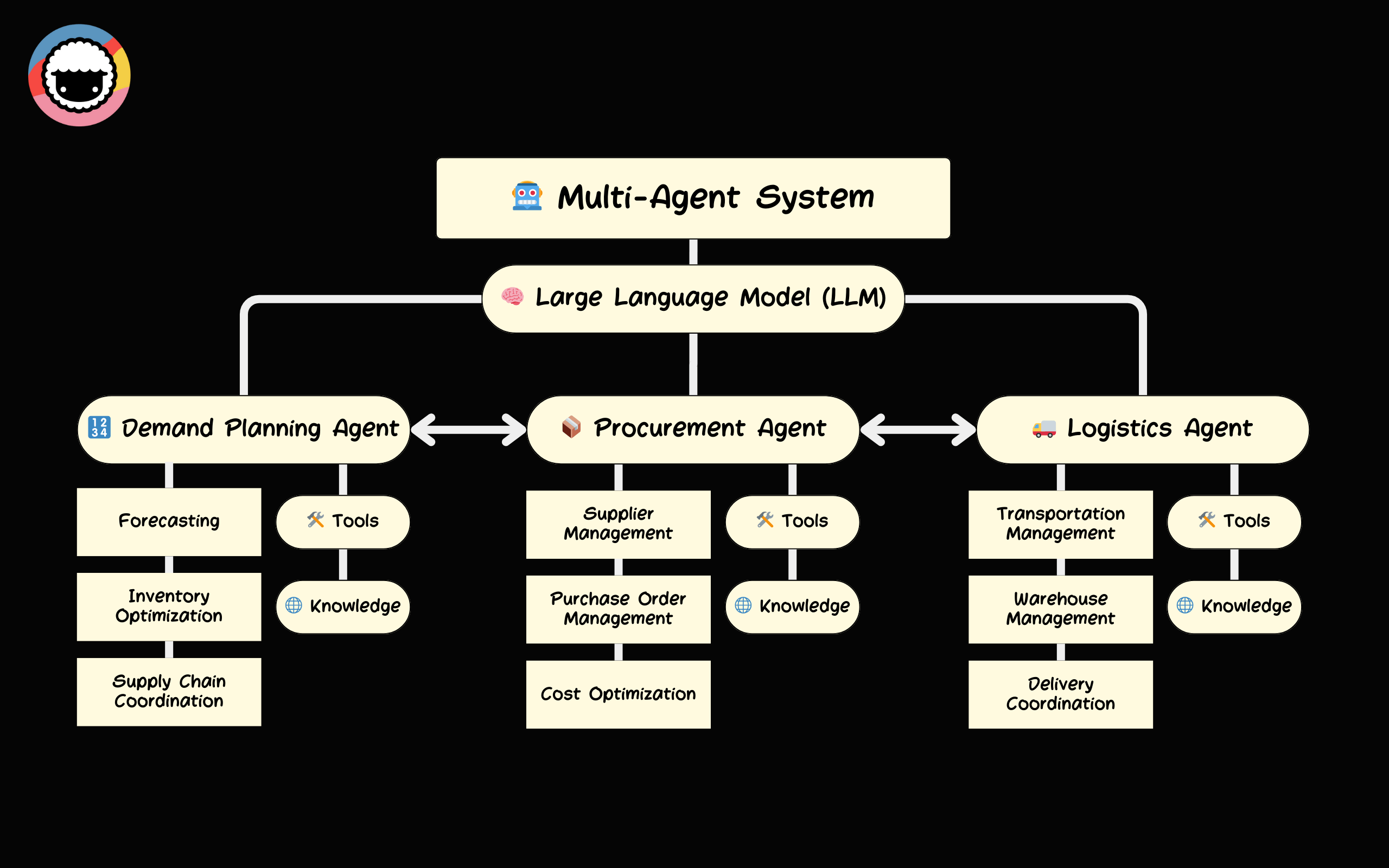
In a multi-agent team topology, a manager (orchestrator) agent plans the work and delegates to specialist worker agents — each running with its own clean context, its own tools, and its own knowledge. The orchestrator assembles the results, and a review step checks the work before it ships.
Similar to single-agent AI systems, multi-agent setups can tap into a range of external tools and use them as needed to carry out specific tasks. You can also fine-tune each “member” of an AI team with new knowledge using documents, web pages, and other resources for more tailored responses.
This orchestrator-worker shape is the most battle-tested multi-agent architecture. Cursor proved it across browsers and compilers — millions of lines of code — with a planner agent that keeps notes and tracks memory, and short-running executor agents that each solve exactly one problem and then get disposed. Their hardest-won lesson: simple scales well with agents. They tried three levels of management hierarchy and it didn't work. The winning pattern is one planner, many clean-context workers, one source of shared truth.
So, what makes multi-agent AI systems different?
Unlike simple agentic systems, AI teams can tackle tasks that require adaptive learning, sequential thinking, and enhanced fault tolerance. Since each agent plays a unique role, they can interact naturally, distribute the workload, and hand off tasks in dynamic and complex scenarios.
🧬 The Four Species of AI Agents (2026 Taxonomy)
"Agent" is too broad a word in 2026. Industry practitioners now distinguish at least four distinct species of agent, all built from the same primitive — an LLM with tools in a feedback loop — but constructed differently for different work. Confusing them is one of the most common and costly mistakes in production AI. Here is the taxonomy, mapped to single-vs-multi-agent design:
| Species | Scale | What it is | Single or multi-agent | Quality gate |
|---|---|---|---|---|
| 🧑💻 Coding harness | Individual task | One agent stands in for a developer; you decompose, it executes | Single agent | Human judgment |
| 👥 Project harness | Team / project | A planner agent manages short-running worker agents toward one goal | Multi-agent | Planner agent + human review |
| 🏭 Dark factory | Pipeline | Spec in, software out; humans only at the top (spec) and end (eval) | Multi-agent | Automated evals + optional human |
| 📈 Auto research | Metric optimization | An agent runs experiments to hill-climb a measurable metric | Single or multi | Metric improvement |
| 🔀 Orchestration | Workflow routing | Specialized agents (researcher → writer → editor) hand off in sequence | Multi-agent | Per-handoff validation |
The single most useful question this taxonomy forces: is my problem software-shaped or metric-shaped? If you have a rate to improve (conversion, runtime, accuracy), that's auto research — a fundamentally different setup from "build me working software." Mixing them up is where teams get into trouble.
The Five Multi-Agent Coordination Patterns
When you do go multi-agent, the field has converged on five primitive communication patterns. Every sophisticated agent team is some composition of these — there is no sixth trick hiding behind the marketing. Frame them as the industry vocabulary for how agents coordinate:
- Delegation — one agent spawns another and gets a result back ("go figure out the schema"). The simplest form, and what most teams build first.
- Creator-Verifier — one agent builds, a separate agent with fresh context checks the work. The builder has a bias toward its own output; a fresh reviewer is far likelier to catch issues. This is an industry pattern, the same reason human teams do code review — it is not something Taskade ships as a built-in QA validator today, so treat it as a design principle, not a Taskade feature.
- Direct communication — agents talk peer-to-peer with no central coordinator. Powerful but hard to get right, because state fragments across conversations.
- Negotiation — agents coordinate over a shared resource (the same file region, the same API), ideally as positive-sum trading rather than conflict.
- Broadcast — one agent shares state or constraints with many. Less flashy, but critical for keeping long-running runs coherent.
The headline finding from teams running multi-day agent workflows: serial execution with targeted, read-only parallelization beats naïve "10 agents = 10× throughput." When agents run fully in parallel on the same goal, they conflict, duplicate work, and make inconsistent decisions. Running features one at a time — with parallelism reserved for read-only work like search and research — is slower on paper, but the error rate drops dramatically and correctness compounds over long runs.
⚡ Key Differences Between Single-Agent and Multi-Agent Systems
Single agent systems versus multi-agent AI teams — how do these two differ? which is better? Check the table below for a quick overview or scroll down for a detailed comparison.
| Single-Agent Systems | Multi-Agent Systems | |
|---|---|---|
| 🧩 Complexity | Simple and straightforward. | More complex and dynamic. |
| Ideal for handling specific, ad-hoc tasks. | Consists of multiple unique agents with specialized tools, knowledge, and skills. | |
| Easy to set up, deploy, and maintain. | Suitable for high-level, intricate tasks part of extensive workflows. | |
| 🤹♀️ Flexibility | Operates within a specific area of expertise. | Covers a broader scope with several specialized agents. |
| Functions well as a generalist for specific tasks. | Coordinates multiple agents, each trained on specific subsets of documents and resources. | |
| 📈 Scalability | Not easily scalable. | Reconfigurable and expandable as needed. |
| Requires manual work to repurpose or switch between roles. | Can start with a few agents and grow into a full-fledged team with endless possibilities for expansion. | |
| ⚡️ Performance | Ideal for quick, one-off tasks. | Suitable for complex, ongoing tasks requiring coordination. |
| Faster results due to less setup and tinkering. | Allows for chaining AI outputs, providing accurate and tailored results without user intervention. |
Single agent vs. multi-agent systems compared
Complexity
Single-agent systems are simple and straightforward. They're perfect for handling specific, ad-hoc tasks that aren't tied to larger workflows. Because of their simplicity, they’re easy to set up, deploy, and maintain. Think of them as the go-to solution for quick, isolated jobs.
On the other hand, multi-agent AI systems are more complex and dynamic. They consist of multiple unique agents, each equipped with specialized tools, knowledge, and skills. This setup makes them ideal for tackling high-level, intricate tasks that are part of extensive workflows with many dependencies.
Flexibility
Both single-agent and multi-agent systems are similar in terms of their applications. But there are certain situations where one may perform better than the other.
A single-agent system that has been set up and fine-tuned usually operates within a specific area of expertise. For instance, a Project Management Assistant agent can help with different aspects of project management, including planning, scheduling, or risk management. It’s a generalist at heart.
A multi-agent system covers much more ground. Instead of including one project management assistant agent, it may coordinate several specialized agents like an AI Sprint Planner, Documentation Manager, or a Bug Tracker, each trained on a specific subset of internal documents and external resources.
Scalability
Single-agent AI systems are not scalable. At least not in a convenient way. You can fine-tune and repurpose one agent to serve a different role, but this will take time. You could also set up additional, individual agents and switch between them, but that just means more manual work.
A multi-agent system can be reconfigured and expanded as needed. You can start with just two agents — an SEO Agent and a Copywriter Agent — and then grow this into a full-fledged AI content team by adding a Social Media Agent, a Script Writer Agent, and many more. The possibilities are endless.
Performance
Single-agent AI systems are perfect for quick, one-off tasks like answering questions or generating individual pieces of content. With less setup and tinkering required, you can get results faster. But for complex tasks that require AI team coordination, multi-agent systems are what you’re looking for.
A multi-agent system is the right choice when you want to “chain” AI outputs. For instance, when you ask the AI Copywriter Agent to draft an article, the draft can then be reviewed and refined by the AI Editor Agent without your intervention. You get accurate and tailored results without legwork.
There is also a practical performance reason for multi-agent architectures. Manus (the AI company acquired by Meta) found that their agents averaged ~50 tool calls per task, and even with large context windows, performance degrades as important instructions from the start of a session get buried under intermediate results. Their solution — reduce, offload, isolate — is essentially a multi-agent pattern: shrink each agent's context, spin up sub-agents for heavy tasks, and bring back only the summary. This keeps each agent focused while the overall system handles complexity.
🚀 Benefits of Multi-Agent AI Teams
So, what are the benefits of multi-agent AI? Do they outweigh single agent AI advantages? Let’s find out!
Efficiency and Throughput
Building a single agent for different tasks brings its own set of problems. The most frustrating part of that? The bottlenecks. When an LLM (the brains of the agent) is processing a request, it can’t do anything else. You have to wait for the task to finish before you can prompt it again.
With multi-agent AI systems, you can “delegate” several tasks to agents at the same time, as you would to a human team. Or you can set an overarching objective and let the LLM partition it into bite-sized subtasks. Each task would then be automatically assigned to the most relevant agent.
Check the video below to see how Taskade handles multi-agent collaboration. 👇
Sign up and build your AI team in under 5 minutes! 👈
Specialized Expertise
Multi-agent systems leverage the strengths of individual agents with deep domain knowledge. Each agent brings a unique, focused perspective to the table it can then share with other agents as needed. This makes agent output more focused, relevant, and precise.
Spreading expertise across a team instead of relying on a single agent also cuts down on AI mistakes or AI hallucinations. When a language model is overloaded with too much information, it's more likely to spit out errors. But when agents specialize, they can excel in their area of expertise.
Automated Workflows
By design, agents are meant to simplify interactions with artificial intelligence: they minimize the need for constant prompting, reduce the need for follow-ups, and essentially put complex workflows on autopilot. All you need to do is define a goal and kick off the thought process with a single prompt.
The only quirk? You still have to deal with processing the output and feeding it into another agent.
Multi-agent AI systems take this to the next level. You no longer have to babysit each step; one agent passes the baton to the next. Sure, there's still a human in the loop, but now your job is mostly to sit back and watch. This creates an efficient, seamless, and almost effortless workflow.
🔬 Research Evidence: Single Agents vs. Agent Teams
The single-vs-multi debate isn't theoretical — three landmark research projects provide hard evidence for when multi-agent architectures deliver qualitatively different outcomes.
Stanford's Smallville (2023) placed 25 LLM-powered agents in a virtual town. Each received a one-paragraph backstory — no behavioral scripts. A single agent would have responded to prompts. But 25 agents interacting produced emergent social behavior: spontaneous party planning, relationship formation, information cascading through organic conversation, and coordinated daily schedules. The paper (ACM UIST '23) demonstrated that multi-agent interaction creates complexity that single agents fundamentally cannot.
Project Sid (2024) scaled this to 1,000 agents in Minecraft. At this scale, behaviors emerged that no small-agent simulation produced: agents invented specialized roles (farmers, merchants, artists, a self-appointed treasury guard), debated and amended tax laws through constitutional votes, and spread cultural beliefs through peer-to-peer networks — with two-thirds of conversions happening agent-to-agent, not from designated “leaders.” The ablation studies proved the key point: removing social awareness (the multi-agent component) reduced role selection to random chance.
ChatDev (2023) applied multi-agent architecture to software development. A single coding agent writes code. ChatDev's team of agents — CEO, CTO, programmers, testers — negotiated architectural decisions, produced working applications in 20 minutes, and added features nobody requested. The improvements emerged from inter-agent debate, not better individual prompts.
The pattern: single agents handle well-defined, sequential tasks effectively. Multi-agent teams unlock emergent capability — behavior that no individual agent was designed to produce — which matters for anything requiring coordination, creativity, or adaptation.
Industry validation: The Claude Code team at Anthropic confirmed that sub-agents with uncorrelated context windows consistently produce better results than a single agent. Their engineers run 10+ sub-agents in parallel for code migrations, with a main agent creating a task list and map-reducing work across sub-agents. For code review, they use an opponent-process pattern — two sub-agents debating from different perspectives — to filter false positives and surface real issues. As Claude Code co-creator Boris put it: "The value is the uncorrelated context windows where you have these two context windows that don't know about each other."
🪄 Practical Examples of Multi-Agent Systems
Now comes the big question: “Where do I use multi-agent systems?”
The short answer is “everywhere,” but we can be more specific.
An agentic system with multiple AI agents can help you automate business workflows, optimize supply chains, manage customer service, streamline research, create content, and much more.
Now, let’s look at some real-life examples. 👇
Customer Support Systems
Let’s say you’re running an online store. You’re flooded with customer inquiries — returns, shipping updates, product questions. It’s overwhelming, and you can’t keep up.
Instead of swimming upstream, you can set up an AI dream team to help you out.
First, you can create a support agent trained on descriptions and specs of your entire product lineup. This agent will help your customer reps answer questions and quickly create personalized offers.
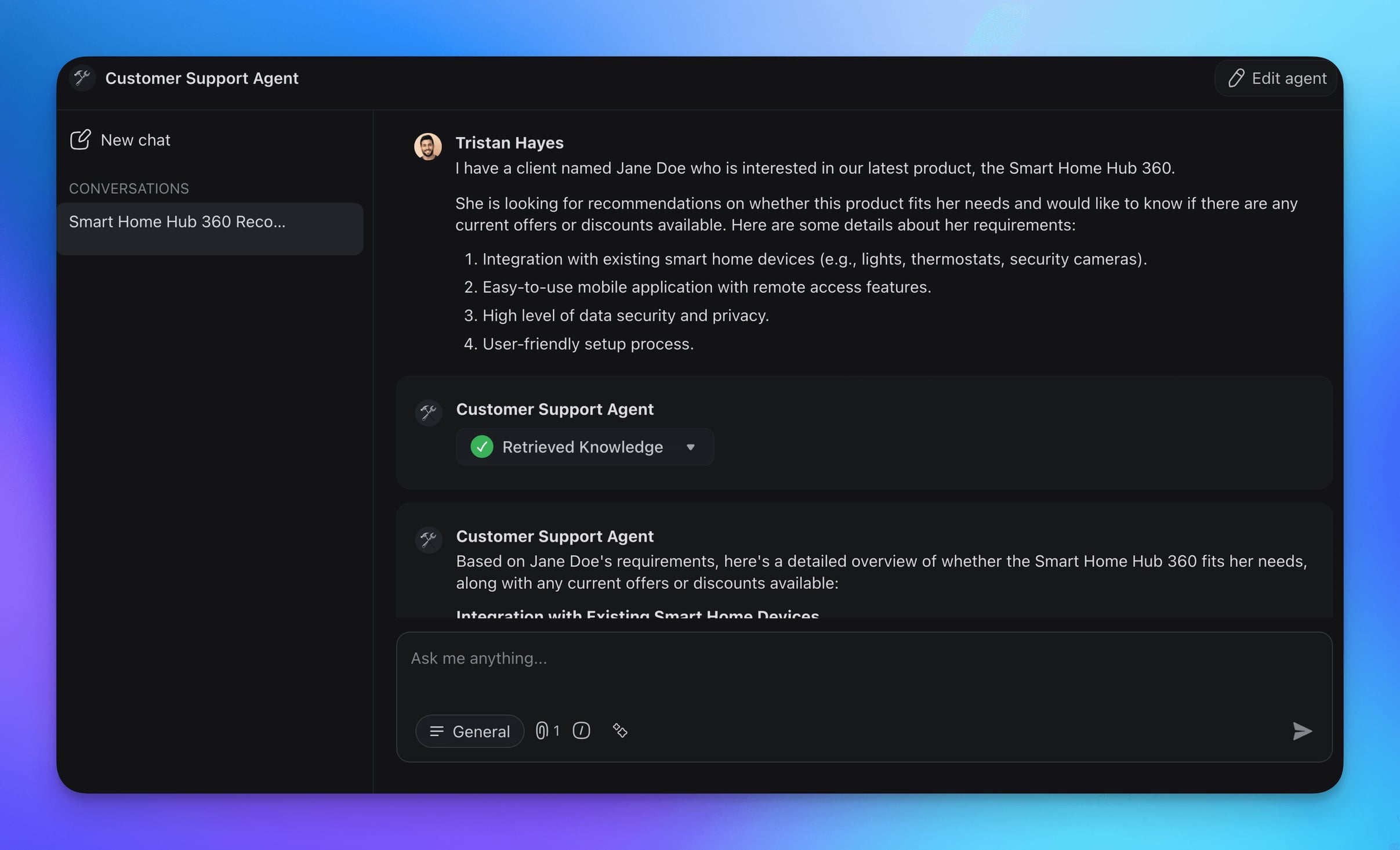
The Customer Support Agents retrieves knowledge from internal documents to answer the customer's questions and create a personalized offer.
This is step one. Step two is covering more ground.
Your support team can set and deploy more agents to handle other aspects of the workflow as needed. For example, a Ticketing Agent can log and categorize issues as they come in. For order-related concerns, an Order Management Agent can track shipment statuses, and so on.
Each specialized agent plays a role. Each saves precious hours. The result? A smoother operation, happier customers, and a more efficient support system that scales with your business. Want to see this in action? Explore ready-made AI agent apps in the Taskade Community.
Automated Task Management
It’s a typical day at the office — you’re starting a new project, and the pressure is on. You’re juggling deadlines and trying to keep your team on track. It feels like too much to handle.
This is where the Planning agent comes in. First, it breaks the project into manageable, bite-sized chunks. Then it outlines each step and defines clear tasks and subtasks.
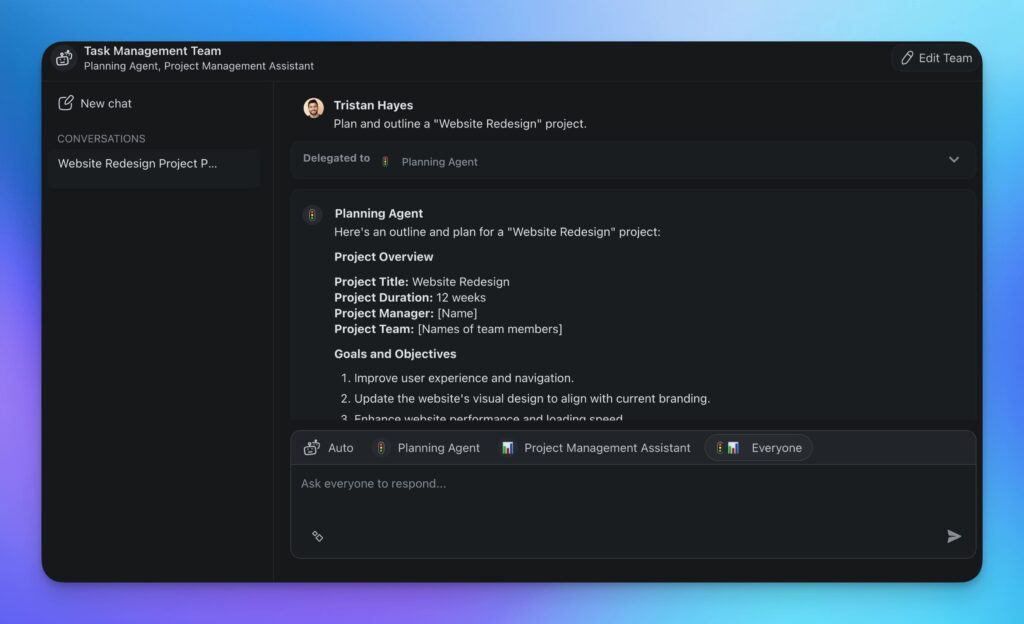
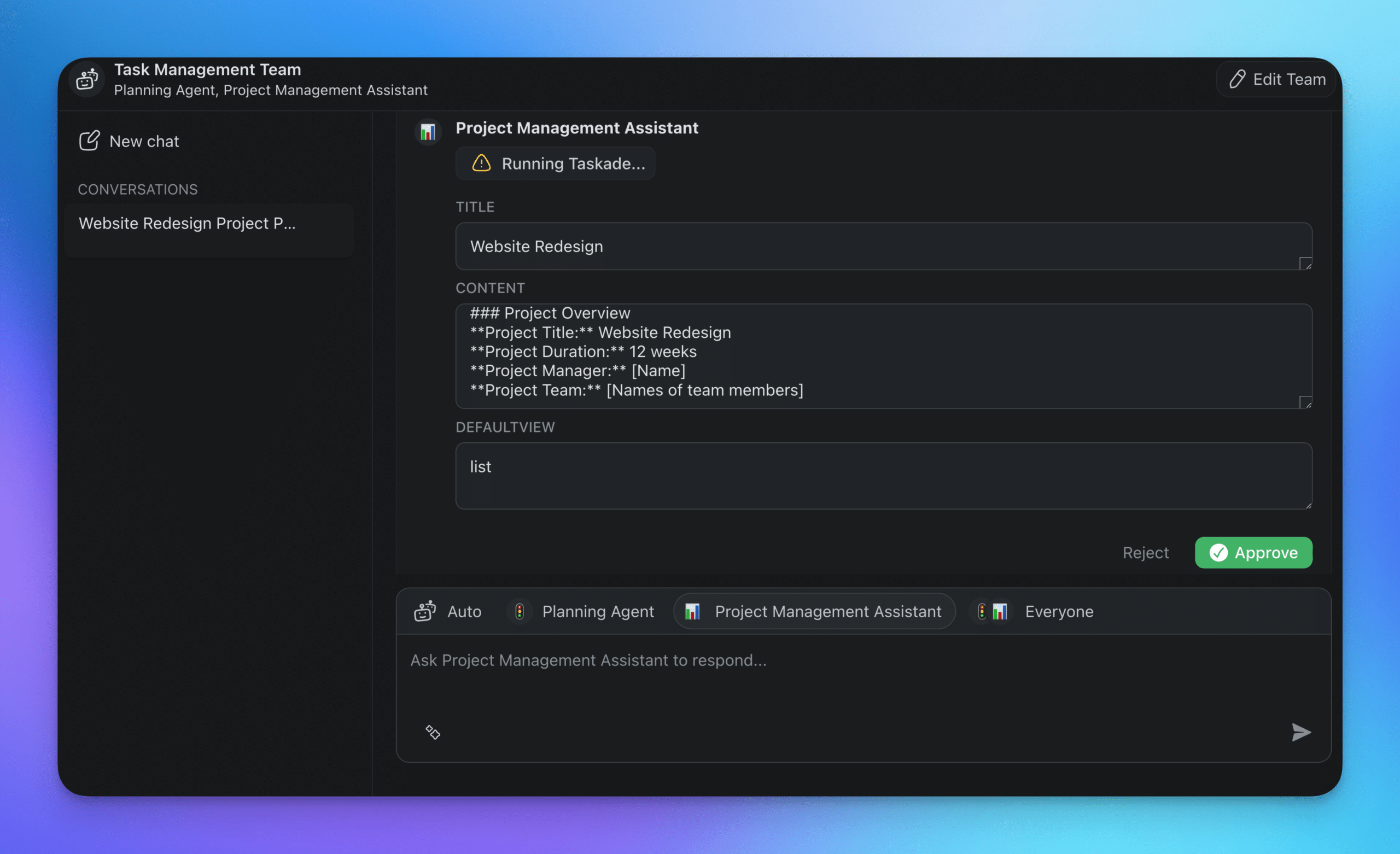
Once the tasks are defined, the Planning Agent hands off the output to a Project Management Assistant agent which sets up tasks and projects inside a shared workspace.
Want to take it a step further?
You can set up an automation that will use Gmail to send personalized emails to each team member with details of their responsibilities and deadlines. It can also push any updates to a team Slack channel.
The number of agents and automation steps you add to the workflow is up to you. You can build a fully-fledged AI team or keep it lean and organize your agents into small, agile squads. Learn more about autonomous task management and how to build your first AI agent.
Content Creation and Curation
Creating any kind of content is a multi-step process. Research, planning, first (terrible) drafts, it’s all part of the process. But you can cut down on a big chunk of the work grunt with an AI team at your side.
Take, for example, recording YouTube videos; the journey begins long before you hit the record button.
First, you need to identify topics that resonate with your target audience. Once you’ve selected a topic, the next step is planning the video, choosing visuals, scripting… You have your work cut out for you.
Let’s try to build an AI team to simplify the process.
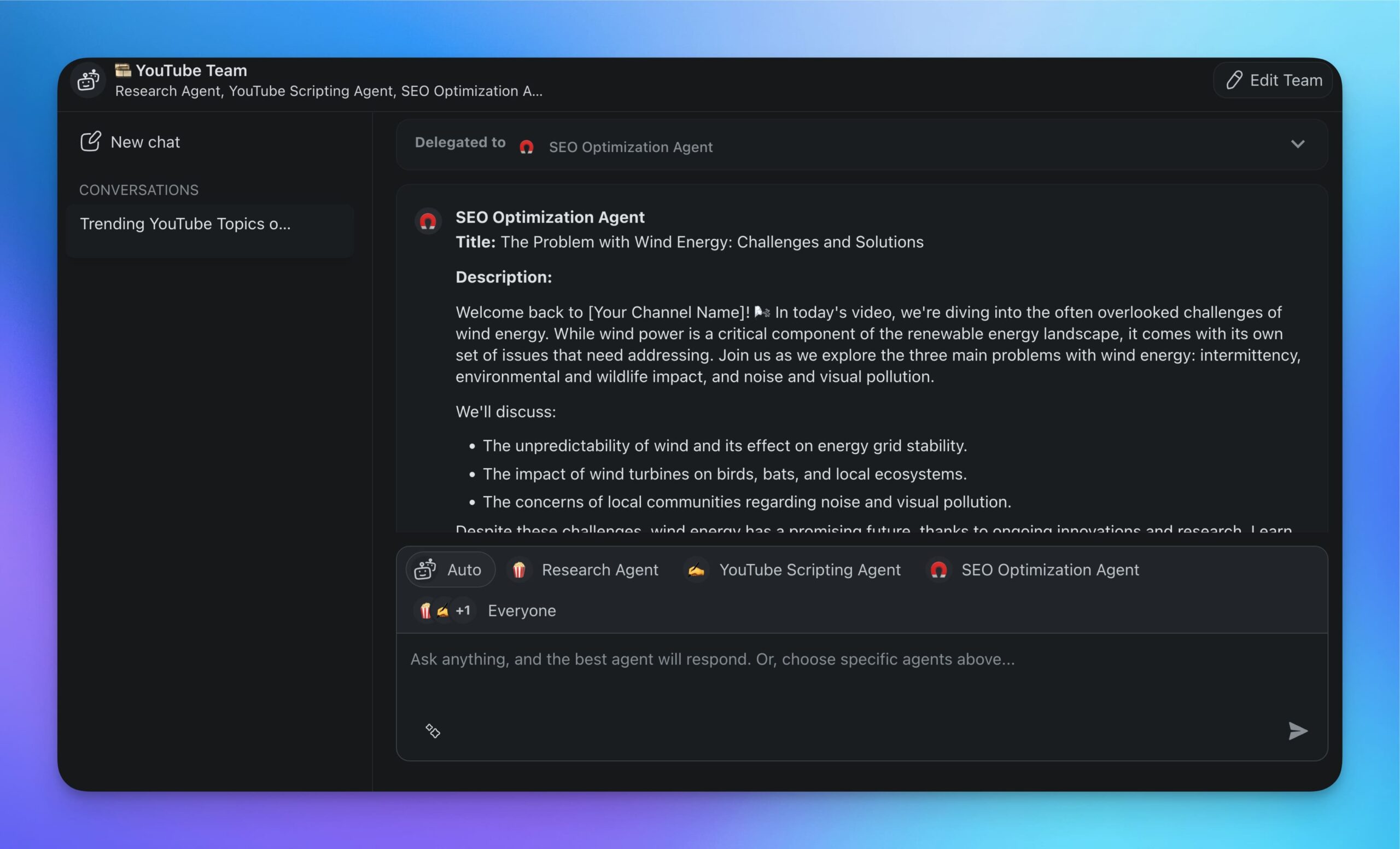
Start with the Video Research Agent. It will help you find trending topics that your audience will love.
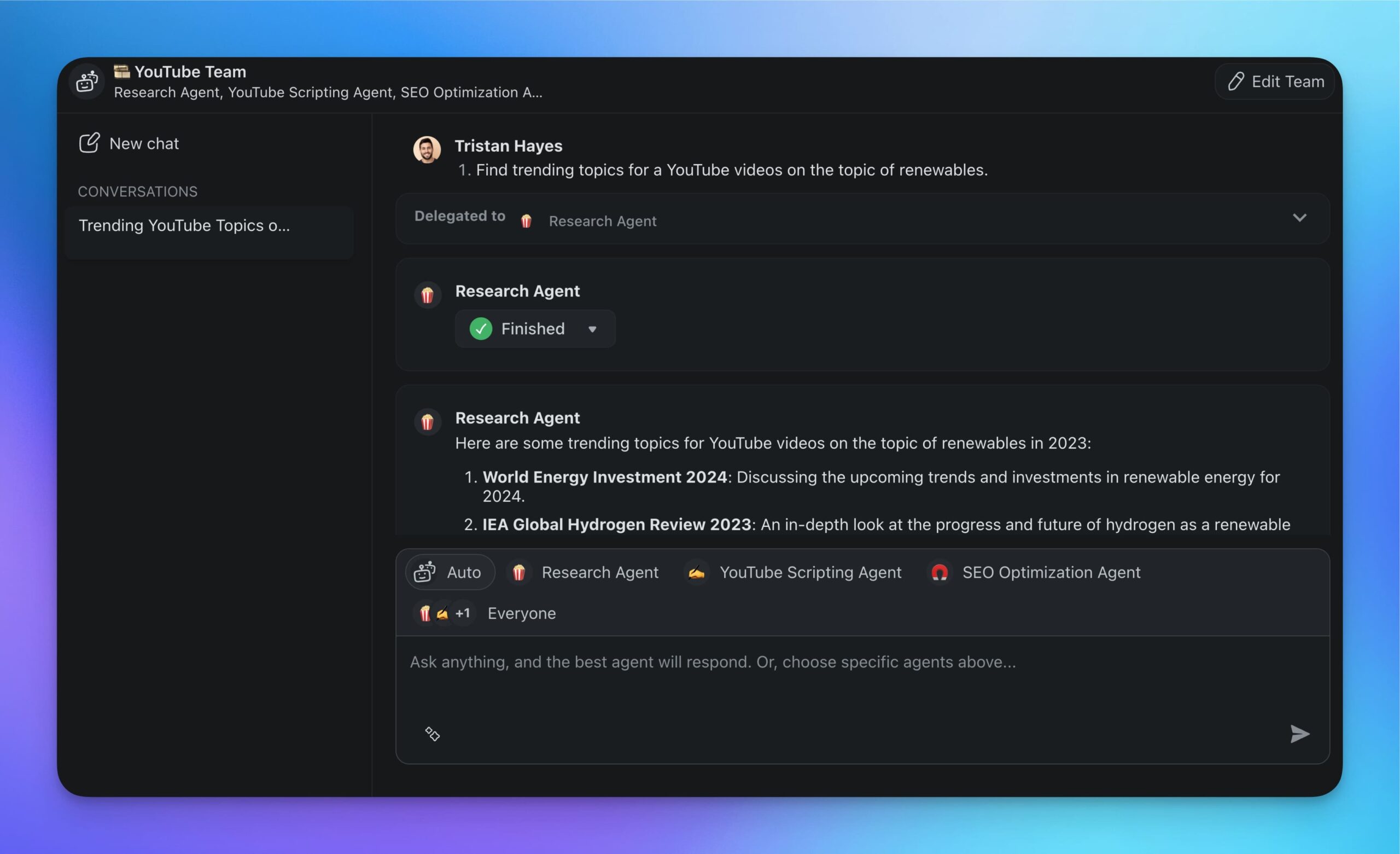
Next, the Scripting Agent will analyze the topic and write a script that grabs attention and keeps viewers engaged. The Scene Planning Agent will then take the script and lay out your video.
Finally, the SEO Optimization Agent steps in. It will analyze the video you’re working on and add the right keywords and descriptions to ensure your video gets seen by the right audience.
💰 Multi-Agent Platform Cost Comparison (2026)
Running multi-agent systems has a cost. The question is whether you pay per API call, per seat, or per platform. Here is how the leading options compare for a 10-person team running multi-agent workflows:
| Platform | Type | Pricing (10 users) | Unlimited Agents? | Built-in Integrations |
|---|---|---|---|---|
| Taskade | No-code workspace | $10/mo total (Pro) | Yes | 100+ native |
| CrewAI Cloud | Developer platform | ~$200/mo (estimated) | API-limited | Custom code only |
| AutoGen (Microsoft) | OSS framework | Free + API costs ($50-500+/mo) | Yes | Custom code only |
| LangChain/LangGraph | Developer framework | Free + API costs | Yes | Custom code only |
| ChatGPT Teams | Chat-based | $300/mo ($30/user) | GPTs only | Limited |
| ClickUp | PM with AI | $120/mo ($12/user) + $70 AI add-on ($7/user) | Credit-limited | 1,000+ |
Gartner predicts 40% of enterprise applications will feature task-specific AI agents by end of 2026, up from less than 5% in 2025. The AI agents market is projected to reach $52.62 billion by 2030 (MarketsandMarkets, CAGR 46.3%). As agents handle increasingly complex workflows, the total cost of ownership shifts from API costs to orchestration costs — deployment, monitoring, error recovery, and inter-agent communication. Taskade absorbs these orchestration costs with a durable execution engine, making multi-agent systems accessible at $10/month for a full team.
The key insight: raw API access is cheap, but production multi-agent systems require infrastructure (persistent memory, error recovery, monitoring, integration connectors) that OSS frameworks leave as exercises for the reader. Taskade provides this infrastructure out of the box.
🧭 Single Agent vs Multi-Agent: When to Use Which
Use a single agent for well-defined, sequential tasks where speed beats depth. Use a multi-agent team when the work spans distinct skills, needs quality checks, or has parallel steps. The choice depends on task complexity, quality requirements, and budget — here is the decision table at a glance:
| Decision factor | Use a single agent | Use a multi-agent team |
|---|---|---|
| 🧩 Task shape | Well-defined, sequential | Multiple distinct skills (research + write + review) |
| ⚡ Priority | Speed over depth — quick answers | Quality with checks and balances |
| 🔁 Parallelism | One thing at a time is fine | Steps can run simultaneously |
| 📚 Knowledge | One domain, one knowledge base | Different knowledge per phase |
| 🛠️ Setup effort | Minimal — start here | Worth the coordination overhead at scale |
| 💸 Cost profile | Fewer calls, cheaper per task | More calls, more compute |
| 🧪 Quality gate | Your judgment is final | A reviewer agent checks another's work |
| 📈 Scale | Dozens of items | Thousands of items (then coordination pays off) |
The rule of thumb: start with a single agent, then split into a team when you see quality gaps or bottlenecks. Don't reach for orchestration at low volume — if you're only handling 100 tickets, the coordination overhead isn't worth it. If you're handling 10,000+, it clearly is.
Here is the same decision as an ASCII tree you can keep on a sticky note:
                    ┌─────────────────────────────┐
                    │   What kind of work is it?  │
                    └──────────────┬──────────────┘
                                   │
              ┌────────────────────┼────────────────────┐
              │                    │                     │
       metric-shaped?       software-shaped?      workflow-shaped?
       (a rate to            (build a thing)       (specialized
        optimize)                  │                handoffs)
              │                    │                     │
         ┌────▼────┐               │                ┌────▼─────┐
         │  AUTO   │               │                │ ORCHEST- │
         │RESEARCH │               │                │  RATION  │
         └─────────┘               │                └────┬─────┘
                                   │                     │
                     ┌─────────────┴─────────────┐  scale > thousands?
                     │                           │  ──yes──► worth it
              well-defined +              complex / multi-skill
              your judgment final          / needs review?
                     │                           │
              ┌──────▼──────┐            ┌────────▼────────┐
              │   SINGLE    │            │  MULTI-AGENT    │
              │   AGENT     │            │     TEAM        │
              │ (1 context) │   start ─► │ orchestrator +  │
              └─────────────┘   simple   │ worker agents   │
                                grow when └─────────────────┘
                                you hit a
                                bottleneck
We’ve gone through the core mechanics of multi-agent AI systems, explained their benefits, and explored a handful of use cases you can try using Taskade’s AI Teams feature.
Let’s recap everything we’ve learned today:
✨ Multi-agent AI systems consist of multiple specialized agents working together.
✨ They enable AI agent collaboration and seamless communication between agents.
✨ Agentic systems can easily be expanded and reconfigured with additional tools and knowledge.
✨ Multi-agent setups leverage the specialized knowledge of individual agents.
✨ Autonomous task management in multi-agent systems enables seamless task transition.
✨ Multi-agent systems enhance precision by using agents with deep domain expertise.
✨ Multi-agent cooperation is the focus of agentic architecture.
And that's it. Building a team of AI agents is easier than you think, if you have the right tools. Set up yours with Taskade AI in under 5 minutes and put your workflow on autopilot.
🐑 How Taskade Genesis Builds Multi-Agent Teams (No Code)
Taskade Genesis turns a single prompt into a complete multi-agent system — agents, automations, a database, and a shareable app — without writing code. Describe what you want, and the system assembles the orchestrator-worker pattern this guide describes, backed by persistent memory so context compounds across runs. 150,000+ apps have been built since launch.
Here is what you get out of the box, mapped to the patterns above:
| Capability | What it does | Pattern it implements |
|---|---|---|
| 🤖 AI agents | built-in tools — web search, code, file analysis, custom slash commands, persistent memory, public embedding | The worker / specialist seat |
| 👥 Multi-agent collaboration | Agents work as a team across a shared workspace | Delegation + broadcast |
| 🧠 Orchestration mode | A manager agent plans the steps and delegates to specialist agents with a review step | Orchestrator-worker |
| 🔌 100+ bidirectional integrations | Triggers pull events in, actions push data out — including native Shopify and Stripe | Broadcast / negotiation over shared resources |
| ⚙️ Reliable automation workflows | Branch, loop, filter, wait minutes to days, and resume from the failed step | Durable multi-agent execution |
| 🗂️ Projects with multiple views | List, Board, Calendar, Table, Mind Map, Gantt, Org Chart | Shared memory the whole team reads |
| 🧬 Workspace DNA | Memory + Intelligence + Execution as a self-reinforcing loop | Persistent shared state |
| 🌐 Publish | Custom domains, built-in sign-in for published apps, Community Gallery, app kits | Distribution layer |
This is how the single-agent simplicity and multi-agent power described above stop being a tradeoff: EVE, the meta-agent inside Taskade Genesis, starts as one planning agent and spins up a team only where the work needs it. You stay the architect; the system handles the execution.
One honest note on the five coordination patterns: the Creator-Verifier pattern — a fresh, separate agent that independently QA-checks a builder's work — is a valuable industry concept, not a built-in Taskade validator. Taskade gives you orchestration with a review step and a live preview you can inspect; the adversarial fresh-context verifier is something the broader field is still standardizing.
Want the full build playbook? See best practices for building multi-agent AI teams, explore the autonomous multi-agent systems wiki, browse ready-made AI agent apps, or compare visual builders in our Make.com alternatives guide if you're coming from a no-code automation background.
🧬 Next Level: Build Entire Apps with Multi-Agent Teams
Ready to go beyond building agent teams? Taskade Genesis lets you generate complete multi-agent applications from a single prompt. Describe your business need and Taskade creates interconnected AI teams trained on your knowledge, workflows, and automations — all working together as living software. Explore AI apps in our community or create your own app now.
This is vibe coding — build by describing, not coding. See how it compares to traditional development in our best vibe coding tools guide.
Build your AI workforce of the future with Taskade AI! 🐑
🔗 Related Reading
- Multi-Agent AI Platforms for Teams (2026) — Eight-platform buyer guide on the seven capabilities that matter
- Workspace-Native AI Agents: A New Category — The seven-test criteria for workspace-native agents
- Replace a Team With Taskade Genesis — Twelve roles, twelve cloneable apps
- What Are Multi-Agent Systems? — How agent teams coordinate and collaborate
- What is Agentic AI? — The complete guide to autonomous agents and frameworks
- Agentic Workflows: The Path to AGI — How agent workflows bridge today's AI to AGI
- 12 Best Open-Source AI Agents — AutoGPT, CrewAI, LangChain, and more
- Claude Code vs Cursor vs Taskade Genesis — AI coding tools compared
- Best Devin AI Alternatives — AI coding agents for 2026
- What is Anthropic? — History of Claude AI and Constitutional AI
- What is OpenAI? — Complete history of ChatGPT and GPT
- Taskade vs Asana — AI-powered project management comparison
- Taskade vs Monday.com — Collaborative AI workspace comparison
▲ ■ ● Workspace DNA — a single agent remembers, reasons, and acts in one loop; a team of agents does it in parallel. Taskade Genesis lets you start with one and grow into a team without rebuilding anything.
Frequently Asked Questions
What is the difference between single-agent and multi-agent AI systems?
A single-agent system uses one AI agent to handle all aspects of a task — it plans, executes, and evaluates on its own. A multi-agent system deploys multiple specialized agents that collaborate, each handling a specific part of the workflow. Analogy: a single agent is like a solo freelancer doing everything; a multi-agent team is like a department with specialized roles (researcher, analyst, writer, reviewer). Single agents are simpler to set up and work well for straightforward tasks. Multi-agent teams handle complex workflows better because specialization improves quality and parallel execution improves speed.
When should you use a single agent vs a multi-agent team?
Use a single agent when: 1) The task is well-defined and sequential (e.g., summarize this document), 2) Speed matters more than depth (quick answers, simple automation), 3) You're starting out and want simplicity. Use a multi-agent team when: 1) The task involves multiple distinct skills (research + writing + review), 2) Quality matters and you want checks and balances (one agent reviews another's work), 3) The workflow has parallel steps that can execute simultaneously, 4) The task requires different knowledge bases or tools for different phases. Start with a single agent and split into a team when you see quality gaps or bottlenecks.
How do multi-agent AI teams coordinate work?
Multi-agent teams coordinate through three patterns: 1) Sequential pipeline — agents work in order, each receiving the previous agent's output (researcher → writer → editor), 2) Parallel execution — multiple agents work on different subtasks simultaneously, then a coordinator agent combines the results, 3) Hierarchical delegation — a manager agent breaks down the goal and assigns subtasks to specialist agents, then reviews and assembles the final output. In Taskade, agents can communicate through shared workspace projects, trigger each other through automations, and access shared knowledge bases — enabling all three coordination patterns without manual orchestration.
What are the challenges of multi-agent AI systems?
Four main challenges: 1) Coordination overhead — agents need clear communication protocols; poorly defined handoffs create errors that compound through the pipeline, 2) Error propagation — if an early agent produces incorrect output, downstream agents build on that mistake, 3) Cost — each agent uses API calls and compute, so multi-agent systems cost more per task than single agents, 4) Debugging complexity — when the final output is wrong, tracing the error back to the responsible agent requires logging and monitoring at each step. Mitigation: start small (2-3 agents), define clear input/output contracts, add human review checkpoints, and use platforms like Taskade that provide built-in agent monitoring.
What research proves multi-agent teams outperform single agents?
Three landmark studies demonstrate multi-agent superiority for complex tasks: 1) Stanford Smallville (2023) — 25 agents produced emergent social behavior (party planning, relationships, information cascading) that single agents cannot generate, 2) Project Sid (2024) — 1,000 agents in Minecraft invented specialized roles, debated laws, and spread culture; ablation studies proved removing social awareness collapsed coordination to random chance, 3) ChatDev (2023) — multi-agent software teams negotiated architecture and produced working applications in 20 minutes with unrequested improvements. The consistent finding: multi-agent interaction unlocks emergent capabilities beyond any single agent's design.
How much does it cost to run multi-agent AI systems?
Cost depends on how many agents you run and how often they execute. Each agent uses API calls, so multi-agent systems cost more per task than single agents. Taskade is free to start, with Pro from $10/month (billed annually) including 10 users, giving you access to unlimited multi-agent teams and 100+ integrations at a flat rate. By comparison, running individual API calls directly can cost $0.01-0.06 per 1K tokens, and a complex multi-agent workflow may consume thousands of tokens per run. Platform pricing like Taskade provides cost predictability that raw API usage does not.
Can I build a multi-agent system without coding?
Yes. No-code platforms like Taskade let you build multi-agent systems by describing what you want in natural language. You create agents with custom instructions, assign them knowledge bases and tools, then connect them through visual workflow builders. Taskade Genesis takes this further with vibe coding — describe your desired outcome in a single prompt and the system generates interconnected agents, workflows, and automations as living software. The Community gallery also offers clonable multi-agent apps you can deploy and customize immediately without writing a single line of code.
What is the future of single-agent vs multi-agent AI?
The METR benchmark shows AI task capability doubling every 4-7 months, and as agents handle increasingly longer and more complex tasks, multi-agent coordination becomes essential. Single agents will continue to handle routine, well-defined tasks efficiently. Multi-agent teams will take over complex, creative, and adaptive workflows that require diverse expertise, parallel execution, and quality checks. The trajectory points toward hybrid architectures where a single orchestrator agent dynamically spawns and coordinates specialist agents as needed — blurring the line between single-agent simplicity and multi-agent power.
What are the five multi-agent coordination patterns?
The industry has converged on five primitive coordination patterns that multi-agent systems compose: 1) Delegation — one agent spawns another and gets a result back, the simplest and most common form, 2) Creator-Verifier — one agent builds and a separate fresh-context agent checks the work, removing the builder's bias toward its own output, 3) Direct communication — agents talk peer-to-peer with no central coordinator, 4) Negotiation — agents coordinate over a shared resource such as the same file or API, ideally as positive-sum trading, 5) Broadcast — one agent shares state or constraints with many, which keeps long-running runs coherent. Most production teams start with delegation and add broadcast as runs get longer. In Taskade, a manager agent in orchestration mode plans steps and delegates to specialist agents with a review step, then shares state through workspace projects.
What is an orchestrator-worker multi-agent architecture?
An orchestrator-worker architecture is the most proven multi-agent pattern for complex work: a planning or manager agent breaks the goal into steps, keeps notes and memory, and assigns each step to a short-running specialist worker agent. Workers run with clean context, finish one task, and hand back a structured summary. Research from Cursor (millions of lines of code) found that adding more management layers hurt results — "simple scales well with agents." Taskade Genesis ships this pattern as orchestration mode, where a manager agent plans steps and delegates to specialist agents with a built-in review step, all backed by persistent Workspace DNA memory so context compounds across runs.