







Most writing about multi-agent systems is about the agents. The interesting engineering is in the space between them.
A handoff is the moment one agent passes work to another. It is where context gets lost, where authority gets assumed, and where a small error early in a chain becomes a confident, elaborated error at the end. In practice, multi-agent systems rarely fail because an individual agent was bad at its job. They fail at the seams.
There is a lot of published material on orchestration patterns — sequential, hierarchical, parallel — and almost none on what a handoff should actually contain. This article is about the payload.
TL;DR: An agent handoff transfers three things at once: the remaining task, the context to do it, and the authority to act. Good handoffs carry four payload fields — objective, state, evidence, boundary — plus provenance metadata, and nothing else. The most common mistake is passing the full transcript, which costs tokens and buries the instruction. Build agent workflows →
What Is an Agent Handoff?
An agent handoff is the transfer of work from one AI agent to another, carrying the task still to be done, the context needed to do it, and the permission to act on it. Every multi-agent architecture contains handoffs regardless of its shape — a sequential pipeline has one per hop, a parallel fan-out has one per branch plus one per merge, and a hierarchical system has one per delegation and one per report-back.
The count matters. A sequential chain of n agents contains n-1 agent-to-agent handoffs, and a manager with n specialists contains 2n. Each one is an independent failure point. This is the real cost of adding an agent, and it is usually larger than the token cost.
What a Handoff Must Carry: Four Fields Plus Provenance
After stripping out everything optional, a working handoff carries four payload fields. A fifth item, provenance, rides alongside as metadata.
| Field | What it is | What happens without it |
|---|---|---|
| Objective | The outcome wanted, stated as a result rather than steps | The receiver optimizes for the wrong thing, competently |
| State | What is already settled, what remains open | The receiver redoes finished work or skips unfinished work |
| Evidence | The minimum sources needed to verify, not to trust | The receiver cannot check the sender and inherits its errors |
| Boundary | What the receiver may and may not do | The receiver either overreaches or stalls asking permission |
| Provenance (metadata) | Which agent produced each claim, recorded by the system | Nobody can trace an error back to the hop that made it |
The sender composes the four payload fields. The system records provenance. Everything else is usually the sender's working transcript. It costs context budget on both sides — the sender pays to write it, the receiver pays to read it — and it adds nothing the receiver can act on.
A BAD HANDOFF                        A GOOD HANDOFF[ entire conversation ]              OBJECTIVE
[ every tool call ]                    ship a comparison table
[ every intermediate thought ]         readers can act on
[ the actual instruction,            STATE
somewhere in the middle ]            settled: 4 tools chosen
[ more transcript ]                    open: pricing unverified
EVIDENCE
3 source URLs
1 prior draft section
BOUNDARY
may rewrite prose
may not change the 4 tools
PROVENANCE (metadata)
researcher: tools, sources
~40,000 tokens                       ~600 tokens
receiver reads maybe 5%              receiver reads 100%
The asymmetry is the point. The second version is not a lossy compression of the first — it is a different kind of object. It states what is decided, so the receiver does not relitigate it. It states what is open, so the receiver knows where to work. It supplies evidence rather than conclusions, so the receiver can disagree.
The Five Ways Handoffs Break
These are the recurring failure modes, in rough order of how often they show up.
1. Context flooding
The sender passes everything. This feels safe because nothing is omitted, and it is the default behavior of most naive implementations. The cost is real: the receiving agent spends its context window on material it will not use, and the actual instruction competes for attention with thousands of irrelevant tokens. The quality degradation that follows has a name — context rot — and it compounds at every hop.
2. Context starvation
The opposite error. The sender passes a conclusion — "the best option is X" — with none of the reasoning or sources. The receiver has no way to verify, so it treats the conclusion as fact. This is how a single early mistake becomes the foundation of everything downstream.
3. Silent authority transfer
The handoff says what to do but not what is permitted. Can the receiver contact a customer? Change a price? Delete a record? Unstated permissions get resolved by the model's judgment in the moment, which is not a specification. This is the failure mode with the largest blast radius, because it is the one that touches the outside world.
4. Error propagation
The mitigation is not a better agent — it is an independent check. One agent whose job is to verify rather than produce, with its own fresh context, catches what a chain of producers cannot.
5. Lost provenance
At the end, nobody can tell which agent produced which claim. When the output is wrong, you cannot trace the error back to its source, so you cannot fix the responsible step. Provenance has to be carried deliberately; it does not survive a handoff by accident.
| Failure mode | Symptom you will actually see | Fix |
|---|---|---|
| Context flooding | Latency and cost climb per hop; quality drops late in the chain | Bound the payload to the four payload fields |
| Context starvation | Downstream agents cannot explain why | Pass evidence, not just conclusions |
| Silent authority | An agent does something nobody authorized | State the boundary explicitly |
| Error propagation | Output is confidently, consistently wrong | Add an independent verifier |
| Lost provenance | You cannot reproduce or locate the error | Tag every claim with its producing agent |
The Bandwidth Lesson from Biology
There is a useful data point here from an unexpected place, and it is empirical rather than theoretical.
In September 2026 researchers published the first complete wiring diagram of a male fruit fly's central nervous system: 166,700 neurons and roughly 125 million connections, brain and nerve cord together, three months after the first female one. We covered the full result in the complete connectome explained.
One structural detail is directly relevant. The brain communicates with the nerve cord through the neck — a physically constrained channel carrying ascending and descending neurons, a small population next to the sensory and motor periphery they serve. Behavior still works, and works well.
A narrow channel forces abstraction. The nerve cord does not stream raw sensory data upward; it reports a state. The brain does not micro-manage a muscle; it selects a behavior and lets the local loop handle execution.
The June 2026 companion paper found the same principle at the level of whole-system organization: effectors are driven mainly by sensors in the same body part, forming local feedback loops, with ascending and descending neurons joining those loops into behavior-centric modules. The authors call the architecture "distributed, parallelized and embodied."
Translate that into agent design and you get a rule: the handoff channel should be narrow on purpose. A module that owns its own loop needs selection and a reporting format, not supervision of every step.
This is a design analogy, not proof — flies are not language models. But it is a working existence proof that a system with constrained inter-module bandwidth can produce sophisticated behavior, and the burden of argument sits with whoever wants to pass 40,000 tokens per hop.
Four Coordination Patterns, Compared
Handoffs take different shapes depending on the topology. Here are the four that matter, with their real trade-offs.
| Pattern | Handoffs | Best for | Main risk |
|---|---|---|---|
| Sequential pipeline | n-1 | Ordered work where each stage genuinely needs the last | Error propagation compounds with chain length |
| Parallel fan-out | 2n | Independent subtasks that can run at once | The merge step becomes the bottleneck and the failure point |
| Hierarchical delegation | 2n | Goals that decompose cleanly into specialties | Manager becomes a context bottleneck |
| Peer-to-peer | up to n² | Genuinely emergent coordination | Coordination cost grows quadratically; hard to debug |
Most production systems land on hierarchical delegation with parallel fan-out inside it. It bounds coordination cost while still allowing concurrency, and it gives you one place to put the verifier.
One honest note on peer-to-peer: it is the pattern most papers find interesting and the one fewest teams ship, because n² communication paths are very hard to reason about when something goes wrong. If you want more depth on the messaging layer specifically, we covered protocols in inter-agent communication patterns.
Writing the Handoff Contract
The practical output of all this is a contract. Here is the shape, kept deliberately small.
HANDOFF -> {receiving agent}OBJECTIVE
One sentence. An outcome, not a procedure.
STATE
SETTLED:  decisions the receiver must not reopen
OPEN:     the specific questions this hop must answer
BLOCKED:  anything that needs a human
EVIDENCE
Links or IDs. The minimum needed to verify,
not the full research trail.
BOUNDARY
MAY:      actions that are in scope
MAY NOT:  actions that require escalation
PROVENANCE  (metadata, not payload)
Who produced what, so the next failure is traceable.
Provenance is the fifth item in the contract, and it is deliberately metadata rather than payload: it is written by the system, not composed by the sending agent, and it does not compete for the receiver's attention.
Three rules make this work in practice.
Separate settled from open. This single split prevents the two most expensive behaviors in a chain: relitigating a finished decision, and silently skipping an unfinished one.
Pass evidence, not conclusions. A receiver that can check the sender is a receiver that can catch an error. A receiver that only gets conclusions is structurally unable to disagree.
State the boundary even when it seems obvious. "May not contact the customer" costs eight words and prevents the failure mode with the worst consequences.
Measuring Whether Your Handoffs Work
Here is the part most architecture content skips entirely, and it is the part that decides whether any of the above helped.
An architecture diagram cannot tell you whether a handoff works. A diagram shows which paths exist. It says nothing about how strongly they carry, which ones actually fire, or which ones silently fail.
This is not a soft observation. It is the same limit neuroscience ran into with the connectome, and the field named it precisely. A 2024 Nature paper put it this way: a complete wiring diagram "specifies the synaptic paths by which neurons can affect each other, but not how strongly they do affect each other in vivo." Their solution was not a better map. It was perturbation — change something and measure what happens downstream.
The agent-system version:
| Probe | What you change | What it reveals |
|---|---|---|
| Single-input perturbation | One fact in the initial prompt | Whether that fact survives to the final output, and intact |
| Agent ablation | Remove one agent from the chain | Whether the system degrades gracefully or collapses |
| Payload size sweep | Handoff size at each hop | Where context flooding starts costing quality |
| Contradiction rate | Nothing — just log it | How often a downstream agent contradicts an upstream one |
| Fire-rate audit | Nothing — just log it | Which designed handoffs never actually execute |
That last row catches more real problems than any of the others. Designed-but-never-fired handoffs are extremely common, and they are invisible in every diagram.
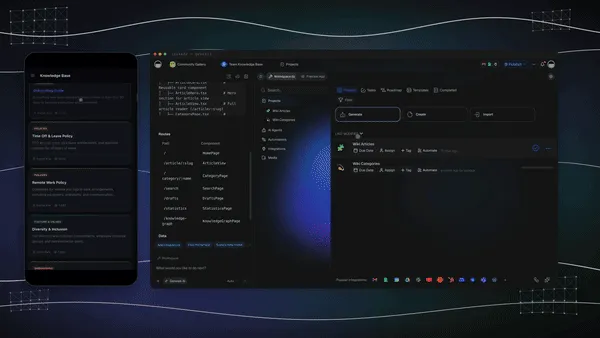
There is one more structural option worth naming. If agents share a persistent substrate — a workspace, a project, a knowledge base — then a handoff can carry a pointer rather than a payload. "The findings are in project X" is a handoff of four words. This is what persistent memory buys you architecturally, and it is a different solution from summarizing harder.
Handoffs in a Workspace
Taskade organizes this as Workspace DNA — Memory, Intelligence and Execution. Projects hold the memory, AI agents supply the intelligence, and automations execute. Because all three share one substrate, a handoff between agents can reference shared state instead of copying it.
| Handoff concern | Where it lives in a workspace |
|---|---|
| Objective and boundary | The receiving agent's own instructions |
| State: settled vs open | A shared project both agents can read and write |
| Evidence | Knowledge sources attached to the agent |
| Execution and sequencing | An automation with defined steps |
| Provenance | The run history for each automation |
Taskade keeps all three on one substrate, which is what lets a handoff reference shared state instead of copying it. You can start free with 2 workspace members, 3 Genesis apps and 1 agent, with paid plans from $10/month billed annually and 100+ integrations. Browse working examples in the app gallery, or start from the AI app builder.
Frequently Asked Questions
What is an agent handoff in simple terms?
It is the moment one AI agent gives work to another, along with the context needed to continue and the permission to act. Think of it as a shift change: the outgoing worker has to say what is done, what is not, and what the incoming worker is allowed to decide.
What is the most common handoff mistake?
Passing the entire conversation. It feels safe because nothing is left out, but it fills the receiving agent's context with material it will not read and buries the real instruction. A structured summary with explicit open questions usually outperforms a raw transcript.
How do you stop errors spreading between agents?
Add an independent verifier with its own fresh context, and pass evidence rather than conclusions so each agent can check the one before it. A chain of producers cannot catch its own error, because every agent after the mistake is behaving correctly given its input.
How many agents should I use?
Start with one. Add a second only when you can name why — different knowledge, different tools, or an independent check. Every agent adds a handoff, and handoffs are where errors enter. Two to four specialized agents cover most real workflows.
What is the difference between a handoff and a tool call?
A tool call returns a result to the same agent, which keeps the context and the authority. A handoff transfers the work to a different agent with its own context and its own permissions. The distinction matters because a handoff is where state can be lost, and a tool call is not.
Should agents share memory or pass context?
Both, for different things. Shared memory handles durable state — findings, decisions, source material — and lets a handoff carry a pointer instead of a payload. The handoff itself should still carry the objective, the open questions and the boundary, because those are specific to this hop and should not be inferred.
Do more agents always produce better results?
No. Beyond a small number of genuinely specialized roles, coordination cost tends to grow faster than output quality. The honest test is whether each additional agent brings knowledge, a tool, or a check that the existing ones do not have. If it does not, it is adding a failure point.
How do I debug a multi-agent system that produces wrong output?
Start with provenance. Tag each claim with the agent that produced it, then walk backward to the first hop where the output stopped matching the input. Without that tagging, you are guessing. Then perturb: change one input and watch what reaches the end.
What is context rot?
Context rot is the quality degradation that happens as a context window fills with accumulated, partly irrelevant material. It makes naive handoffs worse the longer the chain runs, since each agent appends its reasoning to what it received. Bounded handoffs are the direct fix.
Can I build this without writing code?
Yes. Define each agent's instructions, knowledge and tools, then connect them with automations that pass structured output between steps. The handoff contract lives in how you specify each agent's inputs and outputs, not in code.
The agents get the attention. The seams decide whether the system works.
If you take one thing from this: make the channel narrow on purpose, and then measure what actually crosses it. A complete map of the most thoroughly documented nervous system on Earth still cannot tell you how strongly one neuron affects another. Your architecture diagram will not tell you how well your agents hand off either. You find out by running them.
▲ ■ ● Memory. Intelligence. Execution.
Further reading: The complete connectome explained · Single agent vs multi-agent teams · The AI agent stack · Inter-agent communication patterns · Agentic automation explained · The history of agent memory · Why AI agents need an ontology · The scaffolding tax · Multi-agent systems · Persistent memory · Context window · Evals