

TL;DR: Taskade Genesis is the workspace-native A0 alternative: one prompt returns a hosted web app with AI agents, automations, and 100+ integrations. A0 builds React Native mobile apps you publish to the App Store, with Pro at $20/mo and Max at $200/mo. Taskade Genesis is Free Forever, with Pro at $10/mo billed annually for 10 seats. Try Taskade Genesis free →
See the alternative working — clone in 60 seconds
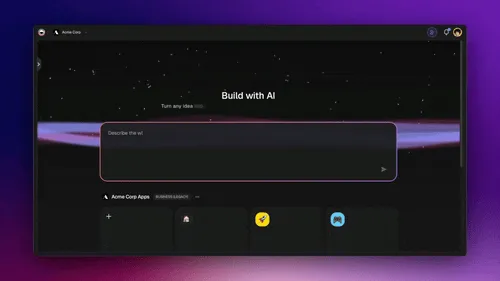
No signup, no credit card. Live client portal
| Capability | A0 | Taskade Genesis |
|---|---|---|
| Pricing (starting) | Pro $20/mo, Max $200/mo | $0 Free · $10/mo Pro billed annually (10 seats) |
| Cloneable live demo | ❌ | ✅ |
| Built-in AI agents | Coding agent in the app builder | ✅ Built-in tools, persistent memory |
| Automation engine | No workspace automation engine | ✅ Durable runtime, 100+ integrations |
| Workspace DNA loop | ❌ | ✅ ▲ Memory · ■ Intelligence · ● Execution |
What is Taskade Genesis?
Taskade Genesis is the AI app builder inside the Taskade workspace, from the Y Combinator-backed team that has run Taskade since 2017. It is the web-side counterpart to a mobile builder: instead of a binary you submit for review, you get a URL that works the second the build finishes.
That makes it the fast path for everything a consumer app founder still needs off-store: a waitlist and onboarding portal, an admin console for support, a lightweight CRM, an internal dashboard. Users sign in with email via GenesisAuth on every plan, and any build can be shared to the Community Gallery with one click.
What Taskade Genesis actually builds
Each build is a full application, with screens, data, agents, and automations, hosted and reachable at a URL. If you want to see how much the underlying model matters, the TSK-1 Benchmark gives competing AI models the same job and grades what comes back: does the app open, did it build what was asked for, does it save your data.
What is A0?
A0 (a0.dev) is an AI mobile app builder from the Y Combinator Winter 2025 batch, founded by Seth Setse and Ayomide Omolewa. You chat with an AI coding agent that generates a custom React Native project. You test it in the browser preview, in the a0 app, or in Expo Go, then publish to the App Store through your App Store Connect account. A0 apps use a Convex backend for data and push notifications, and the monetization tab sets up subscriptions with Stripe on the web and Apple in-app purchases on iOS.
A0 at a glance (verified October 2026 on a0.dev/pricing and docs.a0.dev): Pro $20 per month with 100 credits, expanded messaging limits, advanced coding models, unlimited app builds, a custom domain without a0 branding, and code export. Max $200 per month with 1,250 credits, 250 bonus credits each month, the top AI models, and unlimited support calls. App Store publishing, IPA and APK builds, and over-the-air updates. Android payments are listed as not supported yet.
Where each tool wins
An app in the store with payments wired in: A0
If the goal is an iOS app with subscriptions set up from day one, A0 is purpose-built for that path: build, test on a device, publish, and push over-the-air fixes in one platform.
A working app right now: Taskade Genesis
If the thing you need is a business app your team and customers open in a browser, for example an admin console, a portal, or a dashboard, Taskade Genesis ships it working on the first prompt. No review queue, no binary, nothing between the idea and the URL.
Three launch jobs, side by side
Most consumer app launches need the same three jobs done in the first month. A0 and Taskade Genesis split them cleanly:
| Launch job | With A0 | With Taskade Genesis |
|---|---|---|
| Get the app into users' hands | Build, test on a device, submit through App Store Connect | Not covered. Taskade does not build mobile binaries |
| Answer the first wave of support questions | Write the replies yourself, or code a help screen | A public AI agent answers from your help docs, and hard cases become tasks |
| Track who paid, who churned, and why | Stripe and App Store dashboards, separately | One Subscribers project and dashboard, fed by the Stripe connector and webhooks |
The common split: the app ships from the mobile builder, and the operating system for the business runs in a workspace.
Use both: A0 for the app, Taskade for the business behind it
Indie founders often ship the app on A0 and run the customer side in Taskade. A concrete setup for an app that sells a web subscription through Stripe:
- In Taskade, create an automation with the Stripe connector trigger for a new payment.
- Add a step that writes the customer email, plan, and amount as a row in a Subscribers project.
- Add an AI step where a Taskade agent with your help docs as knowledge drafts a welcome email with three tips for the first week.
- Send it with the Gmail connector and post the sale to
#revenuewith the Slack connector. - Add a second automation on failed payments that creates a follow-up task and a short win-back email draft.
The Subscribers project feeds a Taskade Genesis revenue dashboard and a support portal with an embedded FAQ agent. A0 stays focused on the app. Taskade runs the relationship with the people who pay for it.
The Workspace DNA advantage
A0's mental model is "chat generates a mobile app, the founder publishes and monetizes it." Taskade Genesis's mental model is Workspace DNA: a self-reinforcing loop between three pillars.
- Memory (Projects): Roadmap, support notes, user research, and tables live where the agents can reach them, so your workspace knows the product without a briefing. Read How Workspace DNA Works.
- Intelligence (Agents): AI Agents v2 hold memory across sessions, run custom tools, and can be embedded publicly so users talk to them inside a shipped app.
- Execution (Automations): Durable workflows react to a new signup, a Stripe charge, an inbound email, or a schedule, and log the result back into the workspace.
A0 is excellent at one slice of that: getting a mobile app into the store. Taskade Genesis keeps the three pillars running, so everything your team learns about the product ends up somewhere the next build can use it.
Pricing comparison
| Plan | Taskade Genesis | A0 (verified October 2026) |
|---|---|---|
| Free | Free Forever: 3 Taskade Genesis apps, 2 members, 1 agent | See a0.dev for current free access |
| Entry | Pro $10/mo billed annually: up to 10 seats, unlimited apps, up to 10 custom domains | Pro $20/mo: 100 credits, unlimited app builds |
| Team | Business $25/mo billed annually: unlimited seats | No team plan listed |
| High capacity | Max $100/mo billed annually | Max $200/mo: 1,250 credits + 250 bonus |
| Top tier | Enterprise $250/mo billed annually | No enterprise plan listed |
A0 prices by credits for the coding agent, so heavy build months use more of the allowance. Publishing to the App Store also needs an Apple Developer Program membership, which Apple bills separately. Taskade plans also use AI credits for builds and agents, and include hosting, automations, and collaboration in the plan price.
Choose Taskade Genesis if
- Your product needs a web surface, for example a portal, admin console, or dashboard, next to the mobile app
- You want an agent embedded in the app to handle support and onboarding questions
- You want signups and payments to trigger real work across 100+ connected tools
- You would rather ship to a URL than wait on a review queue
- The people who need to build are not all engineers
Choose A0 if
- Your goal is an App Store listing with publishing handled from the builder
- You want subscriptions and in-app purchases set up inside the builder
- You want over-the-air updates and an exportable React Native codebase
Frequently asked questions
Is Taskade Genesis a good A0 alternative?
When the job is a hosted business app you can ship today, yes. When the job is a mobile app published to the App Store, A0 remains the better fit.
How does Taskade Genesis pricing compare to A0?
Taskade Genesis is Free Forever, with Pro at $10 per month billed annually. A0 Pro is $20 per month with 100 credits, and A0 Max is $200 per month with 1,250 credits (verified October 2026).
Can I use A0 and Taskade Genesis together?
Yes. The Taskade Stripe connector reacts to each A0 web payment, so an agent can welcome the customer and update your dashboard.
Can Taskade Genesis publish to the App Store?
No. Taskade Genesis ships live web applications with share links, embedding, and custom domains on Pro and above.
Which AI models power Taskade Genesis?
Taskade Genesis runs frontier models from top AI labs, with TSK-Auto as the default. On Pro and up, you can bring your own OpenAI, Anthropic, or Google Vertex AI key (BYOK).
Can I publish a Taskade Genesis app to a custom domain?
Yes, from Pro ($10/mo billed annually). GenesisAuth email sign-in works on every plan including Free, and password protection is available from Pro.
Build without permission
A0 gives indie app founders a faster road to the store with monetization wired in. Taskade Genesis gives every team — engineers and non-engineers alike — a workshop where business apps come out finished, hosted, and ready for users.
- Start with Taskade Genesis — One prompt, one live web app
- Browse the Community Gallery — Clone a build instead of starting blank
- Read the Workspace DNA explainer — How memory, agents, and automations compound
Explore Taskade Genesis
- AI App Builder — The web side of your product, built from a prompt
- AI Agent Platform — Support and onboarding agents you can embed
- Workflow Automation — Signups and payments that trigger real work
- AI Website Builder — Waitlist and launch pages fast
- Vibe Coding — Shipping software by describing it
Build without code
- AI App Generator — Complete apps from a prompt
- AI Dashboard Generator — Admin and analytics consoles
- AI CRM Generator — Customer records with an interface on top
- AI Form Generator — Signup, feedback, and support intake
- Browse Community Apps — Clone a working build
Related reading
- The Build Without Permission article — Our manifesto
- Best AI App Builders — The category, compared
- Best Vibe Coding Tools in 2026 — What each tool is actually good at
- AI Tools Built With Taskade Genesis — Apps you can open and clone
- How Workspace DNA Works — Memory, Intelligence, Execution
- Origin of Living Software — Apps that keep changing after launch