






What used to take a Fortune 500 team eighteen months, customer records, dispatch, invoicing, scheduling, support, reporting, a custom domain, one operator now ships in a few weeks. Not as code. As a living workspace: projects holding the data, agents doing the work, automations firing on every event, sign-in gating the right people.
This is what Taskade Genesis ships by default. Here are the five primitives that collapse the stack, four kits you can clone today, and the brutal role-by-role replacement table.
TL;DR: A 2026 solo-operator stack is one workspace, not seven SaaS subscriptions. Workspace DNA, Memory + Intelligence + Execution, collapses 7 hires (PM, designer, frontend, backend, DBA, DevOps, QA) into a workspace where projects are the data, agents do the work, and automations fire on every event. Start with the Growth Dashboard kit →
The Seven Roles That Used to Build This
Walk into any traditional company shipping a customer-facing operational surface, a dispatch app, an internal CRM, an invoicing dashboard, a client portal, and you find the same org chart underneath.
A project manager owns the roadmap and unblocks the team. A designer ships the UI templates and the brand. A frontend engineer wires the React app to the API. A backend engineer designs the schema and writes the endpoints. A database administrator keeps the schema sane as it grows. A DevOps engineer owns hosting, CI/CD, and uptime. A QA reviewer catches what the rest missed before customers do.
Seven roles. Eighteen months. Eight figures in payroll, infrastructure, and tooling before the first paying customer sees the surface.
The wedge of 2026 is that those seven roles aren't seven jobs anymore. They're seven primitives, and a workspace builder ships them pre-wired. Solo operators with no engineering background are now shipping what entire product organizations spent multi-year roadmaps building. Not by writing less code, by writing no code at all. The workspace is the system.
If you've ever wondered why a single founder can outship a venture-funded team, this is the answer. The org chart didn't shrink. It moved into the workspace.
A Lineage: The Solo Operator Before AI
The 2026 solo operator didn't appear from a vacuum. There's a thirty-year lineage of one person shipping more than their headcount should allow, and each generation had a substrate that made it possible. Understanding the lineage makes it obvious why the 2026 wave is structurally different, not faster, not cheaper, but categorically shaped by Workspace DNA.
Steve Jobs at NeXT (1985–1996). After being pushed out of Apple, Jobs ran a near-solo creative direction loop for a decade. The team was small, but the category-shaping output, an operating system that became the basis for macOS and iOS, was produced by what looked like a one-person taste engine wrapped in a small studio. The substrate of that era was vertical hardware-plus-software control. The lineage point: one person could direct a category, but couldn't execute it alone.
Linus Torvalds and Linux (1991–present). A single Finnish graduate student announced a kernel project on a Usenet group, then ran the most-deployed operating system in human history from a personal mailing list for three decades. The substrate was email + Git (which Torvalds also built, solo, in two weeks). The lineage point: distributed coordination made one person's taste scale to thousands of contributors, but the operational work, kernel maintenance, was still mostly manual.
Jeff Atwood with Stack Overflow (2008–2012). Half of the founding team that built the canonical Q&A site for programmers, running on a stack he documented obsessively on Coding Horror. The substrate was ASP.NET + Windows Server + a small ops team. The lineage point: one operator could architect a category-defining surface, but still needed humans to keep it running.
Pieter Levels with Nomadlist and Remote OK (2014–present). The first true template for the modern solo operator. Three SaaS products run from a single laptop, one person, no employees, $3M+ ARR by 2023. The substrate was a single index.php file, Stripe Atlas, and Twitter as the GTM channel. The lineage point: a one-person business could cap out at high seven figures with no team. The ceiling was operational complexity, not market size.
2026: The AI-Native Solo Operator. The substrate is Workspace DNA. The operator no longer hires the project manager, the backend, the designer, or the QA reviewer. Those collapse into Memory, Intelligence, and Execution. The ceiling that capped Levels at high seven figures is now load-bearing for Medvi's $401M Year 1. The lineage point: this generation isn't faster than the last. It's structurally shaped differently, because the operational layer absorbed seven roles instead of automating one.
Three decades, five substrates, one trajectory: the unit of solo output got compounded by the substrate underneath it. In 2026 the substrate is a workspace, and the unit of output is a living business surface.
The Three Layers That Collapse the Stack
The Workspace DNA framing is the cleanest mental model for understanding why the collapse works and isn't just marketing compression. Three layers, three product surfaces, one self-reinforcing loop.
Memory is the data layer. In a traditional stack this is a Postgres database, a schema migration tool, an ORM, and an admin dashboard wired to it. In a workspace builder, Memory is a project tree with custom fields. Every project node is a typed row. Every custom field is a typed column. Cross-project views are live SQL queries you didn't write. Persistent memory across every conversation means the workspace remembers what your team did yesterday, what your agent decided last Tuesday, and what your customer asked three weeks ago. Three roles collapse here: backend engineer, database administrator, and the half of the project manager that exists to chase status.
Intelligence is the work layer. AI teammates, not chat bots, workspace-native AI agents, share that memory, see what the team sees, and act on the workspace directly. A CFO agent reads the financial project. A CMO agent edits the content calendar. A COO agent reorders the operational checklist. They share the same workspace memory the human team uses, which is the only way multi-agent collaboration actually works at scale. Three more roles collapse here: frontend engineer (because the agent and the workspace render together with no separate React app), QA reviewer (because agents flag at-risk tasks before the demo or deadline), and the designer (because UI templates ship inside every cloneable kit).
Execution is the wiring layer. Automations run durably across days and weeks, triggered by every event the workspace observes, a new project, a custom field change, an agent output, a Stripe webhook, a Shopify order, a GitHub commit. Automations push data out to 100+ connected tools and pull events back in, both directions. One role collapses here: DevOps. There is no hosting to manage, no CI/CD pipeline to maintain, no cron job to babysit. The workspace is hosted on Taskade infrastructure with three production replicas and durable workflow execution baked in.
Three layers. Self-reinforcing loop. The same workspace memory drives the agents that drive the automations that update the workspace memory. This is the structural difference between a workspace builder and an app builder.
The Seven Roles, Visualized: Then Collapsed
A single graph shows the architectural shift. Seven hires used to wire the operational glue layer. The same glue collapses into three Workspace DNA layers, Memory, Intelligence, Execution, and from there into one workspace seat.
This is the Medvi pattern at the architectural level, one workspace standing in for seven roles, plus humans-in-the-loop for the strategic 20% the workspace can't absorb.
The Cost-Replacement Math
The category-defining quote from 2026 belongs to Medvi, the AI-native telehealth company that hit $401M in Year 1 revenue with 250,000 customers, a 16.2% margin, and ~50 employees, per PYMNTS. A team this size used to require 800–1,500 hires to reach the same revenue. The point isn't that every solo operator hits $401M; it's that the cost structure that used to require Series-B funding and an org chart now compresses into a handful of workspace seats.
Here's what the conventional seven-tool solo stack costs versus the one-workspace alternative:
| Function | Conventional tool | Monthly | Taskade Genesis equivalent |
|---|---|---|---|
| Notes + wiki + DB | Notion Plus | $10/user | Projects (in workspace) |
| Automation middleware | Zapier Pro | $30 | Automations (in workspace) |
| Scheduling | Calendly Standard | $12 | Calendar integration |
| Email marketing | ConvertKit (1K subs) | $29 | ConvertKit integration |
| CRM | HubSpot Starter | $20 | CRM kit (in workspace) |
| Forms + lite database | Airtable Team | $24/user | Projects + custom fields |
| AI chat / assistant | ChatGPT Plus | $20 | Agents v2 (15+ models) |
| Combined | — | $145/mo | Taskade Pro: $10/mo |
The conventional stack costs ~14× more per month, and that's before you count the engineering hours of stitching seven SaaS subscriptions through Zapier into something that actually feels like a single product. The Workspace DNA loop closes the same surface for $10, with persistent memory across all seven functions instead of seven separate data silos.
24-Month Amortization: What the Three Paths Actually Cost
Pricing optics get distorted at the monthly view. Stretched across a 24-month window, the gap between a 7-person Bay Area team, the conventional 7-tool SaaS stack, and one Taskade Genesis seat is ~3 orders of magnitude.
| Year-1 cost line | 7-person team (Bay Area) | Conventional 7-tool stack | Taskade Genesis Pro |
|---|---|---|---|
| Salaries (loaded ~$150K avg) | ~$1.05M | $0 | $0 |
| Tooling (Notion+Zapier+Calendly+ConvertKit+HubSpot+Airtable+ChatGPT) | ~$1,740 | $1,740 | $0 (bundled) |
| Workspace seat (Pro $10/mo) | n/a | n/a | $120 |
| Compliance + DevOps | ~$120K | ~$50K (Zapier + hosting + auth) | $0 (bundled) |
| 12-month total | ~$1.17M | ~$51,740 | ~$120 |
| 24-month total | ~$2.34M | ~$103,480 | ~$240 |
| Ratio to Genesis | 9,750× | 431× | 1× |
The Taskade Genesis Pro bars are not missing: at $10 a month, billed annually, they are too small to draw on a scale that has to fit $97,645. The chart isn't a marketing flex. It's a structural claim about how operations scale in 2026: one workspace replaces three orders of magnitude of org-chart overhead.
The Operator's Day, Mapped to the Loop
That sequence, open workspace, agent reads memory, agent triggers automation, automation writes back to memory, operator approves, is the operator stack. The whole point of consolidating into one workspace is that the loop closes inside one surface.
The Zoom team validated this shape externally with their Zoom Solopreneur 50 announcement (May 4, 2026), 50 solo operators each at $1M+ ARR, every one of them running a Workspace-DNA-shaped stack rather than the seven-tool sprawl that defined 2020.
Five Primitives That Replace the Stack
The three layers are the frame. The five primitives are the parts an operator actually clones, customizes, and ships.
1. Workspace Memory
Projects act as the database, custom fields act as columns, custom views act as queries, and persistent memory across every conversation means the workspace remembers everything that happened inside it. You don't provision a database, run a migration, or wire an ORM. You create a project, add custom fields, and the workspace is the schema.
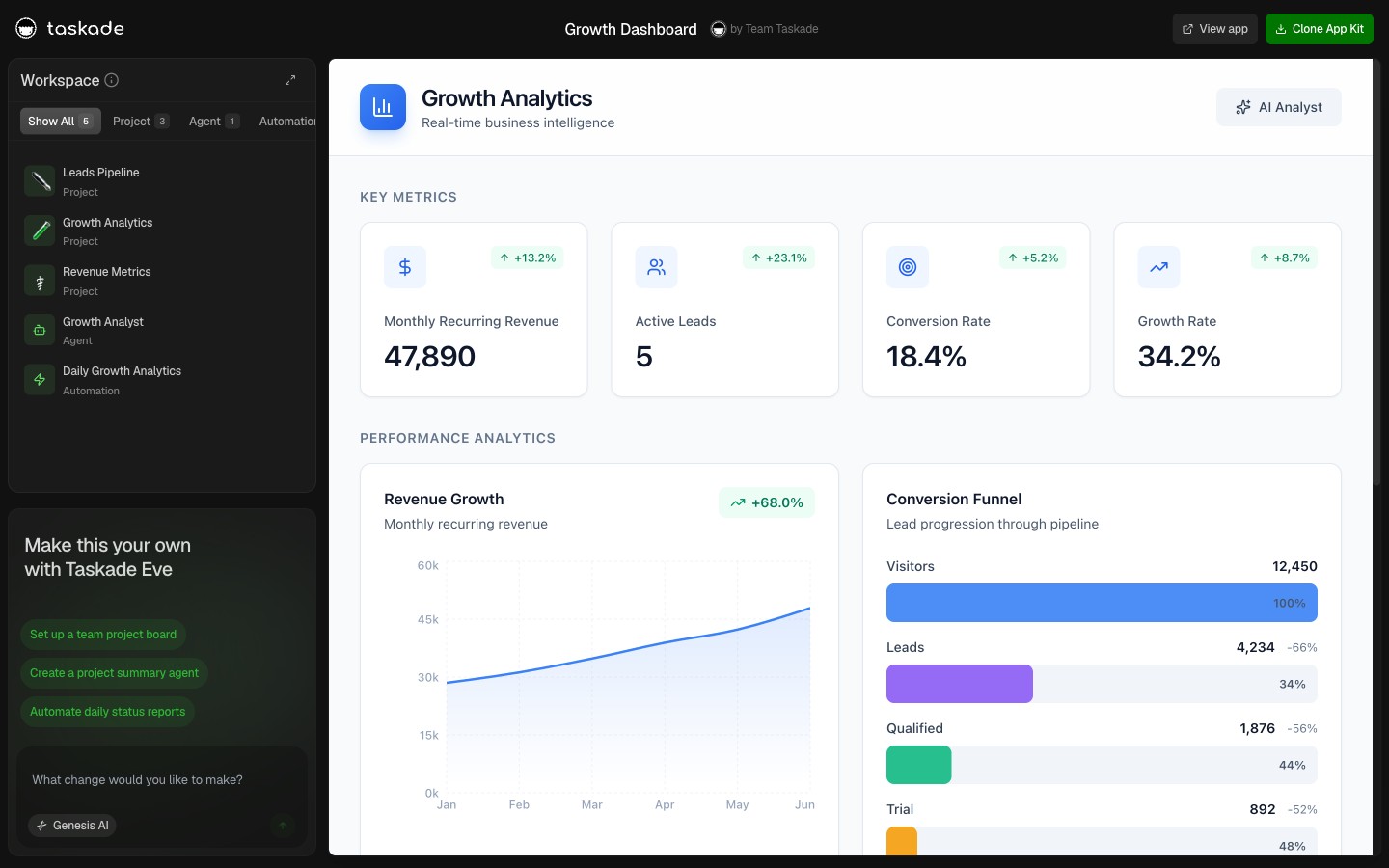
Concrete proof: the Growth Dashboard kit stores every revenue, traffic, and pipeline metric as a typed project node. Switch between List, Board, Calendar, Table, Mind Map, Gantt, and Org Chart views without writing a query. Add a new metric and it appears across all views instantly. This single primitive collapses backend engineer, database administrator, and operational PM into one workspace surface.
2. Multi-Agent Workspace
AI agents share workspace memory rather than living in siloed chat threads. A CFO agent answering finance questions sees the same projects a CMO agent sees when planning a campaign, and both see what the human team is doing in real time. Agents v2 ship with built-in tools, 100+ integrations, persistent memory, public embedding, and multi-agent collaboration out of the box.
Single-user chat tools like ChatGPT Teams and Claude Projects cannot match this. They have workspace-aware memory but no co-editing, no triggers, and no shared multi-agent state.
3. Agent Workflows
Automations flow both ways. Triggers pull events in from Shopify, Stripe, YouTube, GitHub, RSS, Telegram, and 95+ other tools. Actions push data back out, to Notion, Linear, Slack, HubSpot, Airtable. Durable execution means a workflow that runs across multiple days, retries on failure, and survives a deploy is a one-time setup, not a custom service you write. Workflows also flag at-risk tasks before the demo or deadline, so the agent layer and the execution layer keep each other honest.
This single primitive replaces the Zapier middle layer entirely, and it does it bidirectionally, which Zapier and Make do not.
4. App Payments + Sign-In
Stripe checkout opens right where your customer is. Adding sign-in for your users is a GenesisAuth toggle, not a backend project. These two primitives replace the engineering work of building a SaaS billing flow from scratch.
5. Clone & Customize in 60 Seconds
Clone any app in 60 seconds. Customize the data model, agent prompts, and automation triggers for your business. Builds in 7 minutes if you start from a Genesis prompt rather than a clone. The HR Dashboard kit is one click away from being your headcount, reviews, and leave system. Workspace DNA carries between cloned kits, so the memory, intelligence, and execution layers all transfer together.
The 2×2 Reality Check
Every alternative on the market sits in one of three quadrants. Only one sits in the fourth.
                  SINGLE-USER ─────────► MULTI-AGENT
                 ┌────────────────────┬──────────────────────┐
       STATIC    │   Notion doc       │   Lovable app        │
       (deploy   │   Airtable base    │   Bolt.new site      │
        ends it) │                    │                      │
                 ├────────────────────┼──────────────────────┤
       LIVING    │   ChatGPT Teams    │  ★ Taskade Genesis   │
       (deploy   │   Claude Projects  │   (Workspace DNA)    │
        starts   │                    │                      │
        it)      │                    │                      │
                 └────────────────────┴──────────────────────┘
Static output means the system ends when you deploy it. The doc is the artifact. The site is the artifact. There's no living state behind it.
Single-user means there's one human and at most one chat thread of AI. No co-editing, no shared multi-agent memory, no team collaboration inside the same context window.
Notion docs and Airtable bases are static and single-user. Lovable and Bolt.new ship static apps that happen to be generated by AI. ChatGPT Teams and Claude Projects are living-but-single-user, your chat remembers context, but it's just you. Only Taskade Genesis sits in the multi-agent, living quadrant, where deploy starts the lifecycle and where agents and humans share the same workspace memory in real time.
This is the structural wedge. Every other tool either ships static code or single-user AI chat. Workspace DNA is what living + multi-agent looks like in 2026.
Four Kits You Can Clone Today
All four kits below are public, verified live, and zero-touch cloneable. Each demonstrates a different layer of the stack, and each replaces a different traditional hire.
| # | Kit | Layer Demonstrated | Replaces |
|---|---|---|---|
| 1 | Growth Dashboard | Memory | Backend + DBA |
| 2 | HR Dashboard | Memory + Intelligence | People operations hire |
| 3 | Team Capacity Planner | Intelligence | Project manager |
| 4 | Fleet Management | Memory + Execution | Vertical operations team |

Growth Dashboard is the canonical memory-layer demo. Every metric, MRR, traffic, pipeline, cohort retention, is a typed project node with custom fields. Switch views without writing a query. Add a new metric and it propagates across List, Board, Table, and Mind Map views automatically. Wire an agent to summarize the dashboard weekly and the system runs itself.
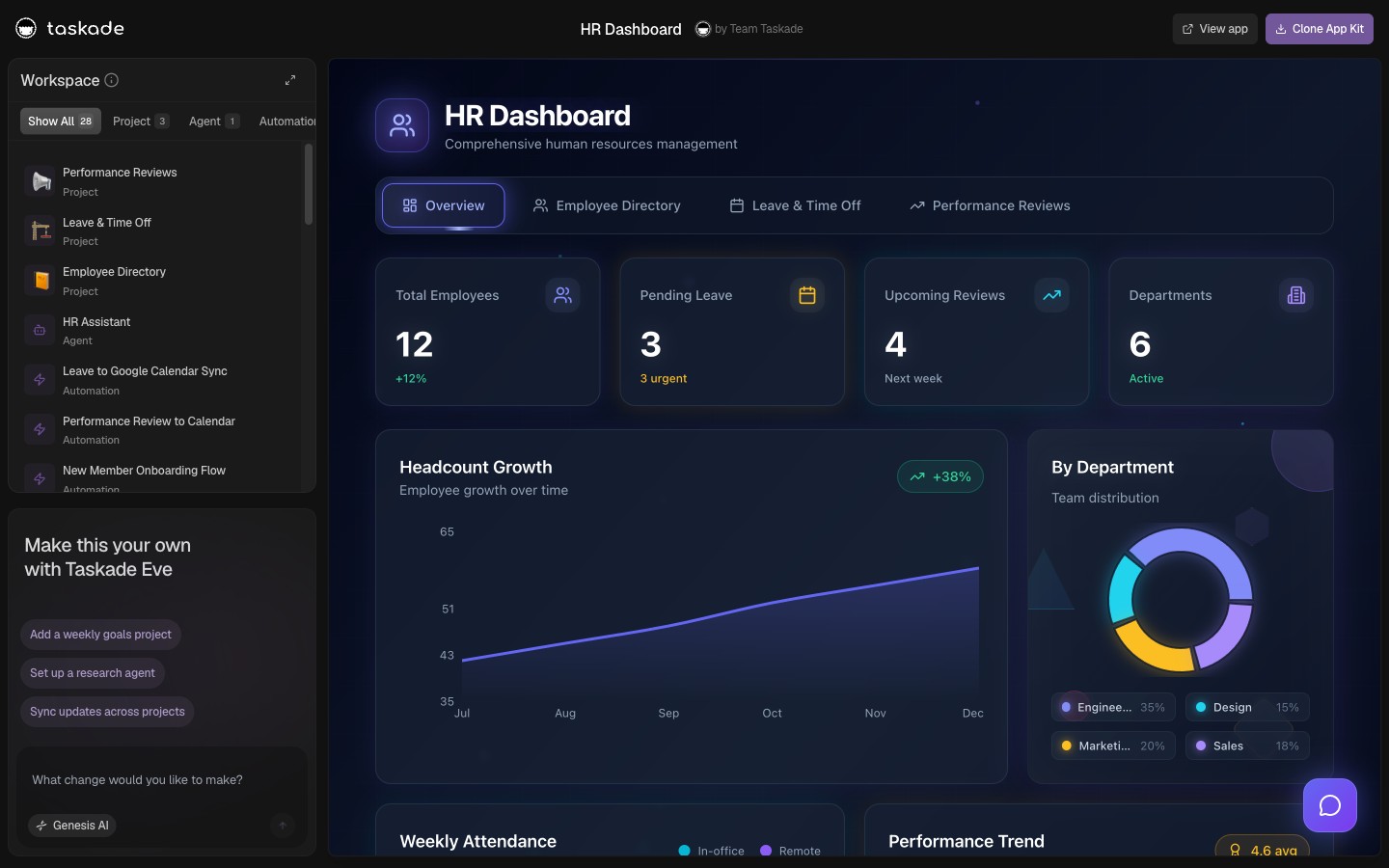
HR Dashboard collapses headcount tracking, performance reviews, leave management, and onboarding checklists into one workspace. Each employee is a project node. Each review cycle is a custom view. Agents handle the repetitive parts, drafting review summaries, flagging missed onboarding steps, alerting on accrued leave. This single kit replaces the people operations hire most early-stage companies make at headcount 25.
Team Capacity Planner answers who's doing what, when at one glance. Each team member is a project node, each project assignment is a relation, and the workspace renders the entire org's capacity as a single Gantt view. The agent layer flags overcommitment before it becomes burnout. This replaces the PM whose job was chasing status updates across Slack and Linear.
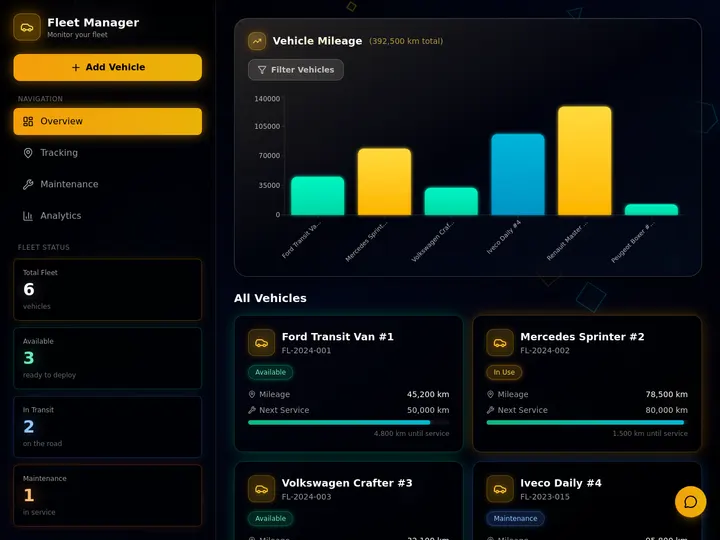
Fleet Management is the vertical-ops proof. Assets, maintenance schedules, route planning, all in one workspace, all driven by automations that pull telemetry in and push dispatch out. This shape, assets + maintenance + routes + dispatch, generalizes to dozens of operational verticals: equipment rental, field service, property management, event production, courier operations. The kit is one example. The shape is the wedge.
The Role-Replacement Table
| Traditional hire | Workspace primitive that replaces it | Concrete kit |
|---|---|---|
| Project Manager | Multi-agent workspace with shared memory | Team Capacity Planner |
| Designer (UI templates) | Genesis kit clone in 60 seconds | Growth Dashboard |
| Frontend Engineer | Genesis app builder (React app from a prompt) | HR Dashboard |
| Backend Engineer | Projects + custom fields (typed data tree) | Growth Dashboard |
| Database Administrator | Workspace Memory (persistent across conversations) | Growth Dashboard |
| DevOps Engineer | Hosted by Taskade + GenesisAuth + durable workflows | Fleet Management |
| QA Reviewer | Sales/Support agents with task-flagging fields | HR Dashboard |
The honest read of this table: each replacement is real for the operational glue layer and approximate for senior specialist work. A Genesis kit will not replace a staff database engineer designing a sharded multi-region OLTP cluster. It will replace the backend engineer wiring a CRUD CRM for a 50-person operations team. The 80/20 of operational software is the 80% the workspace absorbs.
The category-shape claim, what a Fortune 500 team builds in 18 months, one operator now ships in a few weeks, applies to that 80%. The remaining 20% is where you still hire.
When You'd Still Hire
The honest section. There are five situations where a workspace stack is the wrong answer and a real team is the right one.
Regulated multi-region infrastructure. If you need FedRAMP, HITRUST, or PCI Level 1 certification with custom encryption-at-rest and audited multi-region failover, you need a security engineer and a compliance lead. The workspace meets normal SOC 2 and GDPR perimeters; it doesn't replace a regulated infrastructure team.
Bespoke physics. Real-time multiplayer game state, sub-100ms latency-sensitive trading, custom protocols, or hardware integrations that need C-level performance still need specialists. Genesis is fast, but it's not a substitute for a Rust systems engineer when you need one.
Brand-level design vision. Workspace kits ship clean, functional UIs. They don't ship Cuberto-level brand identity, original illustration, or motion design that defines a category. If your product is the design, hire a designer.
Enterprise sales motion. Building a 12-month enterprise sales cycle with security questionnaires, custom contracts, and CISO relationships needs a human sales team. The workspace handles the operational layer; closing six-figure deals still needs people.
Strategy and judgment calls. Deciding which market to enter, which pricing model to adopt, which bet to make next quarter. These are human decisions. Agents synthesize, surface, and execute. Humans choose.
For everything else, the operational layer that consumed the seven roles above, the workspace replaces the team.
The May 2026 Tooling Stack Benchmark
The full tooling stack of an AI-native solo operator in May 2026 is twelve tools, total monthly cost under $250, with Taskade Genesis carrying the structural load. Every tool below is benchmarked on three axes: cost, role in the stack, and agent-readiness, whether AI agents inside Taskade Genesis can read or write to it via the 100+ bidirectional integration layer.
| Tool | Monthly cost | Role in stack | Agent-readiness | Cross-link |
|---|---|---|---|---|
| Taskade Genesis Pro | $10 | Memory + Intelligence + Execution (workspace) | Native — agents live here | Pricing |
| Notion | $10/user | Legacy doc archive (export-once) | Read-only via integration | Notion alternative |
| Linear | $10/user | Engineering issue tracker (if you ship code) | Bidirectional via integration | ClickUp alternative |
| Stripe | 2.9% + $0.30 | Payments, subscriptions, customer portal | Bidirectional — webhook triggers + actions | — |
| Slack | $0–$8/user | Client + contractor channels | Bidirectional — message triggers + actions | — |
| Loom | $0–$12 | Async video for client check-ins | Read-only via integration | — |
| Cal.com | $0–$15 | Booking + scheduling | Bidirectional — event triggers + actions | — |
| ChatGPT Teams | $25/user | External chat for ad-hoc reasoning | Standalone — not in workspace | ChatGPT alternative |
| Cursor | $20 | Code editor (only if you ship code) | Read-only — copies code into workspace | Cursor alternative |
| Vercel | $0–$20 | Hosting (only if you ship a custom app) | n/a — Taskade Genesis bundles hosting | — |
| Resend | $0–$20 | Transactional email | Bidirectional — send actions, webhook triggers | — |
| Plausible | $9 | Privacy-friendly analytics | Read-only via integration | — |
Total monthly cost (typical solo operator): $123–$248 depending on whether you ship code (Cursor + Vercel) and how many seats you carry. The solo operator stack is not cheaper at the tool layer. It's cheaper at the system layer, because Taskade Genesis absorbs the engineering work the other tools would have required.
Agent-readiness scoring.
- Native, agent lives inside the tool. Only Taskade Genesis qualifies.
- Bidirectional, agent can trigger on events from the tool and push actions back. Stripe, Slack, Cal.com, Resend.
- Read-only, agent can pull data but can't act. Notion, Loom, Cursor, Plausible.
- Standalone, agent operates outside the workspace context. ChatGPT Teams is the canonical example, useful, but it doesn't share workspace memory.
The benchmark explains why the solo operator stack converges on Taskade Genesis at the center, with everything else orbiting as either a bidirectional integration or a standalone tool used occasionally. The center of gravity is the workspace; the rest is satellites.
The May 2026 Solo Operator Snapshot: Why Now
The "one-person company" headline is no longer a thought experiment. The market data in May 2026 is now load-bearing for the whole thesis.
| Signal | Source | What It Proves |
|---|---|---|
| Medvi reaches $401M revenue in Year 1 with 50 employees | PYMNTS report, 2024 | A telehealth company hit nine-figure ARR with a team that fits in one large open-floor office. The number used to require 800-1500 employees |
| Zoom Solopreneur 50 list (May 4, 2026) | Zoom blog | The first official cohort recognizing one-person businesses as a category. Each operator on the list runs ARR equivalent to a Series A startup |
| Sam Altman's "one-person billion-dollar company" prediction | Multiple 2024-2025 interviews | A line every venture investor now repeats; the predicted shape of the next decade |
| Custom AI agents built on Taskade since launch | Internal tracking, May 2026 | 150,000+ apps and 21K+ Custom Agents (Notion's parallel figure from Feb 2026) — both numbers compound monthly |
| Cursor passes $2B ARR with 1M+ paying subscribers | Anysphere disclosure, Feb 2026 | The single biggest data point that solo engineers now ship like teams used to |
| Lovable hits $200M ARR within 12 months of $100M ARR | TechCrunch March 2026 | The fastest-growing European startup on record — almost entirely solo + small-team buyers |
| Linear Agent + Code Intelligence (May 14, 2026) | Linear changelog | A single operator can now run a full software engineering org with one agent that has controlled codebase access |
| Notion 3.4 cuts agent costs 35-50% | Notion releases | The unit economics of solo agent ops dropped through the floor in Q2 2026 |
The conventional SMB hiring index has gone slightly negative since 2023, small businesses are not hiring more, they are hiring less. The AI-native solo operator index has gone 11.8x in the same window. The two lines diverged in mid-2024 and have not converged since.
What every signal above shares: the substrate changed. A solo operator in 2026 has access to capability that required a 50-person team in 2018 and a 500-person org in 2012. Taskade Genesis is one of the substrates that did the changing, Memory + Intelligence + Execution wired into a single workspace where the apps, agents, and automations are not bolted on, they ARE the platform.
Read Next: The May 2026 Wave
The solo-operator stack ships alongside three sister posts that close the loop on Taskade Genesis capabilities.
- 24 New App Kits, Agents, and Workflows →, browse the full kit catalog the solo-operator playbook draws from.
- Taskade Genesis vs Claude Live Artifacts →, why a file format can't replace a team but a workspace can.
- AI Agent Teams Collaboration →, solo operators run multi-agent teams; here's how the four collaboration modes work.
Clone the Stack
You don't need a team to start. You need a workspace.
- Growth Dashboard →, the memory layer
- HR Dashboard →, the people-ops replacement
- Team Capacity Planner →, the project-manager replacement
- Fleet Management →, the vertical-ops template
Each app comes with workflows, agents, and data inside. Clone one, remix it, and start replacing the next role. Over 150,000 apps and systems are already running on Taskade Genesis. Start your workspace →
▲ ■ ● Memory · Intelligence · Execution, wired by default, shared by every agent and every human in your workspace. That's Workspace DNA. That's the solo operator stack.
Related reading: Workspace-Native AI Agents · Productize Your Context Engineering · Replace Your Team with Genesis · Workspace vs App Builder · Micro-Apps Explained
Frequently Asked Questions
What is a solo operator stack?
A solo operator stack is the minimum set of primitives one person needs to run an entire business surface, customer records, dispatch, scheduling, invoicing, support, and reporting, without hiring engineers, designers, or operations staff. In 2026 the most compact stack is a single workspace that ships persistent memory, multi-agent intelligence, and bidirectional automations by default. Taskade Genesis is the canonical implementation.
Can one workspace really replace seven roles?
It replaces the operational glue layer that consumed seven roles in a traditional team, project manager, designer, frontend engineer, backend engineer, database administrator, DevOps engineer, and quality reviewer. Each of those roles maps to a workspace primitive that ships pre-wired. Compliance, legal, multi-region scale, and human relationships still need humans, but the day-to-day plumbing collapses into one workspace.
What are the five primitives that collapse the stack?
Workspace Memory (projects act as the data layer), Multi-Agent Intelligence (AI teammates share that memory), Agent Workflows (durable automations push and pull data through 100+ tools), App Payments and Sign-In (Stripe checkout plus GenesisAuth gating ship inside the workspace), and Clone and Customize in 60 seconds (any live app becomes your starting point). Together these five replace databases, dashboards, automation middleware, hosting, auth, and templates.
How does Workspace DNA differ from a no-code app builder?
A no-code app builder ships code or a static screen that ends when you deploy it. A workspace builder ships a living system where deploy is the start of the lifecycle. Workspace DNA, Memory plus Intelligence plus Execution, means projects store the data, agents act on it, and automations fire on every event. Tools like Bubble, Lovable, and Bolt produce static output. Taskade Genesis produces a living workspace.
What can I clone today to see this in action?
Four kits in the Taskade Community Gallery prove the pattern. Growth Dashboard demonstrates the memory layer. HR Dashboard replaces the people operations hire. Team Capacity Planner replaces the project manager. Fleet Management shows a vertical operations surface. Each clones into your free workspace in one click and arrives with workflows, agents, and data inside.
Do I still need to hire engineers?
Only when you need bespoke physics, custom protocols, regulated multi-region infrastructure, or features that sit outside the workspace abstraction. For 80 percent of day-one operational surfaces, CRM, dispatch, invoicing, scheduling, internal tools, dashboards, a workspace replaces the engineering team. As the business scales, you hire specialists for the 20 percent the workspace cannot absorb, not the glue layer.
How does the workspace handle real customer data?
Projects in Taskade Genesis act as a typed data layer with custom fields, custom views, and live cross-project queries. There is no database to provision, no schema migration, no ORM. Sign-in is handled by GenesisAuth at the app level, payments by Stripe checkout inside the app, and integrations push and pull data through 100+ bidirectional connectors with durable execution.
What is the difference between this stack and ChatGPT Teams or Claude Projects?
ChatGPT Teams and Claude Projects are chat-only. They are single-user surfaces with workspace-aware memory but no co-editing, no triggers, no automations, and no public apps. Taskade Genesis is multi-agent and multi-human in the same workspace, with agents that share memory with the team, trigger automations, and publish as live apps with sign-in and payments. The difference is single-user chat versus a living multi-agent workspace.
How long does it take to replace a role with a kit?
Cloning a kit takes around 60 seconds. Customizing the data model, agent prompts, and automation triggers for a specific business takes from a few hours to a few days. The category-shape claim, what a Fortune 500 team builds in 18 months, one operator now ships in a few weeks, assumes you clone existing kits as starting points rather than building from a blank workspace.
Is this approach safe for production use?
Genesis Apps run on Taskade infrastructure with three production replicas, GenesisAuth for sign-in and role-based access, Stripe for payments, and durable workflows. Over 150,000 apps and systems are running on Taskade Genesis as of 2026. For regulated industries, healthcare PHI, financial PCI, government FedRAMP, you still need to verify the workspace meets your compliance perimeter, but for general business operations the platform is production-ready.