






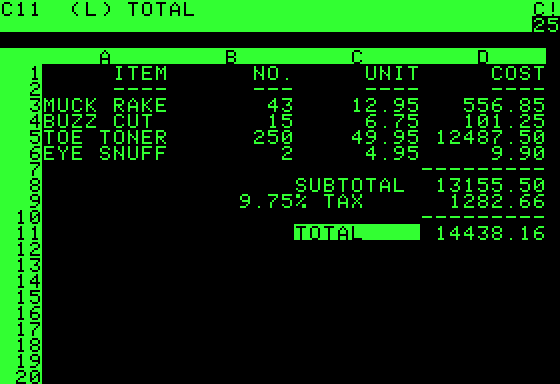
In the fall of 1978, a Harvard Business School student named Dan Bricklin watched a professor fill a blackboard with a financial model. Revenue. Tax rates. Net margins. Projections across five years. It was elegant, until the professor found an error in one of the assumptions.
He erased the number. Then he erased every dependent calculation. Then he recalculated each one by hand, chalk squeaking across the board, the entire model rebuilt from scratch to fix a single input.
Bricklin watched and asked a question that would restructure the economy: what if a computer could do that automatically?
The answer was VisiCalc. VisiCalc was the first killer app, a piece of software so necessary that people bought the hardware to run it. Businesses purchased $2,000 Apple IIs specifically to run a $100 program. The computer was the accessory.
Forty-seven years later, we are watching the same scene again. A new platform has arrived. A new gateway application has made it accessible to the masses. And somewhere in the next five years, the real killer app, the one that will define how a generation works, is being built by someone who doesn't know yet that they're building it.
This is the killer app theory: four laws that explain every platform rupture from 1979 to today, why ChatGPT is Netscape and not the destination, and what the AI-era killer app actually looks like.
TL;DR: Every platform rupture, PC, internet, mobile, AI, follows the same four laws. A killer app democratizes a specialist capability, drives platform adoption, gets displaced by the next wave, and the durable value migrates UP the stack to the apps built on top. ChatGPT validated the AI platform the way Netscape validated the internet. We are in 1997. The apps that define this era are still being built. Try Taskade Genesis →
🗺️ Four Eras, One Pattern
🔑 What Is a Killer App?
The term was coined before most people knew what it described. On May 24, 1988, tech columnist Jim Seymour published an article in PC Week titled "Killer Apps theory doesn't sway big business." He used the phrase to describe VisiCalc and Lotus 1-2-3, software so essential that it single-handedly justified owning the hardware.
The formal definition: a killer app is a piece of software so valuable that its existence drives adoption of the platform it runs on. People don't buy the platform for its features. They buy the platform for the killer app, and everything else comes along for the ride.
Three conditions define a true killer app:
It democratizes a capability locked behind specialists. Before VisiCalc, financial modeling required trained accountants. Before Netscape, accessing the internet required a Unix terminal. Before the App Store, mobile software required knowing how to code. The killer app eliminates the specialist as the gatekeeper.
It drives hardware or platform sales beyond the platform company's own expectations. Apple did not predict that VisiCalc would sell Apple IIs to accountants. AT&T did not predict that mobile apps would sell smartphones. Platform companies are always surprised by the killer app.
Its durable value migrates upstream. The killer app validates the platform; the platform becomes commodity infrastructure; the value accretes to the applications built on top. Netscape was worth $10 billion. Google, which Netscape enabled, became worth $2 trillion.
Understanding these three conditions reveals why every generation of technologists underestimates the current transition while overestimating which specific tool will define it.
🍎 Act I: VisiCalc and the Apple II Rupture (1979)
VisiCalc was not supposed to exist. In the late 1970s, computers were for hobbyists and engineers. Business software meant mainframes. The idea that a small business could buy a personal computer and use it for financial analysis was, to most industry observers, absurd.
Dan Bricklin was a Harvard Business School student who had previously been a programmer at DEC and at a firm called Software Arts. His co-founder Bob Frankston was a MIT-trained programmer who would write most of VisiCalc's production code. Together, working out of Frankston's attic in Arlington, Massachusetts through the winter of 1978–1979, they built something the industry had not asked for.
Bricklin's original insight was specific and technical: he wanted a program that behaved like the blackboard he'd watched his professor use, but with one crucial difference. Change one number, and every dependent number would update automatically. This wasn't just a convenience feature. It was a philosophical shift in how computation could be organized, away from static output and toward reactive, living models.
The Dependency Graph: The Actual Innovation
The spreadsheet grid, the rows and columns, was not VisiCalc's breakthrough. Tabular data had existed in accounting for centuries. The breakthrough was the dependency graph: a hidden data structure tracking which cells referenced which other cells, so that when any cell changed, the propagation cascaded automatically through the entire model.
VisiCalc Dependency Cascade
━━━━━━━━━━━━━━━━━━━━━━━━━━━━━━━━━━━━━━━━━━━━━━BEFORE VisiCalc (manual recalculation)
┌────────────────────────────────────────────────┐
│ Revenue:    $1,240,000                         │
│ Tax (15%):  $186,000   ← recalculated by hand  │
│ Net:        $1,054,000 ← recalculated by hand  │
│ Annual:    $12,648,000 ← recalculated by hand  │
│  Change Revenue → erase all → redo every line  │
└────────────────────────────────────────────────┘
AFTER VisiCalc (reactive dependency graph)
┌────────────────────────────────────────────────┐
│ A1  Revenue:   $1,240,000  ← change this once  │
│       ↓                                        │
│ B1  Tax:       =A10.15   → auto: $186,000     │
│       ↓                                        │
│ C1  Net:       =A1-B1     → auto: $1,054,000   │
│       ↓                                        │
│ D1  Annual:    =C112     → auto: $12,648,000  │
│       ↓                                        │
│ E1  5yr proj:  =D1*5      → auto: $63,240,000  │
└────────────────────────────────────────────────┘
Change A1 once → entire model recalculates in <50ms
━━━━━━━━━━━━━━━━━━━━━━━━━━━━━━━━━━━━━━━━━━━━━━
The dependency graph is why Byte magazine wrote in 1980: "VisiCalc is the first program available on a microcomputer that has been responsible for sales of entire systems." Business owners who saw a VisiCalc demonstration went home and ordered an Apple II, not because they wanted a computer, but because they wanted VisiCalc.
For a full chronicle of VisiCalc's technical arc, from the Apple II through the history of spreadsheets to today's AI-native databases, see our complete timeline. The spreadsheet-of-thought post explores how the primitive evolved from calculating cells to reasoning cells.
The "Accessory" Paradox
The Apple II launched in 1977 at $1,298 for the base unit, closer to $6,500 in 2026 dollars. Before VisiCalc, it was primarily purchased by hobbyists and early adopters. After VisiCalc, Apple II unit sales accelerated sharply: roughly 35,000 units in 1979 and closer to 78,000 by 1980.
John Markoff, covering the industry at the time, noted the paradox: businessmen were ordering the Apple II as a VisiCalc accessory. They saw the software first and added the hardware to the order. This inversion, software driving hardware, was so new that no one had a name for it. Jim Seymour wouldn't coin "killer app" for another nine years.
| Year | Key Event | Apple II Context |
|---|---|---|
| 1977 | Apple II launches | Hobbyist/enthusiast market |
| 1978 | Bricklin conceives VisiCalc at Harvard | Building in Frankston's attic |
| Oct 17, 1979 | VisiCalc launches at under $100 | Computer sold as "VisiCalc accessory" |
| 1980 | Byte: "first program responsible for system sales" | ~78K Apple II units/yr |
| 1981 | IBM PC launches | New platform threatens Apple II |
| Jan 26, 1983 | Lotus 1-2-3 ships for IBM PC | VisiCalc sales collapse |
| 1984 | Software Arts in terminal decline | Lotus captured the market |
| 1985 | Lotus acquires Software Arts; VisiCalc discontinued | Original killer app dead |
How Lotus 1-2-3 Killed VisiCalc
Mitch Kapor had worked at VisiCorp (the VisiCalc distributor) before leaving to found Lotus Development Corporation in 1982. He had watched VisiCalc closely enough to understand its limitations, and the opportunity created by the IBM PC's arrival in 1981.
IBM PC hardware was substantially faster and better-suited for larger spreadsheets than the Apple II. Kapor hired Jonathan Sachs, an MIT systems programmer, to build Lotus 1-2-3 from scratch in optimized assembly language for the IBM PC. The name captured the product's three integrated functions: spreadsheet, basic charting, and a simple database. VisiCalc had none of these additions.
Lotus 1-2-3 shipped January 26, 1983. Within twelve months, it had generated $53 million in revenue. VisiCalc's sales practically evaporated. Software Arts filed for bankruptcy in 1985. Lotus acquired it and immediately discontinued VisiCalc.
The lesson from Act I: the killer app wins by running on the dominant hardware platform of its era, not by being the best software. When the platform shifts, the incumbent app dies and a new killer app built for the new platform takes its place. This pattern would repeat, precisely, in every subsequent era.
The history of Lotus Notes and the history of HyperCard capture two adjacent stories from this same era, Ray Ozzie's workspace vision and Bill Atkinson's no-code builder, both of which trace the same arc from platform-dependent genius to platform-dependent obsolescence.
🌐 Act II: Netscape and the Internet Rupture (1994)
By 1993, the internet existed. But it was inaccessible to anyone without a Unix terminal and technical knowledge. Tim Berners-Lee's World Wide Web protocol had been published in 1991, but using it required command-line tools that felt foreign to anyone outside academia and research labs.
Marc Andreessen was a 22-year-old computer science student at the University of Illinois when he co-created NCSA Mosaic, the first graphical browser, in early 1993. Mosaic showed that the web could look like a magazine rather than a terminal. By the end of 1993, Mosaic had been downloaded 2 million times.
James H. Clark, the founder of Silicon Graphics, tracked Andreessen down and offered $4 million to co-found a new company. They incorporated Mosaic Communications Corporation on April 4, 1994, and renamed it Netscape Communications Corporation on November 14, 1994.
Netscape Navigator and the 90% Moment
Mosaic Netscape 0.9 launched on October 13, 1994. Netscape Navigator 1.0 shipped December 15, 1994. The pace of adoption was unlike anything the industry had witnessed. Within four months, Navigator held 75% of the browser market. By mid-1995, Netscape had approximately 90% market share.
The company collected $365,000 in licensing revenue within two weeks of its initial release. This for software the company was technically giving away free to individuals and educational institutions.
The Netscape IPO on August 9, 1995 is now a landmark event in technology history. The stock was priced at $28. It opened at $75 and closed at $58 on the first day, giving the five-year-old company, which had never turned a profit, a market valuation of approximately $2.9 billion. Time magazine put Andreessen on its cover barefoot.
What Netscape did for the internet was precisely what VisiCalc had done for the Apple II: it made an otherwise inaccessible platform usable by non-specialists. You no longer needed to know Unix to access the web. You clicked. You browsed. The browser was the killer app.
| Metric | Value | Context |
|---|---|---|
| Founded | April 4, 1994 | By Andreessen + Clark, $4M seed |
| Netscape 0.9 launch | October 13, 1994 | First public browser release |
| Navigator 1.0 | December 15, 1994 | Full commercial release |
| Market share, 4 months | 75% | Fastest browser adoption in history |
| Peak market share | ~90% | Mid-1995 |
| IPO date | August 9, 1995 | $28 priced → $75 open → $58 close |
| AOL acquisition | March 17, 1999 | ~$10 billion |
| Browser discontinued | March 1, 2008 | 14 years after founding |
The Value Migration: Why Netscape Lost
Netscape never became the trillion-dollar company the IPO suggested it could be. Microsoft shipped Internet Explorer 3.0 in 1996 and bundled it free with Windows 95. By 1999, IE held more than 75% of the browser market. Netscape was acquired by AOL. The browser division was eventually disbanded.
The economic value of the internet era did not concentrate in Netscape. It concentrated in the companies that solved problems the browser had revealed:
- Google (founded 1998): Search. The internet was now accessible to everyone, but no one could find anything. Google became the index.
- Amazon (founded 1994, but internet-dominant by 1997–2000): The internet enabled shopping without a physical store. Amazon became the store.
- eBay (founded 1995): The internet enabled peer-to-peer commerce. eBay became the marketplace.
- PayPal (founded 1998): Internet commerce required internet payments. PayPal became the rails.
Marc Andreessen, who watched this value migration happen in real time as Netscape's CEO, drew the lesson clearly. He went on to co-found Andreessen Horowitz (a16z) in 2009 and wrote "Software Is Eating the World" for the Wall Street Journal in 2011, the essay that codified the idea that every industry would be restructured by the applications built on internet infrastructure. His former a16z colleague Benedict Evans has spent the years since applying the same framework to AI.
📱 Act III: The App Store and the Mobile Rupture (2008)
The iPhone launched in January 2007 as a phone with no third-party applications. Steve Jobs's original position was that web apps running in the browser would be sufficient for developers. The developer community disagreed loudly.
Apple launched the App Store on July 10, 2008, with 500 apps and $0.99–$9.99 pricing. Within 60 days, users had downloaded 100 million apps. By the end of year one, 1.5 billion downloads. The phrase "there's an app for that" became Apple's advertising tagline in early 2009, and simultaneously the decade's most accurate description of a shift in how software was made and distributed.
The App Store was not itself the killer app of the mobile era. It was the platform mechanism that enabled an explosion of killer apps. The companies that captured the durable value of mobile were not Apple (which captured the platform economics) but the applications built during the 2008–2014 window:
- Instagram (launched October 2010): The smartphone had a camera. Instagram made those photos shareable with one tap. Acquired by Facebook for $1 billion in April 2012, at the time, the largest acquisition of a company with no revenue in history.
- Uber (launched 2009): The smartphone knew your location. Uber made transportation on-demand. IPO in 2019 at $82 billion.
- WhatsApp (launched 2009): The smartphone was always in your pocket. WhatsApp made messaging free globally. Acquired by Facebook for $19 billion in February 2014.
Each of these companies was worth zero before the App Store existed. Each required the App Store's distribution mechanism to reach scale. None of their value concentrated in Apple.
The pattern is now unmistakable:
🤖 Act IV: ChatGPT Is Netscape, Not the Killer App
On November 30, 2022, OpenAI launched ChatGPT. It reached one million users in five days. One hundred million users in sixty days. It is the fastest consumer adoption of any application in recorded history, and that record is not even close.
By early 2026, ChatGPT serves approximately 900 million weekly active users, a number Marc Andreessen once pointed out is only possible because 900 million people were already on the internet. ChatGPT did not need to wait for broadband deployment or hardware distribution. It ran on the infrastructure its predecessors had built.
Benedict Evans, who spent years as the in-house analyst at Andreessen Horowitz before becoming an independent analyst tracking technology platform shifts, has articulated the parallel with precision. His framing: "My most controversial opinion is that I think AI is as big a deal as the internet or mobile, and only as big a deal as the internet or mobile."
The "only" carries the weight. Evans is not being dismissive, the internet fundamentally restructured civilization. He is saying that the current moment maps onto prior platform transitions in a specific, pattern-consistent way: the infrastructure is real, the adoption is accelerating, and the applications that will define the era have not yet been built.
"We're in 1997," Evans has written. "It's very exciting. Most stuff kind of doesn't work yet. Most of the stuff that people are going to do hasn't been built yet and it's not really clear how any of it's going to work when it does work."
He extends the VisiCalc analogy directly to the present moment. Software developers, he argues, are the accountants seeing VisiCalc in 2024 and 2025. Claude Code is a before/after rupture for engineers. But for most industries, law, medicine, finance, logistics, operations, the AI equivalent of the word processor has not been invented yet.
This is not a pessimistic reading. It is a structural observation about where we are in the adoption curve, and it has direct implications for where the value will concentrate.
Why Foundation Models Are Telcos, Not Destinations
Evans draws the analogy explicitly: the global mobile industry generates approximately $1 trillion in revenue annually. It spends $200 billion per year on capital expenditure, building objectively remarkable global infrastructure. Mobile data consumption is 1,500 to 2,000 times what it was in 2010. And mobile telecom stocks have gone nowhere in 25 years.
The carriers built the pipes. The value concentrated in the apps.
The OpenAI history and the Anthropic history capture the stories of the two most prominent foundation model labs in detail. Both are building extraordinary infrastructure. By the structural logic of every prior platform transition, the durable value will migrate to the applications built on that infrastructure.
ChatGPT is Netscape: the gateway that made AI accessible to non-specialists, that drove adoption of the AI platform, and that validated the era. Anthropic's Claude, Google's Gemini, and Meta's Llama are building the infrastructure. The question, the question that every platform transition has answered the same way, is: what are the Instagram, Uber, and WhatsApp of the AI era?
If you want to understand where to look, you need to understand what problem they will solve.
For the full Claude ecosystem picture, see our comparison of the AI assistant landscape and what distinguishes workspace-native AI from chat-native AI.
🔑 The Four Laws, Applied to AI
Every killer app in history democratized a capability that was previously locked behind specialists. This is the first law, and it is the primary diagnostic.
| Era | Capability Democratized | Previously Required | Killer App |
|---|---|---|---|
| PC (1979) | Financial modeling | Trained accountant + ledger | VisiCalc |
| PC (1983) | Integrated data + charts | Database programmer | Lotus 1-2-3 |
| Web (1994) | Internet access | Unix terminal + technical knowledge | Netscape |
| Mobile (2008) | Mobile software distribution | App developer + carrier deal | App Store |
| AI (2022–???) | ??? (still being built) | Programmer + ML engineer | ??? |
The pattern points directly to what the AI-era killer app will do: it will allow non-programmers to build and deploy AI-powered workflows. Not by chatting with an AI assistant. Not by generating code. By describing what they need, in plain language, and having an intelligent system build, deploy, and run it.
This is the equivalent of VisiCalc's magic blackboard, except instead of "describe the financial model and the computer recalculates it," the proposition is: "describe the workflow you need, and the computer builds, staffs, and runs it."
The what are AI agents post provides the foundational context for why autonomous agents are the missing primitive in every prior productivity platform. The AI agent builders overview shows the current landscape of platforms trying to solve this problem. The free AI app builders roundup shows who's competing for the position.
⚡ The Dependency Graph Lives On: VisiCalc's Core Architecture in Taskade Genesis
Here is the precise parallel that connects 1979 to 2026, not metaphorically, but technically.
VisiCalc's breakthrough was the dependency graph: a reactive system where changing any input automatically propagates through every dependent calculation. The cascade is the product. Without the cascade, VisiCalc is just a grid with numbers. With the cascade, it becomes a living model that responds to the world.
Modern AI agents and automations implement the same architecture. The nodes have changed, from formula cells to reasoning agents. But the dependency structure is identical.
In Taskade Genesis, changing a database record triggers every AI agent and automation watching that record, the agent fires, produces output, potentially triggers another agent, executes an automation, and writes the result back to the workspace as memory for the next cycle. The cascade propagates through the entire system, just as a changed cell propagates through every dependent formula in a spreadsheet.
This is the Workspace DNA loop: Memory (the database record) feeds Intelligence (the agents), Intelligence triggers Execution (the automations), Execution creates Memory, and the loop begins again.
| Concept | VisiCalc (1979) | Taskade Genesis (2026) |
|---|---|---|
| Data node | Cell containing a value | Database record or project item |
| Reactive node | Formula referencing other cells | AI agent watching a record or table |
| Cascade trigger | Cell value changes | Record field updated or status changed |
| Dependent recalculation | All formulas in dependency chain | All agents + automations watching that data |
| Output destination | New cell values | Emails, Slack messages, invoices, new records |
| State persistence | Saved spreadsheet | Workspace memory for next agent cycle |
| Non-specialist access | Anyone who can type a number | Anyone who can describe what they need |
| Time to cascade | Under 50ms | Seconds to minutes, depending on agent |
The cascade pattern is 47 years old. The nodes are new. The democratization follows the same law: Dan Bricklin eliminated the need for a trained accountant to recalculate a financial model. Taskade Genesis eliminates the need for a software engineer to build and maintain an automated workflow.
For a deeper exploration of how the primitive evolved, from calculating cells to database cells to reasoning cells, the spreadsheet-of-thought post provides the philosophical arc. The history of spreadsheets covers the product lineage from VisiCalc through Airtable and Notion in full detail.
Where Notion AI and Airtable Fall Short
Two incumbent platforms have made serious bets on the agent-augmented structured workspace category.
Notion 3.0 (launched September 18, 2025) introduced AI Agents that can create documents, build databases, and run multi-step workflows autonomously. The agents work within Notion's existing document and page architecture, AI layered on top of a docs-first product. Custom Agents (scheduled, triggered, and team-shared) were described as "coming soon" at launch. Notion agents are powerful within the Notion paradigm but operate as an add-on to an architecture built around blocks and pages, not around agents and automations as first-class primitives.
Airtable Omni (launched June 24, 2025) relaunched the company as "AI-native," with conversational app building, Field Agents embedded in structured data, and the ability to generate production tables and interfaces from descriptions. Airtable's framing is compelling. But Omni is AI assistance layered on an existing relational database product. The architecture was designed for human users managing tables; AI is retrofitted on top.
Both platforms are doing what incumbents always do when a new primitive arrives: adding it as a feature to their existing architecture. The notion-vs-taskade-genesis post covers this distinction in detail. The compare/free-notion-alternative and compare/free-airtable-alternative pages give a structured side-by-side.
The distinction matters because the dependency graph is architectural, not cosmetic. You cannot retrofit reactive cascades onto a docs-first or database-first product the way Lotus 1-2-3 retrod VisiCalc's interface onto IBM PC hardware. You can only approximate the behavior. A platform built from the ground up around agents as primary actors, with the database as the shared memory layer and automations as the execution primitive, has a structural advantage that feature additions cannot replicate.
🌅 The 1997 Window: What Gets Built Between Now and 2030
In every prior platform transition, the companies that captured the durable value were founded during a specific window, the years immediately following the killer app that opened the era, before the platform matured enough for incumbents to respond effectively.
| Platform Era | Opening Killer App | Value Window | Companies Founded |
|---|---|---|---|
| PC | VisiCalc (1979) | 1979–1985 | Lotus (1982), Microsoft Word (1983), PageMaker (1985) |
| Internet | Netscape (1994) | 1994–2003 | Google (1998), Amazon (founded 1994, dominant 1997+), PayPal (1998), Salesforce (1999) |
| Mobile | App Store (2008) | 2008–2014 | Instagram (2010), Uber (2009), WhatsApp (2009), Snapchat (2011) |
| AI | ChatGPT (2022) | 2022–2028 | We are inside this window right now |
If the pattern holds, and it has held across five decades and three prior platform waves, the companies that define the AI era are being built right now. Some of them already exist and don't yet know they've won. Some haven't been founded yet.
Benedict Evans has noted that even looking back at the 1994–2000 SaaS era, the majority of companies that became significant could have been founded five to fifteen years earlier. The delay was not technological readiness, the technology existed. The delay was someone realizing: oh, we could solve that problem, for that industry, with this tool.
The vibe-coded-business post and the founder-operating-system both explore what it looks like to build in this window, the new primitives available to founders and operators who are willing to use them before the playbook is established.
The mother of all demos provides essential context for why computing transitions always feel sudden to outsiders but were being slowly assembled for years beforehand. Doug Engelbart demonstrated collaborative documents, hyperlinks, and video conferencing in 1968, nineteen years before the commercial internet. The ideas always precede the rupture.
🏆 What the AI-Era Killer App Looks Like
Apply the first law, the killer app democratizes a capability locked behind specialists, and the answer becomes legible.
The capability currently locked behind specialists is this: building, deploying, and operating software systems that execute complex workflows automatically.
Today, creating an automated system that watches a CRM for closed deals, drafts a follow-up email, creates an invoice, sends it via Stripe, and posts to Slack requires a software engineer. It requires understanding APIs, authentication, error handling, data schemas, and deployment infrastructure. It takes days to build and weeks to maintain.
The AI-era killer app eliminates that specialist requirement. A non-programmer describes what they need, in language, and the system builds, deploys, and runs it. The workflow operates autonomously, recalculating in response to changes in the underlying data, exactly as VisiCalc's spreadsheet recalculated in response to changes in cells.
This is not hypothetical. It is being built.
Taskade Genesis generates production-ready AI-powered applications from a prompt: structured databases with the memory of your work, AI agents that operate on that memory, and automation workflows that execute on triggers, all deployed and accessible to collaborators and clients without writing code. Free to start, with Pro at $10 per month for custom domains, scaling to Business at $25 per month for advanced features. The community gallery shows what people have built: client portals, research pipelines, sales workflows, project management systems, onboarding flows.
The technology is not complete. The category is not won. We are in 1997. But the dependency graph is already running.
🔮 Frequently Asked Questions
What is a killer app in computing?
A killer app is software so valuable that people buy the underlying hardware or platform specifically to run it. Dan Bricklin's VisiCalc (1979) is the canonical first example, businesses purchased $2,000 Apple IIs to run a $100 spreadsheet program. Lotus 1-2-3 (1983), Netscape Navigator (1994), and ChatGPT (2022) are subsequent examples. Each drove platform adoption by eliminating a specialist gatekeeping function and making a previously restricted capability available to non-specialists.
How did VisiCalc change personal computing?
VisiCalc transformed the Apple II from a hobbyist machine into a business computer, driving a roughly doubling of annual unit sales within a year of its October 1979 launch. By 1980, Byte magazine reported that VisiCalc was "the first program available on a microcomputer that has been responsible for sales of entire systems." Businessmen ordered Apple IIs to run VisiCalc, not the other way around. This established the killer app model that defined every subsequent platform transition in computing history.
Why did Netscape fail even though it dominated the browser market?
Netscape dominated but did not capture. The company hit approximately 90% browser market share in 1995 but was acquired by AOL for $10 billion in 1999 and had its browser division disbanded by 2003. The economic value of the internet era concentrated not in the browser but in the applications the browser enabled, Google, Amazon, eBay, PayPal. This is the fourth law of killer apps: the durable value migrates upstream to the applications built on the platform the killer app validated. Being the gateway does not guarantee capturing the destination.
Is AI bigger than the internet?
Tech analyst Benedict Evans, former partner at Andreessen Horowitz, argues that AI is "as big a deal as the internet or mobile, and only as big a deal as the internet or mobile." The "only" is a calibration against those who frame AI as civilization-scale disruption beyond any prior transition. The internet restructured every major industry over twenty years. AI is likely to do the same over a similar horizon. The current moment maps to 1997: the platform is real, adoption is accelerating, and the applications that will define the era have not yet been built. See the full Anthropic and Claude context for how the leading AI lab frames the current moment.
What companies were built during the internet's "1997 window"?
The 1994–2003 window produced most of the companies that captured the durable value of the internet era. Google was founded 1998 (IPO 2004, current market cap $2T+). Amazon was founded 1994 but achieved dominance 1997–2001. Salesforce was founded 1999. PayPal was founded 1998 (acquired by eBay 2002, spun out 2015). Wikipedia launched 2001. LinkedIn launched 2003. The analogous window for AI is approximately 2022–2028. We are currently inside it.
What is Taskade Genesis and how does it relate to killer app theory?
Taskade Genesis is an AI-native workspace platform where a single prompt generates a deployed application: structured databases that hold your data, AI agents that reason over that data, and automation workflows that execute on changes, all without writing code. In the framework of killer app theory, Genesis addresses the capability currently locked behind specialists: building and operating autonomous AI workflows. It implements the same reactive dependency cascade that made VisiCalc revolutionary in 1979, with AI agents as the reactive nodes instead of formula cells. Plans start free, with Pro at $10/month, scaling to Business at $25/month for teams. Explore the community gallery →
What is the dependency graph and why does it matter for AI?
The dependency graph is VisiCalc's core architectural innovation: a data structure that tracks which cells reference which other cells, so that changing any cell automatically propagates through every dependent formula. This reactive cascade is what made VisiCalc feel like magic. The same pattern underpins every reactive computing system since: database triggers, event-driven architectures, pub/sub messaging, and, now, AI agent cascades. In Taskade Genesis, changing a database record triggers every agent and automation watching that record. The cascade propagates through the system, writes results back to memory, and primes the next cycle. The dependency graph is 47 years old. The nodes are new.
🚀 What Comes Next
Every era's killer app looked obvious in retrospect and premature at the time. VisiCalc was a solution to a problem most people didn't know they had, until they saw the demo, and the demo was instant conversion. The accountant at the Apple II did not think about dependency graphs or reactive computation. They saw numbers recalculate in real time and understood, viscerally, that their job had changed.
The AI-era killer app will have the same quality. It will solve a problem so clearly, in a demo that creates instant conversion, that the question will shift from "can this work?" to "why didn't this exist before?"
If the pattern holds, and it has held across five decades, the window is open. The platform infrastructure exists. The distribution mechanisms are in place. The Cambrian explosion of applications is beginning.
We are in 1997. The word processor for the AI era is being built.
▲ ■ ● Memory feeds Intelligence. Intelligence triggers Execution. Execution creates Memory. That is the loop. Taskade Genesis is where it runs.
Related reading: History of Spreadsheets: VisiCalc to Taskade Genesis · Spreadsheet of Thought: 47 Years of Non-Programmer Power · History of HyperCard: The First No-Code Builder · History of Lotus Notes: The Original Workspace App · History of Computing: Binary to AI Agents · What Are AI Agents?