







In 2003, a 50-year-old engineer named Fred Luddy sat alone with a laptop in San Diego. He had just watched roughly $35 million of personal stock vanish in the Peregrine Systems accounting-fraud collapse, three of his former executives were on their way to prison, and he had no co-founder, no investor, and no customer. He wrote one line of code.
Twenty-three years later, that line of code runs the Fortune 500.
TL;DR: ServiceNow went from Fred Luddy's solo 2003 garage project to $13.28B in revenue, 85% of the Fortune 500, and 100+ billion workflows per year. At Knowledge 2026 it repositioned itself as "the AI Control Tower for business reinvention", one architecture to govern every AI agent, identity, and asset in the enterprise. The bet: intelligence is commoditizing, but workflow is the moat. Taskade Genesis applies the same Workspace DNA thesis at workspace scale, Memory + Intelligence + Execution in one loop.
This is the complete story of ServiceNow, from Luddy's failed first company, through Frank Slootman's "90 days from going out of business" turnaround, the 2012 IPO, the Bill McDermott era that 4×'d revenue, the Moveworks-Armis-Veza acquisition spree, and the Knowledge 2026 pivot to agentic business. With lessons every builder, founder, and PM should steal.
┌──────────────────────────────────────────────────────────────────────────────┐
│   ServiceNow — 23 years in 5 eras                                            │
├───────────┬──────────────────────────────────┬───────────────────────────────┤
│ 2003-2010 │  Garage Era                      │  $0 → ~$120M ARR · solo CTO   │
│ 2011-2017 │  Slootman IPO Era                │  $93M → $1.4B · NYSE: NOW     │
│ 2017-2019 │  Donahoe Platform Bridge         │  $1.9B → $3.5B · S&P 500      │
│ 2019-2024 │  McDermott Scale-Up              │  $3.5B → $11.0B · Idris Elba  │
│ 2025-2026 │  Agentic Pivot                   │  $13.3B · "AI of agents"      │
└───────────┴──────────────────────────────────┴───────────────────────────────┘
🗺️ ServiceNow at a Glance: 23 Years in One Picture
The story compresses cleanly into five eras: the garage years (2003-2010), the Slootman IPO turnaround (2011-2017), the Donahoe platform pivot (2017-2019), the McDermott 4× scale-up (2019-2024), and the agentic-AI repositioning of 2025-2026. Every era inherits the moat that the previous one built, and the moat in 2026 looks nothing like the ticketing software that started it.
🧠 What Is ServiceNow?
ServiceNow is the AI Control Tower for the enterprise, one platform that automates work across every department of the Fortune 500. It started as IT service management (ITSM), grew into a cross-functional workflow platform spanning HR, finance, customer service, and security, and at Knowledge 2026 it repositioned itself as "the AI of agents", the orchestration layer that governs every AI model, agent, identity, and asset across the enterprise, no matter which vendor built them.
The numbers anchor the claim. ServiceNow runs 100+ billion workflows and 7 trillion transactions per year. It serves 85% of the Fortune 500, 8,800+ enterprise customers, and 603 accounts with annual contracts above $5M. The platform integrates with more than 800 systems of record, every major ERP, CRM, HRIS, data warehouse, and AI model. And it's built on a single underlying engine, the Now Platform. That the company has shipped twice a year for two decades.
What makes ServiceNow different from Salesforce, SAP, or Workday is that it doesn't try to replace those systems. It sits above them, orchestrates work across them, and, increasingly, runs autonomous agents that close the loop. "AI thinks. Workflow acts.". That's the line President and COO Amit Zavery used at Knowledge 2026 to draw the boundary. Every agent in the demo could think for milliseconds with a large language model. Only ServiceNow could close the case across HR, finance, legal, compliance, and risk.
This is the moat. And it took 23 years to build.
🌱 The Pre-History: Fred Luddy's $35M Comeback
To understand ServiceNow, you have to understand why it didn't exist in 2002.
Fred Luddy was born in 1955 in Indiana. He learned to code in the late 1970s at Amdahl Corporation, the IBM mainframe competitor. He co-founded a startup called Enterprise Software that built an early help-desk tool. Then in the late 1980s he joined Peregrine Systems in San Diego, a fast-growing software company that made IT asset management tools, and became CTO. Peregrine was Luddy's life. By the early 2000s he held roughly $35 million in Peregrine stock as the company crossed $1 billion in reported revenue.
Then it all went up in smoke.
In May 2002, Peregrine disclosed that it had overstated revenue by approximately $509 million of the $1.34 billion it had previously reported. The company filed for Chapter 11 bankruptcy on September 22, 2002. The SEC and the Department of Justice investigated. Peregrine's CEO, CFO, and Head of Sales were ultimately convicted and sent to prison for accounting fraud. The stock collapsed. Luddy's $35M went to zero. He was, by his own account, a 51-year-old engineer with no company, no money, and no idea what came next.
"He didn't blame anyone. He didn't sue. He went home, sat with the wreckage for a while, and then opened a laptop."
, Sequoia's Crucible Moments podcast on the ServiceNow origin
This is the moment the story turns. Luddy did the thing nobody expects a 50-year-old CTO to do: he started over. Not at another big company. Not by retiring on whatever savings he had left. He built a new product the way he wished Peregrine's existed, cloud-delivered, single-instance, with a clean configuration management database (CMDB) at the core. He called it GlideSoft.
The lesson, as ServiceNow's official 22nd-birthday post would later put it: "There is no better experience than giving someone a piece of technology that lets them do something they never thought they could do." Luddy gave that to himself first.
💾 The Garage Era (2003–2010): One Laptop, No VCs, No Hurry
Glidesoft, Inc. was incorporated in California on June 24, 2004. Luddy was the sole employee. The first paying customer was reportedly WagerWorks, a San Francisco online casino software vendor, exactly the kind of mid-market ops team that needed real ITSM but couldn't afford BMC Remedy or HP OpenView. The pitch was simple: cloud, multi-tenant, no on-prem servers, no perpetual licenses. The product was a ticketing system, a CMDB, and a workflow engine, all in a single instance per customer.
The company didn't raise venture capital for years. JMI Equity put in a small seed round in 2005 (reported around $2.5M) and ServiceNow operated at near-break-even on customer revenue. In 2006 the company rebranded to Service-now.com to telegraph the SaaS delivery model, at a time when "cloud" still meant "the diagram you drew on the whiteboard for things you didn't want to explain."
Key milestones nobody noticed at the time:
| Year | Milestone | Why it mattered |
|---|---|---|
| 2003 | Luddy starts GlideSoft alone | The "platform" thesis is already inside the first build |
| 2004 | Incorporated in California | Glidesoft, Inc. — the GlideRecord API in the platform today is the surviving fingerprint of this name |
| 2005 | First customer (WagerWorks) + JMI Equity seed | Cloud ITSM finds product-market fit in the mid-market |
| 2006 | Renamed to Service-now.com | Brand bet on SaaS before "SaaS" was a category investors funded |
| 2007 | $13M revenue, first San Jose office, first cash-flow-positive year | Bootstrapped past the seed-stage death zone |
| 2009 | Sequoia leads $41.4M Series D | The first round that signaled "this is a real category" — and let early investors take $37M off the table |
| 2010 | Customer base passes 600 | Quiet snowball — ServiceNow was now bigger than most public ITSM vendors |
The Sequoia round in November 2009 is the inflection. Doug Leone, Sequoia's partner who led the deal, would later say it was one of the most under-priced enterprise rounds he ever saw. Service-now.com had taken seven years to need real growth capital, and it had spent those seven years building a single-tenant, multi-instance architecture that nobody else in ITSM had. By 2010 customers had 600 production instances of the Now Platform. That's the unit economics of a platform, not a tool.
☁️ The Service-Now.com Era (2006–2010): How Cloud ITSM Ate BMC's Lunch
If the garage era was about survival, the Service-now.com era was about disruption by category timing. The IT service management market in the mid-2000s was a $4B oligopoly: BMC Remedy, HP OpenView, IBM Tivoli, and CA Unicenter. They sold on-premise licenses for hundreds of thousands of dollars. They required armies of consultants. And they were dying, slowly, then faster, under the weight of their own complexity.
Cloud was already eating the rest of enterprise software. Salesforce had hit $300M ARR by 2006. NetSuite was the cloud-ERP heretic. But ITSM was untouched. The reason wasn't technical. It was political. CIOs liked their giant Remedy implementations because consultants spent two years configuring them, and that two years generated a paper trail that justified the headcount of the IT department.
ServiceNow's pitch was the opposite: one instance, configured in weeks, with the workflow engine built in. CIOs at customer #100, customer #500, and customer #1000 all configured their tickets through the same Glide UI. The CMDB, historically the most expensive and most-failed sub-project in any ITSM rollout, was bundled. And because the platform was multi-tenant cloud, ServiceNow could ship every customer a new release at the same time. Twice a year. Forever.
The release cadence is the underrated part of the moat. Every six months ServiceNow ships a named release, Aspen, Berlin, Calgary, Dublin, … Utah (2023), Vancouver (2023), Washington DC (2024), Xanadu (Q3 2024), Yokohama (Q1 2025), Zurich (Q4 2025). After Zurich, the alphabet ran out, so the company is switching to country names starting with Australia in Q2 2026 and Brazil in Q4 2026. Two named releases per year for two decades. Try doing that on perpetual license software.
By 2010, ServiceNow had 600+ enterprise customers, was growing 100%+ YoY, and was profitable. BMC, HP, and IBM hadn't shipped a new ITSM architecture in a decade. The category was theirs to lose, and they were losing it.
📈 The Slootman Era (2011–2017): "90 Days From Going Out of Business" → IPO
In May 2011, the board hired Frank Slootman as CEO. Slootman had just run Data Domain to a $2.4B EMC acquisition. He had a reputation for cold, surgical operating discipline, the kind of CEO who reads the customer churn report on Sunday night and emails three account executives by Monday morning at 7am. Luddy stepped into a chairman role. The company also rebranded one last time, dropping the hyphen to become simply ServiceNow.
Slootman would later tell the Crucible Moments podcast that despite the press narrative, ServiceNow was "90 days from going out of business" when he took over, not because growth had stalled, but because the company was scaling faster than it could finance. Revenue was around $93M in 2011 but burn was extreme, cash conversion was poor, and the sales motion was held together with founder enthusiasm and a handful of heroic AEs.
Slootman did three things that re-engineered the company:
- Industrialized the sales motion. He hired enterprise reps with rolodexes, killed the discount-everything pricing posture, and instituted a forecast discipline that customers later described as "Frank energy."
- Forced platform over point product. ITSM was the wedge. The platform was the prize. He pushed the engineering team to ship HR Service Delivery, Customer Service Management, and Security Operations as separate priced applications all sitting on the same Now Platform.
- Set up the IPO. ServiceNow priced its IPO on June 29, 2012 at $18 per share, above its $15–17 range, sold 11.65 million shares for a $210 million raise and an opening-day valuation of $2.17 billion, according to Bloomberg and the Business Wire pricing notice. One month after Facebook's disastrous debut. Morgan Stanley led the book. Ticker: NOW.
The numbers tell the rest. Revenue went from $93M (2011) → $1.4B (2016). That's 14× in five years on the same product ServiceNow was selling at the start of the run. The IPO chart shows the inflection. Slootman left in 2017 to run Snowflake (which he would IPO at an $80B valuation in 2020. But that's another story). He had built ServiceNow's sales operating system. That sales operating system is still in place today.
🌉 The Donahoe Bridge (2017–2019): Platform of Platforms
John Donahoe, fresh off his run as CEO of eBay, joined as CEO in May 2017. He had two jobs. First: keep Slootman's growth machine running. Second: convert ITSM from a sales pitch into a board-level conversation. CIOs already bought ServiceNow. Donahoe's bet was that CEOs would buy it once they realized it could automate work across every silo.
The Donahoe era brought:
- The platform-of-platforms positioning. ITSM, ITOM, HR, CSM, Security Ops, GRC, and the Now Intelligence layer all priced and sold as a portfolio.
- The Element AI acquisition (2021), which later folded into Now Assist.
- S&P 500 inclusion on November 18, 2019, replacing Celgene. Market cap at inclusion: ~$50B.
- The Idris Elba conversation that would not land for another five years.
Then on October 22, 2019, ServiceNow announced something the industry didn't see coming. Donahoe was leaving, to become CEO of Nike. His replacement was Bill McDermott, who had just exited as CEO of SAP, the German enterprise giant Donahoe had spent two decades watching. McDermott would start in November 2019. The press release was bigger than the company.
🚀 The McDermott Era (2019–Present): From $3.46B to $13.3B
When Bill McDermott walked in the door in November 2019, ServiceNow's trailing-twelve-month revenue was $3.46 billion. As of Q4 FY2025 (announced January 2026), it was $13.28 billion. That's a ~3.85× revenue lift in six fiscal years, and the company is guiding to roughly $15.5 billion in FY2026 at 21%+ subscription growth.
What McDermott brought wasn't a new product strategy. The Now Platform was already best-in-class. What he brought was enterprise-scale brand, sales muscle, and a willingness to chase the CEO conversation directly, the playbook he had perfected over two decades at SAP and one at Xerox before that.
McDermott's first move was symbolic. He hired Idris Elba as the brand's face in 2020 (publicly launched as the "Put AI to Work for People" campaign in May 2024, then extended with the "Connecting Corners" series in 2025). The pitch was that ServiceNow was no longer enterprise plumbing. It was the operating system of the modern company. He set a goal he repeats in every quarterly earnings call: become a top-10 global brand. Not top-10 in enterprise software. Top-10 period, measured the same way Apple, Coca-Cola, and Nike are measured.
The financial result speaks louder than the slogan:
| Metric | FY2019 (McDermott Day 1) | FY2024 | FY2025 | FY2026 Target |
|---|---|---|---|---|
| Total revenue | $3.46B | $10.98B | $13.28B | ~$15.5B |
| Subscription revenue | $3.26B | $10.65B | $12.88B | +21.5% YoY |
| Free cash flow margin | ~28% | ~32% | ~35% | "Rule of 55" |
| Customers >$5M ACV | 86 | ~500 | 603 | 700+ |
| % of Fortune 500 | ~75% | ~85% | 85%+ | 90%+ |
| Employees | ~10,000 | ~25,000 | ~29,000 | — |
McDermott's framing of the "Rule of 55", 21% growth plus 35% free cash flow margin, is the line he uses on the analyst circuit to argue that ServiceNow is "the only enterprise software company at scale that combines high growth with high margin." Per Semafor's December 2025 profile, under McDermott ServiceNow has tripled full-year revenue, maintained a 98% renewal rate, and reports that AI agents now handle 90% of routine support work across its own IT, HR, and customer service teams, without corresponding headcount cuts. The 2024 SaaS-stock derating temporarily ignored the unit economics. The 2026 agentic-AI conversation rediscovered them.
🛒 The Acquisition Spree (2024–2026): Five Deals That Reshape the Stack
The acquisition timeline ribbon — five deals, $4B+ committed  2024 Q1 ───●  Element AI (~$230M est)     — AI Control Tower seed
│
2024 Q3 ───●  Hitch Works ($30M est)      — Skills graph for Autonomous Workforce
│
2024 Q4 ───●  Lightstep (folded in)       — Observability for AI ops
│
2025 Q1 ───●  ★ Moveworks ($2.85B) ★      — Largest deal ever; becomes Employee Works
│       announced Mar 2025
│       closed Q1 2026
│
2025 Q3 ───●  Cuein ($100M est)           — Customer agent capabilities for Otto
│
2026 Q1 ───●  (Moveworks deal closes)     — Integration to Otto unveiled at Knowledge 2026
  Total committed: ~$4.0B+ over 24 months
Strategic thesis: build an "AI of agents" stack before Salesforce
Agentforce or Microsoft Copilot Studio locks down the enterprise.
The McDermott era's middle game is M&A. Where Slootman built organically and Donahoe consolidated, McDermott went shopping. From 2024 through May 2026, ServiceNow announced or closed six major acquisitions, its busiest run since the company existed. Each one fills a specific gap in the AI Control Tower.
Moveworks, $2.85B (announced March 10, 2025, closed December 15, 2025). ServiceNow's largest deal at the time. According to TechCrunch and Everest Group, the $2.85B price valued Moveworks at ~20× its 2024 revenue and required an estimated $150–$300M in integration costs over the following twelve months. Moveworks ran at roughly $100M ARR at acquisition. It is being absorbed into the Employee Works brand inside the platform, what McDermott calls "the agentic front door to the enterprise." The logic: conversational front-doors are where every employee meets every system of record.
Logik.ai, April 2025. AI-powered, composable CPQ (Configure-Price-Quote), the most under-glamorous and most-valuable software category nobody talks about. The Logik.ai deal lets ServiceNow's Autonomous CRM ship native quoting workflows that handle pricing, bundling, compatibility, and discounting at scale. Pure Storage is the publicly-cited reference customer: resolution time 26 days → 5 days, response time 26 minutes → 4 minutes, 13 software platforms eliminated overnight, NPS 82%.
data.world, Knowledge 2025 (May 2025) announcement. Cloud-native data catalog and governance, with a knowledge graph at its core. It feeds the Workflow Data Fabric, the federated data layer that lets ServiceNow agents reason over Snowflake, Databricks, BigQuery, and hyperscaler lakes without copying the data.
Veza, December 2025 (closed March 2026). AI-native identity security. Veza's Access Graph gives visibility into 30 billion+ permissions across human, machine, and AI identities. (The Knowledge 2026 keynote referenced this product as "Vasa", the official name is Veza.) Identity is the wedge issue of agentic AI: you can't safely deploy an autonomous agent if you can't tell who it is, what it can touch, and whether it has stayed inside its lane.
Armis, $7.75B (announced 2025, expected H2 2026 close). The largest acquisition in ServiceNow's history. Armis is the leading cyber-exposure-management platform for OT (operating technology), IoT, and medical devices, the half of the enterprise stack ServiceNow's traditional CMDB never saw. Manufacturing floors, hospitals, critical infrastructure. McDermott has framed the deal as "securing every corner of the agentic business."
Element AI, 2021. Not a 2025 deal, but worth flagging because it's often miscounted. Element AI was a Montreal-based research lab acquired in 2021 that became the engineering core of Now Assist.
Total acquisition spend in this run is on the order of $12B+, dwarfed only by Microsoft's Activision and Cisco's Splunk. The arithmetic only works if the Now Platform is the integration fabric for all of it, which is the whole point of the next two sections.
🧪 Knowledge 2025: The Birth of the AI Control Tower
Knowledge 2025 (May 2025, Las Vegas) was the first time ServiceNow articulated the agentic strategy as a single thesis instead of a roadmap. President and CPO Amit Zavery delivered the opening keynote and led with a stat that landed harder than the announcements: ServiceNow's own AI Maturity Index had dropped 9 points year-over-year, despite record investment, because AI agents were popping up everywhere and not working together.
The fix had three pillars:
- An AI-ready database, RaptorDB Pro. ServiceNow's first homegrown high-performance database. Loads 130M+ configuration items near-instantly versus minutes on legacy MariaDB. Standard edition for every customer, Pro edition with column-store indexes and parallel processing for "analytics at the speed of thought."
- A federated data layer, Workflow Data Fabric. Not a data warehouse. A semantic + zero-copy layer that lets ServiceNow workflows ingest from Snowflake, Databricks, Teradata, AWS Redshift, Google Cloud, Microsoft Fabric, and data.world without moving any data.
- A governance layer, AI Control Tower (preview). First sketch of the discovery, governance, ROI tracking, and observability stack that would expand massively a year later at Knowledge 2026.
Customer proof points landed in the keynote itself, and they read like a row-by-row case study for "where does the AI ROI actually show up":
| Customer | Product / agent | Result | Time saved / efficiency gain |
|---|---|---|---|
| Canada Life | AI-powered catalog builder + creator assist | Catalog dev time cut 200% | Faster employee request flows |
| Lloyd's Banking Group | Now Assist + GenAI virtual agent (HR + workplace) | Up to 90% of HR cases deflected | 4,000+ work days saved |
| Aura | Virtual agent for IT service desk | Deflection 18% → 94% | 2× fully-resolved cases, zero humans |
| USI | Now Assist (research-type tasks) | 30% savings on research work | Faster IT broker workflows |
| PepsiCo | Procurement workflow consolidation | 8 procurement processes → 1 | $5M annual savings |
| Siemens | Global Business Services automation | Cross-function workflow automation | 1M+ hours saved annually |
| Stellantis | Global employee portal on the Now Platform | 14 brands, hundreds of thousands of employees on one portal | 2-second answer vs. 100-page document scan |
| Pure Storage (post-Logik.ai integration) | Autonomous CRM + CPQ | Resolution time 26 days → 5 days; response 26 min → 4 min | 13 software platforms eliminated; NPS 82% |
The IDC analyst Ritu Jyoti delivered the line of the keynote: "You really cannot sit on the aisles. The journey to an agentic AI heaven goes through a data hell."
The agentic strategy had a shape. It needed a year to ship.
🤖 Knowledge 2026: The "AI of Agents" Moment
Knowledge 2026 (May 5-8, 2026, Las Vegas, 25,000 attendees) was Bill McDermott's biggest stage to date and the most concentrated set of product announcements in ServiceNow's history. The opening keynote framed the year with one phrase: "AI thinks. Workflow acts." And one warning: the AI blind spot is real.
McDermott's open was unsentimental. Every AI pitch in enterprise software in 2026 leads with the language model. Models are commoditizing. The probabilistic answer is a starting point, not an ending point. "You may have read recently about the AI failures of PocketOS, deleting production databases, customer data, reservations, backups, all gone in nine seconds. That's what an AI agent can do when no one's watching." Governance, he said, isn't a feature. It's the whole ball game.
The Four Knowledge 2026 Launches
| Launch | What it is | Who it competes with |
|---|---|---|
| AI Control Tower (expanded) | One pane of glass: discovers, governs, and secures every AI model + agent + identity + asset across the enterprise. Connects to 30+ AI systems (AWS, Google, Azure, Anthropic, OpenAI). Kill switch + audit trail. | Datadog, AWS Bedrock Guardrails, Microsoft Purview — but none of them span agent governance, identity, OT/IoT, and workflow in one platform |
| Action Fabric + ServiceNow MCP Server | Exposes ServiceNow's full system of action to any external AI via REST APIs, MCP (Model Context Protocol), and agent-to-agent protocols. Launch partner: Anthropic Claude Co-work | Salesforce Agentforce, Microsoft Copilot Studio, Google Agentspace |
| Autonomous CRM | Sales, service, fulfillment, success on one AI platform. CPQ (Logik.ai) processing 7M+ transactions/month. Autonomous quoting, conversational sales, industry-specific workflows | Salesforce, HubSpot, Microsoft Dynamics |
| Autonomous Workforce / AI Specialists | AI agents modeled on roles, not tasks: L1 IT Service Desk, Case Management, Risk & Vulnerabilities, Procurement Sourcing, HR Succession Planning. Same governance + access controls as human workers | Internal automation teams, RPA vendors, point-solution agent startups |
The single most viral demo of the keynote was the AI Control Tower kill switch. The presenter triggered a fictional prompt injection that told an agent to set shipping to $1 and skip the audit log. The platform popped a red alert. One button removed all permissions and deactivated the agent. A P1 security incident was generated. Communications were drafted to stakeholders. Mischief managed. That's the demo that lands with CIOs in 2026.
The Five Verbs of AI Control Tower
At Knowledge 2026, ServiceNow re-organized AI Control Tower around five verbs, the framework ServiceNow, The Register, CXToday, and Constellation Research all used to describe the expanded product. AI Control Tower is now bundled into every product package by default (no longer an add-on SKU), with 30 new enterprise integrations added across AWS, Google Cloud, Azure, SAP, Oracle, and Workday, and general availability slated for August 2026.
| Verb | What it does | Powered by |
|---|---|---|
| Discover | Auto-catalogs every model, agent, dataset, MCP server, and SaaS — across 30+ vendor systems | Workflow Data Fabric + data.world catalog |
| Observe | Real-time observability: traces every agent action; flags hallucinations, bias, toxic content, leakage, drift | Traceloop runtime AI observability stack |
| Govern | Automated lifecycle: intake → risk assessment → compliance mapping → policy enforcement | AI Control Tower core + ServiceNow GRC |
| Secure | Identity + asset visibility for human, machine, and AI agents — plus the kill switch | Veza Access Graph (30B+ permissions) + Armis (IT/OT/IoT/medical) |
| Measure | ROI per agent: $ saved, hours saved, token spend, value created, board-ready dashboards | AI Control Tower value-tracking module |
Sequence: What Happens When an Agent Goes Off the Rails
That sequence, injection → telemetry → detection → kill → audit, is the entire "AI safety" thesis compressed into a single workflow. ServiceNow's argument is that agentic AI is unsafe without a control plane. The 2026 PocketOS incident, production databases, customer data, reservations, backups all gone in nine seconds, is the cautionary tale every IT buyer has memorized.
The AI Control Tower Architecture (Plain English)
What's actually new here is the connection between the layers. ServiceNow has had a CMDB since 2003 and a workflow engine since 2003. It now has an identity graph (Veza), an OT/IoT asset graph (Armis), a federated data layer (Workflow Data Fabric + RaptorDB + data.world), a multi-vendor agent control plane (AI Control Tower), and an MCP-based outbound system-of-action (Action Fabric). The vertical stack is the moat. No competitor has all five layers.
NVIDIA + Anthropic: The Two Bookends
Two partnerships announced at K2026 anchor the platform on either end of the AI stack.
NVIDIA, Open Shell + Project Arc. Jensen Huang appeared on stage to announce that NVIDIA is implementing its Open Shell sandbox spec into the ServiceNow platform. Open Shell is the same sandbox NVIDIA uses internally to govern Claude Code and Codex agents. Alongside Open Shell, NVIDIA and ServiceNow unveiled Project Arc, a long-running, self-evolving autonomous desktop agent for developers and IT teams that natively connects to the Now Platform via Action Fabric. Project Arc brings governance and auditability to every action a knowledge-worker agent takes on a laptop, not just inside a SaaS UI. NVIDIA has cut two-thirds of employee support interactions to zero human involvement using ServiceNow + NVIDIA's internal IQ AI. Jensen's line, two years after his last K-keynote appearance: "You started out being the human operating system for enterprise. So now you become the AI agentic operating system."
Anthropic, Claude Co-work. Announced January 28, 2026 and amplified at K2026. Claude is the default Build Agent model inside Action Fabric. 29,000 ServiceNow employees use Claude internally. ServiceNow has reported a 95% reduction in sales-prep time using Claude inside Now Assist, and a 50% reduction in time-to-implement for customer deployments. The Anthropic deal is the public proof that ServiceNow is not building its own frontier model. It is building the governance and action layer above every frontier model. This is the same wager McDermott told the No Priors podcast Taskade transcribed in May 2026:
"For a simple application on our platform, it would be 10× greater in cost to try to replicate it with a language model. People make mistakes. They never will forgive software for making a mistake."
, Bill McDermott on No Priors
FedEx: The Customer Story
The keynote's anchor customer was FedEx. CEO Raj Subramaniam and CDIO Vishal Talwar flew in for a panel. The headline numbers:
- 18M packages/day across 220 countries, 700 planes, 200,000 vehicles, 5,000 facilities, 800,000 team members
- $2T of commerce/year, 3M shippers, 225M consumers
- 2 PB of supply-chain data/day; digital twin of FedEx in production since 2020
- 5M ServiceNow workflows/month across hire-to-retire, source-to-pay, ship-to-collect
- Target: $1.8T of global supply-chain inefficiency
Vishal's three pillars for trusted AI at scale became the most-quoted slide of the conference: clarity of workflows + integrity of data + governance framework. The line "AI is only as good as the data that feeds it" migrated immediately to every analyst note for the next month.
🎤 The Bill McDermott Playbook: From a Long Island Deli to a $200B CEO
You cannot read the McDermott playbook without reading the man's origin story. He has told it on every podcast he's ever done (Acquired, No Priors, Ben Thompson's Stratechery, Howard Schultz's interview series). It always lands the same way: with a deli, a 38th-floor interview, and a promise to his father.
The Deli (Amityville, Long Island)
McDermott bought a delicatessen at age 16 for $5,500 ($7,000 with interest), with the suppliers extending consignment because he had worked at the store and they knew him. His three core customers:
- Blue-collar workers like his dad ("rich on Friday, dead broke by Sunday morning")
- Senior citizens who wanted home delivery before DoorDash existed
- Kids, who would otherwise go to the 7-Eleven a block-and-a-half away. He installed Asteroids and Pac-Man arcade games. One kid told him: "When we want to have good food, be treated with dignity and respect, and play video games, we come to your store. When we want to steal stuff, we go to 7-Eleven."
The lesson he carried for the next 40 years: "In the end, the customer alone determines whether you win or lose."
The Xerox Interview (9 West 57th, 38th Floor, 1983)
McDermott promised his dad he would come home from the Xerox interview with an employee badge in his pocket. At the last interview, Emerson Fulwood told him "HR will be in touch in the next couple of weeks." McDermott: "I don't think you understand the situation, sir. I haven't broken a promise to my father in 21 years, and I guaranteed him I'm coming home tonight with my employee badge in my pocket." Fulwood: "As long as you haven't committed any crimes, you're hired."
25 years later Fulwood told a Rochester Institute of Technology audience it was the only time he had ever broken policy at Xerox.
The SPIN Selling Frame
Xerox in 1983 was the Google of its era. McDermott graduated #1 in the training class and ran the uptown Manhattan territory (57th Street → 242nd Street, Park to Harlem). He knew every doorman, every receptionist, every coffee cart on the block. He still uses Xerox's SPIN selling framework, Situation, Problem, Implication, Need-payoff, instinctively, four decades later.
The McDermott operating principles every operator should steal:
- "Performance is the price of freedom." Be #1 and you don't sit in internal meetings.
- "Roughly right executed right now beats perfect two weeks from now."
- "Nobody gets to fail." Map each person's top skill, then require discretionary effort: 80% personal, 20% team. Everyone makes President's Club.
- "Stop thinking about yourself and how great your tech is. Nobody cares as much as you. They are hiring your product to do a job."
- "If two people are in the same room at the same time with the same opinion, one of them is redundant."
- "Trust is built in drops, lost in buckets."
He runs ServiceNow with the same energy. He told the No Priors podcast he had 17 one-on-one conversations with quota-carrying reps on a single day in May 2026, with 72 such conversations on the calendar for the month. CEOs at $200B+ companies don't usually do that. Bill McDermott does.
🎬 The Idris Elba & Brand Era (2024–2026)
Most enterprise software companies don't have a brand strategy. They have a logo and a PowerPoint template. McDermott has a top-10 global brand ambition and a campaign budget that backs it.
Idris Elba joined as brand ambassador and evangelist CEO in May 2024 with the "Put AI to Work for People" campaign, produced by BBDO New York. The 2025 follow-up "Connecting Corners" series (directed by Matt Aselton) was the kind of cinematic enterprise advertising that hadn't been seen since IBM's "Smarter Planet" era. K2026 added the "AI Agents" spot and Elba's appearance on the "Knowledge Unscripted" panel.
The Elba relationship isn't a pure media deal. The actor is integrating ServiceNow into his own businesses (production company, hospitality ventures) and partnering with the company on a sustainable infrastructure project on Sherbro Island in Sierra Leone, his father's homeland. ServiceNow is committing tech, water systems, and capital. McDermott has said the brand relationship is "multi-year because he believes in what we are doing."
The brand investment is visible in the financials too. ServiceNow won the American Opportunity Index (Howard Schultz's philanthropic 440-company study) for top technology company two years in a row, and top-5 regardless of industry, based on how employees progress and prosper at the company and after they leave. The brand isn't an ad campaign. It's an operating output.
📊 ServiceNow Today, By the Numbers (May 2026)
| Metric | Value | Source / context |
|---|---|---|
| Total revenue FY2025 | $13.28B | Q4 FY25 earnings, Jan 29 2026 |
| Subscription revenue FY2025 | $12.88B (+21% YoY) | Q4 FY25 earnings |
| FY2026 guidance | ~$15.5B, ~21.5% subscription growth | Q4 FY25 earnings |
| Customers | 8,800+ | Q4 FY25 |
| % of Fortune 500 | 85%+ | Q4 FY25 |
| Customers >$5M ACV | 603 | Q4 FY25 |
| Employees | ~29,000 | Q4 FY25 |
| Workflows per year | 100+ billion | Knowledge 2026 |
| Transactions per year | 7 trillion | Knowledge 2026 |
| Systems of record integrated | 800+ | Knowledge 2026 |
| Market cap (May 2026) | ~$94B (down from $219B Jan 2025 peak) | CompaniesMarketCap.com |
| Share buyback authorized | +$5B | Jan 2026 board action |
| Knowledge 2026 attendees | 25,000 | Las Vegas, May 5-8 |
| Now Platform releases per year | 2 (current: Zurich → Australia Q2 2026) | Release cadence since 2003 |
A note on the market cap: ServiceNow stock peaked at $219B in January 2025, sold off through 2025 as the broader "SaaS apocalypse" narrative gathered force, and traded around $94B in May 2026. McDermott's response, repeated in interviews and on the K2026 stage, has been that the platform's actual unit economics are stronger than the multiple suggests, and that the company's "Rule of 55" framework will compound through the cycle. Whether the market re-rates ServiceNow back to its January 2025 high or holds the current multiple is the open question of the 2026 enterprise software story. It's a great story for builders to watch in real time.
⚔️ ServiceNow vs The Field
ServiceNow's positioning is unusual in enterprise software: it doesn't compete head-on with most of its peers. It integrates with them. But it has competitive collisions in three places.
| Vendor | Where ServiceNow collides | ServiceNow's framing |
|---|---|---|
| Salesforce + Agentforce | CRM + agentic AI for sales/service | "Salesforce sells AI agents on top of CRM. We sell AI Specialists across the full enterprise — sales, service, fulfillment, success, and IT, HR, finance, security." Logik.ai CPQ is a direct shot at Salesforce CPQ. |
| SAP + Joule | ERP + AI agents | "ERP is a system of record. We're the system of action above it. McDermott's old company has the data; we orchestrate the work." |
| Microsoft + Copilot Studio / Agent 365 | Productivity + agents | "Microsoft Copilot is the assistant inside Office. The AI Control Tower discovers and governs Microsoft agents and every other agent in your enterprise. Microsoft Agent 365 is a partner, not a replacement." |
| Workday + Illuminate | HR + finance AI | "Workday is the HCM system of record. Our Core Business Suite + Now Assist for HR sits across all the HR systems, not just one." |
| Oracle Fusion + AI agents | ERP + CRM + agents | "Oracle is great at being Oracle. We make Oracle better, like we make every system of record better." |
| Databricks / Snowflake | Data platforms | "Not competition — partnership. Workflow Data Fabric does zero-copy reads from Databricks, Snowflake, Google, Microsoft. Their lake, our action." |
| Datadog / Splunk | Observability | "We govern the agents and the workflows. They observe the infrastructure. Increasingly: same customer, different layer." |
The McDermott pitch on partnership in enterprise software is non-zero-sum: "The more closely-knitted tech companies can be, the more the prize is for the customer." The pitch on competition is the same line every time: "Single-function, departmental companies that don't span multiple departments and aren't a hard-to-replicate system of record are the ones at risk." The 2026 ITSM market is full of those.
ServiceNow vs Salesforce in 2026: The Growth-Rate Read
The most-searched competitive matchup in enterprise software in 2026 is ServiceNow vs Salesforce. The numbers, per Yahoo Finance, TIKR, and 24/7 Wall St analyst consensus, tell a story analysts call a growth-rate divergence:
| 2026 metric | ServiceNow | Salesforce |
|---|---|---|
| Consensus revenue growth (FY) | ~22% | ~9.6% |
| Subscription growth | ~21% | ~10% |
| Flagship agentic AI line | AI Control Tower + Action Fabric | Agentforce |
| Agentic AI run-rate disclosed | (bundled into platform — not broken out) | ~$540M ARR, up 330% YoY |
| Free cash flow margin | ~35% ("Rule of 55") | ~33% |
| Recent acquisitions (2024-2026) | Moveworks, Logik.ai, data.world, Veza, Armis | Informatica, Convergence, Bluebird |
| Strategic narrative | "AI of agents — control tower for the enterprise" | "Agentforce — agents on the CRM" |
Both companies are racing into the same agentic-AI category. ServiceNow's argument is governance-across-every-system; Salesforce's argument is agents-bolted-onto-the-CRM-system-you-already-own. The 2026 SERP literally splits on this line, every analyst note frames the competition this way. The growth-rate gap is the simplest way to communicate why ServiceNow has been re-rated upward at the narrative level even while the stock has not (yet) re-rated upward at the multiple level.
Agentic workflow platforms in May 2026: the head-to-head
| Platform | AI agent layer | Workflow engine | Data fabric | Pricing model | 2026 enterprise customers |
|---|---|---|---|---|---|
| ServiceNow | Otto (Now Assist + Employee Works) + AI Agent Studio | Now Platform + Action Fabric (MCP) | Workflow Data Fabric (zero-copy) | Per-seat (workflow), AI Control Tower add-on | 80% of Fortune 500 |
| Salesforce Agentforce | Agentforce 2 / Atlas reasoning engine | Flow + MuleSoft | Data Cloud (Hyperforce) | Per-conversation ($2 / conv) | Most Fortune 500 sales orgs |
| Microsoft Copilot Studio + Agent 365 | Copilot agents + Foundry | Power Automate | Fabric + Dataverse | Per-message ($0.01 / message) + Copilot seat | Microsoft 365 base (~1.5B seats) |
| Workday Illuminate | Illuminate agents | Workday Extend | Built-in HCM/FIN data lake | Bundled in Workday seat | ~10K HR-led enterprises |
| Taskade Genesis | EVE meta-agent + built-in toolkit + 15+ frontier models | Durable automations | Workspace DNA: Memory ↔ Intelligence ↔ Execution loop | Free / $10-$100/mo flat, billed annually (10 seats on Pro, unlimited above) | SMB → mid-market → 150K+ apps built |
| n8n | LangChain nodes, BYO model | Self-hostable workflow engine | None (BYO databases) | Free / $20-50/mo cloud | Self-hosters, devs, OSS shops |
🎓 Lessons for Builders: What ServiceNow Teaches Us
ServiceNow's 23-year arc is a masterclass in platform leverage. The lessons compress nicely for anyone building a product, a startup, or an AI workflow.
- System of record + system of action is the moat. A pretty UI on top of a language model is a feature. A workflow that closes the case across HR, finance, legal, and compliance is a company. AI thinks. Workflow acts.
- Be on the side of the customer, not your stack. Salesforce's Agentforce sells you Salesforce agents. ServiceNow's AI Control Tower discovers and governs every agent, including its competitors'. The customer wins. The customer remembers.
- Build the integration fabric instead of replacing systems. 800+ systems of record integrate with the Now Platform. Each integration is technical debt for ServiceNow and lock-in for the customer. The asymmetry compounds.
- Sales discipline > product genius (most years). Slootman didn't invent ITSM. He industrialized the sales motion. McDermott didn't invent the AI Control Tower. He gave it a brand and a CEO conversation. Both 10×'d the business.
- Brand is operating output, not marketing budget. Top technology company in the American Opportunity Index two years in a row didn't happen because of Idris Elba. Idris Elba happened because employees were already proud of the company.
- Use the platform's strength against your competitors' weakness. "Probabilistic answers cost tokens. Deterministic workflow costs governance. We have governance. They don't."
- The 56-year-old founder is underrated. Fred Luddy was the wrong demographic for a SaaS unicorn. He built one anyway. The pattern matters: domain experts who already understand the customer's pain start companies that look weird in pitches and obvious in retrospect.
- Patience is a moat. Two named releases per year, every year, for two decades, with full backward compatibility, is something almost no modern startup is set up to do.
🧬 The Taskade Parallel: Workspace DNA Is the Same Thesis, Reimagined for Everyone Else
ServiceNow built the AI Control Tower for the Fortune 500. 150,000+ apps have already been built on Taskade Genesis, the workspace-native, prompt-to-deploy version of the same thesis for the other 99% of the economy: startups, agencies, freelancers, ops teams, indie builders.
The architecture rhymes:
ServiceNow's three-pillar pitch, AI that thinks + Data Fabric + Workflow that acts, maps directly to Taskade's Workspace DNA: Memory + Intelligence + Execution in a self-reinforcing loop. The difference is scale and surface, not architecture. ServiceNow runs 100B workflows/year for the Fortune 500. Genesis runs 150,000+ live apps for the long tail.
       ┌─────────┐   feeds    ┌──────────────┐  triggers  ┌──────────┐
       │ Memory  │───────────►│ Intelligence │──────────►│ Execution│
       │ /memory │            │ 15+ models   │           │ 100+ int │
       └─────────┘            └──────────────┘           └──────────┘
            ▲                                                  │
            │            creates new context                   │
            └──────────────────────────────────────────────────┘
That ASCII loop is the entire Workspace DNA thesis on a postcard. Execution creates new Memory; Memory feeds Intelligence; Intelligence triggers Execution. Same self-reinforcing flywheel ServiceNow runs on the AI Control Tower stack, just at workspace scale and at workspace pricing.
The Workspace DNA Knowledge Graph
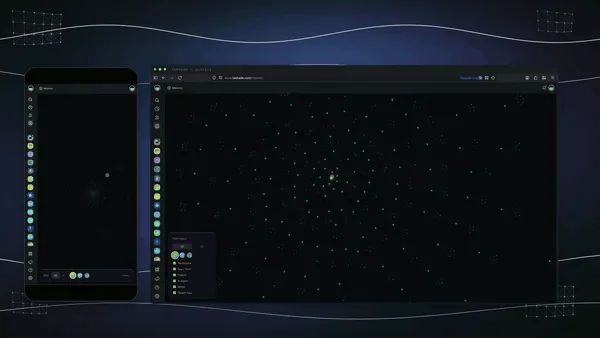
The DNA Knowledge Graph at /memory is the workspace-scale analog of ServiceNow's AI Control Tower discovery layer. It visualizes every Project, Agent, Automation, file, and integration as nodes you can browse, query, and feed back into your AI agents. Source: Workspace Memory, Agent Workflows, App Payments newsletter (May 2026).
The Complete Genesis Capability Matrix
Below is the full Taskade Genesis capability surface as of May 2026, mapped to the equivalent ServiceNow product for the parallel narrative. Every row is shipping today, free or in a paid tier, not future roadmap, not gated by a six-month implementation.
| Genesis Capability | What it does | ServiceNow equivalent | Source |
|---|---|---|---|
/memory Workspace DNA Knowledge Graph |
Living graph of every Project, Agent, Automation, file, and integration — visualizable, queryable | AI Control Tower (Discover layer) | May 3 2026 newsletter |
| AI Agents v2 | built-in tools, custom tools, slash commands, persistent memory, multi-agent collaboration, public embedding | Autonomous Workforce / AI Specialists | May 3 2026 |
| 15+ frontier models, auto-routed | Claude Sonnet/Opus, GPT-5.x, Gemini, plus open-weight via gateway. Picks the right model per task; you can override anytime | Now Assist + multi-LLM Workflow Data Fabric | Apr 19 2026 |
| 100+ bidirectional integrations | Triggers pull events in (Slack, Gmail, Stripe, Sheets, Calendly, webhooks). Actions push data out (Notion, Salesforce, GitHub, Shopify, Linear, Monday) | Now Platform + Action Fabric ecosystem | Apr 19 2026 |
| Stripe Checkout inside Genesis apps | One-time payments, subscriptions, in-app product catalog, no redirect, no extra signup | Industry CRM monetization workflows | May 3 2026 |
| App Kits — clone in 60 seconds | Pre-wired starter apps: CRM, storefront, dashboard, client portal, knowledge base, habit tracker, meal planner, candle store, restaurant finder, portfolio site | ServiceNow Store / industry templates | Apr 25 2026 Genesis Apps Live |
| Hosted MCP server | Claude Desktop, Cursor, and VS Code connect in, on every paid plan. The reverse direction runs on every plan via the MCP Client automation step, which calls external MCP servers for an agent. ~2-min setup | Action Fabric + ServiceNow MCP Server | Apr 29 2026 |
| Community Gallery + 1-click clone | 150,000+ published Genesis apps, public creator profiles, leaderboards, follow | ServiceNow Store ecosystem | Apr 25 2026 |
| Custom domains + auto SSL + password protection | your-domain.com on Business+; password protection on Pro+; auto SSL on every published Genesis app |
Hosted enterprise portals | Apr 19 2026 |
| Embeddable apps + Open Graph | Responsive embed in dashboards, Notion, partner sites; custom Open Graph for social shares | Service Portal / Employee Center | Apr 19 2026 |
| Files / Media Browser | Folder-organized uploads, drag-and-drop, agent-readable | Content delivery / asset management | Apr 19 2026 |
| Workspace Memory + Mind Graph | Living wiki + knowledge graph + mind-map zoom, all agent-readable | Knowledge Management | Apr 29 2026 |
| EVE (Genesis meta-agent) | User-facing AI assistant with /commands, @-mentions, persistent memory stored as real Taskade Projects, ask-questions tool for clarifying ambiguity, a secure sandbox for running commands |
Now Assist + Otto front door | Apr 19 2026 |
| Genesis Apps — live, deployed, intelligent | Single prompt → full app with workflows + agents + UI + data in ~7 minutes. Custom domains, password protection, monetization, embedding | Autonomous CRM (deployment surface for F500) | Apr 25 2026 Genesis Apps Live |
See It Move: Genesis in Action
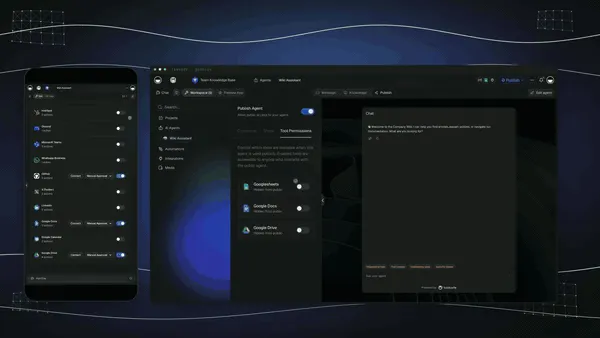
Agent Workflows wire AI Agents v2 to built-in tools and 100+ bidirectional integrations, the workspace-scale analog of ServiceNow's Autonomous Workforce + AI Specialists. Source: May 3 2026 newsletter.
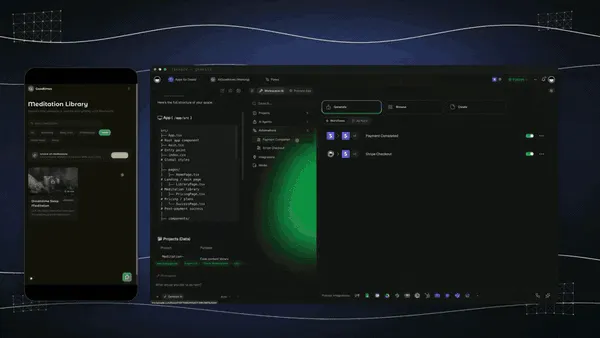
In-app Stripe Checkout lets every Genesis app monetize directly, one-time payments, subscriptions, and product catalogs without redirecting to a separate Stripe page. The Genesis equivalent of ServiceNow's industry-specific CRM monetization workflows.

Taskade Speaks MCP, the Taskade-as-Server side of the Model Context Protocol bet. External AI clients (Claude Desktop, Cursor, VS Code) talk to your Taskade workspace via OAuth2 + PKCE. Tools include list_spaces, inspect_space, list_tasks, and write_file, 18 in all as of July 2026, backed by the same app files the Taskade Genesis build agent uses. The Taskade Genesis analog of ServiceNow's Action Fabric + MCP Server.
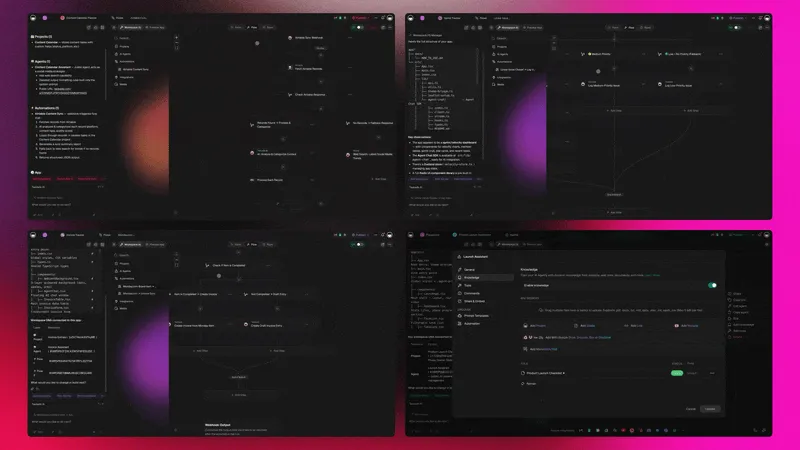
100+ bidirectional integrations across Communication, Email/CRM, Payments, Development, Productivity, Content, Data/Analytics, Storage, Calendar, and E-commerce. Triggers pull events in. Actions push data out. The Genesis analog of ServiceNow's 800+ systems of record integrating with the Now Platform.
Autonomous CRM in the Enterprise → Genesis Apps in Your Workspace
ServiceNow's Knowledge 2026 launch of Autonomous CRM, sales, service, fulfillment, and customer success on one AI platform, is the F500 version of what's already shipping inside Taskade Genesis. In the recent CRM, Storefront & Analytics Dashboard newsletter, Genesis users shipped what ServiceNow customers would call point solutions as business-in-a-box apps:
- A sales CRM with pipeline tracking, contact records, and automated follow-up.
- A storefront with cart, checkout, and Stripe-powered payments.
- A live analytics dashboard that updates as deals close.
All three were prompt-to-deploy. All three are clonable in the Community Gallery. All three sit inside the same workspace, sharing Memory across Projects, Intelligence across Agents, and Execution across Automations.
The Architectural Bet
Both companies are pricing the same future. Intelligence is commoditizing; workflow is the moat. ServiceNow priced that future at $13.28B in F500 revenue and a ~$94B market cap. Taskade is pricing it at Free, $10/mo (Pro), $25/mo (Business), $100/mo (Max), for anyone who wants to build a Genesis app today on our pricing page.
Bill McDermott's No Priors line, "For a simple application on our platform, it would be 10× greater in cost to try to replicate it with a language model", is the same line every Genesis customer ends up making to themselves before they upgrade past Free. The math works at $200B and it works for free. AI thinks. Workflow acts.
Where to Start
If you want the Taskade Genesis version of the AI Control Tower thesis:
- Build your first Genesis app, describe it in a prompt, ship it in roughly seven minutes.
- Browse the Gallery, 150+ live, clonable Genesis apps spanning CRM, storefront, knowledge base, client portal, habit tracker, meal planner, dashboard, and more.
- Custom AI agents, wire your agents to built-in tools and 100+ integrations.
- Automations, triggers that pull events in (Slack, Gmail, Sheets, Calendly, webhooks) + actions that push data out (Stripe, Shopify, Notion, Salesforce, GitHub).
- Compare, the $300/seat CRM math vs. building your own.
That's the workspace-DNA version of every Knowledge 2026 announcement, available today, for individuals and small teams.
🔮 The Road Ahead: 2026-2030
Three open questions define the ServiceNow story for the rest of the decade.
1. Does the AI Control Tower category actually exist? ServiceNow is betting that governance, observability, and identity for multi-vendor agents is a software category worth a top-3 multiple. Datadog, Microsoft Purview, AWS Bedrock Guardrails, and a wave of startups are betting on slices of the same thesis. ServiceNow's claim is integration breadth + customer base + 23-year platform discipline. The next four years decide whether the platform compounds or whether the category fragments into best-of-breed tools.
2. Can ServiceNow rebuild the multiple? Stock peaked at $219B in January 2025 and traded around $94B in May 2026, a roughly 57% drawdown amid the broader SaaS derating. McDermott's "Rule of 55" argument is that ServiceNow's combination of 21% growth and 35% FCF margin is the rarest combination in software. If it holds for four more years, the multiple re-rates. If growth slips below 18%, the bear case wins.
3. Will the M&A bet pay off? Moveworks ($2.85B), Logik.ai (undisclosed), data.world (undisclosed), Veza (~$1B), Armis ($7.75B) is roughly $12B+ in announced acquisitions in 18 months. Each deal is justified individually. Together they bet on a unified agentic stack where every part, front door, governance, identity, asset graph, data fabric, action layer, runs on Now Platform integration. The cultural question is whether ServiceNow can absorb 5,000+ new employees from acquired companies without diluting the operating discipline that got the company to $13B.
The big-picture bet is unchanged. As McDermott put it on stage in May 2026: "Putting AI to work for people is the gateway to economic growth." The Fortune 500 doesn't get to ignore AI. They also don't get to deploy it carelessly. Workflow is the safety net under the language model. ServiceNow controls the safety net.
And it all started with a 50-year-old engineer who had just lost $35M.
💬 Frequently Asked Questions About ServiceNow
Who is Fred Luddy and why does he matter?
Fred Luddy founded ServiceNow in 2003 as Glidesoft, Inc. after the 2002 accounting-fraud collapse of his previous company, Peregrine Systems, wiped out approximately $35M of his personal stock. He had been CTO at Peregrine and learned firsthand what enterprise software customers needed when their incumbent vendors failed them. Luddy ran ServiceNow as CEO until 2011, then served as Chairman emeritus, and remains the company's spiritual father.
When did ServiceNow IPO?
ServiceNow priced its IPO on June 29, 2012 at $18 per share on the NYSE (ticker: NOW). It sold 11.65 million shares and raised approximately $210 million at a roughly $2 billion valuation, just one month after Facebook's troubled IPO. Morgan Stanley led the offering. Frank Slootman was CEO; Fred Luddy was Chairman.
How big is ServiceNow in 2026?
For fiscal 2025, ServiceNow reported $13.28 billion in total revenue and $12.88 billion in subscription revenue (+21% YoY). It serves more than 8,800 customers including 85% of the Fortune 500, has 603 customers with annual contracts above $5M, and employs around 29,000 people. The Now Platform runs 100+ billion workflows and 7 trillion transactions per year.
Who is the CEO of ServiceNow?
Bill McDermott has been CEO since November 2019. He previously ran SAP as CEO from 2014 to 2019, after serving as Co-CEO from 2010 to 2014. He started his career at Xerox in 1983 in Manhattan, having previously owned a delicatessen in Amityville, Long Island. McDermott also chairs the board of ServiceNow.
What is the AI Control Tower?
The AI Control Tower is ServiceNow's governance, observability, and security layer for every AI agent, model, identity, and asset across the enterprise, regardless of vendor. It includes a kill switch that pauses or stops any agent mid-action, automatic detection of hallucinations, bias, toxic content, leakage, and drift, continuous ROI tracking, and integration with 30+ AI systems including Anthropic, OpenAI, Google, Microsoft, AWS, and Azure. It was expanded significantly at Knowledge 2026 with Veza identity (30B+ permissions) and Armis asset visibility for OT and IoT.
What is ServiceNow Action Fabric?
Announced at Knowledge 2026, Action Fabric exposes the full Now Platform's system of action (workflows, business rules, approvals, SLAs, audit trails, compliance) to external AI agents through REST APIs, the Model Context Protocol (MCP), and agent-to-agent protocols. Every call inherits ServiceNow governance and context. Anthropic's Claude Co-work is the launch partner, Claude agents can take governed action inside ServiceNow workflows.
What is Autonomous CRM?
Autonomous CRM is ServiceNow's Knowledge 2026 launch combining sales, service, order fulfillment, and customer success on one AI platform. It uses Logik.ai's CPQ engine (processing 7M+ transactions/month) for autonomous quoting and conversational sales, plus Autonomous Industry CRM with purpose-built workflows for telco, banking, technology, manufacturing, healthcare, and more. Public reference customers include Pure Storage (resolution time 26 days → 5 days, NPS 82%) and Aura (deflection rate 18% → 94%).
What is the Autonomous Workforce / AI Specialists?
AI Specialists are autonomous team members modeled on specific business roles, not just tasks, an L1 IT Service Desk specialist, a Case Management specialist for customer service, a Risk & Vulnerabilities specialist for security. Each has a defined role, business context, and full audit trail. ServiceNow's own L1 IT Service Desk specialist resolves cases 99% faster than the human equivalent. DocuSign and Honeywell already deflect the majority of L1 requests via Autonomous Workforce. Specialists slot into existing teams with the same governance and access controls as human workers.
Did ServiceNow acquire Moveworks?
Yes. ServiceNow announced the acquisition of Moveworks on March 10, 2025 for $2.85 billion and closed the deal on December 15, 2025. Moveworks was at roughly $100M ARR at acquisition. Inside ServiceNow it has been rebranded Employee Works, the "agentic front door to the enterprise" combining conversational AI, enterprise search, and the front-end UX for Now Assist and the Autonomous Workforce.
What is the ServiceNow + NVIDIA partnership?
Jensen Huang appeared at Knowledge 2026 to announce that NVIDIA is implementing its Open Shell sandbox into the ServiceNow platform. Open Shell is the same governance sandbox NVIDIA uses internally to safely run Claude Code, Codex, and other coding agents. NVIDIA also uses ServiceNow + its internal IQ AI to cut two-thirds of employee support interactions to zero human involvement. NVIDIA and ServiceNow have been engineering partners for several years across NIM microservices and Project Arc.
Is ServiceNow a competitor to Taskade?
No. They serve very different scales of customer. ServiceNow targets the Fortune 500 and runs 100B+ workflows for enterprise customers with multi-million-dollar contracts. Taskade Genesis targets startups, agencies, indie builders, and small teams with a workspace-DNA platform that delivers the same architectural bet (Memory + Intelligence + Execution) at workspace scale. Both companies are betting on the same insight, intelligence is commoditizing, workflow is the moat, at different ends of the market. Build your first Genesis app at taskade.com/create.
📚 Further Reading on Workspace Software History
ServiceNow sits on a 60-year lineage of workspace and workflow software. The full series:
- History of Real-Time Collaboration: From Engelbart to AI Agents, the pillar piece on collaborative software
- Google Wave Lessons: OT, Aaron Iba & the Taskade Lineage, the failed product whose OT engine survived
- OT vs CRDT: The Two Algorithms Behind Every Real-Time App, sync engine deep dive
- History of Etherpad: Aaron Iba's Editor, the pre-Wave story
- History of CRDTs: How Math Beat the Distributed-Systems Problem, academic side
- History of HyperCard: The First No-Code Builder, Bill Atkinson's substrate, prefigured Taskade Genesis
- History of Lotus Notes: The Original Workspace App, Ray Ozzie's lineage
- History of Workflow Automation: From IFTTT to Bidirectional AI Agents, the iPaaS lineage Taskade Automations extend
- History of WebSockets: How the Web Got Real-Time, the substrate beneath every real-time app
- History of Spreadsheets: From VisiCalc to Taskade Genesis, the programmable-document lineage
- What Is Taskade? Complete History, the workspace-native AI app builder
- 15 Best AI Workflow Automation Tools in 2026 (Build an App From One Prompt)
- 14 Best AI Agent Builder Platforms in 2026 (Ranked and Tested)
🔗 Resources
- Wikipedia: ServiceNow
- Wikipedia: Fred Luddy
- Wikipedia: Frank Slootman
- Wikipedia: Bill McDermott
- Sequoia: The ServiceNow Story, Crucible Moments podcast
- Bloomberg: ServiceNow IPO at $18
- SEC: Peregrine Systems complaint
- ServiceNow press: McDermott CEO transition (Oct 22 2019)
- ServiceNow Q4/FY25 earnings (Jan 2026)
- TechCrunch: ServiceNow buys Moveworks for $2.85B
- ServiceNow press: Logik.ai acquisition
- TechCrunch: data.world acquisition
- ServiceNow press: Veza identity acquisition
- ServiceNow press: Armis $7.75B acquisition
- Anthropic: ServiceNow chooses Claude
- Constellation Research: K2026 AI Control Tower
- LBB Online: Idris Elba "Connecting Corners"
- CompaniesMarketCap: ServiceNow
- No Priors: Sarah Guo with Bill McDermott (May 2026)
🐑 Before you go, if the ServiceNow story sparked something, the same architectural bet is shipping today inside Taskade Genesis: one prompt, one workspace, persistent memory, built-in tools, 100+ integrations, 15+ frontier models from OpenAI, Anthropic, and Google, and 150,000+ live apps in the Community Gallery to clone and remix. Workspace DNA, Memory feeds Intelligence, Intelligence triggers Execution, Execution creates new Memory. Build your first app free →
🧬 Related Reading
- History posts, What is OpenAI? · What is NVIDIA? · What is Anthropic? · History of Apple · History of Mermaid.js · What is Airtable? · History of Monday.com · History of ClickUp · History of Notion · History of Obsidian · History of n8n
- Agentic AI, What is Agentic AI? · What is Agentic Engineering? · 12 Best Agentic Engineering Platforms · Agents vs Copilots vs Chatbots · Workspace DNA Architecture · Workspace DNA Context · Agentic Workspaces
- SaaS market, The SaaSpocalypse Explained · The Great SaaS Unbundling · Will Vibe Coding Kill SaaS? · Build Your Own CRM vs Salesforce
- Taskade Genesis, Introducing Taskade Genesis · The Ultimate Guide to Taskade Genesis · What is Vibe Coding? · Origin of Living Software
- Taskade Genesis newsletters, Workspace Memory, Agent Workflows, App Payments (May 2026) · Deploy Agents, Launch Shops, Automate Payments (April 2026) · CRM, Storefront & Analytics Dashboard · Map Your Mind, Plan Tasks, Track Habits
🆕 New Free Templates This Month
ServiceNow ships an "AI Control Tower" at enterprise contract sizes. Five fresh Taskade Genesis listicles ship the same architecture as cloneable free apps, each comparison ranks the category leaders against verified May 2026 pricing:
- AI Customer Onboarding Templates, vs Userpilot ($299/mo), Appcues ($249/mo), Pendo ($7K+/yr)
- SaaS Metrics Dashboards, vs ChartMogul ($129+/mo), Baremetrics ($129+/mo), Mixpanel
- AI Investor CRM & Fundraising Tracker, vs Visible.vc ($112/mo), Affinity ($2K/seat/yr), Carta
- AI Recruiting Pipeline With Sourcer Agent, vs Greenhouse ($6.5K+/yr), Lever, Ashby ($400+/mo)
- Founder Dinner CRM (Event Templates), vs Cvent ($20K+/yr), Luma Plus ($59/mo), Partiful