






In January 2026, Monday.com CEO Eran Zinman made an announcement that sent shockwaves through the SaaS industry: he had replaced the company's entire 100-person SDR team with AI agents. Response times dropped from 24 hours to 3 minutes. Conversion rates went up, not down.

TL;DR: AI agents are collapsing the per-seat SaaS model. Monday.com cut 100 SDRs, Atlassian saw its first seat decline, and $285B evaporated from SaaS stocks. Companies that needed 500 licenses now need 50. New pricing models — usage-based, outcome-based, credit-based — are replacing headcount licensing. Taskade Genesis is built for this shift: AI agents, automations, and app building free to start, with Pro from $10/month billed annually, no per-seat trap.
Then he said something that should keep every SaaS CEO awake at night:
"Nobody will want to buy software that's not doing the majority of the work for them." — Eran Zinman, CEO of Monday.com
This was not a startup founder making a bold prediction. This was the CEO of a $10B+ public company admitting that his own company's pricing model is obsolete. If AI agents do the work, why would anyone pay for human seats?
Welcome to The Great SaaS Unbundling — the moment when AI agents break the economic foundation of the software industry and force every vendor to answer a simple question: are you charging for seats or for outcomes?
For deeper context on why AI-native architecture matters more than AI features, see our analysis of AI-native vs AI-bolted-on software. For the broader disruption thesis, read Will vibe coding kill SaaS?. And for teams ready to build rather than subscribe, Taskade Genesis is the platform where AI agents, automations, and app building replace your SaaS stack entirely.
💀 The Seat-Count Crisis: $285 Billion Evaporates
The per-seat pricing model is the economic bedrock of the SaaS industry. Salesforce, Microsoft 365, Slack, Zoom, Notion, Monday.com, Atlassian — every major SaaS vendor charges some variation of per-user, per-month.
The logic was elegant: more employees means more seats means more revenue. As companies grew, SaaS vendors grew with them. The model created predictable, recurring revenue that Wall Street loved — and it powered a multi-trillion-dollar industry.
Then AI agents arrived.
The February 2026 Reckoning
In February 2026, the market delivered its verdict. $285 billion in market capitalization evaporated from SaaS stocks in what analysts dubbed the SaaSpocalypse. Per-seat companies were hit hardest.
The catalyst was not a single event but an accumulation of signals that the per-seat model is structurally broken:
| Signal | Impact |
|---|---|
| Monday.com replaces 100 SDRs with AI agents | Proof that AI agents replace human seats at scale |
| Atlassian reports first-ever enterprise seat decline | Per-seat growth engine stalls for the first time |
| Bain & Company publishes "Will Agentic AI Disrupt SaaS?" | Institutional validation of the disruption thesis |
| Deloitte releases "SaaS Meets AI Agents" predictions | Big Four consulting firm confirms the shift |
| 90% seat compression reported across early adopters | The math becomes undeniable |
Jason Lemkin, founder of SaaStr and one of the most influential voices in SaaS, crystallized the problem:
"If 10 AI agents can do the work of 100 sales reps, you don't need 100 Salesforce seats — you need 10." — Jason Lemkin, SaaStr
This is not a marginal reduction. This is a 90% revenue compression for every vendor whose business model depends on headcount.
The market was not punishing SaaS companies for poor earnings. It was repricing the entire category based on a structural truth: when AI agents do the work, humans do not need seats.
🤖 The Monday.com Case Study: 100 SDRs → AI Agents
Let's look at the numbers behind Monday.com's decision because they reveal the mechanics of seat compression in granular detail.
Before: The 100-SDR Operation
A traditional enterprise SDR (sales development representative) team operates like this:
- 100 SDRs working 8-hour shifts across time zones
- Average response time: 24 hours (industry standard for inbound leads)
- Cost per SDR: $60,000-$80,000 base salary plus benefits, tools, management overhead
- Total annual cost: $8-10 million for the team
- Software stack per SDR: CRM seat + email tool + dialer + prospecting platform + analytics = $300-500/month in SaaS per person
After: The AI Agent Replacement
Monday.com deployed AI agents to handle the same inbound sales workload:
- Response time: 3 minutes (down from 24 hours — a 480x improvement)
- Conversion rates: Higher than human SDRs
- Availability: 24/7/365, no shifts, no PTO, no ramp time
- Cost: A fraction of the human team
| Metric | 100 Human SDRs | AI Agents | Change |
|---|---|---|---|
| Response time | 24 hours | 3 minutes | 480x faster |
| Availability | 8hr shifts, weekdays | 24/7/365 | Always on |
| Annual team cost | $8-10M | <$1M | 90%+ reduction |
| SaaS seats needed | 500+ (across stack) | ~50 | 90% compression |
| Conversion rate | Baseline | Higher | Improvement |
| Ramp time for new capacity | 3-6 months | Minutes | Instant |
But here is the part that matters for the SaaS industry: Monday.com did not just save on salaries. They eliminated 500+ SaaS seats across the tooling stack that supported those 100 people.
Every SDR had a CRM license, an email platform seat, a dialer subscription, a prospecting tool, an analytics dashboard. When the humans left, the seats left with them.
This is the cascading seat effect — a single AI agent replacement does not eliminate one SaaS seat. It eliminates the entire stack of seats that supported that human role. An SDR who used five different tools represented five different per-seat subscriptions. Multiply that by 100 people and you are looking at 500 seats vanishing across half a dozen SaaS vendors simultaneously.
And here is the uncomfortable truth for Monday.com itself: if Zinman's own company replaces human SDRs with AI agents, other companies will do the same with Monday.com seats. The CEO of a per-seat company publicly demonstrated why per-seat pricing is dying. The irony was not lost on Wall Street.
Zinman then made an even bolder prediction about what happens next:
"The TAM of software, how much companies are going to spend on software, is going to be 100x from what it is today." — Eran Zinman, CEO of Monday.com
This is not contradictory. The per-seat market shrinks. The total software market explodes — because AI agents unlock workflows that were never economically viable to staff with humans. Every task that was too expensive to hire a person for becomes automatable.
The lesson from Monday.com is not just about headcount reduction. It is about the velocity of change. A decision that would have taken two years of planning, hiring freezes, and gradual attrition happened in months. Other companies are watching — and accelerating their own timelines. For a deeper look at how AI agents are reshaping workflows, see our guide to agentic engineering.
📊 The Math Behind Seat Compression
Seat compression is not theoretical. It is already measurable across industries.
The SaaS Sprawl Baseline
Before we calculate compression, let's establish what companies actually spend on SaaS today. According to Zylo's annual SaaS management report:
| Metric | Value | Source |
|---|---|---|
| Average SaaS spend per employee | $8,435/year | Zylo |
| Average apps per large enterprise | 371 | Zylo |
| SaaS purchases bypassing IT (Shadow IT) | 65% | Zylo |
| Average SaaS contract renewal rate | 90%+ | Industry standard |
A 1,000-person company spends roughly $8.4 million per year on SaaS subscriptions across 371 applications. Most of those subscriptions scale linearly with headcount.
The Compression Calculation
When AI agents take over tasks, seat requirements drop. Here is what early adopters are reporting:
Seat Compression by Department
Not every department compresses equally. Here is a realistic breakdown of where AI agents replace the most seats:
| Department | Typical Seats | Post-AI Seats | Compression | Primary AI Agent Role |
|---|---|---|---|---|
| Sales Development | 100 | 10 | 90% | Lead qualification, outreach, follow-up |
| Customer Support | 80 | 15 | 81% | Ticket triage, resolution, escalation |
| Data Entry / Ops | 60 | 5 | 92% | Data processing, validation, routing |
| Marketing Ops | 40 | 10 | 75% | Content scheduling, reporting, A/B testing |
| Finance / Accounting | 30 | 10 | 67% | Invoice processing, reconciliation, reporting |
| Engineering | 50 | 40 | 20% | Code review assist, testing (humans still lead) |
| Executive / Strategy | 20 | 18 | 10% | Briefing prep, research summarization |
| Total | 380 | 108 | 72% | — |
The departments with the highest ratio of repetitive, rule-based tasks see the most compression. This is why support, sales, and operations roles are disappearing from SaaS seat counts first.
The ripple effect is devastating for per-seat vendors: when a 380-person department drops to 108 active human users, every SaaS subscription tied to those seats loses 72% of its revenue — without the company reducing output by a single unit.
💰 The New Pricing Models: What Replaces Per-Seat
If per-seat is dying, what comes next? Four models are emerging, each suited to different product categories.
The Four Post-Seat Pricing Models
Model Comparison
| Model | How It Works | Best For | Risk for Buyer | Example Vendors |
|---|---|---|---|---|
| Per-Seat (legacy) | Fixed price per human user per month | Low-complexity tools with 1:1 human-seat mapping | Overpaying when AI agents reduce human usage | Salesforce, Slack, Notion |
| Usage-Based | Pay per API call, compute minute, or action | Infrastructure, developer tools, data platforms | Unpredictable costs during spikes | AWS, Snowflake, Twilio |
| Outcome-Based | Pay per result: lead generated, ticket resolved, deal closed | Sales, support, and marketing automation | Vendor must prove attribution | AI SDR platforms, performance marketing |
| Credit-Based | Buy credit pools consumed by AI operations at different rates | Creative tools, generative AI platforms | Credit burn rate is opaque | Adobe Generative Credits, Midjourney |
| Hybrid | Base platform fee + usage or outcome surcharges | AI-native workspaces, modern SaaS | Complexity in billing | Taskade Genesis, HubSpot (evolving) |
Adobe's Generative Credit Pivot
Adobe's shift to Generative Credits is one of the clearest examples of a legacy vendor adapting. Instead of charging per seat for Photoshop or Illustrator AI features, Adobe allocates a credit pool that gets consumed when users generate images, expand canvases, or use AI-powered editing.
The credit model decouples revenue from headcount. It does not matter how many people are on the team — what matters is how much AI-powered work gets done. This is the direction the entire industry is heading.
Deep Dive: How Each Model Handles AI Agents
The critical question for each model is: how does it account for AI agents that work alongside — or instead of — humans?
Per-seat treats AI agents as a paradox. If an AI agent replaces a human seat, the vendor loses revenue. Some vendors have tried charging per "AI agent seat" (Salesforce briefly floated $2/conversation for Agentforce), but the economics are awkward — customers resist paying human-level prices for software that costs near-zero to run at the margin.
Usage-based handles agents naturally. An AI agent making 10,000 API calls per month is just another source of usage. The vendor does not care whether the calls come from a human clicking or an agent executing. This is why infrastructure companies (AWS, Snowflake) are relatively insulated from seat compression — their revenue tracks compute consumption, not headcount.
Outcome-based is the most AI-aligned model. If an AI agent generates 500 qualified leads per month, the vendor charges for 500 leads — regardless of whether a human SDR or an AI agent produced them. This model rewards efficiency and naturally favors AI-native platforms that deliver more outcomes per dollar.
Credit-based provides a translation layer between AI operations and billing. Different AI actions consume different credit amounts (a simple text generation might cost 1 credit, while a complex multi-step agent workflow costs 20). This gives vendors granular pricing control while giving buyers predictable budget pools.
Hybrid combines the best of multiple approaches — a base platform fee ensures predictable revenue for the vendor, while usage or outcome surcharges capture the value of AI agent activity above the baseline. Taskade Genesis uses this approach: a flat platform fee that includes AI agents, automations, and app building, with capacity that scales as teams grow.
The Pricing Model Decision Matrix
| If your team... | Choose this model | Why |
|---|---|---|
| Uses AI agents for >50% of tasks | Outcome-based or hybrid | Pay for results, not idle seats |
| Has unpredictable AI usage patterns | Credit-based | Budget predictability with flexibility |
| Runs heavy compute workloads | Usage-based | Pay scales with actual consumption |
| Has a small team with diverse needs | Hybrid (Taskade Genesis) | One platform, one price, unlimited AI agents |
| Still relies primarily on human users | Per-seat (for now) | But plan your migration — compression is coming |
🔄 The Unbundling: Monolith SaaS Falls Apart
Per-seat pricing did not just define revenue models — it shaped product strategy. SaaS vendors had an incentive to bundle everything into a single platform because every feature added was another justification for keeping (or increasing) per-seat prices.
The result? Bloated monoliths.
Salesforce became a CRM, marketing platform, analytics suite, commerce engine, and AI chatbot. Monday.com expanded from project management into CRM, dev tools, and marketing workflows. Notion added AI, databases, wikis, calendars, and projects. Each expansion justified higher per-seat fees.
But when AI agents collapse seat counts, the bundling logic inverts. Teams no longer need a monolith that does everything for 500 users. They need specialized AI-native tools that do specific jobs exceptionally well for a small team augmented by agents.
This is the unbundling. And it happens in three stages:
Stage 1 — Seat Compression (now): AI agents reduce the number of humans using legacy SaaS tools. Revenue contracts. Stock prices fall.
Stage 2 — Feature Extraction (2026-2027): Teams pull individual capabilities out of monoliths and replace them with AI-native alternatives. Instead of Salesforce for CRM + marketing + analytics, they use three specialized tools that each cost less and perform better.
Stage 3 — Workspace Consolidation (2027+): The surviving platforms are those that serve as the operating system for teams — the central workspace where AI agents, automations, and human collaborators converge. Everything else becomes an integration.
This is exactly where Taskade Genesis sits. Not as another monolith, but as the AI-native workspace where teams build, deploy, and orchestrate. For teams evaluating their current stack, our comparison guides break down exactly what you are overpaying for with legacy tools.
🌟 The Golden Age Paradox: Sherwin Wu's Thesis
Here is the counterintuitive truth: the death of per-seat pricing does not mean the death of SaaS. It means the birth of something much larger.
Sherwin Wu, a leader at OpenAI, articulated this paradox:
"In order to enable a one-person billion-dollar startup, there might be a hundred other small startups building bespoke software. We might enter a golden age of B2B SaaS." — Sherwin Wu, OpenAI
Let that sink in. AI agents do not just eliminate human seats. They create entirely new categories of work that were never economically viable to staff. When an AI agent can monitor, analyze, and act on data streams at near-zero marginal cost, companies automate processes they never could have afforded to hire humans for.
Christina Melas-Kyriazi, a partner at Bain Capital Ventures, sees the same pattern:
She described the AI-native software opportunity as "comparable to Shopify and social media explosion" — a once-in-a-generation market creation event.
The Math of Market Expansion
The SaaS market is not shrinking. It is restructuring.
| Metric | Per-Seat Era | AI-Native Era | Direction |
|---|---|---|---|
| Revenue per human seat | $8,435/year (Zylo) | Declining (compression) | Down |
| Number of automatable tasks | Limited by headcount | Unlimited (agents scale) | Up |
| Total addressable market | ~$300B (current SaaS) | "100x" (Zinman) | Massively up |
| Average tools per company | 371 (Zylo) | Fewer monoliths, more specialized | Restructures |
| New software categories | Incremental | Explosive (AI-native niches) | Up |
The per-seat market shrinks from $300 billion to perhaps $100 billion. But the total software market — including usage-based, outcome-based, and AI-native platforms — expands to multiples of the current size.
Eran Zinman's "100x" prediction may sound hyperbolic, but consider: every task that was too expensive to dedicate a human to — monitoring obscure data feeds, personalizing every customer interaction, testing every UI variation, auditing every compliance document — becomes automatable at near-zero marginal cost. The number of software-addressable workflows goes from millions to billions.
This is why the companies building AI-native tools are not worried about the SaaSpocalypse. They are building for the market that emerges on the other side. For more on how AI-native architecture differs from bolted-on AI, see AI-native vs AI-bolted-on.
What Bain & Company and Deloitte Are Telling Enterprise Buyers
Two of the most influential consulting firms in the world published reports in early 2026 that validated the seat compression thesis and gave enterprise buyers a framework for responding.
Bain & Company's "Will Agentic AI Disrupt SaaS?" is the more aggressive of the two. Bain's core argument is that agentic AI does not just improve SaaS — it restructures the economic model. Key findings from the report:
- Per-seat pricing is "structurally vulnerable" to AI agent adoption
- Vendors who fail to transition pricing within 18 months face permanent revenue erosion
- The shift favors platforms that can demonstrate measurable outcomes over feature checklists
- Enterprise procurement teams should renegotiate contracts with AI compression clauses
Deloitte's "SaaS Meets AI Agents" takes a broader view, mapping out how the entire SaaS value chain restructures. Deloitte predicts:
- By 2027, the majority of new SaaS contracts will include usage-based or outcome-based components
- Shadow IT (currently 65% of SaaS purchases) will increase as teams adopt AI-native tools faster than IT can evaluate them
- The vendor landscape will bifurcate into "platform plays" (workspaces that orchestrate agents) and "point solutions" (deep vertical AI tools)
- Compliance and auditability of AI agent actions will become a key procurement criterion
Both reports point toward the same conclusion: the winners in the post-seat era are platforms that combine agent orchestration, workflow automation, and measurable outcomes in a single environment. This is the design philosophy behind Taskade Genesis — and why Workspace DNA was architected for a world where AI agents are first-class participants, not add-ons.
The Value Migration: Where Does the Money Go?
The unbundling is not just about pricing models shifting within SaaS. It is about value leaving the software sector entirely.
For three decades, the digital economy rested on one foundational assumption: software is expensive to build. That scarcity created moats worth trillions. AI broke the assumption. A frontier model lets one person replicate in days what previously required tens of millions in VC and months of engineering. The code costs pennies to generate. The creation moat — the entire basis of software company valuations — is draining.
The bottleneck shifts from software (digital) to compute (physical). Value migrates toward data centers, semiconductor manufacturing, energy infrastructure, and the materials supply chain. Pure-digital SaaS companies — enterprise CRM, MarTech stacks, advertising middleware — are the most exposed because their moats depended entirely on software creation being scarce.
Meanwhile, AI agents are removing the need for human interfaces altogether. Before AI, a SaaS company's value lived in the screens humans clicked — Google Search nudging behavior, Amazon's product pages driving purchases. Agentic AI bypasses these interfaces. Agents research, browse, and buy on behalf of humans without ever seeing an ad. Companies whose revenue depends on altering human behavior through UI face the deepest structural disruption of all.
For teams watching the SaaSpocalypse unfold, the question is not just "which pricing model survives?" — it is "which layer of the economy captures the value that SaaS is losing?" The answer: whoever controls the intelligent runtime. Not the interface. Not the code. The living system that remembers, decides, and acts. That is what Taskade Genesis builds. For the broader economic context, see Creative Destruction Comes for SaaS.
🛡️ Sankar's Frame: Beta Software Dies, Alpha Software Wins
The cleanest framing of which SaaS survives the apocalypse came from Palantir CTO Shyam Sankar in his April 2026 a16z American Dynamism conversation. Sankar split the SaaS world into two camps: beta software and alpha software.
| Beta Software | Alpha Software | |
|---|---|---|
| Purpose | Make you more similar to every other company | Express your competitive advantage |
| Vendor feedback loop | "Can we sell it?" | "Did it create value?" |
| AI impact | Commoditized, generic dashboards = generic outputs | AI extends and personalizes your unique edge |
| Pricing trajectory | Per-seat → race to zero | Outcome / workspace / capacity-based premium |
| Examples | Generic CRM dashboards, standard project trackers, off-the-shelf ERP modules | Custom Palantir Foundry deployments, bespoke Taskade Genesis apps, internal AI orchestration layers |
"Software that's about beta is going to really struggle. The platforms that are already focused on alpha are going to continue to have an advantage. And on the flip side, the stuff that's all beta is really going to struggle. You can almost argue maybe the beta wasn't that valuable to begin with."
Shyam Sankar, Palantir CTO — a16z American Dynamism (April 2026)
Sankar's COVID anecdote sharpens the point: in 2020, no Fortune 500 CEO mentioned their generic ERP implementation in earnings calls. They mentioned Zoom and Teams — the alpha tools that absorbed the disruption at speed. Same lesson: alpha tools sell themselves under stress, beta tools fall over like paper tigers.
Where Value Actually Accrues (Sankar's Stack View)
Sankar gave one of the clearest 2026 reads on which AI stack layers retain margin:
The squeeze is on raw model APIs and on generic SaaS sitting in the middle. Both ends — chips below, ontology / workspace layer above — are defensible because they own structural assets nobody can re-create from a prompt. That ontology layer is exactly where Taskade Genesis operates: workspace-scoped Memory (your projects, files, databases), Intelligence (agents tuned to your data), and Execution (automations triggered by your events). When AI commoditizes models below and competitors compress in the middle, the workspace becomes the durable surface that compounds.
This connects directly to NVIDIA CEO Jensen Huang's framing of AI harnesses — the orchestration software around models. See NVIDIA's complete history for how Jensen articulated the same dynamic from the chip side.
The ServiceNow Read: Workflow is the Moat the Models Can't Touch
The cleanest enterprise-side mirror of Sankar's frame is ServiceNow under Bill McDermott. At Knowledge 2026, McDermott put it in one line: "AI thinks. Workflow acts." ServiceNow's argument is the same as Sankar's, scaled to the Fortune 500: language models are commoditizing, the system of action that closes the case across HR, finance, legal, compliance, and risk is not. The company shipped an AI Control Tower that governs every multi-vendor agent in the enterprise (Microsoft, Google, Anthropic, OpenAI) with a kill switch and full audit trail, plus Action Fabric — an MCP-based outbound API that lets external AIs like Anthropic's Claude Co-work take governed action inside the platform. The result is the same conclusion as the workspace-DNA bet, applied to enterprise: alpha software owns the workflow. Beta software ships another chat widget.
The Same Defense Mechanism at Workspace Scale
Same diagnosis. Same prescription. Different price point. Here's what Taskade Genesis ships today against the unbundling — every row is a 2026 capability, not a roadmap item:
| What you used to pay $X/seat for | The Genesis-native version | Capability source |
|---|---|---|
| Notion / Confluence wiki | Workspace Memory + Mind Graph at /memory — agent-readable knowledge graph |
May 3 2026 |
| Zapier / Make automations | 100+ bidirectional integrations — triggers in, actions out | Apr 19 2026 |
| HubSpot CRM / Salesforce CPQ | Genesis CRM App Kits with pipeline, contacts, Stripe checkout | Apr 8 2026 |
| Shopify / Stripe storefront | In-app Stripe Checkout inside any Genesis app | May 3 2026 |
| GPT/Claude/Gemini × 3 separate subscriptions | 15+ frontier models, auto-routed per task | Apr 19 2026 |
| Webflow / Framer site + custom domain | Genesis app published to your-domain.com + auto SSL | Apr 25 2026 |
| Intercom / Zendesk help center | EVE meta-agent + knowledge base App Kit | Apr 19 2026 |
| Cursor / Claude Code IDE integration | Taskade-as-MCP-Server in Cursor, VS Code, Claude Desktop | Apr 29 2026 |
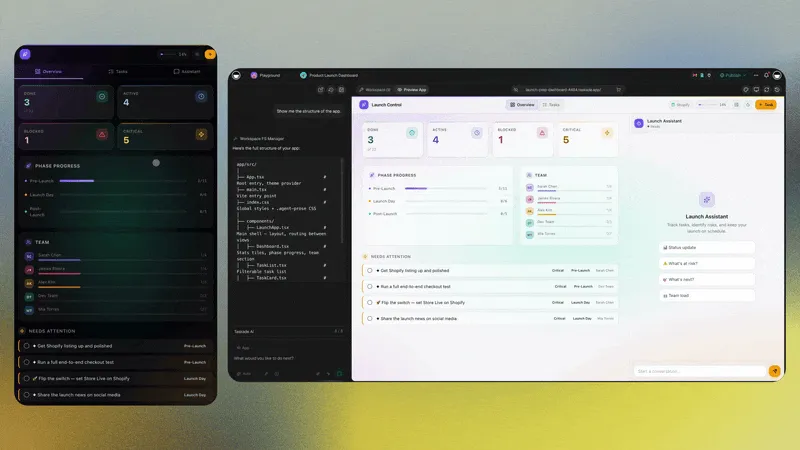
100+ bidirectional integrations is the unbundling-defense backbone of Taskade Genesis — the same architecture ServiceNow uses with 800+ systems of record at F500 scale, applied to the everyday tools individual teams already pay per-seat for. Source: Integrations + App Kits newsletter (Apr 2026).
🏢 What This Means for Teams in 2026
If you lead a team, manage a budget, or choose software, the SaaS unbundling changes your calculus today. Here is a practical framework for evaluating your stack.
The SaaS Audit Checklist
Step 1: Count your per-seat subscriptions.
List every tool your team pays for on a per-user basis. For most companies, this is 60-80% of their SaaS spend.
Step 2: Identify automatable seats.
For each tool, ask: "Could an AI agent handle 50% or more of what this seat is used for?" If yes, that seat is vulnerable to compression.
Step 3: Calculate your compression exposure.
Multiply your per-seat spend by the estimated compression percentage for each department (see the table above). This is your annual savings opportunity — and the amount your current vendors stand to lose.
Step 4: Evaluate AI-native alternatives.
For each vulnerable category, find platforms that price based on value delivered rather than headcount. Prioritize tools with built-in AI agents and automations rather than AI bolt-ons.
Step 5: Consolidate around a workspace hub.
Instead of subscribing to 371 tools, identify one AI-native workspace for coordination and specialized tools for deep vertical work.
The Stacked SaaS Cost vs AI-Native Cost
Here is what a typical 50-person team spends on a legacy SaaS stack versus an AI-native alternative:
| Category | Legacy Stack | Monthly Cost | AI-Native Alternative |
|---|---|---|---|
| Project Management | Monday.com (50 seats) | $800/mo | Taskade Genesis — included |
| Documentation | Notion (50 seats) | $500/mo | Taskade Genesis — included |
| AI Assistant | ChatGPT Team (50 seats) | $1,250/mo | Taskade Genesis — 15+ models included |
| Workflow Automation | Zapier (Team plan) | $350/mo | Taskade Genesis — 100+ integrations included |
| App Building | Retool (5 builders) | $500/mo | Taskade Genesis — app builder included |
| Communication Hub | Slack (50 seats) | $625/mo | Taskade built-in chat + video |
| Total | 6 subscriptions | $4,025/mo | 1 subscription |
| $48,300/year | Pro: $10/mo for 10 users |
That is not a marginal savings. It is a structural cost reduction — and it gets more dramatic as the team grows because Taskade Genesis does not charge per additional seat for AI agent capacity.
Teams already making this switch share their builds in the Taskade Community, where 150,000+ apps demonstrate what is possible when you stop subscribing and start building. For templates that accelerate the transition, browse our gallery of pre-built AI agent workflows and automation blueprints.
The Shadow IT Acceleration
One under-discussed consequence of the unbundling is the acceleration of shadow IT. Zylo reports that 65% of SaaS purchases already bypass IT approval. As AI-native tools become cheaper, faster to deploy, and more capable than enterprise-approved monoliths, that percentage will climb.
Consider the dynamics at play:
- A marketing manager discovers that an AI-native tool does in minutes what their approved SaaS stack takes days to accomplish
- The AI tool costs $6-10/month versus $50/user/month for the enterprise-approved alternative
- IT has a 4-6 week procurement cycle; the AI tool is available immediately
- The manager signs up with a personal credit card and starts producing results
This happened with Slack in 2014. It happened with Notion in 2019. It is happening now with AI-native workspaces like Taskade Genesis. By the time IT notices, entire departments have migrated — and they are producing better results at lower cost.
The smart IT organizations are not fighting this trend. They are channeling it by pre-approving AI-native platforms with enterprise security (role-based access, SSO, audit logs) and letting teams self-serve within guardrails. Taskade Genesis supports this with permissions from Owner through Viewer, workspace-level controls, and integrations that connect to existing enterprise infrastructure.
Real-World Migration Stories
The shift from stacked SaaS to AI-native workspace is not hypothetical. Teams across industries are making the switch:
Startups (5-20 people) are the fastest adopters. A founder who previously needed subscriptions to Notion ($10/user/month), Asana ($10.99/user/month), Zapier ($19.99/month), and ChatGPT Team ($25/user/month) now runs everything through Taskade Genesis — project management, documentation, AI chat, workflow automation, and app building — for a fraction of the combined cost.
Mid-market teams (50-200 people) are the biggest beneficiaries of seat compression. They have enough SaaS sprawl to see dramatic savings but are nimble enough to switch without multi-year procurement cycles. These teams typically save 60-80% on their software stack in the first year.
Enterprise departments (pilot programs) are running controlled experiments. A department of 100 deploys AI agents for a specific workflow (customer support, data processing, content creation), measures the seat compression, and uses the results to build a business case for broader adoption.
🧬 How Taskade Genesis Fits: The Post-Seat Workspace
Taskade Genesis was not built to compete with per-seat SaaS. It was built for the world that comes after.
Workspace DNA: The Architecture for the Unbundled Era
Where legacy platforms charge per seat because their value scales with human users, Taskade Genesis uses Workspace DNA — an architecture where value scales with work completed, regardless of whether a human or an AI agent does it.
Per-seat pricing was a side effect of the cloud era. Per-workspace pricing is what comes next. When SaaS was a single app deployed to a hyperscaler, charging per user made sense — each seat consumed roughly a server slice's worth of resources. Workspace-native software runs many apps inside one workspace, so the unit of value shifts from "user" to "workspace." For the seven-era timeline that ends with this pricing inversion, see The History of Cloud Computing — IBM CP-40 (1964) through AWS (2006), Kubernetes (2015), Lambda (2014), and AI compute (2022+).
| Cloud era | Pricing unit it produced | Why |
|---|---|---|
| Mainframe timesharing (1964) | CPU-hour | Compute was the scarce resource |
| AWS public cloud (2006) | Per-second EC2 instance | One server, one workload |
| SaaS app layer (2008–2024) | Per-seat per-month | One app, one user, one server slice |
| Workspace-native (2025+) | Flat per-workspace | One workspace runs many apps and many agents |
The unit of pricing always tracks the unit of compute. Per-seat made sense when one app meant one slice. Per-workspace makes sense when one workspace runs a CRM, a knowledge base, an automation engine, and twelve AI agents — and they all share memory.
Memory (Projects, documents, knowledge bases) feeds Intelligence (AI agents with built-in tools, persistent memory, and frontier models from OpenAI, Anthropic, and Google). Intelligence triggers Execution (automations with 100+ integrations, live app deployment, workflow orchestration). Execution creates new Memory. The loop is self-reinforcing.
This is why Taskade Genesis does not break when you reduce headcount. The DNA loop runs whether you have 5 humans or 50. The AI agents keep working. The automations keep executing. The apps keep serving users.
What You Get vs What You Replace
| Capability | Legacy SaaS Approach | Taskade Genesis |
|---|---|---|
| Project management | Monday.com ($9-16/seat/month) | multiple project views — List, Board, Calendar, Table, Mind Map, Gantt, Org Chart |
| AI assistance | ChatGPT Teams ($25/user/month) | 15+ frontier models from OpenAI, Anthropic, Google — built in |
| AI agents | No equivalent (custom dev required) | AI agents with built-in tools, persistent memory, public embedding |
| Workflow automation | Zapier ($20-70/month) | Automations with 100+ integrations, branching, looping, filtering |
| App building | Retool ($10-80/user/month) | Genesis app builder — prompt to deployed app, custom domains |
| Knowledge base | Notion ($10/user/month) | Built-in docs, wikis, and knowledge management |
| Team collaboration | Slack ($7.25-12.50/user/month) | Real-time collaboration with role-based access (Owner through Viewer) |
Taskade is free to start. Pro at $10/month billed annually includes 10 users — with AI agents, automations, and app building as core features, not paid add-ons.
This is not about being cheap. It is about aligning price with value. When AI agents handle 70-90% of execution, charging per human seat is charging for the wrong unit.
From SaaS Subscriber to App Builder
The deepest shift is not just in pricing — it is in what software is for.
In the per-seat era, you subscribed to tools that organized your work. In the AI-native era, you build tools that do your work.
150,000+ apps have already been built on Taskade Genesis, and 63% of builders are non-developers. These are not prototypes. They are live applications with custom domains, password protection, and embedded AI agents — deployed from natural language prompts.
Browse the Community Gallery to see what teams are building. Check our prompt library for inspiration. And when you are ready to stop paying per seat for software that organizes and start building software that executes, create your first app.
📈 What Comes Next: The 2026-2027 Roadmap
The SaaS unbundling is not a one-time event. It is a multi-year restructuring with identifiable phases.
Phase Timeline
| Phase | Timeline | Key Events | Winners |
|---|---|---|---|
| Seat Compression | Q1-Q2 2026 | SaaSpocalypse, first seat declines, Monday.com SDR replacement | AI agent platforms, usage-based vendors |
| Pricing Model Transition | Q3 2026-Q1 2027 | Legacy vendors announce credit/usage tiers, Adobe-style pivots accelerate | Vendors who adapt fastest |
| Feature Unbundling | Q2-Q4 2027 | Teams extract capabilities from monoliths, replace with AI-native specialists | Specialized AI-native tools |
| Workspace Consolidation | 2027-2028 | Surviving platforms become operating systems for AI agents + humans | AI-native workspaces (Taskade Genesis) |
Deloitte's "SaaS Meets AI Agents" report predicts that by 2027, the majority of new SaaS contracts will include usage-based or outcome-based components. Bain & Company's analysis suggests that vendors who fail to transition pricing models within 18 months of first seat compression will face permanent revenue erosion.
The playbook for teams is clear:
- Audit your SaaS stack now — count seats, calculate compression exposure.
- Negotiate flexible contracts — avoid 3-year per-seat commitments for tools where AI agents will reduce usage.
- Adopt AI-native platforms — Taskade Genesis for workspace coordination, specialized tools for deep vertical work.
- Build, don't subscribe — use AI agents and automations to create custom solutions rather than buying off-the-shelf monoliths.
- Measure outcomes, not seats — track work completed per dollar spent, not users provisioned.
Warning Signs Your SaaS Vendor Is Not Adapting
Not every vendor will survive the transition. Here are the red flags that indicate a SaaS vendor is on the wrong side of the unbundling:
| Warning Sign | What It Means | What to Do |
|---|---|---|
| AI features require separate per-user add-on fees | Vendor is double-charging: base seat + AI seat | Evaluate AI-native alternatives that include AI in the base price |
| No usage-based or outcome-based pricing option | Vendor's revenue model depends entirely on headcount | Negotiate shorter contract terms, plan migration |
| "AI copilot" is a sidebar chatbot only | AI is bolted on, not integrated into workflows | The product is AI-bolted-on, not AI-native |
| Vendor cannot articulate AI agent strategy | Leadership is still in denial about seat compression | High risk — begin evaluating replacements now |
| Multi-year lock-in with per-seat minimums | Vendor is trying to lock in revenue before compression hits | Resist, or negotiate AI compression clauses |
| Price increases despite AI reducing your usage | Vendor is extracting value as seat counts decline | This is the strongest signal to migrate immediately |
📉 The Investor Perspective: How Wall Street Is Repricing SaaS
The SaaSpocalypse was not irrational panic. It was Wall Street applying a new valuation framework to an industry that had been priced on per-seat growth assumptions for 20 years.
The Old SaaS Valuation Model
For two decades, SaaS companies were valued on a simple formula: Net Revenue Retention (NRR) x Growth Rate x Revenue Multiple. The magic metric was NRR — the percentage of revenue retained from existing customers year-over-year, including expansion.
Best-in-class SaaS companies posted NRR of 120-140%, meaning existing customers spent 20-40% more each year without any new sales. The primary driver? Headcount growth. As companies hired, they bought more seats. SaaS revenue grew automatically.
AI agents break this flywheel. When AI agents replace human seats:
- NRR drops below 100% for the first time at companies like Atlassian
- Per-seat expansion revenue turns negative (seat contraction)
- Customer count stays stable, but revenue per customer declines
- The valuation multiple compresses because the growth engine is broken
The New Valuation Framework
Investors are shifting to value SaaS companies based on:
- Output per dollar — how much work gets done per dollar of subscription cost
- Agent engagement metrics — how many AI agents are deployed and how actively they work
- Outcome attribution — can the vendor prove that their platform generated measurable business results
- Platform stickiness — does the vendor serve as a workspace hub or a replaceable point solution
Companies that can demonstrate high agent engagement and measurable outcomes command premium multiples. Companies still reporting per-seat growth metrics are being discounted as the market assumes compression is coming.
This is why AI-native platforms like Taskade Genesis are positioned differently in investor conversations. The value proposition is not "more seats" — it is "more outcomes from the same workspace." The Workspace DNA architecture — Memory feeding Intelligence feeding Execution — creates compounding value that grows with usage, not headcount. Visit our pricing page to see how this translates into plans.
🎯 The Bottom Line
The per-seat pricing model powered a trillion-dollar SaaS industry for two decades. It was elegant, predictable, and perfectly aligned with a world where software value scaled linearly with human headcount.
That world is over.
AI agents collapsed the equation. Monday.com's 100-person SDR team was the proof of concept. Atlassian's seat decline was the confirmation. The $285 billion SaaSpocalypse was the market's repricing event.
What replaces per-seat is not a single model but a portfolio of value-aligned pricing — usage-based, outcome-based, credit-based, and hybrid models that decouple software revenue from human headcount and tie it to work actually performed.
The companies that thrive in this new landscape are not the ones adding AI chatbots to 25-year-old architectures. They are the ones building AI-native platforms where agents, automations, and human collaborators converge in a single workspace.
Taskade Genesis is that platform. AI agents with built-in tools. Automations with 100+ integrations. An app builder that turns prompts into deployed applications. Workspace DNA that scales with output, not headcount. Free to start, with Pro from $10/month billed annually.
The great unbundling has begun. The question is not whether your SaaS stack will be disrupted — it is whether you will be the one doing the disrupting.
To recap the key numbers:
- $285 billion evaporated from SaaS stocks in the February 2026 SaaSpocalypse
- 90% seat compression reported by early AI agent adopters
- $8,435/employee/year average SaaS spend — most of it tied to per-seat licensing
- 371 apps per large enterprise, 65% purchased as shadow IT
- 480x faster response times when Monday.com replaced 100 SDRs with AI agents
- 100x TAM expansion predicted by Monday.com's CEO as AI agents unlock new workflows
The shift is not gradual. It is structural. And the companies that move first — auditing their SaaS stacks, adopting AI-native platforms, and building rather than subscribing — will capture the value that per-seat incumbents leave on the table.
Start building with Taskade Genesis →
For more on the forces reshaping software, explore our deep dives on AI-native vs AI-bolted-on architecture, will vibe coding kill SaaS, agentic engineering, and the ultimate guide to Taskade Genesis. Browse 150,000+ community-built apps in the Taskade Gallery, explore AI agent templates, and check our automation workflows to see seat compression in action.
Frequently Asked Questions
How are AI agents breaking the per-seat SaaS pricing model?
AI agents perform work previously done by humans, reducing the number of human seats companies need to license. Monday.com replaced its entire 100-person SDR team with AI agents, cutting response times from 24 hours to 3 minutes with better conversion rates. Jason Lemkin of SaaStr summarized the dynamic: if 10 AI agents can do the work of 100 sales reps, you don't need 100 Salesforce seats, you need 10. This seat compression threatens the revenue model of every SaaS vendor charging per user.
What is the SaaSpocalypse and how much value was lost?
The SaaSpocalypse refers to the $285 billion market capitalization wipeout in February 2026 when investors repriced SaaS stocks based on the threat of AI-driven seat compression. Per-seat SaaS companies were hit hardest as the market recognized that AI agents would reduce the number of human users enterprises need to license. The selloff marked a structural shift in how Wall Street values subscription software businesses.
What happened when Monday.com replaced its SDR team with AI agents?
Monday.com CEO Eran Zinman replaced the company's entire 100-person sales development representative team with AI agents. Response times dropped from 24 hours to 3 minutes, and conversion rates improved. Zinman stated that nobody will want to buy software that is not doing the majority of the work for them, and predicted that the total addressable market for software will be 100x from what it is today as AI agents take over execution.
What is seat compression in SaaS and how severe is it?
Seat compression is the reduction in human software licenses needed when AI agents take over tasks previously performed by people. Companies that needed 500 SaaS licenses now achieve the same output with 50 — a 90% reduction. This directly undermines per-seat revenue models because vendor income is tied to headcount, and AI agents shrink effective headcount without reducing organizational output.
What new pricing models are replacing per-seat SaaS licensing?
Four models are emerging. Usage-based pricing charges for compute, API calls, or actions consumed. Outcome-based pricing ties cost to measurable results like leads generated or tickets resolved. Credit-based pricing (pioneered by Adobe with Generative Credits) allocates a pool of credits consumed by AI operations. Hybrid models combine a base platform fee with usage or outcome surcharges. Taskade Genesis uses a hybrid approach that is free to start, with Pro from $10/month billed annually, including AI agents, automations, and app building.
Why did Atlassian experience its first enterprise seat count decline?
In 2026, Atlassian reported its first-ever decline in enterprise seat counts. The primary driver was AI agent adoption replacing tasks that previously required dedicated human operators using Jira, Confluence, and other Atlassian tools. When AI agents handle ticket triage, documentation, and project tracking, organizations need fewer people logged into those platforms, directly reducing the seats they purchase.
How much do companies spend on SaaS per employee?
According to Zylo research, the average company spends $8,435 per employee per year on SaaS subscriptions. Large enterprises use an average of 371 SaaS applications, and 65% of SaaS purchases bypass IT approval as shadow IT. This sprawl creates massive cost exposure to seat compression as AI agents reduce the human headcount that drives licensing costs across hundreds of tools simultaneously.
What is the golden age of B2B SaaS paradox?
OpenAI's Sherwin Wu argues that enabling one-person billion-dollar startups requires hundreds of other small startups building bespoke software, potentially creating a golden age of B2B SaaS. The paradox is that while AI destroys per-seat revenue for legacy vendors, it simultaneously creates demand for new AI-native tools. Christina Melas-Kyriazi of Bain Capital compares the opportunity to the Shopify and social media explosion. The market does not shrink — it restructures around AI-native platforms.
How does Taskade Genesis replace stacked SaaS subscriptions?
Taskade Genesis consolidates capabilities that previously required separate subscriptions for project management, document collaboration, AI chat, workflow automation, and app building into a single AI-native platform. Free to start, with Pro from $10/month billed annually for up to 10 users included, it replaces tools like Notion, Asana, Zapier, and standalone AI assistants. The platform includes AI agents with built-in tools, 100+ integrations, and Workspace DNA architecture where Memory, Intelligence, and Execution form a self-reinforcing loop.
What did Bain and Company predict about agentic AI and SaaS?
Bain and Company published a report titled Will Agentic AI Disrupt SaaS predicting that agentic AI will fundamentally restructure SaaS business models. The report identified per-seat pricing as structurally vulnerable because AI agents reduce the human headcount that drives licensing revenue. Bain recommended that SaaS vendors transition to outcome-based or usage-based models before seat compression erodes their recurring revenue base.
What is the difference between AI-native and AI-bolted-on pricing?
AI-native platforms like Taskade Genesis price based on workspace value — agents, automations, and app capacity — rather than human headcount. AI-bolted-on platforms like Salesforce, Monday.com, and Notion still charge per seat with optional AI add-on fees, creating a double cost burden where companies pay for seats and AI simultaneously. As AI agents reduce the need for human seats, AI-native pricing scales with output while AI-bolted-on pricing becomes increasingly misaligned with actual usage.
How will the SaaS market restructure by 2027?
Analysts predict a shift from monolithic SaaS suites toward specialized AI-native tools. Deloitte's SaaS Meets AI Agents report forecasts that by 2027 the majority of new SaaS contracts will include usage-based or outcome-based components. Eran Zinman of Monday.com predicts the total addressable market for software will grow 100x as AI agents enable companies to automate workflows that were never economically viable to staff with humans. The winners will be platforms that price for outcomes rather than headcount.
What is alpha software vs beta software in the SaaS unbundling?
Palantir CTO Shyam Sankar gave the cleanest framing of which SaaS survives. Beta software makes you more similar to every other company — generic CRM dashboards, generic project trackers, generic ERP modules. The feedback loop for beta software vendors is "can we sell it" not "did it create value," so AI commoditizes it fast. Alpha software lets you express your competitive advantage — custom workflows, proprietary data ontologies, AI agents tuned to your operations. Sankar's prediction is that beta software gets crushed by the SaaS apocalypse while alpha software accrues a premium. Taskade Genesis is alpha-software infrastructure: prompt-built apps, custom agents, and workspace-specific automations that no two companies use the same way.
Where does AI value actually accrue in the stack?
Sankar's empirical view from Palantir is that value accrues in two places: the chips layer (NVIDIA's territory) and the AI infrastructure / ontology layer immediately above it. The model layer is being commoditized — model companies are now expanding upward into "harnesses" (the orchestration software around the model) because raw model APIs no longer differentiate. Vertical AI applications, meanwhile, are reaching downward into infrastructure to handle their scale. The squeeze is on pure model APIs and on generic SaaS sitting between infrastructure and the workspace layer. Taskade operates at the workspace / ontology layer, where Memory, Intelligence, and Execution are encoded as durable customer-owned structure.