







Wake up. AI is here, it is not going back in the box, and the shape of the 2026 winner is already visible.
The winners are not the smartest operators, the best-capitalized, or the loudest on X. They are the ones who stopped org-charting roles and started org-charting workflows. That is the whole game. Everything else — BYOA pricing, revenue-per-employee leaderboards, agent-as-teammate frameworks — is downstream of that one shift.
TL;DR: The 2026 AI winners run workflow-first, not role-first. They break every job into discrete tasks, route each task to the best executor (human, agent, or automation), and compound leverage across iterations. Taskade Genesis is the canvas most operators use — Memory (Projects) feeds Intelligence (Agents), Intelligence triggers Execution (Automations), and the loop keeps getting smarter. Ten plays, one playbook, zero fluff. Build your first workflow app →
This is the pillar. Three companion posts go deep on each branch: the BYOA compensation model, the roles-to-workflows org-chart rewrite, and training agents like employees. Read this one first.
What Is an AI-First Operator in 2026?
An AI-first operator is a knowledge worker whose default executors are agents and automations, not headcount. They arrive at every problem with a portable agent stack, define work as inputs → transformation → outputs, and only spend human attention on judgment, taste, and risk-taking. Five traits are non-negotiable — (1) they org-chart workflows instead of roles, (2) they publish every repeatable recipe as a Taskade Genesis app or automation, (3) they train agents on 16+ examples of their own best work, (4) they price on outcomes, not hours, (5) they compound every engagement into reusable Memory. An AI-first operator is the human unit of the AI-first business.
What Is an AI-First Business in 2026?
An AI-first business is one where agents and automations are the default executors, and humans only own the tasks that require taste, risk-taking, or judgment. The org chart is workflow-first. Pricing is outcome-based, not hours-based. Output per employee lands in the $1M–$18M ARR range, not $200K–$400K.
The strategy gap is wider than the adoption gap. 73% of enterprises say they are adopting AI. 96% are shipping AI features. Fewer than 10% report AI-attributable revenue impact. And Gartner projects 60% of AI projects will be abandoned through 2026 because of poor data quality, unclear outcomes, and missing workflow redesign. Adoption ≠ winning.
The three layers of AI maturity, in the order most companies move through them:
| Layer | What it looks like | Leverage ceiling |
|---|---|---|
| 1. Personal productivity | Individuals use ChatGPT, Copilot, Cursor on tasks | 1.5–3× for the individual |
| 2. Workflow automation | Teams wire agents + automations to repeatable work | 4–8× for the team |
| 3. Core process rewrite | The org chart itself is workflow-first; humans are Judge-only | 20–100× at the business-unit level |
Most companies in April 2026 are stuck on Layer 1 because Layer 2 and Layer 3 require redesigning how work gets done, not just handing new tools to the same people. Taskade Genesis was built for Layer 2 and 3 because Workspace DNA encodes Memory + Intelligence + Execution in a single canvas — so the workflow layer and the business are the same artifact.
AI-Native Companies Ranked by Revenue Per Employee (April 2026)
This is the scoreboard. Every number below comes from public filings, Series-stage disclosures, or widely reported press figures. The pattern is not accidental — every company on this list organized around workflows and agents from day one.
| Rank | Company | Category | Reported ARR / headcount signal | ARR-per-employee |
|---|---|---|---|---|
| 1 | Midjourney | Generative image | ~$500M ARR · ~28 employees (public reporting) | ≈ $18M |
| 2 | Lovable | AI app builder | Series A at ~$2.7M ARR/head (reported Q1 2026) | ≈ $2.7M |
| 3 | Cursor | AI code editor | $1B+ annualized · small team (one-room scale) | ≈ $1.8–2M |
| 4 | Anthropic Claude Code | AI coding assistant | ~$2.5B ARR run-rate · lean product team | ≈ $1–2M |
| 5 | OpenAI (ChatGPT) | Chat + platform | ~$12–15B ARR · ~3,500 employees | ≈ $3–4M |
| 6 | Taskade Genesis | AI workspace builder | 150,000+ Genesis apps shipped · workflow-first team | Operator-grade (not disclosed) |
| 7 | Typical SaaS median | Work software | Public SaaS median salary-adjusted | ≈ $200–400K |
The gap is the mechanism. A median SaaS company lands at $200K–$400K ARR-per-employee because the org chart is role-first — every box costs a salary + a coordination tax. Midjourney, Lovable, Cursor, and Anthropic Claude Code land 10–40× higher because the org chart is workflow-first — agents and automations absorb the roles the other companies are hiring for. The 2026 playbook is not "copy Midjourney." It is "copy the shape of Midjourney's org chart for the part of your business that is a repeatable workflow."
This table is what the next seven sections are a recipe for reproducing.
▲ ■ ● The One Shift: Role-First → Workflow-First
Old paradigm: "I need to hire an editor."
New paradigm: "What are the eight things an editor actually does, and can each one live inside a workflow instead of a headcount?"
That is the entire 2026 playbook compressed into one sentence. Everything below is implementation.
The role-first operator thinks in boxes on an org chart. The workflow-first operator thinks in inputs, transformation, outputs — the manufacturing model applied to knowledge work.
A business at its most basic level takes raw inputs, adds something, and produces a more valuable output. Service businesses do the same thing knowledge businesses do: inputs (talent, data, context) + transformation (SOPs, judgment, taste) = outputs (copy, code, ads, apps). The org chart exists only to coordinate humans. The workflow exists to produce the output.
In 2026, agents and automations do the coordination work the org chart used to do — and they do it at 100× speed for roughly 1% of the cost. So the org chart collapses, and the workflow is all that is left.
Where Your Business Sits on the AI-First Matrix
Most strategy posts describe AI readiness in prose. The picture is clearer as a 2×2 — value-chain control on one axis, AI readiness on the other.
                         HIGH AI READINESS
                               │
                               │
                  ┌────────────┼────────────┐
                  │ ◼ ENTRANT  │ ◆ INCUMBENT│
        LOW       │   edge:    │   edge:    │    HIGH
        VALUE-    │   speed,   │   speed +  │    VALUE-
        CHAIN ────┤   BYOA     │   moat     ├──── CHAIN
        CONTROL   │   stack    │            │    CONTROL
                  ├────────────┼────────────┤
                  │ ▲ FADING   │ ● GIANT    │
                  │   exposed  │   exposed  │
                  │   on every │   on every │
                  │   side     │   customer │
                  └────────────┼────────────┘
                               │
                               │
                         LOW AI READINESS
- ◆ Incumbent + high readiness (Microsoft, Salesforce): extend your moat. Ship AI-first core processes before a smaller challenger catches up.
- ◼ Entrant + high readiness (AI-first startups): ride the workflow-first edge until incumbents catch up. Lovable, Cursor, Midjourney all live here.
- ● Giant + low readiness (most Fortune 500 in 2024 — fewer today): you have the customer base; every quarter you delay makes the catch-up bill larger.
- ▲ Fading + low readiness: the most dangerous quadrant. No moat, no leverage. Move to a corner or exit.
Physical-AI proof point the HBR paywall gates: GM + Autodesk Fusion 360 generative-design brackets came out 40% lighter and 20% stronger than the human-designed original. Same input. Better output. Different process. That is what Layer 3 looks like in atoms; Genesis apps are what it looks like in bits.
The Workflow-First Operator's Stack: Three Folders, One Workspace
Every AI-first operator keeps three folders. The folders are not metaphors — they are the literal structure of your working environment.
┌─────────────────────────────────────────────────────────────┐
│  FOLDER 1 — BUSINESS CONTEXT                                │
│  Mission, offer, pricing, ICP, brand voice, style rules     │
│  "Who we are. What we sell. How we sound."                  │
├─────────────────────────────────────────────────────────────┤
│  FOLDER 2 — SOP / PROMPT REPOSITORY                         │
│  Every recipe that turns an input into an output            │
│  "The thing we do, written once, run forever."              │
├─────────────────────────────────────────────────────────────┤
│  FOLDER 3 — DATA SOURCES                                    │
│  Transcripts, past emails, sales calls, prior best work     │
│  "The evidence agents reference to sound like us."          │
└─────────────────────────────────────────────────────────────┘
Most operators try to spread these three folders across five tools: Notion for context, Google Drive for data, ChatGPT for prompts, Zapier for execution, Slack for communication. Every tool switch is a context loss. Every handoff is a place for the workflow to break.
Taskade collapses all three into one workspace. That is what the Workspace DNA triangle encodes.
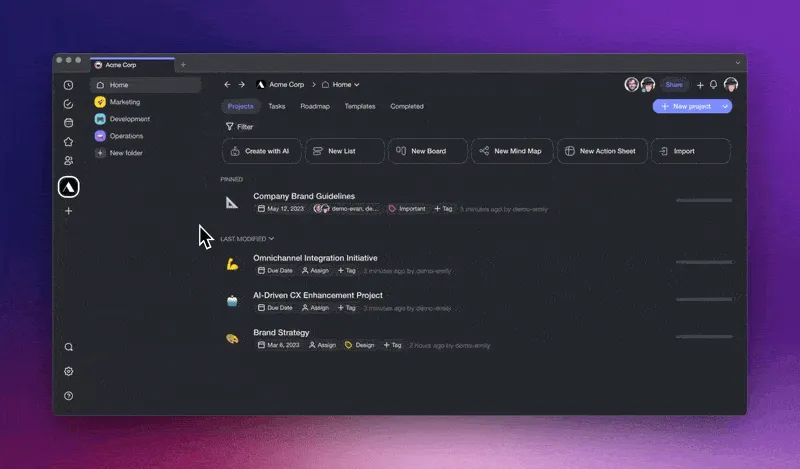
Memory feeds Intelligence. Intelligence triggers Execution. Execution creates new Memory. It is a self-reinforcing loop, and it is what a workflow-first operator actually runs on. Read the Workspace DNA architecture post for the deep dive.
The Full Taskade Genesis Capability Map (What Actually Ships)
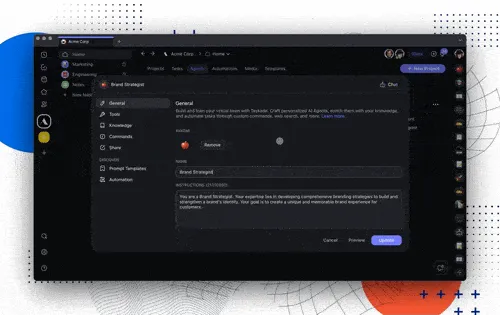
Operators routinely ask "is it really everything in one workspace?" Here is the answer, mapped to the three DNA layers:
| DNA Layer | Ships Today (April 2026) | Where it lives |
|---|---|---|
| ▲ Memory | multiple project views (List/Board/Calendar/Table/Mind Map/Gantt/Org Chart) · multi-layer search (full-text + semantic + OCR) · real-time OT collaboration · version history · file memory with OCR | Projects + Workspace |
| ■ Intelligence | Agents v2 with custom tools, slash commands, @-mention, persistent memory, public embedding · built-in tools + custom tool builder · EVE (meta-agent) with self-planning, ask-questions, tool-call UI · frontier models from top AI labs · multi-agent teams (Fan-out, Chain, Debate) | Agents v2 + EVE |
| ● Execution | Durable automations with branching/looping/filtering · 100+ integrations across 10 categories (Salesforce, Notion, Slack, Google Workspace, Shopify, Stripe, GitHub, Linear, Discord, etc.) · Taskade Genesis apps with custom domains, password protection, built-in OIDC/SSO · hosted MCP server on every paid plan · Community Gallery publishing | Automations + Genesis apps |
Every Layer-2 and Layer-3 win in this post routes through one or more rows of that table. The reason Taskade Genesis operators out-leverage "ChatGPT + Zapier + Notion" operators is not model quality — it is that the three layers live inside the same workspace instead of being glued together with webhook duct tape.
This is Bill Atkinson's HyperCard principle in 2026 dress: every operator becomes a creator (Taskade Genesis compiles a prompt into a running app), every creation becomes a discovery surface (public URL + Gallery), and the surface feeds Memory back into the loop. One workspace, one URL, one compounding asset.
The Ten Plays
Each play is one lever. Running all ten is a quarter of work. Running three of them is a weekend.
▲ ■ ● Hormozi's Five AI Hygiene Rules (Read These Before Play 1)
Alex Hormozi's April 2026 frame ("Get Rich in the AI Revolution") names five hygiene rules every operator running these ten plays should internalize first. The plays describe what to do; Hormozi describes how to use AI without burning yourself.
| # | Rule | What it means in practice |
|---|---|---|
| 1 | Start a new chat per topic | "For every time that you want to ask anything that is not related to the question before, you want to start a new chat." Context decay is real and silent. |
| 2 | Iterate within the chat | "Your fourth answer on a string is going to be superior to the first answer. Again, the big C-word is context." Push to perfection inside a thread before opening a new one. |
| 3 | Verify facts | "If there's numbers in there or it says a study, make sure that you just double-check it." AI is a research-and-drafting partner, not a citation. |
| 4 | Outsource typing, not thinking | "Decision-making is still yours… You'll still be rewarded by the quality of your judgment and your taste. So what we want to really have AI do is outsource the typing." |
| 5 | The idea is the alpha | "The idea is still the alpha. So your idea from a content, from a sales message, from an offer, the idea is still the alpha." |
Rules 4 and 5 are why workflow-first beats role-first. The role-first operator hires a person to type the idea up. The workflow-first operator writes the prompt once, saves it as a Genesis SOP Project, and types nothing for the next 100 iterations. The prompt is the SOP — Hormozi's exact framing: "Translate SOP to prompt. It is the same thing… What do you think a prompt is? You're giving them the operating procedure to get an output."
Play 1 — List every task you touched last week at the most granular level
Not "I ran ads." That is a bucket. Drill down: "I drafted three headline variations, I checked CPC against last week, I paused one underperformer, I wrote a replacement creative, I requested a new landing page, I reviewed yesterday's leads, I wrote the follow-up email template, I tagged each lead by source, I forwarded high-intent leads to the sales Slack channel, I built the weekly performance slide."
Ten tasks inside one "role." Each of those ten is a candidate for a workflow. That is the first chart you draw before doing anything else.
Play 2 — Sort every task into Judge, Route, or Run
| Task Type | What it is | Who should do it in 2026 |
|---|---|---|
| Judge | Decisions requiring taste, risk, or relational context | Human (you) |
| Route | Deciding where a piece of work goes next | Agent or simple rule |
| Run | Executing a known recipe against known inputs | Automation or agent with tools |
The Run row is where 60–80% of most knowledge work sits. It is the row that disappears first.
Play 3 — Build the first workflow this weekend, not this quarter
Pick one Run-row task. Paste its steps into Taskade Genesis as a prompt. Get a working first version live in under four hours. You will not like it. Iterate. Version 4 will be 5× better than version 1 — not because the model got smarter, but because your prompt and your data sources got sharper. (This is Hormozi's "fourth answer on a string" observation, and it holds for every agent you will ever build.)
In The Nvidia Way, Tae Kim documents how NVIDIA CEO Jensen Huang refuses to run a planning calendar at all: "We don't do a periodic planning system... There's no five-year plan. We just plan continuously." Strategy is what an organization does, not the deck it presents. The workflow-first operator runs the same way — you ship the first version this weekend and let continuous iteration set direction, which is why execution beats fundraising and a planning quarter every time.
Play 4 — Train every agent with at least 16 examples of your best past work
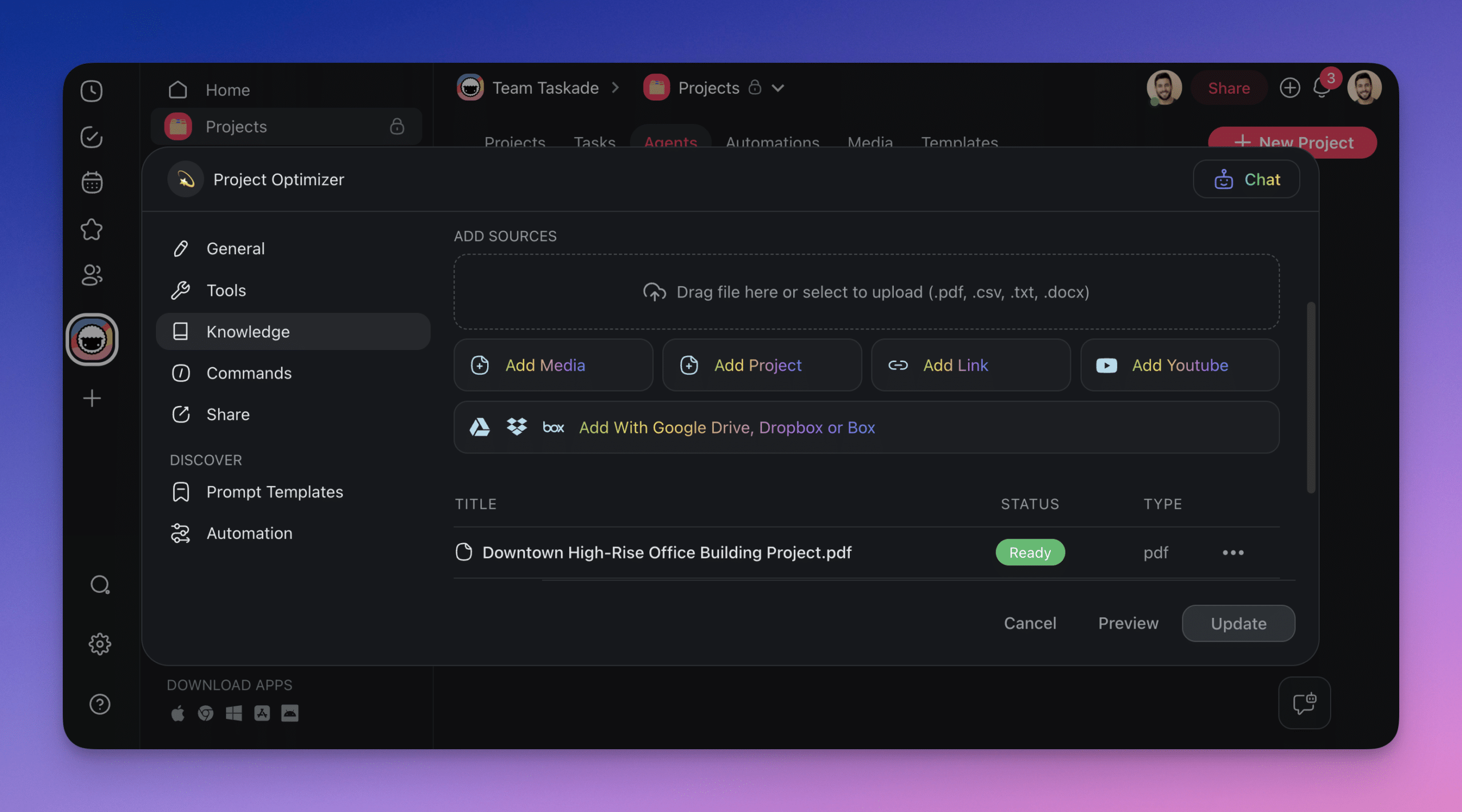
Agents default to "sounding like the internet" because they were trained on the internet. Give them 16 writing samples from your own archive and they will sound like you instead. Fifteen is not enough. Thirty is fine. Sixteen is the number where voice locks in reliably. Store the examples in the agent's persistent memory, not in the prompt — memory compounds across sessions, prompts do not.
Play 5 — Build asset chains, not one-off prompts
A sales call transcript is not just a transcript. It becomes: a gold-standard script → a VSL → a newsletter → an objection-handling library → a lead-qualification rubric → a coaching doc for the next hire. Seven outputs from one input. Every asset you build should feed the next one.
This is what durable execution workflows were built for — one transcript, seven outputs, no human glue.
Play 6 — Target realistic leverage ratios (4× – 8×), not "infinite"
Hype says 100× leverage overnight. Reality is 4–8× on the tasks AI genuinely shortens, and 1× on the ones it does not. The operators who win are not the ones who believed the hype — they are the ones who mapped which tasks fall into which bucket.
| Workflow | Old time | New time | Real leverage |
|---|---|---|---|
| Internal weekly memo | 60 min | 15 min | 4× |
| Long-form YouTube script from outline | 120 min | 15 min | 8× |
| Daily social posts (5/day) | 90 min | 12 min | ~7× |
| Sales-call follow-up email | 20 min | 2 min | 10× |
| Customer-support first-pass reply | 10 min | 1 min | 10× |
| Strategic pricing decision | 4 hrs | 4 hrs | 1× |
| Hiring a senior executive | weeks | weeks | 1× |
The win is stacking 4× – 8× leverage across 30 tasks, not dreaming of 1000× on one.
Play 7 — Publish workflows as Genesis apps, not screenshots in Slack
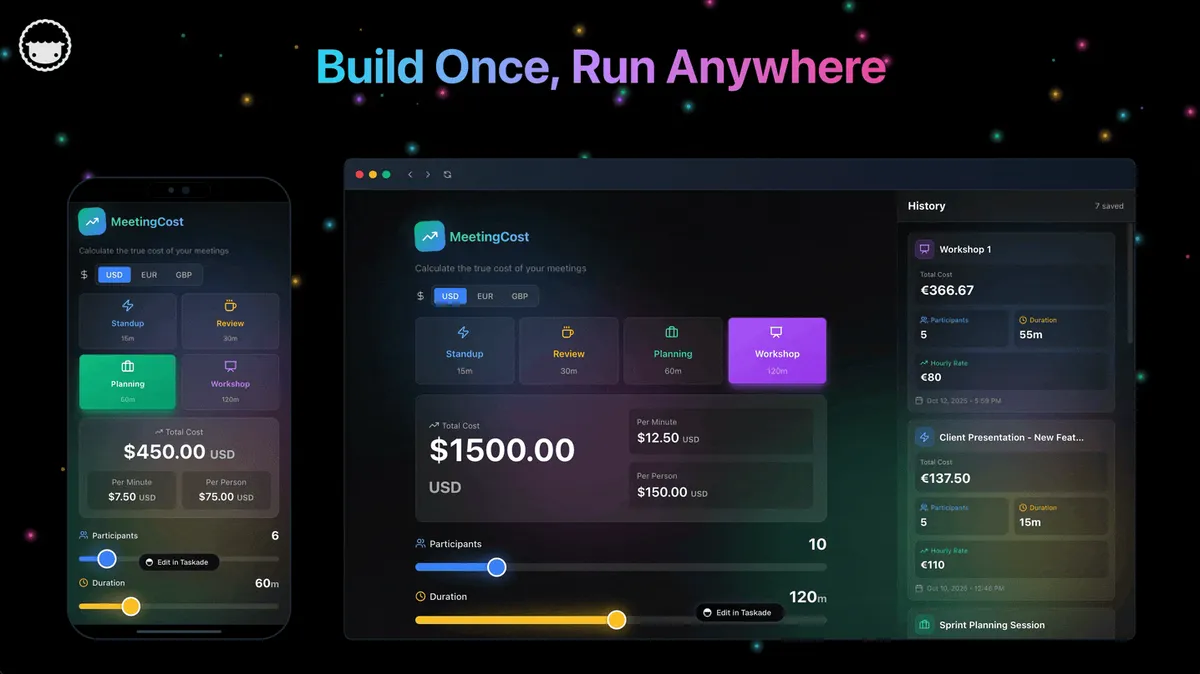
A workflow buried inside one operator's brain is a liability. A workflow published as a Taskade Genesis app with custom domain, password protection, and an OIDC-backed auth layer is a shipped asset. Your team runs it. Your clients run it. Your successors run it. That is the difference between tribal knowledge and institutional leverage.
Play 8 — Run the barbell strategy
On one end of the barbell: high-conviction AI-native plays. Build the AI-first company. Replace the three-person ops team with six agents. Ship before incumbents wake up.
On the other end: bets on things that will not change. Humans will have bodies — healthcare, fitness, supplements will exist. Humans will have leisure — entertainment will exist. Humans will need to eat and sleep somewhere — food and shelter will exist. Skip the middle. The middle is where the 2026 casualties pile up.
Play 9 — Pay yourself first in compounding assets
A $20,000 month of revenue is nice. A $20,000 month of revenue plus a tuned outreach agent, a tuned objection-handling agent, and a six-workflow Genesis app is generational. One is cash. The other is cash plus infrastructure that keeps producing cash. In 2026 the infrastructure line compounds. The cash line does not.
Play 10 — Close the 20-hour gap
"It takes about 20 hours to become proficient in any new skill — but people delay the first hour by decades." Hormozi's tweet, but it holds for every operator reading this. Book the weekend. Open Taskade. Build the first app. Version 4 will already be useful. Version 40 will be your moat.
▲ ■ ● The Refound Test (Howie Liu's Binary)
Every operator who already runs a business should run themselves through Airtable CEO Howie Liu's refound test at least once a quarter:
"If you were literally founding a new company from scratch with the same mission, how would you execute on that mission using a fully AI-native approach? If you can't, then you should find a buyer — and then if you really care about this mission, like go and start the next carnation of it."
— Howie Liu, CEO of Airtable, Lenny's Podcast (Aug 2025)
The test isn't theatre. Liu used it to refound a 14-year-old company and to justify spinning Superagent and Hyperagent out as standalone product brands — explicitly acknowledging that some agent-shaped surfaces deserved separate IA, separate URLs, separate pricing.
For operators reading this post, the test compresses to a one-screen worksheet:
┌──────────────────────────────────────────────────────────────────┐
│  THE REFOUND WORKSHEET (15 minutes, once a quarter)             │
├──────────────────────────────────────────────────────────────────┤
│  1. If I started this business today as AI-native, what would   │
│     it look like?                                                │
│                                                                  │
│  2. Which of my current primitives accelerate that build?       │
│     (Brand, distribution, customer relationships, data)         │
│                                                                  │
│  3. Which of my current primitives are dead weight?             │
│     (Org chart, dev shop contracts, custom infra, headcount)    │
│                                                                  │
│  4. Net answer — refound, sell, or transition?                  │
│                                                                  │
│  5. If refound: what is the v1 of the AI-native product, and    │
│     when does it ship? (Liu's bar: "drop your jaw" quality;     │
│     near-weekly cadence, not quarterly.)                        │
└──────────────────────────────────────────────────────────────────┘
The companion play to the test: Liu also explicitly told his EPD organization that anyone who wanted to cancel a full week of meetings to play with every AI product on the market should just go do it. That permission is the cheapest way to widen the team's tasting menu, and the operators who grant it compound faster than the ones who don't.
Anthropic's 1-Person Marketing Department (And How to Copy It)
Anthropic famously runs a marketing function with about one human. That is not marketing puff — the one human is not doing everything solo. The one human is orchestrating agents and automations that do what a 15-person department used to do.
This is the BYOA pattern in its final form: a single operator who arrives at a company with a portable agent stack and replaces a department. The agents onboard with the company's workspace, ingest its brand voice from past campaigns, run the outreach/content/analytics loops, and report into the human for strategy and approval.
The whole model is explored in BYOA: The $1M-Per-Employee Era. It is the single most consequential shift in how labor gets priced in 2026.
The Phase Shift (Why the 2026 Window Closes)
Brian Johnson's frame, via Hormozi: most operators have trained their whole lives to swim. Pool, lake, coast, ocean — you keep getting better at swimming. The phase shift is when the water boils off into gas. You flap your arms. Your swimming skill is intact. It just does not apply to the new medium.
▲ ■ ● The Karpathy Loop in Practice — Real Operators Are Already Compounding
Karpathy's "auto-research loop" (April 2026) formalizes what the most leveraged AI-first operators are already doing informally: one editable file, one objective metric, one fixed time budget. Run an agent over its own harness 700 times. Accept the runs that beat the previous best. Repeat overnight.
| Operator | Experiments | Speedup | Mechanism | Compute |
|---|---|---|---|---|
| Karpathy (March 2026) | 700 in 2 days | 11% | nanochat training pipeline | Single consumer GPU |
| Tobi Lütke (Shopify CEO) | 37 in 8 hours | 19% | Internal Shopify data harness | Internal cluster |
| SkyPilot | 910 in 8 hours | Width-scaling discovery | 16-GPU Kubernetes cluster | Under $300 total |
| Third Layer (auto-agent) | continuous | Benchmark #1 | Meta-agent rewriting harnesses | YC startup, small team |
Source: Andrej Karpathy auto-research / Sequoia AI Ascent April 20, 2026.
A fifth row belongs in that table: Howie Liu, CEO of Airtable, who reorganized his entire 14-year-old company into "fast-thinking" and "slow-thinking" halves to ship AI capabilities near-weekly while still running a HyperDB-scale enterprise stack. Standing 1:1s cancelled. Hourly Claude usage. 30 parallel Claude Code instances. The full IC-CEO playbook is in the history of Airtable — and the Omni → Superagent → Hyperagent product trilogy that came out of it is the clearest proof in 2026 that a public-capable, decacorn-era SaaS company can ship at AI-native speed if the CEO is willing to refound it.
The point isn't the percentages. It's the principle: operators who let an agent re-run the harness while they sleep compound at a different rate than operators who hand-tune. Inside Taskade Genesis, the same pattern looks like an Agent v2 with custom tools running scheduled Automations against a Project of metric snapshots — the workspace is the harness. This is the loop the 2026 window closes around.
The same continuous-execution discipline scales all the way up. Look at how Jensen Huang runs NVIDIA: no five-year plan, a flat org that attacks problems in the room, and a benchmark set against physics itself rather than last year's numbers. It is the same workflow-first instinct — route the work, run it continuously, judge the output — operating at the scale of the company that powers the AI era. And it is why the deeper lever is always the system you run, not the prompts you collect.
"Vibe coding is about raising the floor for everyone in terms of what they can do in software. Agentic engineering is about preserving the quality bar of professional software."
— Andrej Karpathy, Sequoia AI Ascent, April 20 2026.
2026 is the last year where humans with better tools still beats humans with worse tools on roughly equal terms. Starting in 2027, the baseline capability of agents lifts another step, and the spread between operators who built workflows and those who did not stops being a skill gap — it becomes structural. The catchable window closes.
Good news: this is not doom. It is the last easy window. 20 hours now replaces 200 hours in 2027. If you are reading this, you are already ahead of the 60%+ of operators who are still debating whether AI is real.
Your Monday Morning Playbook (45 minutes, 5 actions)
┌──────────────────────────────────────────────────────────────────┐
│  09:00 — Open Taskade. Create a new Project called "Task Audit" │
│  09:05 — List every task you touched last week at granular level│
│  09:20 — Paste the list into a Taskade Genesis prompt: "Rank the top 3  │
│          most automatable tasks and draft workflows for each."  │
│  09:30 — Pick the top 1. Build the workflow live.               │
│  09:45 — Ship the v1. Review Friday. Iterate over weekend.      │
└──────────────────────────────────────────────────────────────────┘
That is it. Five actions. Forty-five minutes. The entire playbook compresses to this one screen. Every operator who did this between 2023 and 2025 now has a compounding asset. Every operator who does it in April 2026 will too. Every operator who waits until 2027 will look up and wonder what happened.
Start your first workflow in Taskade Genesis →
▲ ■ ● Taskade Genesis in Practice — The Full Capability Stack
Every workflow-first play above maps onto one or more Taskade Genesis capabilities. This is the full stack the 2026 operators are running on, at the feature level.
▲ ■ ●   Memory  · multiple project views · agent knowledge · workspace DNA
▲ ■ ●   Intel   · built-in tools · custom slash commands · hosted MCP server
▲ ■ ●   Exec    · 100+ integrations · durable retries · App Kits
▲ ■ ●   Ship    · custom domains · password protection · OIDC/SSO
▲ ■ ●   Share   · Community Gallery · 150K+ live apps · one-click clone
What Taskade Genesis ships that code-generators and automation-tools don't
| Capability | Taskade Genesis | Lovable / Bolt / v0 | Zapier / n8n / Make |
|---|---|---|---|
| Persistent Memory across sessions | ✓ (as Projects) | ✗ | ✗ |
| Agents with custom tools + slash commands | ✓ | ✗ | ~ (single-agent) |
| 100+ bidirectional integrations | ✓ | ✗ (deploy only) | ✓ (one-way glue) |
| Durable execution (retry, timeout, idempotency) | ✓ (durable execution) | ✗ | ~ (varies) |
| Multiple live project views (same data) | ✓ | ✗ | ✗ |
| Hosted MCP server (clients connect in) | ✓ | ✗ | ✗ |
| Custom domains + auth + password protection | ✓ | ~ (host only) | ✗ |
| Community Gallery of 150K+ cloneable apps | ✓ | ✗ | ✗ |
This table is the moat. Code-generators create files; Taskade Genesis creates deployed, intelligent, living systems. Automation-tools glue apps; Taskade Genesis is the app. Read how Taskade Genesis differs from AI App Builders →
What Winning Actually Looks Like in 2026
Pull back to the whole board.
Four weeks. One playbook. Every block downstream of the last.
The Three Companion Reads (Deep Dives)
| Topic | Post |
|---|---|
| The compensation model shift | BYOA: The $1M-Per-Employee Era |
| The org-chart rewrite | From Roles to Workflows: The AI Org Chart |
| How to actually train your agents | Training AI Agents Like Employees |
And for further context, read these adjacent posts from the April 2026 drop:
- The Workspace DNA Architecture — the technical substrate
- Genesis Compilation: Prompt to Deployed App — what "build an app in one prompt" actually means
- Multi-Agent Collaboration in Production — lessons from 500,000+ agent deployments
- Durable Execution AI Workflows — why your automations need to survive a retry
- AI App Builders vs Workspace Builders — the category split defining 2026
- Micro App Economy State of Category — 150,000 apps built, what came of them
- One-Person Companies: Future of Work — the solo operator model this playbook enables
- The 2026 Productivity Playbook hub — the curated /productivity page where this pillar and all three companions live alongside the Agents, Automation, and Genesis sections
Glossary Deep Dives
The vocabulary behind this playbook, explained from first principles:
- Agentic AI — the paradigm that makes workflow-first possible
- Tool Use and Function Calling — how agents actually reach your stack
- ReAct Pattern — the loop running inside every good agent
- Planning and Reasoning — how agents decompose a goal
- Agentic RAG — why your agents need real context, not just prompts
- Model Context Protocol and the Taskade MCP Server — the open standard that lets Claude Desktop, Cursor, and VS Code drive your workspace
- Ask Questions Tool — how EVE pauses a build to ask instead of guessing
- Taskade Genesis Auth and App Users — how every app you ship gets sign-in and user management without writing auth code
The Only Question Left
You either take the weekend and build the first workflow — or you read one more article next Monday, and one more after that, and eventually wake up in 2028 wondering where the leverage went. The operators who are winning in 2026 made this exact choice sometime between 2023 and today. The water has not boiled yet. But it is getting warm.
Open Taskade Genesis and build your first workflow →
▲ ■ ● Workflow-first. Always.
Frequently Asked Questions
What does it mean to win with AI in 2026?
Winning with AI in 2026 means running workflow-first instead of role-first. Operators who win rewrite every job description as a chain of discrete tasks, then route each task to the best executor — a human, an agent, or an automation. Taskade Genesis is the canvas most operators use because it keeps Memory (Projects), Intelligence (Agents), and Execution (Automations) in one workspace instead of gluing five SaaS tools together.
What is workflow-first thinking?
Workflow-first thinking replaces "who owns this role" with "what are the inputs, the transformation, and the outputs." Instead of hiring an editor, you list the eight things an editor does — transcription, rough cut, color grade, captions, thumbnail, publish, tag, analytics — and ask whether each step can live inside a workflow, not a headcount. Agents and automations handle the repeatable steps. Humans keep the judgment steps.
Why do AI-first startups have higher revenue per employee?
AI-first startups hit $1M-$3M+ ARR per employee because they never built the organizational coordination tax in the first place. Lovable reached roughly $2.7M ARR per employee at its Series A. Midjourney runs around $18M per employee. The pattern: start workflow-first from day one, use agents for repeatable work, and keep humans on judgment, taste, and risk-taking. Adding humans later is a last resort, not a default.
What are the three folders every AI-first operator needs?
Every AI-first operator keeps three folders. First, Business Context — mission, offer, pricing, customer profile, tone. Second, an SOP or prompt repository — the recipes that turn inputs into outputs. Third, Data Sources — transcripts, past emails, sales calls, prior work that agents can reference. In Taskade these three folders are Workspace, Agents, and Project memory — the Workspace DNA triangle of Memory, Intelligence, and Execution.
How many hours does it take to become proficient with AI tools?
Roughly 20 focused hours gets most operators to useful fluency with AI tools. The trap is not the 20 hours — it is the first hour, which people delay by decades. Taking one weekend to build a working Taskade Genesis app, wire one automation, and onboard one agent produces more learning than a month of articles. The cost is a weekend. The return compounds for years.
What is BYOA and why does it matter in 2026?
BYOA stands for Bring Your Own Agent. It is the emerging compensation model where operators show up to a business with their own pre-trained agents and automations, not just their labor. A BYOA marketer who arrives with a working outreach agent, content agent, and analytics agent can replace a five-person marketing team. The economics rewrite hiring, pricing, and equity allocation. Taskade Genesis is where most operators build and park their BYOA stack.
What is the barbell strategy for AI bets?
The barbell strategy means making two kinds of bets at the same time. On one end, high-conviction, high-reward AI-native plays — automate everything automatable, build AI-first companies, ship before the incumbents wake up. On the other end, bets on things that will not change — food, shelter, healthcare, entertainment. Skip the middle. Avoid businesses that have neither AI leverage nor durable human demand.
How do you train an AI agent to match your voice and judgment?
Train agents the way you would train a new employee. Give them a written role, access to the tools they need, a SOP Project with 16+ examples of your best work, and a feedback loop where you accept or reject outputs. Over 100 iterations the agent locks onto your taste — faster than any human could. In Taskade this lives in Agents v2 with persistent memory and custom tools, so training compounds across sessions instead of evaporating when a chat closes.
What should every operator do Monday morning to get started?
First, write down every task you touched last week at the most granular level. Second, paste that list into a Taskade Genesis prompt and ask which three tasks are safest to automate. Third, build the first workflow today — not next quarter. Fourth, check the output the same way you would review a new hire's first deliverable. Fifth, iterate. A weekend of this replaces six months of reading about AI.
Why is the 2026 window closing faster than 2024 or 2025?
Because this is the last cycle where humans-with-better-tools still beat humans-with-worse-tools on equal terms. Once the baseline capability of agents lifts another step, the spread between operators who built workflows and operators who did not becomes structural, not catchable. The window is not doom — it is the last easy window. 20 hours now beats 200 hours in 2027.
What are the 5 AI hygiene rules every operator should follow?
Alex Hormozi named the cleanest set in his April 2026 frame. Rule 1, start a new chat for every new topic — context decay is silent. Rule 2, iterate within the chat — your fourth answer beats your first because context compounds. Rule 3, verify facts and figures — AI is a drafting partner, not a citation. Rule 4, outsource typing, not thinking — decision-making and taste stay yours. Rule 5, the idea is the alpha — a sharp idea typed by AI beats a generic idea typed by a human. The unifying frame: the prompt is the SOP. Standardized prompts run by AI agents are the operating procedures of the AI era. Inside Taskade Genesis, store reusable prompts in a SOP Project and feed them to Agents v2 with persistent memory.
What is a Karpathy loop and should an operator run one?
The Karpathy loop is an auto-research pattern named for Andrej Karpathy's April 2026 work. The structure is minimal: one editable file, one objective metric, one fixed time budget. A meta-agent runs experiments over its own harness, accepts any run that beats the previous best, and repeats overnight. Karpathy reported an 11% speedup from 700 experiments on his own training pipeline. Shopify CEO Tobi Lütke replicated the pattern with 37 experiments and reported a 19% gain in 8 hours. SkyPilot ran 910 experiments on 16 GPUs for under $300. The principle for AI-first operators is that the meta-agent compounds while you sleep, which moves the leverage frontier faster than hand-tuning. Inside Taskade Genesis, the same pattern looks like an Agent v2 with custom tools running scheduled Automations against a Project of metric snapshots — the workspace is the harness.