






A software company called Midjourney generates roughly $18 million in ARR per employee. Cursor crossed $1B annualized with a team small enough to fit in one meeting room. Lovable hit approximately $2.7M ARR per head at its Series A. Anthropic runs a marketing function with about one human.
These are not outliers. They are the leading edge of a structural shift, and the shift has a name.
TL;DR: BYOA — Bring Your Own Agent — is the emerging compensation model where operators arrive with pre-trained agent stacks instead of raw labor. It unlocks $1M to $18M+ ARR per employee by replacing coordination-heavy departments with orchestrated agent workflows. The playbook, the pricing, and the five-layer stack are all below. Taskade Genesis is the canvas most BYOA operators ship on.
This is the first companion post to the Win With AI in 2026 pillar. Read that one first if you want the full frame.
What Is BYOA? (The Answer-First Version)
BYOA stands for Bring Your Own Agent. It is what happens when "bring your own device" meets agentic AI: operators show up to a business with their own portable, pre-trained AI stack, not just their labor.
BYOA splits cleanly into two tiers that most coverage conflates:
| Tier | Who it is for | The portable artifact | Example |
|---|---|---|---|
| Platform-BYOA | End-users, operators, ops teams | An Agent stack (Taskade Agents v2, Dharmesh Shah's "Agentic UX" / AUX surfaces) | A fractional marketing operator arrives with an outbound agent |
| Developer-BYOA | Engineers building software | An SDK/protocol connection (MCP, Anthropic's Agent Client Protocol, OpenAI SDK) | A dev's agent runs across Cursor, VS Code, and Warp via MCP |
Taskade Genesis plays both sides: it is a Platform-BYOA canvas for operators and exposes a hosted MCP server on every paid plan so developer-BYOA agents can plug in. The same workspace is the runtime for both tiers.
The terminology is hardening fast. Dharmesh Shah coined AUX (Agentic UX) as the consumer-surface label for what this post calls Platform-BYOA. Expect AUX, BYOA, and "agent mesh" to show up on every vendor's slide deck by Q3 2026.
The old contractor model:
┌───────────────────────────────┐
│  Old Contractor / Freelancer  │
│  ─────────────────────────    │
│  Brings: time, skill          │
│  Pricing: hourly              │
│  Asset: reputation            │
│  Scaling: linear with hours   │
└───────────────────────────────┘
The BYOA model:
┌───────────────────────────────────────┐
│  BYOA Operator                        │
│  ─────────────────────────────────    │
│  Brings: agent stack + judgment       │
│  Pricing: outcome / retainer          │
│  Asset: reusable workflow library     │
│  Scaling: compounding, not linear     │
└───────────────────────────────────────┘
The same human shows up to the same client. But the unit of value has changed. One sells hours. The other sells a living system that produces hours.
The $1M-Per-Employee Math
Why now? Because the arithmetic finally clears. And the numbers are not cherry-picked — they are the operating ratios of the companies currently reshaping the software industry.
The AI-First Revenue-Per-Employee Benchmark Table
| Company | ARR (est.) | Headcount | ARR / employee | Pattern |
|---|---|---|---|---|
| Midjourney | ~$200M+ | ~11 | ~$18M / head | Workflow-first from day one, near-zero sales team |
| GitHub Copilot (unit) | ~$500M | ~120 on Copilot | ~$4.2M / head | Embedded-product attach inside a mature dev surface |
| Cursor / Anysphere | ~$1B annualized | ~80–100 | ~$10M+ / head | AI-native dev tools, agent-assisted everything |
| Perplexity | ~$150M+ | ~50 | ~$3M / head | AI-first search with automated index pipelines |
| Lovable | ~$50M+ at Series A | ~18–20 | ~$2.7M / head | Vibe-coding stack, automation-heavy ops |
| OpenAI (product-eng) | ~$5B+ ARR | ~4,500 | ~$1.1M / head | Platform at scale; BYOA substrate for others |
| Legacy SaaS benchmark | (weighted avg) | — | $200K–$400K / head | Role-first org; coordination tax is the bottleneck |
The 3×–90× gap between legacy SaaS and AI-first is not effort. It is structure. Legacy teams spend most hours coordinating. AI-first teams compress coordination into automation and use human hours for the judgment-heavy ~20% that still requires taste.
The ARR/FTE Era Ladder (Three Decades, Three Orders of Magnitude)
┌────────────────────────────────────────────────────────────┐
│  ERA               TYPICAL ARR / FTE    EXAMPLES           │
├────────────────────────────────────────────────────────────┤
│  Pre-SaaS          $70K – $200K         Shrink-wrapped sw  │
│  2000 – 2010                                                │
├────────────────────────────────────────────────────────────┤
│  Classic SaaS      $200K – $350K        Salesforce, Box    │
│  2010 – 2020                                                │
├────────────────────────────────────────────────────────────┤
│  AI-First          $1M – $18M           Lovable, Midjourney│
│  2022 – now                             Cursor, Perplexity │
└────────────────────────────────────────────────────────────┘
Three orders of magnitude in roughly twenty years. The 2022→2026 step was the largest single jump, and it was caused by exactly one thing: workflow-first operators arriving with BYOA stacks that compressed coordination cost to near zero.
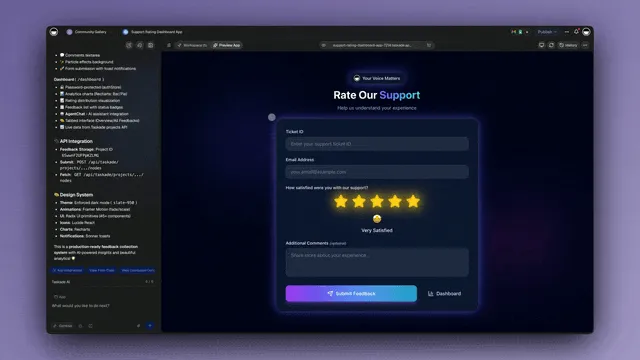
Platform-side validation: Airtable CEO Howie Liu publicly states he is the largest individual inference-cost user of Airtable AI globally — across all customers, not just internal. He runs 30 parallel Claude Code instances coupled to browsers and recently spent ~$150 in tokens on a single board memo that earned him "best memo I've ever written" feedback from his investors. The full IC-CEO playbook lives in the history of Airtable. The pattern: CEOs and operators who BYO their agents into every meeting beat companies whose agents are gated by IT.
The "Agents Take Unintended Actions" Guardrail
SailPoint's 2026 AI security survey reported that 80% of organizations running production agents have seen those agents take at least one unintended action — wrong tool call, wrong permission, wrong customer. Only 44% have formal AI governance in place. BYOA amplifies this if operators don't scope tool access carefully. Taskade Agents v2 mitigate by default: workspace-scoped memory, explicit tool whitelist, human-in-the-loop on external side effects. This is the less-glamorous half of why Taskade Genesis operators sleep at night.
The SDK Market-Share Shift (Lock-in Is Dead)
One proof point the BYOA SERP undersells: the Anthropic-SDK to OpenAI-SDK ratio in public code search moved from roughly 47:1 in January 2024 to roughly 2.8:1 in March 2026. The moat is not the API — it is the workflow. Operators with a portable BYOA stack don't care which model is state-of-the-art this quarter, because the stack runs on whichever model is best-priced and best-performing. Taskade auto-routes across frontier models from top AI labs for exactly this reason.
A BYOA operator — even one — can port this structure into any legacy business. That is why the model is eating contracting and consulting faster than anyone predicted.
▲ ■ ● The BYOA Operator's Daily Flow
What a BYOA operator actually looks like inside Taskade on a Tuesday morning — ASCII-level, no slideware:
  08:00  Operator arrives.
         Opens Taskade workspace brought from last engagement.  08:01  ▲ MEMORY loads:
- projects/client-alpha        (SOPs + past deliverables)
- projects/memories/brand      (voice, tone, do-not-say list)
- agent knowledge              (files, YouTube, PDFs, OCR)
  08:02  ■ INTELLIGENCE wakes:
- Outreach Agent (Claude Opus, email tool + CRM)
- Content Agent  (Gemini, research + writing)
- Analytics Agent (GPT, SQL + charts)
  08:03  ● EXECUTION fires:
- Automation: pull overnight Stripe charges -> Slack summary
- Automation: triage client inbox -> drafts in Projects
- Automation: post yesterday's content -> LinkedIn + X
- All powered by durable execution. Retries survive operator sleep.
  08:05  Operator reviews the 4 drafts. Approves 3, rewrites 1.
08:30  Moves to client Zoom. Workspace works while they talk.
The BYOA operator's real value is not the 30-minute review. It's the 22 hours a day the stack runs without them.
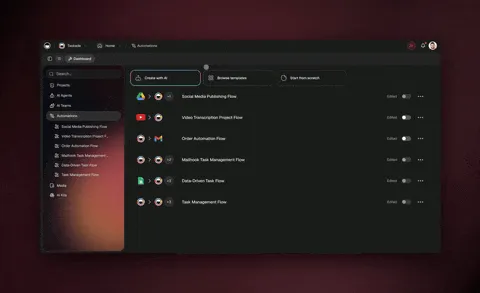
The Five-Layer BYOA Stack
A mature BYOA stack has five layers. Skip one and the whole thing leaks.
Layer 1 — Trained Agents
This is the moat. A generic GPT wrapper is not a BYOA stack — it is a demo. A BYOA agent has been trained on 16+ samples of the operator's best work, has persistent memory across sessions, has access to a curated tool set, and produces output indistinguishable from the operator at their best.
In Taskade this lives in Agents v2 with custom tools, slash commands, and persistent memory.
Layer 2 — SOP / Prompt Library
The recipes. Every workflow the operator has ever run, written once, stored once, referenced by every agent forever. This is what stops the operator from having to re-explain the job every time a new context window opens.
Layer 3 — Data Sources
Your evidence. Sales transcripts, customer emails, past campaigns, prior apps shipped. The more data, the harder the agent is to match. A competitor with the same model weights and a sharper prompt will still lose to you if you have five years of your own archived work.
Layer 4 — Automations
Durable, retry-safe workflow execution. A BYOA stack without automations is just a better copywriter. A BYOA stack with automations is a department. The durable execution engine behind Taskade Automations is how single-operator agencies handle client workloads that used to require a five-person ops team.
Layer 5 — Published App
This is what the client sees. A Taskade Genesis app with custom domain, password protection or SSO, and real UI. Not a Notion doc. Not a shared Slack channel. A working product the client can log into and use. That is what justifies a five-figure monthly retainer for work that previously cost $500/hour at an agency.
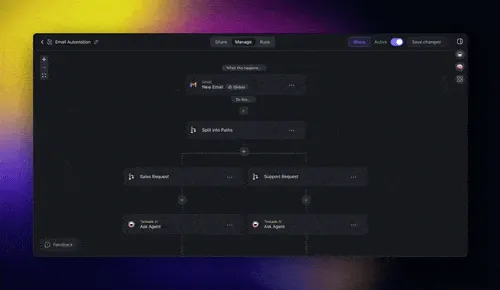
The BYOA × Taskade Genesis Capability Fit
Most BYOA thinkpieces describe the model without pointing to a canvas where the whole stack actually runs. Here is the exact feature-to-layer map.
| BYOA Layer | Taskade Genesis capability | Why it matters for BYOA |
|---|---|---|
| Trained Agents | Agents v2 with custom tools, slash commands, @-mention, persistent memory, public embedding | The agent is portable; memory compounds per client |
| SOP / Prompt Library | Projects with multiple views + real-time OT collaboration | Living SOPs, not dead Notion docs |
| Data Sources | Workspace-scoped memory + multi-layer search (full-text + semantic + OCR) | Client data stays workspace-local; no leak risk |
| Automations | Durable execution engine with branching/looping/filtering + 100+ integrations | Automations survive retries, don't half-fire |
| Published App | Taskade Genesis apps with custom domain, password, built-in OIDC/SSO | Client-facing surface that justifies five-figure fees |
| Distribution | Community Gallery (150,000+ apps) + Clone button | Productize the stack once it hits repeatability |
| Multi-tier tooling | Plays both Platform-BYOA (operators) and Developer-BYOA (hosted MCP server) | One workspace, two tiers, no tool sprawl |
Pricing a BYOA Engagement
Stop pricing on hours. Start pricing on what you replace.
▲ ■ ● Daniel Priestley's Prompt-as-SOP Rule
Daniel Priestley's April 2026 framework draws a line BYOA operators should internalize before they price their first engagement: the prompt is the SOP. The standard operating procedure of the previous decade was a Notion doc with 47 bullet points. The SOP of the AI era is a prompt that, when fed to the right agent against the right context, produces the same output every time. The doc is a recipe a human reads. The prompt is a recipe an agent runs.
What changes in BYOA pricing when this is true: you stop billing for the execution (the agent does that for cents) and start billing for the prompt library — the operator's taste, codified. A typical BYOA engagement now ships a Taskade Genesis workspace containing 10–30 SOP prompts, each tested against 16+ examples of the client's best work. The operator's moat is the catalog of prompts. The agent runs them. The customer keeps the workspace.
"Don't use AI as a search tool. Give AI your hardest problem." — Daniel Priestley, April 2026.
"Passive income ultimately comes from assets. It's not passive income — it's asset income." — Daniel Priestley, April 2026.
The Hormozi corollary makes the same point at the pricing layer: "What you will get is amplification, not automation. You will get more leverage, not infinite leverage." — Alex Hormozi, April 2026. BYOA pricing reflects amplification, not infinite leverage. You charge for what the prompts unlock; you do not promise the agent will run forever without supervision.
A short pricing rule that follows: charge per SOP-Prompt installed, not per hour spent installing. An engagement is "10 prompt SOPs deployed in 30 days" — not "60 hours of consulting." This is how operators avoid the dev-shop trap that Jon Cheney's case study warns about: sell the system, not the build.
┌────────────────────────────────────────────────────────────────────────┐
│  PRICING ANCHOR: What a BYOA engagement REPLACES                       │
├────────────────────────────────────────────────────────────────────────┤
│                                                                        │
│  Marketing team of 5 @ $80K avg fully-loaded → $500K/year              │
│  → BYOA retainer @ $8K–$15K/mo = $96K–$180K/year                       │
│  → Client saves $320K–$400K                                            │
│  → Operator keeps 80%+ margin after tool costs                         │
│                                                                        │
│  Outbound sales SDR team of 3 → $350K/year                             │
│  → BYOA outbound stack retainer @ $6K–$12K/mo = $72K–$144K/year        │
│  → Client saves $200K+                                                 │
│                                                                        │
│  Customer support tier-1 team of 4 → $280K/year                        │
│  → BYOA support agent retainer @ $5K–$10K/mo = $60K–$120K/year         │
│  → Client saves $160K+                                                 │
│                                                                        │
└────────────────────────────────────────────────────────────────────────┘
The operator and the client both win. The only losers are the assumptions that headcount = output and that hours = value. Both assumptions were already cracked. BYOA just accelerates the break.
The BYOA Loop (How It Compounds)
The single most important property of a BYOA stack: it compounds. Hours do not. An agent trained on 500 of your best outputs beats an agent trained on 50, which beats an agent trained on 5. Every engagement feeds the next.
After three engagements, the agent stack becomes a productizable asset. After ten, the operator has the option to spin the stack off as a standalone SaaS. This is why the ceiling on BYOA operators is higher than freelancing, consulting, or traditional agency work combined — the asset has a terminal value the others do not.
Three Types of BYOA Operators Emerging in 2026
| Type | Who they are | How they price | Example vertical |
|---|---|---|---|
| Embedded Operator | Fractional exec with an agent stack | $8K–$25K/mo retainer | Fractional CMO, Head of Ops |
| Agent-Stack Agency | Solo or 2-person team running 10+ clients | $3K–$15K/mo per client | Content, SEO, outbound sales |
| Productizer | Operator who ships the stack as SaaS after 3+ clients | $49–$499/mo SaaS subscription | Vertical AI apps (dental, law) |
All three route through a Taskade workspace because Taskade is the only surface that unifies Memory, Intelligence, and Execution in one place — the Workspace DNA loop the stack runs on.
Starting Your BYOA Practice (The 40-Hour Plan)
You do not start with a productized SaaS. You start with one client and one workflow.
┌──────────────────────────────────────────────────────────────────────┐
│  HOUR 1–8    — Pick the vertical. Audit your own archive for the    │
│                workflow with the most past examples.                 │
│  HOUR 9–16   — Build the Agent v2 with 16+ of your best samples in  │
│                persistent memory + custom tool access.               │
│  HOUR 17–24  — Build the Genesis app as the client-facing surface.  │
│                Custom domain, branded, password or OIDC auth.       │
│  HOUR 25–32  — Wire 2–3 automations that turn the retainer work     │
│                into a durable pipeline.                              │
│  HOUR 33–40  — Land the first pilot. $3K–$5K/mo. Three-month        │
│                commitment. Prove 5–10x leverage, then raise the     │
│                retainer at renewal.                                  │
└──────────────────────────────────────────────────────────────────────┘
Forty hours. One weekend, one full week of evenings, or two long weekends. Hormozi's observation — "it takes 20 hours to become proficient in any new skill; people delay the first hour by decades" — applies here too. Forty hours gets you to a working BYOA practice. The first hour is the hard one.
What Could Go Wrong (And How to Mitigate)
| Risk | Mechanism | Mitigation |
|---|---|---|
| IP contamination | Client data leaks into general agent training | Use workspace-scoped memory in Taskade |
| Client concentration | One client = 60%+ of revenue | Cap any client at 30%. Build the second pilot before the first renews |
| Capability drift | Base model improves; your stack falls behind | Run a 2-hour quarterly retune on every agent |
| Commoditization | Generic BYOA templates race to $499/mo floor | Own a vertical. "AI marketing" commoditizes; "AI outbound for enterprise SaaS security buyers" does not |
| Tool sprawl | Five subscriptions to run one practice | One workspace. Everything in Taskade. |
The CEO Inference-Cost Signal (Liu's Litmus Test)
The single sharpest leading indicator of whether a buyer will pay for a BYOA stack is whether their CEO personally uses AI hourly. Dan Shipper named this signal explicitly on Lenny's Podcast: "Does the CEO use ChatGPT or Claude daily?" Howie Liu's answer for himself, on the same show, was hourly — and he is publicly the largest individual inference-cost user of his own product, deliberately running hundred-dollar map-reduce jobs over a year of sales transcripts because "hundreds of dollars spent on this exercise is trivial compared to the potential strategic value."
For a BYOA operator pitching, that signal flips a six-month sales cycle into a five-day close. The buyer who already spends on inference doesn't need to be sold the value; they need a stack that compounds the spend. The buyer who doesn't will spend the same five months evaluating the engagement and another five months stalling on rollout.
| Signal at the top | What it predicts in the buying org |
|---|---|
| CEO uses Claude/ChatGPT hourly, talks about it | Closes in days, will absorb 10× spend if value is visible |
| CEO uses it weekly | Closes in months, expansion gated on visible ROI |
| CEO has never logged in | Closes in quarters or never; buy-in collapses below the C-suite |
A second-order signal from Liu's own playbook: every Airtable customer who has ever stuck has come bottoms-up — never top-down. From conception to the Fortune-500 enterprise contracts of 2026, the entry point was always a single power user inside one team. BYOA operators who pitch the head-of-marketing first, deliver the workspace second, and only formalize the contract once the function is hooked are running the same playbook Airtable ran for fourteen years.
Where This Goes in 2027
If 2026 is the year BYOA gets named, 2027 is the year it gets priced into the default comp model. Expect:
- Fractional-everything. Not just fractional CFO — fractional CMO, CTO, head of sales, head of support, ops lead. Each arriving with a stack.
- Agent licensing marketplaces. BYOA operators will license their tuned agents to other operators the way freelancers license Figma templates today.
- BYOA-native hiring. "Do you have a stack?" becomes the new "do you have a portfolio."
- Two-tier labor market. BYOA operators charging 3–10× what non-BYOA operators charge for the same job title. The gap widens until the non-BYOA tier collapses or retrains.
Companion Reads
- Win With AI in 2026: The Workflow-First Operator's Playbook — the pillar this post sits under
- From Roles to Workflows: The AI Org Chart — why org charts collapse and workflows take their place
- Training AI Agents Like Employees — the agent-training discipline that makes BYOA work
- One-Person Companies: The Future of Work — what BYOA looks like at its final form
- The Micro App Economy: 150,000 Apps In — where the published Genesis apps end up
- AI Agents v2 · Taskade Automations · Community Gallery — the surfaces BYOA operators ship on
- The 2026 Productivity Playbook — the hub for workflow-first operators, agents, automations, and Taskade Genesis
Glossary Deep Dives
The vocabulary underneath the BYOA stack:
- Tool Use, Function Calling, Structured Outputs — how your agents reach your client's stack
- Agentic RAG, Vector Database, Embeddings — why your portable memory is a moat
- ReAct Pattern, Planning and Reasoning — the inner loop every good agent runs
- Model Context Protocol, Taskade MCP Server — how a BYOA operator's Claude Desktop, Cursor, or VS Code agents connect into the workspace without rewrites, on every paid plan
- Taskade Genesis Auth, App Users — how your portable apps handle sign-in and per-client user management
- RLHF, DPO, AI Alignment — the training methods that turn a raw model into the one that matches your voice
- Evals — how you prove your stack actually performs before a client pays you
The Frame
A freelancer sells hours. An agency sells a team. A BYOA operator sells compounding infrastructure. The first two are bound by time. The third is not.
The 2026 window is the one where a single operator with the right stack out-delivers a 10-person department. That window exists because the agent stack quality is catchable in a weekend and the deployment surface (Taskade Genesis) is free to start on. Both of those are still true today.
They will not be true forever.
Build your BYOA stack in Taskade Genesis →
▲ ■ ● Bring the stack. Keep the leverage.
Frequently Asked Questions
What does BYOA (Bring Your Own Agent) mean?
BYOA stands for Bring Your Own Agent. It is the emerging compensation model where operators and contractors show up to a business with their own pre-trained AI agents and automations instead of just their raw labor. A BYOA marketer arrives with an outreach agent, a content agent, and an analytics dashboard already tuned on past work. The business pays for output, not time. The operator keeps the agent stack portable across clients.
How much ARR per employee can AI-first startups generate?
AI-first startups are now routinely hitting $1M to $3M+ ARR per employee. Lovable reportedly reached roughly $2.7M ARR per employee at its Series A. Midjourney runs around $18M per employee. Cursor crossed $1B in annualized revenue with a team small enough to fit in one meeting room. The common pattern: workflow-first from day one, agents for repeatable work, and humans only for judgment, taste, and risk.
How is BYOA different from freelancing or agency work?
A freelancer sells hours. An agency sells a team. A BYOA operator sells an agent stack plus human orchestration. Pricing shifts from billable hours to outcome-based retainers because the marginal cost of agent work approaches the cost of electricity. A 40-hour-per-week marketing engagement becomes a 4-hour-per-week engagement that ships the same output, and the operator keeps the 36 hours of leverage.
Why are companies hiring BYOA operators instead of full departments?
Because the math works. A marketing department of five at $80K average salary costs around $400K per year plus tools, management, and coordination tax. A BYOA marketer embedded part-time with a mature agent stack delivers comparable output for $60K–$120K per year. The business keeps the output, drops the coordination cost, and the operator keeps their IP. Both sides win — the only loser is the assumption that headcount equals output.
What does a BYOA stack look like in practice?
A typical BYOA stack has five layers. First, a custom-trained Agent for the operator's voice and workflow. Second, a Project-based SOP library the agent reads from. Third, automations that trigger on emails, forms, or calendar events. Fourth, a published Taskade Genesis app as the working surface for the client. Fifth, a persistent memory layer so every engagement compounds the next. All five layers live in one workspace.
Can I actually build and sell a BYOA practice right now?
Yes. Operators are already doing it. The common path: pick one vertical (outbound sales, content, SEO, support, ops), build the agent stack in a Taskade workspace with real work over 20–40 hours, land one paid pilot with a B2B company, prove a 5–10x leverage ratio over the previous process, then productize the pilot as a retainer. Taskade Genesis is where most operators build because it ships the stack in one workspace instead of five tools.
Is BYOA just agency work rebranded?
No. Agency work sells a team's time. BYOA sells a reusable asset. The agent stack the operator brings is portable, upgradable, and compounds with every client it serves. A five-year agency veteran's value is their client list. A five-year BYOA operator's value is their agent library plus their client list. One is roughly linear. The other compounds.
How does equity and ownership work in BYOA engagements?
Three patterns emerged in 2025 and 2026. First, service-style retainers with clear IP ownership clauses (operator keeps the agents, client keeps the data). Second, embedded equity models where the operator takes a small slice of equity in exchange for a cheaper rate plus the BYOA stack. Third, revenue-share models where the agent stack drives a measurable KPI and the operator takes a cut. Most operators start with #1 and graduate to #2 or #3 as they prove leverage.
What risks should BYOA operators prepare for?
Three. First, IP contamination — make sure client data does not leak into the agent's general training. Taskade handles this with workspace-scoped memory. Second, dependency risk — if one client disappears and represented half your revenue, rebuild the pipeline before that happens. Third, capability drift — agent capabilities lift every quarter, and operators who do not upgrade get out-leveraged by the next operator who does.
Where does Taskade Genesis fit in BYOA?
Taskade Genesis is the canvas most BYOA operators use to ship the client-facing surface. The operator's custom agents live in Agents v2 with persistent memory. Their SOPs live as Projects. Their automations run on reliable workflow execution. The entire stack publishes as a Genesis app at a custom domain with password protection or SSO. One workspace, one URL, one retainer. The client never sees five glued-together tools.
How does BYOA pricing work when AI is amplification, not automation?
Alex Hormozi's April 2026 frame — "What you will get is amplification, not automation. You will get more leverage, not infinite leverage" — sets the right expectation for BYOA contracts. Operators amplify a client's existing function (marketing, sales, support) rather than fully automating it. Daniel Priestley's complementary rule, "the prompt is the SOP," provides the pricing unit: charge per SOP-Prompt installed, not per hour spent installing. A typical BYOA engagement ships 10 to 30 prompt SOPs deployed in a 30 day window. Each SOP is tested against 16+ examples of the client's best work and lives in a Taskade Genesis workspace the client keeps. The operator's moat is the prompt library, not the execution — agents run cheap; tuned prompts hold leverage.