






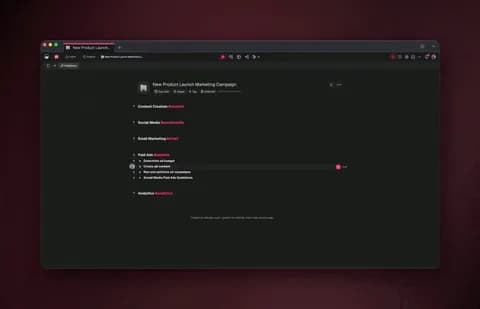
Yes, a solopreneur can run a one-person company with a team of AI agents in 2026 — and the founder keeps only the part that needs a human: strategy, taste, relationships, and the final yes. A small team of agents now covers the four jobs that consume most solo founders' weeks: a content agent ships marketing, a sales agent works the pipeline, a support agent keeps customers happy, and an admin agent handles invoices and scheduling. The agents keep persistent memory, hand work to each other, and connect to your real tools — so one person operates like a 10-person company. The fastest way there is to stop wearing every hat manually and instead describe the business you want to run, then let it build the agents that run it.
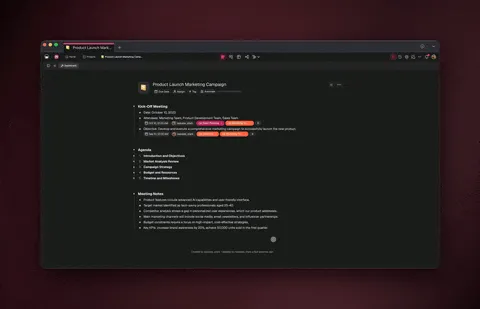
TL;DR: A solopreneur in 2026 can run content, sales, support, and admin with a team of AI agents that keep persistent memory and hand work to each other. One person operates like a small company — and the four-agent starter team replaces a writer tool, CRM, helpdesk, and scheduler. The fastest path: describe the business and let Taskade Genesis build the agents, automations, and live app. Clone the working app below →
This is not the same article as our AI agents for startups guide — that one is about a small team of humans scaling with agents. And it is not how to make money vibe coding — that one is about shipping apps for clients. This guide is the one-person-business angle. It shows you how you, alone, build a team of AI agents that runs your whole company while you sleep. By the end you will know which agents to hire first, how they hand work to each other, and how to wire them into one living workspace. Clone the app above or start your own from a prompt to follow along.
What does it mean to run a one-person company with AI agents?
Running a one-person company with AI agents means hiring software workers instead of doing every job yourself. A solopreneur wears every hat — marketer, salesperson, support rep, bookkeeper — and the math never works because there are only so many hours in a week. A team of AI agents changes the math: each agent owns one function, works around the clock, keeps persistent memory, and hands finished work to the next agent. One founder directs the team; the agents do the volume.
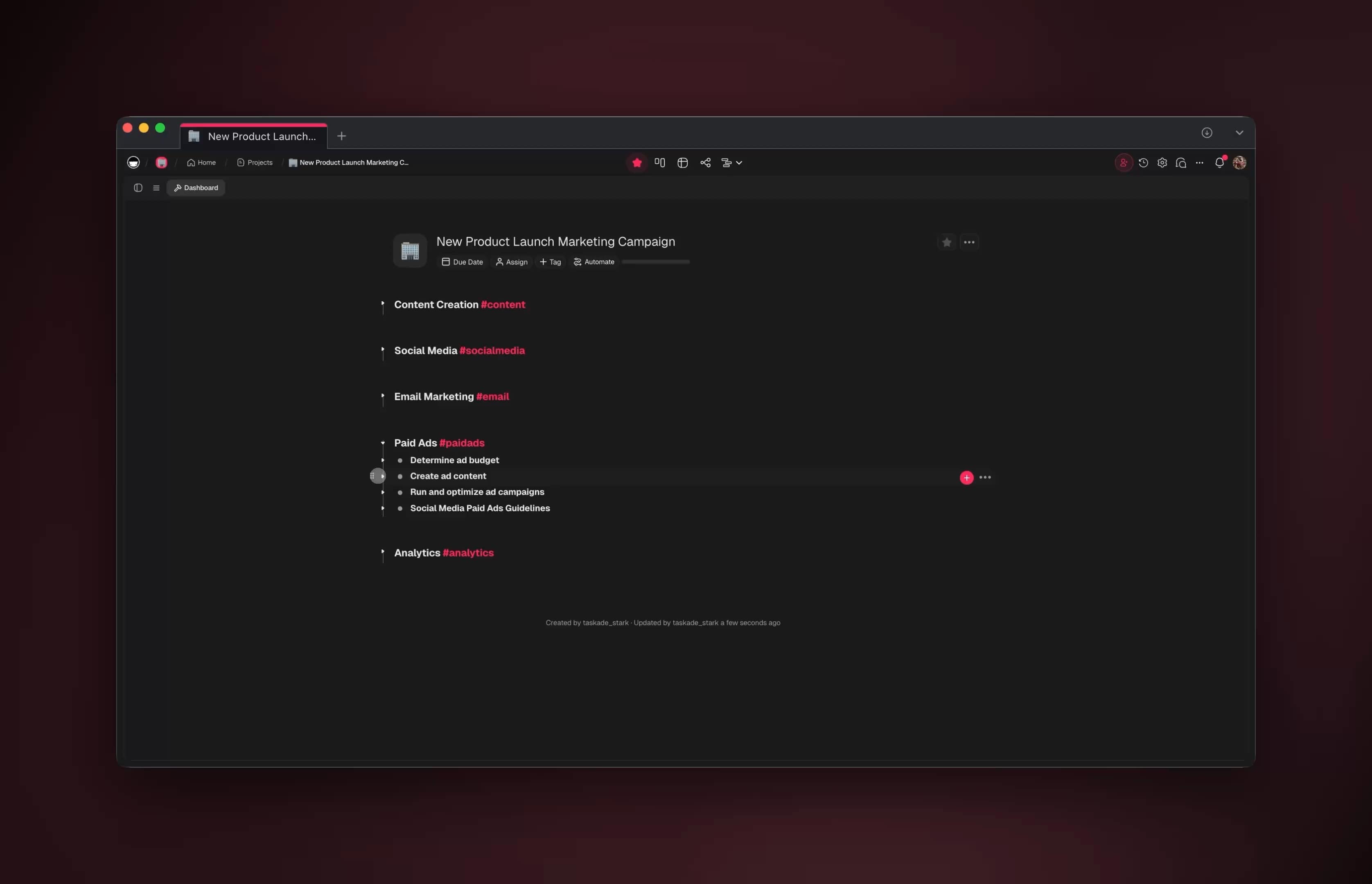
Here is the shift in one picture. The old solopreneur is a single person context-switching between five roles. The 2026 solopreneur is one director above a team of agents that each own a lane.
The practical upshot: you stop being the bottleneck on every task and start being the strategist who points the team. The agents do not get tired, do not forget last week's customer, and do not drop the ball when work passes from one role to the next — because they all share the same workspace memory. Learn the building blocks in our AI agents hub and the agent playbook.
Why solopreneurs win with AI agents in 2026
Solopreneurs who adopt a team of AI agents in 2026 reclaim the single scarcest resource in a one-person business: time. A solo founder spends the majority of the workweek on repeatable work — drafting content, chasing leads, answering the same support questions, and reconciling invoices. Handing those jobs to agents frees most of that time for the work only the founder can do, and it lets one person cover functions that used to require hiring.
The reason this matters now is persistent memory plus handoff. Earlier AI tools answered a single question and forgot everything. A 2026 agent remembers your brand, your customers, and your past decisions, and it passes context to the next agent in the chain. That is the difference between a chatbot and a coworker.
| The job you do alone | Hours a week (typical) | The agent that takes it | What you keep |
|---|---|---|---|
| Content and marketing | 8-12 hrs | Content agent | The brand bets |
| Lead follow-up and sales | 6-10 hrs | Sales agent | The real conversations |
| Customer support | 5-8 hrs | Support agent | The hard cases |
| Invoices and scheduling | 3-5 hrs | Admin agent | The money decisions |
| Reporting and review | 2-4 hrs | Reporting agent | Reading the numbers |
Treat that table as a starting menu, not a ceiling. Every recurring task you do more than once a week is a candidate for an agent. The founders who win automate the high-frequency, low-judgment work first and keep their attention for the 10-20% that actually grows the business. See how the pieces connect on the automation hub.
The four-agent starter team for a one-person company
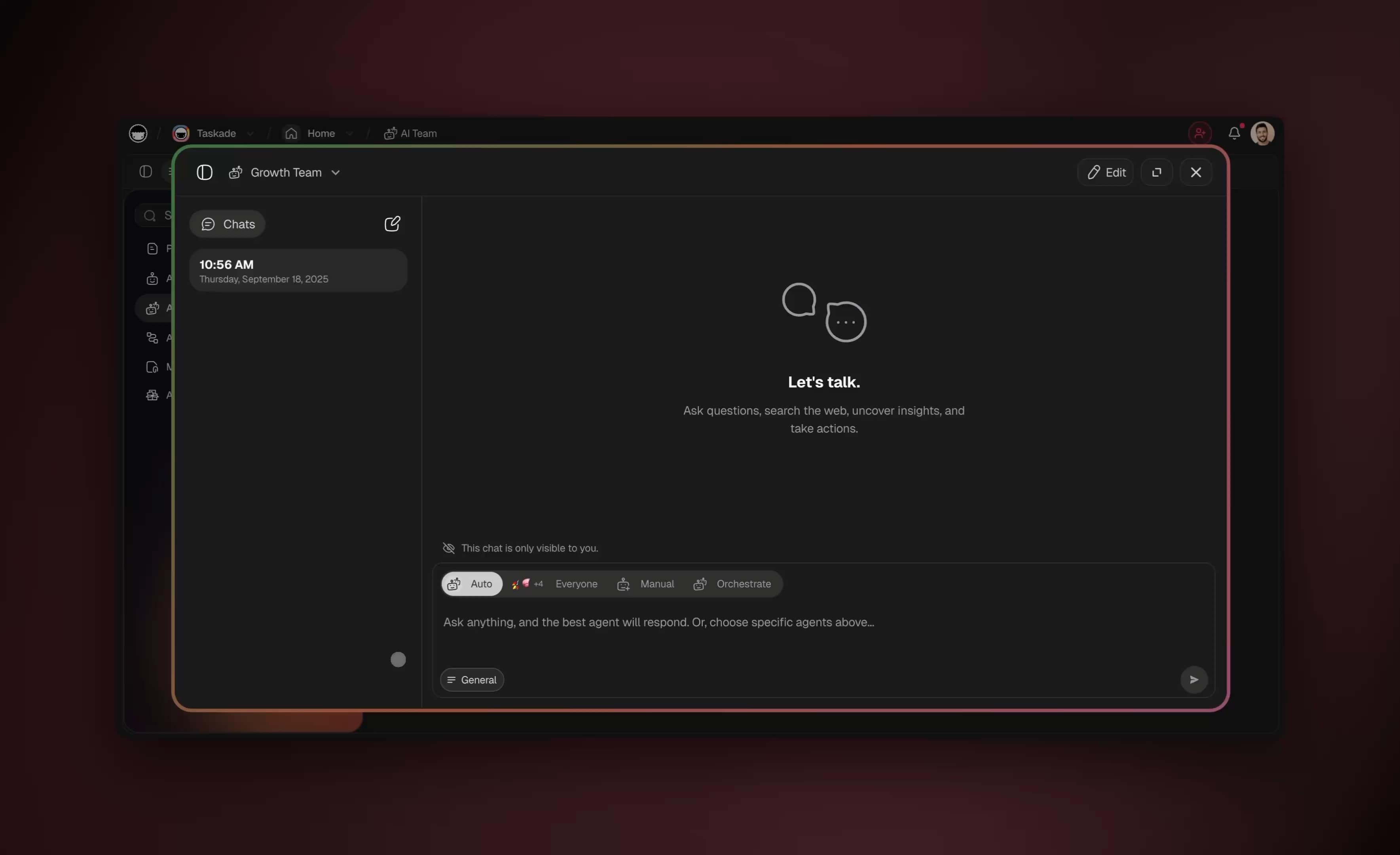
Every solopreneur should start with the same four agents, because they map to the four functions every business has: get attention, win customers, keep customers, and run the back office. You do not need all four on day one — build the one that eats the most of your week first, then add the rest. In Taskade each agent ships with built-in tools (web search, file analysis, code execution, custom slash commands, and more) and routes across frontier models from top AI labs.
| Agent | Owns | What it does all day | Build it first if you |
|---|---|---|---|
| Content agent | Marketing | Drafts posts, repurposes one asset into many formats, schedules | Live or die by content |
| Sales agent | Pipeline | Enriches new leads, scores them, drafts personalized follow-ups | Capture form or inbound leads |
| Support agent | Customers | Answers from your docs and memory, routes hard cases to you | Field repeat questions daily |
| Admin agent | Back office | Generates invoices, books meetings, chases unpaid bills | Drown in busywork |
A good rule for a one-person business: one agent, one job. A narrow agent is reliable, easy to test, and easy to trust with autonomy. When a job spans two functions — say, "win a lead, then onboard them" — you do not build one giant agent. You let two agents hand work to each other, which is the real superpower of the solopreneur stack.
This lead → onboard → support → renew chain is the backbone of a one-person company. Each agent finishes its job and passes the customer to the next, with full context, because they all read and write the same memory. Taskade supports this multi-agent collaboration natively, and agents carry persistent memory, so the customer never has to repeat themselves and you never have to copy-paste between tools. Walk through building your first team in the agent playbook.
How the agent team connects: the one-person-company map
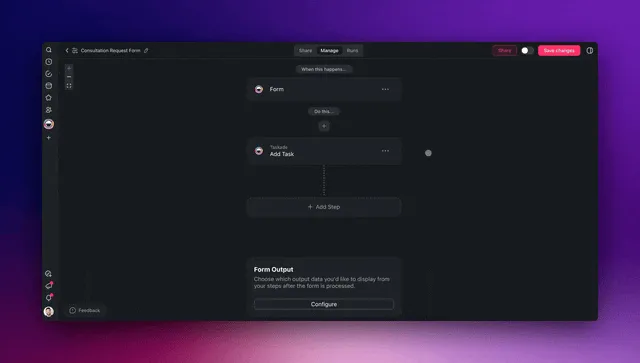
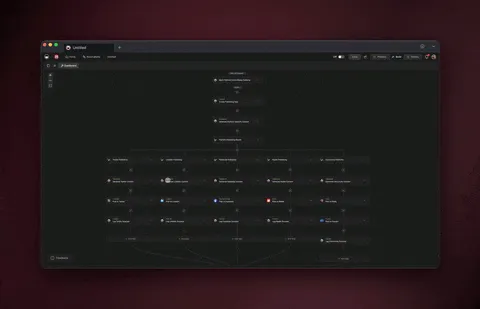
A real one-person company has four moving parts, and they form a loop — not a line. Memory (your projects, customers, and brand data) feeds Intelligence (your agents), which drives Execution (your automations and integrations), which produces new data that flows back into Memory. This is Taskade's Workspace DNA, and it is what turns four disconnected agents into a company that gets smarter every week.
Below is the end-to-end map of how one customer travels through an agent-run company — from first touch to a paid, supported, renewing account — with agents and integrations doing every step and a human only on the decisions that matter.
┌──────────────────────────────────────────────────────────────────┐
│                  THE ONE-PERSON COMPANY                           │
│            (one prompt → one living app in Taskade)               │
├──────────────────────────────────────────────────────────────────┤
│                                                                    │
│   INBOUND (triggers pull in)        OUTBOUND (actions push out)   │
│   ┌─────────────────┐               ┌──────────────────────┐     │
│   │  Form submitted │──┐         ┌─▶│  Invoice sent        │     │
│   │  DM / email     │  │         │  │  Reply delivered     │     │
│   │  Support ticket │  │         │  │  Meeting booked      │     │
│   │  Payment made   │  │         │  │  Post published      │     │
│   └─────────────────┘  │         │  └──────────────────────┘     │
│                        ▼         │                                │
│              ┌───────────────────────────────┐                   │
│              │   INTELLIGENCE (agent team)    │                   │
│              │  ┌──────────┐  ┌────────────┐  │                   │
│              │  │ Content  │  │ Sales      │  │                   │
│              │  │ agent    │  │ agent      │  │                   │
│              │  └──────────┘  └─────┬──────┘  │                   │
│              │  ┌──────────┐  ┌─────▼──────┐  │                   │
│              │  │ Admin    │◀─│ Support    │  │                   │
│              │  │ agent    │  │ agent      │  │                   │
│              │  └────┬─────┘  └────────────┘  │                   │
│              └───────┼────────────────────────┘                   │
│                      ▼                                             │
│              ┌──────────────────┐                                 │
│              │  MEMORY (Projects)│  ◀── results flow back, company│
│              │  Views, history   │      learns and compounds      │
│              └──────────────────┘                                 │
│                                                                    │
└──────────────────────────────────────────────────────────────────┘
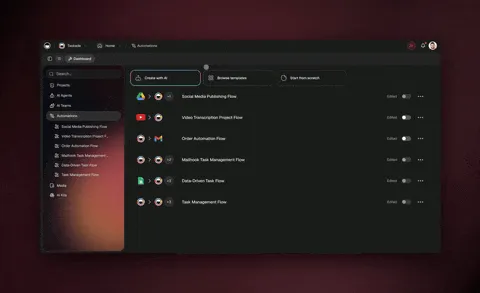
Notice there is no separate "writing tool," "CRM," "helpdesk," and "invoicing app" bolted together with tape. It is one app. That single-system design is exactly why a solopreneur can cut software spend dramatically — you are not paying four vendors and stitching their data by hand at 11pm. Each of the 100+ bidirectional integrations works in both directions, so a payment recorded in your processor can come back as a renewal task and an updated customer record without you copying a field.
How Taskade does it differently
Here is the honest landscape. n8n, Lindy, Zapier, and Make all do a genuinely good job at one thing: connecting apps. You wire a trigger to an action, map the fields, and data moves between tools. For pure data plumbing, these are excellent — and to be fair, Zapier's app catalog is unmatched (thousands of connectors), n8n is wonderfully cost-efficient for high-volume technical flows, Lindy ships polished prebuilt AI assistants for specific roles, and Make's visual canvas is a joy if you love designing every branch by hand. If your only goal is to move data from A to B, any of them will serve a solo founder well.
But notice what they all hand you at the end: an automation. A flowchart. Wiring. You still need a separate place to store your customer data, a separate AI tool to write, a separate helpdesk to support, and a separate app to show a customer. As a solopreneur, you become the integration glue between five systems — which is exactly the job you were trying to escape.
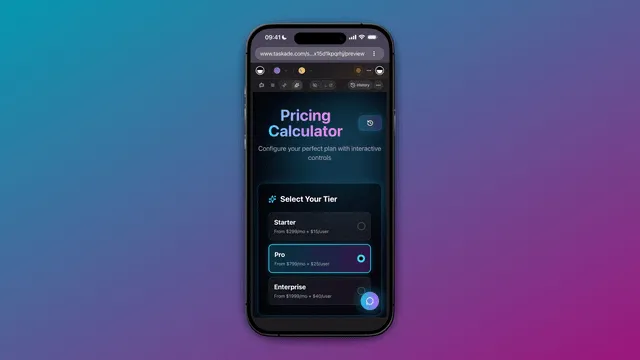
Taskade Genesis takes a different altitude. You do not wire nodes — you describe the business you want to run, and it ships a living app: a database, a team of AI agents, automations, and a shareable URL, all in one. That is the wedge.
| Node-wirers (n8n, Lindy, Zapier, Make) | Taskade Genesis | |
|---|---|---|
| You build by | Wiring triggers → actions on a canvas | Describing the business in plain English |
| You get | An automation (a flow) | A living app — data + agents + automations |
| AI agents | Add-on or single-role bot | A team, native, built-in tools, frontier models |
| Customer data lives | In another tool | In the app (Projects, multiple views) |
| Agents hand off work | You build the bridge | Native multi-agent collaboration |
| Gets smarter over time | No — static flow | Yes — Workspace DNA loop |
The mechanism behind that last row is Workspace DNA — the self-reinforcing loop where Memory feeds Intelligence, Intelligence drives Execution, and Execution creates new Memory.
A node-wirer cannot do this because a flowchart has no memory — every run starts cold, and your agents never learn your customers. A Taskade Genesis company remembers every customer, every conversation, every invoice, and each agent gets better because it works inside that accumulating memory. Add multi-agent teams that hand work to each other and the ability to clone any live app in seconds, and a solo founder gets a company that grows rather than a pile of automations to maintain. Explore the difference on the AI apps page and the agents hub.
Taskade Genesis vs the alternatives for solopreneurs
The best AI agent platform for a one-person business is the one that gives you a whole company in one app — a place to store data, a team of agents, and the automations that connect them — not a single assistant or a flow you still have to glue to four other tools. Taskade Genesis is the only option below that ships memory, a multi-agent team, automations, and a shareable live app from one prompt. The other tools each do one slice genuinely well, and a fair head-to-head should say so.
Here is the honest landscape for the names a solopreneur shortlists in 2026. Each row is the founder's real question; the columns are the five tools most often compared for this job.
| What a solo founder needs | Taskade Genesis | Lindy | Gumloop | Relevance AI | Manus |
|---|---|---|---|---|---|
| You build by | Describing the business in plain English | Configuring a prebuilt assistant | Wiring nodes on a visual canvas | Composing agents for data tasks | Setting a goal, agent self-plans |
| What you get | A living app — data + agent team + automations + URL | A capable single AI assistant | An AI-powered workflow | A research/analysis agent | An autonomous task runner |
| Multi-agent handoff | Native, shared workspace memory | Limited across assistants | Chain steps, not true agent handoff | Multi-agent for data flows | Single autonomous agent |
| Where your data lives | In the app (Projects, multiple views) | In connected tools | In connected tools | In its data layer | In its session |
| Best at | Running a whole one-person company | Inbox, scheduling, sales follow-up | Visual no-code workflows | Data analysis + research | Open-ended autonomous tasks |
Where each competitor is genuinely strong — and who they fit:
- Lindy ships the most polished prebuilt assistants for a single role. If you want an inbox triage or scheduling bot working today and do not need a shared system of record, Lindy is an excellent first hire. Its Pro tier runs about $49/month.
- Gumloop has a genuinely delightful visual canvas. If you enjoy designing each branch by hand and want to pick the model per step, Gumloop is one of the cleanest no-code builders in the category.
- Relevance AI leans hard into data analysis and research automation. For a founder whose bottleneck is enriching, scoring, and synthesizing large amounts of data, its agent tooling is purpose-built — with a free tier scaling to about $199/month.
- Manus is built for open-ended autonomy: hand it a fuzzy goal and it plans the subtasks itself. For one-off research sprints that do not need to live in a system, it shines.
- Cognosys pioneered natural-language objective hand-off, though the product has been winding down — a reminder that for a business you intend to run for years, platform durability matters as much as features.
The pattern: each tool hands a solopreneur one capability. Taskade Genesis hands you the company — the agents, the data they remember, the automations that move work between them, and a live app you can clone and share. That is the wedge, and it is why a founder consolidates four subscriptions into one. Compare the team-scaling angle in our AI agents for startups guide and the small-business automation playbook in automate your small business.
The cost math: one platform vs the solopreneur stack
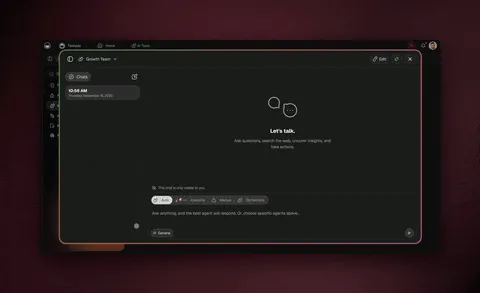
Most solopreneur AI stacks in 2026 cost between $3,000 and $12,000 a year once you add a writer tool, a CRM, a helpdesk, a scheduler, and an agent platform on top — and that is still cheaper than the $24,000 to $60,000 a year a part-time or full-time virtual assistant runs. Consolidating onto one agent system collapses that line item. Taskade Genesis starts free, and the paid tier most solo founders land on is Pro at $10/month on annual billing — a fraction of a single-purpose assistant, with the whole company in one place.
The chart is deliberately blunt: a single human assistant or a stitched-together tool stack costs orders of magnitude more than one consolidated agent platform — and the consolidated platform is the only one that remembers your business and gets smarter every week. Read the broader automation case in AI agents that automate your work.
Hire your first AI agent in 4 steps
You can ship a working agent in an afternoon — no engineer, no code. The pattern is always the same four moves, whether you are automating sales follow-up or customer support.
Step 1 — Pick the role that eats your week. Choose the function that consumes the most of your time and needs the least judgment. For most solopreneurs that is content repurposing, lead follow-up, or first-line support. High frequency means the time savings show up on day one.
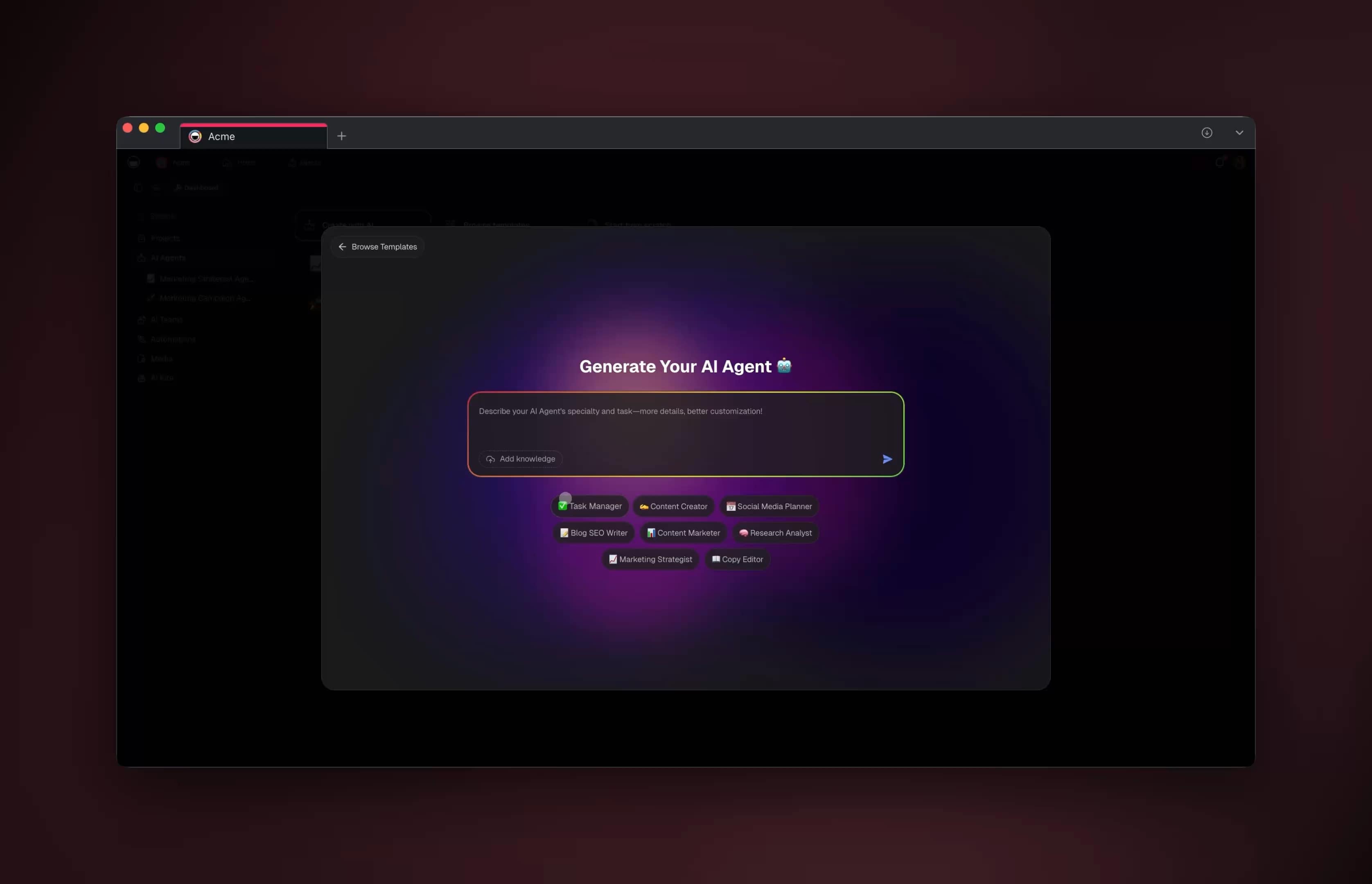
Step 2 — Describe the agent to Taskade Genesis. Write what you want in plain English: "When a lead fills out my form, enrich it, score it, draft a personalized follow-up in my voice, and add it to my pipeline." It builds the agent, the automation, and the app around it.
Step 3 — Connect your tools. Wire in your form, inbox, calendar, and payment tool through the 100+ bidirectional integrations. Triggers pull events in, actions push results out — both directions, automatically synced.
Step 4 — Keep yourself on the decisions. Add a final approval step for anything that sends money, signs a customer, or speaks for your brand. The agents do the volume; you keep the judgment and the final yes.
Then repeat. Hire the next agent, then the next. Because everything lives in one workspace, each new agent reinforces the last — your sales agent feeds your onboarding agent, which feeds your support agent, which feeds your admin agent. That compounding is the difference between a stack of bots and a company. Step-by-step walkthroughs live in Learn Taskade and the agent playbook.
What Taskade Genesis can do for a one-person company
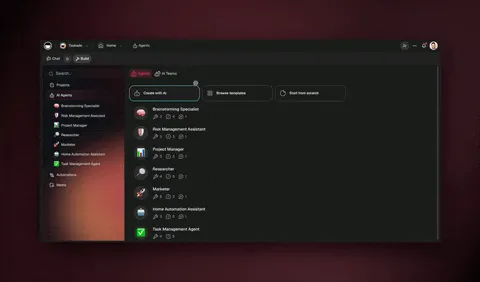
Taskade Genesis gives a solopreneur the full stack of a real company in one app: a place to store everything (Memory), a team of agents that reason over it (Intelligence), and the automations and integrations that do the work (Execution) — all from a plain-English prompt. The reason a single founder can operate like ten people is not any one feature; it is that these three layers form a self-reinforcing loop. Memory feeds the agents, the agents drive execution, and every result flows back into Memory so the whole company gets smarter each week. That loop is Workspace DNA, and it maps cleanly onto the four jobs of a one-person business.
Here is what each capability actually does for this use case — running a company alone:
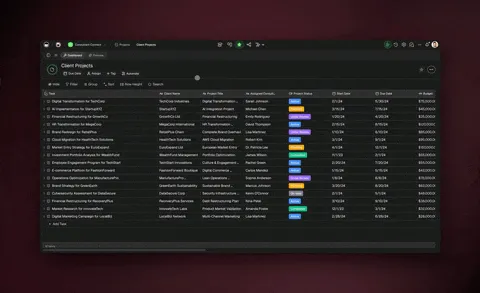
| Capability | What it is | What it does for a solopreneur |
|---|---|---|
| Workspace DNA loop | Memory feeds Intelligence feeds Execution, back to Memory | Your company compounds — every customer handled makes the next one faster |
| built-in agent tools | Web search, file analysis, code execution, custom slash commands, persistent memory | One agent can research a lead, read a contract, and run a calculation — no extra apps |
| Multiple project views | List, Board, Calendar, Table, Mind Map, Gantt, Org Chart | The same customer data is a CRM table, a content calendar, and a pipeline board at once |
| Multi-agent teams | Agents hand work to each other with shared memory | Sales → onboarding → support → admin runs as one flow, no copy-paste |
| 100+ bidirectional integrations | Triggers pull events in, actions push results out | Your form, inbox, calendar, and payment tool all feed the same brain |
| Frontier models | Models from top AI labs, picked per agent | Fast model for triage, a deeper model for the contract — you choose per job |
| Custom domains + publishing | Ship a live app on your own URL with Genesis | Hand customers a branded portal or chatbot, not a spreadsheet |
| Role-based access | Owner through Viewer permissions | Bring in a VA or contractor without handing over billing or brand |
The point is not that any one of these is unique — it is that a solopreneur gets all of them in one prompt-built app, instead of buying, wiring, and babysitting eight separate tools. You describe the company you want to run; Genesis assembles the layers. Explore the building blocks on the agents hub, the automation hub, and the Community Gallery.
Meet the four agents, one at a time
Below is what each member of your starter team actually does, with the trigger that wakes it and the integrations it leans on. Build them in this order and each one hands richer context to the next.
Before the prose, here is the at-a-glance wiring — the event that wakes each agent, the tools it leans on, and the concrete output it produces. Every integration below is one of the 100+ bidirectional integrations, so the trigger pulls events in and the action pushes results out without you touching a field.
| Agent | Trigger that wakes it | Integrations it leans on | What it produces |
|---|---|---|---|
| Content agent | New idea, long asset, or scheduled slot | Docs, social channels, content calendar | Channel-ready posts queued for approval |
| Sales agent | Form submission or new inbound lead | Form tool, enrichment, inbox, pipeline board | Enriched, scored lead + drafted follow-up |
| Support agent | New customer message or ticket | Help docs, inbox/chat, memory | Drafted reply, routine ones auto-sent |
| Admin agent | Payment, meeting request, or due date | Calendar, payment tool, invoicing | Invoice sent, meeting booked, renewal nudged |
The content agent — your marketing department
The content agent turns one idea into a week of marketing. You give it a topic or a long asset — say, a 2,000-word webinar transcript — and it drafts the post, repurposes it into channel-specific formats (a thread, three short posts, a newsletter blurb, five hooks), and queues it for your approval. It remembers your brand voice from past content stored in memory, so the tenth post sounds more like you than the first. This is the agent most solopreneurs build first, because content is the function that never stops asking for hours — typically 8 to 12 hours a week for a solo founder. Pair it with a reviewer agent and you get a clean draft → review → publish loop without a marketing hire. The concrete win: one source asset becomes a week of channel-specific content in minutes instead of an afternoon.
The sales agent — your pipeline that never sleeps
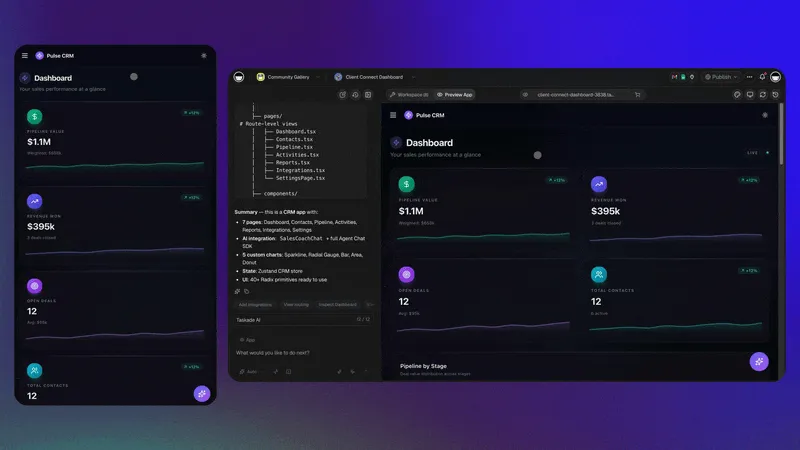
The sales agent works leads the instant they arrive. It enriches the new contact with company and role data, scores them so you focus on the hot ones, and drafts a personalized follow-up in your voice — then hands the qualified, contacted lead to your onboarding flow. A solo founder who used to lose leads in a cold inbox now has a pipeline that responds in seconds, which is one of the biggest predictors of whether a lead converts: replying within the first five minutes can lift conversion several-fold versus an hour later. Concretely, a consultant fielding 100 inquiries a month goes from hours of manual triage to a board where every lead arrives already enriched, scored, and drafted — you just approve the hot ones. The whole pipeline lives in one of the multiple project views, so the same data is a board, a table, and a calendar at once.
The support agent — your help desk
The support agent reads incoming questions, pulls the answer from your docs and past conversations in memory, and drafts a reply in your tone. Routine questions it can answer automatically; the genuinely hard ones it routes to you with the context attached. The result is fast, consistent support without staffing a desk — and every resolved ticket teaches the agent for next time.
The admin agent — your back office
The admin agent handles the invisible work that quietly eats a solo founder's day: generating invoices, booking meetings, chasing unpaid bills, and keeping records in sync. When a customer pays, it updates the record and schedules the renewal nudge. When a meeting is requested, it offers times from your calendar. It is the agent that gives you back your evenings.
A worked example: one customer, start to finish
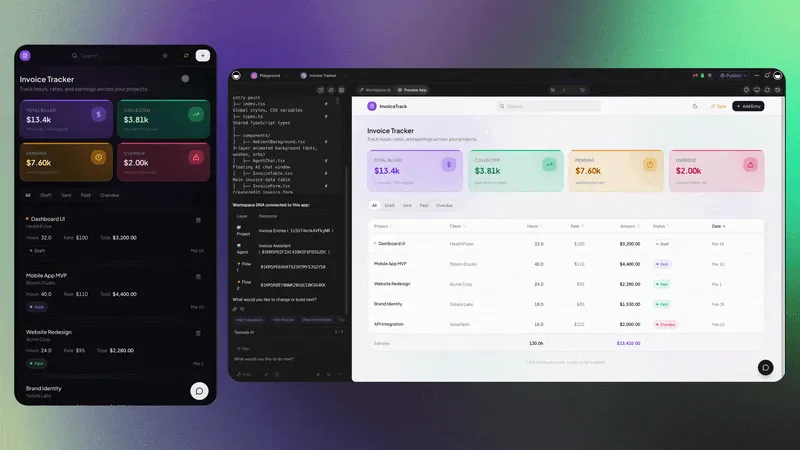
Let us make this concrete with one complete journey — a customer who finds you, buys, gets supported, and renews, run entirely by your agent team with you on only the decisions. Done manually by a solopreneur, this journey is a chain of copy-paste, lookups, drafting, and follow-up spread across four tools and several late nights. Run by agents, it is near-instant, end to end, with you on only the moments that need you.
Picture a solo consultant who gets 100 inbound inquiries a month. Manually, qualifying, replying, onboarding, supporting, and invoicing each one is dozens of hours of context-switching. With an agent team, it is near-zero hours of busywork and faster response times — and response speed is one of the biggest predictors of whether an inquiry becomes a paying customer.
Walk through what each agent does and why it matters for a one-person business:
| Stage | Agent / step | What happens | What you keep |
|---|---|---|---|
| Capture | Sales agent | Pulls the inquiry in, enriches and scores it instantly | Nothing — fully handled |
| First reply | Sales agent → you | Drafts a personalized reply; you approve and send | The relationship and tone |
| Onboard | Onboarding agent | Welcomes the new customer with full context from the handoff | The big setup calls |
| Support | Support agent | Answers questions from memory and docs, routes hard ones to you | The judgment calls |
| Renew | Admin agent | Sends the invoice and the renewal nudge on schedule | The pricing decision |
The magic is not any single step — it is that they run as one continuous flow inside one app, with the customer's context carried from agent to agent. No exporting a CSV to a CRM, no pasting into a separate helpdesk, no manually logging the invoice. The customer is qualified, replied to, onboarded, supported, and renewed without you stitching tools together at midnight. And because it all lives in Taskade, the next agent always picks up exactly where the last one left off.
Build this once and it runs forever. Then point the same four-move pattern at your next workflow — abandoned-cart recovery, content distribution, churn-risk outreach — and your one-person company grows one agent at a time. The full step-by-step lives in the agent playbook and the forms trigger guide.
What a solo founder should keep (the human 10-20%)
Hand the repeatable work to agents; keep the work that needs your taste, your relationships, and your name on it. The split is not about replacing yourself — it is about pointing yourself at the small slice that actually grows a one-person business.
| Give to your agents (the 80-90%) | Keep for yourself (the 10-20%) |
|---|---|
| Drafting content and repurposing | Brand strategy and positioning |
| Lead enrichment and scoring | High-stakes sales conversations |
| First-line support replies | The genuinely hard customer cases |
| Invoicing, scheduling, follow-ups | Pricing and offers |
| Weekly reporting | Reading the numbers and deciding |
A useful gut check: if you could explain the task to a sharp new hire in two sentences, an agent can do it. If it needs your years of context and judgment, keep it. Start with one agent on one role, measure the hours it gives back, then hire the next. The whole point of a one-person company is that you stay rare — the agents make the rest of the business run without you in every loop.
Keep control as your agents take on more
Running a company on agents does not mean losing control — it means setting the right guardrails. Taskade uses role-based access (Owner to Viewer) so that even as a solopreneur, you can bring in a contractor, a virtual assistant, or a future first hire without handing them the keys to everything. Your VA can be an Editor who drafts but cannot publish; a contractor can be a Checker who works assigned items but cannot touch billing.
That governance is what makes "run it on agents" safe as the business grows. The agents do the volume, the roles make sure nothing ships without the right sign-off, and the Owner — you — keeps final say over money and brand. When you do eventually hire a human, they slot into a team and a memory that already knows how the business runs.
Where this is heading
The direction is clear: every solopreneur will run on a self-reinforcing Memory + Intelligence + Execution loop, where a single prompt becomes a living, self-improving company. Today you hire agents one at a time; tomorrow you describe the outcome — "run my consulting business" — and the system stands up the team, the data, and the automations, then improves itself as it learns your customers. The one-person company stops being a person juggling tools and becomes a founder directing a workspace that remembers everything, reasons over it, and acts on it around the clock.
That is the Taskade vision: the gap between having an idea for a business and running it collapses to a sentence. The rare, human part — taste, relationships, the final yes — stays with you. Everything repeatable runs on agents that get smarter every week. The solopreneurs who start building that loop now will compound a year of advantage before the rest of the market catches up. Start the loop from a single prompt on Taskade Genesis.
Clone a working agent app and start today
You do not have to build from a blank page. The Community Gallery is full of cloneable agent apps you can drop into your workspace and point at your own business in minutes.
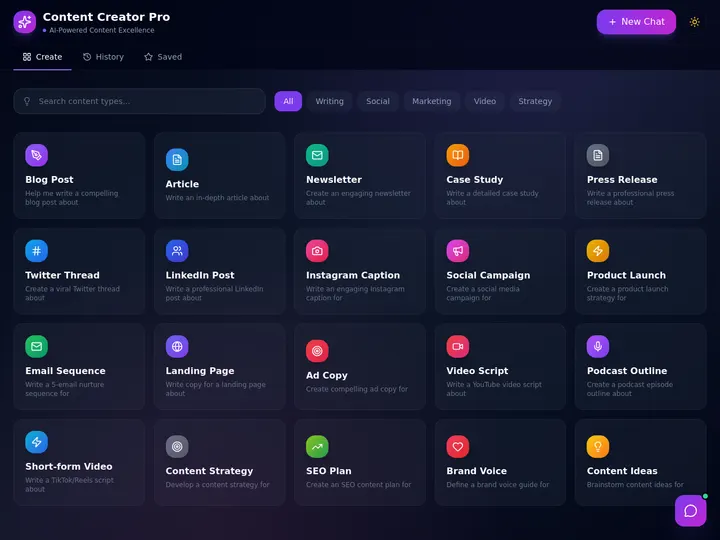
Clone an agent, give it your brand guidelines and past work as memory, and it becomes a tireless coworker that already knows your voice. From there, add a sales agent, a support agent, and an admin agent — one at a time — and you have the full lead → onboard → support → renew company from earlier, built one piece at a time. Browse more cloneable agent apps or start your own from a prompt.
Frequently asked questions
How do I start running my business on AI agents today?
Pick the single role that eats the most of your week, then describe the outcome to Taskade Genesis in plain English. It builds the agent, the automation, and a live app — no code, no wiring. Start free, hire one agent at a time, and let each new agent hand work to the last. Within a few weeks you have a four-agent team running content, sales, support, and admin.
What is the best AI for a one-person business in 2026?
The best fit combines reasoning agents, reliable automations, and a place to store your customer data — not a single chat tool or an app connector alone. Taskade Genesis does all three from one prompt, with built-in agent tools and frontier models from top AI labs. For the team-scaling angle, see our AI agents for startups guide.
Will AI agents replace solopreneurs?
No — they replace the repeatable work so the founder can own the 10-20% that needs judgment: strategy, taste, relationships, and final approval. The solo founder moves from doing every task to directing a team of AI agents. The business runs on agents, but the rare part — you — stays human.
How do AI agents hand work to each other?
In a multi-agent team, one agent finishes its job and passes the result to the next agent, with full context, because they all share the same workspace memory. A sales agent qualifies a lead and hands it to an onboarding agent, which hands the customer to a support agent. Taskade supports this multi-agent collaboration natively, so there is no copy-paste between tools.
How is this different from making money with vibe coding?
Vibe coding is about shipping apps — often for clients — from a prompt; read how to make money vibe coding for that path. This guide is about running your own one-person company on a team of agents that handle content, sales, support, and admin. Different goal, same Genesis engine.
Can I try a real agent app before building my own?
Yes. Clone a live agent app from the Community Gallery in about 30 seconds and run it in your own workspace, or start from a prompt. The content agent embedded above is cloneable today and makes a great first hire for a one-person business.
How much does it cost to run a company on agents?
Taskade Genesis is free to start. Paid plans on annual billing are Pro at $10/month, Business at $25/month, Max at $100/month, and Enterprise at $250/month. Because one platform replaces a separate writer tool, CRM, helpdesk, and scheduler, most solopreneurs cut total software spend significantly after consolidating onto one Taskade system.
How do the agents remember my customers?
Each agent carries persistent memory, and the whole company stores its data in Projects across multiple views — List, Board, Calendar, Table, Mind Map, Gantt, and Org Chart. An agent that handled a customer last week remembers the context this week, so customers never repeat themselves and you never re-explain your business.
Ready to run your one-person company on a team of AI agents? Start free with Taskade Genesis — describe the business you want to run, and watch it build the agents, connect your tools, and ship a live app you can run today. Explore the agents hub, browse cloneable agent apps, the automation hub, or read the AI agents for startups guide for the team-scaling angle.
▲ ■ ● Memory, Intelligence, Execution — describe the company you want to run, and Taskade Genesis remembers your customers, reasons over your business, and runs the work across every function. That is the difference between a solopreneur drowning in hats and a one-person company that runs itself.