







The pandemic has not only changed the way we live and work. It’s also given new momentum to upskilling and workplace education in general. To properly address those changes, remote teams need to cultivate a culture of knowledge sharing.
In today’s guide, we take a look at the benefits of knowledge sharing. We also break down several methods for implementing in a remote workplace.
Here are a handful of questions we answer in this article:
- 💭 What’s knowledge sharing?
- 📈 What are the advantages of sharing knowledge?
- 🤷♀️ Why is knowledge sharing a challenge?
- ⚡️ How to build smarter remote teams in 2021?
💡 Before you start… This guide is part of our series on knowledge management in remote teams. Here are our five top picks you should add to your reading list:
- 🗃 The Zettelkasten Method for Distributed Teams
- 📚 Tsundoku (積ん読): How to Beat Digital Hoarding in Remote Teams
- 🌟 A Single Source of Truth: Why Your Remote Team Needs One
- 🧠 How To Build a Second Brain for Your Team
- 🎄 A Case For Hierarchical Thinking: Complex Problems Made Easy
🧑💻 The Power of Knowledge In a Remote Workplace
What’s Knowledge Sharing (KS)?
Perhaps, we should try to answer this question by asking another.
“What is team (or organizational) knowledge?”
Is it the hands-on experience of individual employees and the team as a whole? Or is it the documentation, processes, and problem-solving strategies at your team’s disposal?
Surprise, surprise, it’s both. And according to the exhaustive World Bank’s report Becoming a Knowledge-Sharing Organization, it deserves some attention:
“Knowledge becomes an important currency of any organization, equal to the value of productivity or products. Organizations that continue doing business as usual without continuous reflection, learning, course correction, iteration, and the application of solution paths will likely fall behind those that use knowledge to influence how they deliver services.”(1)
Steffen Soulejman Janus, Becoming a Knowledge-Sharing Organization (2016)
Now, going back to our original question, knowledge sharing is the process of disseminating that wealth of experience and documented insights across a team, department, or entire organizations.
So, for example, sending a document template to a colleague counts as KS. That’s also true for mentoring new hires or even watercooler chit-chats (more on that in a bit).
And the best part?
Knowledge sharing comes with some powerful benefits that can make your remote team smarter, more productive, independent, and resilient.

🌟 3 Benefits of Knowledge Sharing in a Remote Team
1. It Improves Communication
No team, department, or organization is perfectly unified. There’s always a certain degree of specialization that makes the work of one a great mystery to the other.
In fully remote teams, organizational obscurity makes it difficult for team members to understand each other’s roles and responsibilities. It also creates communication silos.
Knowledge sharing, either through documentation, mentoring, or informal “insider” tips, bridges that gap. It creates a level of understanding that lets remote workers tap into the expertise and experience of their colleagues more easily.
That, in turn, creates a kind of unified, reusable communication patterns that kick in every time your team needs to communicate, coordinate, and collaborate.
2. It Promotes Innovation
The most valuable type of knowledge is the one that’s documented, shared, and most importantly repurposed into new content across the entire organization.
And this is where innovation is born.
Just like in the Spotify Method we discussed a few months back, knowledge sharing removes boundaries like bureaucracy and sets the stage for spontaneous innovation.
The more people weigh in with their expertise, observations, and problem-solving skills, the more likely it’s they’ll create non-linear solutions and evergreen ideas.
Remote teams with solid problem-solving skills are also more autonomous. Whenever they get stuck or face a problem, they can make better decisions and act on them.
3. It Saves Time and Resources
Poorly organized teams often fall into a trap of endless back-and-forths, repetitive administrative work, and duplicated documentation. Tl;dr “Nobody knows anything.”
Without access to up-to-date, reliable data, your remote team will spiral down the limbo of copycat mistakes. Instead of reusing one solution to solve a problem, they’ll have to figure out the same thing over and over again.
A knowledge-sharing strategy will help your team create templates, physical or otherwise, for dealing with problems.
Whether that’s an emergency checklist or something as small as an email template, it’s the little things that can save plenty of time (and money) in the long run.
✅ And speaking of checklists… be sure to read our article The Power of Checklists in Distributed Teams for some cool tips and templates.

🔥 Key Knowledge Sharing Challenges
As observed by the group of researchers behind a study Workplace Knowledge Flows published in The Quarterly Journal of Economics, many business leaders doubt that a remote workplace offers sufficient knowledge sharing capacity:
“[...] leaders like JPMorgan’s Jamie Dimon have called employees back to the office. Their concern about remote work largely centers on difficulties co-workers have sharing knowledge and experience with each other.”
Jason Sandvik, Richard Saouma, Nathan Seegert, and Christopher Stanton at HBR(2)
But according to Deloitte’s 2020 Global Human Capital Trends, the ability to effectively manage and share knowledge is also a challenge for co-located businesses.
While most organizations—79% of all respondents—understand the value of knowledge, few of them are ready to act on it and roll out relevant policies.(3)
A lack of readiness isn’t the only problem. The same report points out a handful of other issues that prevent organizations from putting knowledge to good use:
- 🚧 Organizational silos (55%)
- 🤷♂️ Lack of incentives (37%)
- 💾 Lack of technology infrastructure (36%)
- ❌ Lack of organizational mandate (35%)
- 🤹♂️ Frequent shifts in employee roles (35%)
- 📑 Compliance obstacles (13%)
Luckily, there are many ways to address those issues.
The Workplace Knowledge Flow Study we mentioned earlier, established that certain strategies can boost knowledge sharing in remote and co-located teams and teams.
During the experiment, researchers found that a guided tutoring session between randomly paired sales team members improved sales productivity by 24%.
“Put simply, coworker interactions can improve the long, lower tail of under-performers — provided such interactions are both thoughtful and intentional.”(2)
That, in turn, contributed to a significant increase in revenue and overall employee performance in the 24 weeks following the study.
But there are many other ways to tap into the power of knowledge sharing.

📈 Developing a Modern Knowledge Sharing Strategy
1. Build a Knowledge Management System
Before your team can make use of the collective knowledge, you need to effectively capture, process, document, and organize it in a knowledge management system.
A reliable knowledge management system enables knowledge flow. It creates a reliable source of curated information that’s accessible 24/7.
The good news is Taskade provides all that, and much more.
- 📥 Capture and preserve all types of knowledge (web browser extension)
- 🏷 Tag, categorize, and browse info (Workspaces, Subspaces, Projects)
- 📑 Repurpose knowledge into content (outlining)
- 🎨 Create reusable solutions to problems (templates)
- ✍️ Curate information in a collaborative way (comments)
- 💬 Discuss issues and brainstorm solutions together (video, voice, chat)
- 🔗 Connect insights together to create context (cross-linking)
And the best part?
Taskade combines communication, collaboration, and coordination in one package. That means your team doesn’t have to juggle multiple tools and solutions to find the information they’re looking for.
It’s always there, whenever and wherever they are.
Taskade Knowledge Sharing Tip #1 🐑
In order to build a knowledge management system in Taskade, start by creating a dedicated Workspace or Subspace for your team.
Like this one. 👇
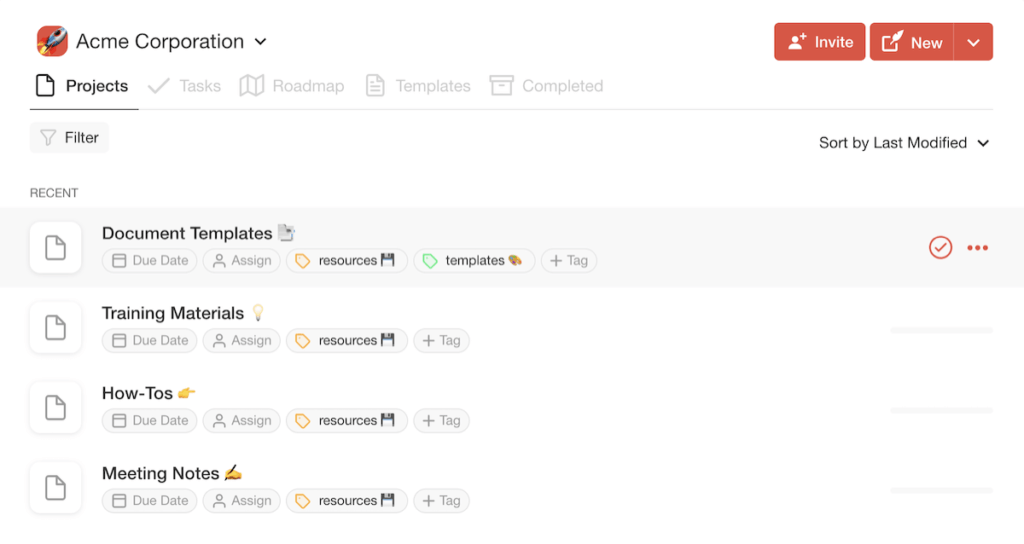
The workspace will serve as a knowledge hub for insights like documents or how-tos. Don't forget to invite other team members so everybody can tap in.
2. Choose Your Approach
There are two core knowledge management strategies: c_odification_ and personalization. While the former relies on digital systems to store and make information accessible, the latter is all about a direct, employee-employee transfer.(4)
You want to focus on one angle at a time, depending on your team’s characteristics, business objectives, and the internal/eternal value you expect.
“A company’s knowledge management strategy should reflect its competitive strategy: how it creates value for customers, how that value supports an economic model, and how the company’s people deliver on the value and the economics.”
Morten T. Hansen, Nitin Nohria, and Thomas J. Tierney, What’s Your Strategy for Managing Knowledge? (1999) via HBR(4)
For instance, sharing knowledge through personalization could include:
- 🤝 1-on-1 remote mentoring
- 🎦 Live video workshops
- ⌨️ Virtual pair programming
- ☕️ Online watercooler chit-chat
- 📚 Virtual book club meetings
- 💌 Remote team newsletter
- ✍️ Collaborative writing/editing
On the other hand, codification can take the form of:
- 🗂 Company/team wikis
- 💡 Internal knowledge base
- 📑 Document templates
- 📀 Video/audio training materials
- 🗄 Team Zettelkasten/Second Brain
- 📨 Company blog/newsletter
- 🖥 E-learning platform
The key is to focus on one strategy and then build the other on top of it. For instance, content stored in a knowledge base (KB) can be a foundation for 1-on-1 mentoring.
Alternatively, online workshops, co-writing sessions, and even book club meetings will provide ample material for a knowledge management system.
Taskade Knowledge Sharing Tip #2 🐑
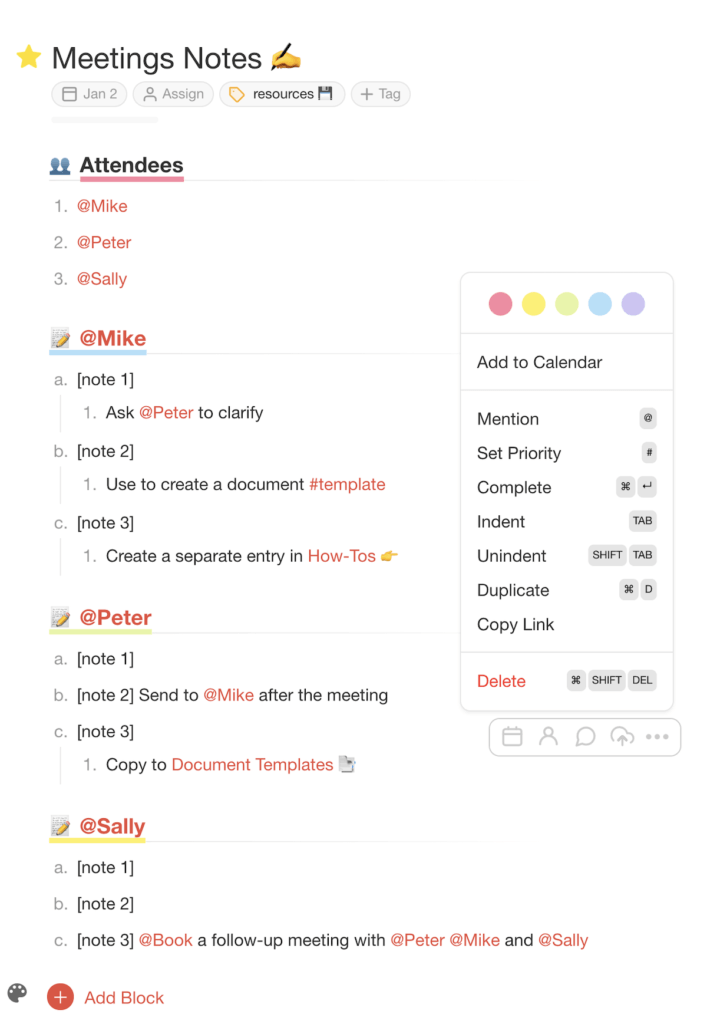
Although your approach will target the team as a whole, it’s important to make sure that individual voices and contributions aren’t lost in the chatter.
Your team members can make their contributions across the knowledge hub using comments, visual cues (color-coding, highlights), and tags.
Like so. 👇
3. Promote Knowledge Sharing
How often do your team members show their curiosity? Do they follow up with questions after meetings, regularly sign up for courses and internal training, or dig into, improve, and adapt team documentation?
If not, you may need to employ a range of incentives and techniques to put them back on track. Some may appeal to your team’s willingness to improve their professional competencies. Others can encourage KS through social recognition and rewards.
Here are a handful of ideas to get you started:
- 🙋♀️ Establish knowledge brokers. You can select knowledge brokers from among top team performers. They’ll help you build a knowledge repository, promote knowledge sharing practices, and guide other team members.
- 👉 Offer guided mentoring. These could be 1-on-1 sessions moderated by you or one of the knowledge brokers. The additional support gives employee pairs direction and proper dynamic so both parties can profit from the exchange.
- 🧙♂️ Expand their authority. Team members who actively participate in knowledge-sharing activities expand their skills and expertise. And that means that they can tackle more responsible roles and tasks within the team.
- 👏 Practice social recognition. Learning new things is a fine reward in itself. But it doesn’t hurt to give knowledge-seekers a shout-out once in a while. You can praise contributions and performance in a team newsletter or during a meeting.
- 💬 Encourage communication. Give your team the means (technology) and opportunities (time) to share knowledge organically. Make sure to provide diverse communication methods, like video, chat, and conference calling.
- 🦸♂️ Lead by example. Always be there for your team to answer questions and share your expertise, actively engage in learning opportunities, create and regularly send out a team newsletter, and co-edit documents.
Regardless of your approach, the key is to guide your team and show them the tangible benefits of knowledge sharing. It should be fun, not a chore.
Taskade Knowledge Sharing Tip #3 🐑
A flat organizational structure and total transparency are key ingredients for enabling the flow of information. Communication should be effortless, omnidirectional, and free of bureaucratic and technical obstacles.
In Taskade, team members can interact with each other using a variety of channels, including chat, calls, and video conferencing, all that with no setup required.
Frequently Asked Questions
How can remote teams share knowledge effectively?
Remote teams share knowledge effectively by: establishing a centralized knowledge base (single source of truth), creating standard operating procedures (SOPs) for recurring processes, holding regular knowledge-sharing sessions (lunch-and-learns, demo days), documenting decisions and their rationale, using collaborative tools that support real-time editing and commenting, and building a culture where sharing knowledge is valued and rewarded rather than treated as overhead.
Why is knowledge sharing harder for remote teams?
Remote teams lose the informal knowledge transfer that happens naturally in offices — hallway conversations, overhearing discussions, shoulder-tapping for quick questions. Information gets siloed in individual inboxes, chat threads, and local files. Time zone differences reduce synchronous learning opportunities. Without intentional systems, tribal knowledge stays locked in people's heads, creating single points of failure when team members leave or are unavailable.
What tools help remote teams share knowledge?
Effective knowledge-sharing tools combine documentation, collaboration, and discovery. Taskade excels with its collaborative workspace (real-time editing for shared documentation), AI agents (trained on team knowledge to answer questions instantly), hierarchical organization (workspaces → folders → projects for structured knowledge), and multi-view support (List, Mind Map, Board for different knowledge types). Unlike wikis that become outdated, Taskade's living documents stay current as teams actively work in them.
How do you build a knowledge-sharing culture in remote teams?
Build a knowledge-sharing culture by: making it easy (reduce friction — if documenting is hard, people won't do it), leading by example (leaders should document openly), celebrating contributions (recognize people who share knowledge), integrating sharing into workflows (documentation as part of the definition of done), scheduling regular knowledge sessions, creating mentorship pairs across departments, and using AI to make captured knowledge instantly accessible and actionable.
🐑 Conclusion
Knowledge sharing is an integral part of remote team culture. Even if your team trades expertise and business intel organically, you should still formalize the process as part of a consistent knowledge management strategy.
Prioritize communication and regularly probe your team’s day-to-day activities for obstacles and problems they may be facing. Seek opportunities for improvement and turn team knowledge into a reusable problem-solving tool.
And that’s it! 👏
🔗 Resources
- https://openknowledge.worldbank.org/bitstream/handle/10986/25320/9781464809439.pdf?sequence=2&isAllowed=y
- https://hbr.org/1999/03/whats-your-strategy-for-managing-knowledge
- https://www2.deloitte.com/us/en/insights/focus/human-capital-trends.html
- https://hbr.org/1999/03/whats-your-strategy-for-managing-knowledge