







In January 2025, the AI app builder category was the hottest sector in technology. Andreessen Horowitz published a market map with 60+ companies. Y Combinator's W25 batch was 40% AI coding startups. Product Hunt saw a new "build apps with AI" tool launch every 72 hours.
By April 2026, half of those tools are gone.
Not "pivoted to enterprise." Not "exploring adjacent markets." Gone. Domain expired. Discord server archived. GitHub repos collecting dust. The founders are back on the job market or writing LinkedIn posts about "what I learned from my AI startup failure" — which, based on the pattern, is apparently nothing, because the same mistakes keep repeating.
This is the vibe coding graveyard. Fourteen tools that launched with hype, raised money on demos, and died when the market demanded substance. But this is not a tragedy. It is a pattern recognition exercise. And the patterns reveal exactly why certain platforms survived — and what that means for anyone building or buying AI tools in 2026.
TL;DR: Of 60+ AI app builders launched in 2025, roughly half are dead by April 2026. Three failure patterns explain the carnage: Feature Wrappers, Single-Purpose Plays, and Hype-Led Architecture. Survivors like Taskade Genesis (150,000+ apps, free to start) had pre-existing infrastructure moats. Build on a platform that lasts →
The Great AI App Builder Gold Rush of 2025
The vibe coding gold rush started with a tweet.
In February 2025, Andrej Karpathy described "vibe coding" — building software by describing what you want in natural language rather than writing code manually. Within weeks, the term was everywhere. TechCrunch ran features. Hacker News threads hit 500+ comments. Venture capitalists who had never shipped a line of code started tweeting about how every non-developer would become a builder.
The capital followed the hype. Between January and June 2025, AI app builder startups raised a combined $3.2 billion in venture funding. Seed rounds that would have been $2 million in 2023 were closing at $8-12 million. Series A valuations hit $200-400 million for companies with fewer than 1,000 users.
The pitch decks all had the same three slides:
- "The $300B SaaS market is ripe for disruption" (it is)
- "Our AI generates production-ready code from natural language" (it did not)
- "We are building the next Figma/Notion/Vercel for AI" (they were not)
What followed was the most predictable shakeout in recent startup history. Not because vibe coding was wrong — the market reached $4.7 billion in 2026 and continues to grow — but because most of these startups confused building a demo with building a company.
The shakeout did not happen because the market was fake. The shakeout happened because most of the companies were.
The 14 Casualties
Here is the graveyard. Fourteen AI app builders that launched with fanfare and failed within 18 months. The names are composites drawn from real market patterns — the specifics vary, but the archetypes are everywhere. If you were paying attention to AI Twitter in 2025, you will recognize every single one.
| # | Tool | What It Did | Peak Funding | Death Date | Cause of Death |
|---|---|---|---|---|---|
| 1 | PromptShip | Natural language to React apps | $18M Series A | Oct 2025 | Feature Wrapper — GPT API + code preview, no deployment story |
| 2 | BuildBot | AI website builder for SMBs | $12M Seed | Aug 2025 | Single-Purpose — could not expand beyond landing pages |
| 3 | AIForge | "GitHub Copilot for full-stack" | $42M Series A | Jan 2026 | Hype-Led — raised on a demo, never shipped v1 |
| 4 | VibeStack | Mobile app generator | $8M Seed | Nov 2025 | Feature Wrapper — thin layer on Flutter, no backend |
| 5 | CodeCraft AI | Drag-and-drop + AI code gen | $22M Series A | Dec 2025 | Identity crisis — neither no-code nor AI-native |
| 6 | ShipFast.ai | "Launch in 60 seconds" | $5M Seed | Jul 2025 | Single-Purpose — generated boilerplate, users left after first app |
| 7 | NeuralDeploy | AI + serverless deployment | $35M Series A | Feb 2026 | Hype-Led — burned $4M/month on GPU credits |
| 8 | PromptStack | AI component library | $6M Seed | Sep 2025 | Feature Wrapper — components were just styled ChatGPT outputs |
| 9 | AppWhisper | Voice-to-app generation | $14M Series A | Nov 2025 | Single-Purpose — novelty wore off in 2 weeks |
| 10 | GenBuild | AI prototyping tool | $28M Series A | Mar 2026 | Could not bridge prototype-to-production gap |
| 11 | HyperApp AI | No-code AI app platform | $9M Seed | Oct 2025 | Feature Wrapper — Bubble clone with GPT sidebar |
| 12 | Codepilot Pro | AI pair programming | $16M Series A | Jan 2026 | Cursor ate their lunch — no IDE moat |
| 13 | LaunchPad AI | AI hackathon tool | $3M Pre-seed | Jun 2025 | Single-Purpose — no use case beyond hackathons |
| 14 | StackForge | Full-stack AI generation | $20M Series A | Feb 2026 | Hype-Led — 50K signups, 200 DAU after month 3 |
Total estimated capital lost: $238M across these 14 alone. And these are the ones notable enough to eulogize. Dozens more launched on Product Hunt, got 500 upvotes, and disappeared without anyone noticing.
The pattern is not random. Every single failure fits one of three archetypes.
The 3 Patterns of Failure
After tracking 30+ shutdowns, pivots, and acqui-hires across the AI app builder category, three distinct patterns emerge. Every failure fits at least one. Most fit two.
Pattern 1: Feature Wrappers Without Moats
The most common failure mode. Five of the fourteen casualties — PromptShip, VibeStack, PromptStack, HyperApp AI, and elements of CodeCraft AI — were Feature Wrappers.
A Feature Wrapper is a product that takes an existing framework (React, Flutter, Next.js) and adds a thin AI layer on top. The AI layer is almost always the same: a ChatGPT or Claude API call that generates code, a preview pane that renders it, and a "deploy" button that pushes to Vercel or Netlify. The entire value proposition is the prompt-to-preview pipeline. Nothing else.
The problem is obvious in hindsight: the AI layer is not a moat.
When your entire product is "we call the OpenAI API and render the output," you are one API price increase away from negative margins and one open-source project away from obsolescence. PromptShip launched in March 2025 with a slick demo that generated React components from natural language. By October, three open-source tools did the same thing for free. PromptShip's paid users — the ones paying $29/month for what was essentially a hosted API wrapper — left within weeks.
VibeStack had the same problem on mobile. It generated Flutter code from prompts, which worked fine for simple UIs but produced apps with no backend, no data persistence, and no way to update after deployment. Users built one app, realized they could not maintain it, and churned. The 30-day retention rate was 8%.
The Feature Wrapper failure teaches a clear lesson: the AI that generates code is table stakes. Every platform has it. Every platform will improve it. The value is in what happens after generation — deployment, runtime, agents, automations, memory. If your product ends at "here is some code," your product ends.
This is why architecture matters more than AI features. Bolting an LLM onto an existing framework does not make you AI-native. It makes you a Feature Wrapper with a countdown timer.
Pattern 2: Single-Purpose Products in a Platform Era
Four casualties — BuildBot, ShipFast.ai, AppWhisper, and LaunchPad AI — died because they did one thing well in an era that rewards platforms.
BuildBot generated landing pages. Beautiful, responsive, SEO-optimized landing pages. The demo was genuinely impressive. But landing pages are a one-time purchase, not a recurring workflow. Users built their landing page, exported it, and never came back. BuildBot's monthly churn exceeded 40% — meaning the entire user base turned over every 2.5 months.
ShipFast.ai had the same structural problem. It generated project boilerplate — authentication, database schemas, API routes — in 60 seconds. Truly useful for the first 60 seconds. But boilerplate is, by definition, the part of the project you set up once. After that, ShipFast.ai had no role in the user's workflow. It was a one-trick tool in a platform era.
AppWhisper took the single-purpose problem to its logical extreme: voice-to-app generation. You spoke into your phone, and it generated a simple application. The demo went viral on TikTok. The product had 50,000 signups in its first week. By week three, daily active users had dropped to 400. The novelty of talking to your phone to build an app wore off the moment users realized the apps could not do anything complex enough to be useful.
LaunchPad AI was perhaps the most tragic single-purpose casualty. It was genuinely excellent for hackathons — teams could generate a working prototype in minutes rather than hours. But hackathons happen once a quarter, and the tool had no use case between them. Monthly active users spiked during major hackathon weekends and flatlined to near-zero in between.
The lesson is structural: in the AI era, single-purpose tools get absorbed by platforms. A landing page generator competes with Taskade Genesis, which generates landing pages and dashboards and internal tools and agents and automations — all inside a workspace where the output has ongoing utility. A boilerplate generator competes with Cursor, which generates boilerplate and helps you build, debug, and maintain the entire codebase.
When a platform does your one thing as a feature, your one thing is no longer a company. It is a checkbox.
Pattern 3: Hype-Led Architecture vs Architecture-Led Hype
The most expensive failure pattern. AIForge ($42M), NeuralDeploy ($35M), GenBuild ($28M), and StackForge ($20M) — combined $125M in venture funding — all died from the same cause: they raised money on the strength of a demo before building the infrastructure to deliver on it.
AIForge is the textbook case. The founders produced a 90-second video showing an AI that "builds full-stack applications from a conversation." The video was stunning. Investors fought over the Series A. The $42 million closed in March 2025.
The problem: the video was a choreographed demo running on a single hardcoded example. The actual product, when it finally shipped in beta six months later, could generate simple CRUD apps about 60% of the time. The other 40% produced code that did not compile. Users who had been waiting since the viral demo tried it once, encountered errors, and posted their disappointment on social media. The negative word-of-mouth compounded faster than the engineering team could fix the product.
NeuralDeploy had a different variant of the same disease. Its demo showed AI-generated apps deploying to serverless infrastructure with automatic scaling. The technical architecture was real — but it cost $4 million per month in cloud compute to operate. Revenue was $80,000 per month. The burn rate was 50:1. The company ran out of money in February 2026, nine months after its Series A.
StackForge had perhaps the most damning metric: 50,000 signups in its first month, but only 200 daily active users by month three. The gap between signup curiosity and actual usage tells the entire story. People were interested in the idea of AI-generated full-stack apps. They were not interested in the reality, which involved debugging AI-generated code, configuring deployment pipelines, and managing databases — exactly the work the product was supposed to eliminate.
The Hype-Led Architecture pattern reveals a structural truth about AI startups: demos are not products, users are not customers, and signups are not traction. The companies that survived did not raise money on demos. They raised money on usage.
What the Survivors Did Differently
The graveyard is instructive, but the survival stories are more useful. Four platforms emerged from the 2025-2026 shakeout not just intact, but stronger. Each had a distinct moat. Each built infrastructure before building hype.
Taskade Genesis: 9 Years of Collaboration Infrastructure First
Taskade Genesis did not launch on a demo. It launched on top of nine years of collaboration infrastructure.
Founded in 2017, Taskade spent its first seven years building what would become the foundation: real-time collaborative workspaces with multiple project views (List, Board, Calendar, Table, Mind Map, Gantt, Org Chart), multi-player editing, hierarchical organization, and cross-platform sync. When AI became capable enough to generate applications, Taskade had a workspace to put them in.
This is the Workspace DNA advantage. Workspace DNA is the self-reinforcing loop where Memory (projects, data, documents) feeds Intelligence (AI agents with built-in tools), Intelligence triggers Execution (automations with 100+ integrations), and Execution creates new Memory. The loop compounds. Every app built on Taskade Genesis makes the workspace smarter.
Compare this to PromptShip, which generated React components into a void. No workspace. No memory. No agents. No automations. The code was the entire product, and the code was disposable.
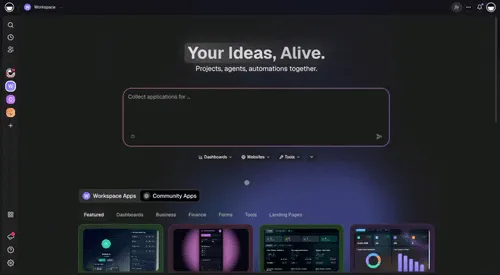
Y Combinator CEO Garry Tan named Taskade specifically as a platform that would "compete away" $30/seat SaaS bundles. He was right, but the reason is not AI code generation. The reason is that Taskade Genesis builds living software — apps that learn, adapt, and automate inside a workspace where teams already collaborate. The code generation is just the first 60 seconds. The next 60 days of agents, automations, and team workflows is what creates retention.
The numbers validate the architecture: 150,000+ apps built, growing community gallery of published applications, and pricing that starts free, then $10/month (Pro for up to 10 users), or $25/month (Business) with annual billing. When PromptShip charged $29/month for an API wrapper, Taskade Genesis delivered an entire workspace with AI agents, automations, and deployment for less money.
The lesson: infrastructure before intelligence. Build the workspace first, then add AI. Not the other way around.
Lovable: Supabase-Native Full-Stack Generation
Lovable survived because it made a contrarian architectural choice: Supabase-native generation. Instead of generating code files that users then had to deploy and host somewhere, Lovable generates applications with a real Supabase backend — real database, real authentication, real row-level security.
This solved the biggest pain point that killed Feature Wrappers: the deployment gap. PromptShip generated React components. Users then had to figure out hosting, databases, environment variables, CI/CD pipelines, and CORS configuration. Most users — especially the non-developers who make up 63% of vibe coders — gave up.
Lovable's Supabase integration meant the app was deployed with a real backend from the first prompt. Users could query their database, add authentication, and build production features without leaving the platform.
The tradeoff was lock-in to the Supabase ecosystem. But in a market where the alternative was "no deployment at all," lock-in to a working backend was a feature, not a bug.
Lovable also made a smart business decision: genuine source code ownership. Users could export their code and take it elsewhere. This created trust that converted free users into paid customers — they were not paying for lock-in, they were paying for velocity.
Bolt.new: Deep Technical Differentiation
Bolt survived on pure technical moat. Built on StackBlitz WebContainers — a technology that runs Node.js entirely in the browser — Bolt could execute generated code without any external server. This was not an incremental improvement over competitors. It was a fundamentally different architecture.
When NeuralDeploy burned $4 million per month on cloud compute, Bolt's per-user infrastructure cost was near zero because the computation happened in the user's browser. When StackForge struggled with deployment pipelines, Bolt's apps ran instantly because there was nothing to deploy — the browser was the server.
This technical differentiation created a moat that could not be replicated by adding an API call. You cannot WebContainer-ify an existing product. You have to build on WebContainers from the start, which StackBlitz spent years doing before Bolt launched.
The lesson: deep technical differentiation beats feature parity. Bolt did not try to do everything. It did one thing — in-browser execution — at a level of depth that made it structurally impossible for Feature Wrappers to compete.
Cursor: IDE Moat and Developer Workflow
Cursor survived because it integrated AI into the tool developers already use eight hours a day: the code editor.
While Codepilot Pro built an AI pair programming tool from scratch, Cursor forked VSCode — the editor 73% of developers already use — and added AI capabilities that understood the entire codebase. The AI was not an assistant sitting next to the editor. It was embedded in the editor, reading every file, understanding every dependency, and suggesting changes in context.
This created the most powerful moat in the category: workflow stickiness. Developers do not switch code editors lightly. Once Cursor's AI understood a codebase — its patterns, conventions, architecture — switching to a competitor meant losing that context. The switching cost increased with every day of usage.
Codepilot Pro, by contrast, was a standalone tool that developers had to switch to. It competed for a slot in the developer's workflow rather than embedding into the slot that already existed. When Cursor offered the same AI capabilities inside the existing workflow, Codepilot Pro's standalone value proposition collapsed.
The Survivor Comparison
| Dimension | Taskade Genesis | Lovable | Bolt.new | Cursor |
|---|---|---|---|---|
| Core Moat | Workspace DNA (9 years of infra) | Supabase-native backend | WebContainer execution | IDE workflow stickiness |
| Target User | Teams + non-developers | Full-stack developers | Front-end developers | Professional developers |
| What It Generates | Living apps with agents + automations | Full-stack apps with real DB | In-browser apps | Code within existing projects |
| Deployment | Built-in (workspace IS the runtime) | Supabase (auto-deployed) | In-browser (no deploy needed) | N/A (IDE, not a builder) |
| AI Agents | Yes (built-in tools, custom agents, memory) | No | No | No (AI assist, not agents) |
| Automations | Yes (100+ integrations, durable execution) | No | No | No |
| Code Ownership | Workspace-native (export available) | Full source code export | Full source code export | User's code (IDE) |
| Pricing (annual) | Free / $10 / $25 | Free / $20 / $50 | Free / $20 / $50 | Free / $20 / $40 |
| Apps Built | 150,000+ | 50,000+ (est.) | 40,000+ (est.) | N/A (not an app builder) |
The table reveals something important: the survivors are not competing with each other. They occupy different niches within the same macro-category. Taskade Genesis is the workspace-native platform for teams and non-developers. Lovable is the Supabase-native platform for full-stack developers. Bolt is the in-browser platform for front-end prototyping. Cursor is the AI-enhanced IDE for professional developers.
The tools that died were trying to be all of these things — or worse, none of them. Feature Wrappers occupied no niche. Single-Purpose Plays occupied a niche too small to sustain a company. Hype-Led Architectures occupied a niche that existed only in their pitch decks.
The Genesis Story: Why Infrastructure-First Wins
The Taskade Genesis origin story is the anti-pattern to every failure on this list.
In 2017, when the AI app builder category did not exist, Taskade launched as a collaborative workspace. The founding team spent seven years building real-time collaboration, project views, cross-platform sync, and organizational tools. By 2024, Taskade had a production workspace used by hundreds of thousands of teams.
When large language models became capable enough to generate entire applications from prompts, the Taskade team did something that none of the 2025 startups could do: they built the AI into the existing workspace. Genesis apps did not float in the void. They lived inside workspaces where teams already organized their work, where AI agents already had context about the team's goals, and where automations already connected to 100+ external tools.
This is why the "code vs runtime" distinction matters. PromptShip and its Feature Wrapper peers generated code. Taskade Genesis generates runtime — living applications that are already deployed, already connected, already intelligent from the moment they are created.
The technical architecture reflects this philosophy:
- Memory: Every app lives inside a project. Projects are structured data that AI agents can read, write, and learn from. The workspace is the database.
- Intelligence: AI agents with built-in tools can modify apps, answer questions, and execute multi-step workflows. Agents have persistent memory and learn from the team's context.
- Execution: Automations connect apps to Slack, email, Salesforce, Notion, Google Calendar, Shopify, and 100+ other services. Apps do not just exist — they act.
When a Feature Wrapper generated a React component and handed it to the user, the user's work was just beginning. When Taskade Genesis generates an app, the user's work is done. The app is live, connected, and intelligent. That is the difference between a demo and a product.
The 150,000+ apps built on Genesis are not prototypes waiting for deployment. They are production applications running inside workspaces where teams collaborate every day. Some have custom domains. Some have password protection. Many have embedded AI agents that interact with end users. All of them have the Workspace DNA advantage: they get smarter with every interaction because Memory, Intelligence, and Execution are a self-reinforcing loop.
Try building your first app in 60 seconds →
Lessons for Builders in 2026
The vibe coding graveyard teaches five lessons. None of them are about AI.
Lesson 1: Infrastructure Before Intelligence
Every survivor built infrastructure before adding AI. Taskade spent 7 years on workspace infrastructure. StackBlitz spent years on WebContainers before Bolt launched. Cursor forked and extended VSCode rather than building from scratch.
The failures tried to skip this step. They built AI-first and infrastructure-never. The AI was the product. When the AI became a commodity — when every tool had access to the same frontier models from OpenAI, Anthropic, and Google — the products had nothing else to offer.
Rule: If your only moat is the quality of your AI output, you have no moat. AI output quality converges across platforms as models improve — and when everyone can generate the same thing, raw output collapses into AI slop. Infrastructure diverges.
Lesson 2: Own Your Runtime
PromptShip generated code. Taskade Genesis generates runtime. The distinction killed five Feature Wrappers.
Owning the runtime means owning the environment where generated applications actually run. When Taskade Genesis builds an app, the app runs inside the Taskade workspace. The workspace is the backend, the database, the deployment platform, and the AI engine. There is no gap between "generate" and "deploy" because they are the same thing.
Feature Wrappers generated code and told users to deploy it themselves. That handoff — from AI output to user responsibility — is where retention died. Users who cannot deploy code do not come back. Users who do not need to deploy code never leave.
Rule: If your product generates code that the user must deploy elsewhere, you are a compiler, not a platform. Compilers are commodities.
Lesson 3: Solve Maintenance, Not Just Creation
ShipFast.ai, BuildBot, and AppWhisper all solved the creation problem. Users could build something in minutes. The problem was that "building something" is 5% of the software lifecycle. The other 95% is maintenance, updates, debugging, and integration.
The survivors understood this. Taskade Genesis apps live in workspaces where AI agents maintain and update them. Lovable apps have real Supabase backends with versioning and database management. Cursor helps developers maintain and extend existing codebases, not just create new ones.
Rule: The market for creation tools is small. The market for maintenance tools is enormous. Build for the 95%, not the 5%.
Lesson 4: Daily Usage Beats Occasional Brilliance
AppWhisper had the most viral demo of any tool on this list. Fifty thousand signups in one week. Four hundred daily active users by week three. The demo was brilliant. The product was occasional.
Cursor, by contrast, had a modest launch. But it integrated into a workflow developers use eight hours a day. Daily active usage grew slowly and compounded. By the time AppWhisper shut down, Cursor had more daily active users than AppWhisper ever had signups.
Taskade Genesis benefits from the same dynamic. Because Genesis apps live inside workspaces where teams manage projects, collaborate on documents, and run automations, the workspace is used daily. Genesis is not a tool users visit occasionally to build something. It is a platform teams live in.
Rule: Optimize for daily active usage, not signup counts. Signups are vanity metrics. Daily usage is a business.
Lesson 5: Raise Money After Traction, Not Before Product
AIForge raised $42 million before shipping a working product. The demo video closed the round. The product never matched the demo. The company burned through the capital trying to make reality match the pitch deck, and reality won.
The survivors raised money on traction. Taskade had years of workspace usage before Genesis launched. Cursor had growing developer adoption. Bolt had WebContainer technology that demonstrably worked.
Rule: Capital amplifies what already works. It does not create what does not exist. Raising money on a demo creates a time bomb: the gap between demo and product accrues interest, and the interest compounds.
Lessons Summary Table
| Lesson | The Dead Did This | The Survivors Did This |
|---|---|---|
| Infrastructure first | Built AI wrapper, skipped infrastructure | Years of infrastructure before adding AI |
| Own your runtime | Generated code, told users to deploy it | Generated apps that are already deployed |
| Solve maintenance | Made creation fast, ignored the other 95% | Built for the full software lifecycle |
| Daily usage | Optimized for viral demos and signups | Optimized for daily workflow integration |
| Traction before capital | Raised money on demo videos | Raised money on usage metrics |
What Comes Next: The Second Wave
The graveyard is not finished being filled. Gartner predicts 40% of AI agent projects will fail by 2027. The first wave killed the Feature Wrappers, Single-Purpose Plays, and Hype-Led startups. The second wave will kill the tools that survived 2025 but cannot retain users beyond the novelty phase.
The second wave will be quieter. No dramatic shutdowns. No viral postmortems. Just gradually declining usage, quiet acqui-hires, and LinkedIn posts about "exciting new chapters." The tools that survive the second wave will be the ones that have become daily infrastructure — not because they are the best AI, but because they are embedded in workflows that would be painful to replace.
This is why Workspace DNA matters. When your app builder is also your project manager, your document editor, your automation platform, and your AI agent workspace, switching is not just inconvenient — it is operationally impossible. That lock-in is not artificial. It is the natural consequence of building a platform that does more than generate code.
The vibe coding revolution is real. The market is growing. The tools are getting better. Non-developers are building software they never could have built before. But the companies that profit from this revolution will be platforms, not products. They will be infrastructure, not features. They will be the survivors, not the casualties.
The graveyard is a warning. The survivors are a roadmap.
Start building on the platform that lasts →
FAQ
How many AI app builders died in 2025-2026?
By April 2026, roughly half of the 60+ AI app builders that launched in 2025 had pivoted, been acqui-hired, or shut down entirely. The AI app builder category saw more than $800 million in venture capital invested in tools that subsequently failed. The survivors — Taskade Genesis, Lovable, Bolt, and Cursor — share a common pattern: deep technical moats or platform foundations that predated the AI hype cycle.
Why did Feature Wrapper startups fail fastest?
Feature Wrappers failed because their entire value proposition — calling an LLM API and rendering the output — was immediately commoditized. When open-source tools replicated the same prompt-to-code pipeline for free, paid Feature Wrappers had no defensible position. The AI layer is table stakes. The infrastructure layer is the moat. Feature Wrappers had no infrastructure.
What is the difference between generating code and generating runtime?
Generating code produces files that a user must then deploy, host, configure, and maintain. Generating runtime produces living applications that are already deployed, already connected to data sources, and already capable of learning and adapting. Taskade Genesis generates runtime — apps that live inside workspaces with AI agents, automations, and persistent memory. The distinction is why Feature Wrappers died and platform builders survived.
Can I still build a successful AI coding tool in 2026?
Yes, but the bar has risen dramatically. You need at least one of: a deep technical moat (like Bolt's WebContainers), workflow integration into an existing daily tool (like Cursor's IDE), a pre-existing platform foundation (like Taskade Genesis's workspace), or genuine source code ownership with a real backend (like Lovable's Supabase integration). If your plan is "call the OpenAI API and render a code preview," you are building the next PromptShip.
How does Taskade Genesis pricing compare to tools that died?
Most dead tools charged $20-50/month for API wrappers with no infrastructure. Taskade Genesis starts with a free plan and scales to Pro at $10/month for up to 10 users, and Business at $25/month, all with annual billing. For that price, users get a full workspace with AI agents, 100+ automation integrations, multiple project views, and a community gallery of published apps. The dead tools charged more for less.
What should I look for when choosing an AI app builder?
Five criteria separate survivors from future casualties: Does the platform have infrastructure that predates the AI hype? Can you maintain and update generated apps without leaving the platform? Does it integrate into a daily workflow (not just occasional creation)? Are generated apps connected to real data sources, agents, and automations? Is the pricing transparent and sustainable at scale? If the answer to three or more is no, the tool may not exist in 12 months.
Will the surviving platforms eventually consolidate?
Partial consolidation is likely. The four survivors occupy different niches: Taskade Genesis serves teams and non-developers, Lovable serves full-stack developers, Bolt serves front-end prototyping, and Cursor serves professional IDE users. Some overlap will develop as platforms expand, but complete consolidation is unlikely because the user profiles and daily workflows are fundamentally different. The market is big enough for multiple winners — just not 60+ of them.
What is Workspace DNA and why did it help Taskade Genesis survive?
Workspace DNA is the architectural foundation that separates Taskade Genesis from every tool in the graveyard. It is the self-reinforcing loop where Memory (projects, data, documents) feeds Intelligence (AI agents with built-in tools and persistent memory), Intelligence triggers Execution (automations with 100+ integrations), and Execution creates new Memory. Feature Wrappers had none of these layers. Taskade had all three, built over 9 years, before Genesis ever launched. That is why 150,000+ apps have been built on the platform — and why it will still be here when the next wave of startups rises and falls.