







TL;DR: Every other AI product turns a prompt into output — text, code, a file. Taskade Genesis turns a prompt into a system that keeps running after you close the tab. Memory, agents, automations, and interface as one live runtime. Not code generation. Not workflow stitching. Not chat. Software that runs itself. See it run →
The Reframe
Here is the entire thesis in one diagram:
The old world:                      Taskade Genesis:  prompt → text                     prompt → system
prompt → code                     (remembers, acts,
prompt → file                      connects, runs without you)
That is the whole thing. Everything else in this essay is consequence.
For three years the AI industry has been selling variations on the same product: you type a prompt, something comes out the other side, you do something with it. The something coming out has gotten more sophisticated — first paragraphs, then code, then full React components, then designs, then complete applications as files. The pattern is the same. You get output. You still have to run it.
Taskade Genesis is a different pattern. You describe what you want. The system constructs itself. It has memory. It has agents. It has automations. It has a live interface. It is running before you finish reading this paragraph. It keeps running after you close the tab, after you go to sleep, after you forget you built it.
We don't ship output. We ship systems.
What's Actually Running
Let me get concrete. A Genesis workspace is four layers, implemented as one runtime:
┌──────────────────────────────────────┐
│           INTERFACE (APP)            │  what users see and use
├──────────────────┬───────────────────┤
                   ▲
┌──────────────────┴───────────────────┐
│       AUTOMATIONS (EXECUTION)        │  triggers → actions → loops
├──────────────────┬───────────────────┤
                   ▲
┌──────────────────┴───────────────────┐
│         AGENTS (INTELLIGENCE)        │  reasoning, tools, decisions
├──────────────────┬───────────────────┤
                   ▲
┌──────────────────┴───────────────────┐
│          PROJECTS (MEMORY)           │  structured, persistent state
└──────────────────────────────────────┘
We call this Workspace DNA, and it isn't marketing. It's the actual architecture the system is built on.
Projects = node graph, not documents
Every Genesis project is a node graph with typed fields — strings, numbers, datetimes, select lists. Like database columns, not like document paragraphs. Views on that graph render as seven interchangeable surfaces: List, Board, Calendar, Table, Mind Map, Gantt, and Org Chart. Add-ons attach due dates, assignees, fields, and tags to any node. This is a structured, persistent memory layer — not a wiki with AI features bolted on.
Agents = LLM + tools + project knowledge
Agents in Taskade Genesis are LLM-powered entities with custom system prompts, access to a tool registry, and bindings to specific project knowledge. They can call automation actions as tools, invoke workflows as tools, and read from any project they're attached to. They are persistent — the same agent lives across sessions, accumulating context through the Memory Reanimation Protocol.
Automations = sequential execution engine
Automations in Taskade Genesis are not Zapier webhooks. They are a sequential execution engine — each node runs in order, with explicit branching via condition expressions. Triggers can be manual, webhook, or form-based. Liquid expressions chain outputs to inputs across trigger/action/loop nodes. This is code, without code.
Apps = live React runtime with agents embedded
Every Genesis app is a modern React runtime rendered live in the workspace. The build system auto-refreshes the preview as the code changes. Auto-generated endpoints expose projects and workflows as callable APIs. Authentication is built in — no OAuth wiring required. An agent chat surface is a first-class component, not a widget embedded from elsewhere.
Four layers. One runtime. Not four products stitched together.
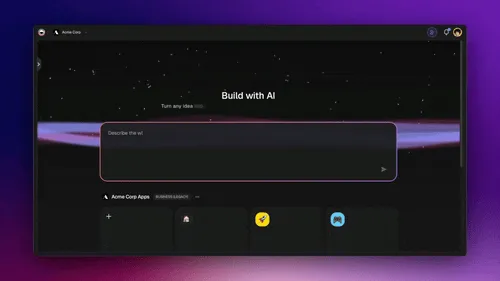
Full Taskade Genesis capability matrix (April 2026)
A single table of what Workspace DNA actually buys you, grouped by primitive:
| Layer | Capability | What it does |
|---|---|---|
| Projects (Memory) | Multiple project views | List · Board · Calendar · Table · Mind Map · Gantt · Org Chart — same data, seven renderings |
| Node graph | Typed fields, assignees, due dates, tags, attachments on every node | |
| Multiplayer + real-time sync | Live cursors, presence, instant merge across devices | |
| Role-based access | Owner to Viewer | |
| Multi-layer search | Full-text, semantic (HNSW), and file-content OCR in one query | |
| Persistent memory layer | Project-scoped memory that survives sessions and onboarding | |
| Agents (Intelligence) | Frontier models | Auto-routed across top AI labs; per-task model selection |
| built-in tools | Web search, scraping, summarization, code, citations, file I/O, and more | |
| Custom tools | Any OpenAPI endpoint becomes an agent tool | |
| Slash commands + @-mentions | Call agents, invoke tools, or hand work to another agent inside any project | |
| Agent memory + handoff | Agents inherit project context and can hand off between each other | |
| Public agent embedding | Publish any agent to the web with optional auth and a custom domain | |
| Automations (Execution) | Sequential execution engine | Triggers → actions → branching logic → loops, chained through Liquid expressions |
| 100+ integrations | Across 10 categories: comms, email/CRM, payments, dev, productivity, content, analytics, storage, calendar, e-commerce | |
| Manual, webhook, and form triggers | Fire workflows from a click, a partner request, or a customer-facing form | |
| Durable runs | Logs, retry, observability — workflows resume predictably | |
| Cross-integration chaining | One workflow spans Gmail → Stripe → Slack → a project update, end-to-end | |
| Apps (Interface) | Prompt-to-app construction | A natural-language prompt assembles projects, agents, automations, and a React app |
| Live React runtime | Embedded React + TypeScript + Tailwind rendered and auto-refreshed in-workspace | |
| Auto-generated project APIs | Every project and workflow is callable from the app with no manual wiring | |
| Custom domains + password protection | Ship a published app to your own domain with one click | |
| Community Gallery | Browse, clone, and remix thousands of published apps | |
| Built-in authentication | OIDC-capable sign-in is generated for you; no separate auth vendor |
Every row is a capability a conventional "AI doc" product would have to bolt on from a separate vendor — and every row writes back into the same project graph. That is the wedge.
The Closed Loop
Here is the part almost nobody else has, and the part that took us years to get right:
             INPUT
              │
              ▼
       ┌─────────────┐
       │   PROJECTS  │  (memory / state)
       └──────┬──────┘
              ▼
       ┌─────────────┐
       │   AGENTS    │  (decide / reason)
       └──────┬──────┘
              ▼
       ┌─────────────┐
       │ AUTOMATIONS │  (act / execute)
       └──────┬──────┘
              ▼
       ┌─────────────┐
       │     APP     │  (surface / interact)
       └──────┬──────┘
              ▼
          FEEDBACK
              │
              └─────── loops back into memory
Four write-back paths exist in Taskade Genesis, and each is a first-class capability:
- Agent → project. An agent creates or updates structured project nodes from inside its reasoning loop. The agent's output becomes new memory.
- Automation → project. An automation action writes to the project on a trigger. The workflow's output becomes new memory.
- App → project. The running app calls the workspace's auto-generated project APIs. User interface events become new memory.
- Meta-agent → project. The meta-agent that orchestrates workspace construction writes durable notes back into a dedicated memory area of the project. The construction process itself becomes new memory.
Every intelligence layer, every execution layer, every interface layer can write back into the same project graph. The loop closes.
As a state machine, the loop never stops:
This is what makes it a system instead of a demo. A system that can't update its own state is a vending machine. A system whose intelligence, execution, and interface all operate on a shared state that each can modify is a living thing.
Competitors in the code-generation category have brilliantly solved the prompt-to-code step. They have not solved the rest of the loop, because their output is code — and code, once generated, no longer has a connection to the prompt that generated it. Taskade Genesis is built on the premise that the loop is the product.
"Build Me a CRM" — What Actually Happens
Make this tangible. Someone types: "build me a CRM for my sales team."
In most AI tools, you get a React app with a contacts table. Beautiful UI, real code, deploys fine. You still have to wire up a database, host the app, set up authentication, integrate email, connect a calendar, configure permissions, and maintain the whole thing. Six more weeks of work, done by you.
In Taskade Genesis, the meta-agent runs a five-step construction sequence:
- Creates the data layer. Contacts, deals, companies as structured projects with typed custom fields — like database tables. Immediately queryable, immediately persistent.
- Wires agents. A deal-qualification agent, a follow-up drafter, a pipeline summarizer — each with system prompts, tools, and knowledge bindings to the projects.
- Connects automations. Lead captured → contact created → qualification agent invoked → follow-up scheduled. Sequential execution. Branching on qualification score.
- Generates the UI. A live React app at
your-crm.taskade.appwith an embedded agent chat for the sales team to talk to their own agents. - Deploys instantly inside the workspace. No build step. No hosting decision. No integration work. The app is running before the user finishes reading the response.
One orchestrated loop. No handoff. No glue. No missing layer.
This is what one of our most active Genesis builders does every day. He is a program-management officer and digital ecosystem architect in Europe with 37 years of PLM delivery experience. He has built hundreds of Genesis apps over the past few months. Among them is a production CRM — a full pipeline, contacts, scoring, segments, email templates, estimates, and a KPI dashboard — targeting a first batch of 14,780 leads he sourced from an 820,000-user database. He didn't write code. He described what he wanted. The system built itself. He has been using Taskade Genesis to refine the build for weeks, and the system has been continuously running the entire time.
He is not an anomaly. He is the shape of the user we are building for.
The Wedge
Everyone else gives you output.
Taskade Genesis gives you execution.
That is the whole wedge. It is narrow on purpose. Everything else in our positioning is downstream of it.
Not code. Not workflows. Not apps. Execution. A running system that keeps running, in a workspace that already has memory, agents, integrations, and permissions pre-wired.
The industry's current infatuation with prompt-to-code is a phase, and a useful one. It is training users to expect that natural language can produce working software. That expectation is the substrate Taskade Genesis needs. Once a user has experienced prompt-to-code, the jump to prompt-to-system is not philosophical — it is obvious. The only question is which product makes the jump first, and lasts.
We have been making that jump since 2017. Taskade has been markdown-native and tree-structured since its first commit — the exact right abstraction for the agent-on-filesystem era. We added agents on top of an 8-year runtime. Competitors starting today have to build the runtime before they can ship the agent. That is the moat, and it is older than the category.
The Category
The competitive landscape in 2026 groups roughly into four lanes:
| Lane | Examples | What they ship | What they don't |
|---|---|---|---|
| Foundation models | Anthropic, OpenAI, Google, Meta | Raw reasoning via API | Interface, persistence, workflows |
| Chat interfaces | ChatGPT, Claude, Gemini, Copilot | Conversational access to models | Memory, structure, automation |
| Code-generation tools | Lovable, v0, Bolt, Cursor, Replit | Generated code + deployment | Persistent state, agents, workflows |
| Execution layer | Taskade Genesis | Running systems with memory, agents, automations, and interface | — |
There is no shame in being in the first three lanes. They are each valuable and in many cases larger markets than the fourth. But they are not the same market, and the conflation — products in lane three being described as competing with products in lane four — is a category error that will clarify over the next eighteen months. The full case is here.
Why Every "Best AI App Builder 2026" Listicle Misses the Shot
Look at the top-ranking roundups in April 2026 — Lindy's "8 Best AI App Builders", NxCode's "Best of 2026", Zapier's "6 Best", Lovable's own domain-hosted comparisons. They rank the same handful of tools (Lovable, Bolt, Base44, v0, Figma Make, Airtable, OpenAI Agent Builder) on roughly the same axes: output fidelity of the generated UI, price per prompt, credit economics, deployment target. The whole category is framed as a bake-off between near-equivalent code generators.
Everything on the left side of that diagram is measured at the click-"Deploy" moment. Everything on the right side only starts mattering after that click. Listicles rank Category A by the axes they share; the axis that actually separates categories is never on the scoreboard. That is the unclaimed ground, and it is where we are playing.
On December 1, 2025, Garry Tan — president and CEO of Y Combinator — posted publicly grouping Taskade with Replit and a handful of other full-stack AI builders as the emerging "full-stack" category competing against bundled SaaS incumbents (Notion, ClickUp, Monday, Airtable). That was the first high-signal public recognition that the fourth lane exists as a category rather than a collection of products. We expect the recognition to become consensus inside twelve months. If you are an investor, operator, or builder reading this in the window between "the category is forming" and "everyone is talking about it," you are early. Early is the right place to be.
Collapsing the Stack
The traditional software stack looks like this:
database
    │
backend
    │
agents / AI services
    │
workflows / integrations
    │
frontend
Every line is a different product, usually a different vendor, usually a different engineering team, usually a different budget. The integration surface between them is where most of the cost, complexity, and fragility in modern software lives.
Taskade Genesis collapses this into a single runtime:
database + backend + agents + workflows + frontend
                        │
                   ONE RUNTIME
Each workspace becomes its own self-contained system. No deploy step. No hosting decision. No integration tax. No fragmentation across five SaaS vendors. The reason we can do this is because we built the runtime first — eight years ago — and only recently added the agent layer on top. Every other product in the category is trying to do the inverse: build an agent product and retrofit a workspace underneath. Our experience is that the inverse path is much harder than it looks, because the workspace layer has a large number of non-obvious design decisions (memory, permissions, real-time sync, multiplayer, file format stability) that take years to get right and cannot be shortcut.
This is not a criticism of competitors. It is an observation about why time-in-market matters in this category: the compounding advantage is on the workspace side, not on the model side.
The Proof
I want to give four proof points that are each verifiable and cumulative.
1. A self-served enterprise build
An experienced enterprise IT program manager who had used Taskade for years self-served to Taskade's enterprise tier through the product — zero sales calls, zero outbound. Built a four-project, twenty-plus-job production service-management dashboard in one week. They estimate the same build would traditionally take roughly 40 people 18 months. The full story is here.
2. Our most active builder, who wrote our documentation
Hundreds of Genesis apps built. Hundreds of meta-agent interactions. Authored a seven-class failure taxonomy — the Genesis Debugging Framework — which we have adopted as official Taskade documentation. When your most active power user writes your documentation, something is happening in the product that is difficult to replicate at any competitor. The full story is here.
3. An entire education business running on Taskade Genesis
A Cambridge English exam prep business in the UK. Runs its entire customer-facing product on nine Genesis apps — score calculators, test makers, a pathway planner, a full LMS. Thousands of monthly visits from their own domain into embedded Genesis apps. Students never leave the partner's domain; they're interacting with our infrastructure, transparently. A credentialed education business runs on Taskade Genesis.
4. A single embedded partner producing nearly 40% of Taskade Genesis referral traffic
A Brazilian event booking platform. Over 54,000 visits per month from their domain to Genesis apps. That is 39% of all external referral traffic to the entire Taskade Genesis ecosystem, from a single embedded partner. The embedded-app distribution model is working at a scale we did not forecast.
Aggregated:
- 6,000+ cash-paying customers — split across web (Stripe) and mobile (RevenueCat)
- $1M+ ARR run-rate with strong double-digit YoY cash revenue growth
- 670K+ MAU in April 2026, up from roughly 500K in February — about a 37% increase in two months
- 150,000+ Genesis apps generated since launch in October 2025
- a large long-time user base sitting on top of the cash-paying base, with first conversions to enterprise underway
These are not projections. Every number is verifiable in Stripe, RevenueCat, and our internal dashboards under NDA.
Why This Works — And Why Now
The preconditions for Taskade Genesis did not exist two years ago. Three of them had to converge:
- Foundation models capable of multi-step reasoning and tool use. Unlocked through 2024 with frontier models at reliable tool-use quality.
- Mature workspace runtime primitives. Real-time collaboration, structured memory, typed fields, live preview, multiplayer state. These are the infrastructure most current AI tools don't have and can't shortcut. Taskade has been building them since 2017.
- User expectation of natural-language-to-software. This is a cultural precondition, not a technical one. Until users believed a prompt could produce working software, the market wasn't ready. The 2023-2025 wave of prompt-to-code products trained users into that belief. Taskade Genesis is the next step those trained users take.
All three converged in 2025. October 2025 — the month we launched Taskade Genesis — was not accidental.
The Convergence Signal: Four Independent Voices Reached the Same Conclusion
If "software that runs itself" were only our claim, it would be marketing. Here are four of the most watched voices in AI in 2026, all arriving at variations of the same thesis from different directions:
Four different vocabularies ("agents improvise," "Software 3.0," "Claude grows itself," "cognitive labor goes negative") describing the same structural shift. Chat is the 2026 version of the 1995 search box — the interface that made the internet legible to a billion people and then became a commodity. Execution is the 2026 version of the 1999 e-commerce checkout flow — the layer where the value of the internet actually got captured. We are building for the second one. Try it free →
Doug Engelbart's 1968 demo showed the full vision of a collaborative, agentic workspace 58 years ago. Every generation of software since has shipped a fragment. The spreadsheet was a fragment. Google Docs was a fragment. Notion was a fragment. ChatGPT was a fragment. The full system requires all of the pieces in the same runtime, and the pieces are only now all available at the same time.
Software that runs itself is not a new idea. It is a 60-year-old idea that finally became buildable. The window for someone to build it is open now and will close in a few years, as the category consolidates. We intend to be the one that stays.
What Taskade Genesis Is Not
Because the above is a strong claim, some honest disclaimers.
- "One prompt → running system" is orchestrated, not atomic. The meta-agent runs a multi-step construction sequence. It is fast — usually under two minutes — but it is a sequence, not instantaneous magic. We say "one prompt kicks off the sequence," which is accurate.
- Automations execute sequentially. There is no parallel multi-agent orchestration in Taskade Genesis yet. This is a deliberate current constraint; the trade-off is predictability and debuggability over throughput. We will add parallel orchestration when the debugging tools catch up.
- Memory is scoped per workspace. There is no cross-workspace memory federation today. Each workspace is isolated. We are actively working on cross-workspace memory with proper permissioning, but it is not shipped.
- Apps are sandboxed. Genesis apps cannot install arbitrary npm packages or modify build configuration. They operate inside a curated runtime. This is a security and stability choice, not an oversight.
- Agents mutate projects through tools, not through direct code edits to apps. App code is modified by the meta-agent in response to prompts, not by end-agents inside the running app. This is a separation we enforce.
Every one of these constraints is a place where the product will evolve. Each is also a place where a competitor claiming to have solved it should be questioned carefully — the non-obvious versions of each of these problems are harder than they appear.
The Category Moat
The question investors ask most often is: what prevents OpenAI or Anthropic from doing this?
Short answer: they probably won't, because it is structurally the wrong shape for them.
Long answer: foundation labs capture value by training models and selling tokens. Their org charts, revenue models, engineering priorities, and GTM motions are oriented around that value capture. Shipping a workspace runtime with real-time collaboration, permission models, SOC 2 Type II compliance, and deep integrations with Gmail, Slack, GitHub, Stripe, Salesforce, Linear, and 90+ other services is not the work they are organized to do. They can ship features — memory, agents, canvas — but the surrounding scaffolding of a full-stack workspace is a different business.
There is a version of this where one of the labs decides to build a full-stack workspace product and takes a serious run at it. The frequency with which we hear investors ask this question suggests it's possible. The frequency with which we watch frontier labs focus on capability benchmarks rather than workspace infrastructure suggests it's unlikely on the current timescale.
The real competition is the next generation of workspace-native AI products — and those products either have the eight-year runtime we have, or they are going to spend the next three years building it while we extend our lead. This is the compounding dynamic we are betting on.
Closing
Taskade is a company in its ninth year, built by a founder who has been trying, mostly without realizing it, to build what Doug Engelbart showed in 1968. The 2025 launch of Taskade Genesis is the point at which the eight-year runtime, the frontier models, and the user expectations all finally lined up.
We don't generate code. We generate systems that run. Every workspace becomes its own stack. No integration tax. No glue. No assembly.
You describe what you want.
It exists.
It works.
It keeps working.
That is the thesis. Try it free.
Deeper Reading
- The Execution Layer: Why the Chatbot Era Is Over — The category thesis this post sits inside
- The Genesis Equation: P × A mod Ω — The architecture, compressed to a formula
- Doug Engelbart's 1968 Demo Was Taskade — The 58-year lineage
- The Frontend Playground Era — Why code-generation tools and Taskade Genesis are different categories
- Memory Reanimation Protocol — The memory layer that makes the loop close
- History of cPanel & WHM (1996 → 2026) — The 30-year origin of the "visual panel for a complex running system" pattern
- From Bronx Science to Taskade Genesis — Where the founder's half of this started
- One Week, Forty People — A customer running the full thesis
- The Customer Who Wrote Our Documentation — What platform depth looks like in practice
John Xie is the founder and CEO of Taskade. He has been building toward this thesis since 2017, most of it without knowing the word for it.
Build with Taskade Genesis: Create an AI App | Deploy AI Agents | Automate Workflows | Explore the Community
Frequently Asked Questions
What does 'software that runs itself' mean?
Software that runs itself is software where the user describes what the system should do, and the system then operates autonomously on that description — maintaining state, reasoning about new inputs, executing actions, and updating its own interface — without requiring the user to write code, deploy a service, wire up integrations, or keep returning to provide instructions. In Taskade Genesis, a single prompt initiates a coordinated construction of four layers (Projects as memory, Agents as intelligence, Automations as execution, and an App as interface) that continue running as a unified system after the prompt is gone.
How is Taskade Genesis different from Lovable, v0, Bolt, or Cursor?
Lovable, v0, Bolt, and Cursor are outstanding code-generation tools. They turn a prompt into code the user then has to assemble, deploy, integrate, authenticate, schedule, and maintain. Taskade Genesis turns a prompt into a running system inside a workspace that already has data storage, agents, integrations, authentication, and permissions pre-wired. The difference is architectural category: code-generation tools are the frontend layer; Taskade Genesis is the execution layer. Both are useful; they are not the same product and rarely compete for the same workflow.
What is Workspace DNA?
Workspace DNA is the four-layer architecture that defines every Genesis workspace: Projects (structured, persistent memory built on a node graph), Agents (LLM-powered reasoning with tools and project knowledge), Automations (sequential execution of triggers, actions, and branching logic), and the App interface (a live React+TypeScript runtime rendered on top of the other layers). These four layers are not separate products bolted together; they are the same runtime viewed from four angles, each writing back into the same project graph. This is what produces a closed-loop system rather than a chain of disconnected tools.
What is the closed-loop architecture?
The closed-loop architecture refers to the property that every active layer of a Genesis workspace can write back into the underlying project graph. Agents write to projects through tool actions. Automations write to projects through action nodes. Apps write to projects through auto-generated REST APIs. The meta-agent writes to project memory through a dedicated memory tool. The result is that intelligence, execution, and interface are not separate silos — they are different surfaces operating on a shared state, and every action deepens the state for future actions.
Is Taskade Genesis no-code?
No. No-code tools are visual builders where the user assembles software by dragging and dropping components. Taskade Genesis is the next category after no-code: the user describes what should exist in natural language, and the system constructs the application — including database structure, agent behavior, automation flows, and interface — as a unified runtime. No-code tools still require the user to act as the architect. Taskade Genesis constructs the architecture from description.
What kinds of customers are actually building on Taskade Genesis?
Genesis customers are a mix of enterprise operators, internal builders at large companies, agencies, indie makers, and small businesses. They include Fortune 500 program managers building production dashboards, digital-ecosystem architects building full CRMs, education businesses running customer-facing learning products, event platforms driving embedded bookings, and enterprise agencies deploying white-label agents. The common thread: these are operators with real problems who needed software faster than traditional development cycles would allow.
What are Taskade's growth metrics as of April 2026?
As of April 2026, Taskade has 6,000+ cash-paying customers across web (Stripe) and mobile (RevenueCat), with a $1M+ run-rate annualized recurring revenue and strong year-over-year cash revenue growth. Monthly active users are 670K+ — up from ~500K in February, a roughly 37% increase in two months. The Genesis platform has generated over 150,000 apps since launch in October 2025, with hundreds built by paying customers. A large long-time user base sits on top of the cash-paying base and has begun converting to enterprise tiers.
Why is Taskade Genesis called the execution layer?
Taskade Genesis is called the execution layer because it sits above foundation models (the raw intelligence tier) and chat interfaces (the conversational access tier) and below the eventual deployed application — the layer where user intent actually gets converted into ongoing operational work. Foundation models produce reasoning. Chat interfaces expose that reasoning conversationally. The execution layer turns that reasoning into persistent systems that maintain state, take actions, and deliver outcomes over time.
What is the 'full-stack' framing for Taskade Genesis?
The full-stack framing means Taskade Genesis collapses the traditional software stack — database, backend, agents, workflows, and frontend — into a single runtime inside a workspace. Instead of building each layer separately and integrating them, a Genesis workspace ships with all five layers pre-wired and ready to be shaped by a natural-language prompt. This collapse is what removes the integration tax that plagues every no-code, low-code, and AI-code-generation product: the user never has to assemble pieces from different tools, because the pieces are already pieces of the same tool.
What does Garry Tan's Dec 2025 tweet say about Taskade Genesis?
On December 1, 2025, Garry Tan — president and CEO of Y Combinator — posted publicly grouping Taskade with Replit and another full-stack AI builder as the emerging category of 'full-stack' AI products competing against the bundled SaaS incumbents (Notion, ClickUp, Monday, Airtable). The tweet is a category-validation signal: it's an acknowledgment from the most influential seed-stage operator in the industry that a new category is emerging, and that Taskade sits inside it.