






TL;DR: Most AI products in 2026 stop at the prompt box. Taskade Genesis doesn't. Three primitives — Projects (Memory) · Agents (Intelligence) · Automations (Execution) — turn AI from a demo into a deployed teammate. Launched October 2025, now running 150K+ apps, 3M+ automations, 2M+ AI requests, and powering production systems from an enterprise operator's service dashboard to an entire Cambridge English exam prep business. This is the origin story of why we built it that way — and why our customers are writing our documentation. Try Taskade Genesis free →
The Problem with AI in 2026
In the first eighteen months after ChatGPT shipped, a category was born and then immediately stalled.
The category was "AI assistant." The stall was the prompt box.
Every knowledge worker in the world now has access to a frontier model. Very few of them have access to work that is actually getting done because of it. The prompt box is where intelligence enters the building and where it dies. You ask a question, you get an answer, you copy the answer somewhere else, and the model forgets you existed the moment you close the tab.
A chatbot is a tourist asking for directions. It doesn't live in the building. It doesn't know what your team decided last Tuesday. It can't open a pull request, update the roadmap, or email the client when the invoice is overdue. It has no memory, no hands, and no skin in the game.
The category has been waiting for something else. Not a better chatbot. A different shape entirely.
Taskade Genesis is our answer to that shape. It has three parts:
- Projects are Memory — structured trees where context, decisions, and work live.
- Agents are Intelligence — stateful inhabitants of Projects that read, reason, and write.
- Automations are Execution — triggers that move decisions into the real world through 100+ integrations.
Those three primitives are the whole pitch. The rest of this post is why we arrived at them, why three is the right number, and what our customers have already built — in production, without us — as proof.
The Shape AI Agents Actually Need
Here's the technical claim that sits under everything else:
An agent cannot reliably edit a blob of prose. An agent can reliably edit a node in a tree.
A blob of text has no handles. No addresses. No scope. Every time an agent touches it, the agent has to re-read the entire thing, and every edit risks stomping on every other edit. This is why so many "AI doc" products feel broken in practice — they're asking a model to operate on a surface that wasn't designed for an operator.
A tree is different. Every node has an ID. Every node has a parent and children. Every node has known scope, known metadata, known relationships. An agent can address a node, read it, modify one thing inside it, and leave the rest of the document untouched.
Taskade has been a tree-based outliner since 2017. My co-founder Stan Chang and I built it that way because we cared about real-time collaboration between humans — an outliner is the purest possible container for structured thought. We were in the lineage of Dave Winer and Doug Engelbart, not the lineage of Notion or Google Docs.
We didn't know it at the time, but the tree was the most important architectural bet we ever made.
When GPT-3 became GPT-3.5 became GPT-4 and the ground under every software category moved at once, we didn't have to rebuild the substrate. The substrate was already correct. We spent most of 2023 and 2024 doing the quieter work: turning the tree into something agents could inhabit — not a document, but a workspace with a permanent memory and a permanent address space.
By mid-2025, the architecture was ready. The question was no longer can we ship something new. The question was the hardest question in the life of any product: what is it actually called, and what are the three or four words that describe it.
Ninety percent of the work of a product launch is naming.
Three Primitives
The answer came out of log files.
Every user action in a product leaves a trace. In aggregate, traces are a behavioral X-ray — you can see which users are finding the spine of a product and which users are wandering in its periphery. The fluent users don't use more features than the non-fluent users. They use three features in a specific sequence.
The sequence, once I wrote it down, was obvious.
Projects. Agents. Automations.
A Project is a container — a tree, a document, a workspace, a structure. It is where memory lives. Every note, every outline, every decision ever recorded is, in the machine's view, a piece of the Project's memory. The Project is where the past is kept.
An Agent is intelligence that lives inside a Project. It reads the Project, understands it, writes to it, reasons over it. It is not a chatbot. A chatbot is a stateless conversation. An Agent is a stateful inhabitant. It lives inside the Project the way a colleague lives inside a company — it knows where things are, it remembers what was said, and it's still there tomorrow.
An Automation is what happens when an Agent's decision becomes a trigger. A user answers an email; an Agent updates a node in a Project; the node fires a webhook; the webhook opens a pull request; the pull request pings a teammate; the teammate's response comes back into the Project as new memory. Automation is execution.
     The Three Primitives  ┌──────────────┐    ┌──────────────┐    ┌──────────────┐
│              │    │              │    │              │
│   PROJECT    ├───▶│    AGENT     ├───▶│  AUTOMATION  │
│              │    │              │    │              │
│    Memory    │    │ Intelligence │    │  Execution   │
│              │    │              │    │              │
│   (a tree)   │    │  (stateful)  │    │  (triggers)  │
└──────────────┘    └──────────────┘    └──────┬───────┘
▲                                        │
│                                        │
└───────────── writes back ──────────────┘
new state into memory
   Projects    = Memory.
   Agents      = Intelligence.
   Automations = Execution.

   One primitive is a feature.
   Two primitives are a trick.
   Four primitives are a mess.
   Three primitives are a language.
Once the three words were in the same sentence, the product's entire future became obvious in a way it had not been obvious the day before. The thing we had been building for seven years was not an outliner that had grown features. It was an execution layer for ideas. The outliner was where memory lived. The agents were where intelligence lived. The automations were where execution lived.
Put the three together, and you had the thing every knowledge worker had been clumsily assembling out of a dozen separate tools for their entire career.
This is Workspace DNA — the self-reinforcing loop where Memory feeds Intelligence, Intelligence triggers Execution, and Execution writes new state back into Memory:
Each cycle makes the system smarter because the Project accumulates signal from every Automation that runs against it. The loop is what separates Taskade Genesis from tools that stop at the prompt box.
P × A mod Ω
There's a formulation my co-founder Stan has an engineer's affection for. The team uses it internally, half as a joke and half as a design principle:
P × A mod Ω.
Project times Agent, modulo the outer world.
The Project brings its memory. The Agent brings its intelligence. The outer world (Ω) — messy, modular, indifferent — is the operator the output has to survive. If a feature can be described in those terms, it belongs inside Taskade Genesis. If it cannot, it belongs somewhere else. The full unpacking of the equation is here.
| Primitive | Symbol | What It Is | What It Replaces |
|---|---|---|---|
| Project | P | Structured memory (tree of nodes) | Docs, notes, task apps |
| Agent | A | Stateful intelligence with memory | Chatbots, prompt boxes, copilots |
| Automation | Ω-entry | Execution triggered by decisions | Zapier-style one-offs, bespoke scripts |
| Outer World | mod Ω | Integrations, APIs, humans | The environment everything must survive |
Every formula eventually becomes a culture. P × A mod Ω has become ours. When someone on the team proposes a feature, the first question in the room is always the same: where does it sit in the equation? If the answer is clean, we build it. If the answer is messy, we redesign the question until the answer is clean.
Why Three Is the Right Number
A product's primitives are its language. You can say anything in the language, but you can only say it using the primitives you've got.
One primitive isn't a language — it's a feature. Two primitives isn't a language — it's a trick (noun + verb, the smallest possible sentence). Four primitives begins to feel like a mess, because the user has to hold a mental model too big to carry around.
Three is the smallest number that composes. Subject, verb, object. Memory, intelligence, execution. Past, present, future. Three primitives give you a complete thought without overloading the working memory of the person using them.
This is not a design opinion. It's a usage pattern we watched emerge in the data before we named it.
The users who activated inside Taskade in the months before Taskade Genesis launched weren't using a richer toolkit than the users who churned. They were using Project → Agent → Automation in that order. Everyone else was using one or two of the three, trying to substitute the missing one with external tools, and slowly giving up.
Once we named the loop, we could build the product around making the loop obvious — not as a feature tour, but as the default shape of the workspace the user lands in.
What People Are Actually Building
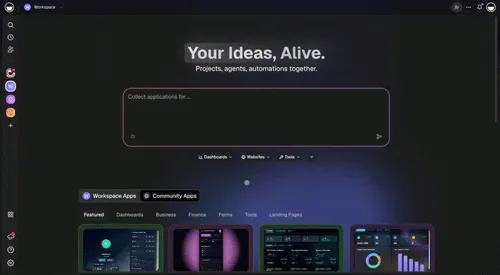
Taskade Genesis launched in October 2025. Within six months, users had generated more than 150,000 applications, run more than 3 million automations, and made more than 2 million AI requests. Monthly active users crossed 670K+.
The numbers are real. But the numbers aren't the point. The point is the shape of what people built — because the shape is the test of whether the three primitives were the right three.
Here are four customers, shipping in production right now.
An enterprise IT program manager, self-served to enterprise
An experienced enterprise IT program manager who had used Taskade for years self-upgraded to the enterprise tier through the product alone — zero sales calls, zero outbound. Found the product, built on it, upgraded themselves.
What they built is a production service-management dashboard — four interconnected Projects running more than twenty live production jobs — in a single week. They estimate the same build would traditionally take roughly 40 people 18 months.
That comparison is the whole thesis in one line. The three primitives collapse headcount and time into tooling. The full story is here.
A European digital ecosystem architect — hundreds of apps, and our debugging framework
A P.M.O. and digital ecosystem architect in Europe with thirty-seven years in PLM delivery. Has built hundreds of Genesis apps — roughly two per day — including a full revenue-operations CRM with Deals Pipeline, Contacts, Scoring, Segments, Email Templates, Estimates, and a KPI Dashboard, targeting a 14,780-lead first batch from an 820K-user database he also generated on Taskade.
While building, he wrote the Genesis Debugging Framework — a seven-class taxonomy of failure modes, with fixes — and we now publish it as official Taskade documentation.
Our customers write our docs. That's the shape of a platform that has crossed the line between tool and substrate.
A Cambridge English exam prep business — entire product on Genesis apps
A UK education business that prepares students for Cambridge English exams. Their entire customer-facing product is nine Genesis apps: five exam score calculators, a Use of English Test Maker, an Exam Pathway Planner, a full LMS, and a WordPress PDF formatter.
Thousands of monthly visits flow from their domain into embedded Genesis apps. Their students never leave their site. Our infrastructure is invisible to them, and that is exactly the right outcome. A credentialed education business runs its customer experience on Taskade Genesis.
A Brazilian event platform — the embedded distribution model
A Brazilian event booking platform. They drive over 54,000 monthly visits from their own domain into Genesis apps — which is 39% of all external referral traffic to the entire Taskade Genesis ecosystem. From one partner.
The lesson here is about the distribution model Taskade Genesis unlocks. When a workspace is the runtime, the customer's website becomes the CDN. Their users interact with Taskade Genesis infrastructure transparently. Brazil is now 42% of all Taskade Genesis traffic — without a single word of localization from us. The product found the country before we did.
The Pattern
| Customer archetype | Role | What They Built | Primitives in Play |
|---|---|---|---|
| Enterprise IT program manager | IT | Service dashboard (4 Projects, 20+ jobs) | P · A · Ω |
| Digital ecosystem architect | PLM consultant | Revenue-ops CRM + GDF + hundreds of apps | P · A · Ω |
| Cambridge exam prep business | Education | 9-app customer-facing exam prep product | P · A · Ω |
| Brazilian event platform | Event bookings | Embedded booking system, 54K monthly visits | P · A · Ω |
Every one of them is using Projects, Agents, and Automations together. None of them is using a fourth primitive. None of them stopped at two.
That's the test. The test passed.
The flywheel the cluster is spinning
Every published Genesis app deepens the Community Gallery. Every template in the Gallery becomes a starting point for the next operator. Every operator's builds inform the next model of the meta-agent. Every model improvement lifts every existing project.
The community becomes the distribution layer. The distribution layer becomes the flywheel. That's the platform thesis in one diagram.
A Quick Note on Where This Came From
I'll keep this part short, because this is a product blog, not a memoir — but it matters for why Taskade Genesis took the shape it took.
I was born in Shanghai. My father came to the United States nine years ahead of us, alone, to build the foothold that would eventually bring the rest of the family over. In 2001, when I was nine, my mother and I joined him in New York. The apartment he had been able to put together was a shared basement in Forest Hills, Queens — one kitchen, one bathroom, the three of us and a single man we did not know, splitting the space between us. It was what nine years of working alone in a new country could afford. It was also the first place in my life where I had a computer.
The computer was a hand-me-down IBM ThinkPad on a dial-up line. I started building websites on GeoCities within weeks. Nobody told me I was allowed to. Nobody told me I wasn't. The internet of 2001 hadn't yet assembled the permission structures that would have stopped me. I opened Notepad, read View Source on every page I liked, hit save, hit upload — and the thing existed, for anyone in the world to see.
That experience burned a single conviction into me that I have carried for twenty-five years:
The distance between imagining a thing and shipping a thing is always smaller than the adult world suggests.
Everything I've built since has been an attempt to collapse that distance for other people. The web hosting businesses I ran through Bronx Science. The outliner Stan and I started in 2017. The agent architecture we rebuilt in 2023. And now Taskade Genesis — which is, honestly, the most direct expression of that conviction I have ever gotten to ship.
Most of what keeps people from building the things they can see in their heads is not a lack of intelligence. It is a lack of tooling. The distance has been kept large by platforms that demanded permission, tools that demanded specialization, and institutions that demanded credentials.
A nine-year-old in a shared basement in Queens, on a dial-up connection, beat the entire apparatus in 2001 because GeoCities had accidentally removed most of the distance. The modern AI stack, for all its power, has been quietly reassembling that distance. Taskade Genesis is our attempt to remove it again.
When a program manager builds a dashboard in a week that would have taken forty people and eighteen months, they are living the same basement experience I lived in 2001. When a consultant writes our documentation before we do, he is doing what a ten-year-old with View Source did in 2001. When a Cambridge exam prep business runs on nine Genesis apps, they are doing what GeoCities kids did in 2001, except now the thing they ship is a real business, not a homepage about their favorite video game.
The distance collapsed, again. That's the only thing Taskade Genesis is trying to do.
Try Taskade Genesis
If you have gotten this far, you probably have something in your head you have been trying to ship, and the apparatus has been refusing to let you.
That is exactly what Taskade Genesis is for.
- Create a Taskade Genesis App — describe what you want, and watch the Project, Agents, and Automations assemble themselves.
- Deploy an Agent — give it memory, goals, and access to your Project, and let it inhabit the work.
- Automate a Workflow — wire decisions to execution with 100+ integrations.
- Explore the Community — see what other people have already built, and borrow liberally.
Projects. Agents. Automations. The execution layer for ideas.
Build without permission.
Three primitives, one atom. Projects, Agents, and Automations are the three layers of the stack. But the atomic unit every one of them composes from is the task. Agents complete tasks. Automations fire on task events. Projects contain tasks. Workspaces compile tasks into apps. Taskade's 2026 claim is that task is the computing primitive of the AI era — the direct descendant of Unix's file, the Mac's icon, the web's page, and Notion's block. Read fifty years of computing primitives →
John Xie is the co-founder and CEO of Taskade (Y Combinator S19). He built web hosting businesses through Bronx High School of Science — the alma mater of AI founders Frank Rosenblatt and Marvin Minsky — and co-founded Taskade in 2017 with Stan Chang. Taskade Genesis is their answer to the gap between AI as a demo and AI as a deployed teammate.
Read next:
- Fifty Years of Computing Primitives: File → Icon → Page → Task — The five-decade lineage from Unix to Taskade Genesis, and why task is the 2026 atom.
- From Bronx Science to Taskade Genesis: Connecting the Dots of AI — The AI history lineage behind Taskade Genesis.
- Software That Runs Itself — The canonical Taskade Genesis thesis.
- The Execution Layer: Why the Chatbot Era Is Over — Why the category shift matters.
- The Genesis Equation: P × A mod Ω — The architecture compressed to a formula.
- Chatbots Are Demos. Agents Are Execution. — The short version.
- How Do LLMs Actually Work? — From Rosenblatt's perceptron to the transformer powering Taskade Genesis.
Build with Taskade Genesis: Create an AI App · Deploy AI Agents · Automate Workflows · Explore the Community
Frequently Asked Questions
What is Taskade Genesis?
Taskade Genesis is the execution layer for ideas — an agentic workspace platform organized around three primitives: Projects (Memory), Agents (Intelligence), and Automations (Execution). Instead of a prompt box or a chatbot, Taskade Genesis gives users a structured workspace where AI agents read, write, and act on real projects with persistent memory, then trigger automations that move work through the real world. It launched in October 2025 and has since generated 150,000+ applications, 3 million+ automations, and 2 million+ AI requests.
What are the three primitives of Taskade Genesis?
Projects, Agents, and Automations. Projects are structured trees of nodes that hold memory — documents, tasks, decisions, context. Agents are stateful inhabitants of Projects that read, reason over, and write to them using frontier LLMs. Automations are the triggers that turn an Agent's decision into motion in the outside world — webhooks, API calls, 100+ integrations. Projects = Memory. Agents = Intelligence. Automations = Execution.
Why is Taskade Genesis different from chatbots and prompt-based AI tools?
Chatbots are stateless: every conversation starts over, the memory lives outside the system, and nothing that happens in the chat touches the real world. Taskade Genesis Agents are stateful inhabitants of Projects with persistent memory and the ability to fire automations that move work through integrations and APIs. The difference is the same as the difference between a tourist asking for directions and a colleague who already knows the building. Chatbots are demos. Agents inside a structured workspace are execution.
What does 'execution layer for ideas' mean?
An execution layer is the infrastructure that sits between an idea and its realization in the world. For most of software history, this layer has been fragmented across a dozen tools: notes apps for memory, chatbots for intelligence, Zapier-style platforms for automation. Taskade Genesis unifies them into a single substrate where Memory, Intelligence, and Execution compose naturally. The user describes what they want; Taskade Genesis assembles the Project, staffs it with Agents, and wires up the Automations that keep it alive.
How does Taskade Genesis compare to Replit, Lovable, v0, and Base44?
Those tools are app builders — their primary output is a deployed application from a natural language prompt. Taskade Genesis is an execution layer — its primary output is an ongoing workspace in which projects, agents, and automations operate together over time. An app builder ends when the app ships. Taskade Genesis begins when the app ships, because the app becomes a Project staffed by Agents and wired into Automations that keep the work alive. Builders optimize for the first run. Taskade Genesis optimizes for the long run.
What is the Workspace DNA framework in Taskade Genesis?
Workspace DNA is the self-reinforcing loop that makes Taskade Genesis compound. Memory (Projects) feeds Intelligence (Agents), Intelligence triggers Execution (Automations), and Execution writes new state back into Memory. Each cycle makes the system smarter because the Project accumulates signal from every automation that runs against it. The loop is what separates Taskade Genesis from tools that stop at the chat box.
Who founded Taskade and when did it launch Taskade Genesis?
Taskade was founded in 2017 by John Xie and Stan Chang, and accepted into Y Combinator's Summer 2019 batch (S19). John is co-founder and CEO; Stan is co-founder and CTO. Taskade Genesis, the agentic workspace platform, launched publicly in October 2025 after roughly two years of architectural rebuild of Taskade's underlying tree-based data model into a substrate on which AI agents could reliably operate.
Why does tree-structured data matter for AI agents?
Agents cannot reliably edit blobs of prose — a wall of text has no handles, no addresses, and every edit risks colliding with every other edit. But agents can reliably edit nodes in a tree: each node has an ID, a parent, children, a known scope, and metadata. Taskade has been a tree-based outliner since 2017, which turned out to be the exact substrate agentic AI needed.
What are customers actually building with Taskade Genesis?
Real examples: an experienced enterprise IT program manager built a production service-management dashboard with 4 interconnected projects running 20+ live production jobs in a single week. A European digital ecosystem architect with 37 years of PLM delivery experience has built hundreds of Genesis apps including a full revenue-operations CRM and authored the debugging framework Taskade now publishes as official documentation. A Cambridge English exam prep business in the UK runs its entire customer-facing product on nine Genesis apps. A Brazilian event platform drives tens of thousands of monthly visits into embedded Genesis apps.