





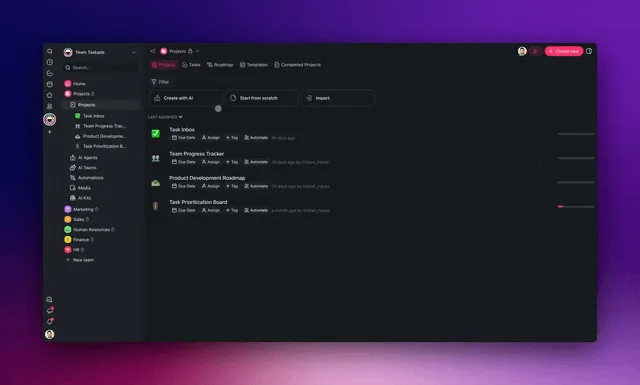
TL;DR: The most popular n8n use cases in 2026 cluster into four jobs, leads, support, content, and finance. n8n lets you wire each one node by node (powerful, and great if you self-host). The faster path for most operators is to describe the outcome and get the workflow plus a live app: Taskade Genesis ships AI agents, 100+ bidirectional integrations, and reliable automations from one prompt. 150,000+ apps have been built on it since launch.
Every "n8n use cases" list looks the same: a grid of workflows, each one assuming you'll open the canvas and place every node by hand. That's the honest n8n experience, and for technical builders who love it, it's excellent.
This guide does something different. For each use case we show the honest n8n node-build next to the describe-the-outcome alternative, so you can pick the right altitude for the job. We cover the four categories operators actually run, lead and sales, support and operations, content and marketing, finance and documents, plus the one example node-by-node tools quietly make you hand-build: deduplication (processing each item exactly once).
We credit n8n's real strengths and tell you when it's still the better tool. No attacks, just an honest map.
What are the most popular n8n use cases in 2026?
The most popular n8n use cases fall into four jobs: lead and sales automation, support and operations, content and marketing, and finance and documents. Each is a workflow teams run daily, scraping leads, triaging an inbox, repurposing content, extracting invoice line items. n8n wires them node by node; Taskade Genesis builds the same outcomes from a plain-English description, then wraps a live app around them. 150,000+ apps have been built on Taskade Genesis since launch.
Here's the altitude difference at a glance, the same job, two ways:
Both columns earn their place. If you love wiring nodes, n8n is one of the best tools on the market. If you care more about the result than the plumbing, describing the outcome is faster, and you end up with an app, not just a flow.
25 n8n use cases: node-by-node vs. describe-the-outcome
Below are 25 real use cases, grouped by job. Each row shows what you build in n8n (the honest node count) and what you'd describe instead in Taskade Genesis.
Lead & sales automation
| # | Use case | The n8n node-build | Describe it instead (Taskade Genesis) |
|---|---|---|---|
| 1 | Web-scrape leads to a sheet | Trigger → scrape node → Split Out → Limit → Google Sheets, mapped field by field | "Pull new leads from this source into a tracker, one row each" |
| 2 | 60-second lead response | Form trigger → Sheets → email node → Slack notify → branch on budget | "When a lead comes in, log it, email them, and ping the team to call" |
| 3 | CRM sync (form → CRM) | Webhook → field mapping → CRM node → error branch | "Add new form submissions to my CRM with the right fields" |
| 4 | Lead enrichment | HTTP request → merge → IF node for missing data | "Enrich each new lead with company info before it reaches sales" |
| 5 | Daily uncalled-leads report | Schedule trigger → Sheets read → Filter → Summarize → email | "Each morning, send me the leads nobody called yet" |
| 6 | Cold-outreach list builder | Multi-source scrape → dedup → format → export | "Build me a clean prospect list from these sources, no duplicates" |
Support & operations
| # | Use case | The n8n node-build | Describe it instead (Taskade Genesis) |
|---|---|---|---|
| 7 | Inbox triage (classify + label) | Gmail trigger → AI classify → Switch → label/archive/draft | "Sort my inbox into promo, personal, sales; draft replies to sales" |
| 8 | Invoice forwarding | Gmail trigger → Filter (has invoice?) → forward to accounting | "Forward any email with an invoice to accounting and log it" |
| 9 | On-call alerting | Webhook → IF severity → Slack / SMS branch | "Alert the on-call channel only when something is urgent" |
| 10 | Website chatbot | Chat trigger → AI agent → tools (FAQ, booking) | "Answer FAQs and book appointments from a chat widget on my site" |
| 11 | Ticket routing | Trigger → AI category → Switch → assign queue | "Route new tickets to the right team based on the topic" |
| 12 | SLA breach watcher | Schedule → read open tickets → Filter aging → notify | "Flag any ticket older than the SLA and tell the owner" |
Content & marketing
| # | Use case | The n8n node-build | Describe it instead (Taskade Genesis) |
|---|---|---|---|
| 13 | RSS → draft | RSS trigger → AI summarize → format → draft to CMS | "Turn new posts from these feeds into draft summaries" |
| 14 | Repurpose long-form | Trigger → AI agent → Split Out per channel → schedule | "Repurpose each new article into posts for every channel" |
| 15 | Social scheduling | Sheets trigger → format → social node per platform | "Schedule this content calendar to the right platforms" |
| 16 | YouTube → highlights | Schedule poll → dedup → transcript → AI highlights | "Summarize each new video on this channel, once each" |
| 17 | Newsletter digest | Schedule → aggregate sources → AI write → send | "Compile a weekly digest from my sources and email it" |
| 18 | SEO brief generator | Form → HTTP SERP → merge → AI outline | "Generate an SEO brief from a target keyword" |
Finance & documents
| # | Use case | The n8n node-build | Describe it instead (Taskade Genesis) |
|---|---|---|---|
| 19 | Receipt / invoice extraction | Telegram trigger → OCR → parse line items → Sheets | "Read receipts I send and log the line items to a sheet" |
| 20 | Document generation | Trigger → template fill (150+ variables) → export | "Generate this document from my data, every time" |
| 21 | Expense reconciliation | Schedule → read statements → match → flag mismatches | "Reconcile transactions and flag anything that doesn't match" |
| 22 | Analytics report | Schedule → pull metrics → Summarize → format → send | "Send me a daily performance report across marketing and sales" |
| 23 | Contract intake (RAG) | Drive trigger → extract text → embed → vector store | "Make my contracts and SOPs searchable for the team" |
| 24 | Renewal reminders | Schedule → read dates → Filter due → notify | "Remind me before any contract or subscription renews" |
| 25 | Approval workflow | Form → branch → wait for approval → continue | "Route purchases over a threshold for approval, then proceed" |
Many of these, the scraping, the inbox triage, the receipt extraction, the RAG contract search, are exactly the workflows automation creators demo as showcase n8n builds. They're all genuinely useful. The question is only how much wiring you want to own.
The one example node-by-node tools make you hand-build: deduplication
The clearest tax of node-by-node automation is idempotency, making sure each item is processed exactly once. Use cases 6 and 16 above both hide it.
Picture a workflow that checks a YouTube channel every hour and summarizes new videos. Without protection, it re-summarizes the same videos on every run. In n8n you solve this by hand: add a Remove Duplicates node, then write each processed item's ID back to a database so it's skipped next time. As one automation builder put it, describing the same YouTube workflow:
"If already processed → do nothing. If new → scrape the transcript, prompt an AI agent for highlights, and mark it off in the database so it doesn't get processed again (deduplication). It's doable. I've built tons of systems like this in n8n. But it takes a while."
That's the honest experience: you design the run-once logic, the storage, and the write-back step yourself. Here's the shape of it:
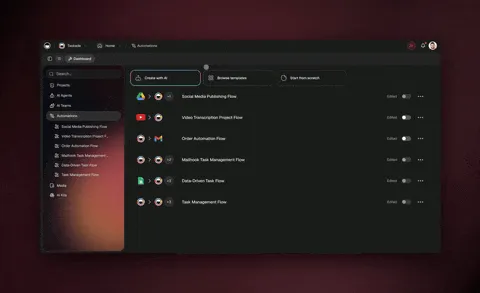
With Taskade Genesis, you describe the outcome, "summarize each new video on this channel, only once each", and the reliable workflow handles the run-once behavior. The same is true for the harder failure cases: durable automations branch, loop, filter, wait minutes to days, and resume from the exact step that failed rather than starting over. You don't hand-build a state machine to get reliability.
Industry note: in the broader agentic-workflow world, builders increasingly let an AI describe the dedup logic and the idempotency key (e.g. the video ID) instead of wiring it. That's a general pattern across the space, not a single product feature. But it's the direction the whole category is moving.
How Taskade Genesis approaches the same use cases
Taskade Genesis treats these use cases as one connected system instead of isolated flows. The whole platform is a self-reinforcing loop, Memory + Intelligence + Execution. That a flat workflow canvas doesn't have:
What you get beyond a pure workflow tool:
- AI agents with built-in tools, web search, code, file analysis, persistent memory. That reason over your data and run multi-step work, across frontier models from top AI labs. Agents can also collaborate as a team in orchestration mode, where a manager agent plans steps and delegates to specialists with a review step.
- 100+ bidirectional integrations, triggers pull events in, actions push data out, including native Shopify and Stripe.
- Reliable, durable automation workflows that branch, loop, filter, wait for minutes or days, and resume from the step that failed.
- A real app layer: Projects with multiple views (List, Board, Calendar, Table, Mind Map, Gantt, Org Chart), custom domains, and built-in sign-in for published apps.
This is how a non-technical operator ships production software. Taskade's first Enterprise customer, an IT program manager, built a working field-service dashboard, Customers, Jobs, Invoices, and Team projects in one app, on Taskade Genesis with no engineering team. The lead-capture, the job tracking, and the invoice flow that an agency would wire as separate n8n workflows all live in one described-once app.
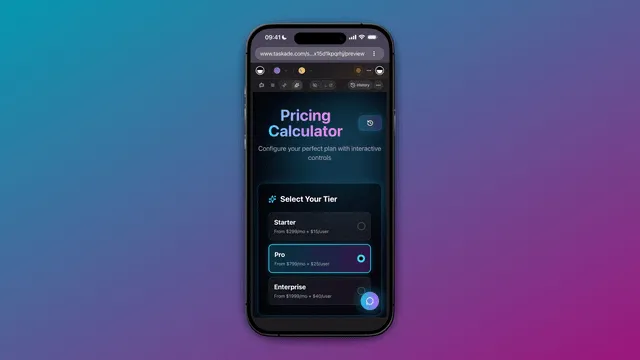
You don't have to start from a blank canvas, either. You can clone a live working app from the Community Gallery in about 30 seconds and run it in your own workspace, then change it in plain English.
When n8n is the better tool (an honest box)
n8n is a genuinely strong platform, and for some teams it's the right call. Credit where it's due:
Choose n8n when:
- You want to self-host. n8n Community Edition is source-available and runs on a low-cost VPS, keeping your data entirely on your own infrastructure. Self-hosting is one of its real strengths.
- You're running high-volume, complex flows. Per-execution pricing means a 2-step run and a 200-step run each count as one execution, dramatically cheaper at scale than per-task tools.
- You want granular node-level control. A deep node library and a precise canvas let technical builders fine-tune every branch, expression, and HTTP header exactly.
If those describe you, n8n is excellent, keep using it, or pair it with the describe-the-outcome approach for the apps you'd rather not wire by hand. For a deeper side-by-side, see our n8n alternatives breakdown and the history of n8n. For the node-level mindset, our sibling Claude Code vs n8n piece goes deeper on code-first vs no-code automation.
n8n vs. Taskade Genesis: capability at a glance
| Capability | n8n | Taskade Genesis |
|---|---|---|
| Visual node canvas | ✅ Deep | ⚠️ Describe-first |
| Self-hosting / data control | ✅ Source-available | ☁️ Managed cloud |
| Per-execution pricing at scale | ✅ Strong | 💲 Plan-based |
| AI agents | ⚠️ AI Agent node | ✅ Native (built-in tools) |
| Multi-agent collaboration | ❌ | ✅ Orchestration mode |
| Bidirectional integrations | ✅ Large library | ✅ 100+ (in + out) |
| Run-once / dedup handling | 🛠️ Hand-built | ✅ Described |
| Resume from failed step | ⚠️ Manual patterns | ✅ Built-in |
| Builds a live app (not just a flow) | ❌ | ✅ Yes |
| Best for | Technical, self-hosted control | Outcome-first operators |
Prices and feature sets change often, confirm n8n's on its pricing page, and Taskade Genesis pricing is canonical on the pricing page.
How to choose for your use case
Match the tool to the job with this quick decision tree:
What do you want at the end of the build?
│
├─ A live APP I can hand to a customer (not just a flow)
│     └─► Taskade Genesis  ── describe it, ship it
│
├─ Just move data between apps, my way
│     ├─ Self-host for data control ............ n8n
│     ├─ Cheapest on complex/high-volume flows .. n8n (per-execution)
│     └─ Easiest, biggest app catalog .......... Zapier
│
├─ I need run-once / reliability without wiring it
│     └─► Taskade Genesis  ── durable, resume-from-failure
│
└─ I'm technical and want node-level control
      └─► n8n  ── deep library + canvas
The deeper question in 2026 is altitude. Happy designing flows node by node? n8n is excellent, and so are Zapier and Make for their own strengths. Want to describe the outcome and get an automation and an AI agent and a working app? That's what Taskade Genesis was built to do.
Frequently asked questions
What are the most popular n8n use cases in 2026?
The most popular n8n use cases cluster into four jobs: lead and sales (scraping, routing, follow-up), support and operations (inbox triage, ticket routing, alerts), content and marketing (RSS-to-draft, repurposing, scheduling), and finance and documents (invoice extraction, reports, reconciliation). n8n wires each node by node; Taskade Genesis builds the same outcomes from a plain-English description and wraps a live app around them.
Can Taskade Genesis replace n8n for these use cases?
For most operators, yes, and it adds a layer n8n doesn't. Taskade Genesis ships AI agents with built-in tools, reliable automations that branch, loop, filter, wait, and resume from the failed step, and 100+ bidirectional integrations. The difference is altitude: describe the result instead of placing every node. If you need a self-hosted, source-available engine with a node-level canvas, n8n is still the better tool.
What is the dedup or idempotency problem in n8n?
Many n8n workflows poll a source on a schedule and must process each item exactly once. In n8n you build that with a Remove Duplicates node plus a database write-back that marks items processed. It works, but you design the logic and storage by hand. With Taskade Genesis you describe the run-once outcome and the reliable workflow handles it.
When is n8n the better tool than Taskade Genesis?
Choose n8n to self-host for data control, when per-execution pricing makes complex high-volume flows cheaper at scale, or when you want a deep node library and granular control. n8n is source-available and runs on a low-cost VPS. For teams who'd rather skip infrastructure and describe outcomes, Taskade Genesis is faster.
Do I need to know how to code to build these n8n use cases?
No for the basics, but complex n8n workflows reach for expressions, a Code node, or custom HTTP requests fast. Taskade Genesis is no-code by design, describe the result and it builds the automation and the app. One IT program manager built a production field-service dashboard on it with no engineering team.
Can n8n use cases include AI agents?
Yes, n8n added an AI Agent node. Taskade Genesis makes agents native instead of a single node: agents with built-in tools that reason over your data across frontier models from top AI labs, and collaborate as a team in orchestration mode.
What's the fastest way to start with an n8n use case?
Importing a blueprint into n8n is fast, but you still wire credentials and fix it for your data. The fastest path overall is to clone a live app in about 30 seconds and tweak it in plain English. Start free at /create.
Does Taskade Genesis build a real app or just an automation?
Both. n8n stops at moving data between apps. Taskade Genesis builds living software, agents, reliable automations, a database with multiple project views, and a full app UI with a shareable URL, custom domains, and built-in sign-in, from one description.
Is n8n good for self-hosted automation?
Yes, self-hosting is a genuine n8n strength. Community Edition runs on a low-cost VPS with unlimited executions and full data control; the tradeoff is the server and DevOps you own. To skip infrastructure entirely, see our n8n alternatives guide.
Ready to ship instead of wire? Start free with Taskade Genesis, describe a use case in plain English, and watch it build the automation, connect your tools, and ship a live app.
Explore the automation library, browse cloneable apps, or compare more tools in our n8n alternatives, Zapier alternatives, and Make alternatives guides, and read the history of n8n for the full story.
▲ ■ ● Memory feeds Intelligence, Intelligence triggers Execution, Execution compounds Memory, describe the outcome once, and the loop keeps shipping.