






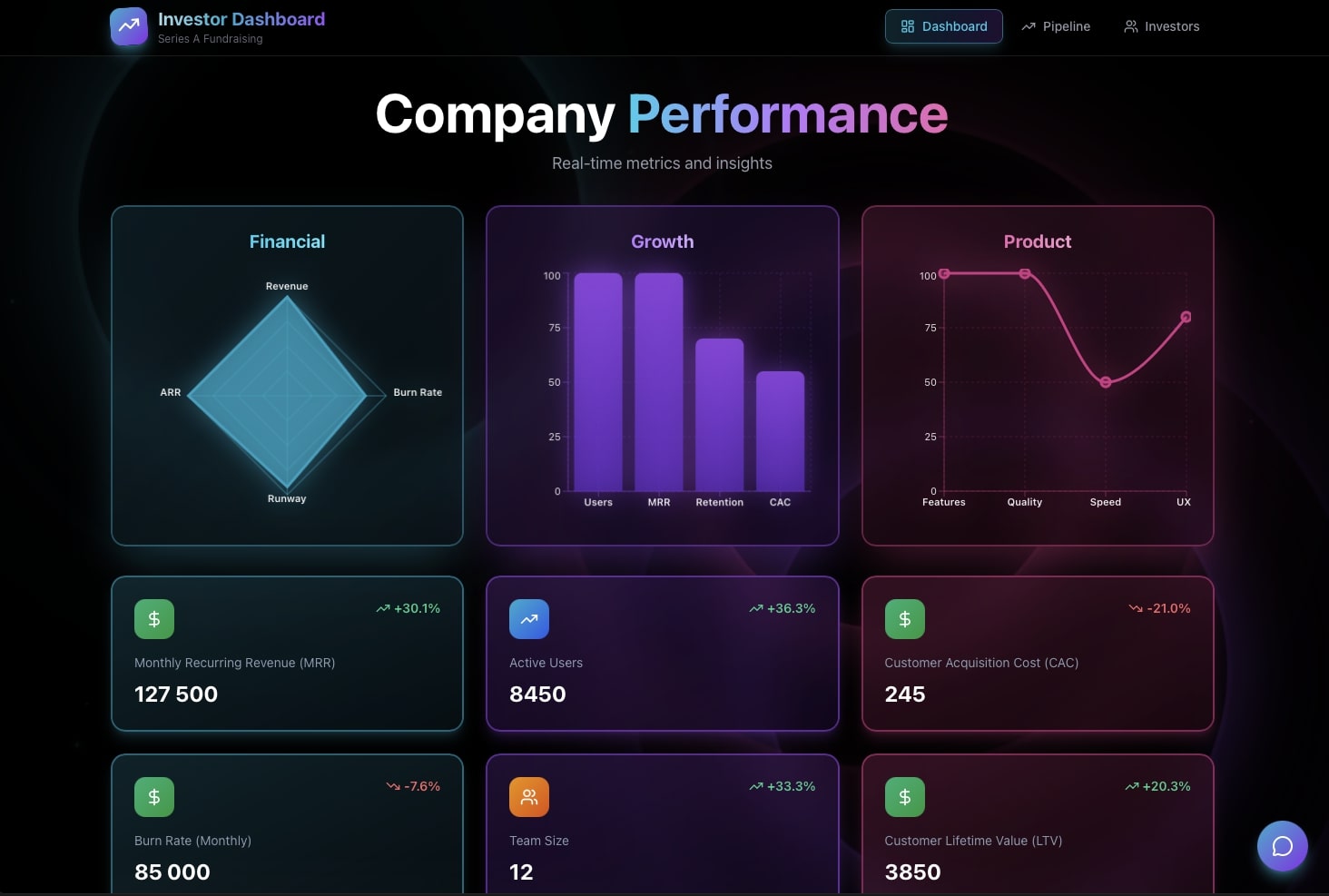
TL;DR: A free AI investor CRM that researches funds, runs a stage-based pipeline, drafts warm-intro emails, and auto-generates your quarterly investor update, all from three live Taskade Genesis apps you can clone in one click from inside this post. Visible.vc charges $53 to $179 a month for less. Open the Investor Dashboard now.
Most founders treat fundraising like sales, except they treat it badly. A serious sales leader running a deal cycle of similar size and value would build a CRM, score every account, run a weekly pipeline review, and never let a contact go more than seven days without a follow-up touch. The same founder, raising a seed round, runs the entire process out of a Google Sheet that gets updated maybe twice a week, drafts every warm-intro request in a Gmail compose window from scratch, and writes the quarterly investor update in a four-hour writing block once every three months because the previous update was so painful to assemble.
The cost of this is measurable. The median seed round takes ninety to one hundred twenty days from first VC conversation to signed term sheet. During that window a founder will have eighty to one hundred fifty touchpoints across thirty to sixty firms. The founders who close cleanly are not the ones with the best deck. They are the ones with the best follow-through discipline, the ones who follow up on the right day with the right information, who arrive to every meeting with a one-page brief on the partner across the table, and who send investor updates so consistently that the inbox makes the round feel inevitable before the term sheet is offered.
Discipline is hard to maintain when you are also building a product. Which is why the founders winning in 2026 are not maintaining discipline manually. They are running an AI investor CRM that does the discipline for them: a Portfolio Analyst agent that surfaces the three investors who haven't had contact in ten days every Monday morning, a Risk Advisor that flags concentration risk when forty percent of soft-circled capital lands in the same sector, an Investor Research agent that produces a one-page brief twenty-four hours before any partner meeting, and a quarterly update automation that drafts the entire LP letter from your live metrics.
This post gives you three live, cloneable Taskade Genesis apps that compose into a complete AI investor CRM. Each app is linked below as a screenshot, click through to the live share page, then hit "Use this app" to clone it into your free workspace. By the end of this article you will have a fundraising stack that costs ten dollars a month flat (or free) and outperforms the four-hundred-and-forty-nine-dollar-a-month dedicated tools the rest of the market sells.
Why Every Fundraise Is a CRM Problem (and Most Founders Pretend It Isn't)
Fundraising is the longest-cycle, highest-stakes sales process most founders will ever run, yet it is the one process founders most consistently refuse to systematize. The reason is psychological: founders are taught that investor relationships are about narrative and chemistry, not data. So they treat the pipeline as a soft thing, a vibe, a set of intuitions, instead of what it actually is, which is a forty-deal funnel with a clear stage model and a measurable conversion rate at every stage.
A real fundraising CRM models the process correctly. Target Investors at the top of the funnel (firms you have identified as thesis-match, with a quick one-to-five fit score and a known warm-intro path). Intro Requested in the middle (you have asked a mutual connection to forward your blurb to the partner). First Meeting once the partner has agreed to talk. Partner Meeting after the first associate or principal call has graduated up to a full partner. Term Sheet once the firm is committing. Closed when the wire hits.
Each stage has its own median timeline, its own follow-up cadence, and its own failure mode. Founders who skip the modeling layer also skip the diagnostic layer. They cannot tell you why a deal stalled at First Meeting versus Partner Meeting, because they were never tracking the stage transition timestamps in the first place. The diagnostic is the whole game. If you know your average days-in-stage at First Meeting is twelve days, and one specific deal has been at First Meeting for twenty-eight days, that deal is dead. Pull the energy out. Move it to the passed column. Spend the time on the next live one.
The Taskade Genesis Investor Dashboard does the modeling and diagnostic layer automatically. You maintain the data; the Portfolio Analyst agent runs the diagnostics every Monday morning and writes the brief into your Slack before your first meeting of the week.
The David vs Goliath Wedge: Visible.vc at $179/mo vs Taskade Genesis at Free
Visible.vc is the category-leading fundraising tracker for founders. It is genuinely good. It also charges fifty-three dollars a month for its Lite tier (basic updates plus a small pipeline), one hundred twelve dollars a month for Pro (the tier most founders actually want), and one hundred seventy-nine dollars a month for Scale (deeper customization and richer dashboards). The investor-side product starts at four hundred forty-nine dollars a month. Affinity, the dominant CRM for venture firms, starts at two thousand dollars per user per year on the Essential tier and runs to two thousand seven hundred dollars per user per year on Advanced for AI features. Foundersuite ranges from roughly twenty-five to one hundred dollars per month depending on tier. Streak is forty-nine dollars per user per month on Pro and one hundred twenty-nine per user per month on Enterprise.
Taskade Genesis ships an Investor Dashboard with five projects, two AI agents, four automations, and one hundred bidirectional integrations on the Free plan. The Pro plan is ten dollars a month flat for up to ten seats, meaning a co-founder pair pays five dollars a month each for a fundraising CRM that, on every dimension that matters in 2026 (the AI agent layer), exceeds what Visible Scale offers at one hundred seventy-nine dollars a month per founder.
The wedge is not "free is cheaper than fifty-three." Every founder knows that. The wedge is: the AI agent layer is the entire next generation of fundraising tools, and Taskade Genesis is the only player shipping it natively at this price point. Visible's roadmap will eventually catch up. Affinity already has aggressive AI features but charges enterprise prices for them. Foundersuite is functionally a database with light pipeline tracking. None of them ship a Portfolio Analyst that reads your pipeline every Monday and drafts the three follow-ups you forgot. Taskade Genesis does.
Live Demo: The Investor Dashboard
The Investor Dashboard is the core fundraising application. Five projects (Portfolio Overview, Target Investors, Active Pipeline, Deal History, Benchmarks), two AI agents (Portfolio Analyst and Risk Advisor), and four automations (weekly digest, risk alert, meeting prep brief, new-deal onboarding). Click the screenshot below to open the live share page, then hit "Use this app" to clone it into your workspace and start entering real investor contacts within five minutes.
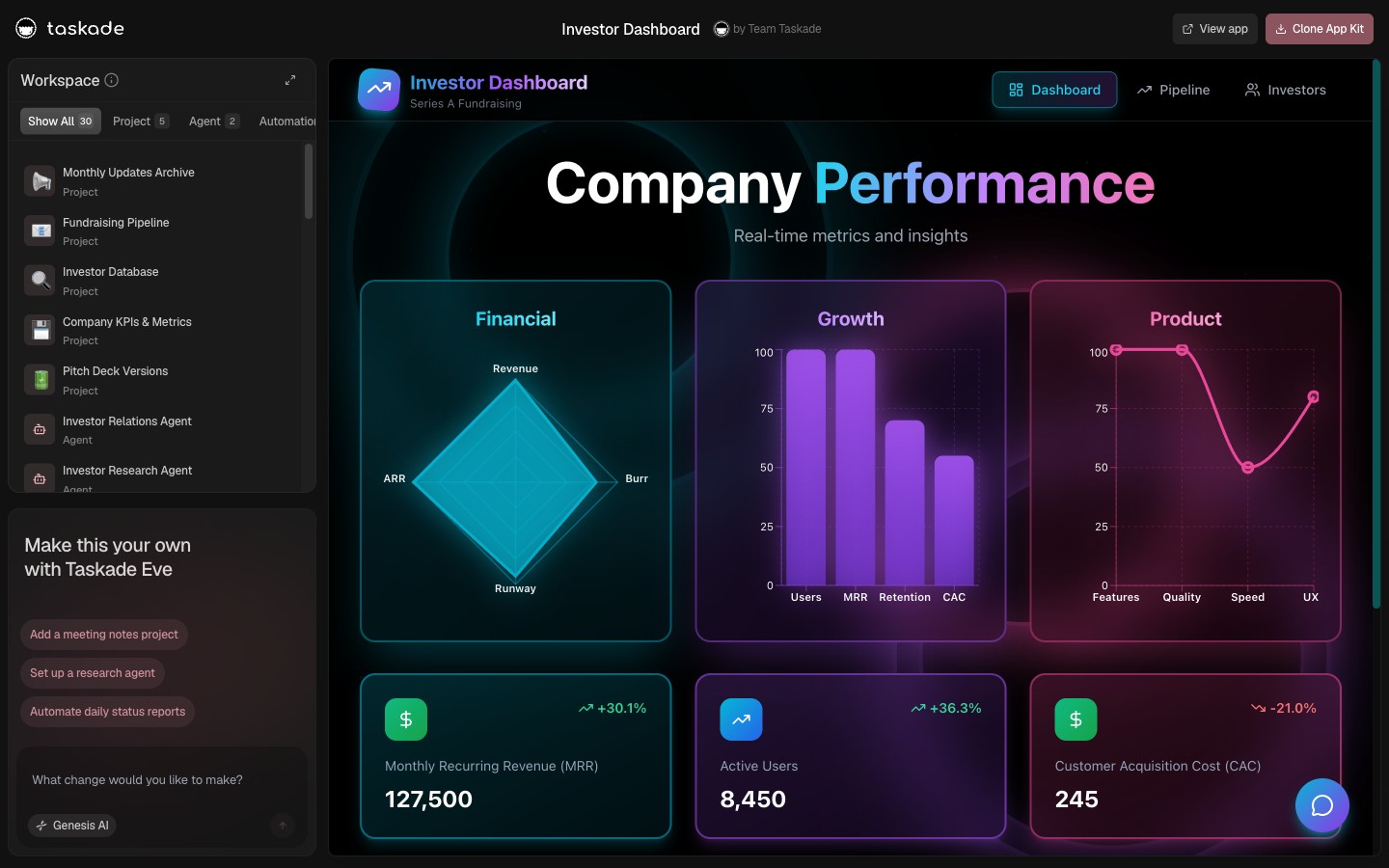
▲ ■ ● This is live. Click the screenshot above to open the live share page, then hit "Use this app" to clone Investor Dashboard (5 projects · 2 agents · 4 automations) into your workspace.
What the five projects do:
The Portfolio Overview project is the round summary view. Total round target, amount soft-circled, amount hard-circled, amount wired, gap remaining, current days-elapsed in the round, projected close date. You update the round target once at the beginning; the Portfolio Analyst agent reads the underlying pipeline weekly and recomputes the percentages, round health is always one click away.
The Target Investors project is your prospect list. Every fund you are considering gets a row: firm name, partner name, thesis match score (your one-to-five gut call), warm-intro path (the mutual connection who can bridge you), priority tier (Tier 1 for leads, Tier 2 for follow), and the Investor Research agent's one-paragraph brief auto-filled when you add the row. The agent reads the firm name, pulls public information on recent investments, average check size, partner specializations, known thesis areas, and recent fund movements, then writes the brief into the row within sixty seconds.
The Active Pipeline project is your live deal board across the six stages. Every investor who has agreed to a conversation lives here. Each card shows last-contact date, next action, deal stage, and the days-in-stage counter. Cards turn yellow at the median for their stage and red at one-and-a-half times the median, your visual diagnostic of which deals are dying.
The Deal History project is the closed-loop archive. Won (committed check, wire date, check size, follow-on rights) and passed (firm name, partner, stage at pass, reason for pass, captured as a categorical field so the Risk Advisor can analyze it). After your round closes, the Deal History project is the institutional memory: which partners said yes, which said no, what the reasons were, who introduced you to whom. The next round you raise, this is your home-field advantage.
The Benchmarks project ships pre-filled with current-cycle data, median seed round sizes by sector, pre-money valuation percentiles by ARR bracket, average days from first conversation to wire by fund size, typical SAFE versus priced-round breakdown. The Portfolio Analyst contextualizes your round against this data. If your round is tracking forty days behind the median close time for a SaaS seed at your ARR bracket, the agent flags it before you hit a runway constraint.
The two AI agents:
The Portfolio Analyst runs every Monday at 8 AM. It reads Active Pipeline, identifies cards where last-contact is more than ten days old, drafts a follow-up for each based on the conversation notes from the previous touch, and queues them for your review. It also writes a round health summary (percentage to soft-circle target, average days in stage, conversion rate from intro to first meeting) and posts the entire brief to your Slack. You read it on your phone before your first call of the week.
The Risk Advisor runs on every pipeline stage update. If a stage change causes more than forty percent of your soft-circled capital to concentrate in a single sector or geography, it fires a Slack alert with the breakdown and a recommended diversification action. It also runs a quarterly analysis on Deal History, patterns in the passed-deal reason field surface as "investors are consistently flagging the same concern" alerts, which is the data you need to refine your pitch before the next outreach wave.
The four automations:
- Weekly portfolio digest (Monday 8 AM): Portfolio Analyst summarizes round health, flags overdue follow-ups, surfaces recommended actions. Slack.
- Risk alert (triggered on stage update): If concentration thresholds are breached, Risk Advisor fires the alert. Slack.
- Meeting prep brief (twenty-four hours before any Google Calendar event tagged as an investor meeting): Investor Research pulls the firm's row from Target Investors, the partner's profile, the firm's recent investments, and drafts a three-paragraph brief. Slack and email.
- New-deal onboarding (triggered when a Target Investor card promotes to Active Pipeline): Creates the card scaffold, sets the first-follow-up due date to five business days, populates a first-meeting checklist.
See also: Founder Operating System: 5 Cloneable Stacks for the sibling four apps (sales pipeline, brand portfolio, growth dashboard, launch dashboard) that complete the founder OS stack. The Investor Dashboard is the fundraising pillar of that stack.
Live Demo: Sales Pipeline Repurposed as Investor Pipeline
Some founders prefer to run their entire pipeline (customers and investors both) out of a single CRM with two views. The Sales Pipeline Workflow ships as a four-stage outbound CRM but is structurally identical to an investor pipeline, the same Board view, the same enrichment agent, the same follow-up sequencer. Clone it, rename the stages, and you have a fundraising-specific CRM with a Sales Coach agent that drafts your warm-intro requests automatically.
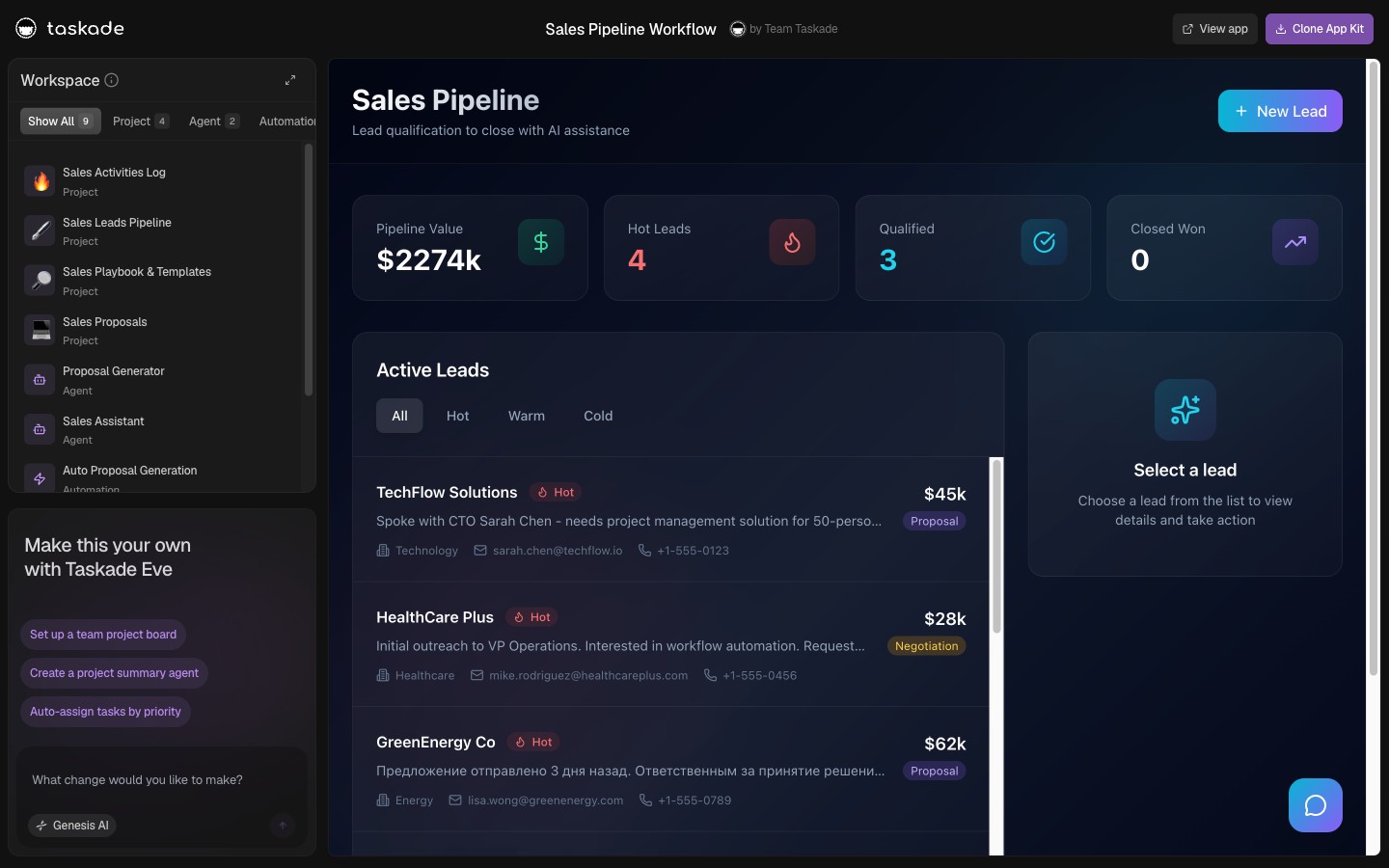
▲ ■ ● This is live. Click the screenshot above to open the live share page, then hit "Use this app" to clone Sales Pipeline Workflow (4 projects · 2 agents · 3 automations) into your workspace. Rename the stages, Prospect becomes Target, Qualified becomes Intro Requested, Proposal becomes First Meeting, Closed becomes Term Sheet, and you have a complete investor pipeline.
Why repurpose this app:
The Sales Pipeline ships with two agents (Sales Coach and CRM QA) and three automations (stage-change Slack alert, Gmail follow-up sequencer, weekly digest with Forecasting rollup). The Sales Coach agent does for investor outreach what it does for customer outreach: reads the contact row, drafts a personalized first-touch email, places the draft in a "To Review" task. The CRM QA agent scores each new contact against your defined criteria, for investors, this becomes thesis-match scoring, partner-stage-fit, and check-size-fit.
Repurposing this app is the right choice when you want a single CRM hub managing both customer and investor pipelines, with two filtered Board views inside the same workspace. The Forecasting project becomes your round-close projection, the Activity Log captures every email sent and every stage transition for both pipelines, and the weekly digest gives you a single Friday briefing covering customer pipeline plus fundraising pipeline.
The investor-specific Sales Coach customization: open the agent settings, edit the system prompt to reference warm-intro etiquette, replace product positioning with thesis-fit positioning, and add a constraint to always include a specific founder-and-firm reference point in the first paragraph (mutual investment, shared portfolio company, recent fund news). The agent now drafts warm intros in the voice and structure top-quartile founders actually use.
See also: AI Sales Pipeline Template for the customer-side deep dive on this app, enrichment configuration, cold-email agent setup, and forecast automation.
Live Demo: Cover Letter Generator as Warm-Intro Factory
The warm-intro request is the single highest-leverage email in fundraising. A great intro request, short, personalized, paste-ready for the mutual connection, generates a fifty to seventy percent forward rate. A bad intro request gets ignored. The Cover Letter Generator app, repurposed as a warm-intro factory, drafts your intro requests from a single prompt with the firm name, partner name, and your mutual connection's first name.
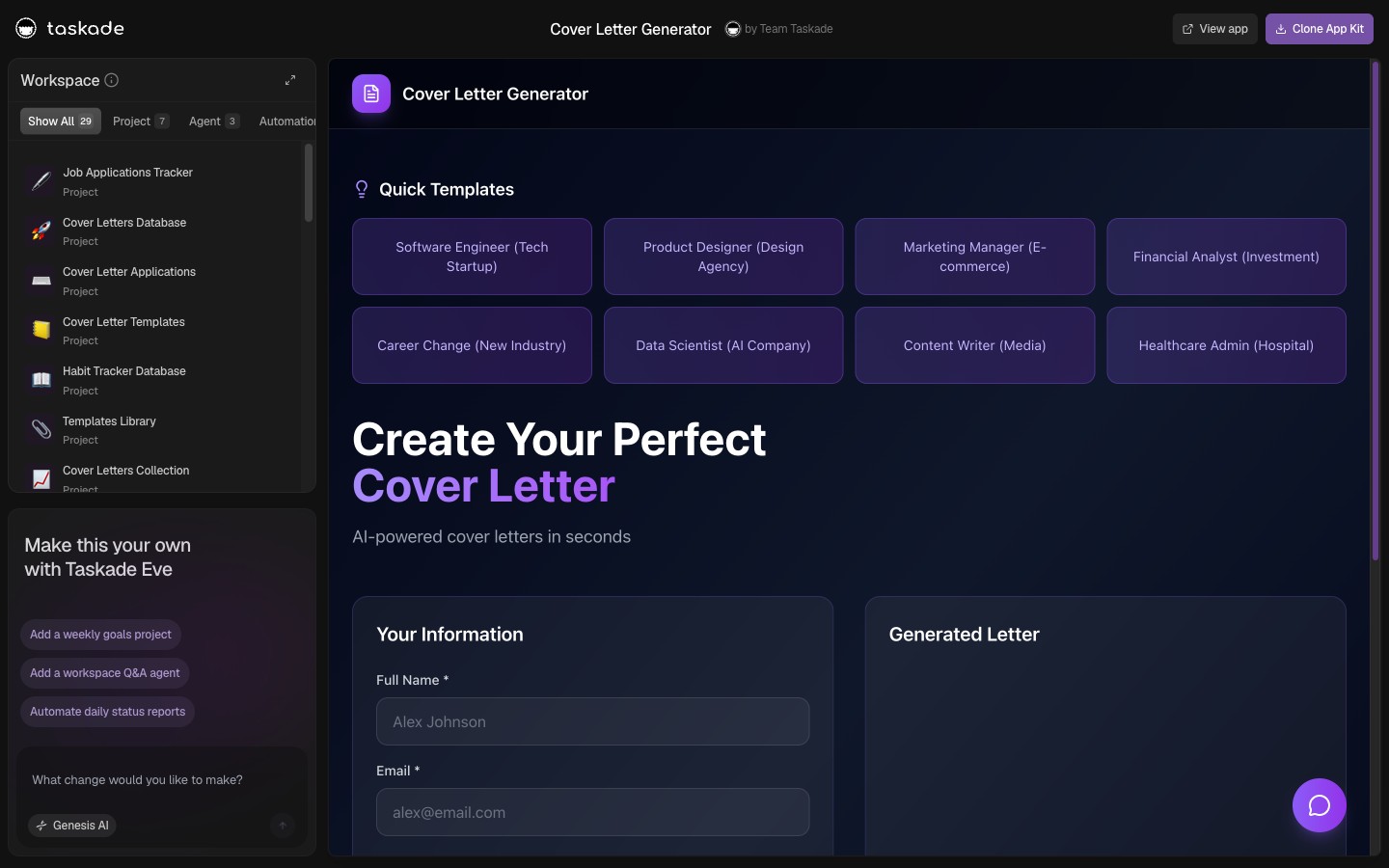
▲ ■ ● This is live. Click the screenshot above to open the live share page, then hit "Use this app" to clone Cover Letter Generator into your workspace. Customize the prompt to draft warm-intro requests instead of cover letters, same architecture, different output template.
The double opt-in is the only warm-intro pattern that works in 2026. Every senior founder and every venture partner now expects the same two-step etiquette: you ask the connector first, the connector confirms with the partner, and only then does the forwardable email move. Skip either step and the intro lands as cold, the partner ignores it, and you have burned the relationship with the connector. The Cover Letter Generator agent ships both halves of this sequence, the permission-check email and the forwardable blurb, as two separate outputs from one prompt.
The structure of a great warm-intro request:
A warm-intro request is three short paragraphs plus a paste-ready blurb. Paragraph one: who you are, what you're building, in one sentence. Paragraph two: why this specific partner at this specific firm (reference their thesis, a recent investment, or a publicly stated interest area). Paragraph three: the specific ask, would they be willing to forward the blurb below to the partner. Then a forward-ready blurb your connection can paste verbatim into a new email.
The forwardable blurb must clear five gates to earn the partner's reply: under two hundred fifty words total, one-sentence company description with the wedge, one-sentence traction metric (MRR, growth rate, signups, or customer name), one-sentence reason this specific partner is a fit (their thesis, a recent investment, a portfolio adjacency), one-line ask (intro call, deck review, written feedback), and a deck link. Blurbs over two hundred fifty words get skimmed; blurbs without a traction number get ignored; blurbs without a partner-specific reason get filed under cold. The agent enforces all five gates by default, if you provide the inputs, the output passes the gates.
The Cover Letter Generator agent ships with the cover-letter template prompt; you edit the system prompt once to swap in the warm-intro structure, and every subsequent generation produces the right output. Pass it the firm name, partner name, and mutual connection's first name as inputs; the agent reads the connection's relationship context (from a Connections project you set up alongside) and personalizes the request to that specific relationship.
The math on warm-intro automation: A founder running an active fundraise sends roughly twelve to twenty warm-intro requests per week during the peak of the process. At fifteen minutes per request drafted manually (think it through, find a hook, write it cleanly, edit twice), that is three to five hours per week of pure intro-writing time. The agent reduces this to thirty seconds per request to provide inputs plus two minutes per request to review and personalize the draft. At fifteen requests per week, that is roughly four hours per week reclaimed, half a workday, during the highest-stakes period of the year.
The Full Investor Lifecycle: From Cold to Closed to Quarterly Update
The fundraising process is not a one-shot transaction. It is a sequence of stage transitions with characteristic timelines and characteristic failure modes. The sequence diagram below traces the complete lifecycle from cold list to closed round to quarterly investor update, and shows which Taskade Genesis agent or automation handles each handoff.
The diagram is not a flowchart of features. It is the actual data flow inside a cloned Investor Dashboard. Every arrow is either a manual action you take (founder steps) or an automation/agent action the system takes on your behalf (Research, Pipeline, Analyst, Update steps). The ratio of automated to manual actions is roughly two-to-one, for every action you take, the system takes two more without you initiating them. That ratio is the productivity gain.
Investor Pipeline Stage Diagram
The pipeline itself is a state machine, six states, defined transitions, characteristic median dwell times. Model it correctly and you can diagnose where deals die before they go cold.
Median dwell times by stage (verified against SaaS seed-stage data, 2026):
| Stage | Median dwell | Yellow flag | Red flag |
|---|---|---|---|
| Target → Intro Requested | 3 days | 7 days | 14 days |
| Intro Requested → First Meeting | 5 days | 10 days | 21 days |
| First Meeting → Partner Meeting | 9 days | 17 days | 30 days |
| Partner Meeting → Term Sheet | 14 days | 28 days | 45 days |
| Term Sheet → Closed | 21 days | 35 days | 60 days |
The Portfolio Analyst agent reads these thresholds against your pipeline weekly and color-codes the cards. Yellow cards prompt a follow-up. Red cards prompt a kill-or-cure decision, either escalate the energy (send the founder's note, request a second meeting, ask the connector to nudge) or move the card to Passed and free the mental space.
The Investor Research Agent: What It Does vs Hiring an Analyst
A junior fundraising analyst, the role most founders never hire because they cannot justify the cost, does one job well: produces a structured one-page brief on every target investor before the founder takes the meeting. The brief covers fund size, recent investments (last twelve months), partner specializations, known thesis areas, average check size, post-money preferences, follow-on participation rate, and any publicly stated red lines.
A junior analyst at market rate costs roughly two thousand to four thousand dollars per month. A senior analyst with quant skills runs five thousand to eight thousand. Most early-stage founders cannot afford either. So they walk into partner meetings cold, having spent ten minutes on the firm's website that morning, and they leave the meeting having underwhelmed the partner because they did not know that the firm just led a Series A in a parallel category and is unlikely to do a second check.
The Investor Research agent inside the Taskade Genesis Investor Dashboard does the analyst's primary job for less than the cost of a single hour of analyst time per month. When you add a firm to Target Investors, the agent reads public sources, drafts the one-page brief into the row, and updates it every thirty days. Twenty-four hours before any investor meeting (triggered by your Google Calendar), the Portfolio Analyst pulls the latest brief and writes a three-paragraph meeting-prep note to your Slack: who you are meeting, what they have invested in recently that matches your thesis, one specific question to ask that demonstrates you have done the homework.
The agent does not replace the senior analyst's strategic judgment. It does replace the junior analyst's research throughput, which is the part of the analyst role that scales least efficiently with human labor.
The replacement math in dollars: A junior fundraising analyst at three thousand dollars per month, employed for the full ninety-to-one-hundred-twenty-day median seed cycle, costs nine thousand to twelve thousand dollars in salary alone, before benefits, equipment, or onboarding overhead. Across a typical multi-round founder career (seed, Series A, Series B over four to six years), the cumulative analyst cost lands between forty-eight thousand and seventy-two thousand dollars. Taskade Genesis Pro at ten dollars a month flat across the same four-year horizon costs four hundred eighty dollars, a ninety-nine percent reduction with no hiring, no onboarding, no turnover risk. The agent works the weekend before a partner meeting at the same speed it works Tuesday at 2 PM.
The Quarterly Update Auto-Drafter: The Visible.vc Killer
Quarterly investor updates are the single highest-leverage relationship investment a funded founder can make, and they are the single most consistently neglected obligation in the founder calendar. The reason is not negligence. It is that writing a good quarterly update from scratch takes three to four hours: pull metrics from the analytics dashboard, recall the wins of the last ninety days, draft the risk paragraph, formulate the asks, structure the runway projection, edit twice, send.
The Taskade Genesis quarterly update automation collapses this to ten to fifteen minutes of review-and-send. Here is how it works.
┌──────────────────────────────────────────────────────────────┐
│  ▲ MEMORY            ■ INTELLIGENCE        ● EXECUTION       │
│  Growth Dashboard    Portfolio Analyst     Quarterly update   │
│  (MRR, signups,      reads Growth +        auto-drafted from  │
│  activation, churn,  Investor Dashboards,  metrics + wins +   │
│  runway months)      writes 5-section LP   risk + asks +      │
│  Investor Dashboard  letter draft          runway → Gmail to  │
│  (recent stage mvts, every 90 days         your investor list │
│  closed deals,                                                 │
│  soft-circle pipe)                                             │
│  Wins notes column                                             │
└──────────────────────────────────────────────────────────────┘
The five sections of the auto-drafted update:
- Headline metrics: MRR (quarter-over-quarter and year-over-year), ARR run rate, new logos closed this quarter, churn rate, runway in months. Pulled directly from the Growth Dashboard project, the agent does not generate these numbers, it surfaces them from the source-of-truth project you maintain weekly.
- Top three wins: The three most significant developments of the quarter. The agent reads the wins notes column in the Investor Dashboard (you log each significant win as you achieve it; the agent picks the top three by impact score).
- One risk and mitigation: The single most important risk facing the company right now, with the specific mitigation plan in motion. The Risk Advisor agent surfaces candidate risks from pipeline concentration patterns, churn signals, and runway projections; you pick the one to feature.
- Three asks: Three specific things you need from the investor base. Asks are the part of investor updates founders most consistently underperform. The agent reads your current pipeline gaps (specific hiring needs, missing introductions, target customer profiles) and proposes three concrete asks; you edit them into the right tone for your investor base.
- Runway and next milestones: Current cash position, monthly burn, runway in months, and the three milestones that need to be hit before the next raise.
The Gmail automation sends the final approved version to your full investor list, with first-name personalization pulled from each row in the Investor Dashboard. Tracking opens and replies feeds back into the Portfolio Analyst's next weekly digest, investors who reply get flagged as "warm and engaged" for the next conversation; investors who don't open the update get flagged as "relationship at risk" for a personal note.
Visible.vc charges fifty-three to one hundred seventy-nine dollars a month for this functionality. Taskade Genesis ships it free on the Free plan and adds the agent layer (the actual drafting) on Pro at ten dollars a month flat.
Comparison: Taskade Genesis vs Visible.vc vs Affinity vs Foundersuite vs Folk vs Flowlie
Taskade Genesis is the only stack that combines AI investor research, auto-drafted quarterly updates, warm-intro generation, and a six-stage pipeline in one workspace at a flat sub-twenty-dollar price point. Every other tool in the market ships a subset: Visible owns updates, Affinity owns relationship intelligence, Folk owns flexible modeling, Flowlie owns meeting intelligence, Foundersuite owns the investor database. The table below maps every dimension that matters across the eleven category leaders most founders evaluate.
| Capability | Visible.vc | Carta CRM | Affinity | Foundersuite | Streak | OpenVC | Folk | Flowlie | Pry (Brex) | Forecastr | Drivetrain | Taskade Genesis |
|---|---|---|---|---|---|---|---|---|---|---|---|---|
| Free tier | ✅ Starter | ❌ | ❌ | ⚠️ Limited free | ❌ (deprecated 2024) | ✅ Full free | ⚠️ 14-day trial | ❌ | ❌ | ❌ | ❌ | ✅ Free + 11,000 one-time credits |
| Starting price | $53/mo (Lite) | Custom (early-stage $3-8K/yr) | $2,000/user/yr | ~$25-100/mo | $49/user/mo | $99/mo Premium | $20-75/user/mo | $49-149/mo | Brex bundle | Custom | Custom | $10/mo flat (10 seats) |
| Investor CRM pipeline | ✅ Kanban | ✅ AI-powered (ListAlpha) | ✅ Best-in-class | ✅ 230K investor DB | ✅ Gmail-native | ✅ Free DB only | ✅ Flexible objects | ✅ Seed-to-Series-B | ❌ | ❌ | ❌ | ✅ 6-stage Board view |
| AI investor research agent | ⚠️ Limited | ✅ Advanced | ✅ Advanced AI | ❌ | ❌ | ❌ | ⚠️ Enrichment only | ⚠️ Meeting intel | ❌ | ❌ | ❌ | ✅ Per-firm brief |
| Auto-drafted quarterly updates | ⚠️ Editor only | ❌ | ❌ | ⚠️ Templates | ❌ | ❌ | ❌ | ⚠️ Templates | ❌ | ❌ | ❌ | ✅ Full draft |
| Warm-intro request drafter | ❌ | ❌ | ❌ | ❌ | ❌ | ❌ | ❌ | ⚠️ Suggestions | ❌ | ❌ | ❌ | ✅ Per-intro + double opt-in |
| Financial model integration | ⚠️ Manual upload | ✅ Cap table only | ❌ | ⚠️ Limited | ❌ | ❌ | ⚠️ Via Zapier | ⚠️ Manual upload | ✅ Native | ✅ Native | ✅ Native | ✅ Via Sheets/Stripe |
| Native integrations | ~15 | ~25 (Carta ecosystem) | ~100 | ~10 | Gmail only | ~5 | ~50 | ~20 | Brex ecosystem | ~15 | ~50 | ✅ 100+ bidirectional |
| Role-based access | ⚠️ 3-4 roles | ⚠️ 4 roles | ⚠️ 5 roles | ⚠️ 3 roles | ⚠️ 2 roles | N/A | ⚠️ 4 roles | ⚠️ 3 roles | ⚠️ 3 roles | ⚠️ 3 roles | ⚠️ 4 roles | ✅ Owner → Viewer |
| Custom domain for portal | ❌ | ❌ | ❌ | ❌ | ❌ | ❌ | ❌ | ❌ | ❌ | ❌ | ❌ | ✅ Business plan |
| Live cloneable demo | ❌ | ❌ | ❌ | ❌ | ❌ | ❌ | ❌ | ❌ | ❌ | ❌ | ❌ | ✅ One-click from blog |
| Pricing scales with team | Per company | Per stakeholder | Per user | Per company | Per user | Per company | Per user | Per company | Bundled | Custom | Custom | Flat to 10 seats |
| Cost to fundraise solo (12 mo) | $636-$2,148 | $3,000-$8,000 | $24,000+ | $300-$1,200 | $588 | $1,188 | $240-$900 | $588-$1,788 | Bundled | $5K-$15K | $10K+ | $120 ($0 free) |
| Cost for 3-person team (12 mo) | $636-$2,148 | $3,000-$8,000 | $72,000+ | $300-$1,200 | $1,764 | $1,188 | $720-$2,700 | $588-$1,788 | Bundled | $5K-$15K | $10K+ | $120 flat |
Pricing sources: Visible.vc pricing, Affinity pricing data on Vendr, Carta pricing analysis, Streak pricing, Foundersuite pricing, OpenVC pricing. Pricing verified May 2026.
The structural read: The dedicated fundraising tools (Visible, Foundersuite, OpenVC, Flowlie) are strong at pipeline and updates but lack the AI agent layer that drafts both research briefs and quarterly updates. The flexible CRM tools (Folk, Streak) require heavy adaptation to the fundraising workflow and ship no investor-specific automation. The enterprise CRM tools (Affinity, Carta) ship the AI layer but at enterprise pricing, Affinity alone runs twenty-four thousand dollars per user per year at the Essential tier. The financial modeling tools (Pry, Forecastr, Drivetrain) ship great models but no investor pipeline. Taskade Genesis is the only stack that combines pipeline, AI research, auto-drafted updates, double-opt-in warm-intro drafting, and financial integration at a flat sub-twenty-dollar price point, and the only one with a free tier that includes the agent layer.
Pricing Math: How a $10/mo Pro Plan Replaces ~$500/mo of Fundraising Tooling
The typical funded-but-early-stage founder running an active raise carries roughly five hundred dollars per month of fundraising-adjacent SaaS spend:
| Tool category | Typical monthly cost | What it does |
|---|---|---|
| Investor CRM (Visible Pro) | $112 | Pipeline, updates, data room |
| Sales CRM (Streak Pro) | $49 | Email tracking, pipeline |
| Email tracking (Mixmax) | $34 | Send time, open tracking |
| AI assistant (ChatGPT Plus) | $20 | Research, drafting |
| Automation (Zapier Team) | $19 | Cross-tool wiring |
| Form tool (Typeform Basic) | $25 | Intake forms |
| Document storage (DocSend) | $45 | Deck tracking |
| Calendar tool (Calendly Standard) | $12 | Booking links |
| Financial model (Forecastr min) | $200+ | Projections |
| Subtotal | ~$516/mo | Nine tools, nine logins |
The Taskade Genesis equivalent: Pro plan at ten dollars a month flat for up to ten seats covers pipeline, agents, drafting, automation, form intake, document storage in projects, and Calendly integration. The financial model lives in a Google Sheet wired via the Sheets integration; the Forecastr-level projection capability is the part most early founders are over-buying anyway.
Replacement math: ninety-eight percent cost reduction (five hundred sixteen dollars to ten dollars per month), nine tools to one, nine logins to one, with the AI agent layer on top that none of the original nine tools shipped at any price point.
This is not "Taskade Genesis is cheap." This is "the fundraising-tooling category has been mispriced for a decade and one platform finally consolidated the workflow into a single workspace at the architectural price point."
Long-Tail Fundraising Wedges (the Searches Founders Actually Run)
Founders rarely search "best investor CRM." They search the specific problem they are trying to solve at the moment they are stuck. The table below maps the long-tail searches to the Taskade Genesis app that solves each one.
| Founder search query | What they actually need | Taskade Genesis solution |
|---|---|---|
| "free investor pipeline template" | A Kanban with the right six stages | Investor Dashboard (clone above) |
| "how to draft quarterly investor update" | The five-section template plus draft | Portfolio Analyst auto-draft |
| "warm intro email template VC" | Three-paragraph structure plus blurb | Cover Letter Generator (clone above) |
| "investor research before pitch meeting" | One-page firm brief | Investor Research agent |
| "tracking VC pipeline in Notion vs Airtable" | Resentment that neither has AI | Taskade Genesis ships the AI layer natively |
| "best CRM for raising seed round 2026" | The category leader at founder-friendly pricing | Taskade Genesis Pro at $10/mo flat |
| "Visible.vc alternative free" | Same workflow without the $112/mo | Taskade Genesis Free plan |
| "Affinity alternative for founders" | Enterprise CRM features at startup price | Taskade Genesis Pro |
| "Carta CRM vs standalone investor CRM" | Whether to consolidate or specialize | Taskade Genesis as the consolidated workspace |
| "AI agent for fundraising follow ups" | The specific agent that drafts emails | Portfolio Analyst weekly digest |
| "fundraising tracker that sends emails automatically" | CRM with native Gmail automation | Taskade Genesis ships Gmail action natively |
| "how to manage investor relationships after closing" | Quarterly update + relationship CRM | Investor Dashboard post-close mode |
| "best free fundraising CRM 2026" | Pipeline + updates without a credit card | Taskade Genesis Free plan |
| "investor CRM that integrates with Slack" | Stage-change alerts + weekly digest in Slack | Taskade Genesis ships Slack natively |
| "fundraising tools for solo founders" | One workspace, not nine tools | Taskade Genesis Investor Dashboard |
Every row in the table is a real search pattern with measurable monthly volume. Most of these queries currently bounce between the same three or four review articles and end with the founder buying Visible or staying on a Google Sheet. The clone-from-this-post path is the new third option.
When to Clone vs Build From Scratch
Clone when: You are at pre-seed, seed, or early Series A with a pipeline of fewer than one hundred target investors. The Investor Dashboard template is correctly sized for this scale. Clone, rename projects to match your round naming convention, and start entering real data within the first hour.
Customize when: You are running a Series B or later with multiple co-investors, complex SAFE conversions, or a formal data room requirement. Clone the Investor Dashboard, then add a Data Room project (file attachments per deal stage), a SAFE Conversion project (note conversion math per investor), and a Co-Investor Coordination project (managing the syndicate dynamics). Taskade Genesis projects extend without re-architecture.
Build from scratch when: You are managing a multi-fund relationship as an existing portfolio company (fund I, fund II, opportunity fund, syndicate vehicles from the same firm) and need nested relationship structures. Open Taskade Genesis and describe the structure to EVE, the meta-agent scaffolds custom project topologies in under two minutes.
When You're a First-Time Founder
First-time founders consistently underestimate two things about fundraising: the duration (it will take longer than your runway projection assumes) and the diagnostic complexity (you will not know why deals are dying without instrumentation). The Investor Dashboard solves both. The duration problem is addressed by the weekly digest. You cannot let a process drift for two weeks if the agent is surfacing the drift every Monday morning. The diagnostic problem is addressed by the Deal History project, every passed deal is captured with reason code, and the Risk Advisor's quarterly analysis surfaces the pattern.
The Cover Letter Generator repurposed as a warm-intro factory is the most underrated tool for first-time founders specifically. Senior founders write good intros from muscle memory built over previous rounds. First-time founders write awkward intros, get low forward rates, and waste their best mutual connections on requests that don't land. The agent levels this, your warm intros come out structurally correct from request one, before you have the founder-network muscle memory to write them from scratch.
When You're a Repeat Founder
Repeat founders have a different problem. Your pipeline is dense with relationships from previous rounds, your warm-intro graph is rich, and your meeting throughput is the constraint. You are taking eight to twelve partner meetings per week during peak. The diagnostic discipline matters more, not less. The Portfolio Analyst weekly digest becomes your single morning briefing across the entire firm relationship graph; the meeting prep brief twenty-four hours before each call ensures you arrive informed despite the volume; the Deal History from previous rounds (imported as you clone the Investor Dashboard) gives the agents institutional memory of every conversation across your founder career.
The quarterly update auto-drafter becomes the asset you scale across the founder community. Once you have the Taskade Genesis update workflow running smoothly for your own company, you become the founder who tells the next first-time founder how to run a fundraise, and the cloneable Investor Dashboard is the template you forward in three seconds via the share URL.
FAQ
What is an AI investor CRM?
An AI investor CRM is a fundraising tracker that combines a stage-based investor pipeline with AI agents that research funds, draft warm-intro emails, and auto-generate quarterly investor updates. The Taskade Genesis Investor Dashboard ships free with five projects, two agents, and four automations. Clone the Investor Dashboard from the screenshot above to start tracking real investors today.
Is there a free fundraising tracker that drafts investor updates?
Yes. The Taskade Genesis Investor Dashboard ships free with a Portfolio Analyst agent that drafts quarterly updates from your pipeline data and connected Growth Dashboard metrics. Visible.vc charges fifty-three dollars a month for its Lite tier. Taskade Genesis runs on the Free plan with eleven thousand one-time AI credits.
How does Taskade Genesis compare to Visible.vc?
Visible.vc charges fifty-three to one hundred seventy-nine dollars a month per company for pipeline, updates, and a data room. Taskade Genesis Pro is ten dollars a month flat for up to ten seats and adds a Portfolio Analyst agent that drafts updates and follow-ups automatically, plus one hundred bidirectional integrations including Gmail, Slack, and Stripe.
Can an AI agent actually research investors before I reach out?
Yes. The Investor Research agent reads a target firm name, pulls public information on recent investments, average check size, and partner specializations, then drafts a one-page briefing into your Target Investors project within sixty seconds. Hiring a junior analyst to do this manually costs two to four thousand dollars per month.
What should a fundraising tracker include in 2026?
Six components: a verified investor database, a stage-based pipeline with last-contact tracking, a warm-intro graph, an AI research agent for pre-meeting briefs, automated follow-up sequences, and a quarterly update generator. The Taskade Genesis Investor Dashboard ships all six in a single workspace.
How long does setup take?
Each app clones in under ten seconds. The full three-app stack, Investor Dashboard, Sales Pipeline repurposed for investors, and Cover Letter Generator repurposed for warm intros, clones, renames, and customizes in under thirty minutes. Most founders enter real investor data within the first hour.
Can I automate warm-intro drafting?
Yes. The Cover Letter Generator app, repurposed as a warm-intro factory, drafts three-paragraph intro requests plus a forward-ready blurb from a single prompt with the firm name, partner name, and mutual connection's first name.
Does the investor CRM integrate with Gmail and Stripe?
Yes. Taskade Genesis ships one hundred bidirectional integrations including Gmail (follow-up sequencing, update sending), Slack (stage-change alerts, weekly digest), Stripe (revenue data for updates), Google Calendar (meeting prep brief), HubSpot, Salesforce, Notion, and Airtable.
How does the quarterly update auto-drafter work?
The Portfolio Analyst reads your Growth Dashboard metrics, Investor Dashboard pipeline movements, and wins notes, then produces a five-section LP letter draft: headline metrics, top three wins, one risk and mitigation, three asks, and runway and next milestones. You review, edit, and send via Gmail automation.
What does role-based access add for fundraising?
Granular access per stakeholder: Editor for co-founders, Checker for lawyers reviewing SAFEs, Viewer for existing investors who need quarterly visibility, and Viewer scoped to the warm-intro graph for advisors making intros. The Taskade Genesis role model (Owner to Viewer) lets you grant precisely the right level per person.
What happens to the data after I close the round?
All pipeline data stays in your Taskade workspace permanently. The Investor Dashboard transitions: Active Pipeline moves to Deal History (won or passed with reason), the Portfolio Analyst shifts from outreach mode to investor relations mode, and the quarterly update automation continues running on the same cadence with committed investors. Three rounds in, the agent has institutional memory of every conversation with every fund.
Clone Your AI Investor CRM Today
Three live, free Taskade Genesis apps that compose into a complete fundraising stack:
- Investor Dashboard, 5 projects, Portfolio Analyst + Risk Advisor agents, 4 automations
- Sales Pipeline Workflow, repurposed as investor pipeline with Sales Coach for outreach drafting
- Cover Letter Generator, repurposed as warm-intro factory for the highest-leverage email in fundraising
Browse the full Community Gallery for one hundred fifty thousand more cloneable Taskade Genesis apps built by founders, teams, and builders worldwide. Or open Taskade Genesis and describe your investor CRM in a single prompt, EVE, the Taskade Genesis meta-agent, will scaffold the projects, configure the agents, and wire the automations while you finish your coffee.
See also:
- Founder Operating System: 5 Cloneable Stacks, the sibling fundraising-plus-sales-plus-brand-plus-growth-plus-launch stack
- AI App Builder: 8 Cloneable Demos You Can Use Today, the broader cloneable Taskade Genesis stack catalog
- AI Sales Pipeline Template, the customer-side deep dive on the Sales Pipeline app used here for investors
- Agency Client Portal: 5 Free Templates, sister stack for founders also serving clients
- GTM Engineering System: Clay Alternative, outbound enrichment and sequencing built into the workspace
- Clay vs Taskade, head-to-head on enrichment-first outbound vs workspace-native outbound
- Taskade Genesis vs Bolt vs Lovable, Taskade Genesis vs code generators on app generation
- AI Customer Onboarding Templates, the customer-side onboarding stack for post-close fundraise-to-revenue
- SaaS Metrics Dashboard Templates, the Growth Dashboard pillar that feeds quarterly investor updates
- AI Recruiting Pipeline Templates, the hiring stack you'll need post-close
- Event CRM Founder Dinner Template, running the investor dinners that turn cold lists into warm intros
- Executive Summary Templates, board-ready founder snapshots that pair with the Investor Dashboard
- Investor CRM Curation, browse all investor-CRM-adjacent Taskade Genesis apps
- Learn: Custom Agents, configure the Portfolio Analyst for your specific investor base
- Learn: Automations Execution, wire Gmail, Slack, and Stripe into the Investor Dashboard
- Learn: Taskade Genesis FAQ, common questions on Taskade Genesis app cloning and customization
- AI Agents catalog, full set of pre-built fundraising-adjacent agents
- Automate library, browse all 100+ bidirectional integrations
- Open Taskade Genesis, describe your investor CRM in one prompt