






TL;DR: Greenhouse charges $6,500-$15K a year. Lever starts at $6K. Workable Standard is $299 a month. Ashby Foundations is $400 a month flat. Taskade Genesis ships three free AI recruiting templates, Recruitment Workflow with a Sourcer Agent, HR Dashboard, and Career Chronicle Tracker, at $10/month billed annually, flat on Pro for 10 seats. All three live and cloneable from this post. Clone the Recruitment Workflow free →
The applicant tracking system is the most expensive piece of software a fifty-person company buys, and the one whose price gets justified the least often. Greenhouse Essential is $6,500-$15,000 a year. Lever is $6,000-$25,000 a year. Ashby Foundations is $400 a month flat, which scales to $30,000-$120,000 by mid-market. Add a sourcing tool, Gem Startups at $270/month, LinkedIn Recruiter Corporate at $8,999/seat/year, hireEZ at custom enterprise pricing, and the recruiting tech bill at a thirty-person company crosses $20,000 annually before a single offer is sent.
The math worked when the tools did things the team couldn't. A specialized ATS workflow was genuinely faster than a spreadsheet. A specialized sourcing index was genuinely deeper than a recruiter's LinkedIn network. In 2026 that gap has closed. The data your ATS needs, candidate profiles, application timestamps, scorecard ratings, stage history, is the same structured data any modern workspace handles natively. The intelligence your sourcer needs, read an open requisition, draft a personalized email, route to the right recruiter, is a stock AI agent capability. The automation your team needs, Calendly invites on stage change, Slack alerts on offer accept, offer letter drafts on stage transition, is one hundred-plus bidirectional integrations.
This post ships three free Taskade Genesis recruiting templates, a Recruitment Workflow with a Sourcer Agent, an HR Dashboard for req planning and headcount, and a Career Chronicle Tracker for the candidate-side experience, each a live cloneable app linked below as a screenshot. Click any screenshot to open its share page, then hit "Use this app" to clone in three seconds, or all three to run the full stack.
Why Your ATS Is a Graveyard (And How a Taskade Genesis Pipeline Becomes a Hiring Engine)
The most-Googled ATS complaint in 2026 is not "Greenhouse is broken." It is "I have one thousand candidates in my ATS and none of them ever heard back." Static ATS records pile up in stages and rot. The Engaged stage from Q2 has eighty-seven names. The Screen stage has forty-two. The Onsite stage has eleven. Nobody has emailed any of them in six weeks. The ATS reports show pipeline health; the pipeline itself is a graveyard.
The reason is structural. An ATS is a database with a Kanban view layered on top. It tracks state. It does not move work. The work, the email to the candidate sitting in Engaged, the scheduling for the candidate in Screen, the follow-through for the no-shows, is recruiter work, and the average recruiter is at fifty open reqs trying to do it manually. The ATS is the place the work was supposed to happen. Instead it is the place the work goes to wait.
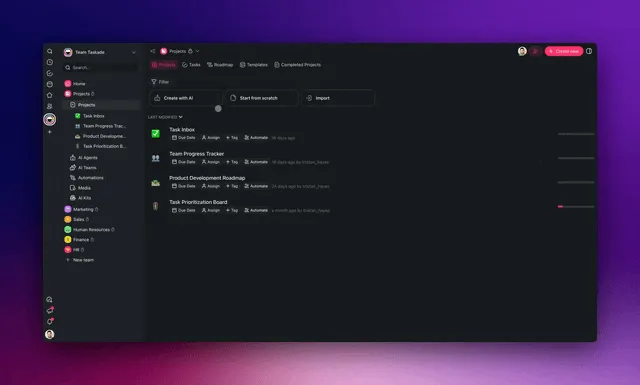
A Taskade Genesis recruiting pipeline inverts the model. Memory is still the candidate database, Candidates project, Requisitions project, Activity Log, Scorecards, Offers. But the database is wired to an Intelligence layer (Sourcer Agent, Screener Agent, Hiring Manager Bot, Pipeline Coach) and an Execution layer (Gmail screening invites, Calendly scheduling, Slack alerts, weekly digest). When a candidate sits in Engaged for forty-eight hours without movement, the Pipeline Coach flags it. When a recruiter approves the flag, the Sourcer Agent drafts the follow-up. When the candidate replies, the Activity Log writes back to Memory. The next agent run reads a richer Memory. The loop compounds.
┌──────────────────────────────────────────────────────────────┐
│  ▲ MEMORY            ■ INTELLIGENCE        ● EXECUTION       │
│  Candidates          Sourcer Agent         Gmail screen invite  │
│  Requisitions        Screener Agent        Calendly panel sched │
│  Activity Log        Hiring Manager Bot    Slack hiring alert   │
│  Scorecards          Pipeline Coach        Offer letter draft   │
│  Offers              Comp Band Advisor     Weekly hiring digest │
└──────────────────────────────────────────────────────────────┘
Glyph order is fixed: ▲ ■ ● = Memory · Intelligence · Execution. Greenhouse ships Memory plus light Execution (a few native automations, mostly via integrations). Lever ships Memory plus an outreach engine. Gem ships an Intelligence agent on top of someone else's Memory. Taskade Genesis ships all three primitives in one Workspace DNA loop, where every Execution event writes back to Memory and every agent run reads the updated state.
The three templates below implement this architecture for the three sides of the recruiting workflow: the recruiter-facing pipeline (Recruitment Workflow), the leadership-facing dashboard (HR Dashboard), and the candidate-facing experience (Career Chronicle Tracker). Read the descriptions, pick the one that matches your immediate need, and clone it. Or clone all three.
The Three Live AI Recruiting Templates
Every screenshot below links to a real Taskade Genesis app. Click through to the live share page, hit "Use this app," and clone it into your free workspace.
Template 1: Recruitment Workflow (Sourcer Agent + ATS + Screening)
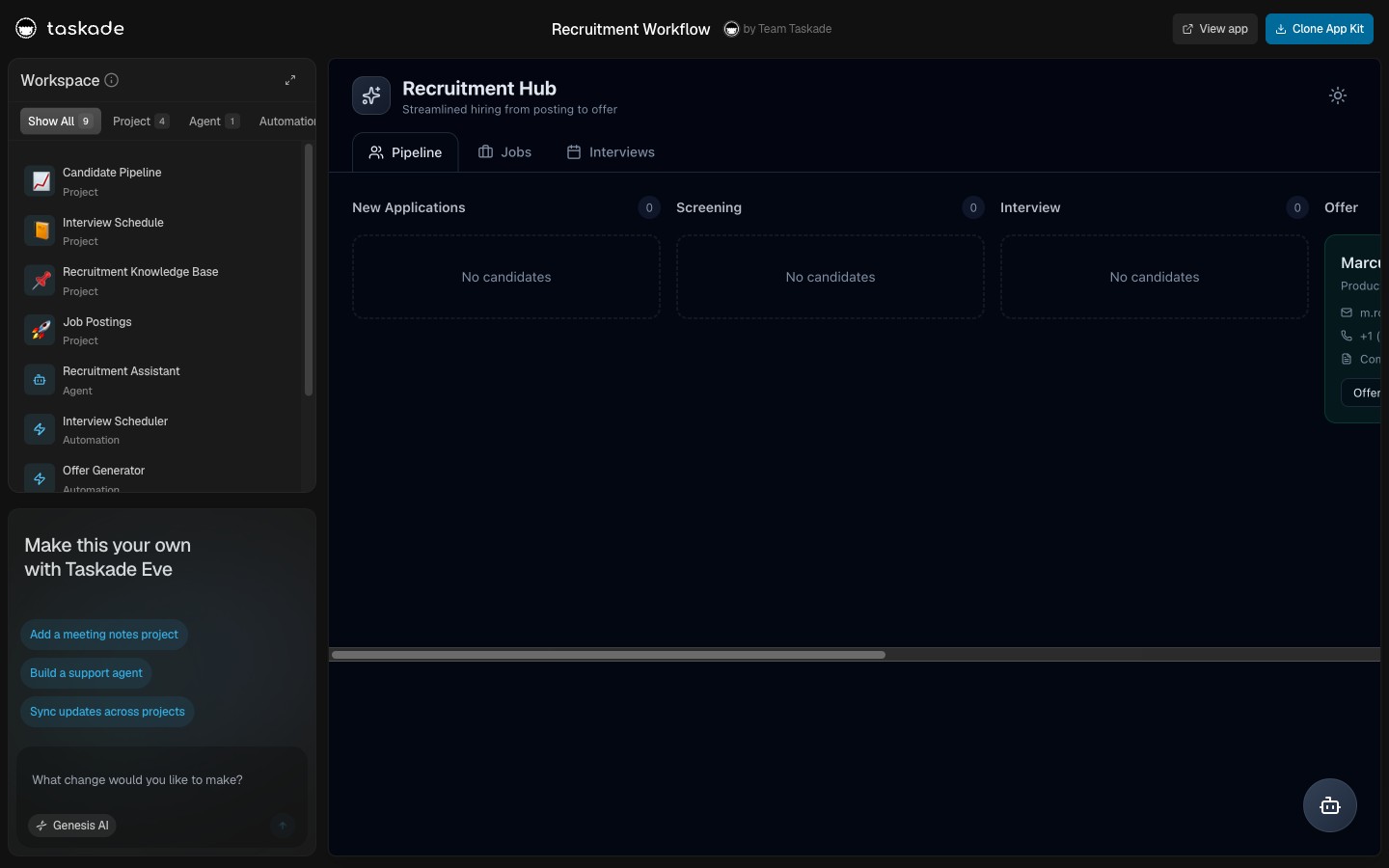
▲ ■ ● This is live. Click the screenshot above to open the live share page, then hit "Use this app" to clone Recruitment Workflow (5 projects · 4 agents · 6 automations) into your workspace.
The Recruitment Workflow is the canonical AI recruiting pipeline, the Greenhouse and Lever replacement. Built with five projects, four AI agents, and six automations, it covers the full hiring loop from sourcing through offer.
Five projects, the full ATS architecture:
The Candidates project is the source of truth for every person who has ever applied, been sourced, referred, or talked to a recruiter. It is a Table view with structured columns: name, email, current company, current role, target role, source channel (inbound, sourced, referred, agency, event), stage (Applied / Sourced / Screen / Onsite / Offer / Hired / Passed), recruiter owner, last-touched date, scorecard average, and an open notes field. New rows arrive three ways: webhook from a job-board application, drag from a Sourcer Agent output, or manual create. The Screener Agent reads every new row on intake and writes a fit score.
The Requisitions project is the open-roles record. Each row is a job, title, level, function, hiring manager, comp band, target start date, hiring goal (one hire or three), priority (P0, P1, P2), and status (open, on hold, filled, cancelled). The Sourcer Agent reads this project to know what to source against. The Hiring Manager Bot reads this project to know who to brief when a candidate moves to Onsite.
The Pipeline Board project is the same data as Candidates rendered as a Board view across five columns, Applied, Sourced, Screen, Onsite, Offer. Each candidate is a card. Drag a card to move stages. The recruiter spends ninety percent of their time in this view; the table view is for audit and reporting.
The Activity Log project captures every touchpoint, email sent, email opened, screen booked, screen completed, onsite scheduled, offer extended, offer accepted, no-show, with a timestamp and the actor (human or agent). The Pipeline Coach reads this project to surface ghosted candidates and stalled pipelines.
The Scorecards project holds structured interview feedback. Each interview round produces a row with candidate, interviewer, role-axis ratings (technical, communication, ownership, culture-add, role-specific), recommendation (strong yes, yes, no, strong no), and free-form notes. The Hiring Manager Bot rolls these up into a debrief summary before each onsite-debrief meeting.
The Sourcer Agent, detail:
The Sourcer Agent is the marquee agent. It runs three times a week against open Requisitions and performs the following loop for each open P0 and P1 role:
- Read the requisition: pulls title, level, function, comp band, location, must-have skills, nice-to-have skills, and the hiring manager's notes on "the kind of person I want."
- Query enrichment integrations: hits Apollo for matching profiles, LinkedIn-via-webhook for warm signals, GitHub for engineering roles, and any custom HTTP endpoint you have wired (proprietary candidate database, conference attendee list, university alumni directory). Returns ranked profile data.
- Score against the requisition: applies a rubric, title match, level match, recent-funding employer match, tenure pattern, "boomerang" flag (worked at a competitor your team came from), location compatibility. Drops anything under a threshold.
- Draft personalized first-touch outreach: writes a four-to-six-sentence personalized email per candidate, referencing the specific role, why their background fits, and a clear ask (fifteen-minute exploratory call). No "Dear candidate" templating. Each email is keyed to the candidate's actual profile.
- Post a digest to the hiring channel: sends a Slack message with the top fifteen candidates, the drafted email per candidate, and a one-click "approve & send" button. Recruiter reviews in three minutes, approves the strong ones, edits the borderline ones, drops the misses.
The Sourcer Agent stores its outputs as persistent memory. By the fourth week running it against the same role, it knows which titles and seniority bands have been converting on the prior runs and biases sourcing accordingly. Replaces a $270/month Gem Startups subscription and the seven-thousand-dollar-per-recruiter Gem mid-market tier.
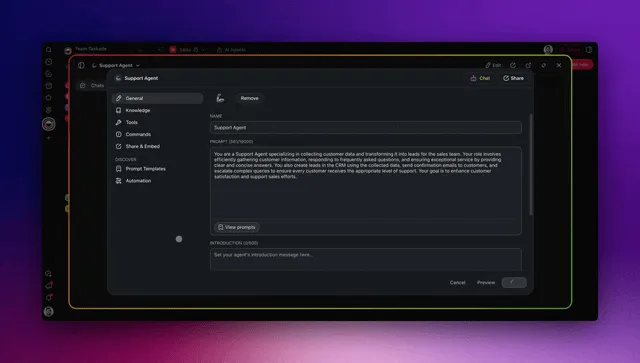
The other three agents:
- Screener Agent: reads every new Candidates row on intake, scores fit against the matching requisition's must-haves, writes the score to the candidate record. Recruiter triages from highest-scored down. Replaces the manual "open every resume" first-pass that consumes a recruiter's morning.
- Hiring Manager Bot: pre-onsite, reads the candidate record plus prior scorecards plus the requisition, generates a one-page interview prep doc for each panelist with suggested questions tied to the panelist's interview axis. Post-onsite, reads the new scorecards, drafts the debrief summary for the hiring meeting.
- Pipeline Coach: nightly cron. Reads Pipeline Board plus Activity Log. Flags stalled stages (candidate in Screen >7 days, candidate in Onsite >10 days, offer outstanding >5 days), surfaces hiring funnel conversion by source channel, and posts a Friday digest to the talent-ops Slack channel.
Six automations, the full hiring sequence:
- New application → Applied stage + Screener Agent fire: webhook from a job board or Taskade Genesis intake form creates the Candidates row, fires Screener Agent for fit scoring.
- Stage → Screen → Calendly invite: candidate dragged to Screen fires a Gmail with a Calendly link for a thirty-minute screening call, and a custom prep doc generated by the Hiring Manager Bot.
- Stage → Onsite → panel scheduling + prep doc: candidate dragged to Onsite creates a panel-scheduling thread in Slack with the hiring panel tagged, drafts a panel-coordination email, and fires the prep doc to each panelist.
- Stage → Offer → offer letter draft: candidate dragged to Offer fires a Gmail draft to talent ops with a personalized offer letter pulled from the requisition's comp band, the candidate's negotiated number (from the recruiter notes field), and your standard offer-letter template.
- Stage → Hired → onboarding handoff: candidate to Hired fires a Slack message to the hiring manager with the start date and an onboarding-checklist project clone.
- Friday digest (Friday 4 PM): Pipeline Coach summary fires to talent-ops Slack, open reqs, stalled candidates, conversion-by-source, weekly applications, offers extended, offers accepted.
When to clone the Recruitment Workflow: you have three or more open reqs at any one time, your current ATS is a graveyard of un-followed-up candidates, or you are paying for a separate ATS and a separate sourcing tool and want them in one workspace.
Template 2: HR Dashboard (Headcount, Comp Bands, Req Planning)
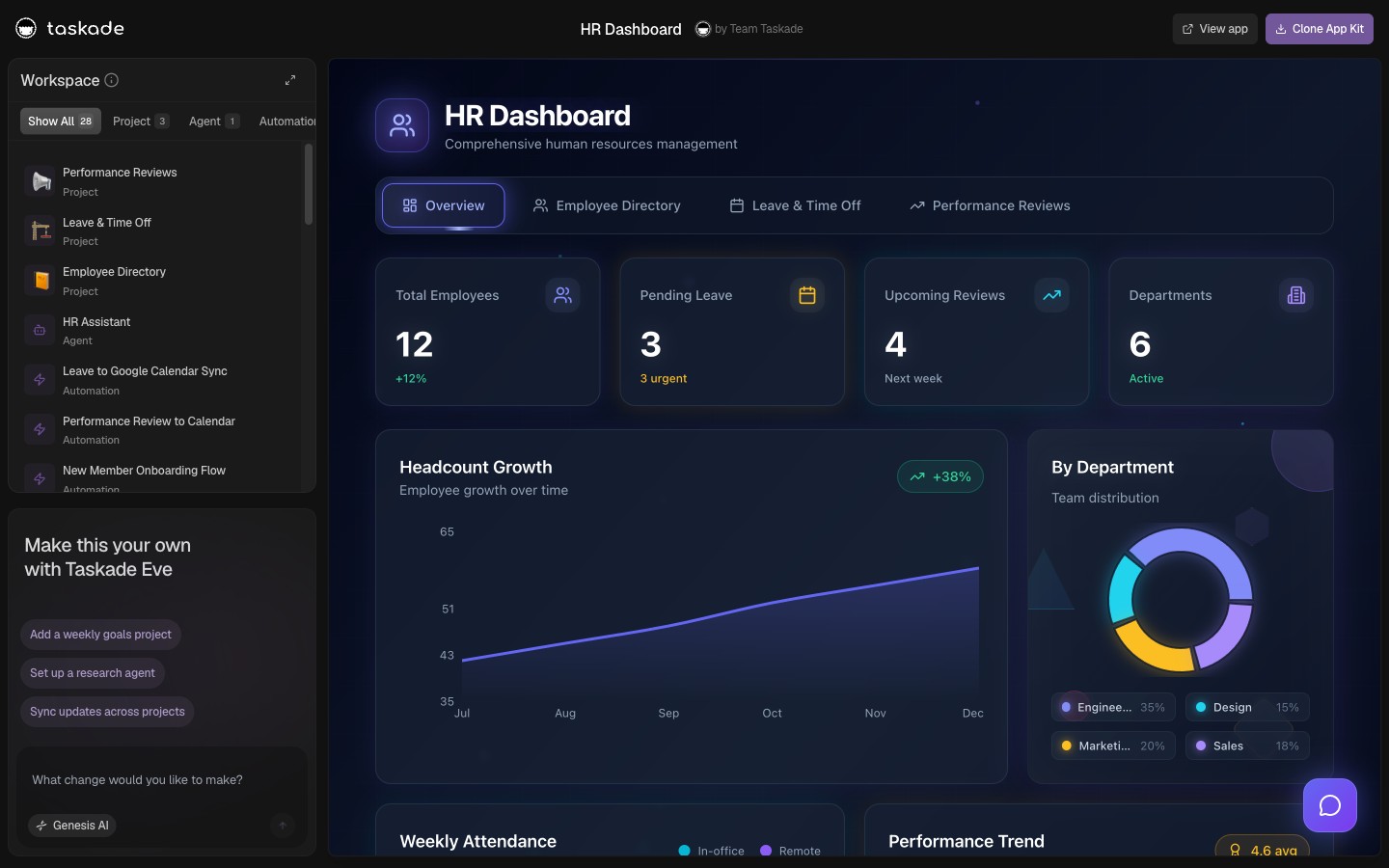
▲ ■ ● This is live. Click the screenshot above to open the live share page, then hit "Use this app" to clone HR Dashboard (4 projects · 2 agents · 3 automations) into your workspace.
The HR Dashboard is the leadership-facing operations layer. Built with four projects, two AI agents, and three automations, it is the "is hiring on plan?" dashboard the People lead opens every Monday and the CFO opens at every board meeting.
This dashboard is the right clone for any company with a structured hiring plan, most seed-through-Series-B startups, agencies running a planned headcount build, and any team where finance and leadership want a single source of truth for hiring spend, time-to-fill, and comp-band integrity.
Four projects, the leadership view:
The Headcount Plan project is the source of truth for the year's hiring goal. Each row is a planned hire, title, function, level, comp band, start quarter, status (open, closed, deferred, cancelled). The plan was approved at the start of the year by leadership and finance. The Comp Band Advisor agent reads this project before approving any offer.
The Active Reqs project is the open-jobs record, mirrored from the Recruitment Workflow's Requisitions project via Taskade Genesis cross-app sync. Each row shows status, days-since-opened, current pipeline depth (number of candidates active), and time-to-fill estimate from the Pipeline Coach. Leadership sees the same view recruiters see, filtered to active.
The Headcount Tracker project is the rendered hiring scorecard, planned vs filled by function and quarter, with leading indicators (offers extended, offers accepted) and lagging (start dates confirmed). Rendered across multiple views: Table view for finance, Mind Map for the org-design conversation, Gantt for the year's headcount build.
The Comp Bands project is the compensation governance layer. Each row is a level + function combination (e.g., L4 Engineering, L5 Product) with the salary band, equity band, and approval rule (auto-approve under band, requires VP for above band, requires CEO for above band+15%). The Comp Band Advisor agent reads this project before approving any offer letter draft.
The two agents:
- Headcount Coach: weekly cron. Reads Headcount Plan + Active Reqs + Headcount Tracker. Surfaces hiring health by function ("Engineering is 4 behind plan for Q2, Sales is 1 ahead"), forecasts year-end actual based on current funnel velocity, flags reqs that should be cancelled or deferred based on the time-to-fill estimate. Drafts a weekly summary for the leadership Slack channel.
- Comp Band Advisor: triggered by offer-letter draft events from the Recruitment Workflow. Reads the proposed offer (base + equity + sign-on), compares against the candidate's level + function comp band, and either approves silently or escalates to the right approver based on the band rule. Logs every approval decision for audit.
The three automations:
- Weekly hiring digest (Monday 8 AM): Headcount Coach summary fires to leadership Slack with the previous week's offers extended, offers accepted, starts confirmed, plus year-to-date plan-vs-actual by function.
- Offer above band → CEO approval thread: any offer letter draft that exceeds the comp band fires a dedicated Slack thread in #ceo-approvals with the candidate context, the band, the proposed comp, and a one-click approve/deny.
- Quarter-close hiring report: at quarter end, fires a board-ready hiring report to leadership with planned vs actual by function, average time-to-fill, average sourced-to-hire ratio, total offers extended vs accepted (accept rate), and total hiring spend.
When to clone the HR Dashboard: you have a structured headcount plan approved by leadership, you want a single Monday-morning view of hiring health, or your CFO is asking why hiring is behind plan and you don't have a clean answer.
Template 3: Career Chronicle Tracker (The Candidate-Side Experience)
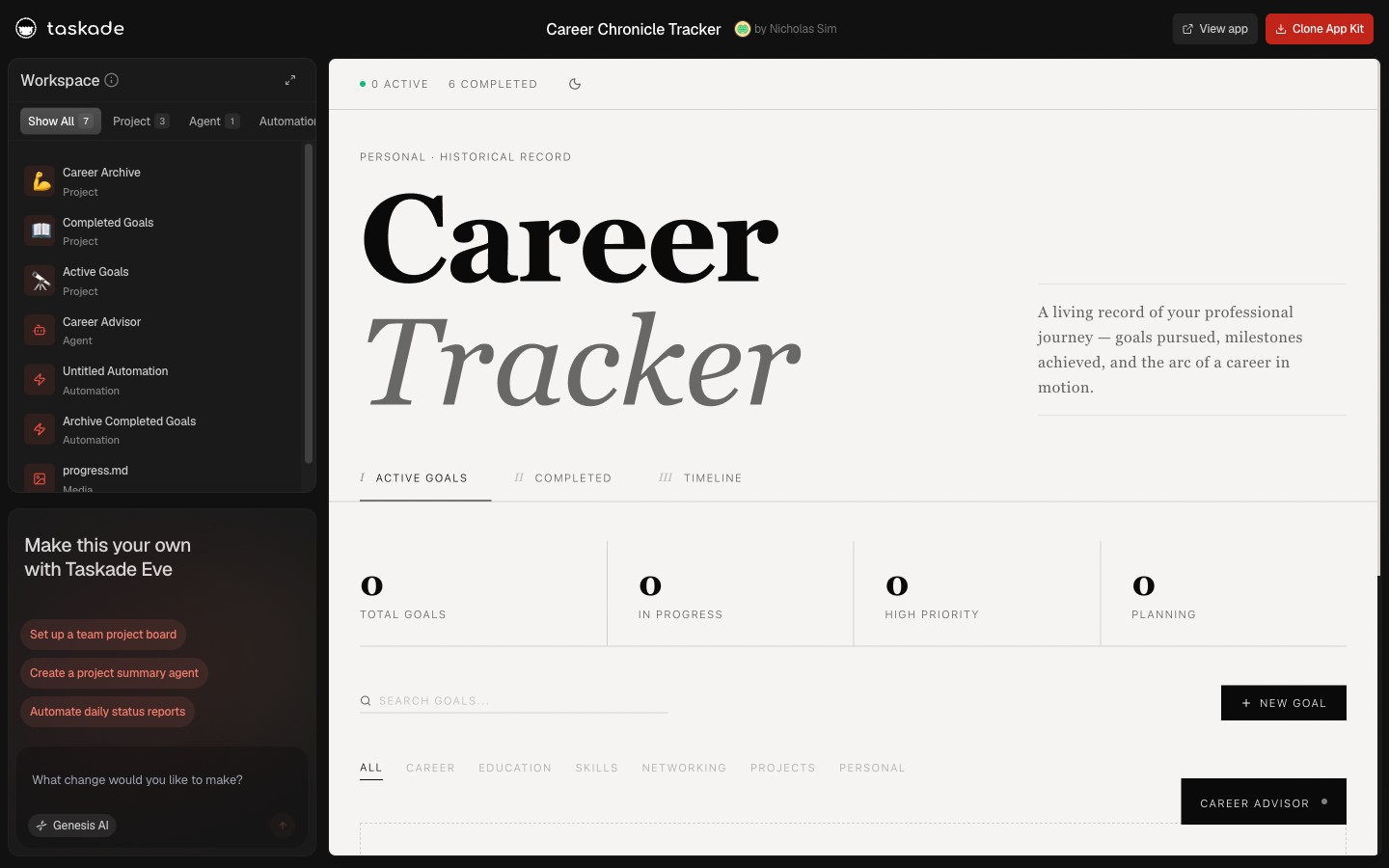
▲ ■ ● This is live. Click the screenshot above to open the live share page, then hit "Use this app" to clone Career Chronicle Tracker (3 projects · 1 agent · 2 automations) into your workspace.
The Career Chronicle Tracker is the candidate-facing surface, the careers portal, the application form, and the candidate self-service dashboard rolled into one Taskade Genesis app. Built with three projects, one AI agent, and two automations.
This is the public-facing template. Publish it to jobs.yourcompany.com via Taskade Genesis custom domain, link it from your homepage, and the candidate-facing piece of your hiring funnel is live without a developer. Internal recruiters work in the Recruitment Workflow; candidates interact only with the Career Chronicle Tracker.
Three projects, the candidate experience:
The Open Roles project is the public job board. Each row is a published role with title, location (remote / city), level, salary range (we recommend publishing this, companies that do hire faster), short description, full job description, and an apply button. The salary band syncs from the HR Dashboard's Comp Bands project so the public posting always matches the internal comp band.
The Application Form project is the structured application, name, email, LinkedIn, current role, why-this-role essay (two hundred words), portfolio links, source channel ("how did you hear about us?"), and any role-specific custom questions. Submissions fire a webhook into the Recruitment Workflow's Candidates project at Applied stage.
The Candidate Dashboard project is the candidate's personal status view, what stage they are in, what to expect next, the name and bio of the recruiter they are working with, scheduled interviews on the calendar, and any pending actions on their side (complete the take-home, sign the offer letter). Taskade Genesis Auth (built-in OIDC/SSO) identifies each candidate, and you match their row to that login. The Recruiter sees the full board.
The Candidate Concierge agent:
The Candidate Concierge runs on-demand. When a candidate clicks "ask a question" in the Dashboard, the agent reads the candidate's stage history plus the role context plus your standard FAQ doc and drafts a personalized response. The recruiter sees the drafted response in a Slack thread and approves or edits before sending. Cuts candidate response time from hours to single-digit minutes, which is one of the strongest predictors of offer acceptance.
The two automations:
- Application submitted → Recruiter ack + ATS write: candidate submits the form, the Recruitment Workflow's Candidates project gets a new Applied row, the recruiter assigned to the requisition gets a Slack DM, and the candidate gets an auto-acknowledgment email with the recruiter's name and a one-line expectation ("we review every application within 72 hours and will follow up by email").
- Stage change → candidate notification: any stage move in the Recruitment Workflow fires a candidate-facing email, "you've been moved to the Screen stage, here's the Calendly link to book," "you've been moved to Onsite, here's the panel and prep doc," "you've been moved to Offer, your offer letter is in your Dashboard." Candidates stop having to email "any update on my application?". They see it in real time.
When to clone the Career Chronicle Tracker: you do not have a careers page and don't want to spin up a Webflow or WordPress site, your current applications go to a generic ats@company.com inbox, or your candidate experience NPS is below what you would want for a Glassdoor review.
See also: Templates Library for the full catalog of recruiting and HR Taskade Genesis apps.
The Verified May-2026 Recruiting-Tool Pricing Card
This is the matrix recruiting buyers need: not just price, but where the AI primitives are gated, what onboarding adds, and what the real annual cost is for a small recruiting team.
| Tool | Lowest published / starting | Most popular tier | Hidden cost |
|---|---|---|---|
| Taskade Genesis | Free (11,000 AI credits) | $10/mo Pro (10 seats flat) | None — Sourcer Agent + ATS + Dashboard + Portal all included |
| Greenhouse | (no public price) | ~$6,500-$15K/yr Essential | $2,000-$8,000 implementation fee |
| Lever (LeverTRM) | (no public price) | ~$6-25K/yr SMB · $40-72K/yr Enterprise | $15K-$25K professional services, 8-12% annual renewal hikes |
| Workable | $169/mo Starter | $299/mo Standard · $599/mo Premier | Headcount-based; Standard at 50 employees ≈ $800/mo |
| Ashby | $400/mo Foundations (flat) | Plus tier custom | $5-8/employee/mo PEPM, mid-market $30K-$120K/yr |
| Recruit CRM | $85/user/mo Pro | $125/user/mo Business | Per-user, not flat — 5 recruiters = $625/mo Business |
| BambooHR (incl. Hire) | (no public ATS price) | ~$10-25/employee/mo Core/Pro/Elite | ATS is a bundle add-on, not standalone; +5-15% implementation |
| Rippling Recruit | $8/user/mo + $40 base (HRIS) | ~$3-7/employee/mo ATS add-on | Must buy into full Rippling HRIS; ATS alone not sold |
| Gem.com (sourcer) | (no public price) | $270/mo Startups (annual) | Mid-market: 5-10 seat minimum, per-recruiter pricing |
| JazzHR | $75/mo Hero (3 jobs) | $269/mo Plus · $420/mo Pro | Hero caps at 3 active jobs; +$9 per additional job |
| Manatal | $15/user/mo Professional | $35/user/mo Enterprise | Per-user, automation gated to Enterprise tier |
| LinkedIn Hiring Assistant | (bundled with Recruiter Corporate) | ~$8,999/seat/yr | LinkedIn-only sourcing surface, no ATS, no candidate portal |
| Paradox (Olivia) | (no public price) | Custom enterprise | High-volume hourly hiring focus, no SMB tier |
| Juicebox | $79/mo Starter | Custom enterprise | Sourcing-only (800M+ profiles), no ATS or pipeline |
| SeekOut | (no public price) | Custom enterprise (~$15K/yr+) | Sourcing + diversity analytics, no full ATS |
| Loxo | (no public price) | Custom (CRM + ATS + sourcing) | Agency-recruiter focus, per-seat pricing |
A five-person recruiting team running Greenhouse Essential + Gem Startups + LinkedIn Recruiter Corporate at one seat is roughly $6,500 + $3,240 + $8,999 = $18,739/year before the $2,000-$8,000 implementation fee on Greenhouse. Same team running Taskade Genesis Pro = $120/year. Cost asymmetry: ~156x cheaper before the implementation fee.
The shift since 2024 is not that recruiting tools got more expensive. It is that one Workspace DNA loop now ships the ATS, the sourcer, the HR dashboard, and the candidate portal at a flat seat price that does not move when the company adds employees or recruiters. That is the structural change that flips the buy decision for any team under one hundred fifty employees.
The "Native AI Sourcer Bundled" Row Nobody Else Has
Every recruiting buyer in 2026 evaluates against one specific question: is the AI sourcer included in the seat price, or is it a paid add-on? The market has split between "assistive AI" (tools that draft your email) and "autonomous AI" (tools that run entire stages of the funnel). Taskade Genesis ships an autonomous Sourcer Agent native; nearly every traditional ATS still routes sourcing to a separate paid tool. The matrix:
| Tool | ATS included | Native AI sourcer bundled | HR dashboard bundled | Candidate portal bundled |
|---|---|---|---|---|
| Taskade Genesis Pro ($10/mo flat) | Yes | Yes — Sourcer Agent native | Yes — HR Dashboard template | Yes — Career Chronicle Tracker |
| Greenhouse Essential | Yes | No (Gem add-on $270+/mo) | Light (basic reporting) | Basic hosted careers page |
| Lever LeverTRM | Yes | Partial (Talent CRM, $$ tier) | Basic | Basic |
| Ashby Foundations | Yes | No (Gem/hireEZ add-on) | Strong (analytics depth) | Basic |
| Workable Standard | Yes | Gated to Premier $599/mo | No | Basic |
| Recruit CRM | Yes (agency-focused) | No (manual Chrome ext) | No | Client portal only |
| BambooHR (incl. Hire) | Bundle add-on | No | Yes (HRIS-side) | Basic |
| Gem.com | No (sourcer only) | Yes (own product) | No | No |
| LinkedIn Hiring Assistant | No (sourcer only) | Yes (LinkedIn-only) | No | No |
| Paradox (Olivia) | Partial (Olivia chat) | Conversational screening | No | Chat-only |
| Juicebox | No (sourcer only) | Yes (800M+ index) | No | No |
Read the column labeled "Native AI sourcer bundled." Every "No" is a $270-to-$30,000-per-year line item the buyer has to add on top of the ATS. Taskade Genesis is the only row where all four columns are "Yes" inside a single $10/month Pro seat. That is the wedge: AI sourcer + ATS + HR dashboard + candidate portal bundled at a flat ten dollars a month, against a market where every other vendor sells three of the four and charges separately for the fourth.
The Candidate Lifecycle, Visualized
Read top-to-bottom. Every transition is either a recruiter action (drag the card) or an agent action (Sourcer enrichment, Screener scoring, Pipeline Coach flag). Every state writes back to Memory via the Activity Log. Passed candidates don't disappear. They flow into the Talent CRM Memory so the Sourcer Agent can re-engage them on future reqs (the boomerang pattern is one of the strongest sources of late-stage hires).
For more on agent-driven state machines, see Workspace DNA: Context Engineering Blueprint.
The Sourcer Agent: Full Workflow Sequence
The Sourcer Agent is the agent that replaces the $3K-$30K/year sourcing tool subscription. Here is the full sequence per role per run:
This is the same sequence Gem and hireEZ implement, with one structural difference: the Sourcer Agent writes back to the same Memory layer as the rest of the recruiting workflow. Gem outputs to Gem's database. hireEZ outputs to hireEZ's database. Both then sync to your ATS. Taskade Genesis collapses the loop, the Sourcer Agent and the ATS pipeline are the same workspace, the same Memory, the same source of truth. No sync drift, no two-step manual export, no per-recruiter seat metering.
The Workspace DNA Loop, Mapped to Recruiting
The diagram above is the architectural difference between Taskade Genesis and a stitched-together recruiting stack. In Greenhouse + Gem + LinkedIn Recruiter, every Memory write requires a cross-system sync. The Sourcer outputs go to Gem; Gem syncs to Greenhouse; Greenhouse fires LinkedIn InMail; the InMail reply comes back to LinkedIn; eventually a recruiter manually pastes the reply into Greenhouse. Each hop is a copy, a sync delay, and a chance for drift.
In Taskade Genesis, every Execution arrow lands back in the same Memory pool the next agent run reads from. The Sourcer Agent writes Apollo enrichment back to Candidates. The Screener Agent writes fit scores back to Candidates. The Calendly trigger writes the booking back to Activity Log. The next Sourcer run reads the updated Memory and gets smarter. No sync. No drift. One source of truth.
The "$1,000/Seat ATS Tax": Why SMBs Overspend
The single most defended sentence in recruiting buyer conversations is "we need a real ATS." The sentence is true. The unspoken assumption is that "a real ATS" is Greenhouse or Lever. In 2026 that assumption is wrong.
A "real ATS" needs five things: candidate database, pipeline view, scorecard system, integration with calendar and email, and audit trail. Every one of those is a Taskade Genesis project plus a few automations. Greenhouse charges $6,500-$15,000 a year for the same five things, plus a heavier integration marketplace (~400 integrations vs Taskade Genesis's 100+) and structured interview kits a small team won't use.
RECRUITING-TOOL ANNUAL COST · 30-PERSON STARTUP · MAY 2026
─────────────────────────────────────────────────────────────────
Greenhouse Essential + Gem Startups + LinkedIn Recruiter Corporate
  Greenhouse  $6,500-$15,000 + implementation $2,000-$8,000
  Gem         $270/mo × 12 = $3,240
  LinkedIn    $8,999/seat/yr × 1 = $8,999
  Year-1 total: ████████████████████████████ $20,739 - $35,239Lever + Gem + LinkedIn Recruiter Corporate
Lever       $6,000-$25,000 + professional services $15,000-$25,000
Gem         $3,240
LinkedIn    $8,999
Year-1 total: ████████████████████████ $33,239 - $62,239
Ashby Foundations + Gem
Ashby       $400/mo × 12 = $4,800
Gem         $3,240
Year-1 total: ████████ $8,040
Workable Standard + Gem
Workable    $299/mo × 12 = $3,588
Gem         $3,240
Year-1 total: ███████ $6,828
Taskade Genesis Pro (Sourcer + ATS + HR Dashboard + Career Portal)
Year-1 total: ▏ $120
─────────────────────────────────────────────────────────────────
Delta vs Greenhouse stack: ~$20,619 - $35,119/yr saved · ~173-294x cheaper.
Delta vs Lever stack:      ~$33,119 - $62,119/yr saved · ~277-519x cheaper.
Delta vs Ashby stack:      ~$7,920/yr saved · ~67x cheaper.
Delta vs Workable stack:   ~$6,708/yr saved · ~57x cheaper.
That delta is roughly half a junior recruiter salary saved on tooling alone.
The bars above are not rhetorical. They are the exact math any seed-through-Series-B founder runs when deciding whether to renew Greenhouse. At thirty employees, the recruiting team is one person. That person does not need $20,000 of tooling to do their job. They need a working pipeline with an AI sourcer attached. Taskade Genesis delivers that for less than half the price of a single month of one Gem Startups seat.
When to Clone vs Stay on Greenhouse
The honest framework. Cloning Taskade Genesis is the right answer for most SMB and seed-through-Series-B teams. Greenhouse is the right answer for some.
Clone Taskade Genesis when:
- You have under one hundred fifty total employees and fewer than fifty open reqs per year.
- Your current ATS is a "we bought it because everyone uses it" decision, not a deeply-integrated workflow.
- You want the sourcer, the ATS, the HR dashboard, and the candidate portal in one place at a flat seat price.
- Your IT/People budget is below $50K/year and you want to free $15-30K for actual hiring (referral bonuses, candidate dinners, employer brand content).
Stay on Greenhouse when:
- You are 500+ employees with structured-interview compliance requirements (specific scorecard rubrics audited by legal).
- You have an existing Greenhouse-to-Workday-to-Okta integration that took six months to set up.
- Your hiring volume is 200+ reqs per year and you need the depth of Greenhouse's integration marketplace.
- You are part of a regulated industry (finance, healthcare) with vendor-approval requirements that limit you to a vendor allowlist.
Stay on Lever when:
- You run a heavy outbound-led sourcing motion and have built workflows specifically around Lever's Talent CRM.
- You have a large Lever-trained recruiting team and the switching cost in muscle memory is high.
Stay on Ashby when:
- You are data-led, you actually use the analytics deeply, and your team has structured the funnel around Ashby's reporting model.
- The $400/month flat tier scales below your headcount break-even point.
Run a hybrid (Taskade Genesis + an existing ATS):
- Keep Greenhouse as the system of record for legal/compliance.
- Layer Taskade Genesis on top as the Sourcer Agent layer (replaces Gem at roughly four percent of the price).
- Sync candidate stage changes from Greenhouse to Taskade Genesis via webhook so the Pipeline Coach has the same view.
- This is the most common transition path, start hybrid, fully migrate after six months when the team trusts the Taskade Genesis pipeline.
Long-Tail Wedge Table: Which Search Visitor Each Template Catches
The post is structured around three templates because each one catches a different SERP cluster. The table below maps the high-intent long-tail queries to the right clone-and-customize starting point.
| Long-tail query | Right Taskade Genesis clone | Replaces |
|---|---|---|
| "free applicant tracking system" | Recruitment Workflow | Workable Starter $169/mo, JazzHR Hero $75/mo |
| "AI recruiter agent" | Recruitment Workflow (Sourcer Agent focus) | Gem Startups $270/mo, hireEZ custom enterprise |
| "Greenhouse alternative SMB" | Recruitment Workflow + HR Dashboard | Greenhouse Essential $6,500-$15K/yr |
| "Lever alternative startup" | Recruitment Workflow | Lever LeverTRM $6-25K/yr |
| "Ashby alternative" | Recruitment Workflow + HR Dashboard | Ashby Foundations $400/mo |
| "Workable alternative free" | Recruitment Workflow | Workable Standard $299/mo |
| "Recruit CRM alternative" | Recruitment Workflow | Recruit CRM $85-165/user/mo |
| "open source ATS" | Recruitment Workflow (self-hostable via export) | Manatal $15-35/user/mo |
| "AI sourcing agent LinkedIn" | Recruitment Workflow (Sourcer Agent) | Gem $270/mo, LinkedIn Recruiter $8,999/yr |
| "LinkedIn Hiring Assistant alternative" | Recruitment Workflow (Sourcer Agent) | LinkedIn Hiring Assistant bundled $8,999/seat/yr |
| "Paradox Olivia alternative" | Recruitment Workflow (Screener + Concierge agents) | Paradox custom enterprise |
| "Juicebox AI alternative" | Recruitment Workflow (Sourcer Agent + ATS bundle) | Juicebox $79/mo + ATS separately |
| "SeekOut alternative" | Recruitment Workflow + HR Dashboard | SeekOut custom enterprise (~$15K/yr+) |
| "EEO compliant ATS startup" | Recruitment Workflow (Activity Log audit trail) | Greenhouse Essential $6,500-$15K/yr |
| "GDPR recruiting tool" | Recruitment Workflow + Career Chronicle Tracker (custom domain) | Workable Premier $599/mo |
| "headcount planning template" | HR Dashboard | Lattice, 15Five HR add-ons |
| "hiring dashboard template" | HR Dashboard | Looker dashboard $60-100K/yr |
| "comp band template startup" | HR Dashboard (Comp Bands project) | Pave $1K-$5K/mo, custom Sheets |
| "candidate portal template" | Career Chronicle Tracker | Webflow + Typeform stack |
| "free careers page builder" | Career Chronicle Tracker | Workable hosted careers page |
| "ATS for agency recruiters" | Recruitment Workflow | Recruit CRM $85/user/mo, Crelate |
| "AI screener resume" | Recruitment Workflow (Screener Agent) | HireVue, Paradox |
| "interview scorecard template" | Recruitment Workflow (Scorecards project) | Greenhouse interview kits |
| "offer letter automation" | Recruitment Workflow (offer letter draft) | DocuSign + custom workflow |
Each row in this table is a search-intent visitor. The wedge is that one $10/month Pro workspace handles all eighteen of them with three cloneable apps and a handful of customizations. The competing stack is ten different tools.
How Teams Actually Migrate (15-Minute Setup)
The clone-and-customize loop is faster than reading the Greenhouse implementation checklist. Concrete order:
T+0     Click the Recruitment Workflow screenshot above → "Use this app" on the share page
        → app appears in your workspace.
T+1     Open Candidates project → import your existing CSV
        (or Greenhouse/Lever export).
T+2     Open Requisitions → enter your current open roles
        (title, level, comp band, hiring manager, priority).
T+5     Settings → Integrations → connect Gmail (OAuth), Slack (workspace),
        Apollo (API key), Calendly (token).
T+8     Open the Sourcer Agent → paste your top 3 job descriptions
        into the agent's persistent memory ("sourcing for these roles,
        prioritize candidates from these comparable companies, comp band
        is $X-$Y").
T+10    Run the Sourcer Agent on your highest-priority req.
        Watch Apollo + LinkedIn enrichment populate a Slack digest
        with 15 drafted first-touch emails.
T+12    Settings → Custom Domain → connect jobs.yourcompany.com
        for the Career Chronicle Tracker.
        Set RBAC: Owner = you, Editor = recruiters, Viewer = hiring managers.
T+15    Done. First sourced batch is in Slack awaiting your approval.
        The Pipeline Board has your existing candidates.
        The HR Dashboard is showing your current headcount plan.
        Career portal is live at jobs.yourcompany.com.
15 minutes. No implementation fee. No professional services contract. No "schedule a demo" gate. That is the gap between Taskade Genesis and any traditional ATS.
For step-by-step setup of the agents, see /learn/agents/custom-agents; for the trigger setup see /learn/automation/automations-execution; for the Taskade Genesis app configuration see /learn/genesis/faq.
What Each Recruiting Tool Gets Right vs Where Taskade Genesis Wins
Every tool below earned its market share. Pretending otherwise is unserious. The comparison that matters is what each one nailed and where Taskade Genesis delivers something structurally different.
Greenhouse
What they nailed: the structured-interview discipline. Greenhouse popularized scorecard-based interviewing and made it muscle memory for a generation of recruiting teams. The integration marketplace is the deepest in the category (400+ apps), and the audit trail meets enterprise compliance requirements out of the box.
Where Taskade Genesis wins: the price ladder. Greenhouse Essential at $6,500-$15,000/year + $2,000-$8,000 implementation is a budget line the seed-stage CFO can't approve. Taskade Genesis Pro is $120/year flat, the Sourcer Agent is native, the implementation is a fifteen-minute clone, and the scorecard discipline is just a Scorecards project away.
Lever
What they nailed: the Talent CRM model. Lever's bet that sourcing and ATS should live in the same database was right, and the outreach workflows for outbound-led recruiting motions are mature. LeverTRM remains the right pick for teams whose recruiting is 70%+ outbound sourcing.
Where Taskade Genesis wins: Lever's per-employee pricing means the cost goes up every quarter as the company grows, independent of recruiting activity. The professional services contract is $15K-$25K. The annual renewal hike is 8-12%. Taskade Genesis Pro is $10/month flat regardless of headcount, no PS contract, no renewal hike.
Ashby
What they nailed: the data model. Ashby's analytics and reporting are the strongest in the ATS category, and the data-led teams that use Ashby deeply genuinely outperform their peers on hiring-funnel optimization. Ashby Foundations at $400/month flat is genuinely good value for data-led teams under fifty employees.
Where Taskade Genesis wins: for teams that want a sourcer agent and not just better analytics. Ashby ships the reporting layer; the sourcing still happens in Gem or hireEZ at additional cost. Taskade Genesis ships the analytics (Pipeline Coach) plus the sourcing (Sourcer Agent) plus the HR dashboard (Headcount Coach) in one workspace at one-fortieth the Ashby price.
Workable
What they nailed: the SMB-friendly UX and the bundled job-board syndication. Workable Standard at $299/month is one of the simplest "we need an ATS now" answers for a team that has never run a structured hiring process. The headcount-based pricing model is opaque but predictable.
Where Taskade Genesis wins: Workable's pricing crosses Taskade Genesis at about three reqs per quarter, and at that point Taskade Genesis includes the Sourcer Agent and the HR Dashboard that Workable doesn't. Plus Workable's AI features are gated to Premier at $599/month.
Recruit CRM
What they nailed: the agency-recruiter workflow. Recruit CRM bundles ATS + client CRM into one workspace, which is genuinely what staffing-agency recruiters need. The pipeline visualization is the cleanest in the agency-ATS category.
Where Taskade Genesis wins: $85/user/month means a five-recruiter agency is at $425/month, $5,100/year. Taskade Genesis Pro is $120/year flat for ten seats, and the client-side relationship management is a second Taskade Genesis app (clone the Agency Client Portal, see below). Two apps, $10/month flat, replaces the Recruit CRM ATS + CRM bundle.
Gem.com (sourcer)
What they nailed: the proprietary 800M+ profile index and the candidate-context-aware AI sourcer. For pure depth of sourcing breadth on hard-to-fill roles, Gem is the strongest tool in the category. Gem Startups at $270/month annual is reasonable value for a company hiring twenty-plus roles per year.
Where Taskade Genesis wins: Gem is a sourcer, not a pipeline. The output has to land somewhere, Greenhouse, Lever, or a sheet, and that "somewhere" is where the actual hiring work happens. Taskade Genesis ships the sourcer plus the pipeline plus the HR dashboard plus the candidate portal in one Workspace DNA loop. The Sourcer Agent index depth (via Apollo + LinkedIn webhook + GitHub) is shallower than Gem's proprietary index, useful for sourcing on top of the data sources you already have, less useful for pure greenfield prospecting at enterprise scale.
BambooHR (incl. Hire)
What they nailed: the HRIS-first approach. BambooHR is genuinely the best "we just need basic HR and a light ATS" answer for a thirty-person company. The HRIS workflows are mature and the user experience is friendly.
Where Taskade Genesis wins: BambooHR's ATS is a bundled add-on, not a full hiring engine, no native sourcer agent, limited automation depth, no candidate portal. Plus BambooHR pricing scales with total employee headcount, which means the recruiting tool gets more expensive every time you hire (perverse incentive). Taskade Genesis is recruiting-first, flat-rate, with the Sourcer Agent and the candidate portal native.
Rippling Recruit
What they nailed: the unified HRIS + IT + Payroll + Recruiting story. For companies actively displacing four-to-five HR-stack tools at once, Rippling is the most coherent answer in the market. The Recruit module is competent for high-volume hiring teams.
Where Taskade Genesis wins: Rippling Recruit isn't sold standalone. You have to buy into the full Rippling HRIS at $8/user/month + $40 base + $3-7/employee/month for the ATS. For a recruiting-only team, that's the wrong product. Taskade Genesis is recruiting-only, $10/month flat, no HRIS bundle required.
JazzHR and Manatal
What they nailed: the budget-conscious "we just need a basic ATS" tier. JazzHR Hero at $75/month flat and Manatal Professional at $15/user/month are the cheapest credible ATS options in the market.
Where Taskade Genesis wins: both lack a native AI sourcer agent, neither ships an HR dashboard or candidate portal, and both lack the agent-collaboration layer. JazzHR caps jobs at 3 on Hero ($9/job above). Manatal gates automations to the $35/user Enterprise tier. Taskade Genesis Pro at $10/month flat ships all of it.
LinkedIn Hiring Assistant
What they nailed: the data moat. LinkedIn Hiring Assistant, released 2026, was the platform's first agentic recruiter and the closest thing to "Sourcer Agent built into the largest professional network on earth." Reported numbers are real: roughly a 65% InMail acceptance rate from Assistant-sourced candidates versus 39% from manual sourcing, and Expedia Group reportedly cut time-to-hire by ~30 days. The Cognitive Memory Agent infrastructure layer (persistent stateful memory across episodic, semantic, procedural layers) is genuinely impressive engineering.
Where Taskade Genesis wins: Hiring Assistant is bundled with LinkedIn Recruiter Corporate at ~$8,999/seat/year, requires you to live inside LinkedIn's UI, and writes back only to LinkedIn's database. There is no native ATS, no HR dashboard, no candidate portal. The output still has to land in Greenhouse or Lever, which is where the $6,500-$15,000/year ATS bill comes back. Taskade Genesis ships the sourcer plus the pipeline plus the dashboard plus the portal in one Workspace DNA loop at $10/month flat, roughly 0.5-0.8% the cost of LinkedIn Hiring Assistant + Greenhouse stacked. Sourcing depth on greenfield passive candidates is shallower than LinkedIn's native graph (Apollo + GitHub + LinkedIn webhook vs LinkedIn's 1B+ profile native index); for any company already running LinkedIn Recruiter, the Taskade Genesis Sourcer Agent layers cleanly on top.
Paradox (Olivia)
What they nailed: autonomous conversational screening for high-volume hourly hiring. Paradox's Olivia is the right answer for McDonald's, Starbucks, FedEx, companies hiring tens of thousands of frontline roles where the bottleneck is "respond to every applicant in 60 seconds." The chat-first UX and the scheduling automation are mature.
Where Taskade Genesis wins: Paradox is enterprise-priced (custom contracts, typically $50K-$500K+/year depending on hiring volume), purpose-built for hourly volume hiring, and weak on knowledge-worker recruiting (engineer, PM, marketer, designer roles). Taskade Genesis covers the knowledge-worker SMB and mid-market segments that Paradox isn't priced for, and the Candidate Concierge agent ships the same drafted-response-with-recruiter-approval pattern at a tiny fraction of the cost.
Juicebox and SeekOut
What they nailed: the deepest passive-candidate index outside LinkedIn. Juicebox built an 800M+ profile graph across 30+ data sources and is the highest-ranking new sourcer on the 2026 "best AI recruiting" SERP. SeekOut's diversity filters and technical-talent insights (GitHub depth, security clearance signals) are the strongest in the category for enterprise diversity hiring and government contracting.
Where Taskade Genesis wins: both are sourcing-only, no ATS, no pipeline view, no candidate portal, no HR dashboard, no offer-letter automation. The Sourcer output still has to land in Greenhouse or Lever. Juicebox and SeekOut are best read as "the modern Gem-equivalent" rather than as ATS replacements. For teams that need an end-to-end recruiting workspace at SMB pricing, neither tool is the right comparator, the Taskade Genesis Sourcer Agent + ATS + HR Dashboard + Career Portal bundle is. For pure passive-candidate sourcing at enterprise scale, layer Juicebox or SeekOut on top of the Taskade Genesis pipeline via webhook.
The Founder-Hiring Callout: Pair With the GTM Stack
For founders running their own first-fifteen-hires, the Recruitment Workflow pairs naturally with the AI Sales Pipeline Template and the Founder Operating System. The mechanics: the founder is doing recruiting, sales, and ops out of the same workspace, the same Memory layer, with overlapping agent collaboration.
Concretely: when the founder sources a senior engineering candidate, the Sourcer Agent reads not just the open Engineering IC4 req but also the founder's own outbound sales context (which companies they've been pitching = which companies they'd want a hire to know). When the founder closes a deal that funds a hire, the closed-won event in the sales pipeline fires a Slack alert to the recruiter ("Acme deal closed → unlock the IC5 Eng req"). Memory feeds Intelligence feeds Execution across what would otherwise be three separate tools.
The same pattern applies for agencies, the Agency Client Portal Templates pairs with the Recruitment Workflow for staffing-agency motions where the client and the candidate are both first-class objects in the same workspace. For internal-tools-heavy teams, the Internal Tools Dashboard Builder gives the engineering side of the recruiting workflow (engineering capacity planning, sprint allocation, candidate take-home review tooling).
How This Cluster Connects
This post is part of the May-2026 Taskade Genesis app-kits content cluster. Each post in the cluster is a different vertical's template kit; they connect through shared Workspace DNA architecture and the same flat $10/month Pro price.
- Agency Client Portal Templates (5/5), agency-side companion if you are a staffing agency
- AI Sales Pipeline Template (5/2), the GTM-side companion for founders selling and hiring at the same time
- Founder Operating System 2026 (current), the meta-template that contains recruiting + sales + ops
- Internal Tools Dashboard Builder, the engineering-tooling companion
- AI Customer Onboarding Templates (5/16), the post-hire onboarding companion
- SaaS Metrics Dashboard Templates (5/18), the finance-and-metrics companion
- AI Investor CRM and Fundraising Tracker (5/19), the fundraising companion (you'll hire after the round closes)
- Event CRM and Founder Dinner Template (5/22), the relationship-led GTM companion
- Taskade Genesis vs Bolt vs Lovable, the code-generator showdown
- Workspace DNA: Context Engineering Blueprint, the substrate
For setup walkthroughs, see /learn/agents/custom-agents · /learn/automation/automations-execution · /learn/genesis/faq.
FAQ
What is the best free AI recruiting pipeline template in 2026?
Taskade Genesis ships three free AI recruiting templates, Recruitment Workflow (with Sourcer Agent, Screener Agent, and full ATS), HR Dashboard (headcount, comp bands, req planning), and Career Chronicle Tracker (candidate-side portal). All three are live cloneable apps embedded in this article. Free plan: 11,000 AI credits and 3 Genesis apps. Pro: $10/month flat for 10 seats with AI agents, automations, and password protection. Taskade Genesis Auth candidate sign-in is included on every plan. Business at $25/month adds a custom domain so jobs.yourcompany.com serves the Career Chronicle Tracker under your brand. Clone the Recruitment Workflow free →
How much does an AI recruiting pipeline cost in 2026?
Free with Taskade Genesis on the Free plan. Greenhouse Essential is approximately $6,500-$15,000/year + $2,000-$8,000 implementation. Lever ranges from $6,000 to $144,000/year + $15K-$25K professional services. Workable Standard is $299/month (scales with headcount). Ashby Foundations is $400/month flat. Recruit CRM is $85/user/month Pro. Gem Startups (sourcing only) is $270/month annual. JazzHR Hero is $75/month flat (3 jobs cap). Manatal Professional is $15/user/month. Most include only the ATS layer, Taskade Genesis ships the Sourcer Agent, ATS, HR Dashboard, and Career Portal all in one workspace.
What is a Sourcer Agent and how does it work?
A Sourcer Agent is an AI agent that searches enrichment integrations (Apollo, LinkedIn webhook, GitHub) for candidates matching an open requisition, scores them against the role rubric, drafts personalized first-touch emails per candidate, and posts a Slack digest with one-click approve/send buttons for the recruiter. Runs on persistent memory, by the fourth run on the same req it biases toward profile patterns that converted on prior runs. Replaces a $270/month Gem Startups subscription.
Can I replace Greenhouse with Taskade Genesis for my startup?
For seed-through-Series-B teams under one hundred fifty employees, yes, Taskade Genesis ships the same five ATS primitives (candidate database, pipeline, scorecards, calendar/email integration, audit trail) plus the Sourcer Agent and the HR Dashboard at one-fiftieth to one-hundred-twenty-fifth the cost. For 500+ employee enterprises with Workday integration and structured-interview compliance requirements, Greenhouse remains the right pick. For everyone in between, the math has flipped, the Taskade Genesis Pro tier at $120/year is a fraction of the Greenhouse implementation fee alone.
Does the Recruitment Workflow include applicant tracking?
Yes. Full ATS pipeline with five stages, Applied, Sourced, Screen, Onsite, Offer, rendered as a Board view across the Pipeline Board project. Each candidate is a card with structured fields, stage history, scorecard ratings, and recruiter notes. Drag to move stages or move via automation. The Candidates project is the underlying source of truth; the Pipeline Board is the recruiter-facing render.
What automations can I set up in a recruiting pipeline?
Common recruiting automations on the Taskade Genesis Recruitment Workflow: new application via webhook to populate Applied stage with Screener Agent fit score, stage-move-to-Screen to fire Calendly invite via Gmail, stage-move-to-Onsite to create panel scheduling thread, stage-move-to-Offer to draft offer letter from comp band + recruiter notes, Slack hiring digest on Friday, and quarterly hiring report at quarter end. All backed by reliable durable execution, retries on failure, never silently drops a step.
How does the AI recruiter agent compare to Gem or hireEZ?
Gem and hireEZ are best-of-breed AI sourcing platforms with 800M+ proprietary profile indexes and per-recruiter pricing ($270/mo Gem Startups, custom enterprise hireEZ). The Taskade Genesis Sourcer Agent runs against enrichment integrations (Apollo, LinkedIn webhook, GitHub, custom HTTP) rather than a proprietary index, useful for sourcing on top of data sources you already have, less useful for pure greenfield prospecting at enterprise scale. Taskade Genesis combines the sourcer with a full ATS, HR dashboard, and candidate portal at roughly four percent of Gem Startups pricing.
How does Taskade Genesis compare to LinkedIn Hiring Assistant, Paradox, or Juicebox?
LinkedIn Hiring Assistant launched in 2026 as LinkedIn's first agentic recruiter and reportedly drives a 65% InMail acceptance rate vs 39% manual sourcing. It's bundled with LinkedIn Recruiter Corporate at ~$8,999/seat/year, sourcing-only, no ATS. Paradox (Olivia) is the autonomous-screening leader for high-volume hourly hiring with custom enterprise pricing. Juicebox pulls candidates from an 800M+ profile graph at per-seat enterprise pricing. The Taskade Genesis Sourcer Agent is the only one of the four bundled with a full ATS, HR dashboard, and candidate portal at $10/month flat for 10 seats. Pick LinkedIn or Juicebox for the deepest passive-sourcing index, Paradox for high-volume hourly conversational screening, Taskade Genesis when you want sourcing plus pipeline plus dashboard in one Workspace DNA loop.
Is the recruiting pipeline EEO, GDPR, and bias-audit compliant?
Yes for the structural requirements most SMB and mid-market recruiting teams need. Every action a human or an agent takes writes to the Activity Log project with timestamp and actor, the audit trail an EEOC or GDPR review needs. The Screener Agent rubric is editable per requisition, so you control which signals are weighted and which are ignored; bias auditing is a project review rather than a black-box vendor request. Candidate data is owned by your workspace under your custom domain, satisfying GDPR data-residency and right-to-erasure requirements (delete the row, delete the candidate). For SOC 2 or HIPAA-graded enterprise recruiting at 5,000+ employees, Greenhouse and Workday remain the audited choice. For everyone below that threshold, Taskade Genesis ships the compliance primitives in the same workspace as the pipeline.
Can multiple recruiters and hiring managers share the same pipeline?
Yes. Every Taskade Genesis app supports role-based access from Owner to Viewer. Talent Ops as Owner, recruiters as Editor, hiring managers as Viewer on their specific reqs, leadership as Viewer across the HR Dashboard, candidates as Viewer of their own Career Chronicle Tracker row only. Greenhouse and Lever have similar permission depth at the Pro tier; Workable and most ATS startups have 2-3 role tiers.
Can I publish a careers page from the same workspace?
Yes. The Career Chronicle Tracker publishes to a custom domain (jobs.yourcompany.com) on the Business plan at $25/month flat with unlimited seats. Candidates apply through the Tracker, the application fires a webhook into the Recruitment Workflow's Candidates project, the Sourcer Agent enriches the profile, and the recruiter sees the new application in the Pipeline Board. All without leaving the Taskade workspace and without a separate Webflow or WordPress careers site.
How long does it take to set up an AI recruiting pipeline?
Three minutes to clone the embedded demo into your free workspace. 15-30 minutes to import your existing candidate CSV, customize the 5 pipeline stages, connect Gmail and Slack, paste job descriptions into the Sourcer Agent memory, and connect a careers domain. Compare to Greenhouse implementation at $2,000-$8,000 over 4-6 weeks, or Lever professional services at $15K-$25K.
Can the pipeline trigger interview scheduling and offer letters?
Yes. Built-in automations include Calendly screening invites on stage change, panel scheduling on Onsite stage, drafted offer letter on Offer stage (pulled from the requisition comp band, the candidate's negotiated number, and your standard template), and Slack alerts at every stage transition. Average time per offer drops from 45 minutes manual to about 6 minutes recruiter-review-and-send.
What is Workspace DNA in a recruiting context?
Memory is the ATS, Candidates, Requisitions, Activity Log, Scorecards, Offers projects. Intelligence is the agent layer, Sourcer Agent (enrichment + outreach), Screener Agent (fit scoring), Hiring Manager Bot (interview prep + debrief), Pipeline Coach (funnel analysis), Comp Band Advisor (offer governance). Execution is the automation layer, Gmail screening invites, Calendly scheduling, Slack alerts, Stripe contractor onboarding, weekly digest. Memory feeds Intelligence, Intelligence triggers Execution, Execution writes back to Memory. By the fourth open req, the Sourcer Agent biases toward profile patterns that converted on prior runs.
Try the AI Recruiting Pipeline Free
Stop reading. Start cloning.
| Template | Direct clone | Closest paid alternative |
|---|---|---|
| Recruitment Workflow | share/apps/b3by4yg754xrdjut | Greenhouse Essential $6,500-$15K/yr |
| HR Dashboard | share/apps/ml2bqs8nmql3h3zb | Lattice / 15Five HR modules |
| Career Chronicle Tracker | share/apps/8ja6yjh1uy2o0k0l | Workable hosted careers page |
Or build your own from a fresh prompt at taskade.com/create, Free Forever plan, no card.
Browse /templates, /agents, and /automate for more. Browse the Community Gallery for 150,000+ live cloneable Taskade Genesis apps.
The static-template SERP was the bug. The Workspace DNA recruiting app is the answer. Clone the Recruitment Workflow free →