






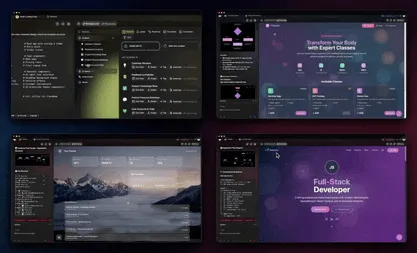
TL;DR: Vibe payments is building payment-driven apps from plain-language prompts. Taskade Genesis ships native Stripe checkout sessions, subscription support, and post-purchase automations from a single prompt, the entire workspace (Memory of orders, Intelligence of agents, Execution of automations) generates in 4-7 minutes. Live cloneable demos throughout. Try Genesis free →
The anchor app is a working Shopify-style storefront you can clone right now.
Click Use this app to copy the storefront (product catalog Project, Stripe checkout Automation, order-status Agent, post-purchase Gmail Automation) into your free workspace. Connect your own Stripe in workspace settings, the storefront is live.
What Vibe Payments Means
Vibe payments is the 2026 term for building payment-driven apps from plain-language prompts. The vibe builder describes the desired flow, "build me a Stripe checkout for my $49 ebook with a thank-you email and a Slack notification on every sale", and the AI generates the catalog Project, the checkout Automation, the post-purchase Gmail step, and the order-status Agent that answers customer questions.
The category emerged from two trends colliding:
- Stripe's API maturity, checkout sessions, subscriptions, Connect, invoices, refunds, all consumable from a single integration layer.
- AI workspace generation, tools like Taskade Genesis that can wire Stripe into a deployed workspace from a prompt.
The result is that payment-driven apps that took an engineering sprint in 2022 take 4-7 minutes in 2026. The wedge is not Stripe (which is available to everyone). It is the Workspace DNA loop that turns Stripe events into Memory the agents and automations can act on.
What you can build with vibe payments
| App | Build time | Stripe surface |
|---|---|---|
| Single-product checkout | 3 min | Checkout sessions |
| Subscription page | 5 min | Subscriptions + Customer Portal |
| E-commerce storefront | 7 min | Checkout + Products + Webhooks |
| Invoice generator | 4 min | Invoices + Hosted invoice page |
| Marketplace payouts | 8 min | Connect + Transfers |
| Donation page | 3 min | Checkout (custom amount) |
| Paywall portal | 6 min | Subscriptions + Customer Portal |
| Service booking + payment | 7 min | Checkout + Calendly integration |
The flowchart shows how Memory, Intelligence, and Execution wire together for a vibe payments app. The user prompt generates the entire graph; every Stripe event flows back into the loop.
Why Workspace DNA Wins for Payments
Payments are where the Workspace DNA loop pays off most clearly. A payment event is the ideal trigger because:
- It is high-signal, a payment is the strongest possible expression of intent.
- It triggers many downstream actions, receipt, fulfillment, follow-up, upsell, accounting.
- It needs context-aware responses, the order-status agent needs to know what was bought, by whom, when, and what stage it is in.
Stripe + a 4-tier stack (Stripe + Webhook handler + Database + Email service) requires custom code for every loop step. Stripe + Taskade Genesis collapses all of it into a workspace.
┌──────────────────────────────────────────────────────────────┐
│  STRIPE + WORKSPACE DNA = VIBE PAYMENTS                      │
│                                                              │
│  ▲ MEMORY              ■ INTELLIGENCE        ● EXECUTION     │
│  ─────────             ───────────────       ─────────────   │
│  Product catalog       Order-status Agent    Stripe Checkout │
│  Orders Project        Refund-policy Agent   Subscription mgr│
│  Customer records      Upsell Agent          Webhook handler │
│  Subscription history  Dispute Agent         Gmail receipt   │
│                                                              │
│  Stripe webhook fires  →  Genesis records order              │
│  Agent reads order     →  Personalized follow-up sent        │
│  Customer asks Q       →  Agent answers from order Memory    │
│                                                              │
│  Loop runs every payment — no custom code required           │
└──────────────────────────────────────────────────────────────┘
Eight Vibe Payments Patterns
1. Single-product checkout (3 min)
The simplest vibe payments app. Prompt: "Build me a Stripe checkout for my $49 ebook with a thank-you email." Genesis generates:
- A 1-row Product Project with title, price, image.
- A Stripe Checkout Session Automation triggered on form submit.
- A post-purchase Gmail Automation that delivers the ebook link.
Clone the pattern and replace the storefront content with your single product.
2. Subscription page (5 min)
Prompt: "Build me a $20/mo subscription page with a 7-day free trial and Stripe Customer Portal for cancellation." Genesis generates:
- A Subscriptions Project with custom fields for tier, status, trial_end.
- A Stripe Subscription Automation.
- A retention Agent that answers cancellation questions and offers a discount.
- A monthly renewal Slack notification.
3. E-commerce storefront (7 min: the anchor demo above)
The anchor demo above is exactly this. Prompt: "Build me a 12-SKU storefront with Stripe checkout, an order-status chatbot, and Slack new-order notifications." Genesis generates the full workspace embedded above.
4. Invoice generator (4 min)
Prompt: "Build me an invoice generator that creates Stripe invoices with line items, taxes, and a hosted payment link." Genesis generates:
- An Invoices Project with line items, taxes, totals, customer.
- A Stripe Invoice Automation that creates and sends the hosted invoice.
- A chase Automation that runs daily for unpaid invoices.
5. Marketplace payouts (8 min)
Prompt: "Build me a marketplace where sellers list products and get paid via Stripe Connect when items sell." Genesis generates:
- A Sellers Project with Stripe Connect account ids.
- A Products Project linked to seller.
- A Stripe Checkout + Transfer Automation that pays the seller on sale.
- An earnings Agent that answers seller payout questions.
6. Donation page (3 min)
Prompt: "Build me a donation page with custom amounts, recurring options, and a personalized thank-you email." Genesis generates:
- A Donations Project.
- A Stripe Checkout (custom amount) Automation.
- A donor-recognition Agent that thanks each donor by name and recommends impact stories.
7. Paywall portal (6 min)
Prompt: "Build me a paywall for my newsletter, $5/mo, Stripe Customer Portal, premium content gated by Genesis Auth." Genesis generates:
- A Subscriptions Project.
- A Stripe Subscription Automation.
- A Genesis Auth-gated content portal at a custom domain.
- A churn-risk Agent that alerts you when a subscriber is likely to cancel.
8. Service booking + payment (7 min)
Prompt: "Build me a service booking flow, Calendly time slots, Stripe checkout, post-booking confirmation email." Genesis generates:
- A Bookings Project linked to Calendly.
- A Stripe Checkout Automation triggered on booking.
- A booking confirmation Agent that handles reschedule requests.
Tool-by-Tool Comparison
How does Genesis compare to other tools you might use for vibe payments?
| Tool | Approach | Time to working checkout | Workspace? |
|---|---|---|---|
| Taskade Genesis | Workspace generation from prompt | 3-7 min | Yes |
| Bolt.new + Stripe | Code generator → manual Stripe wiring | 30-60 min | No |
| Lovable + Stripe | Code generator with Supabase + Stripe | 20-40 min | No |
| Stripe Payment Links | Stripe-hosted no-code link | 2 min | No (no follow-up logic) |
| Stripe Apps | Extend the Stripe Dashboard | 4-8 hours | No (Dashboard-only) |
| Shopify | E-commerce platform | 60+ min | Shopify-shaped |
| Gumroad | Single-link checkout | 5 min | No (Gumroad-hosted) |
The wedge: Genesis is the only tool that combines workspace + AI agents + Stripe wiring + post-purchase flows in one product. Stripe Payment Links are faster for a no-follow-up checkout but stop at the checkout itself. Shopify is more complete for high-volume merchant ops but heavier. Gumroad is fastest for digital products with no customization. Genesis sits in the middle, fast as a Payment Link, complete as Shopify, customizable as a code generator, all in one workspace.
The Pricing Wedge
Fully-loaded monthly cost of a working vibe payments stack:
| Stack | Tool | Hosting | Database | Total / mo | |
|---|---|---|---|---|---|
| Genesis Free | $0 | $0 (built-in) | $0 (built-in) | $0 (Gmail) | Free |
| Bolt + Vercel + Supabase + SendGrid | $20 | $20 | $25 | $15 | $80 |
| Lovable + Vercel + SendGrid | $20 | $0 (Vercel free) | $0 (Supabase bundled) | $15 | $35 |
| Stripe Payment Links | $0 | $0 | $0 | manual | $0 (no follow-up) |
| Shopify Basic | $29 | $0 | $0 | $15 | $44 |
| Gumroad | $0 (9% fee) | $0 | $0 | $0 | $0 (9% takes the place of a fee) |
Genesis, free to start, is the cheapest path to a complete vibe payments app with post-purchase logic. Stripe Payment Links and Gumroad are free too but stop short of the loop.
Stripe API Surface Genesis Supports
The native Stripe integration in Genesis covers:
- Checkout Sessions, one-time and subscription mode.
- Customer Portal, self-serve cancellation, plan switching, payment method updates.
- Subscriptions, create, update, cancel, prorate.
- Invoices, hosted invoice page with line items, taxes, totals.
- Connect, onboard sellers, route payments, transfer to connected accounts.
- Webhooks, every Stripe event lands as a Project record in Memory.
- Refunds, full and partial.
- Promo codes, coupons applied at checkout.
Whatever Stripe API surface you need, Genesis exposes it as an automation step or a webhook trigger. The agent layer can then act on any of these events.
When Vibe Payments Wins (and Loses)
Genesis wins for the long tail of payment-driven apps, solo creators, sub-50-SKU storefronts, subscription products, donation pages, paywalls, ticketing, marketplaces. Shopify wins for high-volume merchant operations. Custom code wins for regional PSPs and enterprise contracts.
Real Patterns From the Community Gallery
Three Workspace DNA payment patterns worth cloning:
- Invoice Generator, Line items, taxes, totals, Stripe-hosted invoice.
- Shopify Storefront, Anchor demo above.
- Subscription Paywall, Newsletter paywall with Stripe Customer Portal.
Each clones in one click. The full implementation guide for Stripe checkout sessions is in Genesis automation reference.
What Stripe Adds to the Workspace DNA Loop
Stripe events are the highest-signal trigger source in the 100+ bidirectional integrations Genesis supports. The integration matters because:
- payment_intent.succeeded, the strongest signal that a customer is ready for the next action.
- charge.refunded, triggers a re-engagement Automation.
- customer.subscription.trial_will_end, triggers a conversion Agent.
- invoice.payment_failed, triggers a recovery flow.
- customer.subscription.deleted, triggers a churn survey.
Every event lands as Memory; the next Agent run reads the context; the next Automation acts. This is the loop, and Stripe is the highest-leverage integration on the list.
The 2026 Verdict
Vibe payments is real. Stripe is the universal payment layer; the wedge is which workspace builds the rest of the app. Taskade Genesis is the workspace-first answer because the output is a deployed app with Memory (orders), Intelligence (agents), and Execution (Stripe automations) wired together, and the pricing wedge (free to start, Pro at $10/mo billed annually) is 3.5-8x cheaper than the alternatives.
Clone the storefront above to see the loop running. Connect your own Stripe and you have a live e-commerce workspace.
Related Reading
- Vibe coding tools, the developer-side companion.
- Vibe marketing tools, payment-driven marketing flows.
- Vibe workspace platforms, broader workspace comparison.
- I built 7 AI apps in 1 day, includes the Invoice Generator pattern.
- 3 finance apps you can clone today, invoice + budget + expense tracker patterns.
- Vibe finance apps, finance-side companion.
- Build pricing calculator, pricing-page pattern.
- Genesis vs Bolt vs Lovable, code-generator alternatives.
- Taskade MCP Server, let Claude Desktop and Cursor read your Stripe-driven workspace.
- Workspace DNA graph, the memory loop explainer.
- EVE: the Genesis meta-agent, the AI that builds your payment workspace.
▲ ■ ● Memory · Intelligence · Execution.
Frequently Asked Questions
What is vibe payments?
Vibe payments is the 2026 term for building payment-driven apps (Stripe checkout, subscription pages, e-commerce storefronts, paywall portals) from plain-language prompts. The vibe builder describes the desired payment flow and the AI generates the checkout page, the Stripe wiring, the order database, and the post-purchase automations. Taskade Genesis is the workspace-first answer because the output is a deployed app with Memory (orders), Intelligence (purchase agents), and Execution (Stripe checkout sessions, follow-up emails).
Can I build a Stripe checkout with Taskade Genesis?
Yes. Taskade Genesis ships a native Stripe checkout session automation action (added in v6.149) that creates a hosted Stripe checkout from a prompt. The full flow, product catalog Project, customer record on payment, post-purchase Gmail follow-up, Slack new-order notification, generates in a single Genesis prompt. The output is a deployed app at /share/apps/{id} cloneable to your free workspace.
What is the anchor demo for this article?
The anchor demo is a Shopify Storefront at /share/apps/jiz9qqa3pono9ntq, a product catalog Project, a Stripe checkout Automation, an order-status Agent that answers customer questions, and a post-purchase Gmail Automation. The clone copies the full workspace including agent prompts and automation flow. Connect your own Stripe and Gmail in workspace settings and the storefront is live.
How is Taskade Genesis Stripe checkout different from Stripe Apps?
Stripe Apps lets developers extend the Stripe Dashboard with custom UI and logic running on Stripe's infrastructure. Taskade Genesis builds the entire customer-facing checkout flow (Project, Agent, Automation) as a workspace, with Stripe wired in as one of the automation steps. Stripe Apps is for extending Stripe; Genesis is for building payment-driven customer apps.
Can Genesis handle subscriptions?
Yes. Genesis supports Stripe Subscriptions through the same checkout session automation, with subscription_mode set. The post-purchase flow can branch on subscription status (new / renewed / canceled) and the agent layer can answer subscription questions and route cancellations to a human-in-the-loop reviewer. The workspace stores the full subscription history as Memory the agent can read.
Does Genesis support Stripe Connect?
Genesis supports Stripe Connect through the Connect automation action, useful for marketplaces and platforms that need to pay sellers, contractors, or affiliates. The seller Project stores connected accounts as Memory; the payout Automation triggers on transaction completion; the agent layer can answer seller earnings questions and dispute resolution.
How is Genesis e-commerce different from Shopify?
Shopify is a full e-commerce platform with native fulfillment, tax, shipping, and Apps. Genesis is a workspace-first vibe payments tool, you describe an e-commerce flow and the workspace generates Projects, Agents, and Automations including Stripe checkout and post-purchase flows. For high-volume merchant operations Shopify remains the right choice; for a 1-50 SKU storefront with AI-driven customer support, Genesis is the simpler workspace.
What is Workspace DNA for payments?
For payment-driven apps, Workspace DNA means orders are stored as Memory (Project records), the Intelligence layer (Agents) answers customer questions and surfaces upsell opportunities, and the Execution layer (Automations) handles Stripe checkout, refunds, follow-ups, and Slack notifications. The loop runs every event, a Stripe webhook lands as a Project record, the agent reads the context, the automation acts.
Can Genesis generate an invoice?
Yes, Genesis includes an Invoice Generator pattern that produces line items, taxes, totals, and a payment link from a single prompt. The Stripe automation generates the hosted invoice and the workspace stores the invoice record as Memory. The agent can answer follow-up questions about the invoice and the automation can chase unpaid invoices on a schedule.
How much does it cost to build a Stripe checkout with Genesis?
The Genesis cost is from $0 (Free, 11,000 credits) to $10/mo (Pro) for an entry-level Stripe checkout app. Stripe takes its standard 2.9% + 30¢ per transaction. The entire stack (workspace + Stripe + Gmail follow-up) starts at $10/mo on Genesis vs $300+/mo for a Shopify Basic + custom-app stack.
What integrations does Genesis offer for payments?
Genesis ships Stripe (checkout sessions, subscriptions, Connect, refunds), Shopify (orders, products), and payment-adjacent integrations including Gmail (follow-up emails), Slack (order notifications), Google Sheets (export), Salesforce (CRM sync), and Webhooks (custom payment processors). All bidirectional, triggers pull events in (payment_intent.succeeded, charge.failed), actions push data out (create checkout session, issue refund, send invoice).