







Every startup reaches the same fork in the road.
Do you raise more money, or do you just build?
The default advice in Silicon Valley is clear: raise. More capital, more hires, more growth. It has become a reflex. A startup without fundraising is seen as a startup without momentum.
But here is the uncomfortable truth: fundraising does not save you. Execution does.
TL;DR: Capital depletes. Execution compounds. Mailchimp bootstrapped to a $12 billion exit. Basecamp has been profitable for 20+ years without outside funding. GitHub grew to $7.5 billion on minimal early capital. The startups that survive are the ones that ship, not the ones that raise. Build with Taskade Genesis →
Fundraising Is Theater
Fundraising is a stage play.
You write the script (the pitch deck).
You rehearse the lines (the metrics, the story).
You find an audience (the investors).
You perform until someone claps with a term sheet.

It feels like progress. Money hits the bank. Your runway extends. Your press release lands on TechCrunch.
But nothing has actually changed about your product, your users, or your ability to ship.
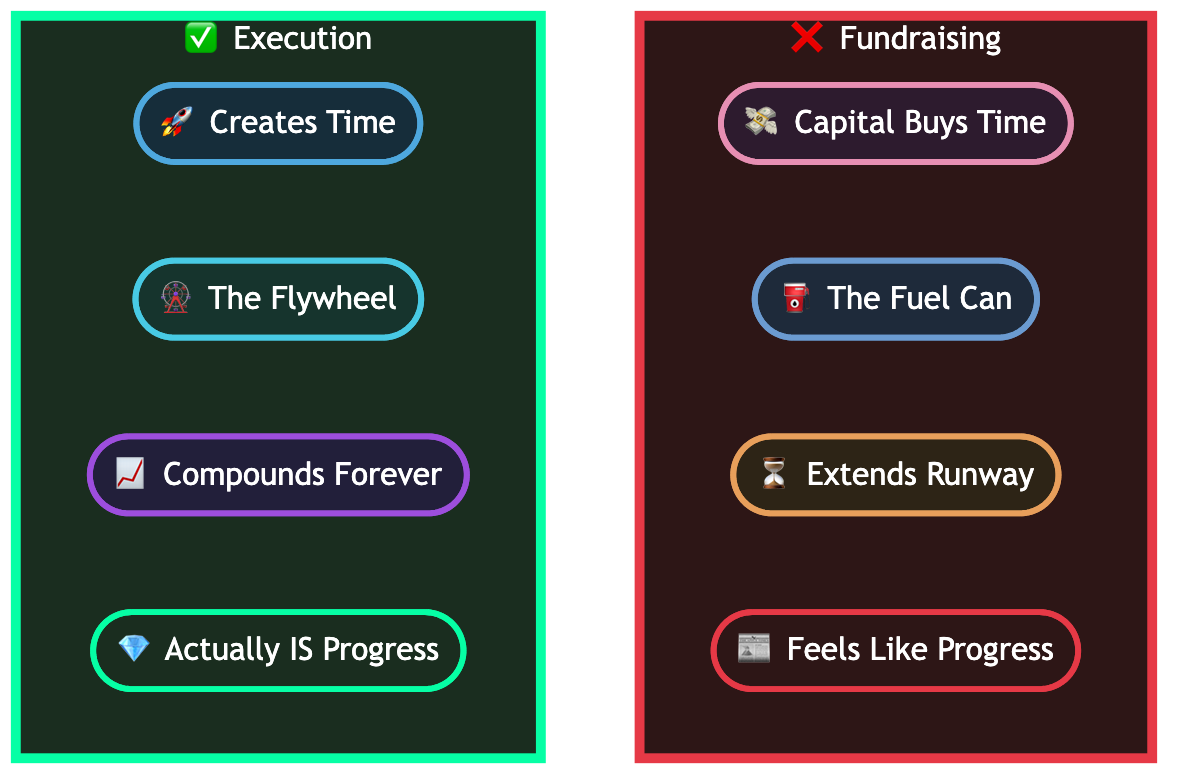
Capital buys time. Execution creates time.
Execution Compounds
Unlike capital, execution compounds.
Every feature shipped, every workflow automated, every bug fixed adds to a foundation that cannot be taken away. Execution creates customers. Customers create revenue. Revenue creates optionality.

The companies that endure are not the ones who raised the biggest rounds. They are the ones who built compounding execution systems long before anyone noticed.
In The Nvidia Way, Tae Kim documents how Jensen Huang kept GPU computing and CUDA as NVIDIA's highest priority for nearly two decades — refusing to retreat even when the work punished the financials — so NVIDIA owned the AI moment when it finally arrived. "We need to consider this work our highest priority," Huang told his teams. That is execution compounding across years: the patient build, not the round, is what owns the moment. (For the full arc, see how Jensen Huang runs NVIDIA.)
The Execution Flywheel vs. The Fundraising Cycle
The execution flywheel accelerates with each revolution. The fundraising cycle depletes with each revolution. One builds equity. The other borrows time.
As the 20VC podcast put it: "The prize for winning is to reinvent the company from scratch and the product from scratch every 6 to 9 months." In AI, execution is not a one-time event. It is a continuous obligation. The companies that stop shipping — even for a quarter — get lapped by teams that never stopped.
Execution is the flywheel. Fundraising is the fuel can.
The same principle applies to AI: stop worshipping prompts, start building workflows.
The Bootstrapped Hall of Fame
The proof is in the outcomes. These companies built execution systems that compounded for years — most without venture capital, all without fundraising as their primary strategy.
| Company | Exit / Valuation | Years Before Exit | Venture Capital | Key Execution Insight |
|---|---|---|---|---|
| Mailchimp | $12B (Intuit, 2021) | 20 years | $0 VC | Built email marketing flywheel one integration at a time |
| Basecamp | Profitable 20+ years | Ongoing (est. 2003) | $0 VC | Focused on profitability over growth, 80 employees serving millions |
| GitHub | $7.5B (Microsoft, 2018) | 10 years | Minimal early ($100M Series A in 2012, 4 years in) | Became developer infrastructure before monetizing |
| Zoho | $1B+ revenue, private | 25+ years (est. 1996) | $0 VC | Built 55+ products from profits, 15,000+ employees |
| Atlassian | $4.4B IPO (2015) | 13 years | $0 VC pre-IPO | No sales team for first decade, product sold itself |
| Shopify | $150B+ market cap | Bootstrapped to profitability, then IPO | Minimal pre-IPO | Built for own snowboard store, then opened platform |
| Craigslist | Est. $3B+ value | 25+ years | $0 VC | 50 employees, minimal changes, enormous revenue |
| Epic Games | $32B valuation | 30+ years (est. 1991) | Tencent minority stake (not VC) | Built Unreal Engine as execution platform |
Every one of these companies could have raised. Most chose not to because execution gave them something capital never could: independence.
The Mirage of Momentum
Too many founders confuse raising with winning.
"We closed a $20M Series A" feels like victory.
"We signed 50 new customers this quarter" feels like not enough.
But raising is not revenue. It is not product-market fit. It is not retention. It is not survival.
It is runway to figure those things out. And without execution, runway just extends the inevitable.
Capital-Focused vs. Execution-Focused Strategy
| Dimension | Capital-Focused | Execution-Focused |
|---|---|---|
| Primary metric | Valuation, round size | Revenue, retention, shipping velocity |
| Team growth | Hire fast, figure out roles later | Hire when bottlenecked, small teams |
| Decision speed | Board approval, investor updates | Ship today, iterate tomorrow |
| Failure mode | Cash runs out before PMF | Slow growth (but survivable) |
| Power dynamics | Investors set milestones | Founders set direction |
| Time horizon | 18-month runway cycles | Indefinite (profitable) |
| Typical burn rate | $500K-2M/month | $50K-200K/month |
| Exit pressure | High (VC timeline: 7-10 years) | None (founder's choice) |
The capital-focused path works for a specific type of company — winner-take-all markets where speed to scale matters more than capital efficiency. For everyone else, execution-focused strategy creates more durable companies.
The Bronx Science Lesson
Back in high school at Bronx Science, I was not raising. I was running a VPS and video hosting business out of a computer lab.
Servers crashed at 2 AM. Pipelines broke during peak traffic. Customers called when streams went down. Nobody cared about my theoretical brilliance. They cared about one thing:
Is it still running?
That is execution. That is the only metric that matters.
It is the same today. Investors do not care about your story once you are funded. Customers do not care about your last round. They care if the system is alive.
Execution in the Age of AI
Right now, AI is in its fundraising theater era. Everyone has a chatbot demo. Everyone has a hype video. Everyone has a deck.
The scale of the theater is staggering.
AI Fundraising Theater: By the Numbers
| Company | Capital Raised | What Happened |
|---|---|---|
| OpenAI | $110B valuation round | Four times the size of the largest IPO in history. $50B from Amazon, but only $15B upfront — the rest contingent on AGI milestones. |
| Anthropic | $7.3B raised | Building real products (Claude), but burn rate requires continuous capital infusion. |
| Inflection AI | $1.3B raised | CEO and most of team left for Microsoft in 2024. Product pivoted. $1.3B in capital did not prevent talent exodus. |
| Stability AI | $101M raised | Burned through cash, lost CEO, faced training data lawsuits. Capital could not outrun operational chaos. |
| Character.ai | $150M raised | Licensed technology to Google. Founders returned to Google. The product became an acqui-hire. |
| Block (Square) | Public company | Announced 40% workforce reduction while pivoting to AI-first. Capital did not save jobs. |
As 20VC's Harry Stebbings noted, these are not investments in execution — they are bets on narratives. The companies that raised the most are cutting the fastest. Capital did not save them. Execution would have.
But chatbots are demos, not execution. They do not ship work. They do not keep the stream alive.
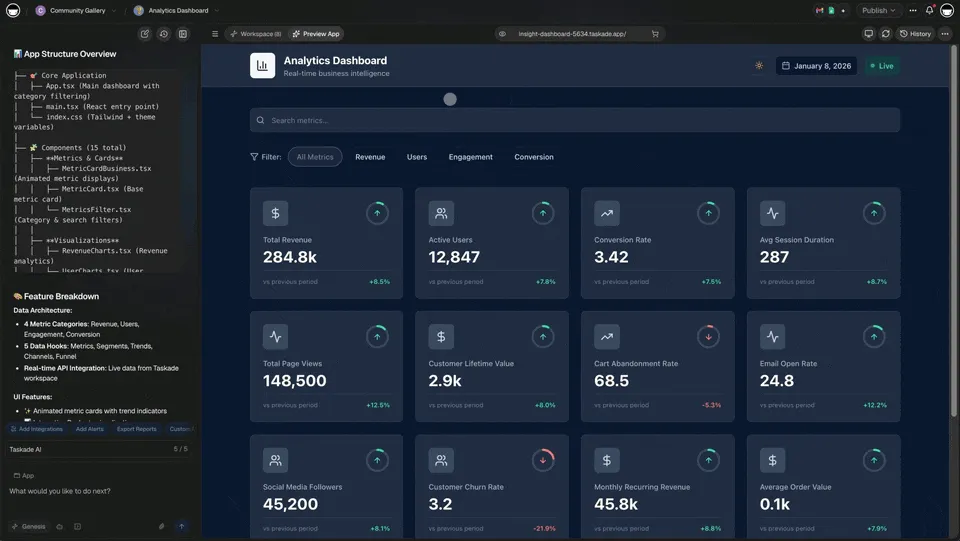
That is why we built Taskade Genesis: not another chatbot wrapper, but the execution layer for human + AI collaboration.
- Websites that actually capture leads, not just sit pretty.
- Dashboards that drive decisions, not just visualize data.
- Workflows that never sleep, not just reply when you ask.
Execution over theater. Systems over slides.
The Execution Playbook
If you believe execution beats fundraising, here is the playbook. These are the principles that bootstrapped companies follow — and that well-funded companies ignore at their peril.
Seven Rules of Execution-First Companies
| Rule | What It Means | Anti-Pattern |
|---|---|---|
| 1. Ship weekly | Deploy something visible every 7 days | Quarterly "big launches" that slip |
| 2. Measure retention, not vanity | Track 30-day retention, not signups | Celebrating downloads without activation |
| 3. Small teams, big ownership | 2-3 person teams own entire features | 15-person "pods" with unclear ownership |
| 4. Customer feedback loop < 48 hours | Bug report to fix deployed in 2 days | Feedback goes into a backlog that never ships |
| 5. Automate before you hire | Use AI agents and automations first | Hire 5 people to do what a workflow handles |
| 6. Revenue before raises | Charge real money for real value early | Free tier forever, raise to cover costs |
| 7. Independence as a feature | Profitable = no one can shut you down | Dependent on next round for survival |
The execution playbook is not about working harder. It is about building systems that compound — where every iteration makes the next one faster, cheaper, and better.
Taskade itself follows this playbook. AI agents with built-in tools handle customer support, content generation, and workflow automation. Automations connecting to 100+ integrations eliminate manual processes. The product ships weekly, and the community gallery grows with every user who publishes an app.
When to Raise: A Decision Framework
Execution-first does not mean never raise. It means raise from a position of strength, not desperation.
Raise When:
- You have product-market fit and capital will accelerate growth you have already proven
- The market has a narrow window and speed to scale matters more than capital efficiency
- Infrastructure costs (GPU clusters, data centers) require upfront investment before revenue
- Strategic investors bring distribution, not just capital
Do Not Raise When:
- You are still figuring out what to build
- Competitors raised and you feel pressure to match
- You want to hire before you have product-market fit
- The money would go to marketing before the product is ready
The strongest fundraising position is having a product that users already love. It shifts the power dynamic from "please fund my idea" to "here is what is already working, capital will accelerate it."
Optionality Comes from Execution
Execution buys optionality.
If you execute well:
- You can raise, but on your terms.
- You can sell, but only if you want to.
- You can stay independent, because you are profitable.
If you do not execute, none of those paths exist. You can raise all the capital in the world, but you will still be standing on sand.
Dario Amodei, CEO of Anthropic, described a useful heuristic for execution leverage in the AI era: "Even if you're only doing 5% of the task, that 5% gets super-amplified — you become 20x more productive." The founders who execute best are not the ones doing everything manually. They are the ones who identify the 5% that matters, ship it relentlessly, and let AI agents handle the rest. That is the heart of the execution layer thesis: the leverage is in the system you build, not the capital you raise. That is how execution compounds in 2026.
The Only Question That Matters
The only question worth asking at 2 AM, at Bronx Science or in San Francisco, is the same:
Is it still breathing?
If it is, you have something real. If it is not, no amount of fundraising will save you.
That is the law of startups. That is the law of execution.
Execution compounds. Fundraising does not.
That is why execution always wins.
Ready to stop worshipping theater and start building execution systems?
Explore Taskade AI:
- AI App Builder — Build complete apps from one prompt
- AI Dashboard Builder — Generate dashboards instantly
- AI Workflow Automation — Automate any business process
- AI Agents — built-in tools for any workflow
- Automations — Connect to 100+ integrations
Build with Genesis:
- Browse All Generator Templates — Apps, dashboards, websites, and more
- Browse Agent Templates — AI agents for every use case
- Explore Community Apps — Clone and customize
- Explore Templates — Ready-to-use templates
Read more:
- Chatbots Are Demos, Agents Are Execution
- Stop Worshipping Prompts, Start Building Workflows
- From Bronx Science to Taskade Genesis
- What is Vibe Coding?
- Build Your First AI App: 12 Beginner Examples
- 10 Personal AI Workspaces (Second Brain)

Frequently Asked Questions
Why do some startups succeed without raising large funding rounds?
Capital extends runway but does not create product-market fit. Mailchimp reached $12 billion in value without venture capital. Basecamp has been profitable for over 20 years without outside funding. GitHub grew to $7.5 billion acquisition value on minimal early funding. These companies succeeded because execution compounds: every shipped feature creates users, users generate feedback, feedback improves the product, and the cycle accelerates.
What is the difference between fundraising theater and real startup execution?
Fundraising theater is the cycle of pitch decks, investor meetings, press releases, and TechCrunch coverage that feels like progress but does not move the product forward. Real execution is shipping features, responding to user feedback, fixing bugs, and building systems that work without manual intervention. The test: if you stopped fundraising tomorrow, would your product keep getting better?
How does product velocity compound over time for bootstrapped startups?
Every feature shipped creates surface area for user feedback, which informs the next feature. Over years, this creates a flywheel: more features attract more users, more users generate more data, more data improves the product. Mailchimp built this flywheel for 20 years before selling for $12 billion. Funded startups often optimize for metrics that impress investors rather than metrics that compound like user retention, feature depth, and organic word-of-mouth.
Should a startup prioritize fundraising or building product?
Build first, raise when or if you need to. The strongest fundraising position is having a product that users already love. It shifts the power dynamic from please fund my idea to here is what is already working and capital will accelerate it. Mailchimp, Basecamp, GitHub, Zoho, Atlassian, and Shopify all built for years before raising or never raised at all.
What are the best examples of bootstrapped companies that reached billion-dollar valuations?
Mailchimp sold to Intuit for $12 billion in 2021 after 20 years of bootstrapped growth. GitHub was acquired by Microsoft for $7.5 billion after raising minimal early capital. Atlassian went public at $4.4 billion valuation with no venture capital. Zoho has been profitable and independent for 25+ years with $1 billion+ revenue. Shopify bootstrapped to profitability before its IPO. Basecamp has been profitable for 20+ years without outside funding.
Is AI in a fundraising theater era?
Yes. OpenAI raised at $110 billion valuation, Anthropic raised $7.3 billion, and Inflection AI raised $1.3 billion then pivoted. Meanwhile many AI startups are chatbot wrappers without sustainable execution. The companies building compounding execution systems with real users and real workflows will outlast the ones optimizing for fundraising narratives.
When should a startup raise venture capital instead of bootstrapping?
Raise when you have product-market fit and capital will clearly accelerate growth you have already proven. Raise when the market has a narrow window and speed to scale matters more than capital efficiency. Raise when infrastructure costs like GPU clusters require upfront investment before revenue. Do not raise to figure out what to build, to hire before you have product-market fit, or because competitors raised.
How does Taskade Genesis relate to the execution over fundraising philosophy?
Taskade Genesis is an execution tool, not a pitch deck tool. It builds live applications, dashboards, and workflows from a single prompt with AI agents, automations connecting to 100+ integrations, and multiple project views. Over 150,000 apps have been built with Genesis. The platform embodies the execution philosophy: ship fast, iterate on feedback, and let the product compound.
What is the execution flywheel and how does it work?
The execution flywheel is a self-reinforcing cycle: ship features, attract users, gather feedback, improve the product, ship more features. Each loop compounds because the product gets better, the user base grows, and the feedback gets richer. Unlike fundraising which depletes over time, execution creates value that accumulates permanently. Every feature shipped, every bug fixed, every workflow automated adds to a foundation that cannot be taken away.
What happened to heavily funded AI startups like Inflection and Stability AI?
Inflection AI raised $1.3 billion, then its CEO and most of the team left for Microsoft in 2024. Stability AI raised $101 million, burned through cash, lost its CEO, and faced lawsuits over training data. Character.ai raised $150 million, then licensed its technology to Google and its founders returned to Google. These examples show that capital without execution does not create durable companies.