






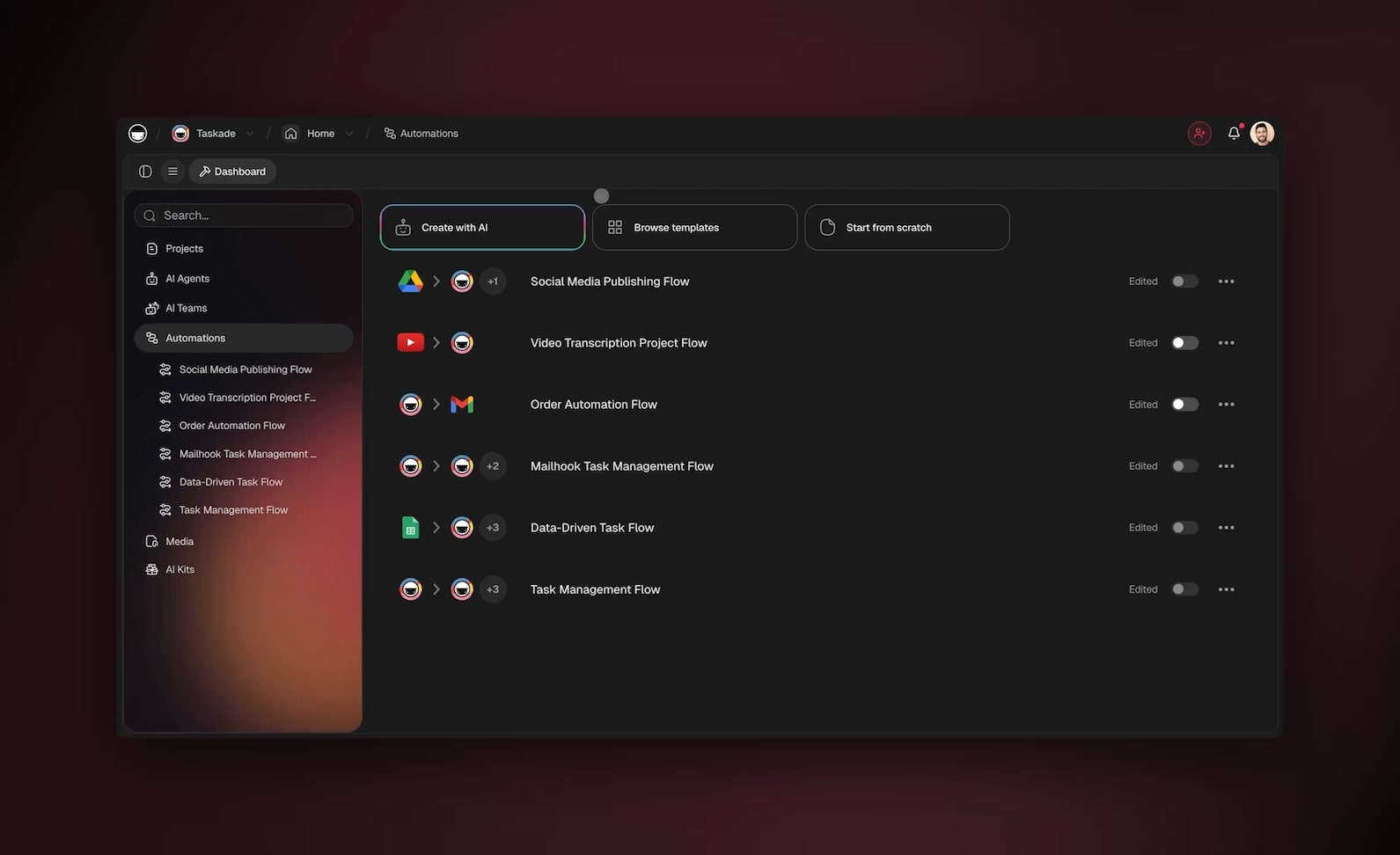
You can automate roughly 99% of the repeatable work in an e-commerce store with AI agents in 2026 — support, order management, returns, cart recovery, review responses, and inventory monitoring — and keep only the genuinely human 1% for yourself. The shift that makes this possible is agentic commerce: instead of operating dashboards by hand, you give an AI agent a goal and it reasons over your store data and acts. The headline number tells the whole story — 89% of retailers have adopted AI, but only about 7% have actually scaled it past pilots. That gap is the opportunity, and this guide shows you how to close it without writing code or hiring engineers.
TL;DR: In 2026, 89% of retailers adopted AI but only ~7% scaled it — the rest are leaving money on the table. With Taskade Genesis you describe the outcome (answer tickets, recover carts, restock low SKUs) and it ships a live app with AI agents, durable automations, and 100+ integrations — no code, no servers. AI-driven traffic converts ~31% higher and personalization leaders see up to +40% revenue. Clone a working store-ops app live →
See it live: a store-operations app you can clone
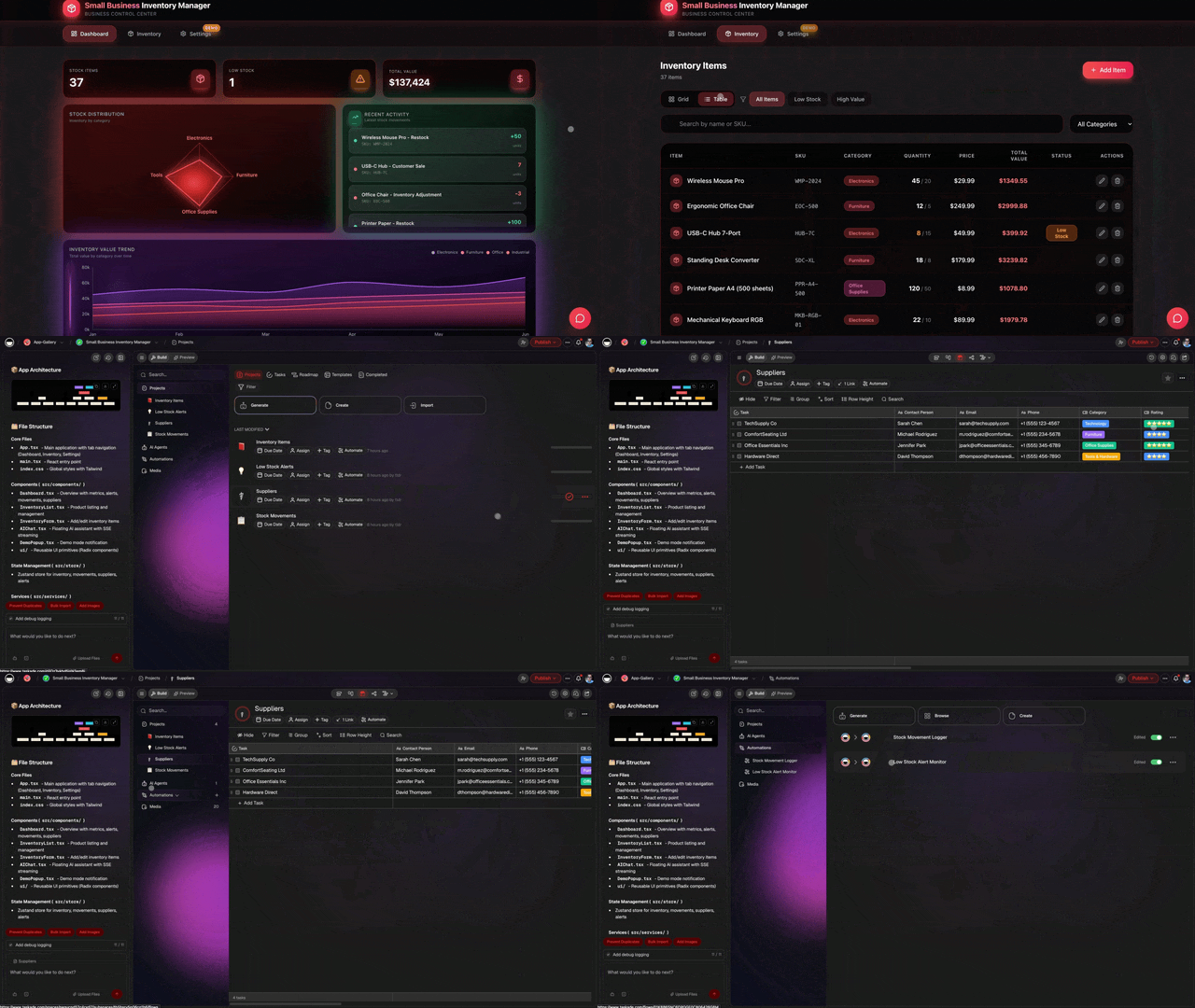
This is a live, cloneable Taskade Genesis app — an AI store-operations console that triages support, tracks orders, and flags low inventory. Click into it, then clone it into your own workspace in about 30 seconds and point it at your store.
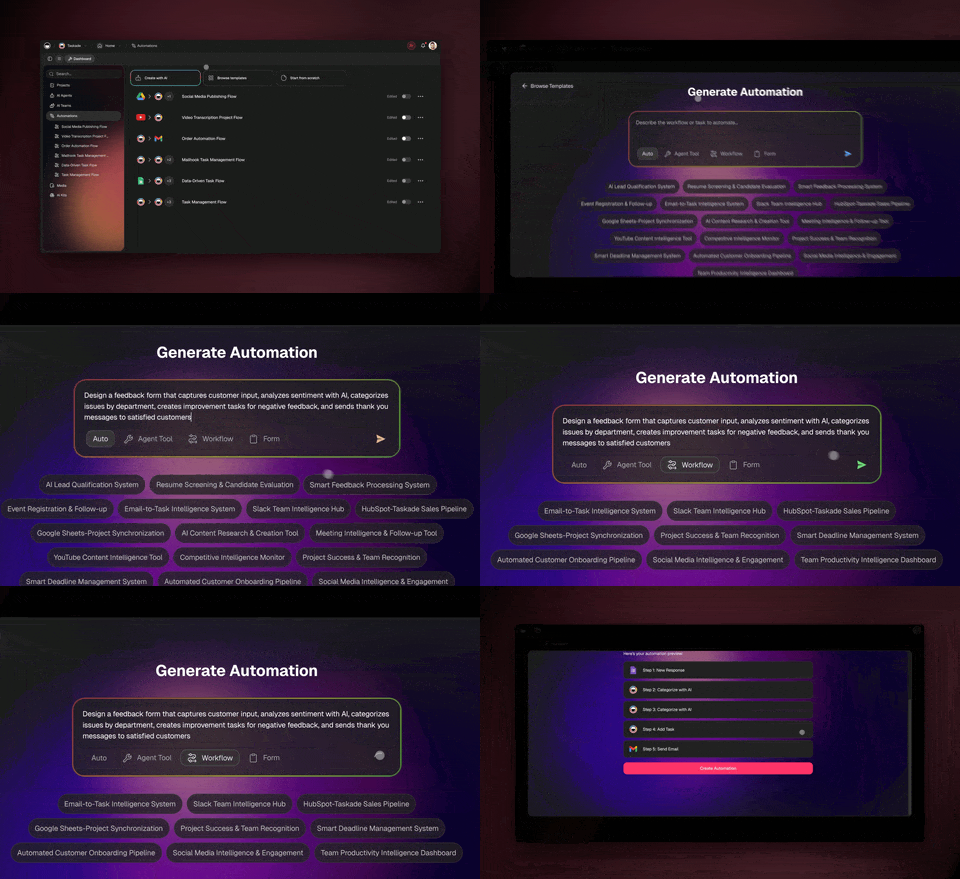
You did not wire a single node to get that. You described what a store-ops console should do, and Taskade Genesis built the app, the agents, and the automations around it. That is the difference between connecting tools and shipping a store that runs itself. Browse more cloneable apps in the Community Gallery to start from a working example instead of a blank page.
What is agentic commerce, and why does it matter in 2026?
Agentic commerce is the 2026 shift from tools you operate by hand to AI agents that operate the store for you, and it is already reshaping the numbers: 89% of retailers report adopting AI, yet only about 7% have scaled it beyond pilots. The winners are not the ones with the most tools — they are the ones who let agents act.
The mechanics are simple to describe. With a traditional automation tool you click through a dashboard and wire each trigger and action. With an agent, you state a goal — "answer this support ticket using my return policy," "recover this abandoned cart," "restock this SKU when it drops below 10" — and the agent reads your data, decides what to do, and does it.
That single change moves three needles at once:
- Lower operating cost. An AI store-operations layer can mean roughly a 95% cost reduction versus a five-person operations team doing the same routine work, because agents run around the clock with no overtime.
- Higher conversion. AI-driven traffic converts about 31% higher than non-AI traffic, because agents respond instantly and personalize in real time.
- More revenue per visitor. AI personalization leaders see up to 40% more revenue from more relevant, timely interactions.
The reason most retailers are stuck at the pilot stage is altitude. Wiring scenarios node by node is slow, brittle, and hard to scale across every part of a store. The teams that scale are the ones who stop wiring and start describing — which is exactly what Taskade Genesis was built to do.
What should you automate first in an e-commerce store?
Start with the six highest-volume, most repetitive workflows, because they run on clear rules and deliver the fastest return: customer support, order management, returns and refunds, abandoned-cart recovery, review responses, and inventory monitoring. Gorgias reports that up to 60% of support inquiries can be automated — and support is usually the single biggest time sink, so it is the best place to begin.
Here is the practical priority order, ranked by how routine the work is and how fast you'll see results.
| # | Workflow | What the AI agent does | Effort to automate | Payoff |
|---|---|---|---|---|
| 1 | Customer support | Answers FAQs, order status, shipping ETAs; escalates edge cases | Low | Very high |
| 2 | Order management | Confirms, tags, routes, and updates order status automatically | Low | High |
| 3 | Returns & refunds | Reads policy, approves eligible returns, issues labels | Medium | High |
| 4 | Cart recovery | Detects abandoned carts, sends timed personalized nudges | Low | Very high |
| 5 | Review responses | Drafts on-brand replies to reviews, flags angry ones | Low | Medium |
| 6 | Inventory monitoring | Watches stock, alerts or reorders below threshold | Medium | High |
The rule of thumb: automate the routine 99% and keep the judgment-heavy 1% — pricing strategy, brand voice, supplier negotiation — for humans. You are not replacing your team; you are removing the repetitive load so they spend time on what only people can do.
Each of these maps cleanly onto an AI agent with the right tools and integrations. Let's walk the six in order.
How do you automate customer support with AI agents?
Customer support is the first and highest-leverage workflow to automate, because Gorgias reports up to 60% of inquiries are routine — order status, shipping questions, sizing, and simple returns — that an AI agent can resolve in seconds without a human. The trick is giving the agent your real data and your real policy, not a generic chatbot script.
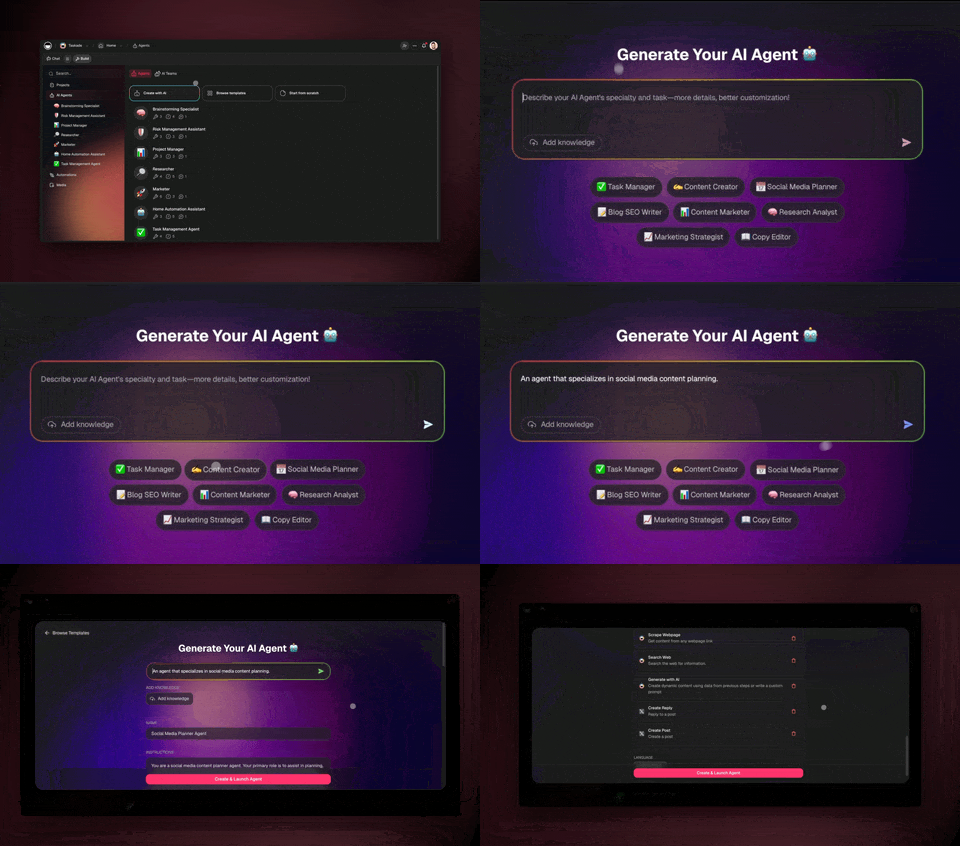
With Taskade Genesis, a support agent reads the incoming ticket, looks up the order through a connected integration, applies your return and shipping policy from a Project, drafts a reply in your brand voice, and escalates only the genuine edge cases to a person. Because agents have 33 built-in tools — including web search, file analysis, and persistent memory — they can pull a tracking number, read your policy doc, and remember the customer's last three orders all in one pass.
The agent does not start from zero each time. Because automations are durable and reliable, a multi-step return that pauses while it waits for a customer photo resumes from the exact step it left off — it never loses the thread. Learn how agents and automations work together in the automation hub, or see how teams wire support into a full revenue workflow on the sales automation page.
The economics here are worth stating plainly. Support is usually a store's largest recurring labor cost, and with up to 60% of inquiries resolvable by an agent, you remove the majority of that load without losing response quality — agents reply in seconds, at any hour, in your brand voice. The remaining 40% reaches a human already triaged, with the order, the policy, and the conversation history attached, so your team starts every escalation halfway to a resolution instead of from a cold ticket. That's how a store reaches a roughly 95% cost reduction on routine operations: not by cutting corners, but by letting agents carry the repetitive volume that never needed a person in the first place.
How do you automate order management and fulfillment?
Order management is the most reliable place to win quickly, because every order follows the same lifecycle — confirm, tag, route, fulfill, notify — and that lifecycle is pure rules an agent can run without supervision. A single agent can process thousands of orders a day with zero manual touches on the happy path.
Connect your store and your shipping and payment tools through 100+ bidirectional integrations — triggers pull events in (a new order, a payment captured), and actions push data out (a label created, a customer notified). Taskade Genesis offers native Shopify and Stripe support, so the moment an order lands, the agent confirms it, tags it by priority, routes it to the right fulfillment path, and updates the customer.
| Trigger (event in) | Agent decision | Action (data out) |
|---|---|---|
| New paid order | Tag by value + region | Create fulfillment task |
| High-value order | Flag for VIP handling | Notify team + customer |
| Payment failed | Check retry policy | Send recovery email |
| Order shipped | Pull tracking number | Update customer + status |
| Delivery delayed | Compare against SLA | Proactive apology + credit |
Payments deserve their own attention. If you run subscriptions or one-time charges through Stripe, the agent can watch for failed payments, apply your dunning rules, and recover revenue automatically — see the Stripe automation guide for the full pattern. Pair that with a CRM so every order updates the customer record; our no-code AI CRM guide shows how to build that side without engineers.
How do you automate returns, refunds, and cart recovery?
Returns and abandoned-cart recovery are two sides of the same coin — both are timed, policy-driven workflows that an AI agent runs better than a human because it never forgets to follow up. Abandoned-cart recovery alone is one of the highest-ROI automations in commerce, and AI-driven nudges convert about 31% higher than generic blasts.
For returns, the agent reads your policy, checks eligibility against the order, approves the straightforward cases, generates a return label, and only escalates the disputes. For cart recovery, the agent detects an abandoned cart, waits a set delay, then sends a personalized nudge — and if there's still no purchase, it sends a second, gentler one. Shopify Flow v4, released in 2026, added delays of up to 30 days and multi-branch logic for exactly this kind of timed sequence, and it's free on every Shopify plan.
The advantage of an agent over a static rule is judgment within the rules. It can vary the message by cart value, skip a discount for a first-time visitor, or hold a nudge during a known shipping delay. You set the policy; the agent applies it consistently. Explore cloneable workflow apps in the Community Gallery to start from a return or recovery flow that already works.
How do you automate review responses and inventory monitoring?
Review responses and inventory monitoring are the two "always watching" automations — one watches your reputation, the other watches your stock — and both run continuously in the background so nothing slips. An inventory agent that catches a low-stock SKU before it sells out protects revenue you'd otherwise lose silently.
For reviews, the agent drafts an on-brand reply to every new review, posts the positive ones automatically, and flags the angry or sensitive ones for a human — turning a chore most stores ignore into a same-day habit. For inventory, the agent watches stock levels across your catalog and either alerts your team or triggers a reorder when a SKU drops below your threshold, so you stop discovering stockouts from customer complaints.
| Signal watched | Threshold | Agent response | Who's notified |
|---|---|---|---|
| New 5-star review | n/a | Post on-brand thank-you | Logged only |
| New 1–2 star review | Sentiment flag | Draft empathetic reply | Human approves |
| SKU stock level | Below 10 units | Alert or auto-reorder | Ops + supplier |
| Fast-moving SKU | Selling 2x forecast | Suggest restock now | Ops |
| Dead stock | No sales in 30d | Suggest markdown | Marketing |
To make inventory concrete, here's the loop a single inventory agent runs in the background, all day, with no one watching it: it polls stock levels on a schedule, compares each SKU against its threshold, and branches — alert the team, suggest a restock, or trigger a reorder — then logs the decision so the next run has context. A best-seller dropping below ten units gets a same-hour "reorder now" before it stocks out; dead stock with no sales in thirty days gets a markdown suggestion routed to marketing instead. You never find out about a stockout from an angry customer again.
Because these agents share the same workspace, they compound. The inventory agent's "low stock" signal can quietly tell the cart-recovery agent to pause nudges for a product that's about to sell out — so your automations cooperate instead of working against each other. That cooperation is the whole point of building on one platform instead of stitching five tools together. See how agents coordinate on the AI agents page.
How Taskade Genesis does it differently
Most automation tools — n8n, Lindy, Zapier, Make, Shopify Flow — help you connect apps and wire nodes. Taskade Genesis helps you ship a living app from one prompt. That's the wedge: a scenario builder ends with an automation; Taskade Genesis ends with a store that runs itself, complete with agents, a database, and a shareable URL.
Let's be fair about the competition first, because each is genuinely good at its job:
- Shopify Flow v4 (2026) is excellent and free on every Shopify plan, with new multi-branch logic and delays up to 30 days. If your automation lives entirely inside Shopify, Flow is the path of least resistance.
- Zapier has the largest app catalog and the gentlest learning curve for simple trigger-to-action automations.
- Make gives you a beautiful visual canvas to fine-tune every branch.
- n8n is the most cost-efficient for complex, high-volume flows if you can self-host.
- Lindy is a strong AI-agent-first assistant for individual tasks.
The most common 2026 stack a Shopify store actually evaluates isn't a generic automation tool at all — it's a support-agent vendor (Gorgias, Fin AI, Stormy AI) bolted to an automation connector (Mesa) bolted to Shopify Flow. Each is good at its slice, but you end up paying three vendors and stitching three data pools. Here's the honest head-to-head against the tools you'll actually shortlist for an AI store, with each vendor's real strength stated plainly:
| Capability | Gorgias AI Agent | Fin AI | Mesa | Shopify Flow | Taskade Genesis |
|---|---|---|---|---|---|
| Built for ecommerce | Yes (Shopify-only) | Yes | Yes (Shopify) | Yes (Shopify-only) | Yes (any store) |
| Pricing model | Per-resolution | Per-resolution | Per-task tiers | Free | Flat per seat |
| Typical cost | ~$0.60–$1.27 / resolution | ~$0.99 / resolution | App-tier pricing | $0 | From $6/mo flat |
| Support automation | Strong | Strongest (≈67% avg) | Via connector | None | Yes (33-tool agents) |
| Beyond support (orders, inventory, recovery) | Limited | Limited | Yes (connectors) | Yes (Shopify rules) | Yes (full crew) |
| Multi-agent teams | No | No | No | No | Yes |
| Database + 7 project views | No | No | No | No | Yes |
| Ships a living app + URL | No | No | No | No | Yes |
| Works off Shopify | No | Yes | No | No | Yes |
Read that table honestly. Fin AI posts the highest published support-resolution rate — roughly 67% on average, and 70–84% for ecommerce brands — so if your single problem is deflecting support tickets and nothing else, a specialist will edge out a generalist on that one metric. Gorgias is purpose-built for Shopify and resolves order-status and returns well (published real-world rates land around 26–56%). Mesa is the friendliest no-code connector for stitching Shopify Flow to your other apps. Shopify Flow is free and unbeatable for rules that live entirely inside Shopify.
The catch is the pricing model and the boundary. Per-resolution billing — roughly $0.60–$2.00 per resolved conversation across the category — means your support bill scales up exactly as your store succeeds; a flat per-seat plan does not. And every one of those tools stops at its lane: a support agent deflects tickets but won't restock a SKU, a connector moves data but won't reason, and Flow won't leave Shopify. Taskade Genesis covers all six store workflows with one flat-priced workspace, agents that reason, and an app you can actually publish.
What none of them ship is a living app. That's where the Workspace DNA model comes in — Memory + Intelligence + Execution as a self-reinforcing loop:
Memory is your Projects and store data, with 7 views — List, Board, Calendar, Table, Mind Map, Gantt, and Org Chart. Intelligence is your AI agents, with 33 built-in tools and 15+ frontier models from OpenAI, Anthropic, and Google routed automatically. Execution is your durable automations plus 100+ bidirectional integrations. Each one feeds the next: every order an agent processes becomes memory the next decision uses. A scenario builder has no memory loop — it runs and forgets. Here's the side-by-side that matters for a store:
| What you want | Wire-the-nodes tools | Taskade Genesis |
|---|---|---|
| Connect Shopify + Stripe | Yes | Yes (native) |
| AI agents that reason and act | Add-on / limited | Native (33 tools) |
| Multi-agent teams that hand off | No | Yes |
| A database with 7 views | No | Yes |
| A shareable, brandable app at the end | No | Yes |
| Memory that compounds across runs | No | Yes (Workspace DNA) |
| Clone a working store from a gallery | No | Yes (/community) |
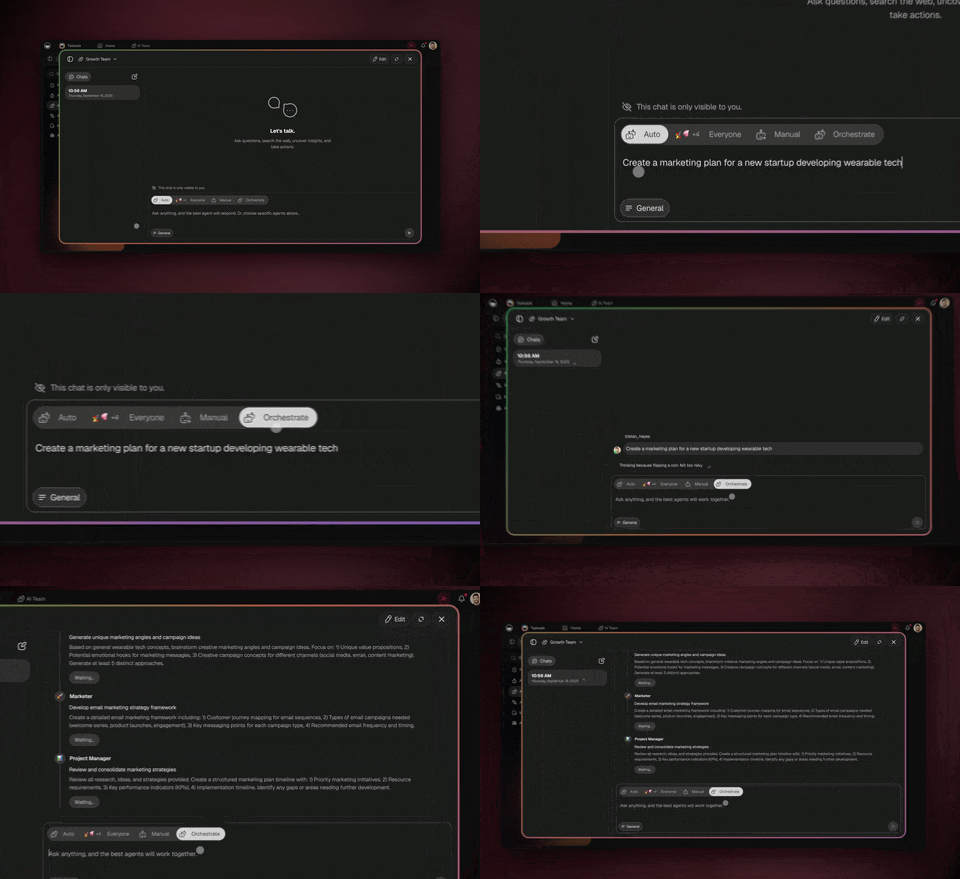
And because agents can work as a team, your store doesn't run on one assistant — it runs on a crew. A support agent hands a complex return to a policy agent, which hands a refund to a payments agent, all inside the same workspace.
        AI STORE-OPS CREW (one Taskade Genesis app)
        ───────────────────────────────────────────   ┌─────────────┐   ┌─────────────┐   ┌─────────────┐
   │  SUPPORT    │   │   ORDERS    │   │  INVENTORY  │
   │   AGENT     │   │    AGENT    │   │    AGENT    │
   │ • triage    │   │ • confirm   │   │ • watch SKU │
   │ • reply     │   │ • route     │   │ • reorder   │
   │ • escalate  │   │ • notify    │   │ • alert     │
   └──────┬──────┘   └──────┬──────┘   └──────┬──────┘
          │                 │                 │
          └────────┬────────┴────────┬────────┘
                   ▼                 ▼
            ┌───────────────────────────────┐
            │     SHARED WORKSPACE MEMORY    │
            │  orders · policies · history   │
            │  (every run makes it smarter)  │
            └───────────────┬───────────────┘
                            ▼
            ┌───────────────────────────────┐
            │   LIVE APP  /share/apps/...    │
            │   custom domain + sign-in      │
            └───────────────────────────────┘
You acknowledge the tradeoff honestly: if you want a pure node-by-node canvas to hand-tune every branch, Make and n8n give you finer control over the wiring. But if you want the store to run itself — agents, automations, data, and a shippable app in one place — that's the job Taskade Genesis was built for.
What can Taskade Genesis actually do for a store?
Taskade Genesis gives a store the whole operating stack in one workspace — a database, AI agents, automations, integrations, and a publishable app — instead of five subscriptions you have to keep in sync. Here's each capability mapped directly to a store job you're trying to get done, so you can see what each one replaces.
| Platform capability | What it is | What it does for your store |
|---|---|---|
| Workspace DNA loop | Memory + Intelligence + Execution, self-reinforcing | Every order an agent processes becomes Memory the next decision uses — your store gets smarter each run |
| 7 project views | List, Board, Calendar, Table, Mind Map, Gantt, Org Chart | A Board of orders by status, a Table of open tickets, a Calendar of restock dates — one dataset, every angle |
| 33 built-in agent tools | Web search, file analysis, persistent memory, code, slash commands | A support agent reads your policy doc, pulls a tracking number, and remembers a customer's last three orders in one pass |
| Multi-agent teams | Agents that hand work off to each other | Support hands a complex return to a policy agent, which hands a refund to a payments agent — a crew, not one bot |
| 100+ bidirectional integrations | Triggers pull events in, actions push data out | A new Shopify order triggers a tag; a refund pushes back to Stripe; a low-stock signal pings your supplier |
| 15+ frontier models | Models from OpenAI, Anthropic, and Google, routed automatically | The right model handles the right job — fast triage on simple tickets, deeper reasoning on disputes |
| Custom domains + app publishing | Ship a real app with its own URL and sign-in | Your store-ops console lives at ops.yourbrand.com, gated by sign-in, handed to your team |
| 7-tier role-based access | Owner through Viewer permission levels | Your VA edits replies, your accountant views orders, only you publish changes — no one over-permissioned |
The capabilities aren't a feature checklist — they compound. The 7 views make your store data legible; the agents read that data through their 33 tools; the automations act on it through 100+ integrations; and every action writes back to Memory so the next decision is better-informed. That compounding loop is the thing a stack of single-purpose tools can't reproduce, because each tool in that stack forgets everything the moment its run ends.
This is also where Genesis quietly outgrows the rest of your stack. The same workspace that runs your store can run your no-code AI CRM feeding customer records to every agent, your sales automation chasing leads and upsells, your customer-support automation deflecting tickets, and your data-entry automation keeping every spreadsheet and record current — all sharing one Memory pool instead of four disconnected ones. Meet the AI agents that do the work, browse the automation library, or start building free.
Where this is heading: the self-running store
The direction is unmistakable: every store becomes a living app that runs on a self-reinforcing Memory + Intelligence + Execution loop, where one prompt becomes software that improves itself every time it runs. Today you describe a store-ops console and Taskade Genesis ships it; tomorrow that same app watches its own results — which nudges recovered carts, which replies cut response time, which reorder points prevented stockouts — and tightens its own rules without being asked. The 7% of retailers who scaled AI in 2026 got there by letting agents act. The next frontier is stores that don't just act but learn: a workspace where Memory deepens with every order, Intelligence sharpens with every decision, and Execution gets more precise with every run. That's not a roadmap promise — it's the shape of the loop you're already building the moment you describe your first agent.
How do you actually build it (no code, ~30 minutes)?
You build a store-automation app in roughly 30 minutes by describing the outcome to Taskade Genesis and letting it assemble the agents, automations, and integrations — there's no canvas to wire and no server to manage. The fastest start isn't from scratch at all: clone a working app from the Community Gallery and point it at your store.
Here's the path, end to end:
- Clone a starting point. Open the live app above or browse the Community Gallery and clone a store-ops app into your workspace in about 30 seconds.
- Describe what you want. Tell Taskade Genesis: "Build me an e-commerce ops console that triages support, tracks orders, recovers carts, and alerts me on low stock." It builds the app.
- Connect your tools. Link Shopify, Stripe, your email, and your help desk through 100+ bidirectional integrations. Triggers pull events in; actions push data out.
- Set your policies. Drop your return policy, shipping rules, and brand voice into a Project. Your agents read from it as Memory.
- Turn on the agents. Assign the support, orders, returns, recovery, reviews, and inventory agents. Each has 33 built-in tools to act.
- Publish. Give the app a custom domain and built-in sign-in, set role-based access (7 levels, Owner through Viewer), and hand it to your team.
To make it concrete, here's a real prompt you could paste into Taskade Genesis to start: "Build a store-operations app for my Shopify shop. Create a support agent that answers order-status and shipping questions using my policy doc and escalates refunds. Add an orders agent that tags new paid orders by value and notifies my team on high-value ones. Add a cart-recovery agent that sends a personalized reminder one hour after abandonment and a gentler one a day later. Add an inventory agent that alerts me when any SKU drops below 10 units. Give me a Table view of open tickets and a Board view of orders by status." That single description produces the app, the four agents, the views, and the automation logic — the work that would take days of node-wiring in a traditional tool.
The whole flow respects your control. Agents act only within the integrations and the 7-tier role-based access you grant them, and every durable automation logs each step so you can audit exactly what ran. You set policy and approvals; the agents handle the repetitive execution. Track how it's all performing with built-in app analytics.

What does an automated store cost — and what's the ROI?
A store-automation app on Taskade Genesis starts free, and the return comes from two directions at once: an AI store-ops layer can mean roughly a 95% cost reduction versus a five-person operations team, while AI personalization leaders see up to 40% more revenue. Paid plans on annual billing run from Starter at $6/month to Enterprise at $400/month, and every tier includes agents, automations, and publishing.
| Plan (annual) | Price | Best for |
|---|---|---|
| Free | $0 | Trying it, cloning a store-ops app |
| Starter | $6/mo | Solo founders automating support + orders |
| Pro | $16/mo | Small teams running the full 6-agent crew |
| Business ★ | $40/mo | Growing stores, custom domains, more agents |
| Max | $200/mo | High-volume ops, advanced needs |
| Enterprise | $400/mo | Multi-brand, governance, sign-on controls |
The math is straightforward. If support, order updates, and returns currently take a few people most of their day, agents that resolve up to 60% of support volume and run order management with zero manual touches reclaim most of that time — at a fraction of the headcount cost. Meanwhile, faster replies and real-time personalization lift conversion (AI-driven traffic converts about 31% higher), so you spend less and earn more per visitor. Confirm current pricing on the pricing page — it's the source of truth.
Why the pricing model matters more than the price
The most overlooked line item in store automation is how a tool charges, not what it charges. Most 2026 support-agent vendors bill per resolution — roughly $0.60 to $2.00 every time the AI closes a conversation. That sounds cheap until you do the volume math: a store handling 5,000 support conversations a month at $1.00 per resolution pays $5,000 a month for support deflection alone, and the bill grows the more your store succeeds. A flat per-seat plan does the opposite — your cost stays put while your volume climbs.
The chart is the whole argument. Per-resolution billing is a line that climbs with your growth; a flat seat is a line that barely moves. This isn't a knock on per-resolution vendors — for a low-volume store, paying per ticket is genuinely cheaper than a seat, and a support specialist like Fin AI may resolve a higher share of those tickets. But the moment your volume scales, the model flips, and the store that automated to grow ends up penalized for growing. Taskade Genesis prices per seat (Free, then $6 to $400 a month flat), so the six-agent crew — support, orders, returns, recovery, reviews, inventory — runs at a fixed cost no matter how many orders you process. You're paying for the workspace, not for each thing the agents do inside it.
The 99% rule: automate the routine, keep the human 1%
The goal is never to remove people from your store — it's to remove the repetition, so your team spends its hours on the 1% that builds real customer relationships. Automate the routine 99% (support FAQs, order updates, eligible returns, timed nudges, review replies, stock alerts) and reserve human judgment for pricing, brand, partnerships, and the hard conversations.
That's what agentic commerce delivers when it's built right: a store that answers instantly at 3 a.m., recovers carts you'd have lost, restocks before you sell out, and hands your team only the decisions that need a human. The 89% who adopted AI but the 7% who scaled it — the difference is exactly this: scaling means letting agents act, end to end, inside a living app.
Ready to automate your store? Start free with Taskade Genesis — describe what your store-ops console should do, connect Shopify and Stripe, turn on your agent crew, and ship a live app your team can run today.
Keep building out the rest of the store from here: explore the automation library, wire up Stripe payment recovery, automate the full sales pipeline that turns browsers into buyers, deflect tickets with AI customer-support automation, kill manual busywork with AI data-entry automation, and build the no-code AI CRM that feeds every agent. Then meet your AI agents or clone a working store from the Community Gallery.
▲ ■ ● Memory, Intelligence, Execution — describe the store you want, and Taskade Genesis remembers your orders and policies, reasons over them, and runs support, fulfillment, and recovery for you. That's the difference between automating a task and shipping a store that runs itself.
Frequently Asked Questions
Can AI agents really automate an e-commerce store in 2026?
Yes. In 2026, 89% of retailers have adopted AI, but only about 7% have scaled it beyond pilots — that gap is the opportunity. AI agents can run the repeatable parts of a store end to end: customer support, order status, returns and refunds, abandoned-cart recovery, review responses, and inventory monitoring. With Taskade Genesis you describe the workflow in plain English and it ships a live app with AI agents that have 33 built-in tools, routing across 15+ frontier models from OpenAI, Anthropic, and Google. It starts free, with Starter at $6 per month on annual billing.
What e-commerce tasks should I automate first?
Start with high-volume, repetitive tasks: customer support (Gorgias reports up to 60% of inquiries can be automated), order tracking, returns and refunds, abandoned-cart recovery, review responses, and low-stock inventory alerts. These run on clear rules and benefit most from AI agents. Save judgment-heavy work — pricing strategy, brand decisions, supplier negotiation — for humans. A practical target is to automate the 99% that is routine and keep the 1% that needs a person.
How much money can store automation save?
An AI store-operations layer can deliver roughly a 95% cost reduction compared with running a five-person operations team for the same routine work, because agents handle support tickets, order updates, and returns around the clock without overtime. On the revenue side, AI personalization leaders see up to 40% more revenue, and AI-driven traffic converts about 31% higher than non-AI traffic. The combination — lower operating cost plus higher conversion — is why agentic commerce is the defining e-commerce shift of 2026.
What is agentic commerce?
Agentic commerce is the 2026 shift from tools you operate by hand to AI agents that operate the store for you. Instead of clicking through dashboards, you give an agent a goal — answer this support ticket, recover this cart, restock this SKU — and it reasons over your data and acts. Taskade Genesis delivers this as a living app: Memory (your Projects and store data), Intelligence (AI agents), and Execution (automations) form a self-reinforcing loop, so the store gets smarter every time it runs.
Do I need to know how to code to automate my store?
No. Taskade Genesis is no-code. You describe the outcome you want in plain English and it builds the automation, connects your tools through 100+ bidirectional integrations, and deploys a real app with a shareable URL. There is no canvas to wire node by node and no server to manage. Shopify Flow v4, released in 2026, is also no-code and free on every Shopify plan, but it stops at automating tasks inside Shopify — it does not ship a standalone app with its own AI agents and database.
How does Taskade Genesis compare to Shopify Flow, Zapier, and Make for e-commerce?
Shopify Flow, Zapier, and Make connect apps and move data between them — you wire triggers and actions step by step. Shopify Flow v4 added multi-branch logic and delays of up to 30 days, free on all plans, and is excellent inside the Shopify ecosystem. Taskade Genesis works at a higher altitude: you describe the result and it ships a living app with AI agents, durable automations, a database with 7 project views, and 100+ bidirectional integrations. Use Flow for Shopify-internal rules; use Taskade Genesis when you want agents that reason and a shareable store-ops app.
Can AI agents handle customer support and returns?
Yes. AI agents can resolve a large share of support volume — Gorgias reports up to 60% of inquiries can be automated — including order status, shipping questions, and routine returns. With Taskade Genesis, a support agent reads the ticket, looks up the order, applies your return policy, drafts a reply, and escalates only the edge cases to a human. Because agents run on durable, reliable automations, a multi-step return that pauses for a customer reply resumes from the exact step it left off rather than starting over.
What does it cost to build a store automation app with Taskade Genesis?
Taskade Genesis is free to start. Paid plans on annual billing are Starter at $6 per month, Pro at $16 per month, Business at $40 per month (the most popular plan), Max at $200 per month, and Enterprise at $400 per month. Every plan includes AI agents, automations, and app publishing. You can clone a working store-automation app from the Community Gallery in about 30 seconds and run it in your own workspace before you build anything from scratch.
Will automation make my store feel impersonal?
No — done well, it makes the store feel more responsive. AI agents reply instantly at any hour, personalize based on a shopper's history, and free your team to handle the conversations that actually need a human. AI personalization leaders see up to 40% more revenue precisely because automation enables more relevant, timely interactions, not fewer. The goal is to automate the routine 99% so your people spend their time on the 1% that builds real customer relationships.
Is per-resolution pricing or flat pricing better for store automation?
It depends on volume. Most 2026 support-agent vendors bill per resolution — roughly $0.60 to $2.00 each time the AI closes a conversation — which is cheap at low volume but grows as your store succeeds. Fin AI averages about a 67% resolution rate at around $0.99 per resolution, and Gorgias resolves order-status and returns well on Shopify. Taskade Genesis prices per seat instead — Free, then $6 to $400 a month flat — so the full six-agent crew (support, orders, returns, recovery, reviews, inventory) runs at a fixed cost no matter how many orders you process. For a high-volume store, flat per-seat pricing usually wins; for a very low-volume store, per-resolution can be cheaper.
How do I keep an automated store secure and in control?
Taskade Genesis uses role-based access with 7 permission levels, from Owner down to Viewer, so you control exactly who can edit automations, view orders, or publish changes. Published store apps support custom domains and built-in sign-in. Agents act within the permissions and integrations you grant them, and durable automations log each step so you can audit what ran. You stay in control of policy and approvals while agents handle the repetitive execution.