

Quick Comparison Table
Verified against the vendors' own model cards and pricing pages in September 2026.
What TSK-1 Found
Neither family has been tested by TSK-1 yet, and neither carries a profile on the hub. The license and cost analysis on this page is the reliable comparison until they do. See the TSK-1 hub for the families the benchmark currently covers.
The 2026 Reversal: Both Halves of the Old Argument Flipped
For two years the standard framing was simple. Mistral's flagship was the clean Apache 2.0 choice, and Meta's Llama carried a 700-million-monthly-active-user cap. Both halves of that are now wrong, and a team that deploys on the old assumption picks the wrong model.
- On the Mistral side, the licenses are attached to different models than most write-ups say. The Apache 2.0 model is Mistral Large 3 (
25.12). Mistral Medium 3.5 (26.04) ships under a Modified MIT license whose own card describes it as open for commercial and non-commercial use with exceptions for companies with large revenue. Medium 3.5's context is 256K, not the 128K still quoted widely, and it dates to April 2026, not March. - On the Meta side, the frontier line is no longer Llama at all — it is Muse.
llama.comnow redirects to developer.meta.com/ai. Muse Spark 1.3, Muse Spark 1.2 and Muse Spark 1.1 are API-only with closed weights, served through the Meta Model API. Meta recommends 1.3 for new work; 1.2 remains listed at the same Standard and Contributor rates. Muse Glimmer is a 30B open model under Apache 2.0. Llama 4 and Llama 3 are now the earlier open-weight generations.
Put those together and the conclusion inverts. Meta's current open model carries a cleaner license than Mistral's Medium flagship — while Meta's best models moved behind a closed API. The 700M-MAU argument still applies, but only to the older Llama 4 and Llama 3 weights.
TL;DR: Mistral's Apache 2.0 model is Large 3 (675B total / 41B active, 256K context, $0.50/$1.50 per 1M tokens), not Medium 3.5 (Modified MIT with a large-revenue exception). Meta's Muse Glimmer is 30B under Apache 2.0. Muse Spark is API-only: Standard $1.25/$4.25, Contributor $0.10/$0.20, per 1M tokens.
The License Decision Flow, Rebuilt
The old version of this diagram asked one question: will you cross 700M users? That question no longer separates the options, because both vendors now publish an Apache 2.0 model. The question that actually separates them is what you need the weights for.
The questions that now decide it:
- Do you need downloadable weights? If yes, Meta's strongest tier is off the table — Muse Spark is API-only. Mistral publishes weights across its whole open line.
- Can you live with a revenue clause? If not, the Mistral model to pick is Large 3, not Medium 3.5. Muse Glimmer clears the same bar at a much smaller size.
- If you take the Meta API, is training on your prompts acceptable? Standard (
muse-spark-1.2) is $1.25 / $4.25 and Meta says prompts and completions are not used to train. Contributor (muse-spark-1.2-contributor) is $0.10 / $0.20 and requires that permission. Same 1,048,576-token window; different contract.
License Comparison
| License dimension | Mistral Large 3 | Mistral Medium 3.5 | Muse Glimmer | Llama 4 / Llama 3 |
|---|---|---|---|---|
| License name | Apache 2.0 | Modified MIT | Apache 2.0 | Llama Community License |
| Commercial use | ✓ unrestricted | ✓ with a large-revenue exception | ✓ unrestricted | ✓ under 700M MAU |
| User cap | none | none stated | none | 700M monthly active users, parent entity and affiliates |
| Revenue clause | none | ✓ present — read the card | none | none |
| Self-host | ✓ | ✓ | ✓ | ✓ |
| Redistribute fine-tunes | ✓ | ✓ | ✓ | ✓ under the same terms |
| Outputs train competing models | ✓ allowed | check the card | ✓ allowed | restricted |
Read the model card, not the reputation. Every row above changed at least once in the last twelve months, and licenses travel with the specific version string — 25.12 and 26.04 are not interchangeable. Mistral's own line spans three different license regimes at once: Apache 2.0 on Large 3, Modified MIT on Medium 3.5, and closed Premier terms on Codestral (25.08).
The Per-Task Routing Matrix
Nobody deploys "the best model". They deploy a model per job, and the cost consequence of that choice is usually larger than the quality difference. Prices are US dollars per million tokens, input then output, from each vendor's published rate card.
| Task | Reach for | License consequence | Cost consequence |
|---|---|---|---|
| Long-context document reasoning | Mistral Large 3, 256K | Apache 2.0, no cap | $0.50 / $1.50 |
| Everyday general work | Mistral Medium 3.5, 256K | Modified MIT, revenue exception | $1.50 / $7.50 |
| Structured reasoning | Magistral Medium, or Magistral Small | Mistral's reasoning line | $2.00 / $5.00, or $0.50 / $1.50 |
| Agentic coding | Devstral 2, or Devstral Small 2 | open coding line; Codestral is closed | $0.40 / $2.00, or $0.10 / $0.30 |
| Meta's coding and agentic tier | Muse Spark 1.2 Standard (muse-spark-1.2); 1.3 recommended for new work at the same rates |
closed weights, API only | Standard $1.25 / $4.25; Contributor $0.10 / $0.20 |
| High-volume classification | Ministral 3 at 3B | open weights, tiny footprint | $0.10 / $0.10 |
| Cheap general throughput | Mistral Small 4, 119B | open weights | $0.15 / $0.60 |
| Small permissive self-host | Muse Glimmer 30B | Apache 2.0, no cap | hardware only |
| Vision plus text | Mistral Large 3 (2.5B vision encoder) | Apache 2.0 | $0.50 / $1.50 |
Three things fall out of that table that a benchmark chart never shows.
The name does not predict the price. Mistral Large 3 costs three times less on input and five times less on output than Mistral Medium 3.5. Large 3 activates 41B of 675B parameters per token, so serving cost tracks the active parameters, not the total. Any budget built on "larger model, larger bill" will be wrong by a factor of five on output.
The Meta planning fork is Standard versus Contributor, not published versus hidden. Muse Spark 1.2 Standard is $1.25 / $4.25 — more than Mistral Large 3 on both sides. Contributor is $0.10 / $0.20, cheaper than Large 3, but only if you accept training on prompts and completions. Those are different model ids, not a discount toggle on the same endpoint.
The cheap rungs are cheap enough to change the architecture. At $0.10 per million tokens in both directions, Ministral 3 at 3B makes it economic to classify, route and pre-filter everything before a frontier model ever sees it — which is usually a bigger cost lever than switching frontier vendors.
Full Mistral Rate Card
| Model | Input / 1M | Output / 1M |
|---|---|---|
| Mistral Large 3 | $0.50 | $1.50 |
| Mistral Medium 3.5 | $1.50 | $7.50 |
| Mistral Small 4 | $0.15 | $0.60 |
| Ministral 3 — 14B / 8B / 3B | $0.20 / $0.15 / $0.10 | same as input |
| Magistral Medium | $2.00 | $5.00 |
| Magistral Small | $0.50 | $1.50 |
| Devstral 2 | $0.40 | $2.00 |
| Devstral Small 2 | $0.10 | $0.30 |
| Codestral | $0.30 | $0.90 |
| Mistral NeMo | $0.15 | $0.15 |
| Mixtral 8x22B (legacy) | $2.00 | $6.00 |
Mistral's product lines beyond the general models: Magistral for reasoning, Devstral 2 and Codestral for coding, Voxtral for audio, OCR 4 for document extraction, and Shieldstral for safety classification.
Meta publishes a per-token rate card for the Meta Model API. Standard covers muse-spark-1.3, muse-spark-1.2 and muse-spark-1.1 at the same rates. Contributor covers muse-spark-1.3-contributor and muse-spark-1.2-contributor only — there is no Contributor id for 1.1. Cached input is $0.15 Standard and $0.002 Contributor. Web search grounding is $2.50 per 1,000 queries on top of token cost.
| Muse Spark tier | Model IDs | Input / 1M | Output / 1M | Cached input / 1M |
|---|---|---|---|---|
| Standard | muse-spark-1.3, muse-spark-1.2, muse-spark-1.1 |
$1.25 | $4.25 | $0.15 |
| Contributor | muse-spark-1.3-contributor, muse-spark-1.2-contributor |
$0.10 | $0.20 | $0.002 |
Consumer plans, priced separately
Le Chat, Mistral's consumer surface, is billed apart from the API: Free, Pro $14.99/mo, Team $24.99 per user/mo with a $50/mo minimum, Education $5.99 for verified students up to twelve months, and a custom Enterprise tier.
That separation is the quiet cost problem in 2026. A team that wants a chat surface and API access buys both — per lab. Add a second lab for coverage and you are running two consumer subscriptions and two API accounts before anything ships.
Where Taskade Fits: Routing Instead of Betting
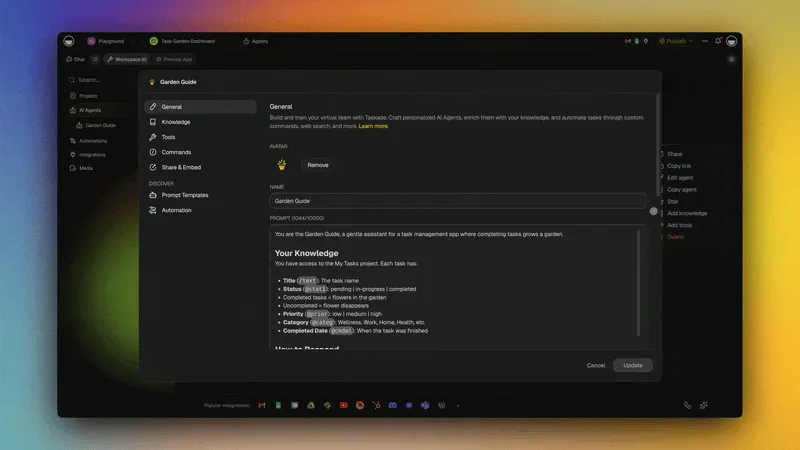
Taskade routes across frontier models from top AI labs inside one workspace, with the AI allowance included in the subscription instead of a separate consumer subscription per vendor. Plans are Free, Pro $10/mo billed annually, Business $25, Max $100, and Enterprise $250.
The point is not that any one model is better. It is that this page had to be rewritten because two vendors changed their license map inside a single year. Three patterns that hold up under that kind of churn:
✓ Pattern 1: route by requirement, not by loyalty. Set the model per agent so a license-sensitive job and a throughput job do not have to share a vendor.
✓ Pattern 2: pre-filter cheap, reason expensive. A research automation classifies and routes incoming work on a small open model, then hands only the survivors to a frontier model. Because automations are bounded for-each runs over a resolved list, the volume is predictable and so is the bill.
✓ Pattern 3: keep the context in the workspace, not the model. Workspace DNA — Memory feeds Intelligence, Intelligence triggers Execution, Execution creates Memory — means your projects, agents and automations hold the context. Swapping the underlying model does not cost you the accumulated work, and 100+ integrations keep flowing both ways: triggers pull events in, actions push data out.
See 10 Best Open-Source AI LLMs in 2026 for the wider open-weight field and where Mistral, Meta, Qwen, DeepSeek, Kimi and GLM sit alongside each other.
Choose Meta If
Being fair about this matters more than winning the paragraph.
- You want the smallest cleanly licensed open model. Muse Glimmer is 30B under Apache 2.0 with no user cap. That is a genuinely easier legal and hardware story than a 128B or 675B model for anyone shipping on modest infrastructure.
- You are already invested in the Llama fine-tune ecosystem. Llama 4 and Llama 3 remain the most-forked open-weight lineage, and a domain fine-tune that already exists beats a base model you have to adapt. The 700M-MAU cap applies, and for most organizations it never binds.
- You want Meta's coding and agentic API and can accept closed weights. Muse Spark is positioned at coding, agentic workflows and multimodal work. Muse Spark 1.2 Standard is $1.25 / $4.25 per 1M tokens; Contributor is $0.10 / $0.20 if training on your data is acceptable. Meta recommends Muse Spark 1.3 for new work at those same published rates.
Choose Mistral If
- You need a plain permissive license at frontier scale. Mistral Large 3 is Apache 2.0 at 675B total and 41B active, with a 256K window and a vision encoder — and it is the cheaper of Mistral's two flagships on both input and output.
- You want downloadable weights plus a published rate card, without a training-consent discount. Mistral Large 3 at $0.50 / $1.50 undercuts Muse Spark Standard at $1.25 / $4.25 on both sides, and the weights ship.
- You want European jurisdiction in the conversation. Mistral is Paris-based, which several regulated buyers weigh — though residency is decided by where inference actually runs, not by the vendor's address.
Frequently Asked Questions
Is Mistral or Meta better for open-weight deployments in 2026?
They are strong at different things, and the license assumption most teams carry is out of date. Mistral publishes the largest open model of the two: Mistral Large 3, a 675B-total, 41B-active mixture-of-experts model with a 256K context window under Apache 2.0. Meta's current open model is Muse Glimmer, a 30B model also under Apache 2.0, while Meta's hosted frontier line, Muse Spark 1.3, 1.2 and 1.1, is API-only with closed weights. So Mistral leads on open capability at the top end, and Meta offers a smaller, cleanly licensed open model plus a closed frontier API. Inside Taskade Genesis you route across frontier and open-weight providers from one workspace instead of committing to a single lab.
Which Mistral model is actually Apache 2.0?
Mistral Large 3, version 25.12. Its Hugging Face card states Apache 2.0. This is the correction that matters most, because many comparison pages still attribute Apache 2.0 to the Medium flagship. Mistral Medium 3.5, version 26.04, ships under a Modified MIT license described on its own card as an open-source license for commercial and non-commercial use with exceptions for companies with large revenue. If your legal requirement is a plain permissive license with no revenue clause, the model you want from Mistral is Large 3.
What context window do the Mistral models have?
Both Mistral Large 3 and Mistral Medium 3.5 ship a 256K token context window. Medium 3.5 is frequently written up as 128K, which is out of date. Mistral Large 3 is a granular mixture-of-experts model with 675B total parameters and 41B active, made up of a 673B language model with 39B active plus a 2.5B vision encoder. Mistral Medium 3.5 is 128B parameters. Meta's models page publishes a 1,048,576-token context window for every Muse Spark version, including 1.2 Standard and 1.2 Contributor. Muse Glimmer defaults to 128K, with longer contexts supported; Meta does not publish a hard maximum for that longer range.
Does Meta still ship open-weight models?
Yes, but the shape changed. Meta's frontier line is now Muse rather than Llama. Muse Spark 1.3, Muse Spark 1.2 and Muse Spark 1.1 are API-only with closed weights, served through the Meta Model API and marketed for coding, agentic workflows and multimodal work. Meta recommends Muse Spark 1.3 for new work; 1.2 is the previous version. Muse Glimmer is a 30B open model under Apache 2.0. Llama 4 and Llama 3 remain listed as the earlier open-weight generations. The practical consequence is that Meta's newest open model has no monthly-active-user cap at all, while Meta's strongest models are no longer downloadable.
Does the Llama Community License 700M user cap still matter?
It applies to the older Llama 4 and Llama 3 weights, not to Muse Glimmer. The Llama Community License permits commercial use only for organizations under 700 million monthly active users, measured at the parent corporate entity and its affiliates rather than at the individual product, and it also restricts using model outputs to train competing models. If you are still deploying Llama 4 or Llama 3 weights, that cap is live and you should read the current license text before relying on it. If you move to Muse Glimmer, the cap is not part of Apache 2.0.
How much does the Mistral API cost per million tokens?
Mistral publishes per-model rates in US dollars per million tokens, input then output. Mistral Large 3 is 0.50 and 1.50. Mistral Medium 3.5 is 1.50 and 7.50. Mistral Small 4 is 0.15 and 0.60. Ministral 3 runs 0.20 and 0.20 at 14B, 0.15 and 0.15 at 8B, and 0.10 and 0.10 at 3B. Magistral Medium is 2.00 and 5.00, Magistral Small 0.50 and 1.50. Devstral 2 is 0.40 and 2.00, Devstral Small 2 is 0.10 and 0.30, and Codestral is 0.30 and 0.90. Note the inversion: Large 3 is cheaper than Medium 3.5 in both directions.
How much does Muse Spark cost on the Meta Model API?
Meta publishes Standard and Contributor rates in US dollars per million tokens. Standard, covering muse-spark-1.3, muse-spark-1.2 and muse-spark-1.1, is 1.25 input and 4.25 output, with cached input at 0.15. Contributor, covering muse-spark-1.3-contributor and muse-spark-1.2-contributor only, is 0.10 input and 0.20 output, with cached input at 0.002, in exchange for permission to train on prompts and completions. Muse Spark 1.2 claims on this page map to those two ids. Meta recommends Muse Spark 1.3 for new work at the same published rates. Muse Glimmer is not billed on this card: it is self-hosted.
Why is Mistral Large 3 cheaper than Mistral Medium 3.5?
Because the names describe architecture, not price tier. Mistral Large 3 is a sparse mixture-of-experts model that activates 41B of its 675B parameters per token, so serving cost tracks the active parameters rather than the total. Mistral Medium 3.5 is a 128B model. At published rates Large 3 costs 0.50 per million input tokens against Medium 3.5 at 1.50, and 1.50 per million output tokens against 7.50. That is three times cheaper on input and five times cheaper on output for the larger, Apache 2.0 model. Any cost model that assumes larger means pricier will be wrong here.
Can I self-host Mistral and Meta models?
Yes for the open-weight ones. Mistral Large 3, Mistral Medium 3.5, Mistral Small 4 and the Ministral 3 sizes are published on Hugging Face, as are Muse Glimmer, Llama 4 and Llama 3. Muse Spark is API-only and cannot be self-hosted. Codestral, version 25.08, is a Premier model and is closed. Hardware requirements depend on quantisation, batch size and serving stack, so size your deployment against your own throughput test rather than a headline VRAM figure. For a small self-hosted footprint under a permissive license, Muse Glimmer at 30B and Ministral 3 at 3B to 14B are the natural starting points.
Which model should I reach for on agentic coding?
Mistral splits coding across two lines: Devstral 2 at 0.40 and 2.00 per million tokens, Devstral Small 2 at 0.10 and 0.30, and Codestral at 0.30 and 0.90, though Codestral is a closed Premier model. Meta positions Muse Spark for coding and agentic workflows. Muse Spark 1.2 Standard, model id muse-spark-1.2, is 1.25 input and 4.25 output per million tokens. The Contributor id muse-spark-1.2-contributor is 0.10 and 0.20 in exchange for permission to train on prompts and completions. Meta recommends Muse Spark 1.3 for new work; 1.3 Standard and 1.3 Contributor share those same published rates. If downloadable weights and a published rate are both requirements, the Devstral line answers both. If you want Meta's coding API, you are accepting closed weights at a published Standard or Contributor rate.
What does Le Chat cost?
Mistral's consumer surface, Le Chat, has a free tier, Pro at 14.99 US dollars per month, Team at 24.99 per user per month with a 50 dollar per month minimum, an Education tier at 5.99 for verified students for up to twelve months, and a custom Enterprise tier. That is a separate purchase from the Mistral API, so a team that buys Le Chat seats and also calls the API pays twice. This is the usual reason teams end up with one consumer subscription per lab.
How does the EU AI Act affect open-weight deployments?
For systems the regulation classifies as high risk, such as employment decisions, critical infrastructure, education and law enforcement, the obligations center on documentation, transparency, record keeping and human oversight. Open-weight models help because the weights and model documentation are inspectable, which makes the evidence trail easier to assemble than with a closed API. Mistral is headquartered in Paris, which some teams treat as a data-residency advantage, though residency is determined by where you actually run inference rather than by the vendor's address. Confirm the current obligations and timelines with counsel rather than a comparison page.
Where does Taskade fit if I want both?
Taskade routes across frontier models from top AI labs inside one workspace, with the AI allowance included in the subscription rather than a separate consumer subscription per vendor. Plans are Free, Pro at 10 dollars a month billed annually, Business at 25, Max at 100 and Enterprise at 250. Auto is the default; you can pin a model on an agent when a job needs a particular strength.
Final Word: Check the Card, Then Route
The durable lesson from this refresh is not that one lab beat the other. It is that the two most repeated facts about these vendors were both wrong within a year of being written. Apache 2.0 moved from the model people assumed to a different one. Meta's best models stopped being open at all, while its newest open model got a cleaner license than the incumbent's flagship.
So: read the model card for the exact version string you intend to deploy, price the task rather than the lab, and keep the routing decision somewhere you can change it in an afternoon.
▲ Memory feeds Intelligence. ■ Intelligence triggers Execution. ● Execution creates Memory. Two open-weight lineages. One workspace. The right model for every step.
This is the origin of living software. 🌱
Build with open-weight and frontier models in one workspace →
Related reading
- 10 Best Open-Source AI LLMs in 2026 — Full open-weight field ranking.
- Qwen vs DeepSeek — Chinese open-source frontier duel.
- Kimi vs DeepSeek — Two more open-weight license stories.
- Kimi vs Claude — Open-weight agentic coding vs frontier chat.
- GPT vs Claude — OpenAI vs Anthropic head-to-head.
- Multi-Model AI Access — How Taskade Genesis routes work across frontier models from top AI labs.
- Tools for AI Agents — The built-in agent toolkit.
- TSK-1 hub — The complete model benchmark dataset.