






How Everything Came Full Circle
I sometimes think about how different the internet felt when I first started hosting.
Those early days in Queens shaped the way I see systems today.
I was working with whatever I could afford: cheap servers running hot, hand-installed WordPress sites, phpBB forums with fragile plugins, video scripts that required strange ffmpeg builds.
Nothing came ready. Every part had to be assembled by hand.
I did not use words like infrastructure or reliability. I just knew something had to stay alive.
If it broke, someone felt it. If it held, someone trusted you. That was enough.
TL;DR: The same instinct that kept servers alive in a Queens apartment now powers
Taskade Genesis — full-stack AI infrastructure where one prompt produces a living
system with memory, intelligence, and execution. 150,000+ apps built from prompts.
Start building →

Years later, I learned that the brain's own reliability works the same way. In 1952, Hodgkin and Huxley published a model showing how a single neuron generates a reliable signal (work that earned them the Nobel Prize in 1963) — a precisely choreographed dance of sodium and potassium ions, opening and closing in sequence, producing an all-or-nothing spike in under two milliseconds. Every time. Billions of times a day. The brain's uptime comes from the same principle as server uptime: redundant, self-correcting mechanisms that keep the signal clean under pressure.
During the day I would be at Bronx Science, half awake, answering support tickets between periods. At lunch, I would slip into the computer room and patch up whatever failed the night before.
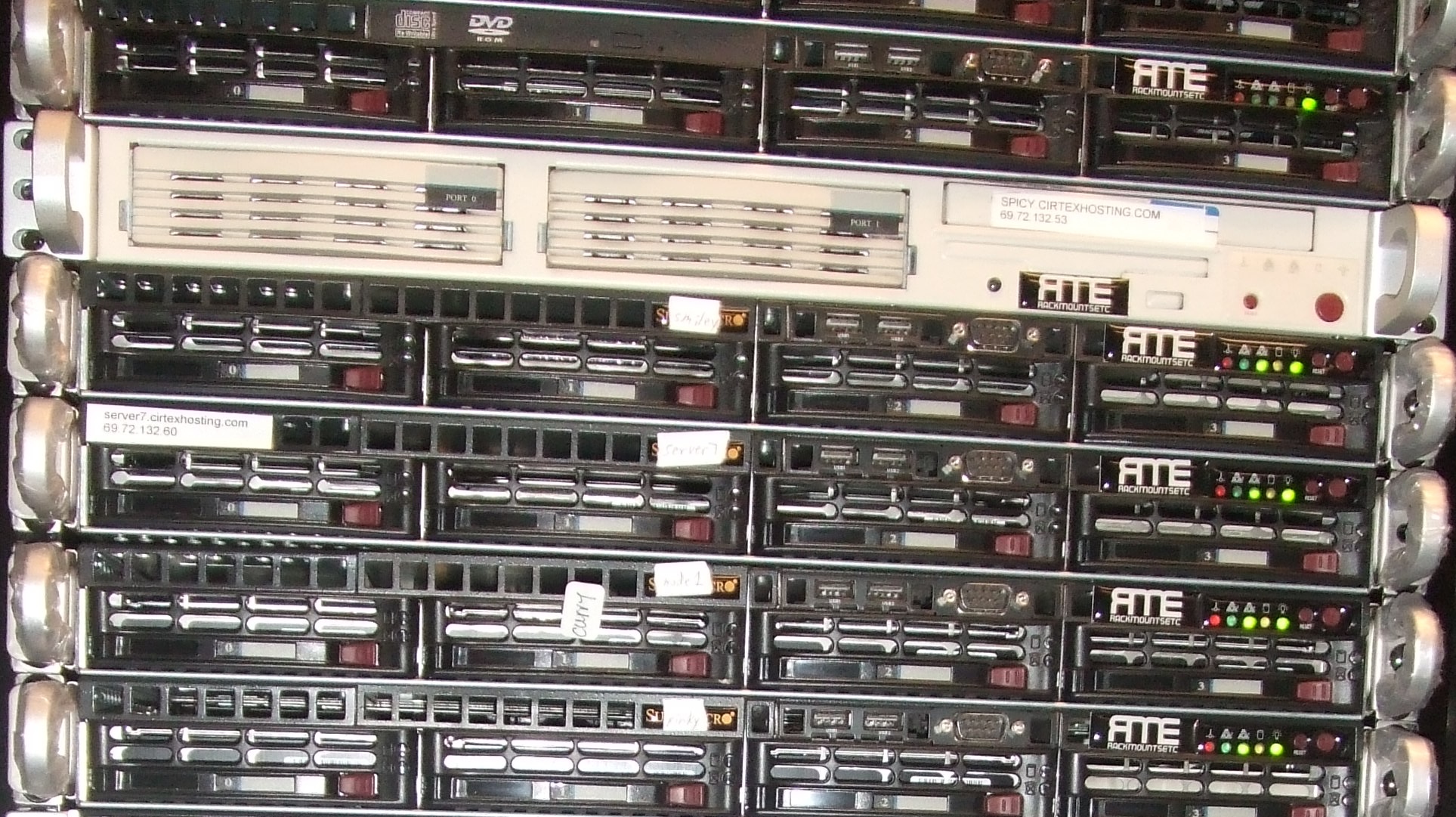
It was a routine that should not have worked, but somehow it did. And without realizing it, those repetitions were teaching me how invisible systems shape people's lives.
The Five Generations of Infrastructure
Looking back, the evolution from web hosting to AI infrastructure follows a clear pattern. Each generation removed a layer of manual work and added a layer of abstraction.
| Generation | What You Managed | What Was Abstracted | Time to Deploy |
|---|---|---|---|
| Physical Hosting | Hardware, OS, network, storage, application | Nothing — you built everything | Weeks to months |
| Datacenter Scale | Multiple racks, redundancy, failover | Physical space and power | Days to weeks |
| Cloud Computing | Virtual machines, containers, APIs | Hardware procurement and maintenance | Hours to days |
| SaaS Applications | Configuration and data entry | Infrastructure and deployment | Minutes to hours |
| AI Infrastructure | A prompt describing what you want | Everything — the system builds itself | Seconds |
Each generation did not replace the previous one — it absorbed it. Cloud computing absorbed datacenter management. SaaS absorbed cloud deployment. AI infrastructure absorbs the entire application layer.
The Quiet Turning Point
Later, when HostV and CirtexHosting grew, I moved from cheap nodes to private racks in multiple datacenters. New Jersey. Dallas. Chicago. Entire rows of machines all tied back to a teenager still trying to finish homework on time.
Sometimes the datacenter would ship broken hardware back to my house in Queens. Heavy servers left at the door like awkward packages.
I would spread the parts across the dining table, testing drives, swapping components, rebuilding RAID arrays. It was messy, but it made something clear.
The web is held up by people quietly keeping things alive when nobody is looking.
The strange part is that I did not notice the shift happening.
Hosting used to mean keeping a website online. A PHP script. A forum. A WordPress install with a fragile theme. But slowly the expectations changed.
People did not want pages anymore. They wanted systems.
- Dashboards that update in real time
- CRMs that behave like living memory
- Client portals that react to events
- Automations that keep going long after you step away
- AI agents that learn what you are trying to do
The internet outgrew static architecture. And the tools of old hosting could not keep up.
The world did not need hosting in the old sense.
It needed something closer to infrastructure that could think.
What Hosting Has Become
Today, one prompt can produce what once took me days or weeks.
- A functioning database with structured fields and relationships
- A frontend you can click and use immediately
- Backend logic tied to the interface
- Automations that trigger themselves based on conditions
- AI agents with built-in tools and persistent memory
- The entire system assembled in seconds, already alive
This is not the hosting I grew up with. It is closer to an organism.
| Aspect | Manual Hosting (2005) | Cloud/SaaS (2015) | Taskade Genesis (2026) |
|---|---|---|---|
| Deployment | SSH into servers, configure manually | Click-deploy from dashboard | One prompt generates a live app |
| Database | Install MySQL, manage schemas by hand | Managed databases (RDS, PlanetScale) | Structured projects with built-in relations |
| Frontend | Hand-coded HTML/CSS/PHP | Templates and drag-and-drop builders | Auto-generated UI from natural language |
| Backend | Custom scripts, cron jobs, server configs | Serverless functions, webhooks | AI agents with persistent memory and context |
| Updates | Patch, test, redeploy, hope nothing breaks | CI/CD pipelines, blue-green deploys | Living systems that adapt continuously |
| Intelligence | None — static content served to browsers | Basic analytics and recommendations | 15+ frontier AI models from OpenAI, Anthropic, Google |
| Automation | Cron jobs and shell scripts | Zapier, Make, IFTTT | Native automation with 100+ integrations |
| Infrastructure | Physical racks, RAID arrays, datacenter contracts | Virtual machines, containers | Workspace DNA: Memory, Intelligence, Execution |
A workspace that listens, remembers, and adapts.
Taskade Genesis builds the environment. It carries the memory. It runs the execution. It understands what you mean before you finish explaining it.
- Projects become the long-term memory
- Agents become the thinking layer
- Automations become the heartbeat
And in a full-circle moment: you can now publish Taskade Genesis apps to custom domains with automatic SSL, the same way I used to set up hosting for clients in the early days. Except now the "hosting" includes AI agents that run while you sleep, version history so you can roll back any change, branded sign-in for your users, and the ability to clone your entire app into any workspace.
The infrastructure stack I used to build with dedicated servers, RAID arrays, and hand-configured DNS now fits inside a single workspace. What took weeks of setup happens in one prompt. 150,000+ community apps prove it works at scale.
Workspace DNA: Infrastructure That Thinks
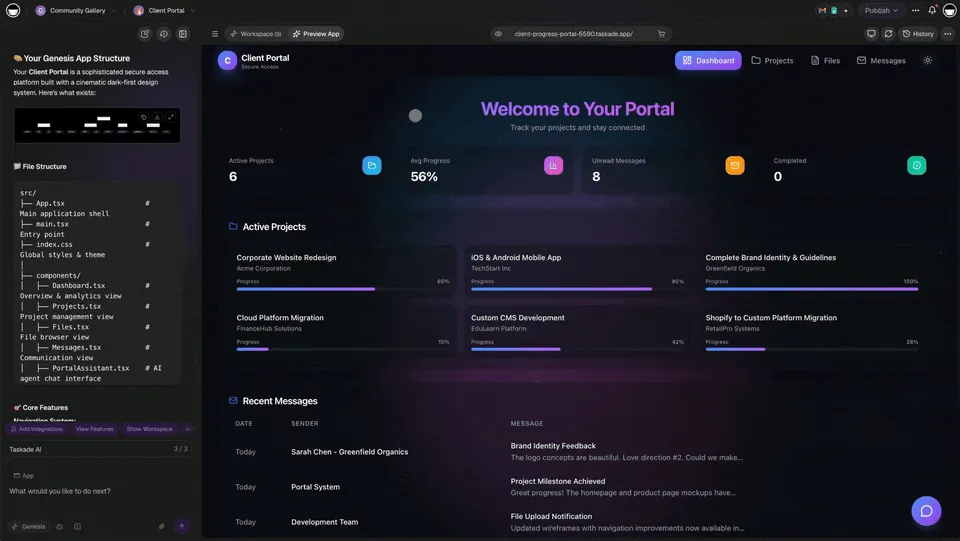
We call it Workspace DNA because that is what it feels like: a structure that grows with the work instead of resisting it.
Memory (Projects and Databases) is the foundation. Every Genesis app stores structured data in projects that support multiple views — List, Board, Calendar, Table, Mind Map, Gantt, and Org Chart. This is the equivalent of the databases I used to install and configure by hand, except now they are schema-aware and relationship-capable from the first prompt.
Intelligence (AI Agents) is the thinking layer. Agents powered by 15+ frontier models from OpenAI, Anthropic, and Google can read your data, answer questions, draft communications, and take actions. They come with built-in tools, custom slash commands, and persistent memory that survives across sessions.
Execution (Automations) is the action layer. Event-driven workflows with 100+ integrations handle everything from Slack notifications to email sequences to calendar scheduling. This is the equivalent of cron jobs and shell scripts — except they are visual, reliable, and connected to the intelligence layer.
The three layers form a self-reinforcing loop: Memory feeds Intelligence, Intelligence triggers Execution, Execution creates Memory. The same feedback loop that kept those early servers running — just at a different scale.
The Reliability Principle
Working on Taskade Genesis reminds me of those nights rebuilding servers at the dining table. The scale is different, and the tools barely resemble each other, but the instinct has not changed.
- Keep systems alive.
- Make things easier for the people depending on you.
- Take complexity off their plate.
Back then it was physical drives failing and machines overheating.
Now it is workflows, knowledge, and logic that need continuity.
The responsibility is the same. Only the canvas changed.
An AI agent that crashes, forgets context, or produces inconsistent results is no different from a server that goes down at 3 AM. The same principles apply: redundancy, fault tolerance, graceful degradation, and the stubborn commitment to keeping things running.
| Hosting Reliability Principle | AI Infrastructure Equivalent |
|---|---|
| RAID arrays for data redundancy | Persistent memory across sessions |
| Uptime monitoring and auto-restart | Agent health checks and retry logic |
| Load balancing across servers | Multi-model routing across providers |
| Backup and disaster recovery | Version history and workspace cloning |
| Graceful degradation under load | Concurrent render limits and queue management |
| SSL and access control | Custom domains with OIDC/SSO and RBAC |
Turning a prompt into a living system brings the whole arc into focus. I started by hosting websites. Now we host intelligence. We host execution. We host full-stack apps.
The circle did not close by accident. It closed because the need never changed. Only the technology finally caught up.
Where the Internet Is Going Next
The web is shifting again, quietly but unmistakably.
- From static content to continuous processes
- From standalone tools to interconnected systems powered by Workspace DNA
- From software you operate to software that collaborates with you
- From code-first development to prompt-first creation
- From separate AI add-ons to native intelligence in every workspace
Taskade Genesis is built for that shift. It turns ideas into applications. Applications into systems. Systems into something that runs twenty-four hours a day without reminders or supervision.
| What Changed | Old Model | New Model |
|---|---|---|
| How you build | Write code, configure servers | Describe what you want in a prompt |
| How it runs | Manual deployment, manual monitoring | Self-maintaining with AI agents |
| How it connects | APIs and middleware glue | 100+ native integrations |
| How it learns | Static until you change it | Agents adapt with persistent memory |
| How you access it | SSH, admin panels, dashboards | Conversational interface + multiple project views |
| What it costs | $500+/month for infrastructure | Free to start, $10/month billed annually |
It is the kind of infrastructure I wish I had when I was starting out.
And for the first time, the world feels ready for it.
Read more:
- History of cPanel & WHM: From a Teenager's Bedroom to the AI Era — the industry-scale version of this story
- From Bronx Science to Taskade Genesis
- The Origin of Living Software
- The Anatomy of a Genesis App
- How Workspace DNA Works
- Build Without Permission
- Build a Business-in-a-Box
- From AI Productivity to AI Infrastructure
- 10 AI Ops Dashboards for Lean Teams
Explore Taskade AI:
- AI App Builder — Build complete apps from one prompt
- AI Dashboard Builder — Generate dashboards instantly
- AI Workflow Automation — Automate any business process
- Browse Community Apps — 150,000+ apps to clone
- Browse Generator Templates — Apps, dashboards, websites, and more
- Browse Agent Templates — AI agents for every use case

Frequently Asked Questions
How did web hosting evolve into AI infrastructure?
Web hosting started as manually maintaining servers -- installing WordPress, patching forums, keeping uptime. Cloud computing abstracted the hardware away. SaaS abstracted the deployment. AI infrastructure abstracts the entire application layer -- you describe what you need and the system builds, deploys, and maintains it. Each generation removed a layer of manual work until the infrastructure itself became intelligent.
What is the connection between infrastructure reliability and AI systems?
Reliability principles from hosting (uptime, fault tolerance, graceful degradation) directly apply to AI systems. An AI agent that crashes, forgets context, or produces inconsistent results is no different from a server that goes down. The same mindset -- something has to stay alive, if it breaks someone feels it -- applies whether you are maintaining a phpBB forum or running 500K AI agents in production.
How does a founder's technical background shape their approach to AI?
Founders who built infrastructure from scratch (servers, hosting, deployment) understand that real systems must be reliable, maintainable, and resilient -- not just impressive in demos. This shapes how they approach AI: focusing on durable execution (workflows that retry and recover), persistent memory (state that survives restarts), and production-grade reliability rather than flashy conversational features.
What does full-stack AI infrastructure include beyond the language model?
A language model alone is just text generation. Full-stack AI infrastructure includes: persistent memory (databases that agents read and write to), execution capabilities (automations triggered by events), integration layer (connections to 100+ external services), deployment infrastructure (hosting, custom domains, access control), and collaboration (real-time multi-user editing of AI-generated applications).
What is Workspace DNA and how does it relate to infrastructure?
Workspace DNA is the foundational architecture of Taskade Genesis -- Memory (Projects store structured data), Intelligence (AI Agents reason and act), and Execution (Automations trigger workflows). It mirrors the evolution of infrastructure itself: from static storage to intelligent processing to automated operations. The same journey from web hosting to AI infrastructure, compressed into one platform.
How does Taskade Genesis compare to traditional hosting?
Traditional hosting required manually installing software, configuring databases, hand-coding frontends, setting up cron jobs, and maintaining physical hardware. Taskade Genesis replaces the entire stack with one prompt that generates a live app with structured databases, AI agents with built-in tools, and automated workflows connected to 100+ integrations. What took weeks now takes seconds.
Can Taskade Genesis apps be published to custom domains?
Yes. Genesis apps support custom domains with automatic SSL, password protection, built-in OIDC/SSO authentication, and publishing to the Community Gallery. This is the same hosting capability that used to require dedicated servers, RAID arrays, and hand-configured DNS -- now built into every workspace.
What makes AI infrastructure different from cloud computing?
Cloud computing abstracted hardware (you rent virtual machines instead of buying physical servers). AI infrastructure abstracts the application layer (you describe what you want and the system builds it). Cloud gives you resources; AI infrastructure gives you complete, running systems with memory, intelligence, and execution baked in. Taskade Genesis represents this shift -- 150,000+ apps built from prompts.