






These days, synchronous (real-time) communication is almost too easy. There are dozens of tools that let teams chat, video conference and get work done. Some, like Taskade, combine all that functionality together, in one unified workspace. But back in the early Internet days, there was only one communication king, and its name was Internet Relay Chat (IRC). 👑
For over 30 years (!), the IRC protocol has enabled millions of people to chat, exchange ideas, and get work done. It may not look like much today, but it’s the true ancestor of online communities and remote communication tools. And when we consider that IRC predates the World Wide Web, it’s nothing short of impressive that the technology is still alive and well today.
🤔 What Is IRC?
“Something is formed by the electrons, born in the silent cable. Shaping and growing and ungrowing. It is there yet not there. It is the source of Internet Relay Chat. I do not know the name, thus I will call it the Tao of Internet Relay Chat.”
The Tao of Internet Relay Chat
We should probably preface IRC’s story with the now-famous words of its creator, Jarkko "WiZ" Oikarinen who gives the following account of its humble beginnings: "The birthday of IRC was in August 1988. The exact date is unknown, at the end of the month anyways."
IRC came to life in the Summer of 1988 as an offshoot of Oulu University’s BBS (Bulleting Board Service) called OuluBox. Oikarinen developed IRC as a pet-project aimed at improving internal communication within Oulu’s network.
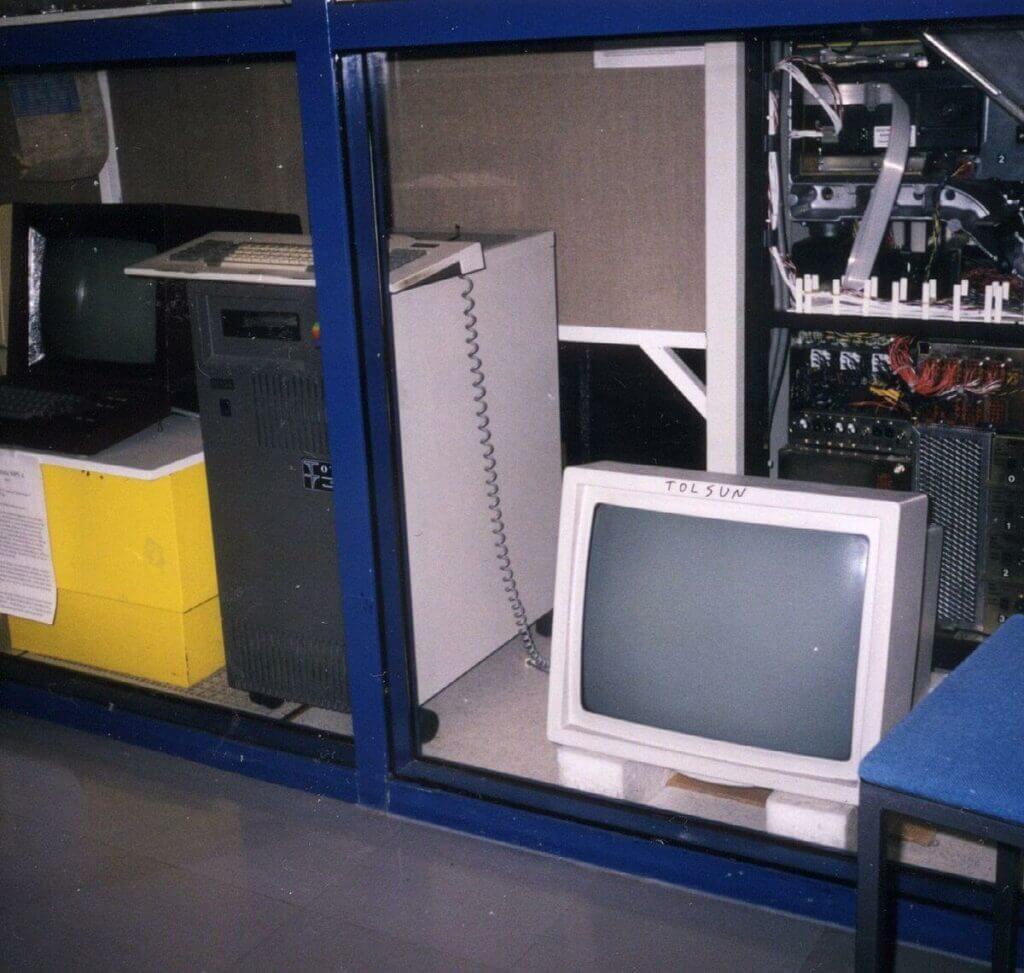
The original tolsun.oulu.fi server that run IRC(1)
On the net technical end, IRC is a protocol (means of sending and receiving data) that “lives” inside a mesh of interconnected servers and enables users to interact with each other via plain-text messages.
According to IRCHelp, Internet Relay Chat can be described as:
“(...) a way of communicating in real-time with people from all over the world. It consists of various separate networks (or "nets") of IRC servers, machines that allow users to connect to IRC. IRC is very similar to text messaging, but designed around communicating with large groups of users instead of one on one.”
Like most modern communication platforms, IRC lets you engage in group conversations within Channels or send private messages via a Client-Client (DCC) connection.
Here’s how a typical IRC discussion looks like. 👇
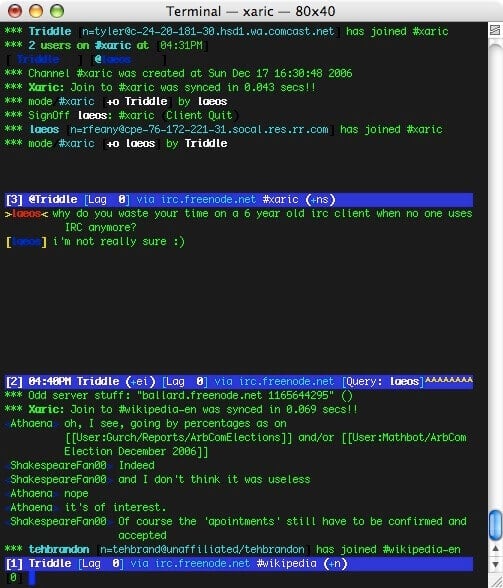
An IRC discussion in a text-based client Xaric(2)
⚙️ How Does Internet Relay Chat Work?
“If the Tao is great, then the IRC is running ceaselessly. If the IRC is great then the server is running without ever stopping. If the server is great then the client will always be the server. The luser***** is then pleased and there is Chat in the world.”
The Tao of Internet Relay Chat
IRC Networks
IRC infrastructure consists of four essential components: Servers, Networks, Channels and Clients. IRC networks (“nets”) are essentially groups of interconnected servers. Users can connect to those networks using Clients, simple, often text-based applications designed to facilitate user-user and user-channel interactions.
💡 IRC Trivia: IRC has often been used to distribute news on major international events. When the Persian Gulf War broke out in the early 90s, many people used the platform to read live reports from the front.
Although individual servers may be geographically dispersed, users connected to two different machines can still interact with each other as long as they are part of the same network.
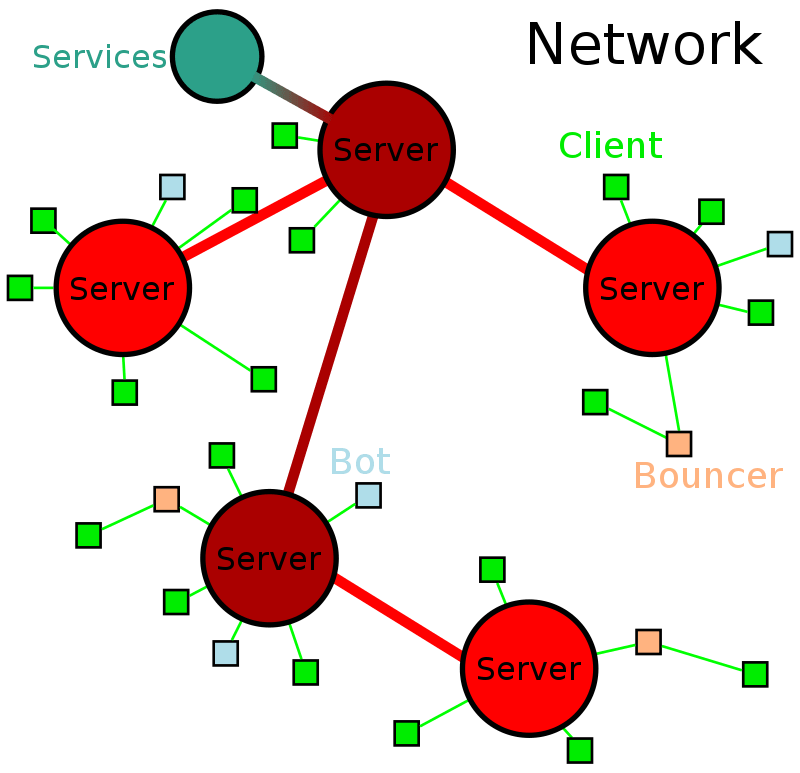
A visualization of an IRC network with Clients (green), Bots (Orange) and Bouncers (blue)(3)
IRC Clients
“A client should be light and be used for communication. The spirit of a good client is that it should be very convenient for the luser to use, but hard for the luser who want to create automata. There should never ever be too many functions or too few functions.”
The Tao of Internet Relay Chat
In simple terms, an IRC client is a piece of software that lets users communicate with IRC channels and other users. Some IRC clients, especially their early iterations, are purely text-based while others use more modern and user-friendly GUIs (graphical user interfaces).
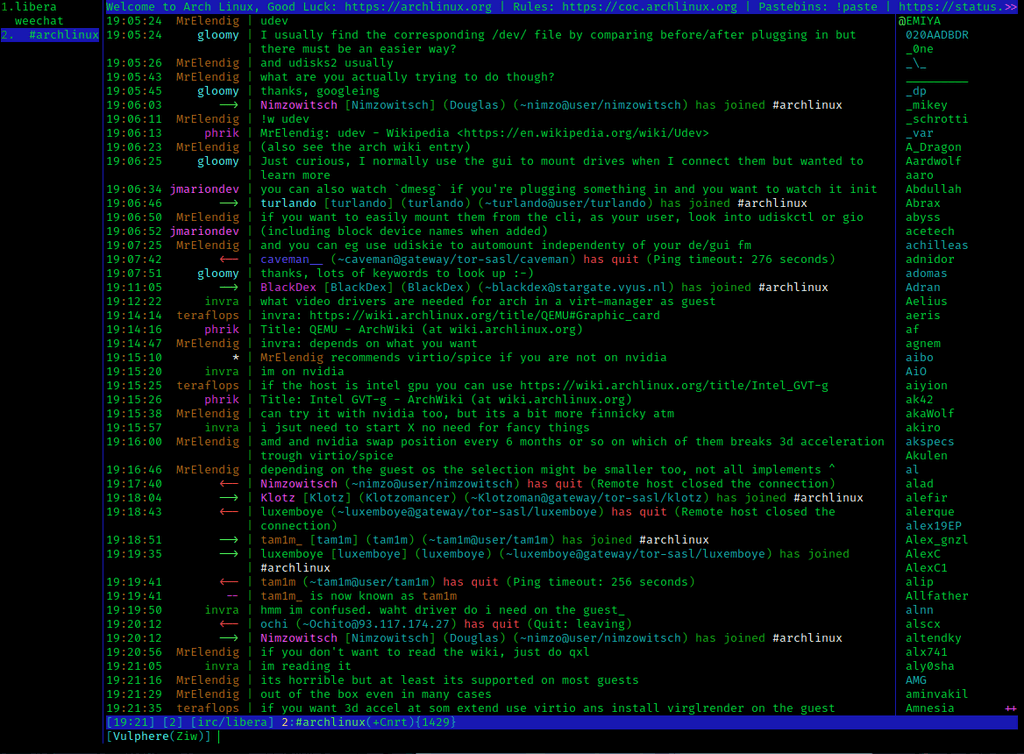
A popular, multi-OS IRC client WeeChat(4)
IRC clients are available for every popular platform, including Windows, Mac OS and Linux as well as mobile devices running Android and iOS. Some web browsers like Firefox and Chrome support (or used to support) IRC out-of-the-box. Some networks even provide proprietary web interfaces so users can connect on the fly, without having to download or install anything.
If you want to give IRC a test run, you can start with one of the following IRC clients:
- 👉 mIRC. Originally developed for Windows, mIRC is one of the most popular IRC clients. It’s distributed in a shareware model (paid after free trial), is really intuitive to use ad supports powerful scripting capabilities dedicated for power users
- 👉 HexChat. A successor of XChat, HexChat comes packed with a customizable interface, scripting capabilities, support for multiple languages and other powerful features. It’s open-source and completely free for Windows and Linux
- 👉 Quassel. Another open-source representative of the ilk, Quassel offers an interesting feature that allows “one (or multiple) client(s) (..) attach to and detach from a central core that stays permanently online.” This, in turn, makes it possible to leave a channel and rejoin a conversation without missing a word
IRC Channels
“Each channel has its purpose, however humble. Each channel is the Yin and Yang of IRC. Each channel has its place within the IRC.”
The Tao of Internet Relay Chat
Channels are the place where IRC magic happens. You can think of channels as chat rooms where users gather to engage in discussions, exchange ideas and collaborate on projects. While some channels focus on specific subjects like #programming or #movies, others dabble in more general discussions.
After connecting to an IRC network, you can select a channel you want to join (marked with “#” or “##”) and jump straight into a discussion. Save for DCC connections, IRC conversations are public so everybody can “hear” what you’re typing.
💡 IRC Trivia: Early IRC clients didn’t archive or log conversations out-of-the-box. To counter that, many people would keep their clients running 24/7 so they didn’t miss out on anything important. Talk about FOMO!
New arrivals can get the feel of a channel/server theme and etiquette by reading the Message of the Day (MOTD) displayed at the first connection. Users who violate the rules set out in MOTD risk being kicked or permanently banned by the operators.
IRC Users
Every IRC channel and network has a group of privileged members who enjoy more control and authority than regular users. The first representative of that ilk are Channel Operators (“ops”) who police good conduct within channels. They’re also in charge of moderating discussions and banning people who don’t play by the rules.
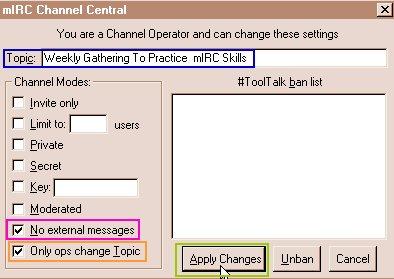
Channel operator menu in mIRC via CSUN(5)
The second group are IRC Operators (“IRCops” or “opers”) who control the technical end of the IRC network infrastructure. Members of both groups can be recognized by “@” (ops) and * (opers) characters preceding their nicknames.
👍 Why IRC Is *Still* Great
"Your client does not work because it does not understand the server. Why should it always work? Only a fool would expect such. But, clients are made by humans, and humans are not perfect. Only Tao is.”
The Tao of Internet Relay Chat
1. It’s *Truly* Minimalist
Call it spartan or even simplistic, but there’s something cathartic about plain-text communication. While it’s obvious that IRC has aged (a lot), it’s aged gracefully and remains usable even to this day, which is a no mean feat for a service that’s over 30 years old. And the best part? IRC clients can run on almost any device, as long as it’s connected to the Internet.
2. Free and Open to All
Ever since its inception at the Department of Information Processing Science of the University of Oulu, IRC has been free and open to all. While some private channels are invite-only, most of the infrastructure can be accessed without limitations. You don’t even need an email address or an account to hook up to a network, pick a channel and start a conversation.
3. Highly Customizable
At a glance, IRC conversations aren’t exactly eye candy. All you get are lines and lines of plain text with a handful of special characters here and there. But many modern clients like mIRC or HexChat come with powerful customization features that let users:
- 🎨 Change the color and font of messages to improve readability
- 🔎 Apply highlighting rules to zero in on certain keywords
- 🔊 Play a sound when certain keywords pop up in conversations
- 🤖 Automate client-channel and client-client interactions with bots
- 👩🎨 Modify background and foreground colors
- And much more…
4. Built by and for the Community
Without a strong, tight-knit community, the platform wouldn’t survive that long, not to mention attain a cult status it has today. IRC is free of advertising, data mining or security breaches. All that matters are *meaningful* conversations and the people that make them possible.
🔮 What caused IRC's Decline?
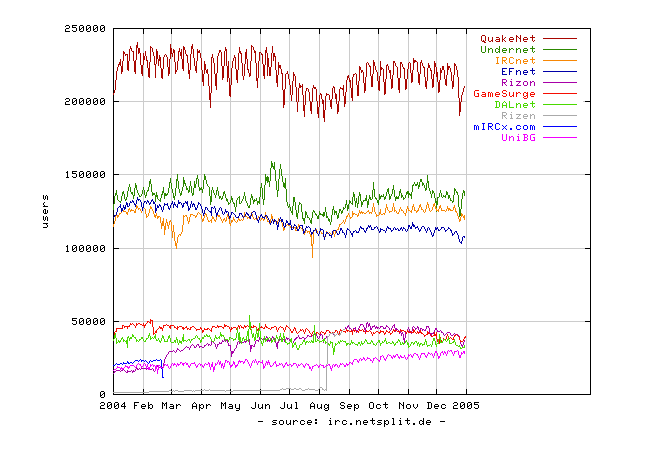
After riding a favorable wave up until 2004, IRC entered a path of steady decline. According to netsplit.de, in the early 2000s, a wildly popular QuakeNet network had over 240k users. In 2008, its community shrunk below 150k. In 2020, the only remaining high-profile network is Freenode with around 90k people still hooked up.
IRC channels
IRC user base by network (2004) via netsplit.de(5)
So, what are the reasons for IRC’s decline?
- 🎥 No support for video and calls. Audio-visual content is a major part of what we do online these days. And we’re not talking only about the popularity of platforms like YouTube or Netflix. The demand for video collaboration solutions has been growing for quite some time and now, due to the pandemic, video conferencing has become synonymous with work-from-home. Unfortunately, IRC doesn’t have any voice or video capabilities which effectively puts it well behind modern collaboration platforms
- 😊 A lack of “little” conveniences. Communication these days is extremely user-friendly. There are push notifications, searchable conversation history, chat logs, emojis, cloud backup… anything to make online interactions as frictionless as possible. While IRC does offer some powerful features, most of the extra functionality isn’t available to non-technical users
- ⌛ *Too* synchronous. When you connect to an IRC channel, you join the discussion at a certain point in time. Just like in a face-to-face conversation, things that had been said before you “walked in” belong in the past. You don’t know what people talked about a few minutes ago and have little to no context apart from the channel’s MOTD. That makes IRC a poor choice for remote collaboration where teams need a reliable and intuitive way to archive and retrieve information
- 🔓 Security hiccups. Given the open nature and aging infrastructure of the platform, IRC isn’t the most secure place for private conversations. While it’s possible to open direct, 1-on-1 connections or even enable SSL encryption, IRC’s security is *not* up to modern standards. And that’s only part of its security shortcomings, others being the infamous DDoS (distributed denial-of-service) attacks, malicious scripts and viruses
As one Reddit user observed:
“I have an archive of IRC logs, for example, from 9/11/2001, when I was logged in as events were going down. I have screenshots of other people desktops, old photographs. An archive of this old community. I miss a lot of those people; we all graduated, got jobs, and couldn't stay logged in all the time.”
So, does that mean the Internet Relay Chat days are numbered?
The short answer is… it depends.
On the technical end, the IRC protocol is old and outdated. Even with the ongoing development of IRCv3 standard (improved security, notifications, chat logs), the technology is miles behind modern solutions.
But does that even matter?
The power of IRC lies elsewhere. It provides a simple and frictionless channel of communication where people can talk, exchange ideas and brainstorm wonderful projects. And after over 30 years, it still manages to deliver on that front. In a sense, IRC has achieved what all modern communication tools aspire to.
Which takes us to the most important question. 👇
⌛ Is IRC Part of the Past Or... Part of the Future?
The master Wumpus said: "Time for you to leave. I did, now I'm happy." The master Gnarfer replied: "Use, but never overuse IRC, then you will also be happy within IRC"
The Tao of Internet Relay Chat
Three decades is a very long time in internet years and few (if any) other tools can match this track record. IRC *is* and always will be the first true collaboration platform, one that continues to inspire contemporary solutions like—and we’re proud to say that—Taskade.
Much like e-mail, IRC belongs to an era where online communication and collaboration was simple, essential and owned by the community. That era gave birth to the ultimate convenience where users can control and customize their experience anyway we want.
Internet Relay Chat is the gold standard for real-time, synchronous communication. And while it continues to live on in its original form, it’s also become part of many contemporary tools that draw from and improve on its heritage.
In a sense, IRC will never *really* cease to exist. Even once all its networks shut down and the dust settles, it’ll be some time before we see another piece of technology that will revolutionize online communication like IRC did.
Enjoyed the article? Be sure to check our other articles on online communication! 👇
- 🤔 Synchronous vs. Asynchronous Communication
- 💬 How to Overcome Poor Communication in a Distributed Team?
- 📽 The Evolution of Video Conferencing
- 🌊 Google Wave and Modern Real-Time Collaboration Tools
🔗 Resources
- https://en.wikipedia.org/wiki/Internet_Relay_Chat
- https://en.wikipedia.org/wiki/Internet_Relay_Chat#/media/File:Xaric_screen_shot.jpg
- https://en.wikipedia.org/wiki/Internet_Relay_Chat#/media/File:Ircnetz-Schema.svg
- https://en.wikipedia.org/wiki/WeeChat#/media/File:WeeChat_3.4_screenshot.png
- https://netsplit.de/networks/top10.php?year=2004
Frequently Asked Questions
What is IRC and how does it work?
Internet Relay Chat (IRC) is a real-time text messaging protocol created in 1988 by Jarkko Oikarinen at the University of Oulu in Finland. It works through a network of interconnected servers that relay messages between users. People connect via IRC clients, join channels (group chat rooms prefixed with #), and communicate through plain-text messages. IRC predates the World Wide Web and remains active today, primarily in open-source and developer communities.
Why was IRC important for the history of online communication?
IRC was the first widely adopted real-time group communication platform on the internet — predating the World Wide Web by several years. It pioneered concepts still used in modern tools: channels (now called rooms or groups), direct messaging, user roles and moderation, bots for automation, and persistent community spaces. Every modern team chat tool — from Slack to Discord to Microsoft Teams — traces its DNA back to IRC's channel-based architecture.
Is IRC still used today and who uses it?
Yes, IRC is still active — primarily among open-source developers, Linux communities, and tech-focused groups. Networks like Libera.Chat (successor to Freenode) host thousands of channels for projects like Python, Arch Linux, and Fedora. While IRC's mainstream popularity declined with the rise of Slack and Discord, its simplicity, open protocol, and lack of corporate ownership keep it relevant for communities that value privacy and decentralization.
How did IRC influence modern collaboration tools like Slack and Taskade?
IRC established the foundational patterns — channels for topic-based discussion, direct messages for private conversation, bots for automation, and real-time presence indicators. Slack's founders explicitly cited IRC as inspiration, building a more polished version with file sharing, search, and integrations. Taskade extends this further by combining real-time chat with task management, project views, and AI agents in one unified workspace.