







When the Canadian prime minister Justin Trudeau visited the White House in 2016, the French part of his speech translated by ABC TV’s speech recognition software was riddled with quirks ranging from suave “portfolio of us old guys” to cryptic “agreeing. 032. clearing.” It wasn’t the finest performance of AI translation, but hey, everybody has to start somewhere.
TL;DR: AI translation tools like Google Translate, DeepL, and LLM-based solutions now achieve 85-95% accuracy for common language pairs. For multilingual teams, Taskade AI agents translate and localize content within collaborative workspaces — no app-switching required. Try it free →
After years of development, artificial intelligence tools seem to be finally catching up with professional translators and interpreters. With over 1 billion users, Google Translate is now the most popular translation service out there, with an impressive accuracy of up to 90%.
But where did it all start?
Will artificial intelligence replace translators?
If an AI translates a recipe, will it still taste as good? (just kidding)
Here’s everything you wanted to know about AI translation technology but were afraid to ask.
🤖 💬 How AI Translation Works
Machine translation (MT) — the use of computers to automatically translate text — has been around since at least the 1950s. It all started when researchers at Georgetown university translated 60 Russian words to English using an IBM 701 mainframe computer.(1)
But science fiction writers had figured it out much earlier.
In a 1945 novella First Contact, writer Murray Leinster played with the concept of a “universal translator,” a device that could translate speech between human and alien languages.
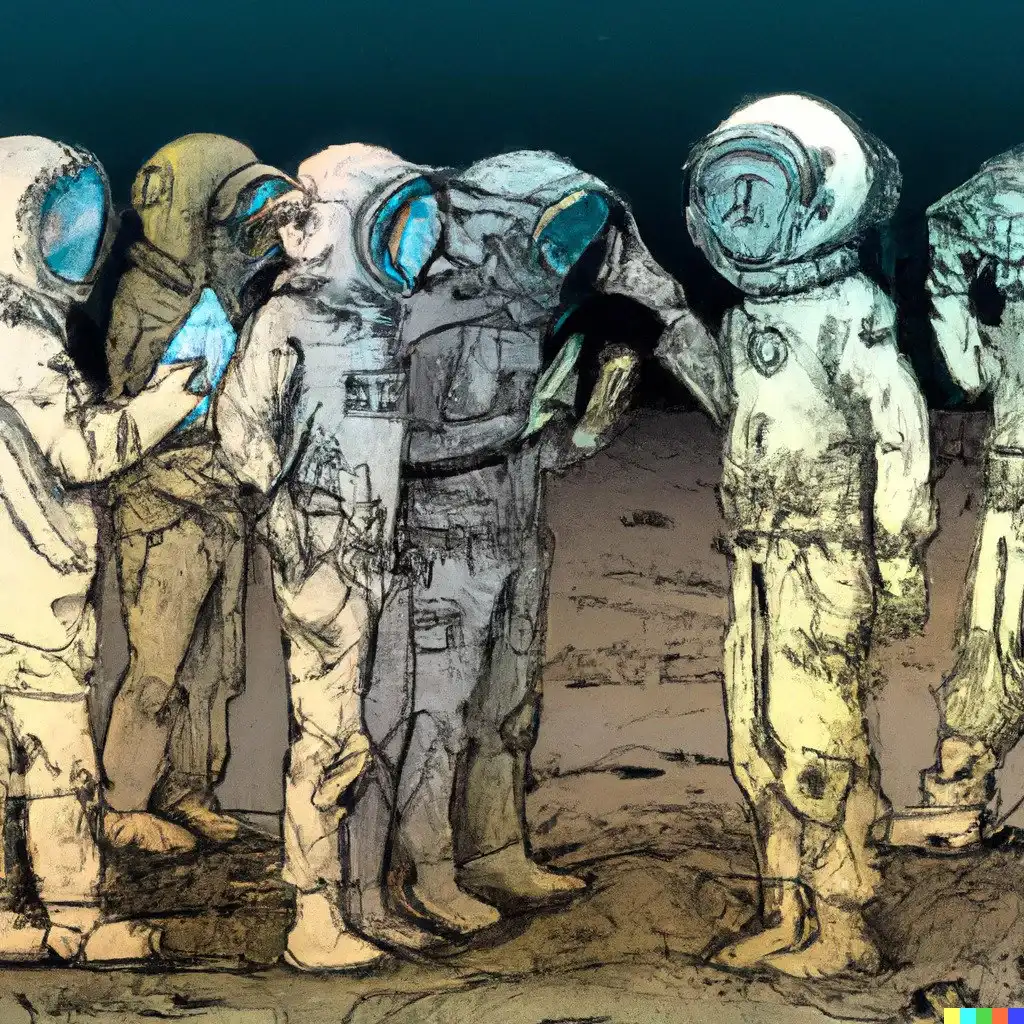
"Universal Translator," digital art generated by DALLE-2
The first real-world attempts at machine translation were rather primitive, at least by the standards of space-traveling, technically advanced alien races. But they opened the door to a wave of funding and sparked public interest, at least for a short while.
During the Cold War, a rule-based translation system called SYSTRAN was used to translate simple sentences from Russian to English. SYSTRAN leveraged w hat's knows as rule-based machine translation (RbMT) that involves sets of linguistic rules and bilingual dictionaries.(2)
In the 1990s, machine translation shifted to statistical models utilizing large amounts of data to learn patterns in languages and to make predictions about how words and phrases are translated. To train those models, researchers fed" them large amounts of data including bilingual corpora, a collection of parallel texts in two different languages.(3)
The researchers involved in the Georgetown-IBM experiment predicted that it would take 3 to 5 years to fully develop MT technology. Well, it took six decades of hilarious mistranslations, awkward phrasing, and occasionally downright offensive results to make a breakthrough.
In 2016, Google announced that they developed a neural machine translation (NMT) system capable of producing much more accurate and fluent translations. The NMT system was based on a type of artificial neural network, which allowed the system to "learn" patterns and structures in language more effectively than rule-based or statistical machines.(4)
Today, NMT is the dominant, and so far the most accurate, translation technology in the space. NMT systems can not only "understand" the complexity of natural languages, but they can also accurately render technical vocabulary, including legal, medical, and scientific terminology.
“Ok, so are AI tools already better than human translators?" Not yet, but they come with some pretty compelling benefits that are simply too good to ignore.
🚀 The Benefits of AI Translation
Improved Communication
When the Persians invaded Greece in 490 BCE under the command of King Darius I, they brought interpreters to communicate with the local population. These days, they would probably simplify the logistics and use smartphones with a stable Wi-Fi connection instead.
Machine translation has become the go-to tool for breaking the language barrier, whether it's for negotiating peace treaties or ordering a bowl of noodles from a street vendor.
But did you know that AI is also hard at work helping you learn new languages?
For instance, the language-learning app Duolingo employs machine learning and natural language processing in the course creation process. The company uses their “Birdbrain” model to personalize the learning experience, track user progress, and… generate answer variations.(5)
Now you know why “you’re crying and the onion is laughing.” 🧅
Increased Global Reach
We live in a global market where you can order a product from the other side of the world and have it shipped to your doorstep faster than you can say "international shipping fees."
In large part, we have to thank AI tools for making that possible.
According to a 2023 report by Unbabel titled “Global Trends in Marketing Localization," 39% of marketers are using machine translation in localization strategies. And that makes a lot of sense since 84% of companies say content localization has a major impact on revenue growth.(6)
The spread of machine-translated content is also a powerful driver of engagement that can make or break a business. Research has shown that 40% of people won't make a purchase if the information about the product or service is not available in their language.(7)
Flexibility and Cost Savings
These days, machine translation can handle large amounts of data with ease and can seamlessly integrate with existing workflows and systems. This is great news for businesses with global customer bases, as it means they can easily reach customers in different parts of the world.
"Isn't that expensive?" Well, not anymore.
AI systems have reached a point where they are more affordable than human translators. The average cost of a professional translation service ranges between $0.10 and $0.30 / word. Amazon Translate API charges $15.00 per million characters and some terrifying accuracy.
AI still flunks the "translate this pick-up line to work in every language" test, but it’s getting there.
AI Translation Tools Comparison (2026)
| Tool | Best For | Languages | Key Strength | Pricing |
|---|---|---|---|---|
| Google Translate | General-purpose translation | 130+ | Widest language coverage | Free / API paid |
| DeepL | European language pairs | 30+ | Natural-sounding output | Free / $8.74/mo |
| ChatGPT / Claude | Nuanced, context-aware translation | 90+ | Tone and audience customization | $20/mo+ |
| Amazon Translate | High-volume API translation | 75+ | AWS integration, batch processing | $15/M characters |
| Taskade | Multilingual team collaboration | 12+ | Translate within shared workspaces with AI agents | Free / $10/mo |
For teams that need translation integrated into their project workflow — not as a separate step — Taskade lets you translate, collaborate, and manage tasks in one place with AI-powered automation.
🧐 The Challenges of AI Translation
The Bible has been subject to many mistranslations throughout history. One of the most bizarre mishaps was a mistranslation of the King James Version of the Bible where the Hebrew word "qeren" (meaning "beam of light") was mistranslated as "horn" in Exodus 34:29-35.
That led to the many portrayals of Moses with horns, like this one.

Moses by Michelangelo Buonarroti.
Image credit: Jörg Bittner Unna
So, how does AI translation technology stack up against that?
Translation Error Rate (TER) and BLEU (Bilingual Evaluation Understudy) are two key metrics for evaluating machine translation. In 2021 researchers at UCLA found that Google Translate is 82.5% accurate in translating medical terms. That would be impressive if not for the fact that the accuracy ranged between 55% and 94% depending on the language.(8)
Of course, the blunders of machine translation can happen in less specialized use cases.
Natural languages are infinitely complex, with nuances in grammar, syntax, and vocabulary that may sometimes be difficult to capture and accurately render with machine translation.
You may not encounter words like Japanese "kintsugi” (“repairing broken pottery with gold or silver lacquer”) or Danish “hygge” (“contentment in one's surroundings”) too often. But when you do, you want to render them in your own language without losing the cultural context.
But that doesn’t mean you have to resort to spending endless nights hunched over dusty tomes like a medieval monk (unless that's your thing, of course).
AI translation tools are an excellent addition to any workflow. If used the right way, they can help you streamline the translation process, improve accuracy, and boost productivity. Just so you can indulge in some "dolce far niente" — the sweet art of doing nothing. 🤷♂️
Workspace DNA: How Memory + Intelligence + Execution Powers Multilingual Teams
For teams working across languages, disconnected tools create a fragmented translation workflow — glossaries in one app, translation memories in another, and project management in a third. Taskade's Workspace DNA framework unifies everything into a self-reinforcing cycle:
- Memory: Projects store translation memories, brand glossaries, style guides, and past corrections. Every translation decision is retained and accessible, so teams never redo work or lose institutional knowledge.
- Intelligence: AI agents with built-in tools and persistent memory learn your terminology preferences, tone guidelines, and common corrections. Over time, agents produce translations that match your brand voice more accurately.
- Execution: Workflow automations with 100+ integrations route content through translation, review, and publishing pipelines. New blog posts trigger automatic translation, routed to reviewers, then published to localized channels — all without manual steps.
This loop compounds: every translation feeds Memory, Memory makes Intelligence more accurate, and Intelligence triggers better Execution. The result is a translation workflow that gets faster and more consistent with every project.
Translation Workflow Comparison
| Approach | Speed | Quality | Cost | Brand Consistency |
|---|---|---|---|---|
| Human translators only | Slow | Highest | $0.10-0.30/word | High (if managed well) |
| Machine translation only (Google, DeepL) | Very fast | Medium | Low / Free | Low |
| AI + human review (LLM draft + editor) | Fast | High | Medium | Medium-High |
| Taskade (agents + automation + human review) | Fast | High | Free / $10/mo | High (persistent memory) |
| Enterprise TMS (Smartling, Phrase) | Medium | High | $500+/mo | High |
Vibe Coding: Building Custom Translation Tools Without Code
Vibe coding — the practice of describing what you want in natural language and letting AI build it — is making custom translation tools accessible to non-technical teams.
Instead of purchasing expensive enterprise translation management systems or cobbling together spreadsheets and free tools, teams can use Taskade Genesis to build tailored translation workflows from a simple prompt. For example:
- "Build a translation dashboard that tracks the status of blog posts across English, Spanish, Japanese, and French"
- "Create a glossary management tool where translators can add, search, and approve terminology"
- "Build a content localization tracker with reviewer assignments and deadline alerts"
Genesis has powered 150,000+ apps built from natural-language prompts, including custom translation portals with custom domains and password protection. Teams can publish these tools to the Community Gallery for others to reuse.
This agentic approach to translation tooling means your workflow adapts to your needs rather than forcing you into a one-size-fits-all platform. Combined with AI agents that handle the actual translation work and automations that route content through review pipelines, the entire multilingual workflow becomes programmable — without writing a single line of code.
🐑 Using Taskade to Translate Content
Whether you’re working on a DIY project or collaborating with a global team, you may need a little help to overcome linguistic barriers. This is where Taskade AI comes into play.
Taskade AI is our writing assistant powered by frontier AI models from OpenAI, Anthropic, and Google. With the help of Taskade AI, you can easily translate text into a number of languages without having to copy text between windows or, well, brandish a dictionary.
Here’s how it works.
Open a Taskade project and paste in or type the text you want to translate. Next, type /translate in the same line and choose one of the available languages. Taskade AI can currently translate your projects into 12 languages, including English, Japanese, and Spanish.
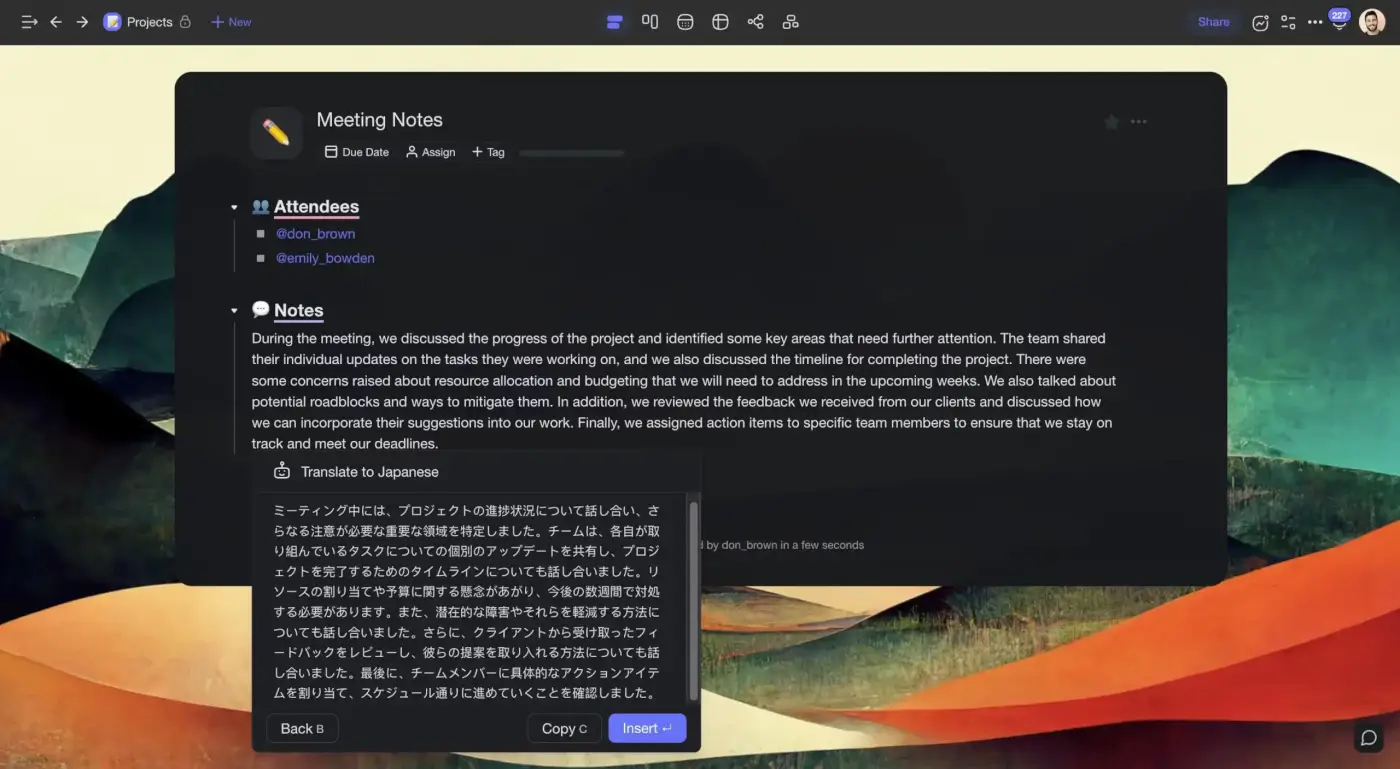
Et voilà ! (in case you’re wondering, that means “there you go!” in French).
Taskade AI is an excellent companion tool for translating:
💰 Marketing materials (brochures, flyers, social media posts, email newsletters)
📑 Reports and documents (business plans, project proposals, whitepapers)
🛒 E-commerce product listings (product descriptions, features, specifications)
📰 Blog articles (news updates, opinion pieces, how-to guides, listicles, post-editing)
🌐 Website content (homepage copy, about pages, product pages)
And much more!
All that integrated seamlessly into our world-class task and project management workflow. ✨
And here's the best part?
You can collaborate on translations with your team in real-time. All project members can use the /translate command and other AI tools and features simultaneously, without limitations.
Ready to break down language barriers and take your projects global?
Learn the language of productivity with Taskade AI!
Custom AI Agents: Build specialized translation and localization agents with built-in tools, persistent memory, and custom tool schemas. Train agents on your brand voice guidelines for consistent multilingual content.
Genesis App Builder: Build live translation dashboards and multilingual content tools from natural-language prompts. Deploy with custom domains and publish to the Community Gallery.
Workflow Automation: Automate translation pipelines with 100+ integrations — trigger translations when new content is created, route to reviewers, and publish across channels.
AI Prompt Templates: Access hundreds of translation and localization prompt templates to speed up multilingual content creation.
AI Chat: Get context-aware translation advice, fine-tune your content for global audiences, and analyze translated materials — all grounded in your workspace data.

🔗 Resources
https://web.stanford.edu/class/archive/cs/cs224n/cs224n.1162/handouts/Collins_annotated.pdf
https://ai.googleblog.com/2016/09/a-neural-network-for-machine.html
https://blog.duolingo.com/how-duolingo-experts-work-with-ai/
https://resources.unbabel.com/blog/new-report-global-trends-in-marketing-localization-for-2023
https://link.springer.com/content/pdf/10.1007/s11606-021-06666-z.pdf
Frequently Asked Questions
How accurate is AI translation compared to human translators?
AI translation accuracy varies by language pair and content type. For common language pairs (English-Spanish, English-French), AI tools like Google Translate and DeepL achieve 85-95% accuracy for straightforward content. However, AI still struggles with: 1) Idiomatic expressions and cultural nuances, 2) Technical jargon in specialized fields, 3) Context-dependent meaning where the same word means different things, 4) Literary and creative writing where tone and voice matter. For business-critical content (legal documents, marketing copy), human review of AI translation is still essential. The optimal workflow: use AI for the initial draft and human translators for review and refinement.
What are the best AI translation tools in 2026?
Top AI translation tools include: 1) DeepL — often produces more natural-sounding translations than Google, especially for European languages, 2) Google Translate — widest language coverage (130+ languages) with good accuracy for common pairs, 3) ChatGPT/Claude — LLM-based translation that handles context and tone better than traditional machine translation, especially for nuanced content, 4) Taskade AI — translates content within collaborative workspaces, useful for multilingual teams working on shared projects. For professional translation workflows, LLM-based tools (ChatGPT, Claude) are increasingly preferred because they can be instructed about tone, audience, and context.
How can AI help multilingual teams collaborate?
AI supports multilingual collaboration in four ways: 1) Real-time translation — AI translates messages and documents as team members create them, reducing communication delays, 2) Content localization — AI adapts marketing materials, documentation, and UI text for different markets while maintaining brand voice, 3) Meeting transcription — AI transcribes and translates multilingual meetings so everyone gets notes in their preferred language, 4) Knowledge base translation — AI makes team documentation accessible across languages so critical information isn't locked in one language. Tools like Taskade integrate translation into the collaborative workspace so multilingual teams can work together without language being a barrier.
Will AI replace human translators?
AI won't replace human translators for high-stakes content but is significantly changing the profession. AI is replacing humans for: high-volume, low-stakes translation (product descriptions, support articles, user reviews). AI augments humans for: business communications, marketing copy, and technical documentation where quality matters but speed is also important. Humans remain essential for: literary translation, legal documents, diplomatic communications, and any content where cultural sensitivity and creative voice are paramount. The translator role is evolving from manual translation to post-editing AI output and managing translation quality — similar to how editors work with writers.
How does Taskade Genesis relate to AI translation workflows?
Taskade Genesis lets teams build custom translation dashboards and multilingual content tools from natural-language prompts — no coding required. With 150,000+ apps built, teams use Genesis to create translation management portals with custom domains, password protection, and publishing to the Community Gallery. Combined with Taskade AI agents that have built-in tools and persistent memory, teams can build end-to-end translation pipelines that handle content intake, translation, review, and publishing in a single workspace.
What is vibe coding and how does it apply to translation tools?
Vibe coding is a development paradigm where you describe what you want in natural language and AI builds it for you. For translation, this means non-technical teams can build custom translation dashboards, localization workflows, and multilingual content management tools by simply describing their requirements to Taskade Genesis. Instead of purchasing expensive enterprise translation management systems, teams can vibe-code their own tools — tailored to their specific language pairs, approval workflows, and publishing channels.
How do AI agents automate translation workflows?
AI agents automate translation workflows by handling multi-step processes autonomously. In Taskade, AI agents with built-in tools and persistent memory can monitor for new content, translate it into target languages, route translations to human reviewers, and publish approved content — all triggered by workflow automations with 100+ integrations. Unlike standalone translation tools, Taskade agents retain context about your brand voice guidelines, terminology preferences, and past corrections, improving translation quality over time.
What is Workspace DNA and why does it matter for multilingual teams?
Workspace DNA is Taskade's framework of Memory + Intelligence + Execution. For multilingual teams, Memory means translation memories, glossaries, and brand guidelines persist across all projects. Intelligence means AI agents learn your preferred terminology and translation style from accumulated project data. Execution means automations route content through translation, review, and publishing pipelines without manual intervention. This self-reinforcing loop ensures translation quality improves with every project, and team knowledge is never lost when members change.