

See the alternative working — clone in 60 seconds
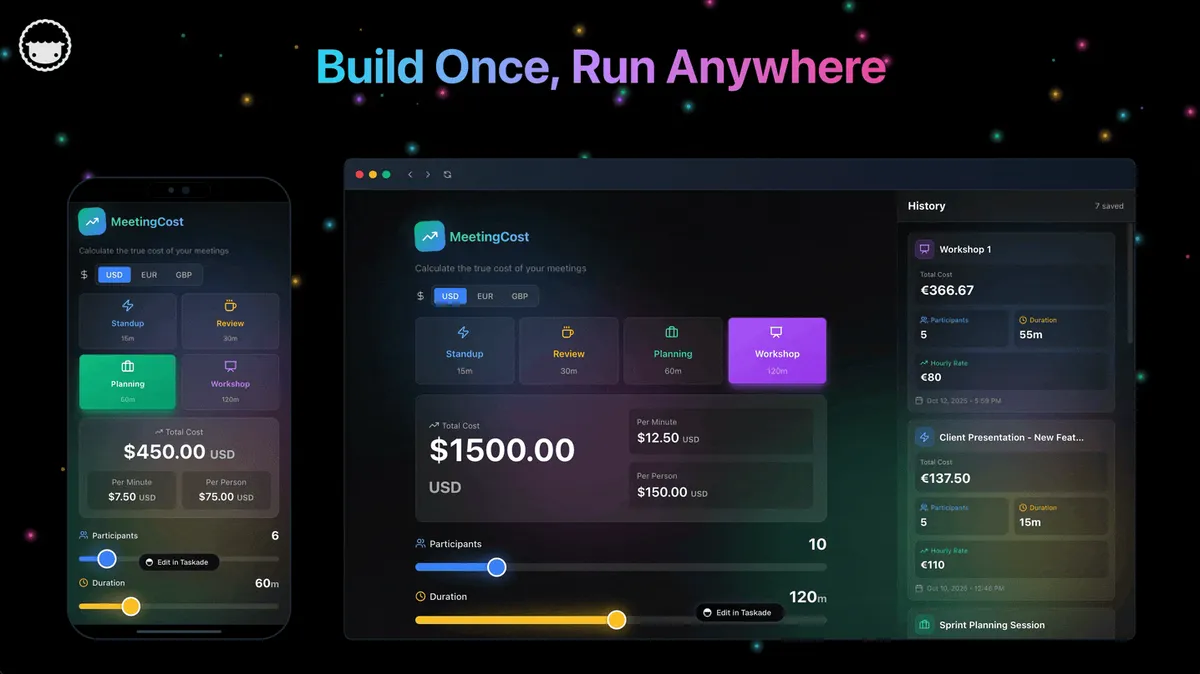
No signup, no credit card. Live AI dev workspace
| Capability | Aider | Taskade Genesis |
|---|---|---|
| Pricing (starting) | Free open source (you pay model API costs) | $0 Free · $10/mo Pro billed annually (10 seats) |
| Cloneable live demo | ❌ | ✅ |
| Built-in AI agents | Code agent only | ✅ built-in tools |
| Automation engine | No workspace automation | ✅ Durable runtime, 100+ integrations |
| Workspace DNA loop | ❌ | ✅ ▲ Memory · ■ Intelligence · ● Execution |
Overall winner: ✅ Taskade Genesis — for anyone whose goal is shipping a working app, not editing files in a repo. Aider remains a great pick for solo engineers who already live in git.
Table of Contents
- Quick Comparison Table
- The fundamental difference
- What is Taskade Genesis?
- What is Aider?
- Feature-by-feature deep dive
- The Workspace DNA advantage
- Pricing and total cost of ownership
- What developers say
- When to choose each
- Frequently asked questions
- Without permission
TL;DR: Aider is a free MIT-licensed terminal pair-programmer for senior developers using git and BYO API keys (44K+ GitHub stars). Taskade Genesis turns one prompt into a deployed app with AI agents, automations, and 100+ integrations for teams who need a running product, not a diff. Try Taskade Genesis free →
The fundamental difference
Aider and Taskade Genesis are aimed at different jobs. Aider is the engineer's surgical knife — open-source, terminal-native, and designed to apply clean diffs to files inside a git repository. It writes code into your project. You then have to build, host, and ship that code yourself.
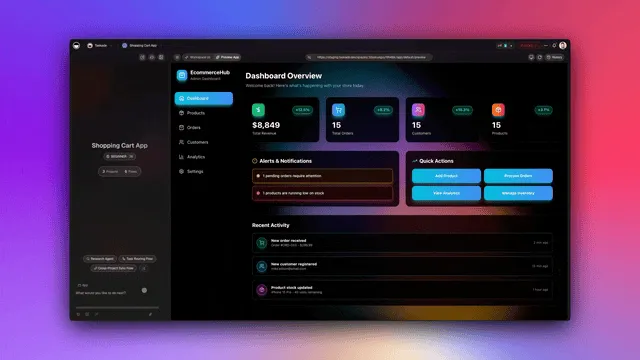
Taskade Genesis starts one step further along the pipeline. You describe what you want and Genesis returns a deployed, working application with AI agents, real-time data, automation workflows, and team collaboration already wired in. Your workspace is the backend. Your projects are the database. Your agents are the runtime.
Aider asks: "What code should I write?" Genesis asks: "What app should exist?"
What is Taskade Genesis?
Taskade Genesis is the AI app builder inside the Taskade workspace. It is built on Workspace DNA — Memory (Projects), Intelligence (AI Agents), and Execution (Automations) — a self-reinforcing loop where what your team does becomes the substrate the agents reason over. Founded by John Xie, Dionis Loire, and Stan Chang in 2017, Taskade is a Y Combinator-backed platform with over a million users and a public Community Gallery of apps anyone can clone.
A single prompt to Genesis can produce a customer support portal, an ops dashboard, a CRM, a knowledge base, a form-driven intake system, or an internal tool — all with built-in AI agents, automations, custom domains, password protection, and the option to embed publicly with GenesisAuth. No DevOps. No CI/CD. No infrastructure to maintain.
Genesis is for everyone — founders, marketers, ops, product managers, customer success, and yes, engineers who want to skip plumbing and focus on the idea.
What is Aider?
Aider is an open-source command-line AI pair programmer created by Paul Gauthier (github.com/Aider-AI/aider). It launches inside any git repository, builds a tree-sitter "repo map" to give the language model context about the codebase, and applies edits as diffs that auto-commit to git with descriptive messages.
Aider at a glance: Free, MIT-licensed, BYO model API key. Supports Claude (Sonnet/Opus 4.x), GPT-5/o-series, Google Gemini 2.5 Pro, DeepSeek V3/R1, Qwen 3, xAI Grok, and local models via Ollama, LM Studio, and OpenRouter. Famous for topping its own polyglot leaderboard on edit accuracy across Python, JavaScript, Go, Rust, C++, and Java.
The headline features developers love about Aider are surgical: a /architect + /code two-model workflow that lets you reason with one model and edit with a cheaper one, a read-only /ask mode for code Q&A without changes, voice coding via Whisper, and a --browser mode for a lightweight web UI. Every change becomes a git commit, so reverting a bad LLM run is one command away.
Aider is, for good reasons, beloved on r/LocalLLaMA and Hacker News. It is also unapologetically a developer tool: you live in your terminal, you bring your own API key, and you ship the resulting code yourself.
Feature-by-feature deep dive
App generation
- Taskade Genesis turns a single prompt into a deployed application with UI, data model, AI agents, and automations connected. You can iterate visually or in natural language. The output runs immediately at a shareable URL.
- Aider edits files in a git repository. The output is source code that the user must compile, deploy, and host. There is no concept of a "live app" inside Aider.
AI agents that take action
- Taskade ships AI Agents v2 — first-class digital teammates with persistent memory, built-in tools (web search, file analysis, project management, image generation, code execution, and more), custom tools you define, and the ability to be embedded publicly inside Genesis Apps.
- Aider is a single-user, single-session tool. It does not maintain agents, host them, or expose them to a team or customer. When you close the terminal, the agent is gone.
Workflow automations and integrations
- Taskade includes production-grade durable Automations with branching, looping, and filtering across 100+ bidirectional integrations. Triggers pull external events in (Slack messages, Gmail, Sheets rows, Calendly events, webhooks). Actions push data out (Stripe checkouts, Shopify orders, Notion syncs, Salesforce updates, GitHub PRs).
- Aider has no automation layer. Workflows happen in your terminal session and stop when you exit.
Team collaboration
- Taskade is workspace-native: real-time multiplayer editing, comments, chat, video calls, and granular role-based access (Owner to Viewer).
- Aider is single-user. Collaboration happens through git pull requests after the fact.
Project views and visual editing
- Taskade offers multiple project views — List, Board, Calendar, Table, Mind Map, Gantt, and Org Chart — plus visual app editing without writing code. The Timeline scrolling component lives inside the Gantt view.
- Aider outputs unified diffs in a terminal. Visual editing is whatever your IDE provides after the fact.
Workspace memory and context
- Taskade's Workspace DNA gives every agent persistent context across projects, files, integrations, and the live state of your business.
- Aider rebuilds context every session from a tree-sitter repo map. Powerful and clean, but local to one repo and one terminal session.
Code ownership and openness
- Aider wins outright here. MIT license, full code ownership, run on any model, run locally with Ollama for full privacy.
- Taskade is a managed platform. You don't own the code that powers a Genesis App, but you do own your data, your agents, your integrations, and you can export your projects to Markdown or text.
The Workspace DNA advantage
Aider's mental model is "the LLM edits files, the human ships them." Genesis's mental model is Workspace DNA: a self-reinforcing loop between three pillars.
- Memory (Projects) — Your team's docs, tasks, files, and structured data become the substrate every agent reasons over. The longer you work, the smarter the workspace gets.
- Intelligence (Agents) — Custom AI Agents with persistent memory, built-in tools, and custom tools you define, plus a hosted MCP server that Claude Desktop, Cursor, and VS Code connect into, while automations carry the work into the 100+ apps you already use. Agents are first-class teammates that live in the workspace, not floating chat sessions.
- Execution (Automations) — Durable workflows triggered by external events (Slack, Gmail, Stripe, GitHub, Calendly, webhooks, schedules) that read from Memory and act through Intelligence — then write the results back into Memory. The loop closes.
Aider is brilliant at one slice of this loop — applying a clean diff to a file. Genesis runs the entire loop continuously, so the longer you use it, the more your workspace itself becomes the thing that builds the next app.
Pricing and total cost of ownership
| Plan | Taskade Genesis | Aider |
|---|---|---|
| Free | Free Forever — limited AI credits, full app builder access | Free open source |
| Pro | $10 / month (annual) — unlimited apps, 10 seats | Pay model provider per token |
| Business | $25 / month — unlimited seats, higher AI capacity | N/A |
| Max | $100 / month — maximum AI generation capacity | N/A |
| Enterprise | $250 / month with custom SLA | N/A |
Aider's headline is "free." The fine print is "free software, paid tokens." A heavy week of pair programming with Claude Sonnet through Aider can easily run $50–$200 in API spend. Self-hosted DeepSeek or Qwen knocks that down dramatically. Either way, the cost lives in your model bill, not in Aider itself.
Genesis flips the model: a flat subscription includes AI credits, hosting, deployment, agents, integrations, and automations. There is no separate model bill, no DevOps line item, no infra cost. For teams that want a predictable monthly number rather than a metered one, Genesis is the more comfortable shape.
What developers say
Aider has a deserved reputation as one of the cleanest developer-facing AI tools on the market. Recurring themes across r/LocalLLaMA and Hacker News:
- "Best price-to-performance for serious coding" — particularly with DeepSeek V3 and Qwen 3 at the back end.
- "The only agent that respects my git history" — auto-commit per change is a beloved feature.
- "Cursor for people who hate IDEs" — surfaces in nearly every Aider thread.
The honest critique: terminal UX intimidates non-CLI users, the repo map can blow context windows on monorepos, and it is unambiguously a developer tool. None of these are bugs — they are just consequences of the audience Aider serves.
Genesis users are usually one step removed from those threads. They show up because they want to ship a portal, a dashboard, a CRM, an internal tool, or a customer-facing app — and they want to do it without thinking about deploys, databases, or auth. Browse the Community Gallery to see the apps people have shipped without ever opening a terminal.
Use-case fit at a glance
| Job to be done | Better fit | Why |
|---|---|---|
| Refactor a 50K-line Python monorepo, atomic commits per change | ✅ Aider | Repo-map + auto-commit per diff is unmatched |
| Ship an internal CRM, customer portal, or ops dashboard this afternoon | ✅ Genesis | Deployed app + agents + automations from one prompt |
| Solo engineer who wants total cost control on local Qwen / DeepSeek | ✅ Aider | Run any model, including Ollama / LM Studio locally |
| PM, marketer, or founder who has the idea but doesn't write code | ✅ Genesis | No terminal, no git, no API keys |
| Surgical fix to a single function in an existing codebase | ✅ Aider | /architect + /code two-model workflow is precise |
| Trigger Slack → enrich lead in HubSpot → DM owner on Stripe checkout | ✅ Genesis | Durable Automations across 100+ integrations |
| Embed an AI agent in a public-facing product for end users | ✅ Genesis | AI Agents v2 with public embedding + custom tools |
| Code review and Q&A on an existing repo, no edits | ✅ Aider | Read-only /ask mode is excellent |
When to choose each
Choose Aider if:
- You are a solo engineer or small dev team comfortable in the terminal.
- You want surgical edits on an existing codebase with auto-commit safety.
- You want full code ownership and the option to run local models for privacy.
- You want to optimize for cost-per-token by routing to DeepSeek, Qwen, or self-hosted models.
- The output you need is source code, not a deployed system.
Choose Taskade Genesis if:
- You want to ship a working app, not edit files in a repo.
- Your team includes non-engineers who need to build alongside engineers.
- You need AI agents that persist, have tools, and can be embedded for customers.
- You need workflow automations across Slack, Gmail, Stripe, Salesforce, Notion, and 100+ other integrations.
- You want one flat subscription that includes hosting, agents, automations, and team collaboration.
Use both if: Many engineering teams keep Aider for cleanup work on existing repos and use Genesis to ship new internal tools, ops dashboards, customer portals, and AI-powered apps that need to actually run in front of users.
Frequently asked questions
Is Aider better than Taskade Genesis for AI coding?
They are aimed at different jobs. Aider is the right tool for editing files in a git repository. Genesis is the right tool for shipping deployed applications. The "better" answer depends entirely on whether your goal is edited code or a running app.
Is Aider really free?
Yes — MIT license, no paid tier. You pay only for the model API calls you make. Sessions run anywhere from a few cents to a few dollars depending on the model.
Does Aider deploy applications?
No. Aider edits files. The user is responsible for building, hosting, and shipping the code.
Does Taskade Genesis include workflow automations?
Yes — production-grade durable automations across 100+ bidirectional integrations. Aider has no automation layer.
Which AI models does Taskade Genesis use?
Taskade includes access to 15+ frontier models from OpenAI, Anthropic, and open-weight providers. You never wire up API keys.
Can I export my work from Genesis?
Yes — projects export to Markdown and text. The Genesis App itself is a deployed managed product, not source code, so the architecture trade-off is hosting and infrastructure included in exchange for not owning the codebase.
Build without permission
Aider gives engineers a sharper knife. Genesis gives everyone — engineers and non-engineers alike — a workshop where the apps come out finished, hosted, and ready for users.
- Build with Genesis → — One prompt, one deployed app
- Browse the Community Gallery — Clone apps shipped by other Genesis builders
- Read the Workspace DNA explainer — How Memory, Intelligence, and Execution work together
Explore Taskade Genesis
- AI App Builder — Build complete apps from one prompt
- Vibe Coding — Natural-language app creation
- AI Agent Platform — Digital teammates that work 24/7
- AI Website Builder — Sites in seconds
- Workflow Automation — AI-powered business automation
Learn the Genesis architecture
Your living workspace includes:
- First-app guide — 5-minute tutorial
- Custom AI Agents — The Intelligence pillar
- Projects & Databases — The Memory pillar
- Automations & Workflows — The Execution pillar
Build without code
- AI App Generator — Full apps from prompts
- AI Dashboard Generator — Business dashboards
- AI Website Generator — Sites in seconds
- AI Form Generator — Smart intake forms
- Browse Community Apps — Clone and customize
Related reading
- The Build Without Permission article — Our manifesto
- How Workspace DNA Works — The architecture
- Origin of Living Software — The future of apps
- Best Cursor Alternatives in 2026 — AI code editors compared
- Best Claude Code Alternatives in 2026 — AI coding agents compared
- Best Vibe Coding Tools in 2026 — AI coding tools compared
- Vibe Coding for Non-Developers — Build apps without code
- Vibe Coding for Teams — Ship 10x faster