







Scrum belongs to the family of popular project management methodologies. It's designed to help teams collaborate on projects. In the same way rugby teams train for their big games, scrums encourage project teams to self-organize and use experiences to tackle problems.
But that’s not all.
It’s key to remember that Scrum is also a popular framework for implementing Agile. In Scrum, teams develop products in short iterations called sprints. This allows them to create a strong software development plan with greater flexibility and transparency.
🏉 Scrum Project Management
Scrum is a way to manage multi-faceted projects that may change in scope along the way. Teams emphasize focus, collaboration, and productivity to build high-quality deliverables and adapt to changes quickly. Taskade’s project scrum board template can make getting started easy.
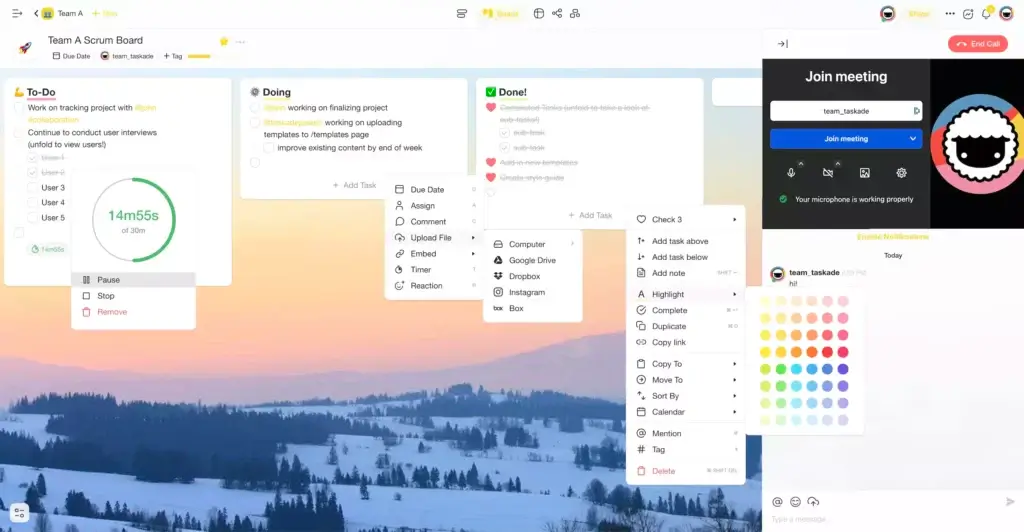
Scrum board in Taskade board view.
Scrum Roles
In Scrum, there are three primary roles:
The product owner
The scrum master
The development team
Product Owner
Product owners decide how to proceed next while representing the customer's interests. Their goal is to ensure the team stays focused on the most critical tasks that generate the most value.
A product owner must always be available to guide the development team or provide input as needed, but the goal isn't to manage the group; the most effective scrum teams self-organize.
Scrum Master
The scrum master's primary goal is to help the development team stay independent. They intercept and remove obstacles to project progress, acting as a buffer between outside forces that interfere with team productivity.
The product owner is responsible for WHAT the team builds, and the scrum master is responsible for HOW by leading daily standup meetings.
Development Team
Development teams are composed of members with multiple functions so the group can have all the skills in-house. A development team focuses on a single project at a time; members don't split their efforts across multiple projects or multitask.
Once a product owner creates a list of necessary tasks, the development team determines how much they can achieve in one sprint and builds the rest of the plan accordingly. The team would then keep track of their progress via daily scrum meetings.
Core Values
As an Agile framework, Scrum's values mimic that of agile methodologies. However, it does also have its own guidelines:
Openness: Teamwork and transparency are essential; collaboration is the most effective way to create a valuable product.
Focus: There is no multitasking with Scrum. Because productivity is crucial, it is important not to split team focus across multiple projects or redirect a member's focus in the middle of a sprint. Instead, Scrum teams concentrate on the single task at hand to deliver the best quality product.
Courage: Teams must have the ability to commit to an ambitious level of work per sprint. Scrum masters must also have the ability to stand up to stakeholders. The product owner must have the confidence to guide a development team with authority.
Commitment: Every sprint is a new commitment. A team must agree on what they will work on and plan to stick to it. This value helps teams determine whether a deliverable is finished; not only must the product be functional, but it must meet certain standards of quality.
Respect: Responsibilities and roles in Scrum are transparent. Each team member gets an equal amount of respect regardless of their seniority, job description, or status. The development team ultimately honors the authority of the product owner concerning what the team works on, and the product owner must respect the team's need to follow the process that works best for it.
⚙️ How Scrum Works
Scrum uses aggressive sprints to make iterative improvements in an Agile approach. Scrum teams coordinate to get large amounts of work done during these sprints, and each one is planned so members can complete lots of work without compromising release integrity or product quality. Each sprint works towards the ultimate product goal to ensure that the best possible product is produced.
The Scrum Process
When a customer brings a need to the team, the final product gets broken down into individual chunks. Then, the scrum team prioritizes these chunks and works on them in short bursts called sprints. Sprints can wrap under four weeks, although one or two weeks are the most common.
At the end of a sprint, the team delivers a product increment. Consider this increment as a product version that could be shipped if needed. Teams and stakeholders review sprint results together in a retrospective meeting since transparency is crucial in Scrum. This allows everyone to stay on the same page concerning deliverables, priorities, and any necessary adjustments.
Teams use daily standups to promote internal transparency. These brief 15-minute daily scrum meetings allow everyone to report what they achieved the day before, what they'll work on that day, and what impediments are currently keeping them from working more efficiently. This open visibility allows leaders to uncover problems so the team can overcome them together.
Sprint Planning, Review, and Retrospective
Scrum succeeds because it relies on self-organizing teams following a project management framework to deliver complete products after fixed periods called sprints or iterations. This structure includes roles, rules, meetings, and artifacts.
Product owner, scrum master, and the development team are the three critical roles involved in every scrum team. The team designs, manages, and communicates information to other members and key stakeholders.
There are four types of Scrum meetings that aid in the development of every product. These meetings are designated by when they appear in the development process:
Sprint Planning: Everyone on the team attends this meeting to present the product. All members are encouraged to voice their opinions and concerns. This meeting also addresses time estimates and identifies priorities to focus on.
Daily Scrum Meeting: Daily scrum meetings occur daily throughout a sprint. The purpose is to create a daily plan for product development and debrief the team. Any member of the Scrum team can address obstacles and concerns they face.
Sprint Review: Think of the sprint review as a check-up on the product a team works on during the sprint. Groups hold sprint reviews at the end of each sprint. The goal is to provide transparency for the stakeholders by revealing what was accomplished in the last couple of weeks.
Sprint Retrospective: These end-of-life retrospective meetings are meant to discuss how well the team performed in the last sprint. It is also the time to brainstorm how to improve team performance in the future.
Scrum practices help teams achieve and manage fluid product goals throughout the process. They also boost accountability by keeping team members informed across all project phases.
Artifacts
Scrum artifacts represent the work that's involved in completing a sprint, offering even more transparency and visibility. The three major artifacts in Scrum are:
Product Backlogs: The backlog of technical and user-centric aspects that must be completed in a project.
Sprint Backlogs: Tasks set during a sprint planning meeting that must be completed in one iteration.
Burndown Charts: This is the rest of the effort needed to complete sprint backlog tasks.
Scrum also leverages other tools, including:
User stories: Stories describe a feature of software from the perspective of the customer, detailing specific desirable variables like the type of user, what they want, and why they want it. The development team uses stories to create code that reflects customer wants.
Timeboxes: Timeboxes are predetermined periods where a team must work towards a goal. This approach stops work when the team reaches the limit, not necessarily when complete. Timeboxes are often used to reset goals and analyze progress.
🤔 Scrum Pros and Cons
Let's recap what we've learned so far. Here's an overview of Scrum:
The product owner makes a product backlog, or a wishlist of tasks the team should prioritize in a project.
The Scrum team has a sprint planning session. During this meeting, the wishlist of necessary tasks gets broken down into smaller chunks that are easier to manage and navigate.
The team generates a sprint backlog and plans on implementing it.
The team sets a time duration for each sprint for any amount under four weeks. The most common interval is about two weeks.
The team meets every day for a quick meeting called a daily standup. During this meeting, each member shares daily updates and helps the team and project manager assess how far along the project is.
The scrum master guides the team and helps them stay motivated and focused on the right tasks.
The product owner and stakeholders conduct a review after each sprint.
Pros
Scrum is a fine-detailed approach with specific ceremonies and roles for every step of the process. The benefits include:
Increased project visibility and transparency: Routine check-ins, daily meetings, and clearly-defined roles allow team members to retain insight into the project and eliminate misunderstandings and problems. It is easy to identify issues before they grow and cause delays, allowing processes to stay in motion.
Accountability: Together, the team decides what work they can accomplish during a sprint. Members voice concerns and opinions throughout every step. There isn't a project manager who silos jobs, which means increased empowerment and collaboration across group members.
More flexibility: Feedback loops are shorter so it's easier to accommodate changes along the way. During sprints, there is consistent reflection and room to refine execution through Scrum meetings.
Savings cost: Scrum brings obstacles to light before they cause delays. That helps companies spend less to develop better quality products across the board. Short sprints make it possible to fix mistakes quickly.
Cons
Scrum is not without its disadvantages. Here are some of them:
Scope creep: An emphasis on change and fluid goals can lead to scope creep. Stakeholders often want to add more functionality, which can suddenly and drastically change the process and goals.
Large teams aren't easy to manage: Scrum works best with small teams.
Teams require commitment and experience: With small teams, each member must be familiar with Scrum and all of its principles to succeed in their role. Anyone who lacks technical knowledge or can't commit will present a problem for achieving goals.
Scrum masters must have lots of knowledge: The wrong scrum master can stifle product success. If they try to control the team instead of trusting and overseeing them, the group will not produce a quality product; the Scrum process will fail.
Failure to define tasks can lead to inaccuracies: If the product owner doesn't accurately define the necessary tasks to focus on, then project timelines will reflect the inaccuracy down the road. Planning becomes harder and sprints can take longer than they're supposed to.
It is crucial to have good decision-making and proper planning to overcome the Scrum methodology's potential disadvantages. For instance, if a company uses a larger team, it is essential to have clearly-defined roles, responsibilities, and goals for each member to remove any excuse for failure. As a result, the team will stay focused and the scrum master will guide them more effectively.
Make sure that you have a project roadmap ready so that you can ensure that your team delivers the product on schedule.
🤹♂️ Most Effective Uses of Scrum
The Scrum framework is straightforward. The roles, rules, events, and artifacts are simple enough to understand. The semi-prescriptive approach actually removes many of the ambiguities that arise during the development process. Additionally, companies can still customize the process.
The best way to use Scrum is in a project that is meant to be flexible and easy and has enough definition to achieve targets and goals that the stakeholder or customer requires.
Scrum is defined by its sprints, so the best way to use it in Agile project management that can benefit from frequently re-examining goals, team roles, and required tasks.
Scrum has prescribed roles that project structure to a given project, but there is also plenty of room for assignments to shift based on the goals and timelines that evolve during the process.
It is also easier to tackle more complex, demanding projects with Scrum's organization into manageable user stories. Additionally, having clearly-defined roles and planned events allow collective ownership and plenty of transparency for the entire development cycle.
Finally, thanks to quick sprints, the team stays motivated, and the users are happy to see progress without waiting too long between releases.
Frequently Asked Questions
What is Scrum in agile project management?
Scrum is an agile framework for managing complex projects through iterative development cycles called sprints (typically 2-4 weeks). Teams self-organize around defined roles (Product Owner, Scrum Master, Development Team) and follow structured ceremonies — sprint planning, daily standups, sprint reviews, and retrospectives. Scrum emphasizes focus, collaboration, and adaptability, allowing teams to deliver working software incrementally while responding to changing requirements.
What are the key roles in a Scrum team?
Scrum has three defined roles: the Product Owner (owns the product backlog, defines priorities, and represents stakeholder interests), the Scrum Master (facilitates ceremonies, removes blockers, and coaches the team on Scrum practices), and the Development Team (cross-functional group of 3-9 members who self-organize to deliver sprint commitments). Each role has distinct responsibilities — the Product Owner decides 'what' to build, the team decides 'how,' and the Scrum Master ensures the process works.
How do Scrum sprints work?
A sprint is a fixed time period (usually 2 weeks) during which the team commits to completing a set of backlog items. It starts with Sprint Planning (selecting items from the backlog), continues with Daily Standups (15-minute check-ins on progress and blockers), and ends with a Sprint Review (demonstrating completed work) and Retrospective (reflecting on process improvements). The cycle repeats, with each sprint producing a potentially shippable product increment.
What tools support Scrum agile project management?
Effective Scrum tools need sprint boards, backlog management, burndown charts, and team collaboration features. Taskade supports Scrum workflows with multiple project views (including Board for Kanban-style sprint boards, List for backlogs, and Calendar for sprint timelines), real-time collaboration, AI agents that can automate sprint reporting and backlog grooming, and built-in video chat for daily standups — all in one workspace without switching between multiple tools.
👋 Conclusion
It can take some time to fully understand Scrum, especially if the software team is used to the traditional waterfall model of development. Scrums are the complete opposite of waterfall as Scrums utilize agile methodologies to get things done. Introducing smaller iterations, daily meetings, sprint reviews, and identifying who will be a scrum master can be a challenging shift for new teams.
Still, the long-term benefits strongly outweigh the initial learning curve.
Scrum has offered much success for agile teams developing complex software and hardware products across numerous industries. It's a compelling framework to adopt for any organization.
💡 Before you go... Want to learn more about effective project management? Be sure to check other similar stories on the blog. Till next time!