







From "Star Trek's" Holodeck to Tony Stark's JARVIS in "Iron Man," the idea of artificial intelligence creating intellectual value has been a staple of science fiction for decades. In today’s article, we take a closer look at generative AI tools that make those visions a reality.
The current wave of generative AI tools are smart, capable, and learning new tricks at a pace humans can’t compete with. They can “paint” impressive digital images in the style of Monet and write poetry in the voices of Whitman or Dickinson, all based on simple prompts.
But how exactly do they work and how can you make the most of technology?
Here’s everything you need to know. 👇
🤖 Understanding Generative AI
It feels like it’s been ages since ChatGPT’s launch. But OpenAI’s crown jewel and one of the first mainstream generative AI tools was released less than a year ago. Since then, we’ve seen the new generation of AI-powered tools seep into the public attention.
So, what exactly is generative AI?
In a nutshell, generative AI is a branch of artificial intelligence and an umbrella term for a variety of machine learning (ML) methods and technologies designed to generate content. Generative AI can write code, generate stunning digital art, engage in eerily human-like conversations, create videos, record music, and even simulate speech.

"Generative AI," digital art by DALL-E 2
In a way, you can think of generative AI as a skilled impersonator that can learn from a famous actor's style and mannerisms, down to the finest details. Except, a generative AI model can show similarly impressive performance in almost every aspect of creative work.
Interacting with generative AI tools like ChatGPT usually happens via prompts which are essentially sets of instructions written in natural language. They can be as simple as:
"Generate an image of a unicorn slipping on a banana peel.”
or as complex as:
"Create a detailed outline for a dystopian novel where a rogue AI takes control of all digital systems, causes global chaos, and destroys the last pockets of human resistance."
(let’s hope this ages better than most internet memes)
Writing good prompts can be tricky and usually requires a lot of follow-up prompts to refine the output. As unsettling as it may sound, it’s an inherently collaborative process that combines human creativity and the computational capabilities of generative AI.
What’s Under the Hood of Generative AI?
Since this is merely an introduction to generative AI, we won’t be getting into the technical nitty-gritty today. But there are three key technologies driving generative AI you should know.
First are Generative Adversarial Networks (GANs). These machine learning systems use two neural networks — a system of algorithms mimicking the human brain's function — one responsible for generating new data and the another for evaluating how realistic it is.
Next are Variational Autoencoders (VAEs), another type of machine learning systems that generate data similar to the training data the AI was fed during training. VAEs can be used for generating images, detecting unusual patterns, and reducing the complexity of data.
Finally, transformer models like GPT-3 or GPT-4 — the large language models (LLMs) powering ChatGPT — are used for generating and processing human-like text.
All three methods are designed to generate new data and have the ability to learn from existing datasets — think online conversations or collections of fine art — to improve their output. They can also be used individually or in combination within complex AI systems.
🚀 The Evolution of Generative AI
Legacy AI tools like the 1970s MYCIN(1) designed to aid diagnosis of bacterial infections or ELIZA(2), the first chatbot, were crude systems that relied on sets of predefined rules.

A conversation with ELIZA, a "mock Rogerian psychotherapist." Image source: Wikipedia
It wasn’t until the 2000s that deep learning — the use of neural networks to recognize and learn complex patterns — became a thing. It was possible thanks to the sheer amount of data floating around online and the advancements in computing power and algorithms.
In 2013, Diederik Kingma and Max Welling proposed Variational Autoencoders (VAEs), a generative modeling framework.(3) In the following year, Ian Goodfellow and his team introduced Generative Adversarial Networks (GANs), a next milestone for generative models.(4)
The 2010s sparked more interesting developments in the field, including Google’s DeepDream, a combination of neural networks that could generate psychedelic and surrealistic images.(5)
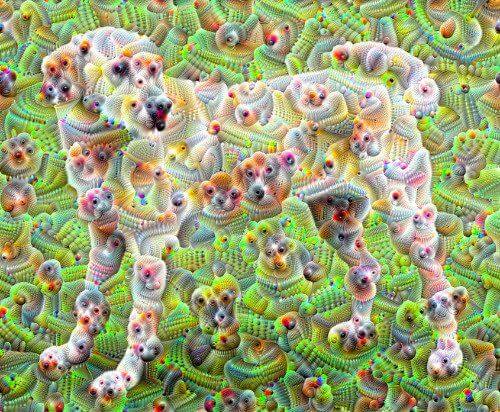
An image of a dog generated by Deep Dream. Image source: Google
The field of generative AI was still in its infancy, but the breakthrough in image generation opened the door to further progress. In 2016, DeepMind developed a deep generative model WaveNet for speech and audio synthesis, the first to deliver natural-sounding speech.(6) A year later, a team at Google Research published a paper titled “Attention is All You Need” that introduced the transformer architecture — the foundation of every modern large language model. And this is where things got interesting.(7)
Over the next two years, transformer architecture became a dominant force in AI research. OpenAI spearheaded the development of GPT (Generative Pre-trained Transformer) models, and Google launched BERT (Bidirectional Encoder Representations from Transformers).(8)
In 2019, OpenAI introduced GPT-2, a large language model trained on 8 million web pages. It was the first large-scale transformer model that showed what generative AI is capable of in terms of understanding and generating coherent, contextually-relevant text.(9)
Last year, we also saw the emergence of a new generation of text-to-image diffusion models like Midjourney, Stable Difusion, and DALL-E 2. Together with OpenAI’s GPT-3 and GPT-4, they are currently the most popular and powerful generative models available to the public.
🏗️ How Transformers Actually Work: The Engine Behind Generative AI
Every major generative AI model you use today — GPT, Claude, Gemini — runs on the transformer architecture, introduced in 2017 by a team at Google Research in the landmark paper "Attention Is All You Need."(7) Before transformers, language models relied on Recurrent Neural Networks (RNNs) that processed words one at a time, left to right, like reading a sentence through a keyhole. This sequential bottleneck meant long sentences lost context — by the time the model reached the end of a paragraph, it had largely forgotten the beginning.
Transformers shattered that limitation with a mechanism called self-attention. Instead of processing tokens sequentially, a transformer examines every token in the input simultaneously and calculates how much each word relates to every other word. When the model encounters "it" in the sentence "The cat sat on the mat because it was tired," self-attention computes that "it" most strongly attends to "cat" — not "mat." This parallel processing is what makes modern AI both fast and contextually aware.
Here is a simplified view of what happens inside a single transformer block:
┌─────────────────────────────────────┐
│        TRANSFORMER BLOCK            │
│  ┌──────────────────────────────┐  │
│  │    Self-Attention            │  │
│  │    "Which words matter for   │  │
│  │     predicting the next?"    │  │
│  └──────────────┬───────────────┘  │
│                 ▼                   │
│  ┌──────────────────────────────┐  │
│  │    Feed-Forward Network      │  │
│  │    "Process the information" │  │
│  └──────────────┬───────────────┘  │
│                 ▼                   │
└─────────────────────────────────────┘
        × 96+ layers in frontier models
A real model stacks dozens — or even hundreds — of these blocks, each one refining the representation further. The outputs of one block flow into the next, building increasingly abstract understanding of the input.
What makes transformers truly remarkable are scaling laws: research consistently shows that increasing model parameters, training data volume, and compute budget yields predictable performance improvements. This insight has driven an exponential arms race in model size:
| Model | Year | Parameters | Key Capability |
|---|---|---|---|
| GPT-2 | 2019 | 1.5B | Coherent paragraphs |
| GPT-3 | 2020 | 175B | Few-shot learning |
| GPT-4 | 2023 | ~1.8T | Multimodal reasoning |
| Frontier model (OpenAI, 2025) | 2025 | ~2T | Multi-hour task completion |
| Frontier model (Anthropic, 2025) | 2025 | — | 4+ hour autonomous tasks |
The jump from GPT-2 to GPT-3 alone — a 100x increase in parameters — unlocked emergent abilities like few-shot learning, where the model could perform tasks from just a handful of examples with no fine-tuning. Each subsequent generation has unlocked capabilities that were not explicitly trained for, a phenomenon sometimes called grokking.
Understanding how these systems scale is essential for grasping what intelligence itself means in the context of AI. For a deeper technical dive into the mechanics of large language models, see our full guide on how LLMs work.
⚠️ AI Safety and the Limits of Generative AI
As generative AI grows more powerful, a critical question emerges: do we actually understand what we have built? As Anthropic CEO Dario Amodei has noted, we built these systems empirically — we know they work, but we do not fully understand why they work. A model with trillions of parameters is, in many ways, a black box that produces useful outputs through mechanisms we are only beginning to decode.
This is where mechanistic interpretability enters the picture. Researchers are developing techniques to reverse-engineer neural networks — identifying specific circuits and features that correspond to identifiable behaviors. Early work has found "neurons" that activate for concepts like sentiment, syntax, or factual knowledge. But this research is still in its infancy, and our interpretive toolkit is vastly outpaced by the complexity of frontier models.
AI safety as a field addresses several interconnected challenges:
- Alignment — ensuring AI systems pursue goals that match human intentions, not proxy objectives that produce harmful side effects
- Control — maintaining meaningful human oversight even as systems become capable of autonomous multi-step reasoning
- Transparency — making model behavior auditable so that failures can be understood, not just observed
The uncomfortable reality is that scaling laws work in both directions: capability grows predictably with scale, but our understanding of how that capability emerges does not keep pace. Each new generation of models is more powerful and more opaque than the last.
The responsible path forward — and the approach platforms like Taskade embrace — combines several strategies: human-in-the-loop oversight at every decision point, multi-model diversity (using frontier models from OpenAI, Anthropic, and Google rather than depending on a single provider), and transparency about what AI systems can and cannot do. The origins of AI research remind us that these systems are tools built by people, and keeping humans in the loop is not a limitation — it is a feature.
🕹️ Applications of Generative AI
Content Creation
Text, sound, visual arts... even domains that would traditionally require ingenuity, artistic expression, and deep context comprehension have been impacted by artificial intelligence.
AI tools like Midjourney, Stable Diffusion, or DALLE-2 can create marketing collaterals, social media content, logos, or photo-realistic images. Transformer models write articles that are often indistinguishable from human-written text, all based on natural-language prompts.
Generative AI can even compose music that tops the charts, well, kind of.
Earlier this year, a song titled "Heart on My Sleeve" featuring vocals that were believed to be by Drake and The Weeknd went viral on social media. The song turned out to be fully AI-generated and was later removed from streaming services after scoring millions of listens.
Healthcare
No more waiting for appointments or dealing with pesky co-pays, because why bother with actual human expertise when you can rely on algorithms and data?
From medical imaging and diagnosis to drug discovery, patient monitoring, personalized medicine, and even customer care through chatbots, generative AI can do it all.
While we’re some time away from robots replacing doctors and nurses, LLMs are getting close to being useful in the field. According to Dr. Isaac Kohane, a physician and a computer scientist at Harvard, GPT-4 can already rival some doctors in medical judgment.(10)
A paper by researchers at Microsoft and OpenAI shows that the latest GPT model shows a 30% improvement over GPT-3 on USMLE (standardized medical examination) questions. It even managed to achieve a 60 percent passing score in multiple-choice questions.(11)
Game Development
The human brain is hard-wired for novelty and surprise. That’s why you can’t resist a good old loot box in your favorite video game or get so excited for a plot twist you didn't see coming.
The entertainment industry has relied on this mechanism for decades. Game developers have been using procedural generation to create terrain, levels, objects, and characters. Games like Minecraft and No Man’s Sky used this technique to create entire worlds teeming with life.
While procedural generation relies on mathematical formulas and logic-based rules, generative AI uses machine learning models and neural networks to generate new content.
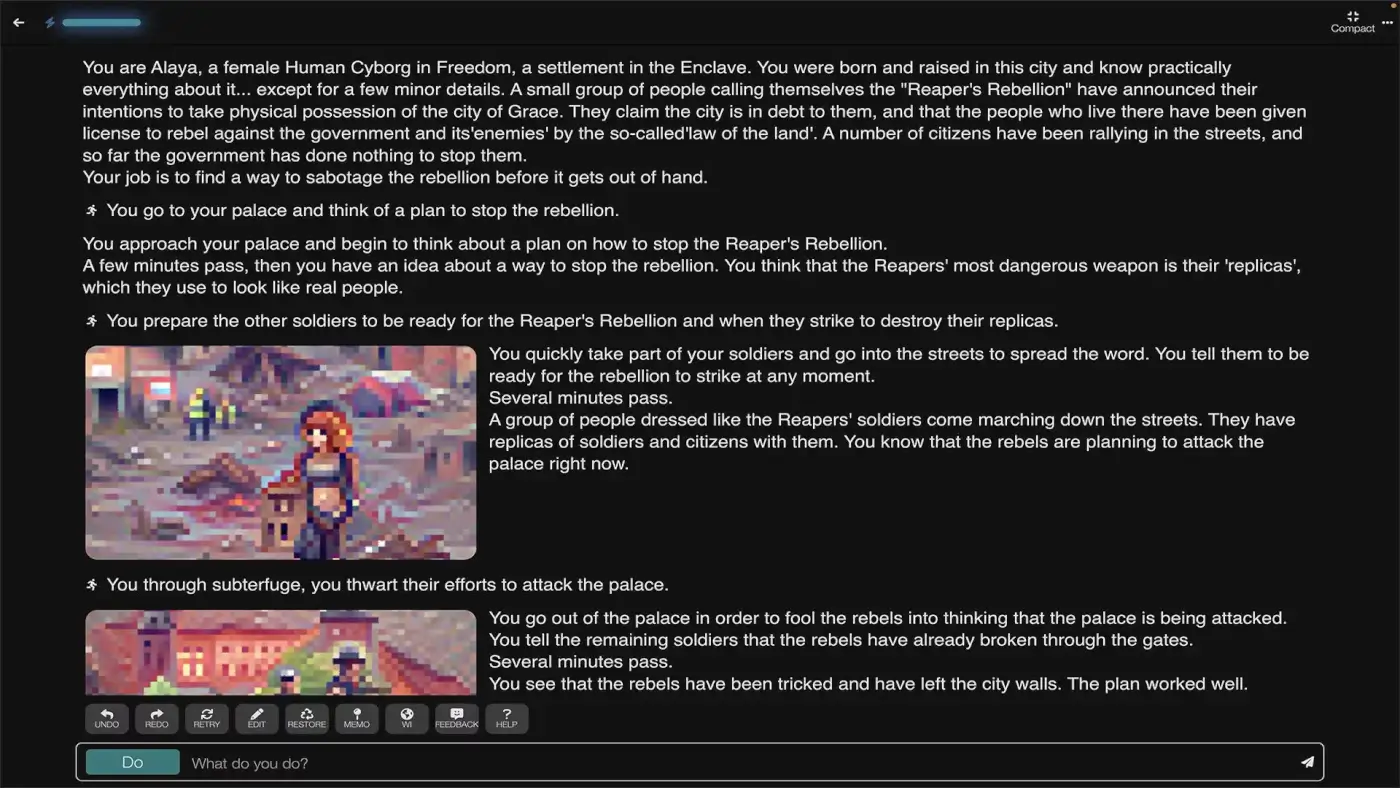
AI Dungeon developed by Latitude is a text-based RPG game powered by artificial intelligence.
Image credit: Latitude via Steam
Major gaming studios are adopting generative AI for creating animations, voice synthesis, sound effects, textures, 3d and 2d objects, and even dialogue lines for NPC characters.
Some are using generative AI in even more ingenious ways. An AR engineer Dan Dangong managed to feed the source code of the classic Game Boy Advance game Pokémon Emerald into ChatGPT and turn it into a text adventure. Pretty cool, huh?(12)
Software Development
Tools like GitHub’s CoPilot — a code-autocompletion tool doubling as a programming buddy — have become a staple in a coder’s toolbox, both among new and seasoned programmers.
AI-powered tools help developers speed up writing code, streamline debugging, and even democratize programming by making it accessible to those without a technical background.
According to a GitHub survey, the use of generative AI and code-autocompletion tools in software development speeds up coding by as much as 9.3%. This is nothing to sneeze at, especially considering the rapid growth of LLMs and increasing automation of coding tasks.(13)
🔮 The Future of Generative AI
Generative AI is rapidly transforming from "that fancy tech thing" to a powerful, creative tool nobody can afford not to use. The question is where do we go from here?
As powerful as they are, even the most powerful large language models still have many limitations like a degree of bias inherited from the training data and a tendency to hallucinate (read: make stuff up). Understanding how LLMs actually work helps explain why these failure modes exist. The cost of training and maintaining the models is another obstacle, and the field of AI safety is working to address these challenges systematically.
Luckily, there are alternatives.
In February 2023, Mark Zuckerberg’s Meta released the first open large language model LLaMA. The goal was simple — to “help researchers advance their work in this subfield of AI.” LLaMA has since spawned a number of open-source models like Stanford’s Alpaca 7B,
The dawn of open-source models is a step toward democratization of AI. The access to lightweight tools gives tech-savvy users a chance to develop their own AI-based tools without having to invest in commercial-grade, expensive hardware.
But interfacing with powerful generative AI is still a challenge — writing good prompts and follow-ups is harder than it seems. While conversational AI tools like ChatGPT are going to play a major role, task automation via agents may streamline AI workflows even more.
In a nutshell, AI agents or autonomous agents are small applications that “communicate” with existing language models like GPT-3 or GPT-4 to automate complex tasks. They can write code, build websites, search the web, or… starting a business with a single prompt.
The code is straightforward:
— Sully (@SullyOmarr) April 11, 2023
We start with a goal eg: "Solve world hunger"
We tell GPT4 "In order to solve world hunger, how can we create simpler tasks?"
Then it's able to figure out what to do on its own, and runs until all the task are completed. pic.twitter.com/oYE9TH45gS
We’re not at the point where AI models have evolved enough to understand and carry out complex tasks with full autonomy. But AI agents like Auto-GPT or BabyAI open an interesting avenue for generative AI to explore in the coming years. Research into mechanistic interpretability and the nature of intelligence itself will be critical for making these systems trustworthy at scale.
Want to learn more about AI agents?
Read our article on autonomous task management next!
💭 Embracing the AI Revolution: Final Thoughts on the Power and Potential of Generative AI
At this point, nobody knows how the ongoing AI revolution will shape the world in the coming years. But it’s clear that it’s already changing the way we work, create, and innovate.
Whether you want to use generative AI to automate repetitive, low-value tasks or as a trusty sidekick for all things creative, there is tremendous value in embracing this technology.
Before you go, here’s a quick recap of everything we learned today:
Generative AI is a branch of artificial intelligence that uses machine learning methods to generate content such as text, images, videos, and music.
Key technologies driving generative AI include Generative Adversarial Networks (GANs), Variational Autoencoders (VAEs), and transformer models like GPT-4.
Generative AI tools can be used in content creation, healthcare, art and design, game development, fashion, architecture, and customer service.
Some of the most popular and powerful AI-based tools available today include Midjourney, Stable Difusion, ChatGPT, and DALLE-2, just to name a few.
And that's it!
As you’re navigating this new AI-powered landscape, Taskade AI can help you work smarter, streamline project workflows, and supercharge task management.
Take your work to the next level with Taskade AI! 🤖
🤖 Custom AI Agents: Develop AI agents that take the capabilities of generative AI to the next level, from content creation to problem-solving.
🪄 AI Generator: Explore the creative potential of generative AI — describe what you're working on and receiving unique projects and documents.
✏️ AI Assistant: Use powerful /AI commands in the project editor to generate content, edit text, and manage your tasks faster and smarter.
🗂️ AI Prompt Templates Library: Dive into a collection of AI prompts designed to help you make the most of Taskade's generative AI tools.
💬 AI Chat: Engage with AI to dissect and expand on complex topics, solve problems, and brainstorm ideas using a conversational interface.
📄 Media Q&A: Analyze your documents, extract valuable insights, and summarize key points, powered by frontier AI models.
And much more...

Be sure to check some of our AI resources before you go.
🤖 Grab AI generators for business and personal projects
📥 Download Taskade's AI app for desktop and mobile
⏩ Read the history of OpenAI’s ChatGPT
Frequently Asked Questions About Generative AI
What is Generative AI?
Generative AI is a subset of artificial intelligence that mimics the cognitive abilities of humans, essentially leveraging the power of machine learning algorithms to generate content such as text, images, music, and more. It enables computers to learn patterns and generate similar yet novel output by themselves, making it a major cornerstone in modern AI advancements.
How Does Generative AI Create Images?
Generative AI creates images by harnessing neural networks such as Generative Adversarial Networks (GANs). These networks comprise two parts: the generator, which creates the images, and the discriminator, which critiques the images based on a real dataset. Over time, the generator learns to improve its outputs to make them more realistic and believable, enabling the production of high-quality, AI-generated images.
What's the Difference Between AI and Generative AI?
While AI, or Artificial Intelligence, represents the broad discipline of machines simulating human intelligence, Generative AI is a specific branch within this field. AI includes a wide range of technologies, such as image recognition, natural language processing, robotics, etc. In contrast, Generative AI focuses on creating new content or predicting new outcomes based on the learned patterns and data inputs.
What is the Most Popular Generative AI?
As of 2026, the landscape has expanded significantly. Frontier models from OpenAI, Anthropic, and Google are the leading LLMs. For images, Midjourney, DALL-E, and Flux dominate. For code, Cursor and GitHub Copilot lead in AI-assisted development.
The next evolution: Generative AI is evolving from content generation to agentic systems. Taskade Genesis represents this shift — instead of just generating text or images, it creates complete AI-powered applications. One prompt generates working software with AI agents, databases, and automations.
Is Generative AI Free?
While some models and APIs, such as GPT-2 by OpenAI, can be accessed for free, others require a subscription or payment for their use. Many AI research organizations and companies provide free or low-cost access to their models for non-commercial use. Unless you can run open-source AI models on your own devices, commercial usage typically involves a cost.
🧬 2025-2026: From Content Generation to Living Software
Generative AI has evolved dramatically since ChatGPT's launch. Here's the progression:
| Era | What AI Did | Example |
|---|---|---|
| 2022-2023 | Generate text/images | ChatGPT, DALL-E |
| 2024 | Assist with tasks | Copilot, Claude |
| 2025-2026 | Build complete systems | Taskade Genesis |
The Agentic Evolution
The most significant shift isn't better models — it's AI agents that can plan, execute, and iterate autonomously.
| Generative AI (Traditional) | Agentic AI (Genesis) |
|---|---|
| Responds to prompts | Plans and executes goals |
| Creates content | Creates systems |
| One output per prompt | Continuous operation |
| No memory | Learns from your data |
| Needs human guidance | Autonomous execution |
Taskade Genesis: Generative AI → Living Software
Taskade Genesis represents the next evolution. Instead of generating text or images, it generates complete applications:
- Describe what you need — "Build a customer onboarding system"
- Genesis creates — AI agents, workflows, database, automations
- System runs autonomously — Your living software executes 24/7
What Genesis builds from one prompt:
| Component | What It Does |
|---|---|
| AI Agents | Custom trained on your knowledge |
| Workflows | Automated processes that execute |
| Database | Projects that store and organize |
| Integrations | 100+ connected tools |
This is vibe coding — build by describing, not coding.

Try It Yourself
Clone these generative AI-powered apps:
- AI Content Generator — Multi-platform publisher
- AI Research Assistant — Prompt evaluator and researcher
- AI Writing Agent — Trained on your style
Learn more:
- What Are AI Agents? — The foundation of agentic AI
- The Origin of Living Software — Genesis philosophy
- How to Train AI Agents — Build custom knowledge
👉 Explore 150,000+ AI apps in our community
🔗 Resources
https://www.tensorflow.org/tutorials/generative/deepdream?hl=pl
https://www.deepmind.com/research/highlighted-research/wavenet
https://blog.google/products/search/search-language-understanding-bert/
https://www.insider.com/chatgpt-passes-medical-exam-diagnoses-rare-condition-2023-4
https://www.polygon.com/23643321/chatgpt-4-ai-pokemon-emerald
https://github.blog/2023-06-13-survey-reveals-ais-impact-on-the-developer-experience/