







Critical thinking skills are one of the most valuable business assets of the 21st century. They help us make more informed decisions, challenge the status quo, and avoid costly thinking fallacies.
But did you know they can also make your remote team excel?

In today's article, we take a deep dive into the obscure world of critical thinking. We also revisit the concept of hierarchical tree structures and how the two go together.
💡 Before you start... This article is part of our series on hierarchical tree structures and knowledge management. Check other similar guides when you're done reading.
👑 A Case For Hierarchical Thinking: Solve Complex Problems The Easy Way
🧠 Here’s Why Your Team Needs Collaborative Mind Mapping Software
🤔 "So, What Is Critical Thinking?"
Most sources trace the origins of critical thinking to Socrates and his questioning method known as Elenchus (cross-examining, scrutiny, refutation).
The Greek philosopher would challenge his students by asking them series of probing questions to expose flaws in their reasoning and help them build foolproof arguments.
"Socrates pursued this task single-mindedly, questioning people about what matters most, e.g., courage, love, reverence, moderation, and the state of their souls generally."
Stanford Encyclopedia of Philosophy(1)
Socrates' questioning—as nagging as it was—forced his disciples to switch to a critical, objective mode of thinking, free of ambiguity, fallacy, or bias.
While the method is 2,500 years old, its premises are still valid today. If you want to give it a try, be sure to watch this awesome TED animation first for a quick introduction.
So, where were we? Ahh right! Here's a more modern definition of critical thinking by philosophers Michael Scriven and Richard Paul:
"Critical thinking is the intellectually disciplined process of actively and skillfully conceptualizing, applying, analyzing, synthesizing, and/or evaluating information gathered from, or generated by, observation, experience, reflection, reasoning, or communication, as a guide to belief and action."
Michael Scriven and Richard Paul via The Foundation for Critical Thinking(2)
You can think of critical thinking (pun not intended) as a daring exploration of the mental avenues we rarely visit. It's an intentional and self-directed investment of intellectual resources in the pursuit of higher knowledge.
"Overall, the application of critical thinking skills is a process—one must analyse, evaluate and then infer; and this process can be repeated to ensure that a reasonable conclusion has been drawn."
Christopher Dwyer, Ph.D. via Psychology Today(3)
In a nutshell, when you apply critical thinking to problems or ideas, you analyze them in a structured, meaningful, and intentional way. You take charge of your thoughts instead of letting them run wild and, well… do whatever wild thoughts do.
🗣 Why Does Critical Thinking Matter?
“Life punishes the vague wish and rewards the specific ask.”
Timothy Ferriss, Tribe of Mentors: Short Life Advice from the Best in the World(4)
According to the 2019 State of the Workplace survey by SHRM, critical thinking—along with problem-solving, innovation, and creativity—is the top sought-after soft skill of the modern workplace.(5)
And for all the good reasons.
The knowledge economy drives the demand for information processing through the roof. Each day, a typical knowledge worker needs to digests and make sense of (easier said than done) a staggering amount of data.
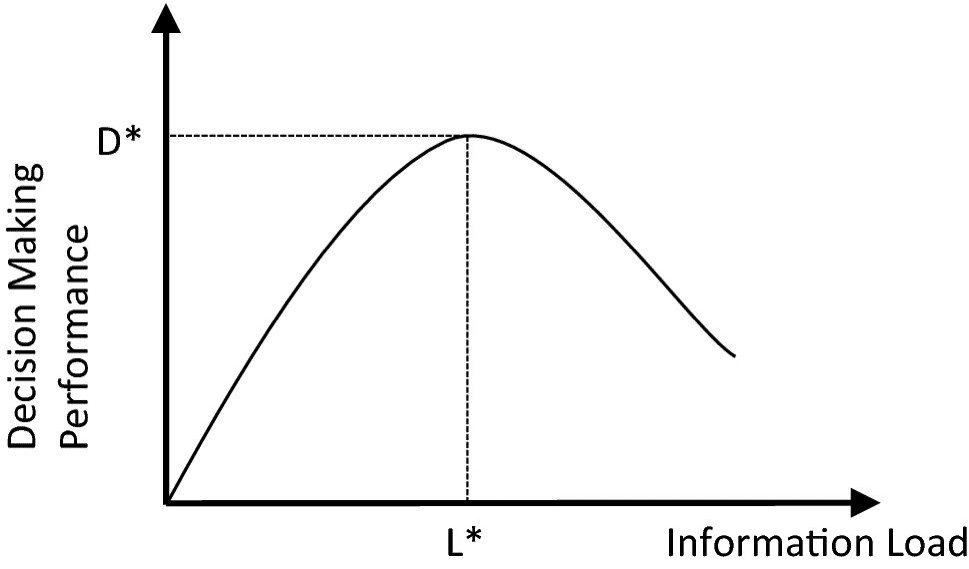
Information and Decision-Making Performance chart(6)
With so much information floating about, our thinking patterns often get skewed by bias, lack of context, prejudice, or fake news. Such obstacles affect both the output and quality of our work. Luckily, critical thinking is here to save the day.
Thanks to critical thinking skills, you can:
📌 Separate useful information from fluff.
🙈 Recognize and avoid thinking errors and fallacies.
👁 Approach problems from many perspectives.
✋ Avoid bad decisions and costly mistakes.
✊ Build stronger arguments.
🤔 Become more curious and inquisitive.
💡 Boost problem-solving and brainstorming skills.
🧠 Improve a wide spectrum of "thinking" skills.
When you live by the principles of critical thinking, you habitually take a step back before making a step forward. It doesn't get more commonsense than that.
🌳 Elon Musk's First Principles and Semantic Trees
"Read not to contradict and confute; nor to believe and take for granted; nor to find talk and discourse; but to weigh and consider."
"Of Studies," Francis Bacon
In our previous article on hierarchical tree structures (click) we discussed Elon Musk's pro learning tip he gave during a 2015 AMA session on Reddit.
Musk's belief that professional competence starts with the basics set him on the path to revolutionizing the commercial space industry.
And he seems to be doing pretty well in other fields too.
But his advice goes further than that.
In a 2013 interview, Musk said he attributes the success of his entrepreneurial pursuits to first principles or what Aristotle calls “the first basis from which a thing is known.”
“I tend to approach things from a physics framework. Physics teaches you to reason from first principles rather than by analogy. So I said, okay, let’s look at the first principles. What is a rocket made of? Aerospace-grade aluminum alloys, plus some titanium, copper, and carbon fiber. Then I asked, what is the value of those materials on the commodity market? It turned out that the materials cost of a rocket was around two percent of the typical price.”
Foundation 20 // Elon Musk(7)
First principles thinking is perfect for breaking down problems into more digestible bits. Instead of looking at a thing as an intimidating whole, you look at the individual components that can be managed more easily.
But there’s a problem.
Decomposing complex issues on the fly isn't always easy. You may lack context, be under time pressure, or end up thousands of kilometers away from your teammates.

Luckily, following Musk's advice, we can apply hierarchical tree structures—including mind maps, and decision/issue trees—to slip into a critical mode of thinking more easily. But more on that in a moment.
⚡️ Why Your Remote Team Needs Critical Thinking
Henry David Thoreau once said, "Think for yourself, or others will think for you without thinking of you." And you couldn't hope for a more timeless piece of advice.
A 2017 study by Joseph Grenny and David Maxfield found that remote workers are less likely to speak up and stand up for themselves than their co-located colleagues.
Rubbing salt into the wound, fully remote and hybrid teams often face communication barriers that stifle conversations and make a silent consensus the go-to option.
"Remote employees are more likely to report feeling that colleagues mistreat them and leave them out. Specifically, they worry that coworkers say bad things behind their backs, make changes to projects without telling them in advance, lobby against them, and don’t fight for their priorities."
Joseph Grenny and David Maxfield via HBR(8)
A passive approach to team interactions doesn't only hinder camaraderie. It also creates a team culture where social proof leads the way.
The voice of the group becomes infallible, even when it isn't.
If pundits tells you something is true, and you don’t have the critical thinking skills to evaluate their statements, then you are putty in their hands, as they shape your world view to their will.
— Neil deGrasse Tyson (@neiltyson) June 17, 2018
Teams apt at critical thinking challenge the status quo. They understand that authority doesn't automatically grant sound judgment and that talking heads are overrated.
Nobody put it better than physicist Richard Feynman. In his 1974 Caltech commencement address, "Cargo Cult Science," he gave us what might be the single most useful rule for thinking clearly:
"The first principle is that you must not fool yourself—and you are the easiest person to fool."
Richard Feynman, "Cargo Cult Science" (1974)
That's the root of critical thinking. Feynman lived it too—he was famous for re-deriving and checking claims himself rather than trusting an expert's tidy summary. The same instinct shows up in how the best operators run their teams. How Jensen Huang runs NVIDIA treats open feedback as a form of learning, so the whole team keeps checking each other's thinking instead of nodding along. Want to put it into practice? The Feynman Technique is a simple way to test whether you actually understand something, and asking better questions keeps your team honest about what it knows.
Critical thinking skills allow remote teams to:
🏃♂️ Act fast with little supervision or guidance.
📣 Get into civil disagreements with sound arguments.
👁 Spot faulty, inconsistent, or biased reasoning.
⚙️ Gather, process, and use information more efficiently.
🔧 Come up with nonlinear solutions to problems.
💡 Think outside the box and generate unique ideas.
The lesson for today?
You don't want complacency in your ranks. If you want your team to act autonomously and exercise sound judgment, give them the breathing room to think critically.

🧠 How to Implement Critical Thinking in Your Team
A remote critical thinking toolbox is minimalist by design. You need A) a team culture that supports critical thinking and B) a bunch of thinking tools to set things in motion.
So, what do you say we start from the beginning?
Make Critical Thinking Part of Team Culture
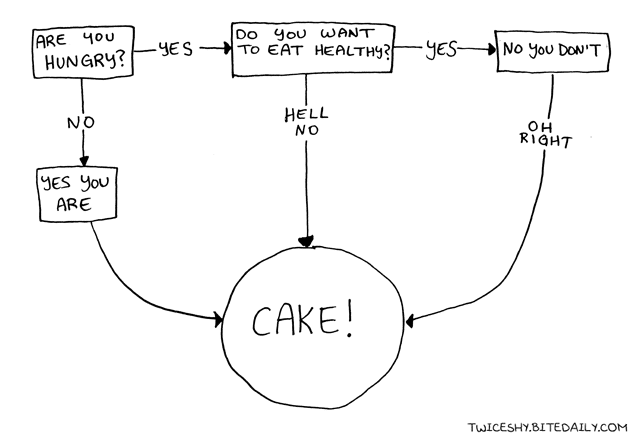
Remote workers are less likely to speak up—either because they fear criticism or face communication problems—even when decisions being made are plain stupid.
Cake! flowchart By twiceshy.bitedaily.com
But that's only one side of the coin.
According to the author of The Art of Thinking Clearly Rolf Dobelli, more often than not, the problem starts at the top of the totem pole.
"Especially at risk are firms with domineering CEOs, where employees are likely to keep their ‘lesser’ opinions to themselves – much to the detriment of the business."(9)
The solution? Cultivate a team culture that invites healthy disagreement. Let them be skeptical and make it OK to object. Encourage your team members to think critically and challenge the status quo when warranted.
“If you ever find yourself in a tight, unanimous group, you must speak your mind, even if your team does not like it. Question tacit assumptions, even if you risk expulsion from the warm nest. And, if you lead a group, appoint someone as devil’s advocate. She will not be the most popular member of the team, but she might be the most important.”
Rolf Dobelli, The Art of Thinking Clearly: Better Thinking, Better Decisions(9)
Invite curiosity and inquisitiveness. Let the team make small, independent decisions and see what happens. Progress to more autonomy if things pan out.
Create a Single Source of Truth (SSOT)
“We live in an information economy. The problem is that information’s usually impossible to get, at least in the right place, at the right time.”
Steve Jobs
Here's the thing. You can't expect people to make informed decisions if they don't have access to reliable, up-to-date business intel in the first place.
But there's a catch. Throwing a bunch of assorted statistics, documents, templates, or FAQs at your team won't work miracles.
As Dobelli continues, you should keep information bias in mind:
"Forget trying to amass all the data. Do your best to get by with the bare facts. It will help you make better decisions. Superfluous knowledge is worthless, whether you know it or not."(9)
The solution?
You need to make sure your team knows how to capture, curate, and organize only the relevant stuff. In other words, good stuff in, good stuff out.
Here's a handful of ideas to get you started (click on the links for detailed guides). 👇
🤝 Learn the basics of knowledge sharing.
👨💻 Implement an all-in-one Remote OS.
📝 Encourage collaborative note-taking.
🧠 Create a single source of truth (SSOT).
🗃 Build a teamwide digital Zettelkasten.
Taskade Pro Tip #1 🐑
Taskade lets you build a shared knowledge hub in a few clicks.
All you need to do is create a new Workspace, invite collaborators, and populate the space with Projects that will store notes, documents, templates, and other resources.
Watch this short video (3 minutes) to learn how. 👇
And now, let’s take the hierarchical tree structures we mentioned earlier.
Find Root Causes of Problems With Issue Trees
Tree structures are visual renditions of whatever you're working on. You can use them to map out problems, concepts, ideas, or hierarchical systems of elements.
The traditional elements of a tree structure include a root, branches, and leaves/nodes, each representing elements of a group and their relationships.
Here's an example. 👇
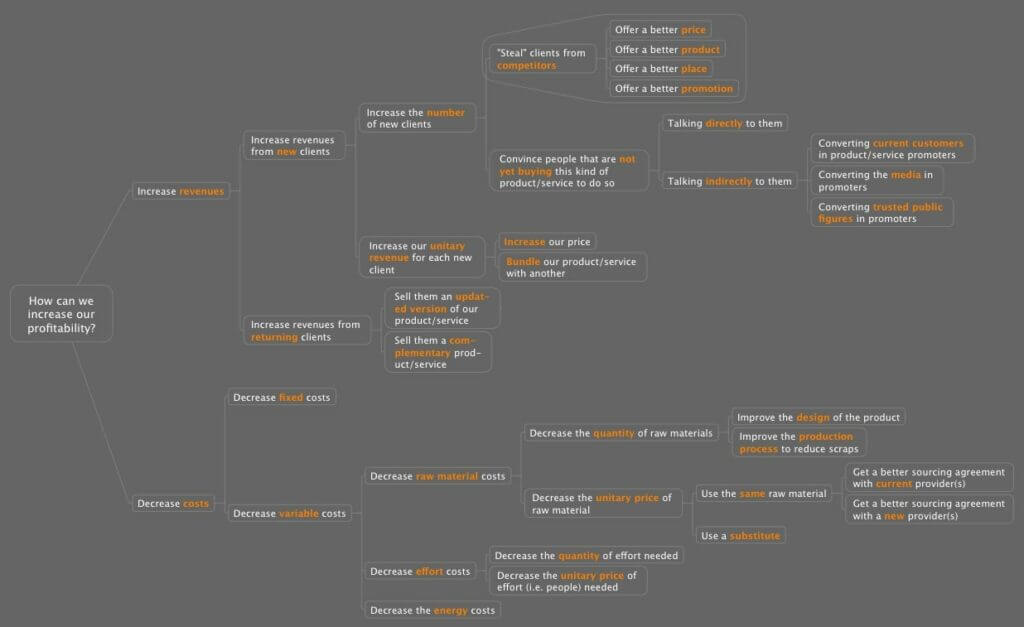
"How to Increase Profitability" by Arnaud Chevallier via Wikipedia(10)
Issue trees aid critical thinking by exposing all aspects of a problem. They represent an issue in a structured way, with all components and their relationship spread out.
Taskade Pro Tip #2 🐑
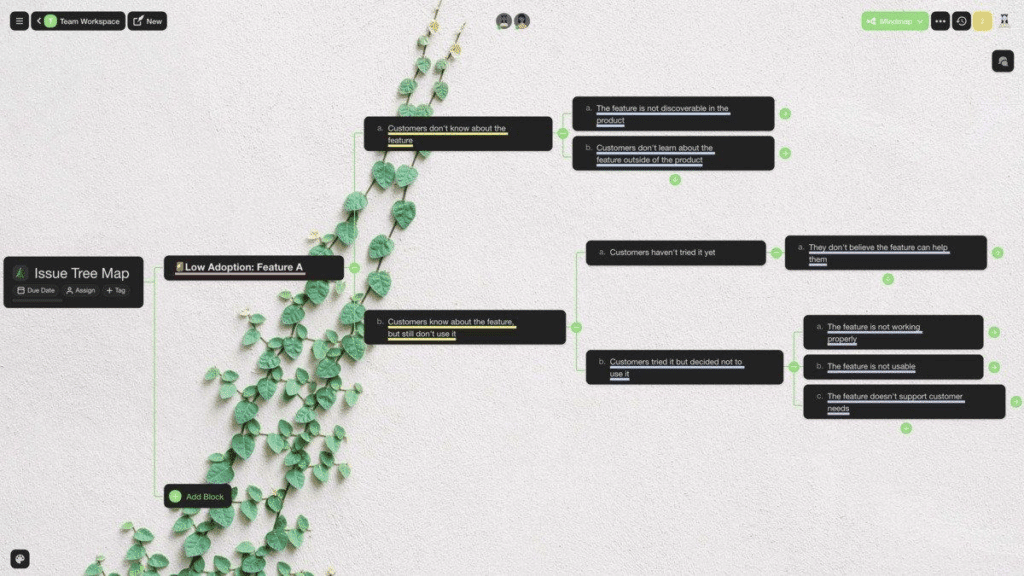
To create a collaborative issue tree in Taskade, open a new Project and invite a few team members for starters. Don't forget to set the Project to the Mindmap or Org Chart view first!

With the basic framework ready, place the problem you want to analyze on the left/at the top of the structure. Discuss it with the team and try to carve out smaller underlying issues.
Take the Right Course of Action With Decision Trees
Making fast and accurate decisions remotely is a heck of a challenge. There are communication hiccups, time-zone differences… you get the picture.
All that stacks up to a hectic and stressful decision-making environment.
"Inexperienced, and in an emergency situation for the first time, my head quickly generated a worst-case scenario. I didn’t see what I wanted to see. I saw what I was afraid of seeing. Critical thinking is always difficult, but it’s almost impossible when we are scared. There’s no room for facts when our minds are occupied by fear."
Factfulness, Anna Rosling Rönnlund, Hans Rosling, and Ola Rosling(11)
Decisions trees are a perfect way to take back control. They let teams visualize the decision-making process and keep emotions, prejudice, and bias out of the picture.
Here's an example. 👇
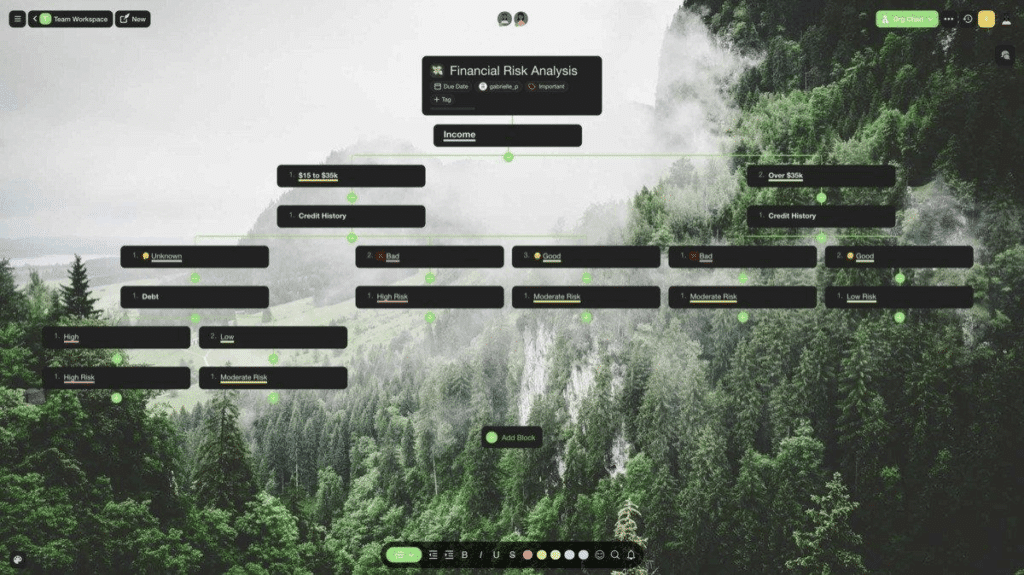
Decision trees visualize the moving parts of a decision-making process. They improve comprehension and show a possible course of action/required resources/consequences of each decision.
Taskade Pro Tip #3 🐑
To create a decision tree in Taskade, select the Mindmap or the Org Chart view. Both will give your team a bird’s-eye view of the decision-making process.
Start by placing the first question/seed idea at the top of the diagram. Next, break the process down by adding new branches representing possible outcomes/variables.
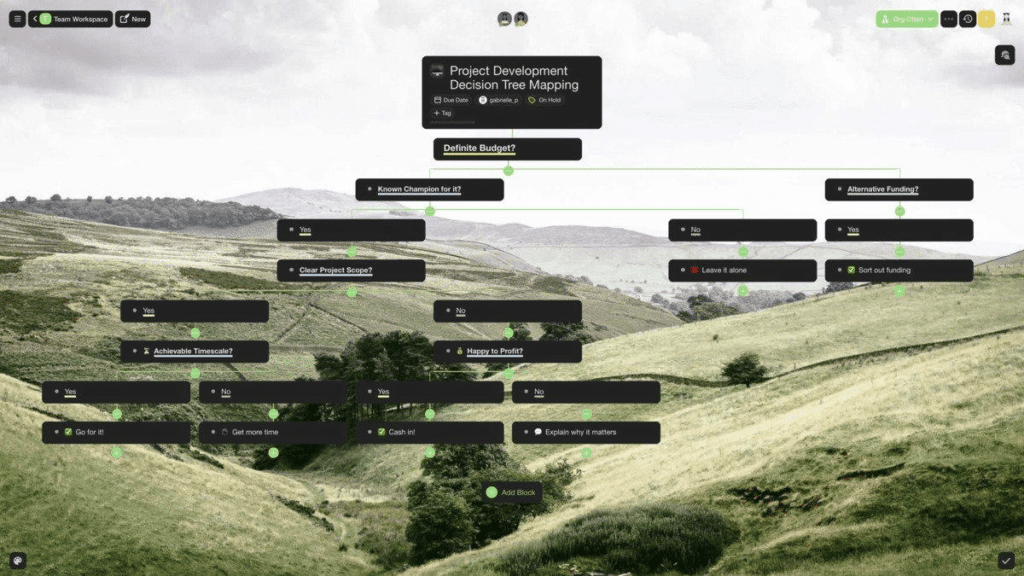
Discuss the results with the team and formulate a strategy. Scrutinize each outcome and try to estimate costs and yields for each outcome.
Boost Creativity with Mind Maps
Mind mapping is a great way to generate ideas without the burden of censorship or criticism. It's the most valuable tool in the critical-thinking toolbox.
“The essence of critical thinking is suspended judgment; and the essence of this suspense is inquiry to determine the nature of the problem before proceeding to attempts at its solution. This, more than any other thing, transforms mere inference into tested inference, suggested conclusions into proof.”
John Dewey, How We Think(12)
Mind maps encourage non-linear, out-of-the-box thinking. Since they defer the critical thinking part, they're excellent for coming up with a ton of ideas quickly.
Taskade Pro Tip #4 🐑
To mind map with your team, choose the Mindmap view and place the core concept or idea on the left of the diagram. You can use a single keyword or image as a "seed."
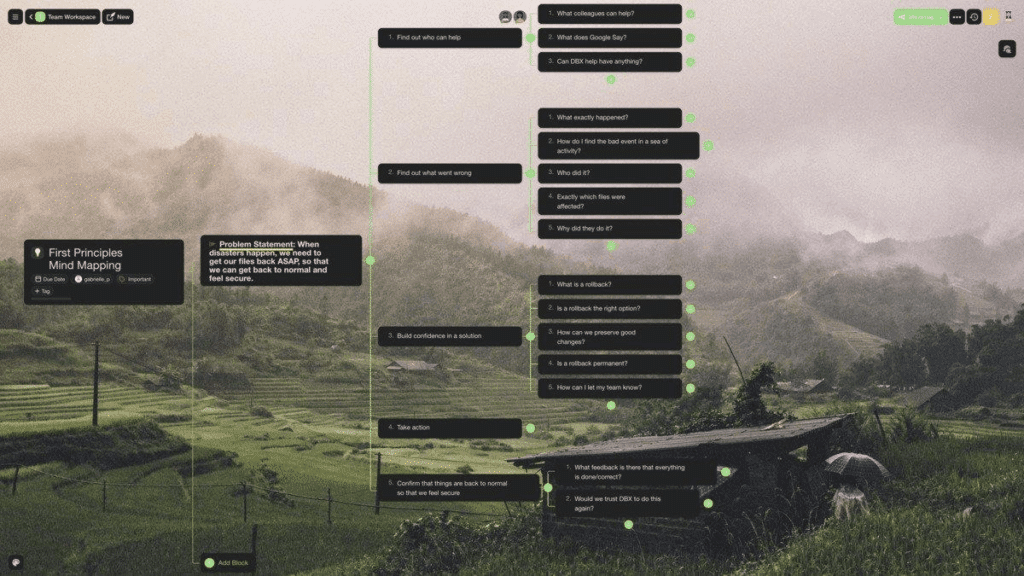
Create subsequent levels by adding peripheral, associated concepts. It's important to leave criticism and evaluation of the ideas for the very end of the session.
And that’s it!
💬 Parting Words
It doesn't matter if your team is facing a critical business decision, trying to solve an insurmountable problem, or brainstorming new marketing ideas. Solid critical thinking skills will help you move fast, avoid costly mistakes, and improve team autonomy.
✋ Before you go… We put together a set of critical-thinking questions for starters. Copy the template to your Workspace and share it with the team.
Till next time! 🐑
Amplify team intelligence with Taskade AI! 🤖
🤖 Custom AI Agents: Deploy AI agents to help manage your team's tasks and projects. Agents are perfect for organizing and streamlining work.
🪄 AI Generator: Use AI to streamline team project creation and documentation. Transform collaborative ideas into comprehensive plans.
✏️ AI Assistant: Leverage OpenAI GPT (frontier models) to enhance team writing, outlining, and document organization. Ideal for quick drafting and editing.
🗂️ AI Prompt Templates Library: Explore a broad selection of AI prompt templates to guide and stimulate your team's creativity.
💬 AI Chat: Engage with AI in team discussions to break down complex concepts, find solutions to challenges, or strategize for future initiatives.
📄 Media Q&A: Employ AI to analyze and summarize documents. Extract and share essential insights for faster decision-making.
And much more...

❓ Frequently Asked Questions
How did Richard Feynman approach critical thinking?
Richard Feynman's first principle was that you must not fool yourself, and you are the easiest person to fool. He verified claims against original evidence rather than trusting an authority's summary. Teams can build the same habit in a shared Taskade Workspace where assumptions are written down and checked together.