

Turning raw source code into clear, comprehensive documentation is one of the most time-consuming tasks in software development. Our AI Code to Documentation Converter analyzes your codebase and generates structured project documentation, from inline comments to full developer guides, so your team spends less time writing docs and more time shipping features.
Unlike tools that only add inline comments, Taskade transforms your code into a full documentation workspace. View your docs as a structured list, navigate module relationships on a mind map, track documentation coverage on a board, or export everything as Markdown and PDF for external stakeholders. With 15+ frontier AI models from OpenAI, Anthropic, and Google, the converter understands code in any language and generates documentation that is accurate, well-organized, and ready for collaboration.
How to Convert Code to Documentation With Taskade
Start by importing your file into Taskade or pasting code directly into a new project. The AI Assistant will parse your code and generate structured documentation covering function signatures, class hierarchies, module purposes, and usage examples. Switch between project views to organize by module, class, or function. Assign AI Agents to keep documentation in sync as your code evolves, and set up workflow automation to flag undocumented code automatically.
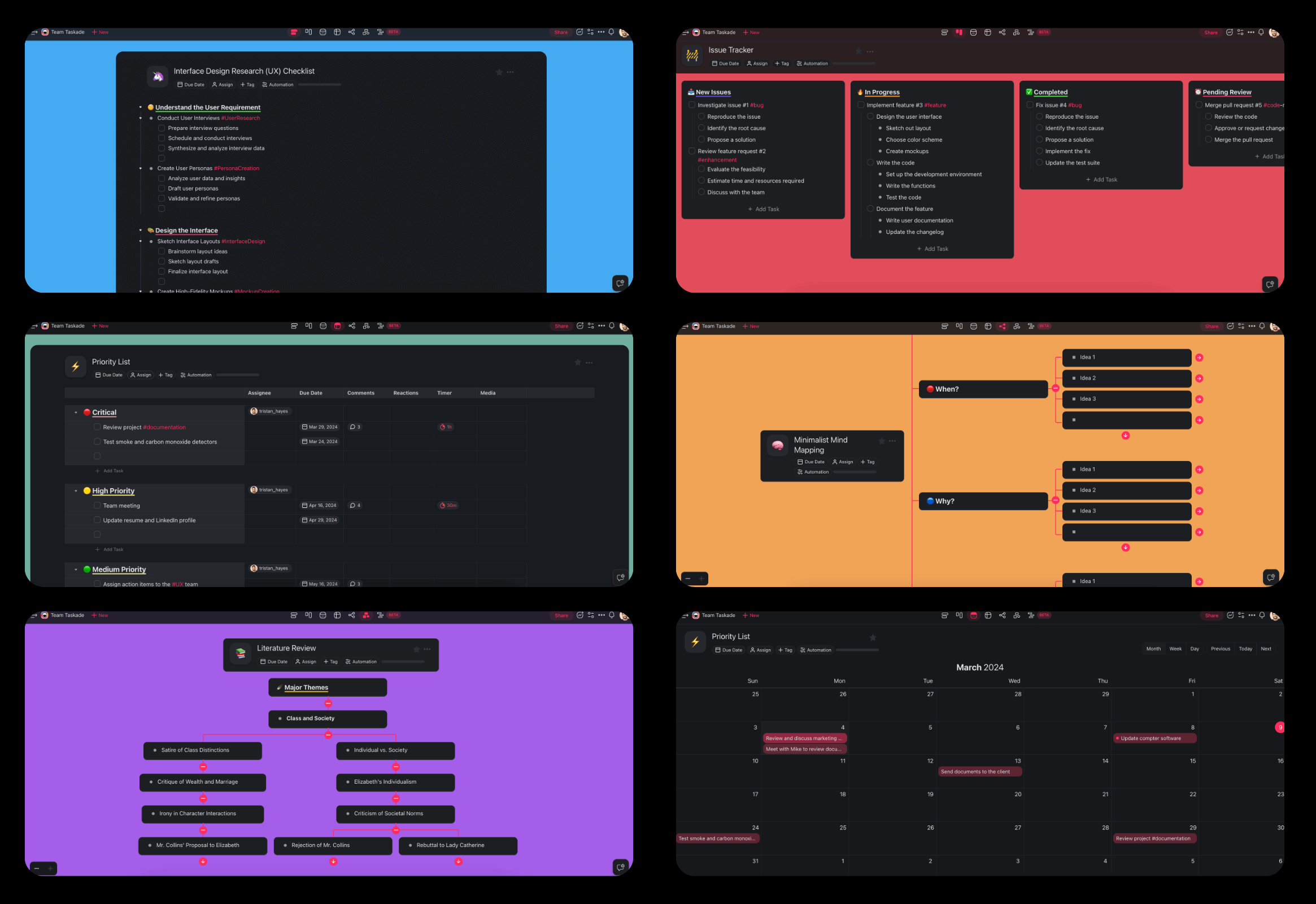
Taskade supports multiple project views so you can visualize documentation in the way that makes the most sense: List for traditional doc pages, Board for tracking doc coverage, Mind Map for mapping module relationships, Table for API endpoint grids, Calendar for doc review schedules, Gantt for documentation sprints, Org Chart for service hierarchies, and Timeline for release-based doc milestones.
Use Cases
Open Source Project Documentation
Generate contributor-friendly docs from your public repositories.
Create getting-started guides, architecture overviews, and contribution guidelines from code structure.
Auto-generate function and class references that stay current with each release.
Export as Markdown for GitHub wikis or static site generators like Docusaurus.
Include code examples and parameter descriptions extracted from docstrings and type annotations.
Enterprise Codebase Documentation
Maintain living documentation for large, multi-team codebases.
Map service dependencies and module boundaries on Mind Map view.
Track documentation coverage per team using Board view with custom columns.
Use permissions (Owner to Viewer) to control who can edit vs. view internal technical docs.
Set up recurring documentation review cycles with Calendar view reminders.
API Documentation
Transform backend code into structured API reference material.
Extract endpoint signatures, request/response schemas, and error codes automatically.
Organize endpoints by resource in Table view for quick scanning.
Share read-only API docs with external partners via Taskade's public sharing.
Generate authentication guides and rate limiting documentation alongside endpoint references.
Developer Onboarding Guides
Reduce ramp-up time for new hires with auto-generated onboarding material.
Generate "how this service works" walkthroughs from controller and service layers.
Create environment setup checklists from Dockerfiles, CI configs, and README fragments.
Assign onboarding tasks on a Board view so managers can track new hire progress.
Build interactive architecture tours using Mind Map view linked to code documentation.
Compliance and Audit Documentation
Generate documentation that satisfies regulatory and audit requirements.
Extract data flow documentation from code handling PII, payments, or health records.
Map security controls and access patterns for SOC 2, HIPAA, or GDPR compliance reviews.
Maintain version-controlled documentation history for audit trails.
Technical Knowledge Bases
Build centralized knowledge bases that aggregate documentation from across your engineering organization.
Consolidate runbooks, architecture decision records (ADRs), and postmortem notes into a searchable workspace.
Use Table view to catalog documentation by team, service, and last-updated date for easy discovery.
Link knowledge base entries to the code repositories they document for instant context switching.
Deploy AI Agents to summarize long documents and generate quick-reference cards for common operations.
Enable cross-team discovery by making documentation searchable across all projects in your workspace.
Taskade vs. Other Code Documentation Tools
| Feature | Taskade | DocuWriter.ai | Swimm | ReadMe |
|---|---|---|---|---|
| AI-powered doc generation | Yes | Yes | Yes | Limited |
| Multiple project views (List, Board, Mind Map, Table, Calendar, Gantt, Org Chart) | Yes | No | No | No |
| Real-time collaboration | Yes | No | Yes | Yes |
| AI Agents for ongoing sync | Yes (built-in tools) | No | Partial | No |
| Workflow automation | Yes | No | No | No |
| Export (Markdown, PDF, HTML, JSON) | Yes | Markdown only | Markdown only | Markdown only |
| 15+ AI models (OpenAI, Anthropic, Google) | Yes | Single model | Single model | Single model |
| Permission system | Yes | No | Basic | Basic |
| Free tier | Yes | Limited | Limited | Limited |
| Trusted by 1M+ users (Y Combinator, 4.8/5 rating) | Yes | No | No | No |
Frequently Asked Questions
What programming languages are supported?
Taskade's AI models understand all major programming languages including Python, JavaScript, TypeScript, Java, Go, Rust, C++, Ruby, PHP, Swift, Kotlin, Scala, Haskell, and many more. Upload any code file and the AI will parse its structure, extract function signatures, and generate meaningful documentation.
Can I keep documentation in sync with code changes?
Yes. Assign an AI Agent to your documentation project and set up automation triggers using workflow automation. When you import updated code files, the agent can regenerate or update the relevant sections automatically, ensuring your docs never fall out of date.
How is this different from inline comment generators?
Inline comment tools add comments to your source files. Taskade generates a standalone documentation workspace with architecture diagrams (Mind Map), task tracking (Board), schedules (Gantt), and exportable reference docs, all from the same source code. You get a full collaborative documentation hub, not just annotated code.
Can I share documentation with non-technical stakeholders?
Absolutely. Use Taskade's public sharing to give read-only access to product managers, executives, or clients. The Mind Map and Org Chart views make complex architectures understandable for non-developers without requiring them to read code.
What export formats are available?
Export your documentation as Markdown, PDF, HTML, or JSON. This makes it easy to publish to GitHub wikis, Confluence, Notion, or any static site generator like Docusaurus, MkDocs, or GitBook.
Is there a limit on file size or project count?
Taskade's free tier supports multiple projects with generous limits. For large enterprise codebases with hundreds of modules and thousands of files, paid plans offer unlimited projects, priority AI processing with faster generation times, and advanced collaboration features for distributed engineering teams.
How To Use This Code to Documentation Converter
Import your code files or paste code into a new Taskade project.
Use the AI Assistant to generate documentation from your code.
Switch between project views to organize docs by module, endpoint, or component.
Assign AI Agents to keep documentation updated as code evolves.
Copy and share the project with your team or export as Markdown/PDF.
Try Taskade for free and convert your code into living documentation in minutes.