

See the alternative working — clone in 60 seconds
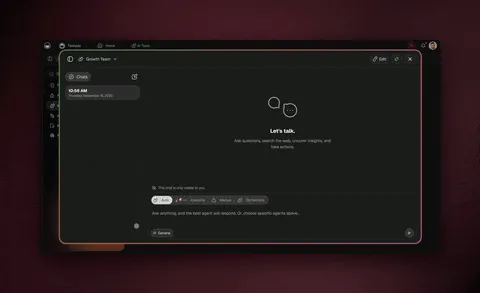
No signup, no credit card. Live multi-agent workspace
| Capability | OpenClaw | Taskade Genesis |
|---|---|---|
| Pricing (starting) | Free open source (you pay infra + model API costs) | $0 Free · $10/mo Pro billed annually (10 seats) |
| Cloneable live demo | ❌ | ✅ |
| Built-in AI agents | Yes, custom agents | ✅ built-in tools |
| Automation engine | Limited / no native integrations | ✅ Durable runtime, 100+ integrations |
| Workspace DNA loop | ❌ | ✅ ▲ Memory · ■ Intelligence · ● Execution |
Overall winner: ✅ Taskade Genesis — for anyone whose goal is shipping a working AI app, not standing up an agent framework. OpenClaw remains a strong pick for engineers who want a transparent, self-hosted base to build their own agent product on.
Table of Contents
- Quick Comparison Table
- The fundamental difference
- What is Taskade Genesis?
- What is OpenClaw?
- Feature-by-feature deep dive
- The Workspace DNA advantage
- Pricing and total cost of ownership
- Where OpenClaw has the edge
- What developers say
- When to choose each
- Frequently asked questions
- Without permission
TL;DR: Taskade Genesis ships deployed apps with AI agents, automations, and 100+ integrations from one prompt, with no DevOps. OpenClaw is a free open-source, self-hosted agent framework where you pay infra and model API costs. Taskade is Free Forever. Pro is $10/mo billed annually. Try Taskade Genesis free →
The fundamental difference
OpenClaw is an open-source agent framework. You install it, point it at a model, write the glue code, host it on a server you operate, and the result is a custom agent stack you fully control. It is a builder's toolbox, not a product.
Taskade Genesis starts further down the pipeline. You describe what you want and Genesis returns a deployed application with AI agents, real-time data, automation workflows, and team collaboration already wired in. Your workspace is the backend. Your projects are the database. Your agents are the runtime.
OpenClaw asks: "What agent framework should I assemble?" Genesis asks: "What app should exist?"
What is Taskade Genesis?
Taskade Genesis is the AI app builder inside the Taskade workspace. It is built on Workspace DNA — Memory (Projects), Intelligence (AI Agents), and Execution (Automations) — a self-reinforcing loop where what your team does becomes the substrate the agents reason over. Founded by John Xie, Dionis Loire, and Stan Chang in 2017, Taskade is a Y Combinator-backed platform with over a million users and a public Community Gallery of apps anyone can clone.
A single prompt to Genesis can produce a customer support portal, an ops dashboard, a CRM, a knowledge base, a form-driven intake system, or an internal tool — all with built-in AI agents, automations, custom domains, password protection, and the option to embed publicly with GenesisAuth. No DevOps. No CI/CD. No infrastructure to maintain.
Genesis is for everyone — founders, marketers, ops, product managers, customer success, and yes, engineers who want to skip plumbing and focus on the idea.
What is OpenClaw?
OpenClaw is an open-source AI agent framework that engineers self-host and wire to their own models, data, and tools. It exposes the building blocks of an autonomous agent — planner, executor, memory, tool registry — as Python primitives that the developer composes into a working system. The community has rallied around it as one of the more transparent agent stacks: you can read every line, swap every model, and deploy it on any infrastructure.
OpenClaw at a glance: Free, open source, model-agnostic. Runs on your machine or your cloud. Strong autonomous task execution loop and a growing ecosystem of community-contributed agent templates. Designed for engineers who want full control of the agent runtime rather than a managed product.
Teams that pick OpenClaw usually do so because they want to keep the model layer flexible, run on their own infrastructure, or build something custom enough that a hosted agent platform would constrain them. It is a great choice for engineers who think of agents as infrastructure to operate rather than features to consume.
Like any open-source framework, OpenClaw assumes you have an engineering team that can install it, host it, secure it, monitor it, and keep it patched. That is a feature for some teams and a tax for others.
Feature-by-feature deep dive
App generation
- Taskade Genesis turns a single prompt into a deployed application with UI, data model, AI agents, and automations connected. You can iterate visually or in natural language. The output runs immediately at a shareable URL.
- OpenClaw does not generate applications. It is the agent layer of an application you still have to design, build, host, and ship.
AI agents that take action
- Taskade ships AI Agents v2 — first-class digital teammates with persistent memory, built-in tools (web search, file analysis, project management, image generation, code execution, and more), custom tools you define, and the ability to be embedded publicly inside Genesis Apps.
- OpenClaw gives you agent primitives. The tools, memory store, persistence layer, and embedding surface are yours to design and operate.
Workflow automations and integrations
- Taskade includes durable Automations with branching, looping, and filtering across 100+ bidirectional integrations. Triggers pull external events in (Slack messages, Gmail, Sheets rows, Calendly events, webhooks). Actions push data out (Stripe checkouts, Shopify orders, Notion syncs, Salesforce updates, GitHub PRs).
- OpenClaw ships with no integration library. Each connector is something an engineer builds against the source API and maintains as those APIs change.
Team collaboration
- Taskade is workspace-native: real-time multiplayer editing, comments, chat, video calls, and granular role-based access (Owner to Viewer).
- OpenClaw has no built-in collaboration model. Multi-user behavior is whatever you build on top.
Project views and visual editing
- Taskade offers multiple project views — List, Board, Calendar, Table, Mind Map, Gantt, and Org Chart — plus visual app editing without writing code. The Timeline scrolling component lives inside the Gantt view.
- OpenClaw is a code-level framework. Any UI is one you implement yourself.
Workspace memory and context
- Taskade's Workspace DNA gives every agent persistent context across projects, files, integrations, and the live state of your business — without you wiring up a vector store or memory backend.
- OpenClaw treats memory as a pluggable component. You pick the store, you handle the retrieval strategy, you keep it healthy.
Code ownership and openness
- OpenClaw wins outright here. Open license, full code ownership, model-agnostic, and you can run it on a single laptop, a private cloud, or fully air-gapped infrastructure.
- Taskade is a managed platform. You don't own the platform code, but you do own your data, your agents, your integrations, and you can export your projects to Markdown or text.
The Workspace DNA advantage
OpenClaw's mental model is "engineers compose an agent runtime from primitives." Genesis's mental model is Workspace DNA: a self-reinforcing loop between three pillars.
- Memory (Projects) — Your team's docs, tasks, files, and structured data become the substrate every agent reasons over. The longer you work, the smarter the workspace gets.
- Intelligence (Agents) — Custom AI Agents with persistent memory, built-in tools, and custom tools you define, plus a hosted MCP server that Claude Desktop, Cursor, and VS Code connect into, while automations carry the work into the 100+ apps you already use. Agents are first-class teammates that live in the workspace, not loose Python scripts.
- Execution (Automations) — Durable workflows triggered by external events (Slack, Gmail, Stripe, GitHub, Calendly, webhooks, schedules) that read from Memory and act through Intelligence — then write the results back into Memory. The loop closes.
OpenClaw can implement any one of these layers if you build them. Genesis runs the entire loop continuously, which is why the longer you use it, the more your workspace itself becomes the thing that builds the next app.
Pricing and total cost of ownership
| Plan | Taskade Genesis | OpenClaw |
|---|---|---|
| Free | Free Forever — one-time 1,000+5,000 credit grant, 3 Genesis apps | Free open source |
| Pro | $10 / month (annual) — unlimited apps, 10 seats | Pay for infra + model provider per token |
| Business | $25 / month — unlimited seats, higher AI capacity | N/A |
| Max | $100 / month — maximum AI generation capacity | N/A |
| Enterprise | $250 / month with custom SLA | N/A |
OpenClaw's headline is "free." The fine print is "free software, paid stack." A real deployment usually involves model API spend with the provider you choose, a server or container running 24/7, observability, security patching, and the engineering hours of whoever keeps it healthy. None of that is OpenClaw's fault — it is the cost of running infrastructure as a team.
Genesis flips the model: a flat subscription includes AI credits, hosting, deployment, agents, integrations, and automations. There is no separate model bill, no DevOps line item, no infra cost. For teams that want a predictable monthly number rather than a metered one, Genesis is the more comfortable shape.
Where OpenClaw has the edge
Honest comparison matters. OpenClaw genuinely wins on a few axes that no managed platform — including Taskade — can match.
- Open source. You can read, fork, and patch every line. There is no vendor between you and the agent.
- Model-agnostic by design. Bring any provider, including a fully local model on your own GPU, with no plan-tier routing in the way.
- Hosting flexibility. Air-gapped on-prem, regional clouds, sovereign data residency — all possible because you operate the runtime.
- Engineering control. If your agent product is the company, owning the framework rather than renting it can be the right call.
Taskade Genesis chooses the opposite trade — managed, hosted, included — because most teams want to spend time on the app, not the framework. Both choices are legitimate.
What developers say
OpenClaw has earned a reputation as one of the more honest open-source agent frameworks. Recurring themes across r/LocalLLaMA, Hacker News, and developer Twitter:
- "Refreshingly readable codebase" — engineers like that they can audit the planner and tool loop themselves.
- "Best fit for teams that already run their own infra" — the cost story works when you already have a platform team.
- "Bring-your-own-model freedom" — favored by privacy-sensitive organizations that need to stay on local or sovereign models.
The honest critique: it is unambiguously a developer framework, integration libraries are thin compared to managed platforms, and operating it well requires real engineering time. None of these are bugs — they are just consequences of the audience OpenClaw serves.
Genesis users typically show up because they want to ship a portal, a dashboard, a CRM, an internal tool, or a customer-facing app — and they want to do it without thinking about deploys, databases, or auth. Browse the Community Gallery to see the apps people have shipped without ever touching a Python file.
When to choose each
Choose OpenClaw if:
- You have an engineering team that already operates infrastructure.
- You want full code ownership of your agent runtime.
- You need to run on local models, sovereign clouds, or fully air-gapped environments.
- The agent stack is a core part of your product, not a means to an end.
- You are happy to build the integration, memory, and UI layers yourself.
Choose Taskade Genesis if:
- You want to ship a working app, not assemble an agent framework.
- Your team includes non-engineers who need to build alongside engineers.
- You need AI agents that persist, have tools, and can be embedded for customers.
- You need workflow automations across Slack, Gmail, Stripe, Salesforce, Notion, and 100+ other integrations.
- You want one flat subscription that includes hosting, agents, automations, and team collaboration.
Use both if: Some engineering teams keep OpenClaw as the substrate for a deeply customized internal agent experiment and use Genesis to ship the customer-facing apps and operational dashboards their business actually runs on.
Frequently asked questions
Is OpenClaw better than Taskade Genesis for building AI agents?
They are aimed at different builders. OpenClaw is a Python framework engineers self-host and operate. Genesis is a managed workspace where Agents v2 are first-class and embedded in deployed apps. The "better" answer depends on whether you want to operate an agent runtime or use one.
Is OpenClaw really free?
Free as software. The realistic running cost includes model API spend, infrastructure, monitoring, and engineering time. For most teams the all-in number lands well above a Taskade subscription.
Does OpenClaw deploy applications?
No. It is an agent framework. Building, hosting, and shipping the surrounding application is on you.
Does Taskade Genesis include workflow automations?
Yes — durable automations with branching, looping, and filtering across 100+ bidirectional integrations. OpenClaw has no integration runtime by default.
Which AI models does Taskade Genesis use?
Taskade provides access to 15+ frontier models from OpenAI, Anthropic, and open-weight providers, with no API keys to wire up.
Can I export my work from Genesis?
Yes — projects export to Markdown and text. The Genesis App itself is a deployed managed product, not source code, so the architecture trade-off is hosting and infrastructure included in exchange for not owning the platform code.
Build without permission
OpenClaw gives engineers a transparent base to build a custom agent product. Genesis gives everyone — engineers and non-engineers alike — a workshop where the apps come out finished, hosted, and ready for users.
- Build with Genesis → — One prompt, one deployed app
- Browse the Community Gallery — Clone apps shipped by other Genesis builders
- Read the Workspace DNA explainer — How Memory, Intelligence, and Execution work together
Explore Taskade Genesis
- AI App Builder — Build complete apps from one prompt
- Vibe Coding — Natural-language app creation
- AI Agent Platform — Digital teammates that work 24/7
- AI Website Builder — Sites in seconds
- Workflow Automation — AI-powered business automation
- Automation workflow library — Ready-made workflows across 100+ integrations
- TSK-1 hub — The complete model benchmark dataset
Learn the Genesis architecture
Your living workspace includes:
- First-app guide — 5-minute tutorial
- Custom AI Agents — The Intelligence pillar
- Projects & Databases — The Memory pillar
- Automations & Workflows — The Execution pillar
Build without code
- AI App Generator — Full apps from prompts
- AI Dashboard Generator — Business dashboards
- AI Website Generator — Sites in seconds
- AI Form Generator — Smart intake forms
- Browse Community Apps — Clone and customize
Related reading
- The Build Without Permission article — Our manifesto
- How Workspace DNA Works — The architecture
- Origin of Living Software — The future of apps
- What Is an Agent Hosting Platform? — Hosted vs self-hosted agents
- Host Your First AI Agent — From prompt to deployed agent
- Best Claude Code Alternatives in 2026 — AI coding agents compared
- Agentic Workflows That Replace Your Startup's Busywork — Real automation patterns
- How to Train AI Agents With Your Knowledge — Make agents smarter over time
- Taskade vs Simular — Sai operates desktop software, Taskade Genesis ships a cloud app