






Before the pandemic started, remote work was kind of a taboo. Many businesses were skeptical and even the progressive ones kept the majority of their workforce in offices. Now that remote policies are popping up all over, it’s time to pick a side: remote-friendly or remote-first culture?
While being a fully distributed team doesn’t give us bragging rights, it certainly does come with a handful of observations. That’s why in today’s article we dig deep to answer these questions:
- 🤷♂️ Remote-first vs. remote-friendly culture. What's the difference?
- ⚗️ Is the latter a test tube for the workplace of the future?
- ⚡️ Which one’s better and why it's for remote-first?
- 🔮 Are we ready for what some call the “New Normal?”
👩💻 What Is a Remote-Friendly Culture?
Is it a bird? Is it a plane? Ok, let’s get serious for a moment and try to answer one fundamental question: “What makes a business or a team remote-friendly?”
A Remote-Friendly Business “Dabbles” in Remote Work
You can say that partially distributed organizations or are “on the fence” when it comes to telecommuting. On the one hand, they keep physical locations where employees clock in and out. On the other, they treat remote work as a viable, albeit tentative, alternative to office work.
Remote-friendly businesses usually have the equipment and technical infrastructure to make remote work possible. They may offer a day or two of work from home each week, but it’s often reserved for higher-ups, senior employees or emergencies only.
Lives and Breathes as HQ Does
Remember that Matrix scene where Neo and Trinity set out to reach 01, the Machine City? In a remote-friendly business, company headquarters reign supreme and set the “pulse” of work. That means all decision-making, paperwork and critical communication have to funnel through it.
Although some employees do occasionally flee the cubicles for a spell, they’re not in any way autonomous. It’s the HQ that sets the pace and time for calls, (virtual) meetings and other day-to-day operations. In a way, offices are like nodes with co-located and remote workers clustered all around them.
Sports an “Office” Mindset
“So, what if my company allows plenty of remote time? Doesn’t that count as remote-first?” Close but no cigar. Even if every employee gets a generous two days of WFH each week, the ratio’s still in favor of the “local” mindset.
So, what’s an “office” mindset?
You can kind of get things done remotely, but you still have to wait for approval from the HQ. You have a takeaway notebook, but you still need access to specialized equipment and software available on company premises.
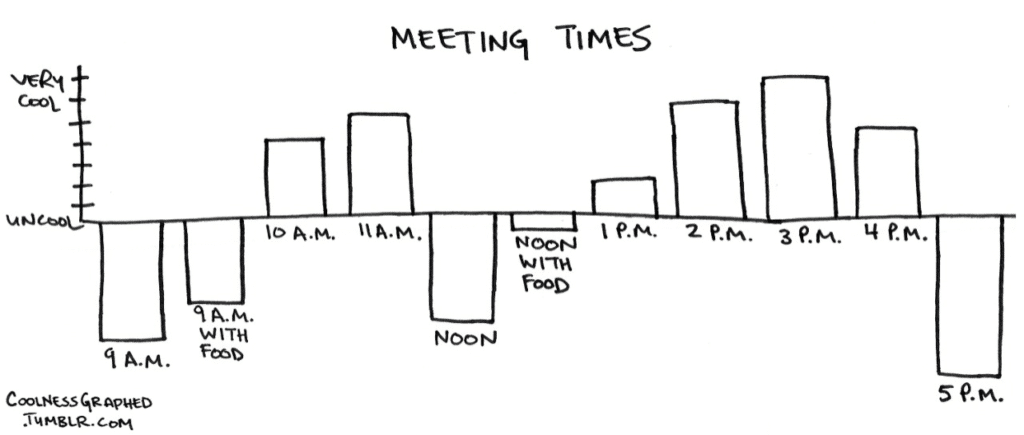
"Meeting Times" by Coolness Graphed
A local mindset means processes and workflows are inherently centralized. They often require on-site presence, handling paper documentation and plenty of face time to get things done.
Prefers Face Time Over Remote Communication
Communication dynamics in a remote-friendly workplace skews toward face-to-face interactions. Watercooler talk, meeting room moots or “swing by your desk” exchanges, you name it. Naturally, most of these exchanges are ephemeral and rarely documented.
Of course, hybrid-remote teams use communication and collaboration tools too. But remote communication is often just an appetizer. Most indirect exchanges and discussions are followed by 1-on-1s or team-wide meetings to “formalize” or sanction initial arrangements.
🌐 What Is a Remote-First Culture?
Is a lack of physical locations enough to warrant a “remote-first” badge? Or are there other subtle qualities that make fully distribute organizations?
A Remote-First Business “Defaults” to Remote Work
A remote-first company doesn’t need foreign branches, local offices or even headquarters for that matter. The organizational structure is completely dispersed and decentralized. Remote, as in “physically distant but socially connected,” is the default mode of engagement.
"Work Whenever, Wherever - We know that productivity is personal, and trust our remote team to work wherever, whenever. We rely on a variety of tools to connect and collaborate across time zones."
—DuckDuckGo
As a fully distributed team, we’ve sported remote-first culture from the very moment Taskade was born (and long before that). With the team working across New York, San Francisco, Malaysia, Singapore and the Philippines, we’ve been global and 100% remote from day one.
Loves Both Async and Sync Communication
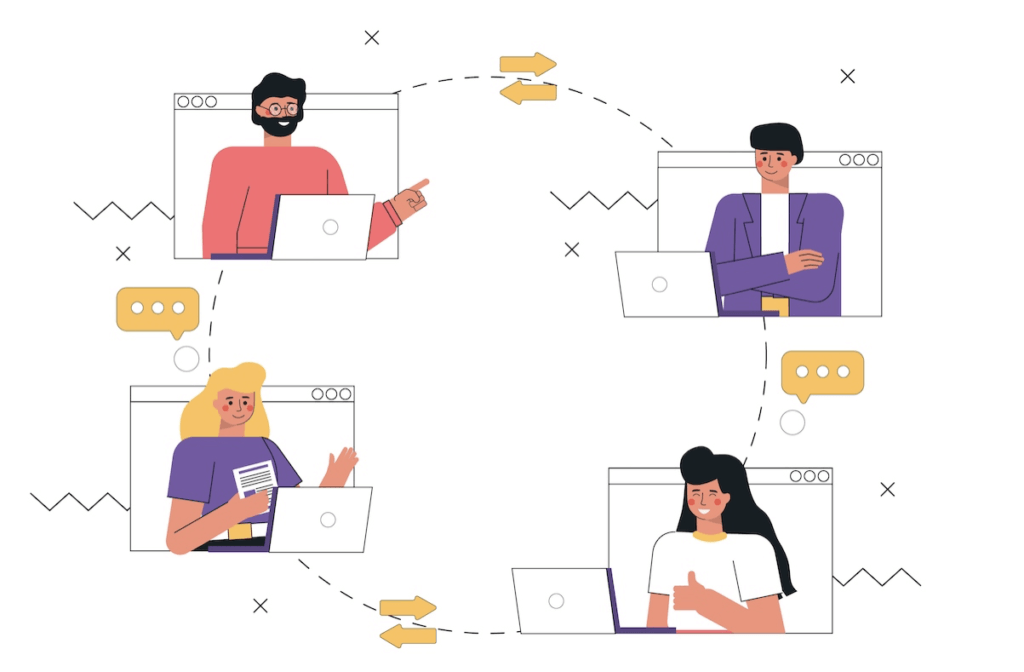
Effective communication isn’t only what you say but also how you say it. That’s why (successful) distributed teams know how to effectively use both synchronous (video, calls) and asynchronous (email, chat) communication channels.
“100% distributed doesn’t hold us back from building bonds—daily conversation in chat includes non-work topics like #fun-cooking and #fun-scifi, weekly posts to our company blog show off pictures of pets and hobbies (...)”
—Zapier
Since the overlap time for meetings is usually much smaller than in hybrid teams, async is usually the preferred mode of communication. Video conferencing comes as a close second.
Uses Remote-First Tools
Here’s the thing. Few communication and collaboration tools branded as “remote-ready” are designed specifically for distributed organizations. In many cases, those tools are developed by co-located or (at best) hybrid teams with little remote experience to draw on.
https://twitter.com/johnxie/status/1187479090401599492
Remote-first teams use remote-first tools. And that means tools that have been built by and for remote teams. Developers who have been and are part of remote workforce can better understand the pain points of distributed organizations and know how to address them.
Never Sleeps
Working across time zones is not the easiest business model to figure out. But it’s one that makes it possible to keep the ball rolling 24/7. Remote-first teams capitalize on that perk and can deliver value to customers wherever and whenever they are.
"Technology now allows people to connect anytime, anywhere, to anyone in the world, from almost any device. This is dramatically changing the way people work, facilitating 24/7 collaboration with colleagues who are dispersed across time zones, countries, and continents. "
—Michael Dell
In remote-first teams, HR, marketing and accounting processes also happen remotely, which helps remove bottlenecks and downtime to a minimum. With no central location, work can continue in multiple locations across the world, according to local time rather than the one set by company headquarters.
⚡️ 7 Reasons Why Remote-First Culture Rocks
Don’t get us wrong. There’s nothing fundamentally wrong with the remote-friendly model. It drives positive changes in the job market, gives employees an opportunity to taste the remote lifestyle and accelerates the paradigm shift in the way we work.
But there’s a problem…
Many remote-friendly businesses don’t really know which way to go. On the one hand, they want to innovate and jump on the remote bandwagon. On the other, they hold on to traditional office values and principles.

image 18
While some teams need to go through the hybrid stage as part of their evolutionary process, it should be merely a brief stop rather than a destination. We may be biased, but... there are many good reasons why a fully distributed model is the future of the workforce. 👇
1. Improved Alignment and Team Camaraderie
Fully remote companies benefit from much better alignment than in remote-friendly organizations. Since all employees work remotely, nobody’s left out or marginalized. That, in turn, makes building rapport much easier and improves team camaraderies in the long run.
And speaking of team camaraderie, be sure to check our article “How to Foster Remote Workplace Camaraderie” when you’re done reading.
2. Fewer Communication Silos
Unlike in hybrid teams, communication in fully remote organizations happen on one plane. There are no “unofficial” halfway exchanges or hearsays. What doesn’t go through a video conference, email or chat, doesn’t happen. It’s also much easier to document key conversations for future reference (more on that in a bit).
3. Improved Employee Engagement
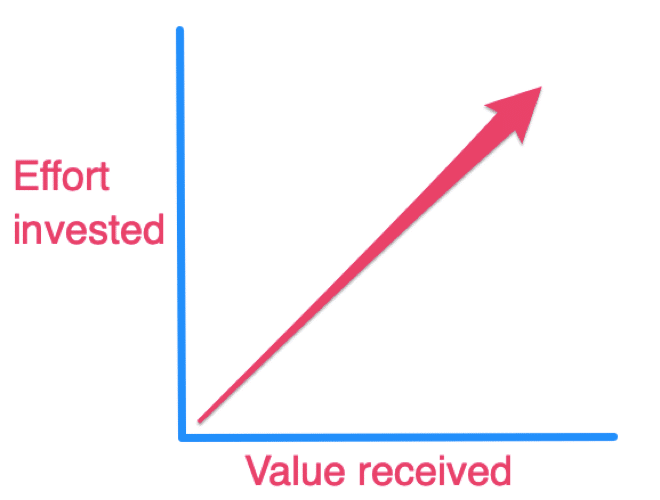
When teams start as remote-first from day one, they capitalize on what’s known as the Digital Ikea Effect. By investing their time and effort into building workflows and remote-first culture from scratch, they become more engaged in what they do. This is much more difficult to achieve in teams that start out as co-located or want to keep their remote-friendly status indefinitely.
4. Remote-First Culture = Frictionless Collaboration
Distributed businesses that have figured out what they want to be can focus on improving their workflows accordingly. They can choose the best set of tools that’ll be unified across the entire organization and build up a coherent communication etiquette. All that makes it much easier to achieve the kind of frictionless collaboration that’s out of reach for those still on the fence.
5. Reduced Overhead
On the net-financial end, no office space means less overhead to care about. And it isn’t just that remote-first companies don’t have to pay their rent, maintenance, utilities or whatnot. Embracing remote-first culture also leads to a significant reduction in overall mileage since employees don’t have to drive/fly in and out of the HQ for business travel.
6. Improved Team Autonomy
A remote-first culture encourages a higher degree of autonomy amongst teams, departments and individual employees. With the right skillset and remote access to company knowledge, managers don’t have to micro-manage every aspect of work. That, in turn, translates to shorter feedback loops and improved more efficient decision-making.
7. Good for the Environment
Thanks to the limited reliance on office spaces and fewer miles on the clock, remote-first culture fits in the “green” model that can potentially aid current environmental efforts. Limited business travel and no commute means a smaller carbon footprint overall. And let’s not forget about all the trees saved because tons of paper documents are not printed and pushed all over the office.
image 21
👨🔧 Remote-Friendly to Remote-First: A Blueprint
Now that we know a remote-first culture is the way to go… how do you actually get there? Do you need to roll out infrastructure or maybe all it takes is a mindset change? How can a remote-friendly workplace transition and a fully distributed model?
Prioritize Communication
Simple enough, right? The thing is, communication dynamic in fully distributed teams is a touch different than the ones in co-located or hybrid ones. Not only do you have to coordinate the flow of information to account for time zone differences but also do so in an inclusive way.
Here are some tips that’ll get you started:
- 💬 Ramp up video conferencing and asynchronous communication
- 👆 Encourage employees to switch between async and sync channels
- ⏰ Figuring out optimal overlap time for remote and office employees
- 🔥 Learn how to diffuse internal conflict and disagreements
- 🤳 Schedule daily or weekly sync up meetings to align goals and priorities
- 📣 Be transparent and leave nobody out of conversations
Create a Center of Team Activity
To bridge the gap between soon-to-be remoters and co-located employees, you need a central hub where people will come together to talk, share team knowledge and get work done. We’ve about all these aspects in-depth in our Single Source of Truth article.

Here’s a bite-sized version:
- 🤝 Create a shared, collaborative space for all employees
- 🔐 Provide universal access to team knowledge
- 🧠 Build a collaborative SSOT, Second Brain or a Zettelkasten
- 🗂 Document office activity e.g. by recording team meetings
- 🔀 Mix and match remote and co-located team members
Build an Inclusive Remote-First Culture
Not everybody in the company will transition in one go. That’s why you need to provide equal opportunities to early adopters and make sure fully distributed team members don’t feel marginalized or left out of important conversations.
- ⛓ Create a transparent and accessible chain of command
- ⏱Consider overlap times for calls and (virtual) team meetings
- 📚 Provide equal access to learning materials and training programs
- 👆 Offer the same career advancement opportunities as for office employees
Offer An Incentive to Switch
You’re ready to make the switch to remote-first culture, but are your employees? Leaving the comfy confines of cubicles may seem like an intimidating idea for some. So, why not offer a cookie to win the skeptics over?
- 💰 Grant a home office stipend to help with furnishing
- 🙋♂️ Provide remote-specific training and coaching
- ➕ Consider subsidizing subscriptions for coworking spaces
- 💻 Put together a hardware/software starter package
- 🏋️♂️ Offer health and wellness perks to match office standards\
And that’s it. Your off to a good start!
Frequently Asked Questions
What is the difference between remote-friendly and remote-first?
Remote-friendly companies allow remote work but design processes around their office — remote employees adapt to in-office norms. Remote-first companies design all processes, communication, and tools for distributed teams by default, treating every employee equally regardless of location.
Why is remote-first better than remote-friendly?
Remote-first eliminates the two-tier system where office workers have information advantages. When everything is documented, meetings are accessible to all time zones, and decisions happen in shared workspaces, every team member has equal access to information and equal voice in discussions.
How do you transition from remote-friendly to remote-first?
Start by documenting all processes and decisions in shared workspaces rather than relying on in-office conversations. Switch to async-first communication, record all meetings, use collaborative tools like Taskade as the single source of truth, and evaluate whether each policy works equally well for on-site and remote employees.
What are the signs of a truly remote-first company?
Key signs include async-first communication norms, all documentation in accessible shared workspaces, meetings that always include a virtual option, hiring that's location-independent, equal promotion opportunities regardless of location, and tooling designed for distributed collaboration rather than adapted from office workflows.
🤔 Conclusion: On the Crossroads
At the end of the day, the decision whether to go 100% remote will depend of the industry you’re in, infrastructure capacity and your employees’ preference. As we’re seeing more companies transition from a remote-friendly to fully distributed model, one thing becomes clear:
If you’re still one the fence when it comes to remote work, this is the best time to decide which way to go. Stay remote-friendly or reap the benefits of remote-first culture?
The good news is, getting work done in fully distributed teams doesn’t have to be difficult (or expensive). With Taskade, your team can manage projects, create to-do lists, collaborate on documents and communicate without friction.
And the best part?
You can use Taskade for free indefinitely without any workspace restrictions. Create as many projects and templates as you like, collaborate with as many people as you need, across all our platforms. Drop by our pricing page to learn more or jump over here to sign up today! 🐑