
Definition: An autonomous app is a software application with embedded AI agents and automations that take actions on behalf of users — not just display data or accept inputs. Taskade Genesis apps are autonomous by default: every published app can ship with one or more agents (intelligence), one or more automations (execution), and a workspace-backed memory (Projects).
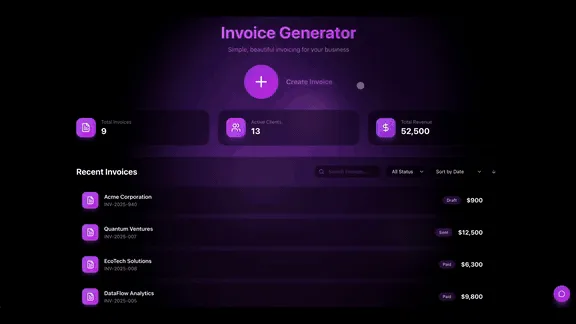
What Makes A Taskade Genesis App Autonomous
A static app shows you data. An autonomous app does things. Concretely, every Taskade Genesis app you publish can include:
- Embedded agents — chat assistants who answer questions about the data, take actions on the user's behalf, or proactively flag things ("3 invoices are overdue, want me to send reminders?")
- Trigger-driven automations — flows that fire on events from the app: "When a new invoice is added, send a confirmation email and create a Stripe payment link"
- Workspace memory — the app reads from and writes to Projects in your workspace, accumulating context over time
- GenesisAuth (v6.144+) — first-class OIDC/SSO so your app's users are identifiable, not anonymous
- App Users (beta, v6.151+) — separate end-user management surface so you can invite customers without giving them workspace access
Together: an app that reads context, decides, acts, and improves with use.
Real Examples
Invoice Tracker
A Taskade Genesis-built invoice app. Embedded agent watches for due dates, drafts reminder emails (with ask_ai_structured to pick the right tone), and posts a daily "AR pulse" to Slack. The user scans the pulse on their phone; clicks Approve on borderline cases; everything else fires autonomously.
Sales Pipeline
CRM-style app where the embedded SDR agent enriches new leads (calls Apollo via integration), classifies intent, and either books a meeting (Calendly action) or hands off to a human SDR if the deal looks hands-on. Memory: the deal record updates with every interaction.
Client Portal
External-facing app published with GenesisAuth, which runs on every plan, and a custom domain from Business up. Sign-in confirms who each client is, and you match their records to that login so they land on their own data. An embedded support agent answers FAQs from the knowledge base; anything outside its tools triggers a human-handoff automation that opens a ticket in your team's workspace.
Internal Operations Dashboard
App that aggregates project-management metrics across teams. The embedded "ops agent" runs every Monday morning, summarizes blockers, and posts a one-paragraph briefing to the leadership Slack channel. No human runs the briefing. Everyone gets it before standup.
Why "Autonomous" Beats "Just Generated"
Cursor, Lovable, Bolt, and v0 generate code you have to deploy, host, secure, and operate. The output is a static app that you turn into a service via your own labor.
Taskade Genesis generates living systems. The output is a deployed, intelligent app — embedded agents and automations included — running on Taskade infrastructure, with custom domains, SSL, password protection, and audit trails handled.
This is the difference between "code that lives in your repo" and "an autonomous teammate that lives at your URL."
Publishing Surface
| Surface | What It Is |
|---|---|
| Workspace-only | Default; only your team sees the app |
| Custom domain | Public app on app.yourcompany.com with SSL handled |
| Password-protected | Public URL but requires a passphrase |
| GenesisAuth (OIDC/SSO) | Users sign in via your IdP (Okta, Google Workspace, etc.) |
| Community Gallery | Publish to Taskade's public Taskade Genesis app showcase (/apps) |
What Changed Recently (v6.140 → v6.164)
| Version | Capability |
|---|---|
| v6.144 | GenesisAuth — first-class OIDC/SSO for Taskade Genesis apps |
| v6.151 | App Users (beta) — end-user management for published apps |
| v6.151 | Onboarding flow for cloned apps |
| v6.150 | Clone creator credits + credit audit log (so creators get paid when their apps are cloned) |
| v6.162 | ask_ai_structured typed JSON output (predictable agent output for app UIs) |
| v6.163 | Bulk-Delete UI for project listings — useful for app data cleanup |
Building Your First Autonomous App
- Open Taskade and prompt EVE: "Build me an invoice tracker for a freelance consultant. Customers can submit invoices via a public form. Send a Slack ping when a new one comes in."
- EVE generates the app: a Project for invoices, a public form bound to it, a Slack automation, and an embedded agent that watches for overdue invoices.
- (Optional) Attach a custom domain. Add GenesisAuth so customers sign in via Google.
- Publish. The app is now autonomous — it watches, it acts, it remembers.