



Taskadetaskade
PricingLoginSign up for free →Sign up for free →
Loved by 1M+ users·Hosting 100K+ apps·Deploying 500K+ AI agents·Running 1M+ automations·Backed by Y Combinator
TaskadeAboutPressPricingFeaturesIntegrationsChangelogContact us
GalleryReviewsHelp CenterDocsFAQ
VibeVibe AppsVibe AgentsVibe CodingVibe Workflows
Vibe MarketingVibe DashboardsVibe CRMVibe AutomationVibe PaymentsVibe DesignVibe SEOVibe Tracking
Community
FeaturedQuick AppsTools
DashboardsWebsitesWorkflowsProjectsFormsCreators
DownloadsAndroidiOSMac
WindowsChromeFirefoxEdge
Compare
vs Cursorvs Boltvs Lovable
vs V0vs Windsurfvs Replitvs Emergentvs Devinvs Claude Codevs ChatGPTvs Claudevs Perplexityvs GitHub Copilotvs Figma AIvs Notionvs ClickUpvs Asanavs Mondayvs Trellovs Jiravs Linearvs Todoistvs Evernotevs Obsidianvs Airtablevs Basecampvs Mirovs Slackvs Bubblevs Retoolvs Webflowvs Framervs Softrvs Glidevs FlutterFlowvs Base44vs Adalovs Durablevs Gammavs Squarespacevs WordPressvs UI Bakeryvs Zapiervs Makevs n8nvs Jaspervs Copy.aivs Writervs Rytrvs Manusvs Crewvs Lindyvs Relevance AIvs Wrikevs Smartsheetvs Monday Magicvs Codavs TickTickvs Any.dovs Thingsvs OmniFocusvs MeisterTaskvs Teamworkvs Workfrontvs Bitrix24vs Process Streetvs Toggl Planvs Motionvs Momentumvs Habiticavs Zenkitvs Google Docsvs Google Keepvs Google Tasksvs Microsoft Teamsvs Dropbox Papervs Quipvs Roam Researchvs Logseqvs Memvs WorkFlowyvs Dynalistvs XMindvs Whimsicalvs Zoomvs Remember The Milkvs Wunderlist
Genesis AIApp BuilderVibe CodingAgent Builder
Dashboard BuilderCRM BuilderWebsite BuilderForm BuilderWorkflow AutomationWorkflow BuilderBusiness-in-a-BoxAI for MarketingAI for Developers
AI Agents
FeaturedProject ManagementProductivity
MarketingTranslatorContentWorkflowResearchPersonalSalesSocial MediaTo-Do ListCRMTask AutomationCoachingCreativityTask ManagementBrandingFinanceLearning and DevelopmentBusinessCommunity ManagementMeetingsAnalyticsDigital AdvertisingContent CurationKnowledge ManagementProduct DevelopmentPublic RelationsProgrammingHuman ResourcesE-CommerceEducationLegalEmailSEODeveloperVideo ProductionDesignFlowchartDataPromptNonprofitAssistantsTeamsCustomer ServiceTrainingTravel PlanningAll Categories
Automations
FeaturedBusiness-in-a-BoxInvestor Operations
Education & LearningHealthcare & ClinicsStripeSalesContentMarketingEmailCustomer SupportHubSpotProject ManagementAgentic WorkflowsBooking & SchedulingCalendarReportsSlackWebsiteFormTaskWeb ScrapingWeb SearchChatGPTText to ActionYoutubeLinkedInTwitterGitHubDiscordMicrosoft TeamsWebflowRSS & Content FeedsGoogle WorkspaceManufacturing & OperationsAI Agent TeamsAll Categories
Wiki
GenesisAI AgentsAutomation
ProjectsLiving DNAPlatformIntegrationsProductivityMethodsProject ManagementAgileScrumAI ConceptsCommunityTerminologyFeatures
Templates
FeaturedChatGPTTable
PersonalProject ManagementSalesFlowchartTask ManagementEngineeringEducationDesignTo-Do ListMarketingMind MapGantt ChartOrganizationalPlanningMeetingsTeam ManagementStrategyGamingProductionProduct ManagementStartupRemote WorkY CombinatorRoadmapCustomer ServiceLegalEmailBudgetsContentConsultingE-CommerceStandard Operating Procedure (SOP)Human ResourcesProgrammingMaintenanceCoachingSocial MediaHow-TosResearchMusicTrip PlanningAll Categories
Generators
AI AppAI WebsiteAI Dashboard
AI FormAI AgentClient PortalAI WorkspaceAI ProductivityAI To-Do ListAI WorkflowsAI EducationAI Mind MapsAI FlowchartAI Scrum Project ManagementAI Agile Project ManagementAI MarketingAI Project ManagementAI Social Media ManagementAI BloggingAI Agency WorkflowsAI ContentAI Software DevelopmentAI MeetingAI PersonasAI OutlineAI SalesAI ProgrammingAI DesignAI FreelancingAI ResumeAI Human ResourceAI SOPAI E-CommerceAI EmailAI Public RelationsAI InfluencersAI Content CreatorsAI Customer ServiceAI BusinessAI PromptsAI Tool BuilderAI SEOAI Gantt ChartAI CalendarsAI BoardAI TableAI ResearchAI LegalAI ProposalAI Video ProductionAI Health and WellnessAI WritingAI PublishingAI NonprofitAI DataAI Event PlanningAI Game DevelopmentAI Project Management AgentAI Productivity AgentAI Marketing AgentAI Personal AgentAI Business and Work AgentAI Education and Learning AgentAI Task Management AgentAI Customer Relations AgentAI Programming AgentAI SchemaAll Categories
Converters
AI Featured ConvertersAI PDF ConvertersAI CSV Converters
AI Markdown ConvertersAI Prompt to App ConvertersAI Data to Dashboard ConvertersAI Workflow to App ConvertersAI Idea to App ConvertersAI Flowcharts ConvertersAI Mind Map ConvertersAI Text ConvertersAI Youtube ConvertersAI Knowledge ConvertersAI Spreadsheet ConvertersAI Email ConvertersAI Web Page ConvertersAI Video ConvertersAI Coding ConvertersAI Task ConvertersAI Kanban Board ConvertersAI Notes ConvertersAI Education ConvertersAI Language TranslatorsAI Business → Backend App ConvertersAI File → App ConvertersAI SOP → Workflow App ConvertersAI Portal → App ConvertersAI Form → App ConvertersAI Schedule → Booking App ConvertersAI Metrics → Dashboard ConvertersAI Game → Playable App ConvertersAI Catalog → Directory App ConvertersAI Creative → Studio App ConvertersAI Agent → Agent App ConvertersAI Image ConvertersAI Resume & Career ConvertersAI Presentation ConvertersAll Categories
Prompts
Blog WritingBrandingPersonal Finance
Human ResourcesPublic RelationsTeam CollaborationProduct ManagementSupportAgencyReal EstateMarketingCodingResearchSalesAdvertisingSocial MediaCopywritingContentProject ManagementWebsite CreationDesignStrategyE-commerceEngineeringSEOEducationEmail MarketingUX/UIProductivityInfluencer MarketingAnalyticsEntrepreneurshipLegalAll Categories
Blog
History of Mermaid.js: Diagrams as Code, From a Lost Visio File to 85K GitHub Stars (2026)What Is Artificial Life? How Intelligence Emerges from Code (2026)The Complete History of Computing: From Binary to AI Agents — How We Got Here (2026)12 Best Agentic Engineering Platforms and Tools for AI Agent Orchestration in 2026
They Generate Code. We Generate Runtime — The Taskade Genesis Manifesto (2026)15 Best Claude Code Alternatives in 2026: AI Coding Agents and Tools ComparedTaskade Genesis Reviews: What Tech Press and Review Sites Say (2026)What Is Intelligence? From Neurons to AI Agents — A Complete Guide (2026)What Is Grokking in AI? When Models Suddenly Learn to Generalize (2026)Taskade vs Zoho: Can AI Workspaces Replace Enterprise SaaS? (2026)What Is Mechanistic Interpretability? How We're Learning to Understand AI (2026)How Do Large Language Models Actually Work? Transformers Explained (2026)What Is an Agentic Workspace? The Complete Guide (2026)Vibe Apps Directory: The Complete Guide to No-Code AI App CategoriesWhat is FFmpeg? Complete History of the Open-Source Multimedia Framework (2026)What Is AI Safety? Complete Guide to AI Risks, Alignment & The Future (2026)What Are Micro Apps? The Trend Reshaping How Software Gets Built (2026)
AIAutomationProductivityProject ManagementRemote WorkStartupsKnowledge ManagementCollaborative WorkUpdates
Changelog
Mobile Agent Panel, Dark Mode Theming & White-Label 404 Pages (Mar 13, 2026)Linear & Monday Integrations, Agent Memory for All Models (Mar 12, 2026)App Kit Export & Import, Agent Memory & Custom Domain SSL (Mar 11, 2026)
Developer SDK, App Kit Sharing & Live Theming (Mar 10, 2026)Airtable Integration, Smarter Agent Models & Workspace File Management (Mar 9, 2026)Bulk Project Import & Real-Time Integration Triggers (Mar 7, 2026)Faster Project Files & Performance (Mar 5, 2026)
Wiki
GenesisAI AgentsAutomation
ProjectsLiving DNAPlatformIntegrationsProductivityMethodsProject ManagementAgileScrumAI ConceptsCommunityTerminologyFeatures
© 2026 Taskade.
PrivacyTermsSecurity
Made withTaskade AIforBuilders
Blog›Productivity›The Anatomy of a Genesis App:…

The Anatomy of a Genesis App: Memory, Agents, Automation

Understand the internal structure of every Genesis app — how Projects, Agents, and Automations work together to create living software.

January 1, 2025·Updated February 1, 2026·6 min read·Taskade Team·Productivity·#Architecture#Genesis#Technical
On this page (20)
🎯 The Three-Layer ArchitectureThe Subject: Neon CRM DashboardLayer 1: Memory (Projects & Databases)SchemaViewsRelationshipsLayer 2: Intelligence (AI Agents)CRM AgentAgent InteractionsLayer 3: Motion (Automations)Trigger → Action FlowsIntegration PointsHow the Layers InteractBuilding Better AppsFor Better MemoryFor Better IntelligenceFor Better MotionInspect Your AppsResourcesFrequently Asked Questions

What's inside a Genesis app?

When you describe something and Genesis builds it, what actually gets created? Understanding the anatomy helps you build better systems — and debug them when things go wrong.

Let's dissect a real app.

🔬 Why This Matters:
Understanding anatomy = building better apps + debugging faster + customizing effectively.


🎯 The Three-Layer Architecture

Every Genesis app has the same structure:

┌─────────────────────────────────────────────────────────┐
│                    GENESIS APP                          │
├─────────────────────────────────────────────────────────┤
│                                                         │
│  LAYER 1: 🧠 MEMORY (Projects & Databases)             │
│  ─────────────────────────────────────────────         │
│  Schema, tables, fields, relationships, views          │
│                                                         │
│  LAYER 2: 🤖 INTELLIGENCE (AI Agents)                  │
│  ─────────────────────────────────────────────         │
│  Personality, knowledge, capabilities, reasoning       │
│                                                         │
│  LAYER 3: ⚡ MOTION (Automations)                      │
│  ─────────────────────────────────────────────         │
│  Triggers, actions, integrations, sequences            │
│                                                         │
└─────────────────────────────────────────────────────────┘

The Subject: Neon CRM Dashboard

We'll examine Neon CRM Dashboard — a sales pipeline management system.
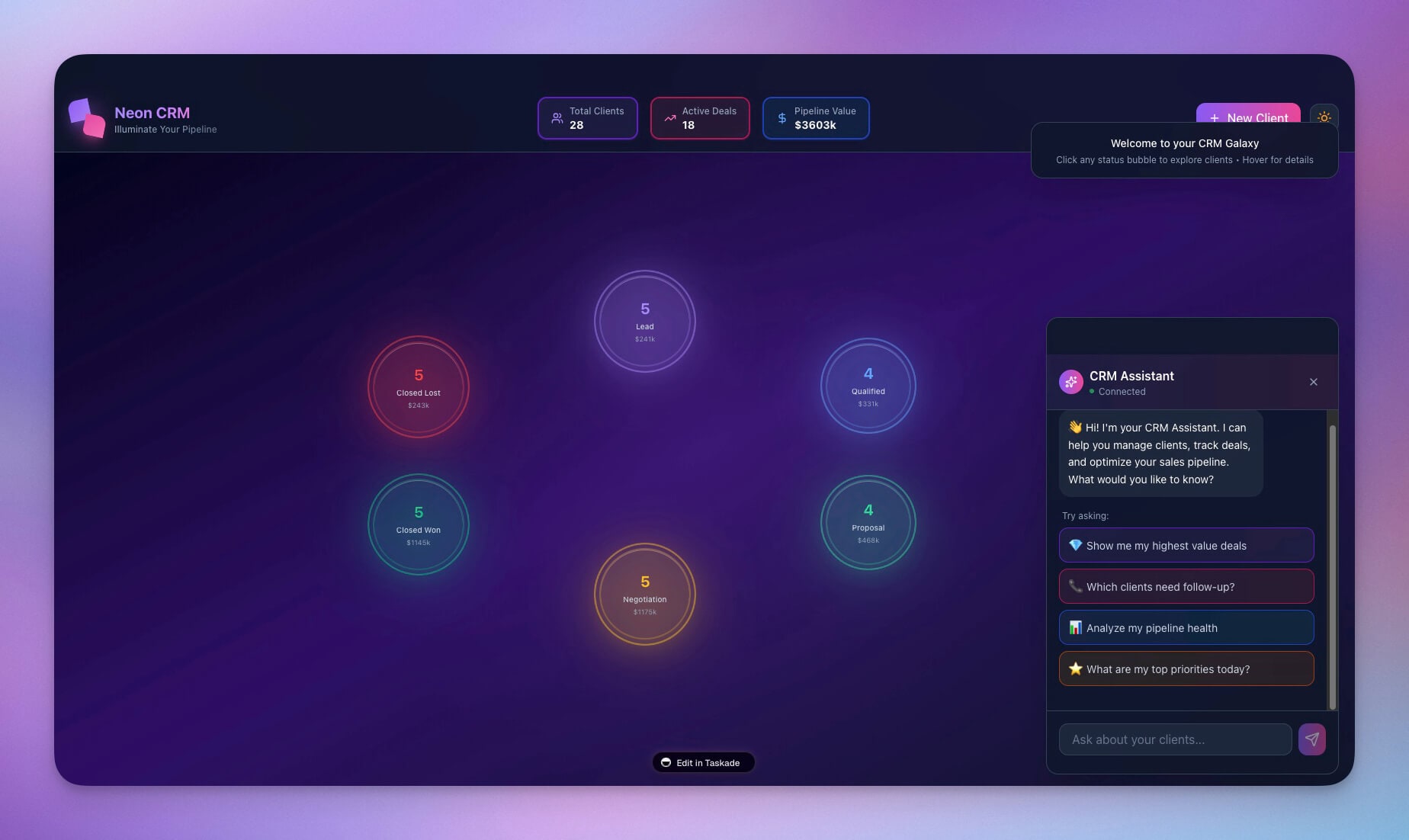
Neon CRM Dashboard

From the outside, it's a CRM. Leads, deals, contacts, pipeline stages. But inside, it's three systems working as one.


Layer 1: Memory (Projects & Databases)

The data foundation. Everything the app knows.

Schema

PROJECTS (Tables)
├── Contacts
│   ├── name (text)
│   ├── email (text)
│   ├── company (relation → Companies)
│   ├── stage (select: lead, qualified, opportunity, customer)
│   └── created_at (date)
│
├── Companies
│   ├── name (text)
│   ├── size (select: startup, smb, enterprise)
│   ├── industry (text)
│   └── annual_value (number)
│
├── Deals
│   ├── name (text)
│   ├── contact (relation → Contacts)
│   ├── value (number)
│   ├── stage (select: discovery, proposal, negotiation, closed)
│   ├── probability (number)
│   └── close_date (date)
│
└── Interactions
    ├── contact (relation → Contacts)
    ├── type (select: email, call, meeting)
    ├── notes (text)
    └── date (date)

Views

Same data, different perspectives:

  • Pipeline view — Deals as kanban by stage
  • Table view — All records as spreadsheet
  • Calendar view — Interactions and close dates
  • Board view — Contacts by stage

Relationships

Connections that create context:

  • Contact → Company (who works where)
  • Deal → Contact (who owns the opportunity)
  • Interaction → Contact (history of engagement)

This is the Memory Pillar.


Layer 2: Intelligence (AI Agents)

The thinking layer. Agents that reason about your data.

CRM Agent

The primary agent, configured with:

Personality:

You are a helpful sales assistant. You help track deals, 
suggest next actions, and provide pipeline insights. Be 
concise and action-oriented.

Knowledge:

  • Access to all CRM tables
  • Understanding of sales stages
  • Company and industry context

Capabilities:

  • Answer questions about pipeline
  • Suggest follow-up actions
  • Draft outreach emails
  • Summarize account status

Agent Interactions

The agent can:

  • Query data: "What deals are closing this month?"
  • Analyze patterns: "Which stage has the most stalled deals?"
  • Suggest actions: "You haven't contacted Acme Corp in 2 weeks"
  • Execute tasks: Create interaction record, update deal stage

This is the Intelligence Pillar.


Layer 3: Motion (Automations)

The action layer. Workflows that run automatically.

Trigger → Action Flows

AUTOMATION 1: New Lead Alert
├── Trigger: New contact created (stage = lead)
├── Action: Send Slack notification to #sales
└── Action: Create welcome task for sales rep

AUTOMATION 2: Deal Stale Alert
├── Trigger: Deal stage unchanged for 14 days
├── Action: Send email reminder to deal owner
└── Action: Update deal flag to "at risk"

AUTOMATION 3: Won Deal Sequence
├── Trigger: Deal stage changed to "closed won"
├── Action: Update contact stage to "customer"
├── Action: Send celebration to #wins channel
├── Action: Create onboarding project
└── Action: Update revenue forecast

AUTOMATION 4: Weekly Pipeline Report
├── Trigger: Every Monday 9am
├── Action: Query all open deals
├── Action: Calculate weighted pipeline
└── Action: Send summary to #sales

Integration Points

Automations connect to external services:

  • Slack — Notifications and alerts
  • Email — Outreach and follow-ups
  • Calendar — Meeting scheduling
  • Webhooks — External systems

This is the Execution Pillar.


How the Layers Interact

The power is in the connections:

┌──────────────────────────────────────────────────┐
│                                                  │
│  User asks: "Show me stalled deals"              │
│                       │                          │
│                       ▼                          │
│  ┌─────────────────────────────────────────┐    │
│  │  🤖 AGENT (Intelligence)                │    │
│  │  - Interprets question                   │    │
│  │  - Queries memory for deals              │    │
│  │  - Analyzes stage durations              │    │
│  └─────────────────────────────────────────┘    │
│                       │                          │
│                       ▼                          │
│  ┌─────────────────────────────────────────┐    │
│  │  🧠 MEMORY (Projects)                   │    │
│  │  - Returns deals with stage > 14 days   │    │
│  │  - Includes contact and value info      │    │
│  └─────────────────────────────────────────┘    │
│                       │                          │
│                       ▼                          │
│  Agent presents: "3 deals stalled:              │
│   - Acme ($50k, 21 days in proposal)            │
│   - BigCo ($100k, 18 days in negotiation)       │
│   - StartupX ($25k, 30 days in discovery)       │
│   Suggest follow-up actions?"                    │
│                       │                          │
│                       ▼                          │
│  User: "Yes, create follow-up tasks"            │
│                       │                          │
│                       ▼                          │
│  ┌─────────────────────────────────────────┐    │
│  │  ⚡ MOTION (Automations)                │    │
│  │  - Creates tasks for each stalled deal  │    │
│  │  - Sends reminders to deal owners       │    │
│  │  - Updates CRM flags                    │    │
│  └─────────────────────────────────────────┘    │
│                       │                          │
│                       ▼                          │
│  Memory updated, user notified                   │
│                                                  │
└──────────────────────────────────────────────────┘

This is Workspace DNA in action.


Building Better Apps

Understanding anatomy helps you build:

For Better Memory

  • Define clear relationships between entities
  • Use appropriate field types
  • Create views for different perspectives

For Better Intelligence

  • Write detailed agent instructions
  • Give agents relevant context
  • Define capabilities clearly

For Better Motion

  • Map out trigger conditions
  • Chain actions logically
  • Connect to relevant services

Inspect Your Apps

Every Genesis app has this structure. To improve any app:

  1. Examine Memory — Is the schema right? Missing fields?
  2. Review Intelligence — Is the agent helpful? Accurate?
  3. Check Motion — Are automations firing? Missing triggers?

The anatomy is your debugging guide.


Resources

Learn more:

  • Projects & Databases — Memory Pillar
  • Custom AI Agents — Intelligence Pillar
  • Automations & Workflows — Execution Pillar
  • Workspace DNA — Full architecture

Start Building →


Genesis Deep Dives:

  • The Origin of Living Software — Where it all began
  • How Workspace DNA Works — The architecture explained
  • Build Your First AI App — 12 beginner examples
  • Build Without Permission — The Genesis Manifesto

Genesis Showcase:

  • 10 AI Dashboards — Finance, CRM, ops
  • 10 AI Client Portals — Deploy instantly
  • 10 AI Booking Systems — Clone for business
  • 20 AI App Ideas — Inspiration gallery

Explore Taskade AI:

  • AI App Builder — Build complete applications
  • AI Agent Builder — Create intelligent assistants
  • AI Workflow Automation — Automate any process

Build with Genesis:

  • Browse All Generator Templates — Apps, dashboards, websites, and more
  • Browse Agent Templates — AI agents for every use case
  • Explore Community Apps — Clone and customize

Frequently Asked Questions

What is the internal structure of a Taskade Genesis app?

Every Genesis app has a three-layer architecture: Memory (Projects and databases that store structured data), Intelligence (AI Agents that reason, respond, and take actions), and Execution (Automations that trigger workflows based on conditions). These three layers work together as Workspace DNA to create living software that adapts and evolves.

What is Workspace DNA in Taskade?

Workspace DNA is the foundational architecture of every Taskade Genesis app, consisting of three components: Memory (structured databases and project data), Intelligence (AI agents powered by 11+ models from 3 providers), and Execution (automated workflows with triggers, conditions, and actions). This architecture ensures every app is not just stored data but an active, intelligent system.

How do AI agents work inside a Genesis app?

AI agents in a Genesis app are the Intelligence layer. Each agent has a defined personality, knowledge base, and set of capabilities. Agents can read and write to the Memory layer (databases), trigger the Execution layer (automations), and collaborate with other agents. They come with 22+ built-in tools, custom slash commands, and persistent memory across interactions.

Can I customize the architecture of a Genesis app after building it?

Yes. Every layer of a Genesis app is fully customizable. You can modify database schemas (Memory), reconfigure agent personalities and capabilities (Intelligence), and adjust automation triggers and workflows (Execution). The app supports 8 project views (List, Board, Calendar, Table, Mind Map, Gantt, Org Chart, Timeline) and 7-tier access control for team collaboration.

0%

On this page

🎯 The Three-Layer ArchitectureThe Subject: Neon CRM DashboardLayer 1: Memory (Projects & Databases)SchemaViewsRelationshipsLayer 2: Intelligence (AI Agents)CRM AgentAgent InteractionsLayer 3: Motion (Automations)Trigger → Action FlowsIntegration PointsHow the Layers InteractBuilding Better AppsFor Better MemoryFor Better IntelligenceFor Better MotionInspect Your AppsResourcesFrequently Asked Questions

Related Articles

/static_images/How Workspace DNA Works — Taskade Genesis
December 28, 2025Productivity

How Workspace DNA Works Inside Taskade Genesis

A deep dive into Workspace DNA — the architecture behind Taskade Genesis that combines Memory, Intelligence, and Executi...

/static_images/Invoice Generator app with payment tracking dashboard showing paid, pending, and overdue invoices
February 28, 2026Productivity

3 Finance Apps You Can Clone Today — Invoice, Meeting Costs & Licenses

Track payments, calculate meeting costs, manage licenses — three complete finance apps you can clone in minutes. AI-powe...

/static_images/Class Booking Portal app showing class listings, schedules, and participant management dashboard
February 21, 2026Productivity

3 Booking Apps You Can Clone Today — Classes, Appointments & Events

Classes, appointments, or events — three complete booking apps with signup forms, automated confirmations, reminders, an...

/static_images/Taskade Genesis dashboard apps showcasing team capacity planning, CRM, and project portal
February 14, 2026Productivity

Taskade Genesis App Highlights: Team Capacity, CRM & Project Portal Dashboards

Manage leads, track requests, plan capacity — AI teammates and automations included. This week's Genesis App Highlights:...

/static_images/AI Workspace Builder — Taskade Genesis
December 31, 2025Productivity

AI Workspace Builder: Turn Your To-Do List Into Live Software

Transform simple lists into intelligent workspaces with AI agents and automations. Learn how the AI workspace builder tu...

/static_images/Business-in-a-Box — Taskade Genesis
December 30, 2025Productivity

Build a Business-in-a-Box With Taskade Genesis

Build a complete operating system for your business with one prompt. Combine CRM, finance, support, publishing, and clie...

View All Articles
The Anatomy of a Genesis App (Memory, Agents, Automation) | Taskade Blog