






Not factories of tasks. Not offices of email. But living gardens of intelligent agents.
TL;DR: By 2030, work will shift from operating machinery to cultivating gardens of AI agents that learn, adapt, and execute. Taskade Genesis is planting the seeds today with 150,000+ apps built, agent tools, and 100+ integrations. Start your garden →
1. From Factories to Gardens
For the last century, we've described work like machinery. We've had "productivity engines," "pipelines," "assembly lines." People became cogs in systems built to run faster and cheaper.
But by 2030, that metaphor collapses.
Work won't feel like operating a factory. It will feel like tending a garden.
You won't manage tasks in spreadsheets or shuffle projects between tools. Instead, you'll grow and prune living systems of intelligent agents — teams of digital collaborators that learn, adapt, and bloom into execution.
And like any good garden, the design won't be about squeezing more hours out of the soil. It will be about cultivating resilience, diversity, and growth.
According to McKinsey's 2024 report on generative AI, up to 30% of work hours across the US economy could be automated by 2030. But automation alone isn't the story. The story is what replaces the old paradigm: not harder machines, but smarter ecosystems.
2. What Agents Feel Like in 2030
Here's what "work" looks like a few years from now:
- You don't "assign" tasks. You plant seeds — a goal, a direction, a constraint.
- Agents germinate ideas, branch into parallel workflows, and cross-pollinate solutions.
- Projects don't sit in Kanban boards; they evolve organically like ecosystems, visible as dashboards that pulse with activity.
- Instead of "managing deadlines," you walk through a workspace garden where every agent, task, and outcome is alive, interconnected, and growing.
When something goes wrong, you don't panic. You prune. You redirect energy. You re-seed.
This is the opposite of today's brittle automation. Gardens adapt. They don't break when conditions change.
The Agent Taxonomy: Species in Your Garden
Just as a garden contains different species with different roles, your workspace will contain specialized agent types:
| Agent Species | Role in the Garden | Human Equivalent | Autonomy Level |
|---|---|---|---|
| Pollinator Agents | Connect ideas across domains, find patterns | Creative strategist | Semi-autonomous |
| Root Agents | Maintain data integrity, ensure system health | Operations manager | Fully autonomous |
| Canopy Agents | Public-facing, handle external interactions | Customer success lead | Supervised |
| Symbiont Agents | Work alongside humans, augmenting decisions | Executive assistant | Collaborative |
| Pruner Agents | Archive outdated content, clean up noise | Quality assurance | Fully autonomous |
Each species contributes to the ecosystem's health. Remove one, and the garden suffers. This diversity is why multi-agent systems outperform single-agent approaches.
3. Why We Get Stuck in 2025
Right now, we're still playing with toys.
- Chatbots that answer questions but forget context.
- "AI copilots" that generate drafts but vanish after the click.
- Automation scripts that snap when your workflow shifts.
These are potted plants in a basement — neat to look at, but incapable of sustaining life.
The leap to 2030 happens when agents stop being outputs and start becoming ecosystems. When they stop answering and start collaborating. When they stop being demos and start becoming teammates.
Today's AI tools are isolated. They answer questions but don't remember. They generate content but don't learn. They automate tasks but don't adapt.
Tomorrow's agents are interconnected. They learn from your workspace, collaborate with each other, and evolve with your business. They're not tools — they're teammates. Bridging that gap is what agentic engineering means — designing systems where agents coordinate, learn, and act as a cohesive unit.
The Maturity Curve: From Tools to Ecosystems
| Stage | Description | Human Role | Agent Capability | Example |
|---|---|---|---|---|
| Stage 1: Tools | Single-purpose AI tools | Operator | Response generation | ChatGPT answering questions |
| Stage 2: Assistants | Context-aware helpers | Supervisor | Task completion with guidance | AI copilots suggesting code |
| Stage 3: Agents | Autonomous task executors | Manager | Independent workflow execution | Taskade agents running campaigns |
| Stage 4: Teams | Multi-agent collaboration | Director | Coordinated problem-solving | Agent teams handling client onboarding |
| Stage 5: Gardens | Self-sustaining ecosystems | Gardener | Adaptive, self-improving systems | Full Workspace DNA with compounding intelligence |
We're between stages 3 and 4 today. By 2030, the leading teams will reach stage 5. Learn how to build agent teams →
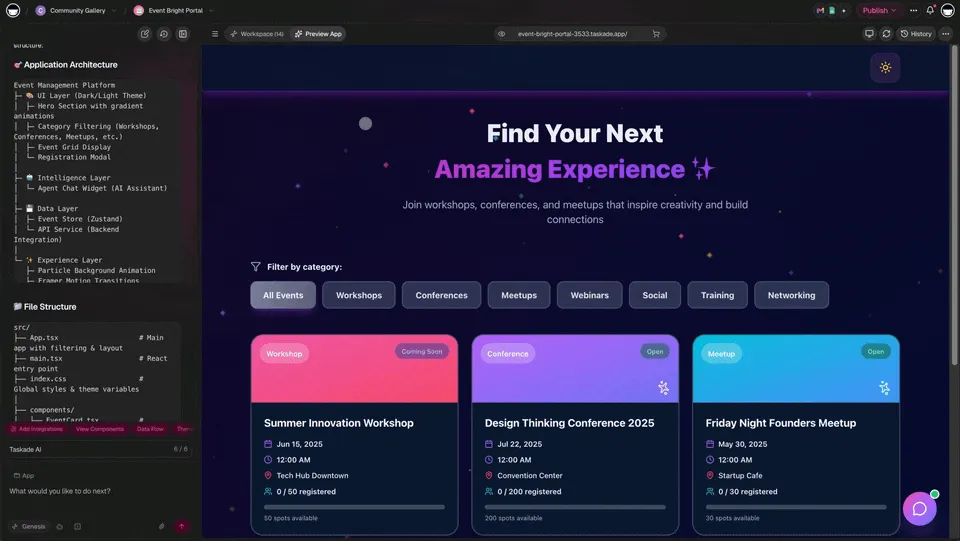
4. The Taskade Genesis Layer: Planting the First Seeds

This is why we built Taskade Genesis.
Genesis is not a chatbot, not a tool, not another row in your productivity stack. It's the soil layer where human creativity and agent intelligence converge.
Memory (Projects & Databases) — the compost of everything your team knows. Projects store structured memory that agents learn from and build upon. Every project becomes a knowledge base that agents can query and automations can process.
Intelligence (AI Agents) — specialized minds that grow from that knowledge. Custom AI agents trained on your files, projects, web links, and YouTube videos become your workspace's intelligence layer. Agent knowledge and persistent memory ensure agents remember context and learn from every interaction. Learn to build your own with the custom agents guide.
Execution (Automations) — the roots and vines that connect systems together. Advanced automation workflows with branching, looping, and filtering power your garden continuously. Automations connect Projects, Agents, and 100+ external tools seamlessly. Configure triggers with the automation triggers guide.
Together, they form Workspace DNA — the living architecture that makes agents ecosystems, not tools.
Genesis Kits are like starter gardens: fundraising, marketing, sales, operations. Each one is a living system of agents, workflows, and apps. You don't build from scratch; you plant, grow, and harvest.
By 2030, every company will have its own Garden of Agents. Genesis is how you start tending yours today.
5. A Day in the Garden (2030)
Imagine it's Tuesday, July 15, 2030.
You open your workspace. Instead of an empty dashboard, you walk into your garden:
Your fundraising vine has grown three new investor connections overnight, nurtured by custom AI agents monitoring Crunchbase and outreach flows. The agent analyzed investor profiles, identified alignment, and drafted personalized outreach — all while you slept. Persistent memory ensures the agent remembers past interactions and preferences.
Your marketing canopy has sprouted a campaign across three channels, already pruned for performance by feedback loops. The automation launched experiments, analyzed results, and optimized messaging — learning what works in real-time. Each campaign feeds back into the memory layer, building a knowledge base that improves future campaigns.
Your compliance orchard quietly tends policies, tracking SOC2/GDPR deadlines, producing ripe audit trails. The agent monitors requirements, updates documentation, and flags gaps before they become problems. Automations ensure deadlines are tracked and documentation stays current.
Your customer success meadow buzzes with activity, agents resolving 90% of support tickets and surfacing only the thorny ones to your team. The multi-agent team collaborates — one agent triages, another researches, a third drafts responses — all working together seamlessly. Each resolved ticket improves the team's collective knowledge.
You don't "manage" this work. You cultivate it. You guide it. You shape it.
The work feels alive because it is alive.
The Garden Dashboard: What You See
| Garden Zone | Agent Count | Status | Last Harvest |
|---|---|---|---|
| Fundraising Vine | 2 agents | 3 new leads generated | 6 hours ago |
| Marketing Canopy | 4 agents | Campaign optimized, +12% CTR | 2 hours ago |
| Compliance Orchard | 1 agent | All policies current | 24 hours ago |
| Customer Success Meadow | 3 agents | 47 tickets resolved, 5 escalated | 15 minutes ago |
| Growth Greenhouse | 2 agents | 3 experiments running | Active now |
6. The Cultural Shift
The metaphor matters.
Factories treat people as interchangeable parts. Gardens celebrate the uniqueness of every element. In 2030:
Startups won't scale by hiring more bodies. They'll scale by growing healthier gardens of agents. Agentic workflows replace busywork, freeing founders to focus on product and growth. Custom AI agents handle routine tasks while founders focus on strategy.
Teams won't drown in tools. They'll collaborate in living ecosystems where agents and humans co-create. 100+ integrations connect everything, but automations orchestrate the connections. Agents understand context across tools, making integrations intelligent rather than mechanical.
Work won't be about extracting effort. It will be about designing conditions where outcomes emerge. Workspace DNA creates the conditions — Memory (projects and databases), Intelligence (AI agents), Execution (automations) — and outcomes emerge naturally.
This is not about efficiency. It's about flourishing.
The Factory vs. Garden Comparison
| Dimension | Factory Mindset | Garden Mindset |
|---|---|---|
| Scaling | Hire more people, add more shifts | Grow agent ecosystems, deepen intelligence |
| Failure | Stop the line, assign blame | Prune the branch, redirect energy |
| Measurement | Output per hour, widgets per worker | Ecosystem health, intelligence depth |
| Innovation | R&D department, scheduled brainstorming | Cross-pollination, emergent discovery |
| Management | Control, optimize, monitor | Cultivate, guide, nurture |
| Knowledge | Training manuals, SOPs | Living memory that compounds |
| Tools | Fixed machinery, rigid processes | Adaptive agents, evolving workflows |
7. The Garden's Hidden Lessons
Every gardener knows:
Diversity beats monoculture. The same applies to agent teams — marketing agents, sales agents, dev agents collaborating across domains. Multi-agent systems thrive on diversity, with each agent bringing unique capabilities to complex problems. Multi-agent teams collaborate seamlessly, with agents delegating tasks, sharing insights, and building on each other's work.
Resilience comes from networks. Redundancy and connection make systems robust. Agents mirror that in workflows. When one agent encounters an edge case, others step in. When one workflow fails, others adapt. This is why Taskade supports 15+ frontier models from OpenAI, Anthropic, and Google — different models for different strengths.
Pruning matters. Left unchecked, even the most fertile system becomes chaos. Human judgment remains the gardener's shears. You guide, you shape, you decide what grows and what gets pruned. Taskade's access control (Owner to Viewer) ensures the right people have the right level of garden authority.
Timing is everything. Plant too early, and seeds don't germinate. Plant too late, and the season passes. The same applies to agent deployment — start with the most impactful workflows, expand as the ecosystem matures.
In other words, the future of work isn't about replacing humans. It's about cultivating ecosystems where humans and agents thrive together.
8. Research Data: The Garden Is Already Growing
The shift from factories to gardens isn't just metaphorical. The data shows it happening now:
- Gartner (2024): By 2028, 33% of enterprise software applications will include agentic AI, up from less than 1% in 2024
- McKinsey (2024): Generative AI could automate 60-70% of employee tasks, but the highest value comes from human-AI collaboration, not full automation
- Stanford HAI (2025): Multi-agent systems outperform single-agent systems on complex tasks by 23-47%, depending on domain
- Deloitte (2024): Companies investing in AI agent ecosystems see 3.5x faster time-to-market compared to traditional automation
These numbers confirm what the garden metaphor illustrates: the future belongs to organizations that cultivate agent ecosystems, not ones that simply deploy isolated tools.
| Metric | 2024 Baseline | 2026 Current | 2030 Projection |
|---|---|---|---|
| Enterprise AI agent adoption | Less than 1% | 8-12% | 33%+ |
| Tasks automatable by agents | 15-20% | 30-40% | 60-70% |
| Multi-agent vs single-agent performance | Parity | +15-25% | +23-47% |
| Average agents per knowledge worker | 0 | 1-2 | 5-10 |
9. The Path Forward
We're not in 2030 yet. We're in the messy in-between.
But the seeds are planted:
- Neural networks (Rosenblatt's perceptrons) gave us the biology.
- Transformers gave us the architecture.
- Taskade Genesis gives us the soil, seeds, and structure.
Now it's about cultivation — moving from demos to execution, from chatbots to agents, from factories to gardens.
Today, you can:
- Build custom AI agents trained on your knowledge — files, projects, web links, YouTube videos
- Create multi-agent teams that collaborate on complex tasks
- Deploy agentic workflows that execute autonomously
- Generate Genesis apps powered by Workspace DNA
- Structure knowledge with projects and databases across multiple views
- Connect everything with 100+ integrations and automation workflows
Tomorrow, these gardens will:
- Learn from every interaction
- Adapt to changing conditions
- Collaborate across domains
- Evolve with your business
Your First Garden: A Starter Blueprint
| Week | Action | What You Plant | What Grows |
|---|---|---|---|
| Week 1 | Create workspace, import knowledge | Memory layer — projects and documents | Foundational context |
| Week 2 | Build first custom agent | Intelligence layer — trained on your data | Answers to common questions |
| Week 3 | Connect automations | Execution layer — workflows and triggers | Automated responses and actions |
| Week 4 | Add second agent, connect them | Multi-agent collaboration | Cross-pollinated intelligence |
| Month 2 | Deploy Genesis app | Public-facing garden | Client interaction data flowing back |
| Month 3 | Prune and optimize | Refined ecosystem | Compounding intelligence |
10. Closing the Circle
By 2030, work won't feel like sprinting on a hamster wheel. It will feel like walking through a garden you've cultivated — alive, adaptive, and abundant.
And when you look at your workspace full of agents collaborating, building, shipping while you sleep, you won't think "this is automation."
You'll think: this is how work was always supposed to feel.
Start Cultivating Your Garden Today
Taskade Genesis is the soil where your Garden of Agents begins.
Core Resources:
- Build your first agent → Custom Agents Guide | What Are AI Agents?
- Create agent teams → Multi-Agent Systems Guide | Agent Templates
- Structure your memory → Templates | Multiple Project Views
- Connect with automations → Automation Workflows | Automation Triggers Guide
- Deploy agentic workflows → 10 Agentic Workflows for Startups
- Build living apps → Genesis App Builder | Custom Domains Guide
Related Reading
Core Architecture:
- How Workspace DNA Works Inside Taskade Genesis — The architecture behind living systems
- What Is Vibe Coding? — Natural language app creation
- Ultimate Taskade Genesis Guide — Everything about Genesis
Vision and Philosophy:
- SaaS Has Quietly Evolved Into Living Software — The evolution from tools to ecosystems
- Your Second Brain, On Autopilot — How agents make knowledge work for you
- Build Without Permission: The Taskade Genesis Manifesto — The philosophy behind Genesis
Practical Guides:
- 10 Agentic Workflows That Replace Your Startup's Busywork — Practical examples
- What Are Multi-Agent Systems? — Teams of agents that collaborate
- How to Train AI Agents on Living Knowledge — Build compounding intelligence
- AI Dashboard Examples — Business intelligence apps
Explore Taskade:
- AI App Builder — One prompt, one app
- AI Agents — Digital teammates with built-in tools
- Automations — 100+ integrations
- Community Gallery — Clone and customize
- Integrations — Connect all your tools
- Pricing — Free to Enterprise
- Bolt Alternative — Compare Genesis vs Bolt
— John Xie, Co-founder and CEO, Taskade
This is the origin of living software
Frequently Asked Questions
What are AI agent ecosystems and how will they change work by 2030?
AI agent ecosystems are networks of intelligent, autonomous agents that collaborate to accomplish complex goals. By 2030, work will shift from managing individual tasks in spreadsheets to cultivating gardens of AI agents that learn, adapt, and execute. The human role moves from operator to orchestrator, designing conditions where intelligent systems flourish.
How does Taskade Genesis support multi-agent collaboration?
Taskade Genesis enables multi-agent collaboration where AI Agents v2 with persistent memory, built-in tools, and custom slash commands work together on shared projects. Agents can be powered by different models from 15+ options across OpenAI, Anthropic, and Google, coordinating across multiple project views (List, Board, Calendar, Table, Mind Map, Gantt, Org Chart).
What is Workspace DNA and how does it power the future of work?
Workspace DNA is Taskade's architecture built on three pillars: Memory (persistent project knowledge and databases), Intelligence (AI agents that reason and decide), and Execution (autonomous automations via durable workflows). Together, these create living workspaces that evolve over time rather than remaining static tool configurations.
Can I build and host custom AI agents in Taskade without coding?
Yes. Taskade Genesis lets you create, customize, and publicly embed AI agents without writing code. You can assign agents specific roles, connect them to your workspace knowledge, configure custom tools and slash commands, and set up multi-agent workflows with access control (Owner to Viewer).
What is the difference between agentic workflows and traditional automation?
Traditional automation follows rigid rules: if X happens, do Y. Agentic workflows use AI agents that understand context, make decisions, and adapt to changing conditions. An agentic workflow can handle unexpected inputs, learn from outcomes, and coordinate with other agents. This is the difference between a factory assembly line and a garden ecosystem.
How many apps have been built with Taskade Genesis?
Over 150,000 apps have been built on the Taskade Genesis platform. These range from CRM dashboards and client portals to booking systems and internal tools. All Genesis apps run on Workspace DNA with built-in AI agents, automations, and custom domains.
What does multi-agent collaboration look like in practice?
In practice, multi-agent collaboration means specialized agents working together on shared projects. A research agent monitors industry trends, a strategy agent synthesizes findings into recommendations, and an execution agent implements the strategy through automations. Each agent contributes its specialty while sharing context through Workspace DNA's persistent memory layer.
How will AI agents change team structure by 2030?
By 2030, teams will be hybrid — humans and AI agents working together. Startups will scale by growing healthier agent ecosystems rather than hiring more people. Teams will not drown in tools but collaborate in living ecosystems. Work will shift from extracting effort to designing conditions where outcomes emerge naturally through the interplay of memory, intelligence, and execution.
What types of AI agents can I create in Taskade?
Taskade supports any type of custom agent: sales agents that qualify leads and draft outreach, support agents that resolve tickets and surface insights, marketing agents that run campaigns and analyze performance, research agents that monitor trends, operations agents that maintain systems, and more. Each agent has access to built-in tools, persistent memory, and 100+ integrations.
How does Taskade pricing work for AI agents and Genesis apps?
Taskade pricing starts with a free tier that includes AI features. Paid plans are Pro at $10/month (up to 10 seats) and Business at $25/month (unlimited seats), both billed annually. All paid plans include AI agents, Genesis app builder, and automation workflows. Enterprise plans are available with custom pricing.