






A Case For Hierarchical Thinking: Solve Complex Problems The Easy Way
Hierarchical systems are the framework for creativity. They help you make sense of the world’s superficial chaos and create new, structured value out of it. The...
On this page (12)
Hierarchical systems are the framework for creativity. They help you make sense of the world’s superficial chaos and create new, structured value out of it. The good news is, harnessing the power of hierarchical thinking isn’t that difficult.
In today’s article, we revisit the concept of hierarchies in knowledge management. You’re going to learn how hierarchical systems can help you process information, stay organized, make better decisions, and solve complex problems.
👑 What’s a Hierarchy?
hierarchy
1. a system in which people or things are arranged according to their importance
2. the people in the upper levels of an organization who control it (1)
If we asked you about the first thing that comes to mind when you think of a “hierarchy,” you’d probably think of social structures.
And you wouldn’t be too far off.
Whether it’s a Fortune 500 company, a three-generation family, or the military, there’s always somebody further up the ladder. Heck, even modern flat organizations need some kind of structure to keep things running smoothly.
See what we mean? 👇

A flat (left) vs. traditional (right) organization structure by NN Group(2)
Buuuuut, that’s not what we want to talk about today.
Hierarchies—from Greek hieros (“sacred”) and archein (“order”)—are essentially clusters of individual elements that occupy specific positions in a system based on their rank.(3)
We already know that hierarchical structures can be made up of people. But they can also pack together concepts, ideas, and thoughts. And that’s where it gets interesting.
So, what do you say we find some examples?
Hierarchical Systems in the Wild
Hierarchies are a constant part of our everyday lives. They underlie the way you see, think (more on that in a bit), and create. In fact, even this article is built on one!
The document uses traditional HTML heading tags—H1 through H6—to transform a solid block of plain text into a more approachable and structured read.
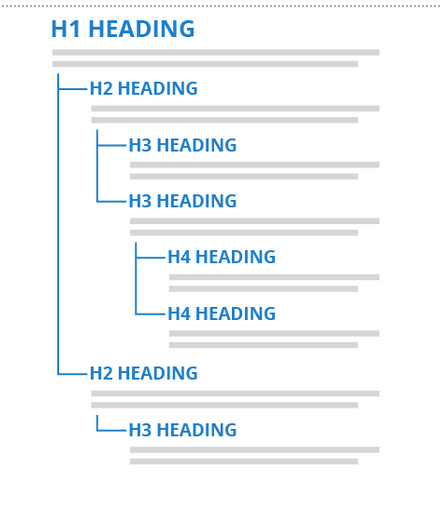
image 106
H1-H6 headings by Seobility (cropped)(4)
Heading tags determine the importance of each heading and “tell” your web browser how they should be styled and displayed on the page.
But that’s not all.
Heading levels also make the document structure comprehensible to search engines and assistive technologies like screen readers. 🔊
In a 1997 book The Order of Things: Hierarchies, Structures, and Pecking Orders, lexicographer and linguist Barbara Ann Kipfer proves that hierarchical structures are everywhere and tracks them across areas likes:
🌍 Geography
🧠 Biology
💥 Physics
🦾 Technology
🌟 Religion
💰 Business & Economy
🎨 Art
🏈 Sports
Take, for example, the documents on your computer’s drive. Individual files “live” inside folders which, in turn, are nested inside other folders like a Matryoshka doll.
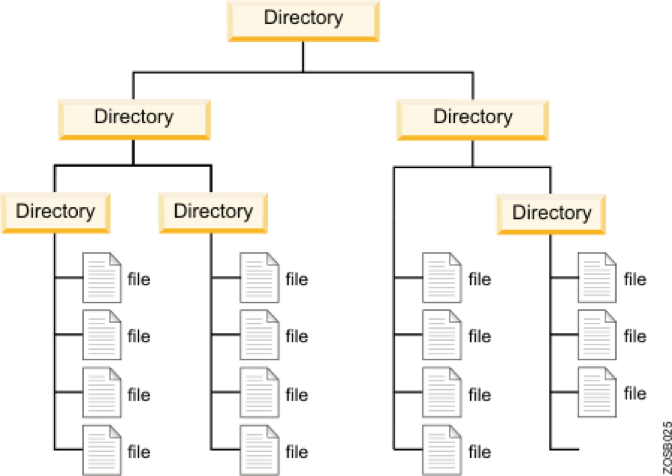
A hierarchical file system structure by IBM(5)
Want more examples?
In web design, we rely on the concept of visual hierarchies that determine the position of graphical elements and dictate the optimal composition of a web page.

Web page layout via The Interaction Design Foundation(6)
“Visual hierarchy controls the delivery of the experience. If you have a hard time figuring out where to look on a page, it’s more than likely that its layout is missing a clear visual hierarchy.”
Kelly Gordon, 5 Principles of Visual Design in UX(7)
By applying the principles of visual hierarchy, designers can tap into the psychological power of hierarchies and direct user attention where it matters.
🧠 Outlining a Case for Hierarchical Thinking
“Order and simplification are the first steps toward mastery of a subject — the actual enemy is the unknown.”
Thomas Mann
Hierarchies aren’t only something that can be observed and obeyed. They’re ingrained in the very way we process, assimilate, and synthesize information, solve complex problems, and break down big projects into smaller steps.
According to Marina Ludwigs, senior lecturer at Stockholm University, hierarchical thinking is our go-to strategy for both simple and complex tasks:
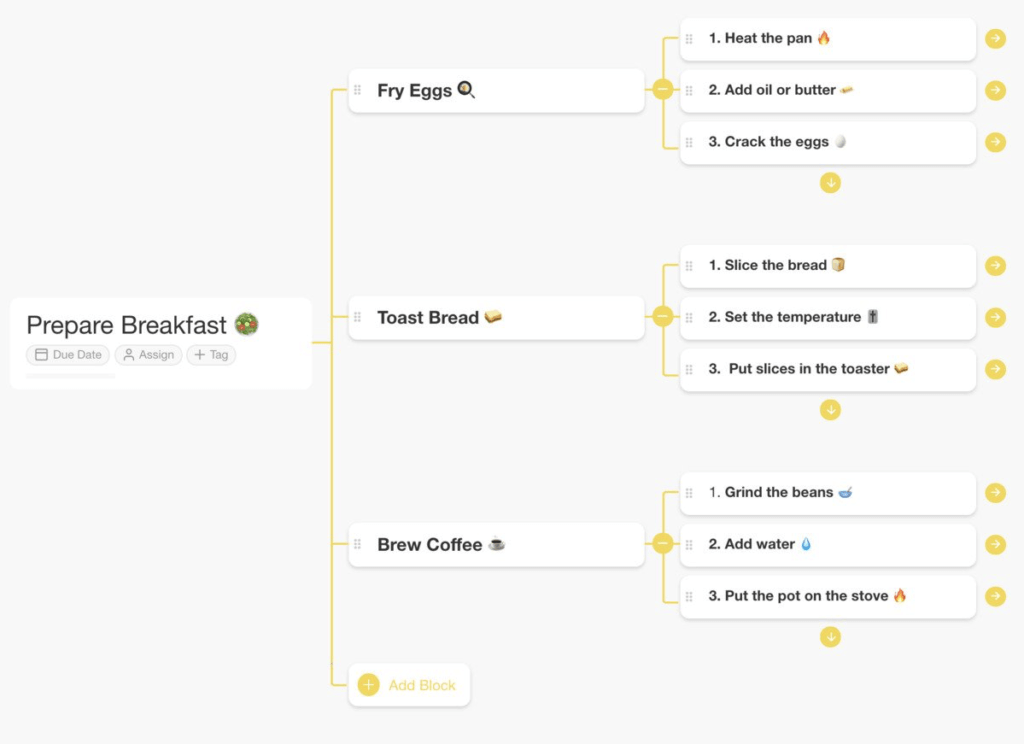
“Hierarchical reasoning is mobilized whenever we approach complex cultural constructs, such as language, music, literature, art, and science. But we make use of it even for the most trivial everyday tasks, such as preparing breakfast, which we automatically understand as a sequence of smaller subtasks [...].”(8)
Here’s how a task of “preparing breakfast” could look as a hierarchical model:
Another example of hierarchical thinking would be the way our brains process language and music. After all, both are created by arranging sounds in a specific order.
“Humans talk, sing, and play music. Some species of birds and whales sing long and complex songs. All these behaviours and sounds exhibit hierarchical structure—syllables and notes are positioned within words and musical phrases, words and motives in sentences and musical phrases [...].”(9)
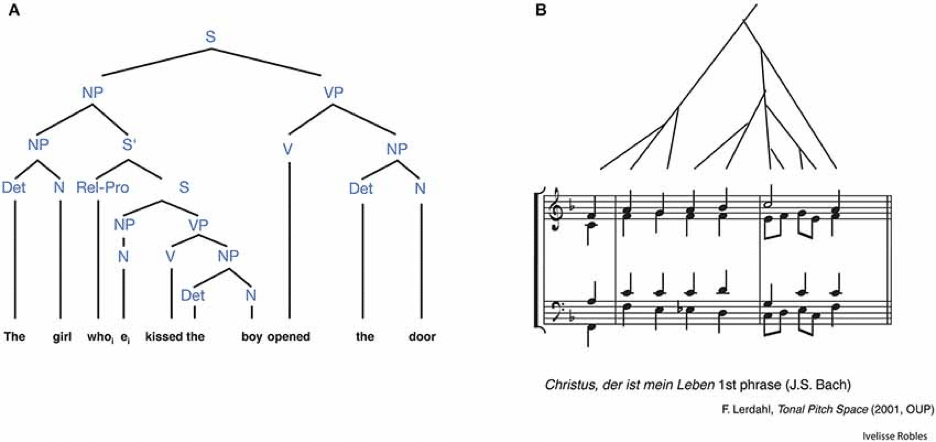
Similarities in Hierarchical Structures Between Language and Music by Jeon, Hyeon-Ae(10)
Ludwig further argues hierarchical thinking can be both an active mode we engage intentionally or a passive process. Both help us:
🙇♂️ Solve problems
🧑✈️ Plan and schedule
👩🍳 Acquire new skills
👩🏫 Memorize information
👩🎤 Play music
💁♂️ Understand language
And more...
And that got us thinking. Is there a way to tap into the full potential of hierarchical thinking? If so, is it possible to turn it into a versatile, deployable tool?
🌲 Visualizing Hierarchical Thinking With Tree Structures
“Harmony should be our goal, although we don’t know why it makes us feel as we do when we see harmony in nature – breeze on the lake or the sunrise. There are so many beautiful elements in nature and, sometimes, in people too. Harmony is a reachable goal.”
Ernő Rubik
Hierarchical structures like to hide in plain sight.
Sure, we assign priorities to activities all the time. We “tag” objects with ranks and classes. We also categorize people based on their external appearance (sigh).
But most of the time, hierarchical processing happens “behind the scenes.”
For instance, an assorted shopping list with bread, butter, and cookies is, in fact, a hierarchy. You know that some products have higher priority than others but don’t give it much thought. That is until you run out of money at checkout.
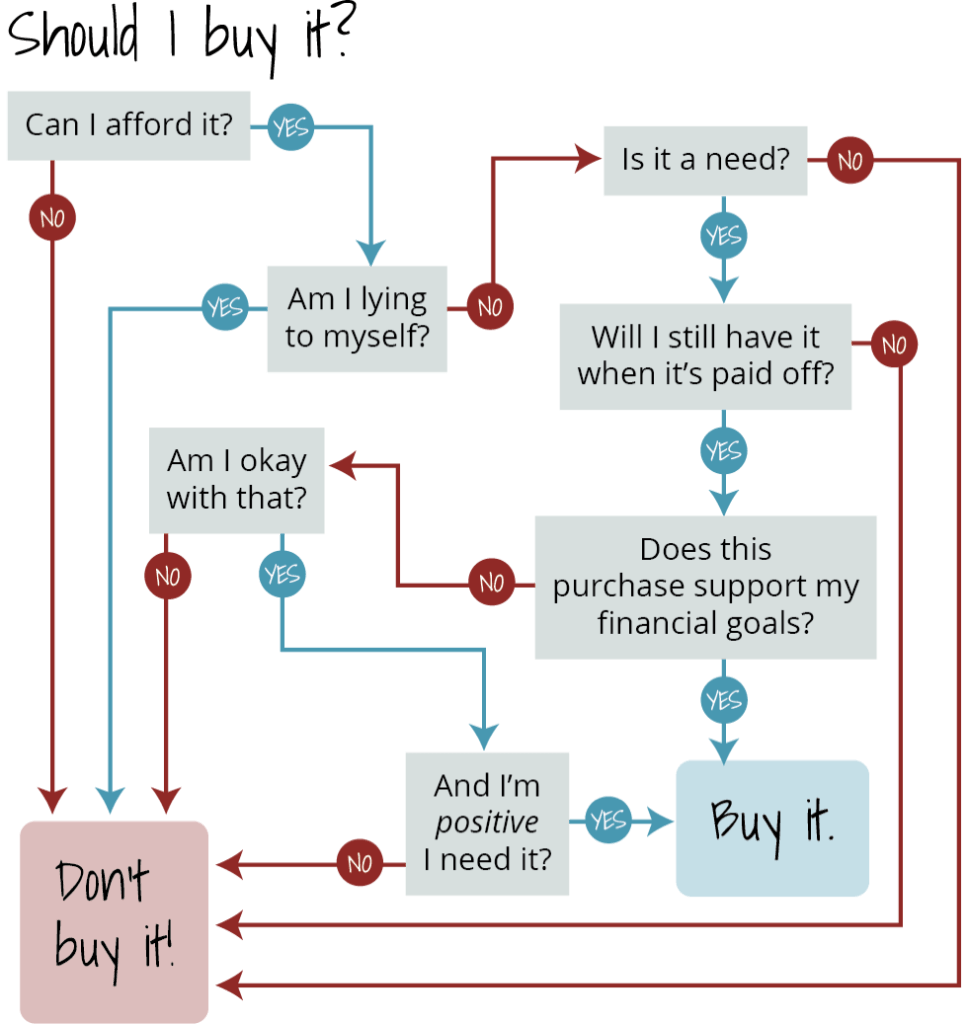
"Should I Buy It?" flowchart by Portland Community College(11)
While essential to our cognition, hierarchical thinking is tricky to tame. We use it all the time but rarely get to appreciate its utility. As Ludwigs’ argument continues:
“Even if we do not normally think of a process as hierarchical, such as building a crate, it mobilizes a hierarchical structure because an overall pattern, like a ready crate, is taken as an idea that is held in mind, being lifted to a higher level [...].”(8)
And this is where tree structures come into play.
What Is Tree Structure (Diagram)?
tree diagram
1. (= simple drawing) that shows the relationships between different pieces of information using lines that are connected and that have different branches(12)
Think of tree structures (a.k.a. diagrams) as a visual representation of hierarchical systems. Just like this beautiful language family tree by Minna Sundberg. 👇
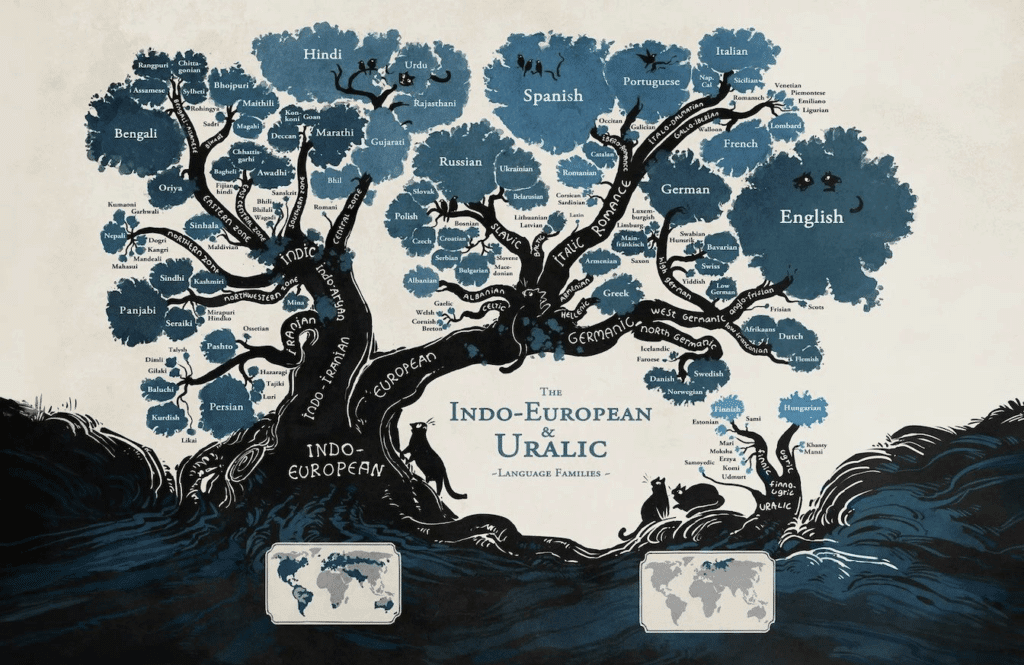
Language Family Tree by Minna Sundberg via The Guardian(13)
The traditional representation of a tree structure is shaped, well... like a tree but upside-down. It has a stem at the top, with branches and leaves spreading from it.
Here’s a less artful but more conservatively designed tree structure. 👇
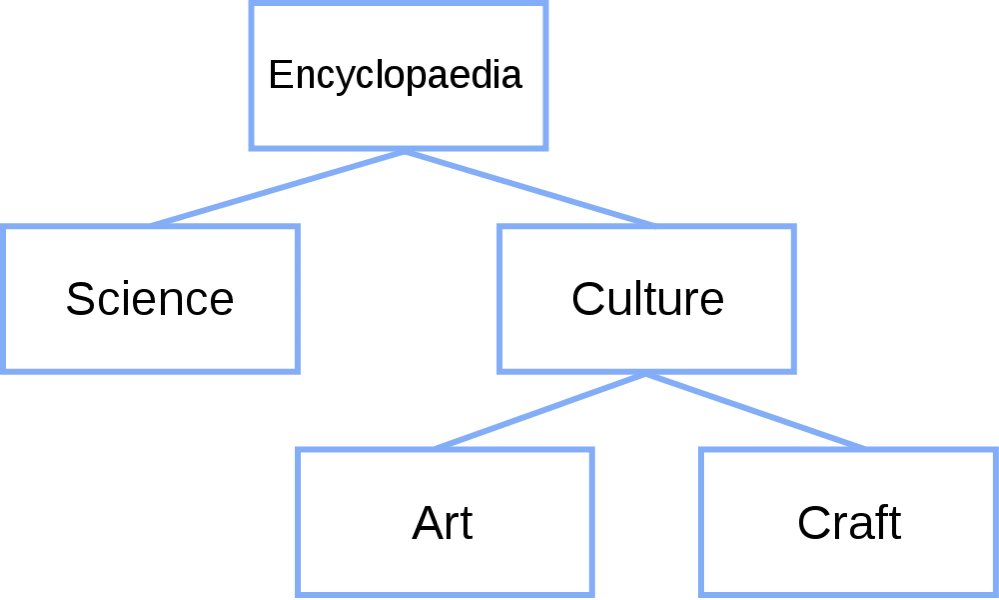
Binary Tree Structure via Wikipedia(14)
Tree structures aren’t just a fancy representation of hierarchies. They make it possible to capture the ephemeral nature of hierarchies and forge hierarchical thinking into a powerful tool. Here’s how you can use them in your creative work.
🤯 Using Tree Structures to Solve Complex Problems
“People will do whatever they can to find a world in which they can predict the outcomes of their actions and the consequences of those outcomes.”
Mihnea C. Moldoveanu, The Power of Predictability
1. Generating New Ideas with Mind Maps
While order and creativity may seem like an odd pair, tree structures, or mind maps to be precise, are perfect for brainstorming ideas in a non-linear way.
Mind maps are diagrams with a central idea (stem) in the middle and associated concepts branching out in all directions. While they don’t follow a traditional tree structure, they are hierarchical in nature, with “seed” nodes and lower-level derivatives.
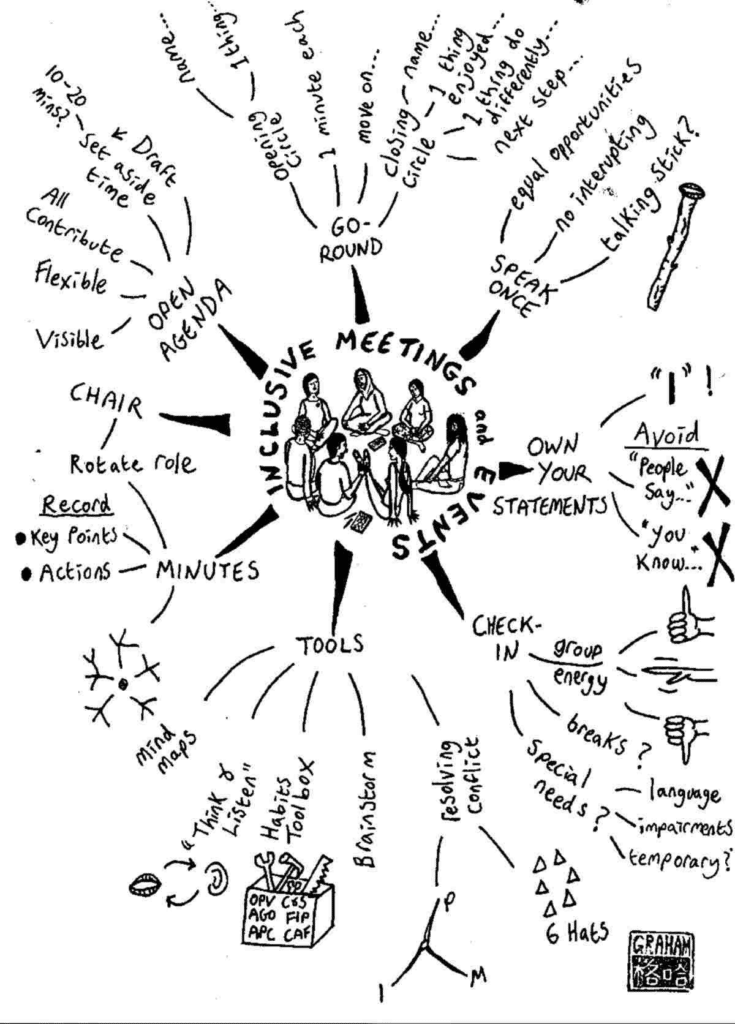
Mind Map by Graham Burnett via Fandom.com(15)
Bob Smale and Julie Fowlie, the authors of How to Succeed at University: An Essential Guide to Academic Skills, Personal Development and Employability, argue that:
“[mind mapping] helps us to expand our lateral thinking and get away from the linear thinking which is associated with making lists, taking notes and writing formal reports.”(16)
To engage hierarchical thinking through mind mapping, follow these simple steps:
💡 Seed the idea. Start by placing the first element of your mind map in the middle of the page. Your seed element can be a single word, question, or even an image. Anything—save for quarks—can be broken down into smaller bits.
🧠 Branch out. Set a timer and start generating derivate concepts as quickly as possible. Spread new elements around the mind map, either randomly, vertically, or horizontally, and draw lines to connect them to the seed idea.
🪢 Go deeper. Use the newly created subtopics to generate even more ideas. Set the timer and start branching out those like you did with the seed idea. Repeat the process as many times as you like.
Take a look at this simple mind map created in Taskade. 👇
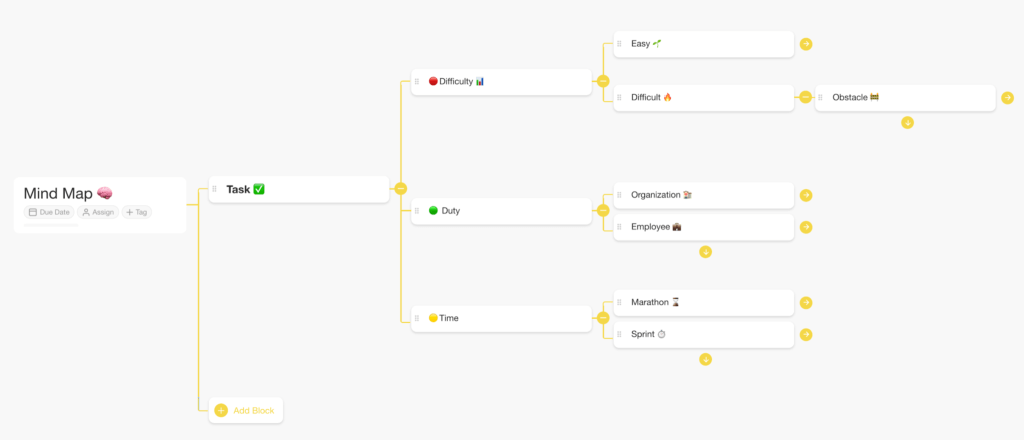
In Taskade, you can toggle between several project views and quickly transform mind maps into a hierarchical list of tasks, and vice versa.

Want to learn more about mind mapping? Be sure to watch this TED talk by Tony Buzan, the man responsible for popularizing mind mapping in the 70s:
https://www.youtube.com/watch?reload=9&v=nMZCghZ1hB4
2. Solving Complex Problems with Issue/Logic Trees
Every problem, concept, or idea is a sum of its parts.
To a layman, solving a Rubik’s Cube may seem like an impossible task. But break the process into a sequence of steps and you can solve the puzzle in 20 moves.
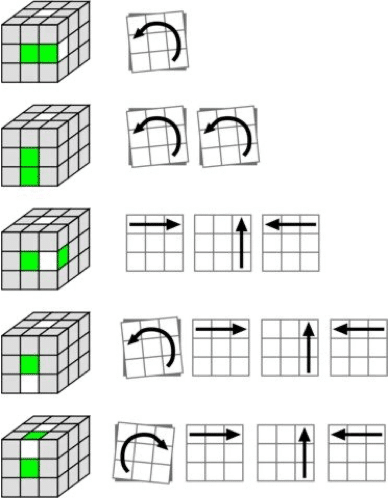
image 116
A set of instructions for completing the first layer cross
of a Rubik’s Cube by speedcube.com(17)
You can apply the same logic to any type of project with issue trees (a.k.a. logic trees), a type of tree structure that’s perfect for breaking down complex problems/tasks into small, more manageable steps.
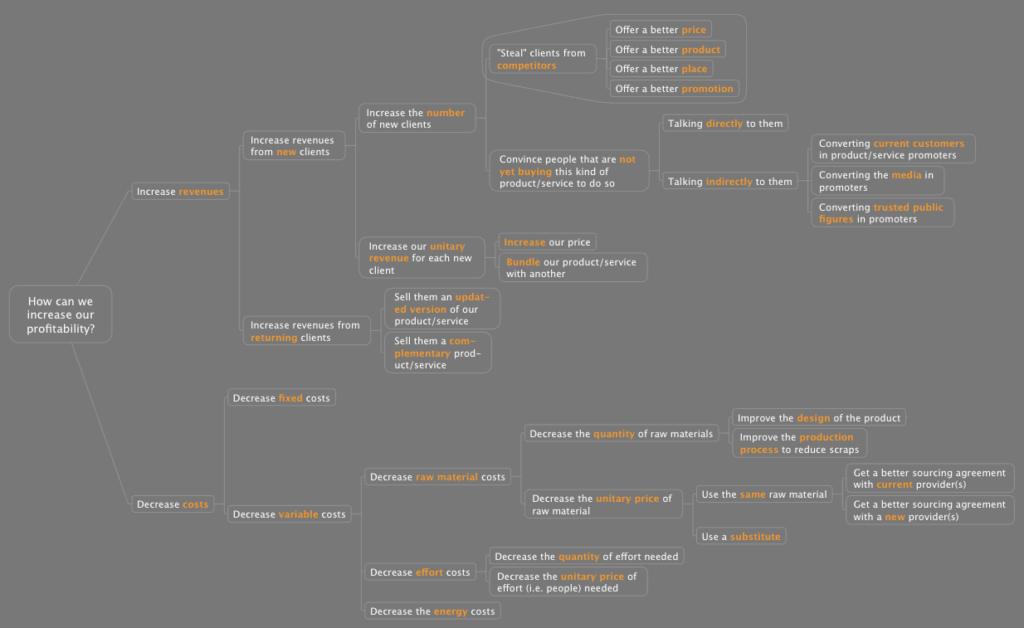
“How can we increase our profitability” issue tree via Wikipedia(18)
Barbara Minto, a former McKinsey employee who expanded the method, argues that:
“The great value of the technique is that it forces you to pull out of the head information that you weren’t aware was there, and then helps you to develop and shape it until the thinking is crystal clear.”(19)
To create your first issue/logic tree, follow these three steps:
💡 Start with a problem. The problem can be phrased as a question, e.g. “how to make the business more profitable?” or a statement like “the business is not profitable.” Put the core issue at the top level of your logic tree.
💨 Build up the momentum. Add a second level with possible, general solutions, e.g. “cut costs” or “increase sales.” You don’t have to worry about the detail as you’ll add them in subsequent tree levels.
🧩 Rinse and repeat. Repeat the process again for the third level of the logic tree. This time, break the general solutions into incremental steps. That’ll help you decide what needs to be done and analyze the feasibility of each solution.
Here’s a simple issue tree rendered in Taskade’s Org Chart view. 👇
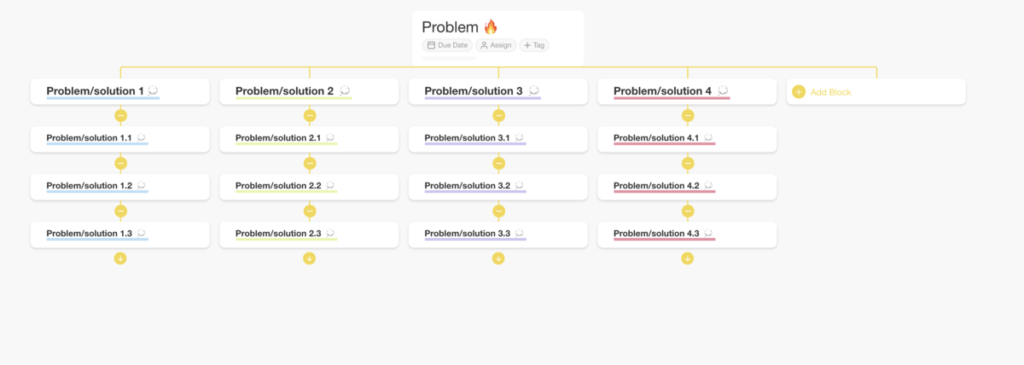
image 118
3. Refining Creative Output with Outlines
While mind mapping borders on raw creativity and structure, outlines, a subset of tree structures, are the ultimate form of hierarchical thinking.
“Making a detailed outline before you begin writing is a good way to make sure your ideas come across in a clear and logical order. A good outline will also save you time in the revision process, reducing the possibility that your ideas will need to be rearranged once you've written them.”(20)
David Kornhaber, Harvard College Writing Center
Outlines make it possible to visualize any kind of creative input—thoughts, processes, documents—and transform it into a highly organized, logical structure.
Remember how we mentioned the hierarchical structure of this document? Here’s a complete breakdown of the article, complete with heading level tags.👇
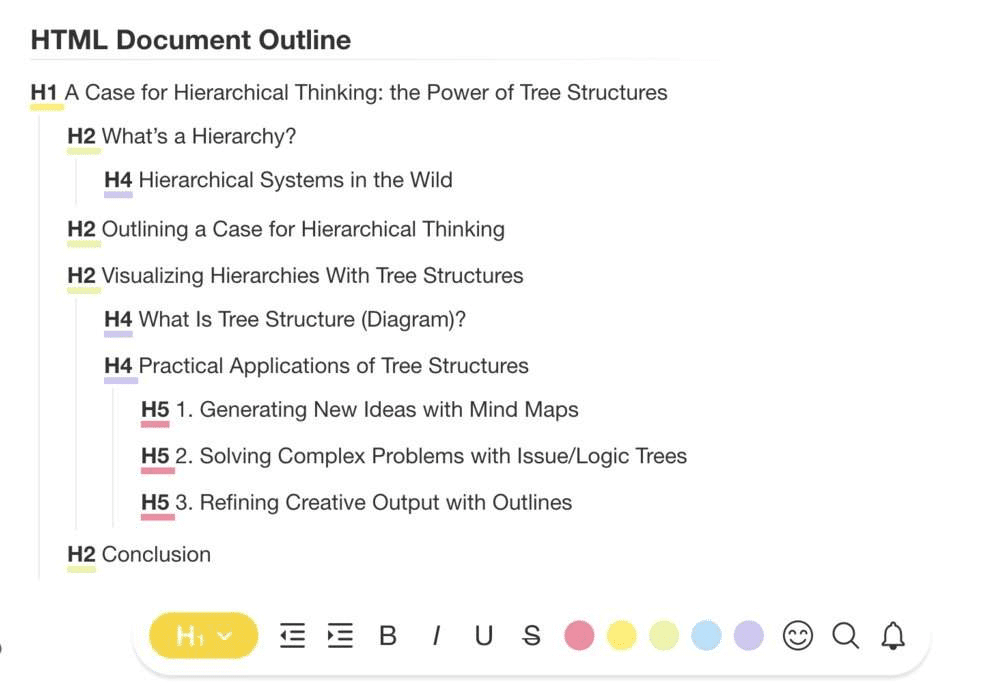
Hierarchical thinking expressed through outlines gives raw creativity a shape and form. It also makes the final product more “predictable.” And that’s nothing to sneeze at.
“People will do whatever they can to find a world in which they can predict the outcomes of their actions and the consequences of those outcomes.”
Howard H. Stevenson and Mihnea C. Moldoveanu, The Power of Predictability(21)
When you use outlines to process assorted bits of information, it’s much easier to connect the dots and see the intricate relationships binding specific elements.
Frequently Asked Questions
What is hierarchical thinking and why is it useful?
Hierarchical thinking is the practice of organizing information, ideas, and problems into nested levels — from general to specific, from abstract to concrete. It mirrors how the brain naturally categorizes the world (animals → mammals → dogs → golden retrievers). It's useful because it reduces cognitive load (you process one level at a time), reveals relationships between concepts, enables progressive detail disclosure, and provides a framework for breaking complex problems into manageable pieces.
How does hierarchical thinking help solve complex problems?
Hierarchical thinking solves complex problems by decomposition — breaking a large, overwhelming challenge into smaller, actionable sub-problems. At each level, you can identify what you know, what you need to learn, and what actions to take. This approach works because human working memory can only hold 5-9 items at once; by nesting complexity within levels, you can manage unlimited complexity while only dealing with a handful of items at any given moment.
How can teams apply hierarchical thinking to their work?
Teams can apply hierarchical thinking through: project breakdown structures (decomposing deliverables into tasks and subtasks), decision trees (mapping options and consequences at each level), knowledge organization (structuring documentation from broad topics to specific details), and meeting agendas (starting with objectives, then topics, then action items). Tools like Taskade support this with nested task lists, Mind Map view for visual hierarchy, and outline-based project editors.
What tools support hierarchical organization of information?
Top tools for hierarchical organization include Taskade (outliner-based editor with Mind Map view, nested projects, and AI agents that can organize content hierarchically), Workflowy (infinite nested lists), Dynalist (hierarchical notes with backlinks), and Obsidian (markdown notes with nested folder structure). Taskade is uniquely suited because you can view the same hierarchical data as a List, Mind Map, Board, or Org Chart — switching between perspectives to see different aspects of the same structure.
🐑 Conclusion
Regardless of the line of business you’re in, there’s no one, universal approach that would warrant a positive outcome of a task, problem, or creative pursuit.
Every enterprise, be it creative or organizational, requires a varying depth of analysis that can only be achieved through intentional hierarchical thinking.
And that brings us to Taskade.
Taskade is a collaborative outliner with hundreds of built-in templates that’ll let you:
🧠 Brainstorm ideas
✅ Schedule tasks
🚀 Execute projects
📊 Visualize progress
🧩 Solve problems
And more!
Jump over here to sign up for a free account today. 👈
💡 Before you go... This article is part of our series on knowledge management. Here are similar stories you may want to read for more tips.
Till next time! 👋
🔗 Resources
https://dictionary.cambridge.org/dictionary/english/hierarchy
https://www.ibm.com/support/knowledgecenter/zosbasics/com.ibm.zos.zconcepts/zOSB025.gif
https://royalsocietypublishing.org/doi/10.1098/rsif.2017.0231
https://www.pcc.edu/resources/panther-tracks/students-guide-to-money/spend-less-save-more.html
https://dictionary.cambridge.org/us/dictionary/english/tree-diagram
https://www.theguardian.com/education/gallery/2015/jan/23/a-language-family-tree-in-pictures#img-1
https://commons.wikimedia.org/wiki/File:Binary_tree_structure.svg
https://permaculture.fandom.com/wiki/Mind_map?file=Meetings.gif
https://www.speedcube.com.au/pages/how-to-solve-a-rubiks-cube